

The DOI matches its Crossref record; 55 of the 55 references it cites were found in a registry or an index; 7 of the 32 sources its claims cite were checked for support.
Method Development and Optimization of Liquid-Liquid Microextraction Based on the Decomposition of Deep Eutectic Solvent for the Determination of Chromium (VI) in Spinach: Assessment of the Greenness Profile Using Eco-scale, AGREE, and AGREEprep
Open accessAbstract
A simple, effective, and ligandless liquid-liquid microextraction (LLME) procedure based on the decomposition of hydrophobic deep eutectic solvents (HDES) was developed for the separation and pre-concentration of chromium (VI) ions in spinach leaves, before the determination by flame atomic absorption spectrophotometry. In the proposed study, the first stage involved the leaching of chromium (VI) from spinach leaves with 0.1 M Na 2 CO 3 , and in the second stage, chromium (VI) extract was preconcentrated with the LLME procedure using a DES prepared from the combination of DL-menthol and formic acid as a chelating agent and extraction solvent. The DES decomposed in an aqueous donor phase resulting in the dispersion of menthol and extraction of Cr (VI) ions. Under optimal experimental conditions, the limits of detection (LOD) and quantification (LOQ) were 0.63 and 2.1 µg L −1 , respectively. The relative standard deviation (RSD) was less than 7%, and the pre-concentration factor (PF) was found to be 31.25. The accuracy of the present methodology was tested by recovery experiments. The greenness of the developed method was assessed using three quantitative green metrics tools: Analytical Eco-scale, AGREE, and AGREEprep, with only Analytical Eco-scale qualifying the proposed method as green.
Overview
CoChat Summary
TL;DR
A ligandless liquid-liquid microextraction (LLME) method based on in situ decomposition of a hydrophobic deep eutectic solvent (DL-menthol:formic acid) was developed to separate and preconcentrate Cr(VI) from spinach leaves prior to flame atomic absorption spectrophotometry. The method gave LOD 0.63 µg L⁻¹, LOQ 2.1 µg L⁻¹, PF 31.25 and recoveries of 96.32–104%, but only the Analytical Eco-scale (score 72) judged it green, while AGREE (0.49) and AGREEprep (0.34) did not.
Key findings
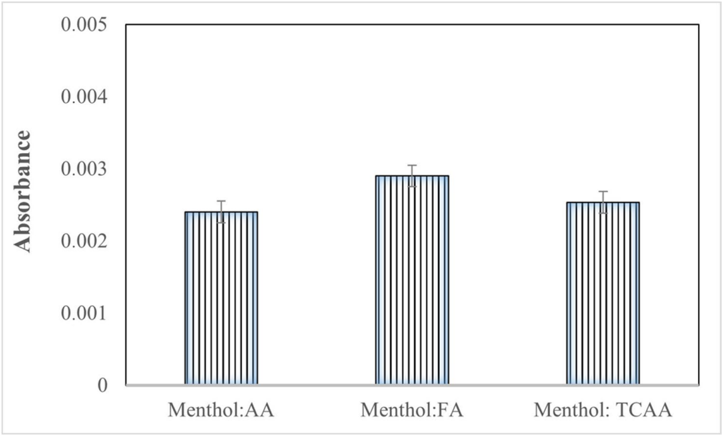
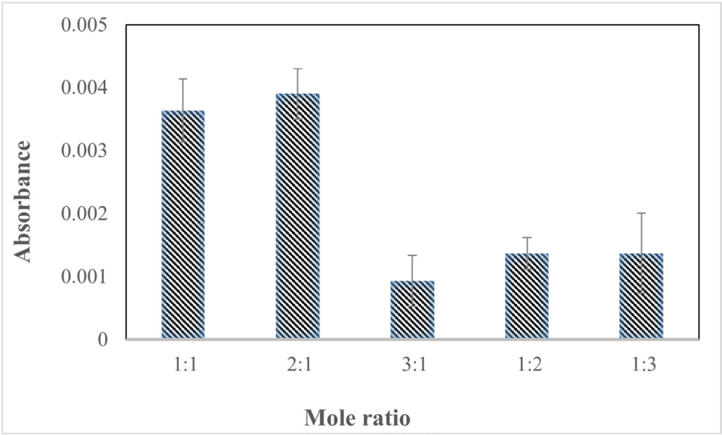
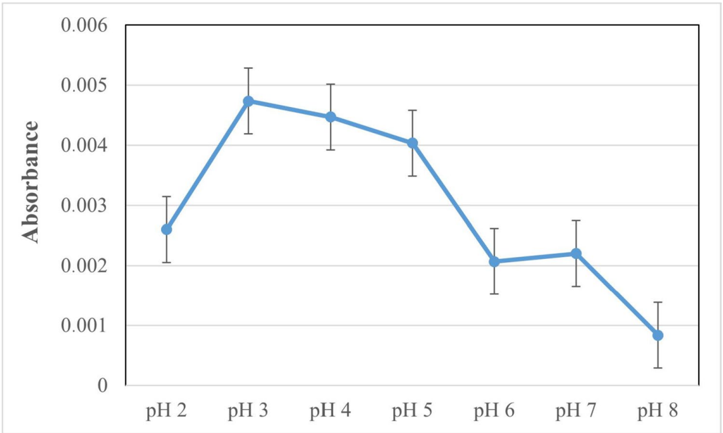
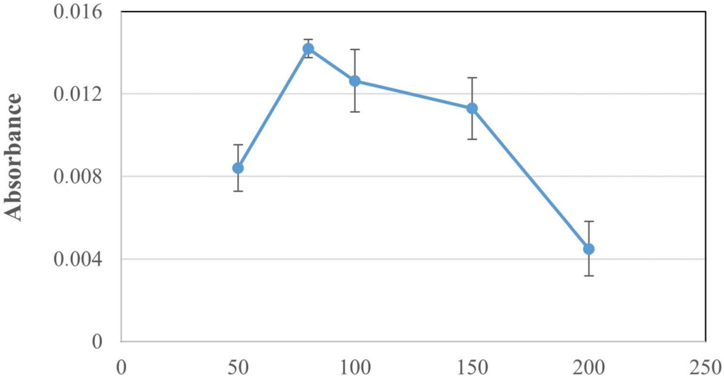
- Under optimized conditions (DES DL-menthol:formic acid 2:1, 80 µL DES, 2.5 mL sample at pH 3, 100 mg NaCl), LOD and LOQ were 0.63 and 2.1 µg L⁻¹, with a preconcentration factor of 31.25.
- Linearity was established over 15–250 µg L⁻¹ using a 5-point matrix-matched calibration curve (r² = 0.9996, r = 0.9999); ANOVA confirmed a significant absorbance–concentration relationship (F = 6344.496622 > Significance F = 0.00015758).
- Accuracy by recovery experiments at 25, 50 and 100 µg kg⁻¹ spiking gave 104%, 103% and 96.32% recovery; repeatability RSD was 5.3% and reproducibility RSD 6.7% (overall RSD < 7%).
- Greenness assessment: Analytical Eco-scale score 72 (acceptable green method), AGREE overall score 0.49 and AGREEprep score 0.34 — both below the ≥ 0.6 threshold cited for a method to be considered green.
Methods
- Design: method development and optimization of an LLME procedure in which a hydrophobic DES (DL-menthol as HBA with formic acid as HBD) decomposes in the aqueous donor phase, acting as dispersive agent, chelating agent and extraction solvent; parameters optimized one variable at a time (OVAT) in triplicate.
- Sample/data: spinach (swiss chard) purchased from local supermarkets in Nairobi, Kenya, oven-dried at 80 °C for 24 h and ground; Cr(VI) leached from 0.25 g dry sample with 25 mL of 0.1 M Na₂CO₃ by boiling 15 min, then 2.5 mL of extract used as donor phase; determination by Shimadzu AA6200 FAAS (357.9 nm).
- Analysis: linearity, precision, accuracy, LOD/LOQ, PF and recovery; ANOVA for linearity significance (p < 0.05) using Excel 2016; greenness scored with Analytical Eco-scale, AGREE and AGREEprep.
Limitations
- Stated by the paper: AGREE (0.49) and AGREEprep (0.34) did not qualify the method as green, with the authors noting the disagreement between metrics stems from their differing evaluation criteria; the PF was lower than that of other reported approaches; sample volume was not increased beyond 2.5 mL and NaCl not beyond 100 mg because the authors intended to use as little material as possible.
- Evident from the text: optimization relied on one-variable-at-a-time rather than a multivariate design; validation was performed on a single matrix (spinach) with spiked samples, and no native Cr(VI) concentrations in the spinach samples are reported; the AGREE/AGREEprep criteria flagged for improvement (in situ preparation, safer solvents/reagents, integration/automation, operator safety) remain unaddressed.
Model-written summary. Check it against the paper before relying on it.
Integrity signals
Registry
Cites
Statistics
Figures

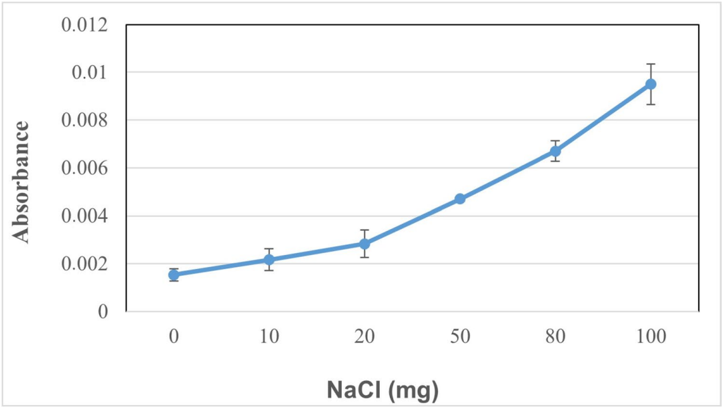
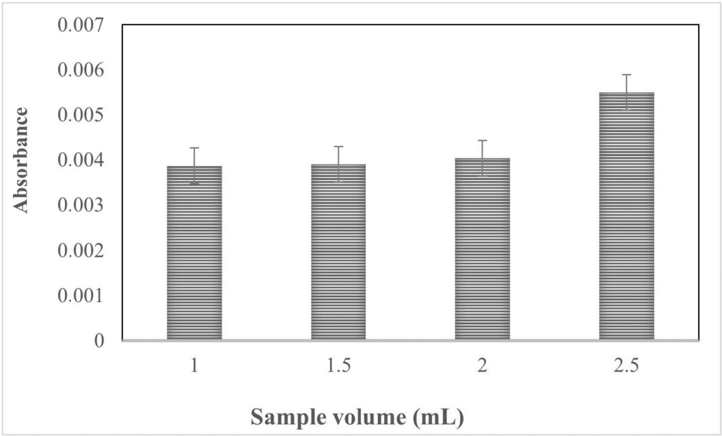
Verification
Claims the paper makes
7 Valid · 0 Not valid · 14 Not checked · 49 Own results and interpretations
Every source the paper cites for this claim was checked and supports it.
In the paper
“This is because at lower pHs Cr(VI) is present as HcrO 4 -, which is the negatively charged form of Cr(VI) (Fenti et al. 2020)”
§ Method Development and Optimization of Liquid-Liquid Microextraction Based on the Decomposition of Deep Eutectic Solvent for the Determination of Chromium (VI) in Spinach: Assessment of the Greenness Profile Using Eco-scale, AGREE, and AGREEprep > Effect of Sample pH
What the sources say
- Supportedcites Fenti et al. 2020 source
Section 2 states that HCrO₄⁻ is the most abundant Cr(VI) species at acidic pH and describes Cr(VI) oxyanions as negatively charged. The supplied excerpt does not specify a page number. (LLM, conf=0.94)
plainstates a cause- Asserted: passes — The authors put it forward as true.
- Checkable: passes — It can be checked against evidence.
- Load-bearing: passes — The paper’s conclusions depend on it.
- Based: passes — The paper gives a reason why it holds.
- Supported
The cited sources support only part of this claim — read each source’s verdict below.
In the paper
“To facilitate DES decomposition and leaching out into the water phase, a hydrophobic DES synthesized by the combination of a hydrophilic and a hydrophobic precursor is a requirement (Florindo et al. 2017, Nemati et al. 2021).”
§ Method Development and Optimization of Liquid-Liquid Microextraction Based on the Decomposition of Deep Eutectic Solvent for the Determination of Chromium (VI) in Spinach: Assessment of the Greenness Profile Using Eco-scale, AGREE, and AGREEprep > Effect of DES Composition
What the sources say
- Partly supportedcites Florindo et al. 2017 sourceExperimental — accuracy not yet measured
Section 3.1 (page unavailable) reports that DESs made from one hydrophilic and one hydrophobic component partially break down in water, allowing a component to leach into the water phase. It also reports this behavior for DESs made from two hydrophilic components, so the mixed-precursor combination is not established as a requirement; the paper describes leaching as contamination, not a desired outcome. (LLM, conf=0.86)
- Not checked — no full text of the sourcecites Nemati et al. 2021 source
plainstates a cause- Asserted: passes — The authors put it forward as true.
- Checkable: passes — It can be checked against evidence.
- Load-bearing: passes — The paper’s conclusions depend on it.
- Based: passes — The paper gives a reason why it holds.
- Partly supported
Every source the paper cites for this claim was checked and supports it.
In the paper
“This could be attributed to the commercial formic acid's high water content (Díaz-Álvarez and Martín-Esteban 2022) which might have aided in the DES decomposition.”
§ Method Development and Optimization of Liquid-Liquid Microextraction Based on the Decomposition of Deep Eutectic Solvent for the Determination of Chromium (VI) in Spinach: Assessment of the Greenness Profile Using Eco-scale, AGREE, and AGREEprep > Effect of DES Composition
What the sources say
- Supportedcites Díaz-Álvarez and Martín-Esteban 2022 source
Section 3.3 says the two phases in the formic acid:L-menthol solvent were probably due to the high water content of the commercial formic acid. The citation is attached to that water-content premise; the suggestion that it aided decomposition is the citing authors’ own inference. (LLM, conf=0.91)
hedgedstates a possible cause- Asserted: passes — The authors put it forward as true.
- Checkable: passes — It can be checked against evidence.
- Load-bearing: passes — The paper’s conclusions depend on it.
- Based: passes — The paper gives a reason why it holds.
- Supported
A result the paper reports from its own data — it cites no other source for it, so there is none to check. The quote shows it is in the paper.
In the paper
“Under optimal experimental conditions, the limits of detection (LOD) and quantification (LOQ) were 0.63 and 2.1 µg L -1 , respectively.”
- Also stated in: § Analytical Performance of the PROPOSED METHOD · plain
“The LOD and LOQ obtained were 0.63 and 2.1 µg L -1 respectively.”
§ Method Development and Optimization of Liquid-Liquid Microextraction Based on the Decomposition of Deep Eutectic Solvent for the Determination of Chromium (VI) in Spinach: Assessment of the Greenness Profile Using Eco-scale, AGREE, and AGREEprep > Abstract
plain- Asserted: passes — The authors put it forward as true.
- Checkable: passes — It can be checked against evidence.
- Load-bearing: passes — The paper’s conclusions depend on it.
- Based: passes — The paper gives a reason why it holds.
- Also stated in: § Analytical Performance of the PROPOSED METHOD · plain
A result the paper reports from its own data — it cites no other source for it, so there is none to check. The quote shows it is in the paper.
In the paper
“Among the DESs synthesized, the absorbance signal increased in the following HBD order, formic acid > trichloroacetic acid > acetic acid (Fig. 1).”
§ Method Development and Optimization of Liquid-Liquid Microextraction Based on the Decomposition of Deep Eutectic Solvent for the Determination of Chromium (VI) in Spinach: Assessment of the Greenness Profile Using Eco-scale, AGREE, and AGREEprep > Effect of DES Composition
plainstates a cause- Asserted: passes — The authors put it forward as true.
- Checkable: passes — It can be checked against evidence.
- Load-bearing: passes — The paper’s conclusions depend on it.
- Based: passes — The paper gives a reason why it holds.
34 more claims
Create a free account to see all 70 claims and every source verdict.
- Probably not a substantial claim. 22
- It may state two separate claims as one. 14
- The quote only partly states this claim. 1
Self-check
Percentages, sums and reported differences re-computed from the paper’s own numbers.
Each contradiction between two passages listed here was confirmed by an independent check.
Rated minor: it would not touch a result — a value no result rests on, a p-value that stays on the same side of the significance level, or a conflict that is clerical, resolved elsewhere in the paper, or outside its own findings.
In the paper
§ Method Development and Optimization of Liquid-Liquid Microextraction Based on the Decomposition of Deep Eutectic Solvent for the Determination of Chromium (VI) in Spinach: Assessment of the Greenness Profile Using Eco-scale, AGREE, and AGREEprep > Analytical Performance of the PROPOSED METHOD
“The linearity was evaluated by using a 5-point matrixmatched calibration curve, and this was in the range of 15 to 250 µg L -1 .”
§ Method Development and Optimization of Liquid-Liquid Microextraction Based on the Decomposition of Deep Eutectic Solvent for the Determination of Chromium (VI) in Spinach: Assessment of the Greenness Profile Using Eco-scale, AGREE, and AGREEprep > Conclusions
“| Total | 3 | 0.00043697 | | | |”
Rated minor: it would not touch a result — a value no result rests on, a p-value that stays on the same side of the significance level, or a conflict that is clerical, resolved elsewhere in the paper, or outside its own findings.
In the paper
§ Method Development and Optimization of Liquid-Liquid Microextraction Based on the Decomposition of Deep Eutectic Solvent for the Determination of Chromium (VI) in Spinach: Assessment of the Greenness Profile Using Eco-scale, AGREE, and AGREEprep > Introduction
“a DES prepared by mixing DL-menthol as an HBD and formic acid as HBA”
§ Method Development and Optimization of Liquid-Liquid Microextraction Based on the Decomposition of Deep Eutectic Solvent for the Determination of Chromium (VI) in Spinach: Assessment of the Greenness Profile Using Eco-scale, AGREE, and AGREEprep > Preparation of DL-Menthol-Based DES
“DL menthol (as a common HBA) with different organic acids, namely formic acid, acetic acid, and trichloroacetic acid (as HBDs)”
Citations
Cites
Deep Eutectic Solvents (DESs) and Their Applications
Smith, E. L., Abbott, A. P., & Ryder, K. S. (2014) · Chemical Reviews · doi:10.1021/cr300162p · Cited by 7,378 · cited 1×
“They are prepared by heating two or more components that function as a hydrogen bond acceptor (HBA) and hydrogen bond donor (HBD) at a certain mole ratio through hydrogen bond interactions to form a eutectic mixture with a melting point lower than that of each component (Smith et al. 2014).”
Abbott, A. P., Capper, G., Davies, D. L., Rasheed, R. K., & Tambyrajah, V. (2003) · Chemical Communications · doi:10.1039/b210714g · Cited by 5,738 · cited 1×
“Deep eutectic solvents (DESs) are analogs of ILs and share some of the unique physicochemical properties with ILs, such as low volatility, nonflammability, and design-ability, and were first proposed by Abbott and coworkers (Abbott et al. 2003).”
Deep eutectic solvents: syntheses, properties and applications
Zhang, Q., De Oliveira Vigier, K., Royer, S., & Jérôme, F. (2012) · Chemical Society Reviews · doi:10.1039/c2cs35178a · Cited by 4,899 · cited 1×
“The ratio between HBA and HBD is one of the important factors as it influences the physicochemical properties and extraction ability of a DES (Zhang et al. 2012).”
AGREE—Analytical GREEnness Metric Approach and Software
Pena-Pereira, F., Wojnowski, W., & Tobiszewski, M. (2020) · Analytical Chemistry · doi:10.1021/acs.analchem.0c01887 · Cited by 3,983
Natural deep eutectic solvents as new potential media for green technology
Dai, Y., van Spronsen, J., Witkamp, G.-J., Verpoorte, R., & Choi, Y. H. (2013) · Analytica Chimica Acta · doi:10.1016/j.aca.2012.12.019 · Cited by 2,694 · cited 1×
“Ionic liquids are a group of organic salts with low melting points below 100 °C, negligible vapor pressure, low flammability, and designability (Dai et al. 2013).”
Analytical Eco-Scale for assessing the greenness of analytical procedures
Gałuszka, A., Migaszewski, Z. M., Konieczka, P., & Namieśnik, J. (2012) · TrAC Trends in Analytical Chemistry · doi:10.1016/j.trac.2012.03.013 · Cited by 2,474 · cited 1×
“To determine the final eco-scale score, penalty points are allocated to each parameter, and the total penalty points are subtracted from 100 (Gałuszka et al. 2012).”
Green analytical chemistry metrics: a review
Sajid, M., & Płotka-Wasylka, J. (2022) · Talanta · doi:10.1016/j.talanta.2021.123046 · Cited by 744 · cited 1×
“The details, which include the advantages and disadvantages of the proposed metrics tools, can be found elsewhere in the literature (Sajid et al. 2022).”
Menthol-based Eutectic Mixtures: Hydrophobic Low Viscosity Solvents
Ribeiro, B. D., Florindo, C., Iff, L. C., Coelho, M. A. Z., & Marrucho, I. M. (2015) · ACS Sustainable Chemistry & Engineering · doi:10.1021/acssuschemeng.5b00532 · Cited by 672 · cited 2×
“Nowadays, the trend in sample preparation methods has been focused on replacing environmentally unsustainable solvents with new solvents that comply with the concept of green chemistry such as ionic liquids (ILs) and deep eutectic solvents (DESs) (Ribeiro et al 2015).”
Florindo, C., Branco, L. C., & Marrucho, I. M. (2017) · Fluid Phase Equilibria · doi:10.1016/j.fluid.2017.04.002 · Cited by 457 · cited 1×
“To facilitate DES decomposition and leaching out into the water phase, a hydrophobic DES synthesized by the combination of a hydrophilic and a hydrophobic precursor is a requirement (Florindo et al. 2017, Nemati et al. 2021).”
Overview of acidic deep eutectic solvents on synthesis, properties and applications
Qin, H., Hu, X., Wang, J., Cheng, H., Chen, L., & Qi, Z. (2020) · Green Energy & Environment · doi:10.1016/j.gee.2019.03.002 · Cited by 448
Research works printed but not linked: 2
- Mandiwana KL, Panichev N, Panicheva S (2011) Determination of chromium (VI) in black, green and herbal teas. Food Chem 129(2011):1839–1843 · DOI
- Nguyen C-H, Le-Thi A-D, Nguyen T-N, Le-Thi H-M, Nhon-Duc Le, Do M-H (2022) Chromium (VI) analysis in effluents using liquid liquid extraction coupled with flame atomic absorption spectrometry. Malays J Anal Sci 26(2):283–294
Cited by
Kaya, S. I., Ozcelikay, G., & Özkan, S. A. (2024) · Green Analytical Chemistry · doi:10.1016/j.greeac.2024.100159 · Cited by 69
Khan, W. A., Varanusupakul, P., Haq, H. U., Arain, M. B., Marchel, M., & Boczkaj, G. (2024) · Separation and Purification Technology · doi:10.1016/j.seppur.2024.130362 · Cited by 47
Tobbi, O., Hattab, Z., Boutefnouchet, H., et al. (2024) · Desalination and Water Treatment · doi:10.1016/j.dwt.2024.100783 · Cited by 24
Sengane, M. V., Sihlahla, M., Nomngongo, P. N., & Mketo, N. (2024) · Microchemical Journal · doi:10.1016/j.microc.2024.111984 · Cited by 27
Atomic spectrometry update – a review of advances in environmental analysis
Cairns, W. R. L., Butler, O. T., Cavoura, O., Davidson, C. M., Torró, J. L. T., & von der Au, M. (2024) · Journal of Analytical Atomic Spectrometry · doi:10.1039/d4ja90056a · Cited by 17
Metadata
- Authors
- Moema, D., Makwakwa, T., Nyambaka, H. N., Dube, S., & Nindi, M.
- Affiliations
- University of South Africa (ZA)
- Kenyatta University (KE)
- Corresponding author
- Moema, D.
- Venue
- Food Analytical Methods
- Published
- 2024-01-29
- Volume
- 17
- Issue
- 3
- Pages
- 464-474
- ISSN
- 1936-9751 (ISSN-L)
- 1936-976X
- OpenAlex
- W4391303045
- Semantic Scholar
- c6ba69e366aaf738d4d724c4f4857cf223531c6c
- Cited by
- 19
- References
- 52
- Citations by year
- 2026: 6 · 2025: 8 · 2024: 5
- FWCI
- 3.27
- Type
- journal article
- Language
- en
- Open access
- hybrid
- doi.org
- Licence
- cc-by
- creativecommons.org/licenses/by/4.0 (tdm)
- creativecommons.org/licenses/by/4.0 (vor)
- Locations
- Food Analytical Methods (publishedVersion, cc-by)
- Funders
- National Research Foundation (138250)
- University of South Africa
- Topics
- Physical Sciences › Chemistry › Analytical Chemistry › Analytical chemistry methods development
- Physical Sciences › Chemistry › Analytical Chemistry › Analytical Chemistry and Chromatography
- Physical Sciences › Chemistry › Physical and Theoretical Chemistry › Ionic liquids properties and applications
- Keywords
- liquid-liquid microextraction, deep eutectic solvents, hexavalent chromium, spinach, preconcentration, DL-menthol, formic acid, green analytical chemistry, Analytical Eco-Scale, AGREE, AGREEprep, food contamination, flame atomic absorption spectrometry
About these checks
Registry, retraction, Cites and statistics results are computed, not judged, with one exception: a printed reference that no index lists is read once by a model before it counts as a citation error. Claims are extracted by a model and kept only when their quote appears verbatim in the text; each cited source is then checked, with a model’s help, for whether it says what the claim relies on. Those verdicts can be wrong — read the claim’s quote and the cited source before relying on one.
The claim verdicts this report counts are experimental: their accuracy is not yet measured.
A language model drew the claims from the paper on 2026-09-29, under version 3 of the claim definition (model deepseek-v4.1-flash, prompt extract-v3).
A second model labelled each claim on 2026-09-29 (model jev-1.13-20260917, definition revision gold-guideline-v0.2).
Cited sources are checked with a language model’s help (gpt-6-sol).
Statistics and arithmetic are recomputed, not judged.
Confidence bands are shown only for fields calibrated on our annotated test set. None is calibrated yet, so no band is shown.
What counts as a claim ›How we measure confidence ›How we check this ›
Are you an author, or do you see a problem with this page? Request a review
How to cite
Cite CoChat for the checks on this page, and the paper for its own findings.
- This page
- CoChat. (2026). Citation check: Method Development and Optimization of Liquid-Liquid Microextraction Based on the Decomposition of Deep Eutectic Solvent for the Determination of Chromium (VI) in Spinach: Assessment of the Greenness Profile Using Eco-scale, AGREE, and AGREEprep. https://app.cochat.ai/papers/10.1007/s12161-024-02583-z
- The paper
- Moema, D., Makwakwa, T., Nyambaka, H. N., Dube, S., & Nindi, M. (2024). Method Development and Optimization of Liquid-Liquid Microextraction Based on the Decomposition of Deep Eutectic Solvent for the Determination of Chromium (VI) in Spinach: Assessment of the Greenness Profile Using Eco-scale, AGREE, and AGREEprep. Food Analytical Methods. https://doi.org/10.1007/s12161-024-02583-z
Data sources
Bibliographic data: Semantic Scholar, OpenAlex, Crossref.
Contains information from the Semantic Scholar Academic Graph Datasets, made available under the ODC Attribution License (ODC-BY 1.0).
Semantic Scholar’s data is described in: Kinney, R., et al. (2023). The Semantic Scholar Open Data Platform. arXiv:2301.10140.
