

The DOI matches its Crossref record; 129 of the 129 references it cites were found in a registry or an index.
Modulation of Insulin Sensitivity by Exercise Training: Implications for Cardiovascular Prevention
Open accessAbstract
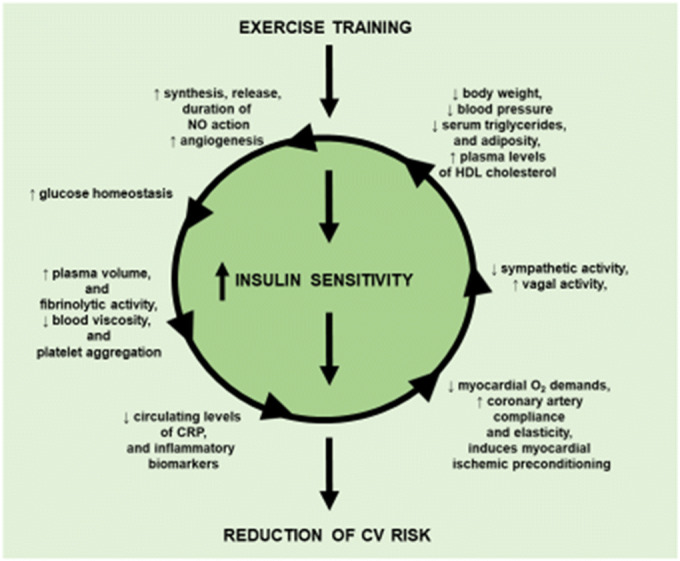
The beneficial effects of physical activity on the cardiovascular system nowadays have achieved the relevance of clinical evidence. In fact, several studies have documented the benefits of exercise training in the prevention of the cardiovascular risk. Abnormalities of insulin signaling transduction account for the impairment of insulin sensitivity and development of insulin resistance, which, in turn, is responsible for the enhancement of cardiovascular risk. Insulin sensitivity is related to the degree of physical activity, and physical training has been shown to ameliorate insulin action in insulin-resistant subjects. This effect is mediated by the improvement of the molecular abnormalities that are responsible of the insulin resistance, contributing in this way to restore the physiological insulin sensitivity. However, it should be underlined that mechanisms that account for this phenomenon are extremely complex and still unclear. Further studies are required to better clarify the molecular basis of the exercise-evoked improvement of insulin signal. Graphical abstract.
Overview
The claims and statistics of this paper haven’t been checked yet.
Run the check — free, no account needed. It reads the open-access text and checks the sources it cites.
Integrity signals
Registry
Cites
Statistics
Figures
Verification
Claims the paper makes
The claims and statistics of this paper haven’t been checked yet.
Run the check — free, no account needed. It reads the open-access text and checks the sources it cites.
Claims other papers make about this one
Each is checked against this paper’s own text: does it say what the citing paper says it does?
In the citing paper
“In subjects with diabetes or obesity, exercise is the cornerstone of therapeutic interventions. It increases insulin sensitivity independently of changes in body fat with nutritional interventions”
From Effects of diet, lifestyle, Chrononutrition and alternative dietary interventions on postprandial Glycemia and insulin resistance (2022) · cites this paper as [240]
Self-check
Percentages, sums and reported differences re-computed from the paper’s own numbers.
The self-check needs the paper’s full text.
Citations
Cites
Reduction in the incidence of type 2 diabetes with lifestyle intervention or metformin
(2002) · New England Journal of Medicine · doi:10.1056/nejmoa012512 · Cited by 19,011
Calcium's Role in Mechanotransduction during Muscle Development
Damm, T. B., & Egli, M. (2014) · Cellular Physiology and Biochemistry · doi:10.1159/000356667 · Cited by 14,552
Tuomilehto, J., Lindström, J., Eriksson, J. G., Valle, T. T., Hämäläinen, H., Ilanne-Parikka, P., Keinänen-Kiukaanniemi, S., Laakso, M., Louheranta, A., Rastas, M., et al. (2001) · New England Journal of Medicine · doi:10.1056/nejm200105033441801 · Cited by 10,873 · cited 2×
“Interestingly, two longitudinal studies achieved similar results: The Finnish Diabetes Prevention [26] and the Diabetes Prevention Program [27] showed, in non-diabetic persons at elevate risk for diabetes, that a lifestylemodification program associated with a regular physical activity is able to reduce the incidence…”
ResultEuropean Guidelines on cardiovascular disease prevention in clinical practice (version 2012)
Authors/Task Force Members:, Perk, J., De Backer, G., Gohlke, H., Graham, I., Reiner, Ž., Verschuren, M., Albus, C., Benlian, P., Boysen, G., et al. (2012) · European Heart Journal · doi:10.1093/eurheartj/ehs092 · Cited by 8,490
2016 European Guidelines on cardiovascular disease prevention in clinical practice
Piepoli, M. F., Hoes, A. W., Agewall, S., Albus, C., Brotons, C., Catapano, A. L., Cooney, M.-T., Corrà, U., Cosyns, B., Deaton, C., et al. (2016) · European Heart Journal · doi:10.1093/eurheartj/ehw106 · Cited by 6,457
Arnett, D. K., Blumenthal, R. S., Albert, M. A., Buroker, A. B., Goldberger, Z. D., Hahn, E. J., Himmelfarb, C. D., Khera, A., Lloyd-Jones, D., McEvoy, J. W., et al. (2019) · Circulation · doi:10.1161/cir.0000000000000678 · Cited by 4,536
(2019) · doi:10.1161/cir.0000000000000677 · Cited by 4,501
Pan, X.-R., Li, G.-W., Hu, Y.-H., Wang, J.-X., Yang, W.-Y., An, Z.-X., Hu, Z.-X., Juan-Lin, Xiao, J.-Z., Cao, H.-B., et al. (1997) · Diabetes Care · doi:10.2337/diacare.20.4.537 · Cited by 4,320
2013 AHA/ACC/TOS Guideline for the Management of Overweight and Obesity in Adults
Jensen, M. D., Ryan, D. H., Apovian, C. M., Ard, J. D., Comuzzie, A. G., Donato, K. A., Hu, F. B., Hubbard, V. S., Jakicic, J. M., Kushner, R. F., et al. (2014) · Journal of the American College of Cardiology · doi:10.1016/j.jacc.2013.11.004 · Cited by 4,058
The anti-inflammatory effect of exercise
Petersen, A. M. W., & Pedersen, B. K. (2005) · Journal of Applied Physiology · doi:10.1152/japplphysiol.00164.2004 · Cited by 3,100 · cited 3×
“Studies performed in animal models of insulin resistance have documented that exercise training is capable to blunt the enhancement of proinflammatory cytokines such as IL-6 and TNF-α and, at the same time, ameliorates the anti-inflammatory response by increasing the circulatory levels of IL-4 and IL-10 [104, 105], re…”
Background
Research works printed but not linked: 1
- (2010). In Global recommendations on physical activity for health (WHO Guidelines Approved by the Guidelines Review Committee). Geneva.
Cited by
Sorted by citations
Kruk, J., Aboul-Enein, B. H., Duchnik, E., & Marchlewicz, M. (2022) · The Journal of Physiological Sciences · doi:10.1186/s12576-022-00845-1 · Cited by 271
Insulin Resistance the Hinge Between Hypertension and Type 2 Diabetes
Mancusi, C., Izzo, R., Gioia, G. D., Losi, M. A., Barbato, E., & Morisco, C. (2020) · High Blood Pressure & Cardiovascular Prevention · doi:10.1007/s40292-020-00408-8 · Cited by 232
Jankauskas, S. S., Kansakar, U., Varzideh, F., Wilson, S. M., Mone, P., Lombardi, A., Gambardella, J., & Santulli, G. (2021) · Metabolism · doi:10.1016/j.metabol.2021.154910 · Cited by 224
Papakonstantinou, E., Oikonomou, C., Nychas, G., & Dimitriadis, G. D. (2022) · Nutrients · doi:10.3390/nu14040823 · Cited by 199
Yaribeygi, H., Maleki, M., Sathyapalan, T., Jamialahmadi, T., & Sahebkar, A. (2021) · Journal of Diabetes Research · doi:10.1155/2021/7796727 · Cited by 91
Metadata
- Authors
- Iaccarino, G., Franco, D., Sorriento, D., Strisciuglio, T., Barbato, E., & Morisco, C.
- Affiliations
- University of Naples Federico II (IT)
- Corresponding author
- Morisco, Carmine
- ORCID
- Venue
- Journal of Cardiovascular Translational Research
- Published
- 2020-07-31
- Volume
- 14
- Issue
- 2
- Pages
- 256-270
- ISSN
- 1937-5387 (ISSN-L)
- 1937-5395
- PMC
- PMC8043859
- OpenAlex
- W3046313480
- Cited by
- 106
- References
- 129
- Citations by year
- 2026: 17 · 2025: 16 · 2024: 14 · 2023: 22 · 2022: 21 · 2021: 14 · 2020: 2
- FWCI
- 2.26
- Type
- journal article
- Language
- en
- Open access
- hybrid
- doi.org
- Locations
- Journal of Cardiovascular Translational Research (publishedVersion, cc-by)
- PubMed Central (publishedVersion, cc-by)
- PubMed (publishedVersion)
- IRIS Research product catalog (Sapienza University of Rome) (submittedVersion, cc-by)
- Funders
- Cardiopath PhD program
- Topics
- Health Sciences › Medicine › Endocrinology, Diabetes and Metabolism › Diabetes, Cardiovascular Risks, and Lipoproteins
- Health Sciences › Medicine › Physiology (medical) › Cardiovascular and exercise physiology
- Health Sciences › Medicine › Public Health, Environmental and Occupational Health › Physical Activity and Health
- Keywords
- insulin sensitivity, exercise training, insulin resistance, insulin signaling, cardiovascular risk prevention, physical activity
- MeSH terms
- Healthy Lifestyle, Heart Disease Risk Factors, Animals, Cardiovascular Diseases, Health Status, Humans, Insulin Resistance, Prognosis, Biomarkers, Exercise, Risk Assessment, Risk Reduction Behavior, Protective Factors
About these checks
Registry, retraction, Cites and statistics results are computed, not judged, with one exception: a printed reference that no index lists is read once by a model before it counts as a citation error. Claims are extracted by a model and kept only when their quote appears verbatim in the text; each cited source is then checked, with a model’s help, for whether it says what the claim relies on. Those verdicts can be wrong — read the claim’s quote and the cited source before relying on one.
Statistics and arithmetic are recomputed, not judged.
Confidence bands are shown only for fields calibrated on our annotated test set. None is calibrated yet, so no band is shown.
What counts as a claim ›How we measure confidence ›How we check this ›
Are you an author, or do you see a problem with this page? Request a review
