

Assessing Acceptance of Assistive Social Agent Technology by Older Adults: the Almere Model
Open accessThe DOI matches its Crossref record; 69 of the 69 references it cites were found in a registry or an index.
Abstract
This paper proposes a model of technology acceptance that is specifically developed to test the acceptance of assistive social agents by elderly users. The research in this paper develops and tests an adaptation and theoretical extension of the Unified Theory of Acceptance and Use of Technology (UTAUT) by explaining intent to use not only in terms of variables related to functional evaluation like perceived usefulness and perceived ease of use, but also variables that relate to social interaction. The new model was tested using controlled experiment and longitudinal data collected regarding three different social agents at elderly care facilities and at the homes of older adults. The model was strongly supported accounting for 59–79% of the variance in usage intentions and 49–59% of the variance in actual use. These findings contribute to our understanding of how elderly users accept assistive social agents.
Overview
The claims and statistics of this paper haven’t been checked yet.
Free: it reads the open-access text and checks the first 5 claims that cite a source we can check. Create a free account to check every claim.
Integrity signals
Registry
Cites
Statistics
Figures
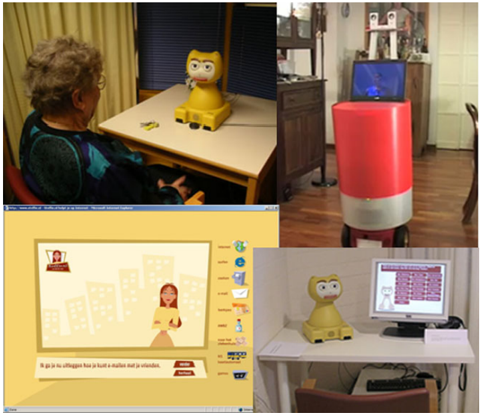
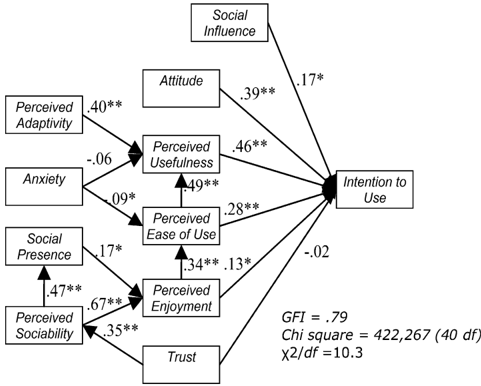

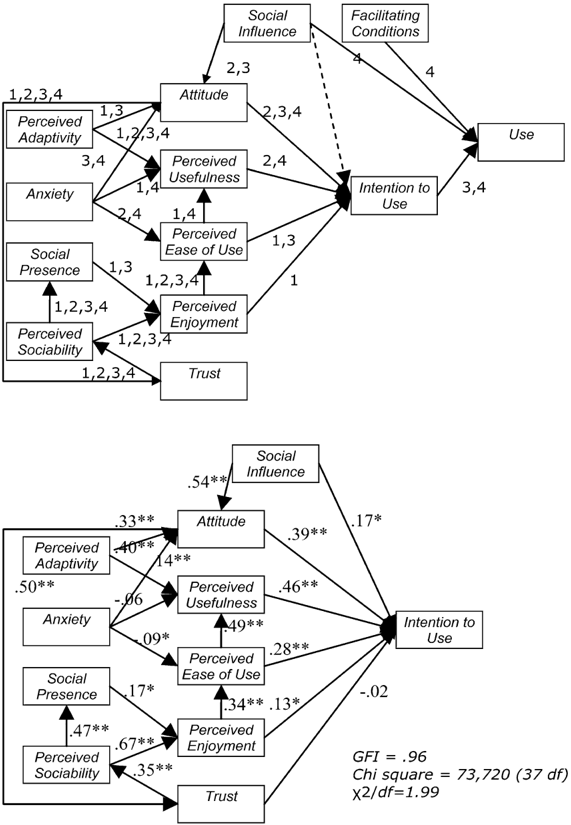
Verification
Claims the paper makes
The claims and statistics of this paper haven’t been checked yet.
Free: it reads the open-access text and checks the first 5 claims that cite a source we can check. Create a free account to check every claim.
Claims other papers make about this one
Each is checked against this paper’s own text: does it say what the citing paper says it does?
The source backs part of the claim, not all of it — or backs it for a different population, condition or comparison.
In the citing paper
“The extant literature attests to a positive correlation between users’ trust in technology and their inclination to use it, as evidenced by many studies [25-31].”
From Investigating the impact of user trust on the adoption and use of ChatGPT: Survey analysis (2023) · cites this paper as [31]
Experimental — accuracy not yet measuredThe cited source says what the claim attributes to it.
In the citing paper
“Prior research has established a positive correlation between intent to use and actual use of technology, indicating that users who intend to use the technology are more likely to actually use it [25,31,34].”
From Investigating the impact of user trust on the adoption and use of ChatGPT: Survey analysis (2023) · cites this paper as [31]
In the citing paper
“For instance, studies on adopting robots as assistive social agents found that users’ intent to use them strongly predicted their actual use [25,31].”
From Investigating the impact of user trust on the adoption and use of ChatGPT: Survey analysis (2023) · cites this paper as [31]
In the citing paper
“A study on technology acceptance for assistive social robots among older adult users found that the intention to use plays a mediating role in the relationship between trust and actual use [31].”
From Investigating the impact of user trust on the adoption and use of ChatGPT: Survey analysis (2023) · cites this paper as [31]
In the citing paper
“Heerink [15] found ITU is impacted by other acceptance factors and can be predicted by users' attitude and how much they perceive the robot to be useful.”
From Factors Affecting the Acceptability of Social Robots by Older Adults Including People with Dementia or Cognitive Impairment: A Literature Review (2018) · cites this paper as [15]
11 more claims about this paper
Create a free account to see every claim other papers make about this one.
Self-check
Percentages, sums and reported differences re-computed from the paper’s own numbers.
The self-check needs the paper’s full text.
Citations
Cites
Perceived usefulness, perceived ease of use, and user acceptance of information technology
Davis, F. D. (1989) · MIS Quarterly · doi:10.2307/249008 · Cited by 68,483
User Acceptance of Information Technology: Toward A Unified View1
Venkatesh, V., Morris, M. G., Davis, G. B., & Davis, F. D. (2003) · MIS Quarterly · doi:10.2307/30036540 · Cited by 45,035
(1975) · PhilPapers (PhilPapers Foundation) · Cited by 36,737
A Beginner's Guide to Structural Equation Modeling: Fourth Edition
Schumacker, R. E., & Lomax, R. G. (2015) · doi:10.4324/9781315749105 · Cited by 6,604
Structural Equation Modeling and Regression: Guidelines for Research Practice
Gefen, D., Straub, D., & Boudreau, M.-C. (2000) · Communications of the Association for Information Systems · doi:10.17705/1cais.00407 · Cited by 6,416
Measuring Presence in Virtual Environments: A Presence Questionnaire
Witmer, B. G., & Singer, M. J. (1998) · Presence: Teleoperators and Virtual Environments · doi:10.1162/105474698565686 · Cited by 6,371
A Beginner's Guide to Structural Equation Modeling
Schumacker, R. E., & Lomax, R. G. (2004) · doi:10.4324/9781410610904 · Cited by 6,235
Extrinsic and Intrinsic Motivation to Use Computers in the Workplace 1
Davis, F. D., Bagozzi, R. P., & Warshaw, P. R. (1992) · Journal of Applied Social Psychology · doi:10.1111/j.1559-1816.1992.tb00945.x · Cited by 6,231
Multivariate Data Analysis with Readings.
Rutherford, G. S. W., Hair, J. F., Anderson, R. E., & Tatham, R. L. (1988) · The Statistician · doi:10.2307/2348783 · Cited by 5,830
Multivariate Data Analysis with Readings.
Jolliffe, I. T., Hair, J. F., Anderson, R. E., & Tatham, R. L. (1988) · Journal of the Royal Statistical Society. Series A (Statistics in Society) · doi:10.2307/2983017 · Cited by 5,077
(1997) · Choice Reviews Online · doi:10.5860/choice.34-3702 · Cited by 4,887
User Acceptance of Hedonic Information Systems1
van der Heijden, H. (2004) · MIS Quarterly · doi:10.2307/25148660 · Cited by 3,850
At the Heart of It All: The Concept of Presence
Lombard, M., & Ditton, T. (2006) · Journal of Computer-Mediated Communication · doi:10.1111/j.1083-6101.1997.tb00072.x · Cited by 3,706
Structural Equation Modeling with LISREL
Hayduk, L. (1988) · Johns Hopkins University Press eBooks · doi:10.56021/9780801834783 · Cited by 1,855
A theory of reasoned action: some applications and implications.
Fishbein, M. (1980) · PubMed · Cited by 1,353
Structural Equation Modeling with LISREL: Essentials and Advances.
Land, K. C., & Hayduk, L. A. (1990) · Social Forces · doi:10.2307/2579660 · Cited by 1,308
Breazeal, C. (2003) · Robotics and Autonomous Systems · doi:10.1016/s0921-8890(02)00373-1 · Cited by 1,032
Tanaka, J. S. (1987) · Child Development · doi:10.2307/1130296 · Cited by 982
Assistive social robots in elderly care: a review
Broekens, J., Heerink, M., & Rosendal, H. (2024) · Gerontechnology · doi:10.4017/gt.2009.08.02.002.00 · Cited by 940
Self-citationWu, I.-L., & Chen, J.-L. (2005) · International Journal of Human-Computer Studies · doi:10.1016/j.ijhcs.2005.03.003 · Cited by 879
It's all about attitude: revisiting the technology acceptance model
Yang, H.-D., & Yoo, Y. (2004) · Decision Support Systems · doi:10.1016/s0167-9236(03)00062-9 · Cited by 578
Equilibrium Theory Revisited: Mutual Gaze and Personal Space in Virtual Environments
Bailenson, J. N., Blascovich, J., Beall, A. C., & Loomis, J. M. (2001) · Presence: Teleoperators and Virtual Environments · doi:10.1162/105474601753272844 · Cited by 547
Structural Equation Modeling with LISREL: Essentials and Advances
Fox, J., & Hayduk, L. A. (1989) · Canadian Journal of Sociology / Cahiers canadiens de sociologie · doi:10.2307/3341309 · Cited by 446
Causal Relationships between Perceived Enjoyment and Perceived Ease of Use: An Alternative Approach
Syracuse University, Sun, H., Zhang, P., & Syracuse University (2006) · Journal of the Association for Information Systems · doi:10.17705/1jais.00100 · Cited by 355
Care-O-bot II—Development of a Next Generation Robotic Home Assistant
Graf, B., Hans, M., & Schraft, R. D. (2004) · Autonomous Robots · doi:10.1023/b:auro.0000016865.35796.e9 · Cited by 332
Measuring acceptance of an assistive social robot: a suggested toolkit
Heerink, M., Krose, B., Evers, V., & Wielinga, B. (2009) · RO-MAN 2009 - The 18th IEEE International Symposium on Robot and Human Interactive Communication · doi:10.1109/roman.2009.5326320 · Cited by 268
Self-citationHow robotic products become social products: an ethnographic study of cleaning in the home
Forlizzi, J. (2007) · Proceedings of the ACM/IEEE international conference on Human-robot interaction · doi:10.1145/1228716.1228734 · Cited by 267
A Review of Approaches to Mobility Telemonitoring of the Elderly in Their Living Environment
Scanaill, C. N., Carew, S., Barralon, P., Noury, N., Lyons, D., & Lyons, G. M. (2006) · Annals of Biomedical Engineering · doi:10.1007/s10439-005-9068-2 · Cited by 265
The influence of social presence on acceptance of a companion robot by older people
Heerink, M., Kröse, B., Evers, V., & Wielinga, B. (2008) · Journal of Physical Agents (JoPha) · doi:10.14198/jopha.2008.2.2.05 · Cited by 258
Self-citationDesigning social presence of social actors in human computer interaction
Lee, K. M., & Nass, C. (2003) · Proceedings of the SIGCHI Conference on Human Factors in Computing Systems · doi:10.1145/642611.642662 · Cited by 257
The rise of the body bots [robotic exoskeletons
Guizzo, E., & Goldstein, H. (2005) · IEEE Spectrum · doi:10.1109/mspec.2005.1515961 · Cited by 238
Embodied Presence in Virtual Environments
Schubert, T., Friedmann, F., & Regenbrecht, H. (1999) · Visual Representations and Interpretations · doi:10.1007/978-1-4471-0563-3_30 · Cited by 227
Assistive Robotics and an Ecology of Elders Living Independently in Their Homes
Forlizzi, J., DiSalvo, C., & Gemperle, F. (2004) · Human-Computer Interaction · doi:10.1207/s15327051hci1901&2_3 · Cited by 224
iCat: an animated user-interface robot with personality
van Breemen, A., Yan, X., & Meerbeek, B. (2005) · Proceedings of the fourth international joint conference on Autonomous agents and multiagent systems · doi:10.1145/1082473.1082823 · Cited by 200
Differences in effect of robot and screen agent recommendations on human decision-making
Shinozawa, K., Naya, F., Yamato, J., & Kogure, K. (2005) · International Journal of Human-Computer Studies · doi:10.1016/j.ijhcs.2004.11.003 · Cited by 199
Measurement of Anxiety toward Robots
Nomura, T., Suzuki, T., Kanda, T., & Kato, K. (2006) · ROMAN 2006 - The 15th IEEE International Symposium on Robot and Human Interactive Communication · doi:10.1109/roman.2006.314462 · Cited by 188
(2004) · National Academies Press eBooks · doi:10.17226/10857 · Cited by 178
Enjoyment intention to use and actual use of a conversational robot by elderly people
Heerink, M., Kröse, B., Wielinga, B., & Evers, V. (2008) · Proceedings of the 3rd ACM/IEEE international conference on Human robot interaction · doi:10.1145/1349822.1349838 · Cited by 170
Self-citationWoods, S., Walters, M., Koay, K. L., & Dautenhahn, K. (2006) · 9th IEEE International Workshop on Advanced Motion Control, 2006. · doi:10.1109/amc.2006.1631754 · Cited by 161
Assessing the effects of building social intelligence in a robotic interface for the home
de Ruyter, B., Saini, P., Markopoulos, P., & van Breemen, A. (2005) · Interacting with Computers · doi:10.1016/j.intcom.2005.03.003 · Cited by 157
An Acceptance Model for Useful and Fun Information Systems
Cheney, T. (2006) · Human Technology: An Interdisciplinary Journal on Humans in ICT Environments · doi:10.17011/ht/urn.2006520 · Cited by 151
The Hug: an exploration of robotic form for intimate communication
DiSalvo, C., Gemperle, F., Forlizzi, J., & Montgomery, E. (2004) · The 12th IEEE International Workshop on Robot and Human Interactive Communication, 2003. Proceedings. ROMAN 2003. · doi:10.1109/roman.2003.1251879 · Cited by 148
Acceptance and usability of a relational agent interface by urban older adults
Bickmore, T. W., Caruso, L., & Clough-Gorr, K. (2005) · CHI '05 Extended Abstracts on Human Factors in Computing Systems · doi:10.1145/1056808.1056879 · Cited by 142
Stiehl, W. D., Tong, C. H., Kishore, A., Berlin, M., Gray, J., Breazeal, C., Han, K.-H., Lieberman, J., Lalla, L., Maymin, A., et al. (2006) · ACM SIGGRAPH Emerging Technologies · doi:10.1145/1179133.1179149 · Cited by 108
Bartneck, C., Reichenbach, J., & Breemen, A. V. (2017) · doi:10.6084/m9.figshare.5160769.v1 · Cited by 99
An extension of the UTAUT model with e-quality, trust, and satisfaction constructs
Cody-Allen, E., & Kishore, R. (2006) · Proceedings of the 2006 ACM SIGMIS CPR conference on computer personnel research: Forty four years of computer personnel research: achievements, challenges & the future · doi:10.1145/1125170.1125196 · Cited by 96
Heerink, M., Kröse, B., Evers, V., & Wielinga, B. (2009) · Advanced Robotics · doi:10.1163/016918609x12518783330289 · Cited by 95
Self-citation(2006) · Cited by 93
Self-citationElderly people at home: technological help in everyday activities
Giuliani, M. V., Scopelliti, M., & Fornara, F. (2006) · ROMAN 2005. IEEE International Workshop on Robot and Human Interactive Communication, 2005. · doi:10.1109/roman.2005.1513806 · Cited by 92
The huggable: a therapeutic robotic companion for relational, affective touch
Stiehl, W. D., Lieberman, J., Breazeal, C., Basel, L., Cooper, R., Knight, H., Lalla, L., Maymin, A., & Purchase, S. (2006) · IEEE Consumer Communications and Networking Conference · doi:10.1109/ccnc.2006.1593253 · Cited by 77
Design of a Virtual Community Infrastructure for Elderly Care
Camarinha-Matos, L. M., & Afsarmanesh, H. (2002) · IFIP advances in information and communication technology · doi:10.1007/978-0-387-35585-6_47 · Cited by 64
Towards a Sociability Theory of Computer Anxiety: An Interpersonal Circumplex Perspective
Brown, H. G., Poole, M. S., Deng, L., & Forducey, P. G. (2005) · Hawaii International Conference on System Sciences (HICSS) · doi:10.1109/hicss.2005.632 · Cited by 62
“How Big is Big Enough?”: Steve, Big, and phallic masculinity in Sex and the City
Brunner, L. A. K. (2010) · Feminist Media Studies · doi:10.1080/14680770903457170 · Cited by 56
Heerink, M., Kröse, B., Evers, V., & Wielinga, B. J. (2008) · IEEE RO-MAN · doi:10.1109/roman.2008.4600748 · Cited by 45
Self-citationHeerink, M., Kröse, B., Wielinga, B., & Evers, V. (2009) · Electronic Workshops in Computing · doi:10.14236/ewic/hci2009.54 · Cited by 44
Self-citationRoboCare: an Integrated Robotic System for the Domestic Care of the Elderly
Bahadori, S., Cesta, A., Grisetti, G., Iocchi, L., Leone, R. G., Nardi, D., Oddi, A., Pecora, F., & Rasconi, R. (2003) · Cited by 41
Supporting interaction in the robocare intelligent assistive environment
Cesta, A., Cortellessa, G., Pecora, F., & Rasconi, R. (2007) · Cited by 38
The media equation: How people treat computers, televisions, and new media as real people and places
Lewis, C. G. (1997) · The Journal of Academic Librarianship · doi:10.1016/s0099-1333(97)90055-0 · Cited by 38
Shibata, T., Wada, K., & Tanie, K. (2004) · 2003 IEEE International Conference on Robotics and Automation (Cat. No.03CH37422) · doi:10.1109/robot.2003.1242075 · Cited by 34
Advanced Robotic Residence for the Elderly/the Handicapped: Realization and User Evaluation
Jung, J.-W., Do, J., Kim, Y.-M., Suh, K.-S., Kim, D., & Bien, Z. (2005) · International Conference on Rehabilitation Robotics · doi:10.1109/icorr.2005.1501149 · Cited by 32
Nomura, T., & Nakao, A. (2010) · International Journal of Social Robotics · doi:10.1007/s12369-010-0050-2 · Cited by 31
Mitsunaga, N., Miyashita, Z., Shinozawa, K., Miyashita, T., Ishiguro, H., & Hagita, N. (2008) · IEEE/RSJ International Conference on Intelligent Robots and Systems (IROS) · doi:10.1109/iros.2008.4650785 · Cited by 31
The comforting presence of relational agents
Bickmore, T., & Schulman, D. (2006) · CHI '06 Extended Abstracts on Human Factors in Computing Systems · doi:10.1145/1125451.1125568 · Cited by 26
Shinozawa, K., Reeves, B. B., & Wise, K. R. (2002) · Cited by 21
Intuitive Human-Machine-Interaction and Implementation on a Household Robot Companion
Parlitz, C., Baum, W., Reiser, U. J., & Hägele, M. (2007) · Lecture notes in computer science · doi:10.1007/978-3-540-73345-4_104 · Cited by 18
Coping strategies and technology in later life
Giuliani, M. V., Scopelliti, M., & Fornara, F. (2005) · Cited by 16
Development and Testing of a Robotic Wheelchair System for Outdoor Navigation
Yanco, H. A. (2001) · Cited by 15
Considering trust in ambient societies
Marsh, S., Briggs, P., & Wagealla, W. (2004) · CHI Conference Extended Abstracts on Human Factors in Computing Systems (CHI EA) · doi:10.1145/985921.986193 · Cited by 4
Research works printed but not linked: 6
- United Nations (2007) World population prospects: the 2006 revision-comprehensive tables. United Nations Publications, New York
- Pollack M (2005) Intelligent technology for an aging population: the use of AI to assist elders with cognitive impairment. AI Mag 26(2):9-24
- Zajicek M, Arnold A (1999) The 'technology push' and the user Tailored information environment. In: 5th European research con- sortium for informatics and mathematics, workshop on user inter- faces for all
- Pollack ME, Brown L, Colbry D, Orosz C, Peintner B, Ramakr- ishnan S, Engberg S, Matthews JT, Dunbar-Jacob J, McCarthy CE, Thrun S, Montemerlo M, Pineau J, Pearl NR (2002) A mobile ro- botic assistant for the elderly. In: AAAI workshop on automation as eldercare
- Heerink M (2009) Exploring adaptability, adaptivity and user control. Information Engineering Institute, Almere
- Heerink M (2008) Evaluating steffie. Information Engineering Institute, Almere
Cited by
Brave new world: service robots in the frontline
Wirtz, J., Patterson, P. G., Kunz, W. H., Gruber, T., Lu, V. N., Paluch, S., & Martins, A. (2018) · Journal of Service Management · doi:10.1108/josm-04-2018-0119 · Cited by 2,315
A Meta-Analysis of Factors Affecting Trust in Human-Robot Interaction
Hancock, P. A., Billings, D. R., Schaefer, K. E., Chen, J. Y. C., de Visser, E. J., & Parasuraman, R. (2011) · Human Factors: The Journal of the Human Factors and Ergonomics Society · doi:10.1177/0018720811417254 · Cited by 2,051
Developing and validating a service robot integration willingness scale
Lu, L., Cai, R., & Gursoy, D. (2019) · International Journal of Hospitality Management · doi:10.1016/j.ijhm.2019.01.005 · Cited by 1,013
Feil-Seifer, D., & Mataric, M. J. (2005) · 9th International Conference on Rehabilitation Robotics, 2005. ICORR 2005. · doi:10.1109/icorr.2005.1501143 · Cited by 972
Pelau, C., Dabija, D.-C., & Ene, I. (2021) · Computers in Human Behavior · doi:10.1016/j.chb.2021.106855 · Cited by 889
Metadata
- Authors
- Heerink, M., Kröse, B., Evers, V., & Wielinga, B.
- Affiliations
- Amsterdam University of Applied Sciences (NL)
- University of Amsterdam (NL)
- Corresponding author
- Heerink, Marcel
- Venue
- International Journal of Social Robotics
- Published
- 2010-09-04
- Volume
- 2
- Issue
- 4
- Pages
- 361-375
- ISSN
- 1875-4791 (ISSN-L)
- 1875-4805
- OpenAlex
- W2137577228
- Cited by
- 1,229
- References
- 69
- Citations by year
- 2026: 145 · 2025: 138 · 2024: 115 · 2023: 142 · 2022: 125 · 2021: 119 · 2020: 104 · 2019: 91 · 2018: 46 · 2017: 47 · 2016: 39 · 2015: 28 · 2014: 34 · 2013: 31 · 2012: 14
- Type
- book review
- Language
- en
- Open access
- hybrid
- doi.org
- Licence
- cc-by-nc
- Locations
- International Journal of Social Robotics (publishedVersion, cc-by-nc)
- UvA-DARE (University of Amsterdam) (publishedVersion, other-oa)
- VU Research Portal (publishedVersion, other-oa)
- UvA-DARE (University of Amsterdam) (submittedVersion, other-oa)
- Data Archiving and Networked Services (DANS) (submittedVersion, other-oa)
- Digital Academic REpository of VU University Amsterdam (Vrije Universiteit Amsterdam) (submittedVersion)
- Funders
- European Commission
- Rabobank Foundation
- Topics
- Social Sciences › Psychology › Social Psychology › Social Robot Interaction and HRI
- Health Sciences › Medicine › Geriatrics and Gerontology › Technology Use by Older Adults
- Social Sciences › Decision Sciences › Information Systems and Management › Technology Adoption and User Behaviour
- Keywords
- technology acceptance, older adults, UTAUT, intention to use, perceived usefulness, perceived ease of use, social interaction, elderly care, social robots
About these checks
Registry, retraction, Cites and statistics results are computed, not judged, with one exception: a printed reference that no index lists is read once by a model before it counts as a citation error. Claims are extracted by a model and kept only when their quote appears verbatim in the text; each cited source is then checked, with a model’s help, for whether it says what the claim relies on. Those verdicts can be wrong — read the claim’s quote and the cited source before relying on one.
Statistics and arithmetic are recomputed, not judged.
Confidence bands are shown only for fields calibrated on our annotated test set. None is calibrated yet, so no band is shown.
What counts as a claim ›How we measure confidence ›How we check this ›
Are you an author, or do you see a problem with this page? Request a review
Data sources
Bibliographic data: Semantic Scholar, OpenAlex, Crossref.
Contains information from the Semantic Scholar Academic Graph Datasets, made available under the ODC Attribution License (ODC-BY 1.0).
Semantic Scholar’s data is described in: Kinney, R., et al. (2023). The Semantic Scholar Open Data Platform. arXiv:2301.10140.
