

Assessing Acceptance of Assistive Social Agent Technology by Older Adults: the Almere Model
Open accessThe DOI matches its Crossref record; 69 of the 69 references it cites were found in a registry or an index.
Abstract
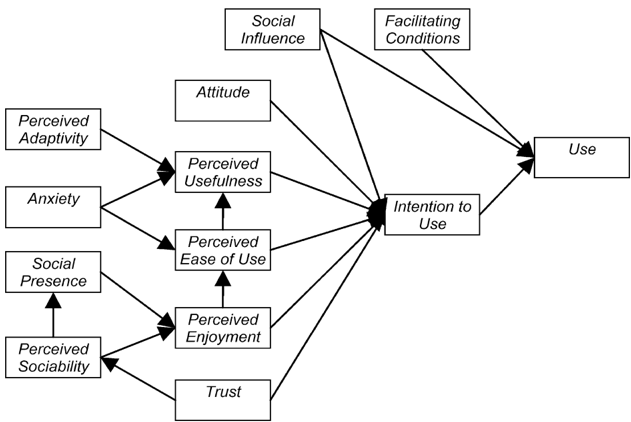
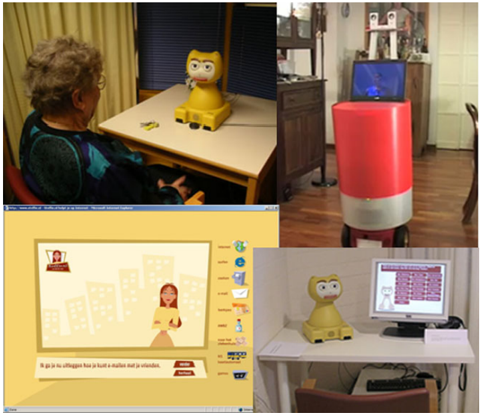
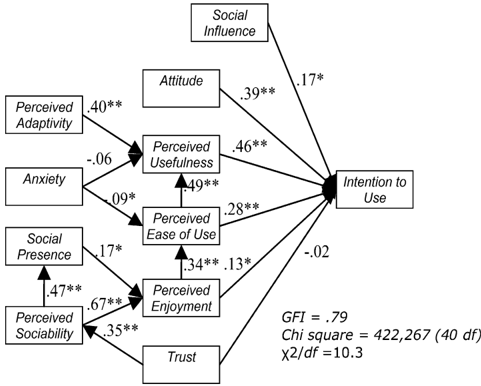
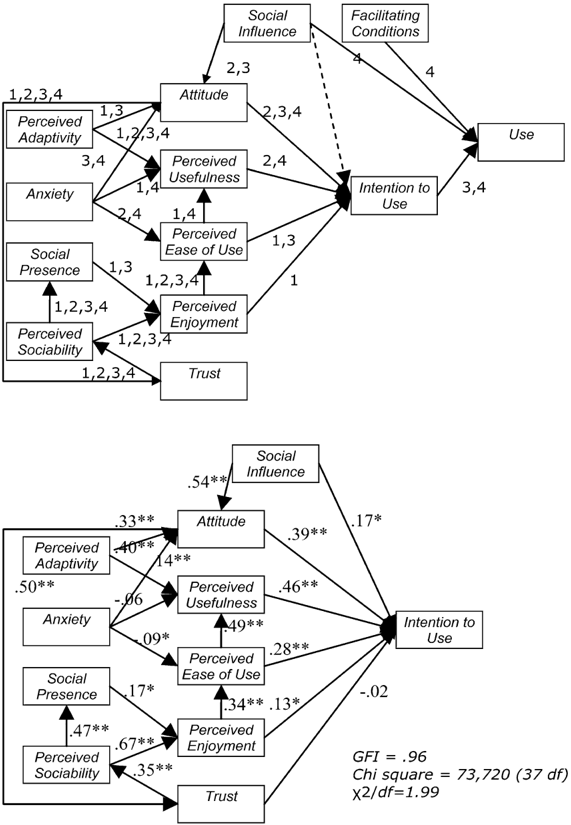
This paper proposes a model of technology acceptance that is specifically developed to test the acceptance of assistive social agents by elderly users. The research in this paper develops and tests an adaptation and theoretical extension of the Unified Theory of Acceptance and Use of Technology (UTAUT) by explaining intent to use not only in terms of variables related to functional evaluation like perceived usefulness and perceived ease of use, but also variables that relate to social interaction. The new model was tested using controlled experiment and longitudinal data collected regarding three different social agents at elderly care facilities and at the homes of older adults. The model was strongly supported accounting for 59–79% of the variance in usage intentions and 49–59% of the variance in actual use. These findings contribute to our understanding of how elderly users accept assistive social agents.
Overview
The claims and statistics of this paper haven’t been checked yet.
Free: it reads the open-access text and checks the first 5 claims that cite a source we can check. Create a free account to check every claim.
Integrity signals
Registry
Cites
Statistics
Figures

Verification
Claims the paper makes
The claims and statistics of this paper haven’t been checked yet.
Free: it reads the open-access text and checks the first 5 claims that cite a source we can check. Create a free account to check every claim.
Claims other papers make about this one
Each is checked against this paper’s own text: does it say what the citing paper says it does?
The source backs part of the claim, not all of it — or backs it for a different population, condition or comparison.
In the citing paper
“The extant literature attests to a positive correlation between users’ trust in technology and their inclination to use it, as evidenced by many studies [25-31].”
From Investigating the impact of user trust on the adoption and use of ChatGPT: Survey analysis (2023) · cites this paper as [31]
Experimental — accuracy not yet measuredThe cited source says what the claim attributes to it.
In the citing paper
“Prior research has established a positive correlation between intent to use and actual use of technology, indicating that users who intend to use the technology are more likely to actually use it [25,31,34].”
From Investigating the impact of user trust on the adoption and use of ChatGPT: Survey analysis (2023) · cites this paper as [31]
In the citing paper
“For instance, studies on adopting robots as assistive social agents found that users’ intent to use them strongly predicted their actual use [25,31].”
From Investigating the impact of user trust on the adoption and use of ChatGPT: Survey analysis (2023) · cites this paper as [31]
In the citing paper
“A study on technology acceptance for assistive social robots among older adult users found that the intention to use plays a mediating role in the relationship between trust and actual use [31].”
From Investigating the impact of user trust on the adoption and use of ChatGPT: Survey analysis (2023) · cites this paper as [31]
In the citing paper
“Heerink [15] found ITU is impacted by other acceptance factors and can be predicted by users' attitude and how much they perceive the robot to be useful.”
From Factors Affecting the Acceptability of Social Robots by Older Adults Including People with Dementia or Cognitive Impairment: A Literature Review (2018) · cites this paper as [15]
11 more claims about this paper
Create a free account to see every claim other papers make about this one.
Self-check
Percentages, sums and reported differences re-computed from the paper’s own numbers.
The self-check needs the paper’s full text.
Citations
Cites
Perceived usefulness, perceived ease of use, and user acceptance of information technology
Davis, F. D. (1989) · MIS Quarterly · doi:10.2307/249008 · Cited by 68,483
User Acceptance of Information Technology: Toward A Unified View1
Venkatesh, V., Morris, M. G., Davis, G. B., & Davis, F. D. (2003) · MIS Quarterly · doi:10.2307/30036540 · Cited by 45,035
(1975) · PhilPapers (PhilPapers Foundation) · Cited by 36,737
A Beginner's Guide to Structural Equation Modeling: Fourth Edition
Schumacker, R. E., & Lomax, R. G. (2015) · doi:10.4324/9781315749105 · Cited by 6,604
Structural Equation Modeling and Regression: Guidelines for Research Practice
Gefen, D., Straub, D., & Boudreau, M.-C. (2000) · Communications of the Association for Information Systems · doi:10.17705/1cais.00407 · Cited by 6,416
Measuring Presence in Virtual Environments: A Presence Questionnaire
Witmer, B. G., & Singer, M. J. (1998) · Presence: Teleoperators and Virtual Environments · doi:10.1162/105474698565686 · Cited by 6,371
A Beginner's Guide to Structural Equation Modeling
Schumacker, R. E., & Lomax, R. G. (2004) · doi:10.4324/9781410610904 · Cited by 6,235
Extrinsic and Intrinsic Motivation to Use Computers in the Workplace 1
Davis, F. D., Bagozzi, R. P., & Warshaw, P. R. (1992) · Journal of Applied Social Psychology · doi:10.1111/j.1559-1816.1992.tb00945.x · Cited by 6,231
Multivariate Data Analysis with Readings.
Rutherford, G. S. W., Hair, J. F., Anderson, R. E., & Tatham, R. L. (1988) · The Statistician · doi:10.2307/2348783 · Cited by 5,830
Multivariate Data Analysis with Readings.
Jolliffe, I. T., Hair, J. F., Anderson, R. E., & Tatham, R. L. (1988) · Journal of the Royal Statistical Society. Series A (Statistics in Society) · doi:10.2307/2983017 · Cited by 5,077
Research works printed but not linked: 6
- United Nations (2007) World population prospects: the 2006 revision-comprehensive tables. United Nations Publications, New York
- Pollack M (2005) Intelligent technology for an aging population: the use of AI to assist elders with cognitive impairment. AI Mag 26(2):9-24
- Zajicek M, Arnold A (1999) The 'technology push' and the user Tailored information environment. In: 5th European research con- sortium for informatics and mathematics, workshop on user inter- faces for all
- Pollack ME, Brown L, Colbry D, Orosz C, Peintner B, Ramakr- ishnan S, Engberg S, Matthews JT, Dunbar-Jacob J, McCarthy CE, Thrun S, Montemerlo M, Pineau J, Pearl NR (2002) A mobile ro- botic assistant for the elderly. In: AAAI workshop on automation as eldercare
- Heerink M (2009) Exploring adaptability, adaptivity and user control. Information Engineering Institute, Almere
- Heerink M (2008) Evaluating steffie. Information Engineering Institute, Almere
Cited by
Brave new world: service robots in the frontline
Wirtz, J., Patterson, P. G., Kunz, W. H., Gruber, T., Lu, V. N., Paluch, S., & Martins, A. (2018) · Journal of Service Management · doi:10.1108/josm-04-2018-0119 · Cited by 2,315
A Meta-Analysis of Factors Affecting Trust in Human-Robot Interaction
Hancock, P. A., Billings, D. R., Schaefer, K. E., Chen, J. Y. C., de Visser, E. J., & Parasuraman, R. (2011) · Human Factors: The Journal of the Human Factors and Ergonomics Society · doi:10.1177/0018720811417254 · Cited by 2,051
Developing and validating a service robot integration willingness scale
Lu, L., Cai, R., & Gursoy, D. (2019) · International Journal of Hospitality Management · doi:10.1016/j.ijhm.2019.01.005 · Cited by 1,013
Feil-Seifer, D., & Mataric, M. J. (2005) · 9th International Conference on Rehabilitation Robotics, 2005. ICORR 2005. · doi:10.1109/icorr.2005.1501143 · Cited by 972
Pelau, C., Dabija, D.-C., & Ene, I. (2021) · Computers in Human Behavior · doi:10.1016/j.chb.2021.106855 · Cited by 889
Online shopping drivers and barriers for older adults: Age and gender differences
Lian, J.-W., & Yen, D. C. (2014) · Computers in Human Behavior · doi:10.1016/j.chb.2014.04.028 · Cited by 660
Fernandes, T., & Oliveira, E. (2021) · Journal of Business Research · doi:10.1016/j.jbusres.2020.08.058 · Cited by 598
Trust in humanoid robots: implications for services marketing
van Pinxteren, M. M. E., Wetzels, R. W. H., Rüger, J., Pluymaekers, M., & Wetzels, M. (2019) · Journal of Services Marketing · doi:10.1108/jsm-01-2018-0045 · Cited by 528
Exploring relationship development with social chatbots: A mixed-method study of replika
Pentina, I., Hancock, T., & Xie, T. (2023) · Computers in Human Behavior · doi:10.1016/j.chb.2022.107600 · Cited by 522
Exploring influencing variables for the acceptance of social robots
de Graaf, M. M. A., & Ben Allouch, S. (2013) · Robotics and Autonomous Systems · doi:10.1016/j.robot.2013.07.007 · Cited by 499
Tay, B., Jung, Y., & Park, T. (2014) · Computers in Human Behavior · doi:10.1016/j.chb.2014.05.014 · Cited by 490
Choudhury, A., & Shamszare, H. (2023) · doi:10.2196/preprints.47184 · Cited by 473
Investigating the impact of user trust on the adoption and use of ChatGPT: Survey analysis
Choudhury, A., & Shamszare, H. (2023) · Journal of Medical Internet Research · doi:10.2196/47184 · Cited by 470
The Role of Healthcare Robots for Older People at Home: A Review
Robinson, H., MacDonald, B., & Broadbent, E. (2014) · International Journal of Social Robotics · doi:10.1007/s12369-014-0242-2 · Cited by 459
A Socially Assistive Robot Exercise Coach for the Elderly
Fasola, J., & Mataric, M. (2013) · Journal of Human-Robot Interaction · doi:10.5898/jhri.2.2.fasola · Cited by 420
A Systematic Review of Attitudes, Anxiety, Acceptance, and Trust Towards Social Robots
Naneva, S., Sarda Gou, M., Webb, T. L., & Prescott, T. J. (2020) · International Journal of Social Robotics · doi:10.1007/s12369-020-00659-4 · Cited by 385
Empathy in Virtual Agents and Robots: A Survey
Paiva, A., Leite, I., Boukricha, H., & Wachsmuth, I. (2017) · ACM Transactions on Interactive Intelligent Systems · doi:10.1145/2912150 · Cited by 361
Pino, M., Boulay, M., Jouen, F., & Rigaud, A.-S. (2015) · Frontiers in Aging Neuroscience · doi:10.3389/fnagi.2015.00141 · Cited by 346
Meiland, F., Innes, A., Mountain, G., Robinson, L., van der Roest, H., García-Casal, J. A., Gove, D., Thyrian, J. R., Evans, S., Dröes, R.-M., et al. (2017) · JMIR Rehabilitation and Assistive Technologies · doi:10.2196/rehab.6376 · Cited by 339
Khosravi, P., & Ghapanchi, A. H. (2016) · International Journal of Medical Informatics · doi:10.1016/j.ijmedinf.2015.05.014 · Cited by 327
Service robots: Applying social exchange theory to better understand human–robot interactions
Kim, H., So, K. K. F., & Wirtz, J. (2022) · Tourism Management · doi:10.1016/j.tourman.2022.104537 · Cited by 322
Ferrari, F., Paladino, M. P., & Jetten, J. (2016) · International Journal of Social Robotics · doi:10.1007/s12369-016-0338-y · Cited by 314
Cheng, X., Bao, Y., Zarifis, A., Gong, W., & Mou, J. (2022) · Internet Research · doi:10.1108/intr-08-2020-0460 · Cited by 300
de Graaf, M. M. A., Allouch, S. B., & Klamer, T. (2015) · Computers in Human Behavior · doi:10.1016/j.chb.2014.10.030 · Cited by 299
Inclusion of older adults in the research and design of digital technology
Mannheim, I., Schwartz, E., Xi, W., Buttigieg, S. C., McDonnell-Naughton, M., Wouters, E. J. M., & van Zaalen, Y. (2019) · International Journal of Environmental Research and Public Health · doi:10.3390/ijerph16193718 · Cited by 291
Coronado, E., Kiyokawa, T., Ricardez, G. A. G., Ramirez-Alpizar, I. G., Venture, G., & Yamanobe, N. (2022) · Journal of Manufacturing Systems · doi:10.1016/j.jmsy.2022.04.007 · Cited by 276
The most human bot: Female gendering increases humanness perceptions of bots and acceptance of AI
Borau, S., Otterbring, T., Laporte, S., & Fosso Wamba, S. (2021) · Psychology & Marketing · doi:10.1002/mar.21480 · Cited by 272
Guner, H., & Acarturk, C. (2020) · Universal Access in the Information Society · doi:10.1007/s10209-018-0642-4 · Cited by 270
Pizzi, G., Scarpi, D., & Pantano, E. (2021) · Journal of Business Research · doi:10.1016/j.jbusres.2020.11.006 · Cited by 265
Wu, Y.-H., Wrobel, J., Cornuet, M., Kerhervé, H., Damnée, S., & Rigaud, A.-S. (2014) · Clinical Interventions in Aging · doi:10.2147/cia.s56435 · Cited by 261
Flandorfer, P. (2012) · International Journal of Population Research · doi:10.1155/2012/829835 · Cited by 257
Domestic robots for older adults: attitudes, preferences, and potential
Smarr, C.-A., Mitzner, T. L., Beer, J. M., Prakash, A., Chen, T. L., Kemp, C. C., & Rogers, W. A. (2014) · International Journal of Social Robotics · doi:10.1007/s12369-013-0220-0 · Cited by 253
Why Would I Use This in My Home? A Model of Domestic Social Robot Acceptance
de Graaf, M. M. A., Ben Allouch, S., & van Dijk, J. A. G. M. (2019) · Human–Computer Interaction · doi:10.1080/07370024.2017.1312406 · Cited by 251
Papadopoulos, I., Koulouglioti, C., Lazzarino, R., & Ali, S. (2020) · BMJ Open · doi:10.1136/bmjopen-2019-033096 · Cited by 212
Liu, L., Miguel Cruz, A., Rios Rincon, A., Buttar, V., Ranson, Q., & Goertzen, D. (2015) · Disability and Rehabilitation · doi:10.3109/09638288.2014.923529 · Cited by 229
Embodiment in Socially Interactive Robots
Deng, E., Mutlu, B., & Matarić, M. J. (2019) · Foundations and Trends® in Robotics · doi:10.1561/2300000056 · Cited by 229
Evolving Trust in Robots: Specification Through Sequential and Comparative Meta-Analyses
Hancock, P. A., Kessler, T. T., Kaplan, A. D., Brill, J. C., & Szalma, J. L. (2021) · Human Factors: The Journal of the Human Factors and Ergonomics Society · doi:10.1177/0018720820922080 · Cited by 229
Value of social robots in services: social cognition perspective
Čaić, M., Mahr, D., & Oderkerken-Schröder, G. (2019) · Journal of Services Marketing · doi:10.1108/jsm-02-2018-0080 · Cited by 227
Fuentes-Moraleda, L., Díaz-Pérez, P., Orea-Giner, A., Muñoz- Mazón, A., & Villacé-Molinero, T. (2020) · Tourism Management Perspectives · doi:10.1016/j.tmp.2020.100751 · Cited by 220
Guests’ perceptions of robot concierge and their adoption intentions
Shin, H. H., & Jeong, M. (2020) · International Journal of Contemporary Hospitality Management · doi:10.1108/ijchm-09-2019-0798 · Cited by 216
Stafford, R. Q., MacDonald, B. A., Jayawardena, C., Wegner, D. M., & Broadbent, E. (2014) · International Journal of Social Robotics · doi:10.1007/s12369-013-0186-y · Cited by 216
Review: Seven Matters of Concern of Social Robots and Older People
Frennert, S., & Östlund, B. (2014) · International Journal of Social Robotics · doi:10.1007/s12369-013-0225-8 · Cited by 192
AI voice bots: a services marketing research agenda
Klaus, P., & Zaichkowsky, J. (2020) · Journal of Services Marketing · doi:10.1108/jsm-01-2019-0043 · Cited by 206
Friend, mentor, lover: does chatbot engagement lead to psychological dependence?
Xie, T., Pentina, I., & Hancock, T. (2023) · Journal of Service Management · doi:10.1108/josm-02-2022-0072 · Cited by 204
Gaudiello, I., Zibetti, E., Lefort, S., Chetouani, M., & Ivaldi, S. (2016) · Computers in Human Behavior · doi:10.1016/j.chb.2016.03.057 · Cited by 203
Kim, S., & Choudhury, A. (2021) · Computers in Human Behavior · doi:10.1016/j.chb.2021.106914 · Cited by 200
Self-efficacy and acceptance of robots
Latikka, R., Turja, T., & Oksanen, A. (2019) · Computers in Human Behavior · doi:10.1016/j.chb.2018.12.017 · Cited by 200
30 years of artificial intelligence (AI) research relating to the hospitality and tourism industry
Kong, H., Wang, K., Qiu, X., Cheung, C., & Bu, N. T. (2022) · International Journal of Contemporary Hospitality Management · doi:10.1108/ijchm-03-2022-0354 · Cited by 222
Conti, D., Di Nuovo, S., Buono, S., & Di Nuovo, A. (2017) · International Journal of Social Robotics · doi:10.1007/s12369-016-0359-6 · Cited by 178
Acceptance of socially assistive humanoid robot by preschool and elementary school teachers
Fridin, M., & Belokopytov, M. (2014) · Computers in Human Behavior · doi:10.1016/j.chb.2013.12.016 · Cited by 185
Acceptance and Attitudes Toward a Human-like Socially Assistive Robot by Older Adults
Louie, W.-Y. G., McColl, D., & Nejat, G. (2014) · Assistive Technology · doi:10.1080/10400435.2013.869703 · Cited by 179
User profiling and behavioral adaptation for HRI: A survey
Rossi, S., Ferland, F., & Tapus, A. (2017) · Pattern Recognition Letters · doi:10.1016/j.patrec.2017.06.002 · Cited by 179
Matarić, M. J., & Scassellati, B. (2016) · Springer Handbooks · doi:10.1007/978-3-319-32552-1_73 · Cited by 170
Why Do They Refuse to Use My Robot?: Reasons for Non-Use Derived from a Long-Term Home Study
de Graaf, M., Ben Allouch, S., & van Dijk, J. (2017) · Proceedings of the 2017 ACM/IEEE International Conference on Human-Robot Interaction · doi:10.1145/2909824.3020236 · Cited by 169
Puri, A., Kim, B., Nguyen, O., Stolee, P., Tung, J., & Lee, J. (2017) · JMIR mHealth and uHealth · doi:10.2196/mhealth.8211 · Cited by 166
A Review of Personality in Human‒Robot Interactions
Robert, L., Alahmad, R., Esterwood, C. T., Kim, S., You, S., & Zhang, Q. (2020) · Foundations and Trends® in Information Systems · doi:10.1561/2900000018 · Cited by 184
Hebesberger, D., Koertner, T., Gisinger, C., & Pripfl, J. (2017) · International Journal of Social Robotics · doi:10.1007/s12369-016-0391-6 · Cited by 163
Chatterjee, S., Nguyen, B., Ghosh, S. K., Bhattacharjee, K. K., & Chaudhuri, S. (2020) · The Bottom Line Managing Library Finances · doi:10.1108/bl-08-2020-0057 · Cited by 194
Whelan, S., Murphy, K., Barrett, E., Krusche, C., Santorelli, A., & Casey, D. (2018) · International Journal of Social Robotics · doi:10.1007/s12369-018-0471-x · Cited by 162
Long-term evaluation of a social robot in real homes
de Graaf, M. M. A., Ben Allouch, S., & van Dijk, J. A. G. M. (2016) · Interaction Studies. Social Behaviour and Communication in Biological and Artificial Systems · doi:10.1075/is.17.3.08deg · Cited by 161
Identifying the Potential for Robotics to Assist Older Adults in Different Living Environments
Mitzner, T. L., Chen, T. L., Kemp, C. C., & Rogers, W. A. (2014) · International Journal of Social Robotics · doi:10.1007/s12369-013-0218-7 · Cited by 158
Friend or Foe? Understanding Assembly Workers’ Acceptance of Human-robot Collaboration
Meißner, A., Trübswetter, A., Conti, A. S., & Schmidtler, J. (2020) · ACM Transactions on Human-Robot Interaction · doi:10.1145/3399433 · Cited by 178
Factors that affect health information technology adoption by seniors: A systematic review
Kavandi, H., & Jaana, M. (2020) · Health & Social Care in the Community · doi:10.1111/hsc.13011 · Cited by 142
Chi, N. T. K., & Hoang Vu, N. (2023) · CAAI Transactions on Intelligence Technology · doi:10.1049/cit2.12133 · Cited by 121
Exploring hotel guests' perceptions of using robot assistants
Lee, Y., Lee, S., & Kim, D.-Y. (2020) · Tourism Management Perspectives · doi:10.1016/j.tmp.2020.100781 · Cited by 169
The Perception And Measurement Of Human-robot Trust
Schaefer, K. E. (2013) · STARS (University of Central Florida) · Cited by 194
Oksanen, A., Savela, N., Latikka, R., & Koivula, A. (2020) · Frontiers in Psychology · doi:10.3389/fpsyg.2020.568256 · Cited by 125
Torta, E., Werner, F., Johnson, D. O., Juola, J. F., Cuijpers, R. H., Bazzani, M., Oberzaucher, J., Lemberger, J., Lewy, H., & Bregman, J. (2014) · Journal of Intelligent & Robotic Systems · doi:10.1007/s10846-013-0019-0 · Cited by 123
Cavallo, F., Esposito, R., Limosani, R., Manzi, A., Bevilacqua, R., Felici, E., Di Nuovo, A., Cangelosi, A., Lattanzio, F., & Dario, P. (2018) · Journal of Medical Internet Research · doi:10.2196/jmir.9460 · Cited by 140
Bradwell, H. L., Edwards, K. J., Winnington, R., Thill, S., & Jones, R. B. (2019) · BMJ Open · doi:10.1136/bmjopen-2019-032468 · Cited by 138
Heerink, M. (2011) · Proceedings of the 6th international conference on Human-robot interaction · doi:10.1145/1957656.1957704 · Cited by 145
Self-citationTurja, T., Aaltonen, I., Taipale, S., & Oksanen, A. (2020) · Information & Management · doi:10.1016/j.im.2019.103220 · Cited by 142
Ye, T., Xue, J., He, M., Gu, J., Lin, H., Xu, B., & Cheng, Y. (2019) · Journal of Medical Internet Research · doi:10.2196/14316 · Cited by 141
The convenience of shopping via voice AI: Introducing AIDM
Klaus, P., & Zaichkowsky, J. L. (2022) · Journal of Retailing and Consumer Services · doi:10.1016/j.jretconser.2021.102490 · Cited by 124
Older Adults’ Preferences for and Acceptance of Robot Assistance for Everyday Living Tasks
Smarr, C.-A., Prakash, A., Beer, J. M., Mitzner, T. L., Kemp, C. C., & Rogers, W. A. (2012) · Proceedings of the Human Factors and Ergonomics Society Annual Meeting · doi:10.1177/1071181312561009 · Cited by 123
Piçarra, N., & Giger, J.-C. (2018) · Computers in Human Behavior · doi:10.1016/j.chb.2018.04.026 · Cited by 130
Meal-Time with a Socially Assistive Robot and Older Adults at a Long-term Care Facility
McColl, D., & Nejat, G. (2013) · Journal of Human-Robot Interaction · doi:10.5898/jhri.2.1.mccoll · Cited by 130
Shareef, M. A., Kumar, V., Dwivedi, Y. K., Kumar, U., Akram, M. S., & Raman, R. (2021) · Technological Forecasting and Social Change · doi:10.1016/j.techfore.2020.120334 · Cited by 122
A Model of Human-Robot Trust: Theoretical Model Development
Sanders, T., Oleson, K. E., Billings, D. R., Chen, J. Y. C., & Hancock, P. A. (2011) · Proceedings of the Human Factors and Ergonomics Society Annual Meeting · doi:10.1177/1071181311551298 · Cited by 122
Towards Effective Interface Designs for Collaborative HRI in Manufacturing: Metrics and Measures
Marvel, J. A., Bagchi, S., Zimmerman, M., & Antonishek, B. (2020) · ACM Transactions on Human-Robot Interaction · doi:10.1145/3385009 · Cited by 149
Prakash, A., & Rogers, W. A. (2015) · International Journal of Social Robotics · doi:10.1007/s12369-014-0269-4 · Cited by 123
Empathic voice assistants: Enhancing consumer responses in voice commerce
Mari, A., Mandelli, A., & Algesheimer, R. (2024) · Journal of Business Research · doi:10.1016/j.jbusres.2024.114566 · Cited by 150
Gross, H.-M., Mueller, S., Schroeter, C., Volkhardt, M., Scheidig, A., Debes, K., Richter, K., & Doering, N. (2015) · 2015 IEEE/RSJ International Conference on Intelligent Robots and Systems (IROS) · doi:10.1109/iros.2015.7354230 · Cited by 118
Hong, A., Lunscher, N., Hu, T., Tsuboi, Y., Zhang, X., Franco dos Reis Alves, S., Nejat, G., & Benhabib, B. (2021) · IEEE Transactions on Cybernetics · doi:10.1109/tcyb.2020.2974688 · Cited by 119
The acceptability of social robots: A scoping review of the recent literature
David, D., Thérouanne, P., & Milhabet, I. (2022) · Computers in Human Behavior · doi:10.1016/j.chb.2022.107419 · Cited by 151
Human Robot Engagement and Acceptability in Residential Aged Care
Khosla, R., Nguyen, K., & Chu, M.-T. (2017) · International Journal of Human–Computer Interaction · doi:10.1080/10447318.2016.1275435 · Cited by 124
Long-Term Evaluation of a Telepresence Robot for the Elderly: Methodology and Ecological Case Study
Cesta, A., Cortellessa, G., Orlandini, A., & Tiberio, L. (2016) · International Journal of Social Robotics · doi:10.1007/s12369-016-0337-z · Cited by 138
Wutz, M., Hermes, M., Winter, V., & Köberlein-Neu, J. (2023) · Journal of Medical Internet Research · doi:10.2196/46548 · Cited by 99
Chandra, B. R., & Rahman, Z. (2023) · Journal of Service Theory and Practice · doi:10.1108/jstp-03-2023-0097 · Cited by 144
So, K. K. F., Kim, H., Liu, S. Q., Fang, X., & Wirtz, J. (2024) · European Journal of Marketing · doi:10.1108/ejm-03-2022-0176 · Cited by 107
Ghazali, A. S., Ham, J. R. C., Barakova, E. I., & Markopoulos, P. (2020) · International Journal of Social Robotics · doi:10.1007/s12369-019-00611-1 · Cited by 134
Guggemos, J., Seufert, S., & Sonderegger, S. (2020) · British Journal of Educational Technology · doi:10.1111/bjet.13006 · Cited by 143
General Attitudes Towards Robots Scale (GAToRS): A New Instrument for Social Surveys
Koverola, M., Kunnari, A., Sundvall, J. R. I., & Laakasuo, M. (2022) · International Journal of Social Robotics · doi:10.1007/s12369-022-00880-3 · Cited by 137
Ke, C., Lou, V. W.-Q., Tan, K. C.-K., Wai, M. Y., & Chan, L. L. (2020) · International Journal of Medical Informatics · doi:10.1016/j.ijmedinf.2020.104241 · Cited by 107
Song, B., Zhang, M., & Wu, P. (2022) · International Journal of Hospitality Management · doi:10.1016/j.ijhm.2022.103278 · Cited by 128
Robotic Versus Human Coaches for Active Aging: An Automated Social Presence Perspective
Čaić, M., Avelino, J., Mahr, D., Odekerken-Schröder, G., & Bernardino, A. (2020) · International Journal of Social Robotics · doi:10.1007/s12369-018-0507-2 · Cited by 103
Effect of customer's perception on service robot acceptance
Li, Y., & Wang, C. (2021) · International Journal of Consumer Studies · doi:10.1111/ijcs.12755 · Cited by 124
Home robotic devices for older adults: opportunities and concerns
Deutsch, I., Erel, H., Paz, M., Hoffman, G., & Zuckerman, O. (2019) · Computers in Human Behavior · doi:10.1016/j.chb.2019.04.002 · Cited by 115
The multi-modal interface of Robot-Era multi-robot services tailored for the elderly
Di Nuovo, A., Broz, F., Wang, N., Belpaeme, T., Cangelosi, A., Jones, R., Esposito, R., Cavallo, F., & Dario, P. (2018) · Intelligent Service Robotics · doi:10.1007/s11370-017-0237-6 · Cited by 111
Children learning with a social robot
Kanda, T., Shimada, M., & Koizumi, S. (2012) · ACM/IEEE International Conference on Human-Robot Interaction (HRI) · doi:10.1145/2157689.2157809 · Cited by 121
Metadata
- Authors
- Heerink, M., Kröse, B., Evers, V., & Wielinga, B.
- Affiliations
- Amsterdam University of Applied Sciences (NL)
- University of Amsterdam (NL)
- Corresponding author
- Heerink, Marcel
- Venue
- International Journal of Social Robotics
- Published
- 2010-09-04
- Volume
- 2
- Issue
- 4
- Pages
- 361-375
- ISSN
- 1875-4791 (ISSN-L)
- 1875-4805
- OpenAlex
- W2137577228
- Cited by
- 1,229
- References
- 69
- Citations by year
- 2026: 145 · 2025: 138 · 2024: 115 · 2023: 142 · 2022: 125 · 2021: 119 · 2020: 104 · 2019: 91 · 2018: 46 · 2017: 47 · 2016: 39 · 2015: 28 · 2014: 34 · 2013: 31 · 2012: 14
- Type
- book review
- Language
- en
- Open access
- hybrid
- doi.org
- Licence
- cc-by-nc
- Locations
- International Journal of Social Robotics (publishedVersion, cc-by-nc)
- UvA-DARE (University of Amsterdam) (publishedVersion, other-oa)
- VU Research Portal (publishedVersion, other-oa)
- UvA-DARE (University of Amsterdam) (submittedVersion, other-oa)
- Data Archiving and Networked Services (DANS) (submittedVersion, other-oa)
- Digital Academic REpository of VU University Amsterdam (Vrije Universiteit Amsterdam) (submittedVersion)
- Funders
- European Commission
- Rabobank Foundation
- Topics
- Social Sciences › Psychology › Social Psychology › Social Robot Interaction and HRI
- Health Sciences › Medicine › Geriatrics and Gerontology › Technology Use by Older Adults
- Social Sciences › Decision Sciences › Information Systems and Management › Technology Adoption and User Behaviour
- Keywords
- technology acceptance, older adults, UTAUT, intention to use, perceived usefulness, perceived ease of use, social interaction, elderly care, social robots
About these checks
Registry, retraction, Cites and statistics results are computed, not judged, with one exception: a printed reference that no index lists is read once by a model before it counts as a citation error. Claims are extracted by a model and kept only when their quote appears verbatim in the text; each cited source is then checked, with a model’s help, for whether it says what the claim relies on. Those verdicts can be wrong — read the claim’s quote and the cited source before relying on one.
Statistics and arithmetic are recomputed, not judged.
Confidence bands are shown only for fields calibrated on our annotated test set. None is calibrated yet, so no band is shown.
What counts as a claim ›How we measure confidence ›How we check this ›
Are you an author, or do you see a problem with this page? Request a review
Data sources
Bibliographic data: Semantic Scholar, OpenAlex, Crossref.
Contains information from the Semantic Scholar Academic Graph Datasets, made available under the ODC Attribution License (ODC-BY 1.0).
Semantic Scholar’s data is described in: Kinney, R., et al. (2023). The Semantic Scholar Open Data Platform. arXiv:2301.10140.
