

Voice Over Body? Older Adults’ Reactions to Robot and Voice Assistant Facilitators of Group Conversation
Open accessThe DOI matches its Crossref record; 86 of the 86 references it cites were found in a registry or an index.
Abstract
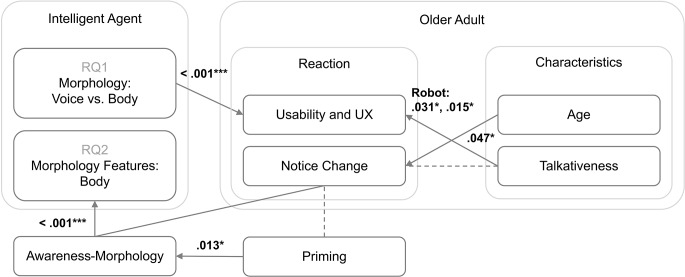
Intelligent agents have great potential as facilitators of group conversation among older adults. However, little is known about how to design agents for this purpose and user group, especially in terms of agent embodiment. To this end, we conducted a mixed methods study of older adults’ reactions to voice and body in a group conversation facilitation agent. Two agent forms with the same underlying artificial intelligence (AI) and voice system were compared: a humanoid robot and a voice assistant. One preliminary study (total n = 24) and one experimental study comparing voice and body morphologies (n = 36) were conducted with older adults and an experienced human facilitator. Findings revealed that the artificiality of the agent, regardless of its form, was beneficial for the socially uncomfortable task of conversation facilitation. Even so, talkative personality types had a poorer experience with the “bodied” robot version. Design implications and supplementary reactions, especially to agent voice, are also discussed.
Overview
The claims and statistics of this paper haven’t been checked yet.
Free: it reads the open-access text and checks the first 5 claims that cite a source we can check. Create a free account to check every claim.
Integrity signals
Registry
Cites
Statistics
Figures
Verification
Claims the paper makes
The claims and statistics of this paper haven’t been checked yet.
Free: it reads the open-access text and checks the first 5 claims that cite a source we can check. Create a free account to check every claim.
Claims other papers make about this one
Each is checked against this paper’s own text: does it say what the citing paper says it does?
The source backs part of the claim, not all of it — or backs it for a different population, condition or comparison.
In the citing paper
“As established by Seaborn etal. (2023), speech interaction leverages natural speech-based communication patterns, mirroring daily conversational flows.”
From The impact of usage experience and input modality on trust experience and cognitive load in older adults (2025) · cites this paper as Seaborn et al. (2023)
Experimental — accuracy not yet measured
Self-check
Percentages, sums and reported differences re-computed from the paper’s own numbers.
The self-check needs the paper’s full text.
Citations
Cites
Using thematic analysis in psychology
Braun, V., & Clarke, V. (2006) · Qualitative Research in Psychology · doi:10.1191/1478088706qp063oa · Cited by 194,414
Designing and Conducting Mixed Methods Research
Robinson, P. (2007) · Australian and New Zealand Journal of Public Health · doi:10.1111/j.1753-6405.2007.00096.x · Cited by 23,258
Content analysis and thematic analysis: Implications for conducting a qualitative descriptive study
Vaismoradi, M., Turunen, H., & Bondas, T. (2013) · Nursing & Health Sciences · doi:10.1111/nhs.12048 · Cited by 8,327
Guest, G., MacQueen, K., & Namey, E. (2012) · doi:10.4135/9781483384436 · Cited by 7,924
Toward a definition of mixed methods research
Johnson, R. B., Onwuegbuzie, A. J., & Turner, L. A. (2007) · Journal of Mixed Methods Research · doi:10.1177/1558689806298224 · Cited by 6,464
An Empirical Evaluation of the System Usability Scale
Bangor, A., Kortum, P. T., & Miller, J. T. (2008) · International Journal of Human–Computer Interaction · doi:10.1080/10447310802205776 · Cited by 5,181
Gorillas in our midst: sustained inattentional blindness for dynamic events
Simons, D. J., & Chabris, C. F. (1999) · Perception · doi:10.1068/p281059 · Cited by 3,181
The trouble with overconfidence.
Moore, D. A., & Healy, P. J. (2008) · Psychological Review · doi:10.1037/0033-295x.115.2.502 · Cited by 2,358
Valtorta, N. K., Kanaan, M., Gilbody, S., Ronzi, S., & Hanratty, B. (2016) · Heart · doi:10.1136/heartjnl-2015-308790 · Cited by 1,971 · cited 1×
“Social applications may be particularly relevant for older adults, who are at risk of isolation and the severe negative impacts it can have on well-being and physical health [17, 18].”
BackgroundProceedings of the 2020 CHI Conference on Human Factors in Computing Systems
(2020) · doi:10.1145/3313831 · Cited by 1,951
Research works printed but not linked: 4
- Hasegawa D, Cassell J, Araki K (2010) The role of embodiment and perspective in direction-giving systems. In: 2010 AAAI Fall Symposium Series. AAAI
- Matsuyama Y, Taniyama H, Fujie S, Kobayashi T (2010) Framework of communication activation robot participating in multiparty conversation. In: Proceedings of the 2010 AAAI Fall Symposium Series
- Weiss A, Bernhaupt R, Tscheligi M, Yoshida E (2009) Addressing user experience and societal impact in a user study with a humanoid robot. In: Adaptive and Emergent Behaviour and Complex Systems - Proceedings of the 23rd Convention of the Society for the Study of Artificial Intelligence and Simulation of Behaviour. Citeseer, Edinburgh, UK, pp–150–157
- Likert R (1932) A technique for the measurement of attitudes. Arch Psychol 22:. https://doi.org/1933-01885-001
Cited by
Irfan, B., Kuoppamäki, S., Hosseini, A., & Skantze, G. (2025) · Autonomous Robots · doi:10.1007/s10514-025-10190-y · Cited by 108
Kuoppamäki, S., Jaberibraheem, R., Hellstrand, M., & McMillan, D. (2023) · International Journal of Social Robotics · doi:10.1007/s12369-023-01055-4 · Cited by 27
“Only few studies have investigated the gaze interaction with older adults [50, 52, 53].”
BackgroundInfluentialLeveraging Chatbots to Combat Health Misinformation for Older Adults: Participatory Design Study
Peng, W., Lee, H. R., & Lim, S. (2024) · JMIR Formative Research · doi:10.2196/60712 · Cited by 33
“Some studies have already shown how technologies such as social robots and voice assistants could be used to promote social connectedness and facilitate conversations in older adult communities [83,84].”
BackgroundArtificial intelligence in voice assistants: User benefits explored
Kim, M., & Kim, J. (2024) · International Journal of Consumer Studies · doi:10.1111/ijcs.13019 · Cited by 20
"This machine is for the aides": Tailoring Voice Assistant Design to Home Health Care Work
Bartle, V., Albright, L., & Dell, N. (2023) · Proceedings of the 2023 CHI Conference on Human Factors in Computing Systems · doi:10.1145/3544548.3581118 · Cited by 18
“This idea connects to recent work that explores how to design intelligent agents to facilitate group conversation among older adults [69].”
BackgroundQualitative Approaches to Voice UX
Seaborn, K., Urakami, J., Pennefather, P., & Miyake, N. (2024) · ACM Computing Surveys · doi:10.1145/3658666 · Cited by 23
Self-citationVagnetti, R., Camp, N., Story, M., Belaid, K. A., Mitra, S., Zecca, M., Nuovo, A. G. D., & Magistro, D. (2024) · Journal of Medical Internet Research · doi:10.2196/55597 · Cited by 23
“Indeed, determining the ideal form that an agent, such as a robot, should take is particularly challenging [102].”
BackgroundLeite, H., Hodgkinson, I. R., Volochtchuk, A. V. L., & Nascimento, T. C. (2024) · Technovation · doi:10.1016/j.technovation.2024.103080 · Cited by 22
Social Identity in Human-Agent Interaction: A Primer
Seaborn, K. (2025) · ACM Transactions on Human-Robot Interaction · doi:10.1145/3760500 · Cited by 21
Self-citationMore-than-Human Storytelling: Designing Longitudinal Narrative Engagements with Generative AI
Fabre, É., Seaborn, K., Koiwai, S., Watanabe, M., & Riesch, P. (2025) · CHI Conference Extended Abstracts on Human Factors in Computing Systems (CHI EA) · doi:10.1145/3706599.3720135 · Cited by 17
“We created a storytelling app titled “Dreamsmithy,” inspired by AI-basedstorytellingsystemsforolderandyoungerJapaneseadults[25, 42,44,50].”
Self-citationTechnology Mediated Caregiving For Older Adults Aging in Place
Mynatt, E. D., Kobayashi, M., Pradhan, A., Mathur, N., Vines, J., Seaborn, K., Buehler, E., Waycott, J., Rudnik, J., Zubatiy, T., et al. (2025) · CHI Conference Extended Abstracts on Human Factors in Computing Systems (CHI EA) · doi:10.1145/3706599.3706721 · Cited by 11
Self-citationHuang, H., & Hou, G. (2025) · Frontiers in Computer Science · doi:10.3389/fcomp.2025.1659594 · Cited by 5
Tokunaga, S., Sekiguchi, T., Miura, K. W., Sugimoto, H., Abe, M., Tamura, K., Kishimoto, T., Kudo, T., & Otake, M. (2024) · JMIR Aging · doi:10.2196/47229 · Cited by 5
“…it would be important to have a perspective on what kind of interface to provide and how to personalize it according to the user’s preferences or personality as well as the characteristics of the user’s daily conversations [40], to keep them motivated to continue with the intervention program.”
BackgroundSelf-citationStrategies for Controlling the Conversation Dynamics in Multi-Party Human-Robot Interaction
Grassi, L., Recchiuto, C. T., & Sgorbissa, A. (2025) · International Journal of Social Robotics · doi:10.1007/s12369-025-01298-3 · Cited by 6
Robotic Backchanneling in Online Conversation Facilitation: A Cross-Generational Study
Kobuki, S., Seaborn, K., Tokunaga, S., Fukumori, K., Hidaka, S., Tamura, K., Inoue, K., Kawahara, T., & 大武, 美. (2023) · IEEE RO-MAN · doi:10.1109/ro-man57019.2023.10309362 · Cited by 4
“In feedback from our previous face-to-face studies [5], participants expressed a desire for empathic responses like backchannelling from the agent.”
BackgroundSelf-citationYuan, S., Coghlan, S., Lederman, R., & Waycott, J. (2025) · CHI Conference on Human Factors in Computing Systems · doi:10.1145/3706598.3713755 · Cited by 6
“Conversational agents including smart speakers and social robots could be used to talk to residents in their own languages [ 62].”
Empathy-Inspired Voice Companion Design for Older Adults
Pathirana, N., Htait, A., & Wanner, E. F. (2026) · Communications in computer and information science · doi:10.1007/978-3-032-12764-8_26 · Cited by 3
Robots for Older Adults: A Scoping Review
Olatunji, S., Tsai, Y.-L., Gowrishankar, S. A., Bayles, M. A., & Rogers, W. A. (2026) · ACM Transactions on Human-Robot Interaction · doi:10.1145/3799977 · Cited by 4
“…l s u pp o r t , p e t t h e r a p y , c o n v e r s a t i o n a l a g e n t s A I B O [ 125 ] , B e tt y [ 108 ] , B o m y [ 71 ] , B o n o B o t [ 198 ] , C L A R C [ 115 ] , C o t a [ 163 ] , D O B O T [ 113 ] , e B e a r [ 100 ] , E M Y S [ 44 ] , E R I C [ 223 ] , F r i W a l k [ 62 ] , G i r…”
Focus Group-Led Refinement of an LLM-Enabled Companion Robot for Older People
Satake, Y., Nygren, M. O., Yu, C. T. K., Tsuboi, A., Endo, I., Umemura, K., Katsuki, K., Ishimaru, D., Rapaport, P., Bianchi‐Berthouze, N., et al. (2026) · International Journal of Social Robotics · doi:10.1007/s12369-026-01407-w · Cited by 4
Conversational Voice User Interfaces Supporting Individuals with Down Syndrome: A Literature Review
Cibrian, F. L., Gastelum, M. C. V., Min, L., & Motti, V. G. (2025) · ACM Transactions on Accessible Computing · doi:10.1145/3715160 · Cited by 4
“Currently, commercial robots are expensive and not accessible to most users compared to voice assistant speakers [95].”
A Cross-Cultural Perspective on Human–Care Robot Interactions
Bourne, J. (2025) · Springer eBooks · doi:10.1007/978-981-96-7185-4_12 · Cited by 2
Getting Contact to Elderly Associates Through the ICT: An Exploratory Study
Martins, G., Carvalho, V. M., Afecto, C., Teixeira, S., & Rodrigues, C. S. (2023) · Lecture notes of the Institute for Computer Sciences, Social Informatics and Telecommunications Engineering · doi:10.1007/978-3-031-32029-3_23 · Cited by 2
Personal intelligent agents: empowering or marginalizing older adults?
Yuan, X. (., Guo, Q., & Gayle, D. B. (2025) · Aslib Journal of Information Management · doi:10.1108/ajim-09-2024-0741 · Cited by 2
Smart Nudging in Education: The Impact of Voice-Based Robots on Value Co-Creation
Mele, C., Spena, T. R., Bernardo, I. D., & Ranieri, A. (2025) · International Journal of Social Robotics · doi:10.1007/s12369-025-01321-7 · Cited by 1
Pathirana, N., Htait, A., & Wanner, E. F. (2026) · Universal Access in the Information Society · doi:10.1007/s10209-026-01352-5 · Cited by 4
“Researchers have recommended enhancing voice-based features, as older adults value humanistic elements, with voice characteristics being a key consideration in VA design [73 ].”
Chopra, R., Bhardwaj, S., & Arya, V. (2026) · Journal of Information Communication and Ethics in Society · doi:10.1108/jices-05-2025-0106 · Cited by 1
Wang, T. (2023) · Journal of Artificial Intelligence Practice · doi:10.23977/jaip.2023.060505 · Cited by 1
“through voice commands, thereby improving the convenience and efficiency of services [14].”
BackgroundNozaki, Y. (2024) · The Annual Report of Educational Psychology in Japan · doi:10.5926/arepj.63.70 · Cited by 4
Narayanan, G. R., & Rajagopal, H. (2024) · Proceedings of International Conference on Artificial Life and Robotics · doi:10.5954/icarob.2024.os18-4
“Additional observations and design implications are also presented, with a focus on agent voice in particular [4].”
BackgroundGonzalez-Vasquez, A., Martínez‐González, C. L., Quezada-Bolaños, E. P., & Burguete-Castillejos, L. F. (2024) · Avances en Interacción Humano-Computadora · doi:10.47756/aihc.y9i1.179
“Es esencial que los diálogos sean cortos, con voces humanas para mejorar la usabilidad [17].”
Zou, Z., Alnajjar, F., Lwin, M., Mahmud, A. A., Khan, A., Swavaf, M., & Mubin, O. (2025) · International Conference on Activity and Behavior Computing (ABC) · doi:10.1109/abc64332.2025.11118612 · Cited by 1
“As a key characteristic of agents, the acoustic properties of agents serve as reliable indicators for differentiating various types of agents [33, 34], including large commercial robots and small household robots.”
Muñoz, J. E., Saleh, S., & Ramirez, N. (2025) · Lecture notes in computer science · doi:10.1007/978-981-95-2398-6_15
Fart Gags and Prudish Machines: Laughter in Human-agent Interactions
Vanzan, V., Bedir, S. T., Maraev, V., Lagerstedt, E., Barthel, M., & Howes, C. (2025) · International Conference on Human-Agent Interaction (HAI) · doi:10.1145/3765766.3765802
Xiong, J., & Sun, D. (2026) · International Journal of Consumer Studies · doi:10.1111/ijcs.70195
Naaz, S., Raza, A., Humayun, M., Ghafir, S., Ahmed, Z., & Ahmad, F. (2026) · Assistive Technology · doi:10.1080/10400435.2026.2642118
“Their findings highlight the significance of embodiment and social presence, which are critical for developing trust and engagement strategies for voice assistants (Seaborn et al., 2023).”
Raja, A. S., Ruitenburg, Y., Velzen, N. V., Lee, M., & Brankaert, R. (2026) · CHI Conference Extended Abstracts on Human Factors in Computing Systems (CHI EA) · doi:10.1145/3772363.3798993
Dreaming with MAKOTO: Co-Designing an "Older Adult" Voice Assistant Intervention for Implicit Ageism
Seaborn, K., Watanabe, M., Fabre, É., Riesch, P., Nam, S., Mandai, Y., & Kojima, M. (2026) · Participatory Design Conference · doi:10.1145/3796624.3796648
Self-citationThe Elderly’s Acceptance of Artificial Intelligence: A Scoping Review
Hutton, A., Scott, D. D., & Ni, R. (2026) · Journal of Technology in Behavioral Science · doi:10.1007/s41347-026-00663-x
Frederiks, K., Vacaru, S. V., Lau, L.-P., Barakova, E. I., & Sterkenburg, P. S. (2026) · Advanced Robotics · doi:10.1080/01691864.2026.2716457 · Cited by 1
Jiang, Y., & Zhou, J. (2026) · International Journal of Human-Computer Interaction · doi:10.1080/10447318.2026.2715160
Learn AI with AI: Designing conversational agents to support older adults in learning about AI
KangJie, E. T., Song, T., Shi, M., & Lee, Y. (2026) · International Journal of Human-Computer Studies · doi:10.1016/j.ijhcs.2026.103953
He, Y., Patulny, R., & Kim, D. (2026) · Research Square · doi:10.21203/rs.3.rs-10316956/v1
Kuch, J. M., Reinwarth, A. L., Hilpert, B., Kanschat, L., Schneeberger, T., & André, E. (2026) · Research Square · doi:10.21203/rs.3.rs-11221361/v1
Metadata
- Authors
- Seaborn, K., Sekiguchi, T., Tokunaga, S., Miyake, N. P., & Otake-Matsuura, M.
- Affiliations
- Tokyo Institute of Technology (JP)
- RIKEN Center for Advanced Intelligence Project (JP)
- Corresponding author
- Seaborn, Katie
- Venue
- International Journal of Social Robotics
- Published
- 2022-11-11
- Volume
- 15
- Issue
- 2
- Pages
- 143-163
- ISSN
- 1875-4791 (ISSN-L)
- 1875-4805
- PMC
- PMC9651097
- OpenAlex
- W4308798315
- Cited by
- 43
- References
- 86
- Citations by year
- 2026: 14 · 2025: 14 · 2024: 10 · 2023: 5
- FWCI
- 6.85
- Type
- journal article
- Language
- en
- Open access
- hybrid
- doi.org
- Licence
- cc-by
- creativecommons.org/licenses/by/4.0 (tdm)
- creativecommons.org/licenses/by/4.0 (vor)
- Locations
- International Journal of Social Robotics (publishedVersion, cc-by)
- arXiv (Cornell University) (publishedVersion)
- PubMed Central (publishedVersion, cc-by)
- PubMed (publishedVersion)
- Institutional Repositories DataBase (IRDB) (submittedVersion, cc-by-nc-nd)
- Institutional Repositories DataBase (IRDB) (submittedVersion, cc-by)
- Tokyo Tech Research Repository (Tokyo Institute of Technology) (submittedVersion, cc-by)
- arXiv (Cornell University)
- Funders
- Japan Society for the Promotion of Science (18KT0035; 19H01138; 20H05022; 20H05574)
- Japan Agency for Medical Research and Development (JP19he2002014)
- Topics
- Social Sciences › Psychology › Social Psychology › Social Robot Interaction and HRI
- Social Sciences › Business, Management and Accounting › Marketing › AI in Service Interactions
- Physical Sciences › Computer Science › Artificial Intelligence › Speech and dialogue systems
- Keywords
- older adults, dialogue facilitation, group conversation, humanoid robots, voice assistants, artificiality, talkativeness, user experience, social interaction
About these checks
Registry, retraction, Cites and statistics results are computed, not judged, with one exception: a printed reference that no index lists is read once by a model before it counts as a citation error. Claims are extracted by a model and kept only when their quote appears verbatim in the text; each cited source is then checked, with a model’s help, for whether it says what the claim relies on. Those verdicts can be wrong — read the claim’s quote and the cited source before relying on one.
Statistics and arithmetic are recomputed, not judged.
Confidence bands are shown only for fields calibrated on our annotated test set. None is calibrated yet, so no band is shown.
What counts as a claim ›How we measure confidence ›How we check this ›
Are you an author, or do you see a problem with this page? Request a review
Data sources
Bibliographic data: Semantic Scholar, OpenAlex, Crossref.
Contains information from the Semantic Scholar Academic Graph Datasets, made available under the ODC Attribution License (ODC-BY 1.0).
Semantic Scholar’s data is described in: Kinney, R., et al. (2023). The Semantic Scholar Open Data Platform. arXiv:2301.10140.
