

Voice Over Body? Older Adults’ Reactions to Robot and Voice Assistant Facilitators of Group Conversation
Open accessThe DOI matches its Crossref record; 86 of the 86 references it cites were found in a registry or an index.
Abstract
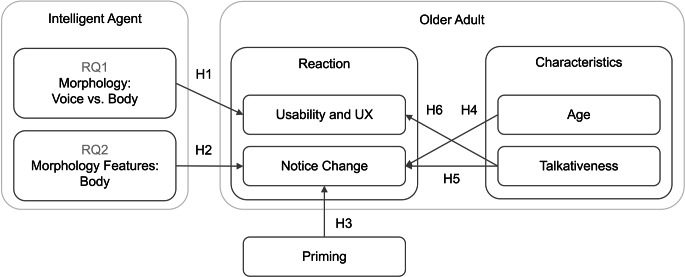
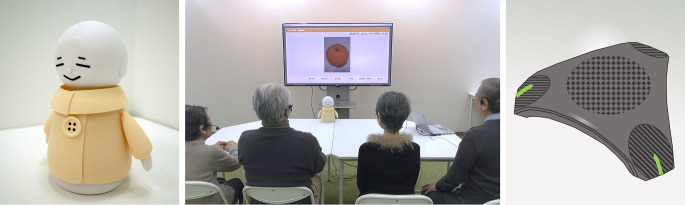
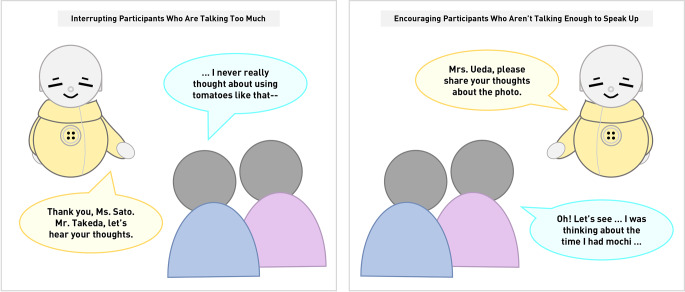
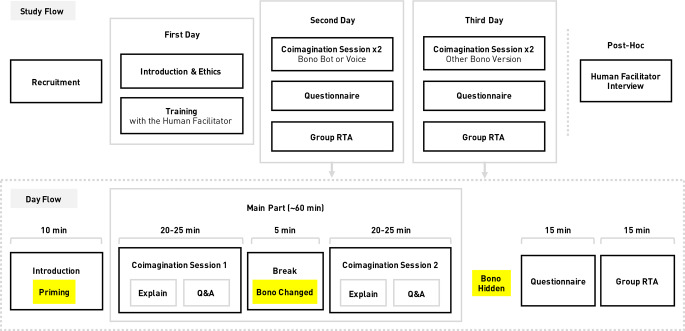
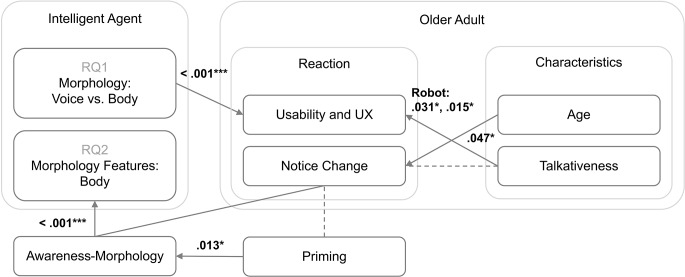
Intelligent agents have great potential as facilitators of group conversation among older adults. However, little is known about how to design agents for this purpose and user group, especially in terms of agent embodiment. To this end, we conducted a mixed methods study of older adults’ reactions to voice and body in a group conversation facilitation agent. Two agent forms with the same underlying artificial intelligence (AI) and voice system were compared: a humanoid robot and a voice assistant. One preliminary study (total n = 24) and one experimental study comparing voice and body morphologies (n = 36) were conducted with older adults and an experienced human facilitator. Findings revealed that the artificiality of the agent, regardless of its form, was beneficial for the socially uncomfortable task of conversation facilitation. Even so, talkative personality types had a poorer experience with the “bodied” robot version. Design implications and supplementary reactions, especially to agent voice, are also discussed.
Overview
The claims and statistics of this paper haven’t been checked yet.
Free: it reads the open-access text and checks the first 5 claims that cite a source we can check. Create a free account to check every claim.
Integrity signals
Registry
Cites
Statistics
Figures
Verification
Claims the paper makes
The claims and statistics of this paper haven’t been checked yet.
Free: it reads the open-access text and checks the first 5 claims that cite a source we can check. Create a free account to check every claim.
Claims other papers make about this one
Each is checked against this paper’s own text: does it say what the citing paper says it does?
The source backs part of the claim, not all of it — or backs it for a different population, condition or comparison.
In the citing paper
“As established by Seaborn etal. (2023), speech interaction leverages natural speech-based communication patterns, mirroring daily conversational flows.”
From The impact of usage experience and input modality on trust experience and cognitive load in older adults (2025) · cites this paper as Seaborn et al. (2023)
Experimental — accuracy not yet measured
Self-check
Percentages, sums and reported differences re-computed from the paper’s own numbers.
The self-check needs the paper’s full text.
Citations
Cites
Using thematic analysis in psychology
Braun, V., & Clarke, V. (2006) · Qualitative Research in Psychology · doi:10.1191/1478088706qp063oa · Cited by 194,414
Designing and Conducting Mixed Methods Research
Robinson, P. (2007) · Australian and New Zealand Journal of Public Health · doi:10.1111/j.1753-6405.2007.00096.x · Cited by 23,258
Content analysis and thematic analysis: Implications for conducting a qualitative descriptive study
Vaismoradi, M., Turunen, H., & Bondas, T. (2013) · Nursing & Health Sciences · doi:10.1111/nhs.12048 · Cited by 8,327
Guest, G., MacQueen, K., & Namey, E. (2012) · doi:10.4135/9781483384436 · Cited by 7,924
Toward a definition of mixed methods research
Johnson, R. B., Onwuegbuzie, A. J., & Turner, L. A. (2007) · Journal of Mixed Methods Research · doi:10.1177/1558689806298224 · Cited by 6,464
An Empirical Evaluation of the System Usability Scale
Bangor, A., Kortum, P. T., & Miller, J. T. (2008) · International Journal of Human–Computer Interaction · doi:10.1080/10447310802205776 · Cited by 5,181
Gorillas in our midst: sustained inattentional blindness for dynamic events
Simons, D. J., & Chabris, C. F. (1999) · Perception · doi:10.1068/p281059 · Cited by 3,181
The trouble with overconfidence.
Moore, D. A., & Healy, P. J. (2008) · Psychological Review · doi:10.1037/0033-295x.115.2.502 · Cited by 2,358
Valtorta, N. K., Kanaan, M., Gilbody, S., Ronzi, S., & Hanratty, B. (2016) · Heart · doi:10.1136/heartjnl-2015-308790 · Cited by 1,971 · cited 1×
“Social applications may be particularly relevant for older adults, who are at risk of isolation and the severe negative impacts it can have on well-being and physical health [17, 18].”
BackgroundProceedings of the 2020 CHI Conference on Human Factors in Computing Systems
(2020) · doi:10.1145/3313831 · Cited by 1,951
Embodied Conversational Agents
(2000) · The MIT Press eBooks · doi:10.7551/mitpress/2697.001.0001 · Cited by 1,799
Breazeal, C. (2002) · The MIT Press eBooks · doi:10.7551/mitpress/2376.001.0001 · Cited by 1,553
Emotion and sociable humanoid robots
Breazeal, C. (2003) · International Journal of Human-Computer Studies · doi:10.1016/s1071-5819(03)00018-1 · Cited by 1,279
The digital divide has grown old: Determinants of a digital divide among seniors
Friemel, T. N. (2016) · New Media & Society · doi:10.1177/1461444814538648 · Cited by 1,136
Rensink, R. A. (2002) · Annual Review of Psychology · doi:10.1146/annurev.psych.53.100901.135125 · Cited by 850
Reminiscence therapy for dementia
Woods, B., O'Philbin, L., Farrell, E. M., Spector, A. E., & Orrell, M. (2018) · Cochrane Database of Systematic Reviews · doi:10.1002/14651858.cd001120.pub3 · Cited by 782
Wizard of Oz Studies in HRI: A Systematic Review and New Reporting Guidelines
Riek, L. (2012) · Journal of Human-Robot Interaction · doi:10.5898/jhri.1.1.riek · Cited by 779
Li, J. (2015) · International Journal of Human-Computer Studies · doi:10.1016/j.ijhcs.2015.01.001 · Cited by 652
Holt-Lunstad, J. (2017) · Public Policy & Aging Report · doi:10.1093/ppar/prx030 · Cited by 569 · cited 1×
“Social applications may be particularly relevant for older adults, who are at risk of isolation and the severe negative impacts it can have on well-being and physical health [17, 18].”
BackgroundAnimal-Assisted Therapy and Loneliness in Nursing Homes: Use of Robotic versus Living Dogs
Banks, M. R., Willoughby, L. M., & Banks, W. A. (2008) · Journal of the American Medical Directors Association · doi:10.1016/j.jamda.2007.11.007 · Cited by 548
The Psychosocial Effects of a Companion Robot: A Randomized Controlled Trial
Robinson, H., MacDonald, B., Kerse, N., & Broadbent, E. (2013) · Journal of the American Medical Directors Association · doi:10.1016/j.jamda.2013.02.007 · Cited by 546
van den Haak, M., De Jong, M., & Jan Schellens, P. (2003) · Behaviour & Information Technology · doi:10.1080/0044929031000 · Cited by 486
Portet, F., Vacher, M., Golanski, C., Roux, C., & Meillon, B. (2013) · Personal and Ubiquitous Computing · doi:10.1007/s00779-011-0470-5 · Cited by 421
Creating Rapport with Virtual Agents
Gratch, J., Wang, N., Gerten, J., Fast, E., & Duffy, R. (2007) · Lecture Notes in Computer Science · doi:10.1007/978-3-540-74997-4_12 · Cited by 419
Exploring Privilege in the Digital Divide: Implications for Theory, Policy, and Practice
Fang, M. L., Canham, S. L., Battersby, L., Sixsmith, J., Wada, M., & Sixsmith, A. (2019) · The Gerontologist · doi:10.1093/geront/gny037 · Cited by 353
Is an Entertainment Robot Useful in the Care of Elderly People With Severe Dementia?
Tamura, T., Yonemitsu, S., Itoh, A., Oikawa, D., Kawakami, A., Higashi, Y., Fujimooto, T., & Nakajima, K. (2004) · The Journals of Gerontology Series A: Biological Sciences and Medical Sciences · doi:10.1093/gerona/59.1.m83 · Cited by 317
Sabanovic, S., Bennett, C. C., Chang, W.-L., & Huber, L. (2013) · 2013 IEEE 13th International Conference on Rehabilitation Robotics (ICORR) · doi:10.1109/icorr.2013.6650427 · Cited by 291
Understanding adoption of intelligent personal assistants: A parasocial relationship perspective
Han, S., & Yang, H. (2018) · Industrial Management & Data Systems · doi:10.1108/imds-05-2017-0214 · Cited by 289
Use of Intelligent Voice Assistants by Older Adults with Low Technology Use
Pradhan, A., Lazar, A., & Findlater, L. (2020) · ACM Transactions on Computer-Human Interaction · doi:10.1145/3373759 · Cited by 285
Domestic robots for older adults: attitudes, preferences, and potential
Smarr, C.-A., Mitzner, T. L., Beer, J. M., Prakash, A., Chen, T. L., Kemp, C. C., & Rogers, W. A. (2014) · International Journal of Social Robotics · doi:10.1007/s12369-013-0220-0 · Cited by 253
Voice in Human–Agent Interaction: A Survey
Seaborn, K., Miyake, N. P., Pennefather, P., & Otake-Matsuura, M. (2022) · ACM Computing Surveys · doi:10.1145/3386867 · Cited by 249
Self-citationRobust Aging among the Young-Old, Old-Old, and Oldest-Old
Garfein, A. J., & Herzog, A. R. (1995) · The Journals of Gerontology Series B: Psychological Sciences and Social Sciences · doi:10.1093/geronb/50b.2.s77 · Cited by 243
Hess, T. M., Hinson, J. T., & Statham, J. A. (2004) · Psychology and Aging · doi:10.1037/0882-7974.19.3.495 · Cited by 231
Embodiment in Socially Interactive Robots
Deng, E., Mutlu, B., & Matarić, M. J. (2019) · Foundations and Trends® in Robotics · doi:10.1561/2300000056 · Cited by 229
Never too old: engaging retired people inventing the future with MaKey MaKey
Rogers, Y., Paay, J., Brereton, M., Vaisutis, K. L., Marsden, G., & Vetere, F. (2014) · Proceedings of the SIGCHI Conference on Human Factors in Computing Systems · doi:10.1145/2556288.2557184 · Cited by 227
The press of personality: A study of conversations between introverts and extraverts.
Thorne, A. (1987) · Journal of Personality and Social Psychology · doi:10.1037//0022-3514.53.4.718 · Cited by 226
A Systematic Review of the Use of Technology for Reminiscence Therapy
Lazar, A., Thompson, H., & Demiris, G. (2014) · Health Education & Behavior · doi:10.1177/1090198114537067 · Cited by 219
Who's In Control?: Interactions In Multi-User Smart Homes
Geeng, C., & Roesner, F. (2019) · Proceedings of the 2019 CHI Conference on Human Factors in Computing Systems · doi:10.1145/3290605.3300498 · Cited by 195
Methods for human – computer interaction research with older people
Dickinson, A., Arnott, J., & Prior, S. (2007) · Behaviour & Information Technology · doi:10.1080/01449290601176948 · Cited by 193
Brooker, D., & Duce, L. (2000) · Aging & Mental Health · doi:10.1080/713649967 · Cited by 180
A systematic review of research into how robotic technology can help older people
Shishehgar, M., Kerr, D., & Blake, J. (2018) · Smart Health · doi:10.1016/j.smhl.2018.03.002 · Cited by 175
Laughter, the Best Mediation: Humor as Emotion Management in Interaction
Francis, L. E. (1994) · Symbolic Interaction · doi:10.1525/si.1994.17.2.147 · Cited by 164
Conversation Disrupts Change Detection in Complex Traffic Scenes
McCarley, J. S., Vais, M. J., Pringle, H., Kramer, A. F., Irwin, D. E., & Strayer, D. L. (2004) · Human Factors: The Journal of the Human Factors and Ergonomics Society · doi:10.1518/hfes.46.3.424.50394 · Cited by 164
Dominance as Expressed and Inferred Through Speaking Time.: A Meta-Analysis
Mast, M. S. (2002) · Human Communication Research · doi:10.1111/j.1468-2958.2002.tb00814.x · Cited by 163
"Alexa is a Toy": Exploring Older Adults' Reasons for Using, Limiting, and Abandoning Echo
Trajkova, M., & Martin-Hammond, A. (2020) · Proceedings of the 2020 CHI Conference on Human Factors in Computing Systems · doi:10.1145/3313831.3376760 · Cited by 154 · cited 5×
“Trajkova and Martin-Hammond [7] focused on older adults’ use of Amazon’s Alexa (via the Echo smart speaker) over a year period.”
BackgroundResultInfluentialKim, S. (2021) · JMIR mHealth and uHealth · doi:10.2196/20427 · Cited by 153 · cited 1×
“Centering older adults as users of voice-based and voice-only agents, interfaces, and systems—voice assistants, conversational user interfaces (CUIs), VUIs, and smart speakers, to name a few—is nascent but needs more attention [3, 7, 10, 27, 46, 47].”
BackgroundHsieh, S. H., & Lee, C. T. (2021) · Journal of Research in Interactive Marketing · doi:10.1108/jrim-11-2019-0179 · Cited by 147
Comparing Social Robot, Screen and Voice Interfaces for Smart-Home Control
Luria, M., Hoffman, G., & Zuckerman, O. (2017) · Proceedings of the 2017 CHI Conference on Human Factors in Computing Systems · doi:10.1145/3025453.3025786 · Cited by 134
Situated facial displays: towards social interaction
Takeuchi, A., & Naito, T. (1995) · Proceedings of the SIGCHI conference on Human factors in computing systems - CHI '95 · doi:10.1145/223904.223965 · Cited by 133
Older Adults and Voice Interaction: A Pilot Study with Google Home
Kowalski, J., Jaskulska, A., Skorupska, K., Abramczuk, K., Biele, C., Kopeć, W., & Marasek, K. (2019) · Extended Abstracts of the 2019 CHI Conference on Human Factors in Computing Systems · doi:10.1145/3290607.3312973 · Cited by 125
Face Value? Exploring the Effects of Embodiment for a Group Facilitation Agent
Shamekhi, A., Liao, Q. V., Wang, D., Bellamy, R. K. E., & Erickson, T. (2018) · Proceedings of the 2018 CHI Conference on Human Factors in Computing Systems · doi:10.1145/3173574.3173965 · Cited by 124
Bornstein, B. H., & Zickafoose, D. J. (1999) · Journal of Experimental Psychology: Applied · doi:10.1037//1076-898x.5.1.76 · Cited by 116
Where to Next? The Impact of COVID-19 on Human-Robot Interaction Research
Feil-Seifer, D., Haring, K. S., Rossi, S., Wagner, A. R., & Williams, T. (2020) · ACM Transactions on Human-Robot Interaction · doi:10.1145/3405450 · Cited by 114
Zubatiy, T., Vickers, K. L., Mathur, N., & Mynatt, E. D. (2021) · Proceedings of the 2021 CHI Conference on Human Factors in Computing Systems · doi:10.1145/3411764.3445124 · Cited by 105
Voice assistants and older people: some open issues
Sayago, S., Neves, B. B., & Cowan, B. R. (2019) · Proceedings of the 1st International Conference on Conversational User Interfaces · doi:10.1145/3342775.3342803 · Cited by 97
Collaborative narration of the past and extraversion
McLean, K. C., & Pasupathi, M. (2006) · Journal of Research in Personality · doi:10.1016/j.jrp.2005.11.006 · Cited by 96
Creating New Technologies for Companionable Agents to Support Isolated Older Adults
Sidner, C. L., Bickmore, T., Nooraie, B., Rich, C., Ring, L., Shayganfar, M., & Vardoulakis, L. (2018) · ACM Transactions on Interactive Intelligent Systems · doi:10.1145/3213050 · Cited by 89
dos Reis, A. M., Paulino, D., Paredes, H., & Barroso, J. (2017) · Lecture notes in computer science · doi:10.1007/978-3-319-58700-4_48 · Cited by 84
The huggable: a therapeutic robotic companion for relational, affective touch
Stiehl, W. D., Lieberman, J., Breazeal, C., Basel, L., Cooper, R., Knight, H., Lalla, L., Maymin, A., & Purchase, S. (2006) · IEEE Consumer Communications and Networking Conference · doi:10.1109/ccnc.2006.1593253 · Cited by 77
Stimulating people with dementia to reminisce using personal and generic photographs
Astell, A. J., Ellis, M. P., Alm, N. A., Dye, R., & Gowans, G. (2010) · International Journal of Computers in Healthcare · doi:10.1504/ijcih.2010.037461 · Cited by 68
Zuckerman, O., Walker, D., Grishko, A., Moran, T., Levy, C., Lisak, B., Wald, I. Y., & Erel, H. (2020) · CHI Conference on Human Factors in Computing Systems · doi:10.1145/3313831.3376411 · Cited by 68
Hands free - care free: elderly people taking advantage of speech-only interaction
Wulf, L., Garschall, M., Himmelsbach, J., & Tscheligi, M. (2014) · Proceedings of the 8th Nordic Conference on Human-Computer Interaction: Fun, Fast, Foundational · doi:10.1145/2639189.2639251 · Cited by 64
Newell, A. F. (2011) · Synthesis lectures on assistive, rehabilitative, and health-preserving technologies · doi:10.2200/s00369ed1v01y201106arh001 · Cited by 64
The Effects of Anthropomorphism and Non-verbal Social Behaviour in Virtual Assistants
Kontogiorgos, D., Pereira, A., Andersson, O., Koivisto, M., Gonzalez Rabal, E., Vartiainen, V., & Gustafson, J. (2019) · Proceedings of the 19th ACM International Conference on Intelligent Virtual Agents · doi:10.1145/3308532.3329466 · Cited by 63
What Older People Expect of Robots: A Mixed Methods Approach
Frennert, S., Eftring, H., & Östlund, B. (2013) · Lecture Notes in Computer Science · doi:10.1007/978-3-319-02675-6_3 · Cited by 60
Supporting Stimulation Needs in Dementia Care through Wall-Sized Displays
Sas, C., Davies, N., Clinch, S., Shaw, P., Mikusz, M., Steeds, M., & Hughes-Noehrer, L. (2020) · CHI Conference on Human Factors in Computing Systems · doi:10.1145/3313831.3376361 · Cited by 59
A shared mechanism for facial expression in human faces and face pareidolia
Alais, D., Xu, Y., Wardle, S. G., & Taubert, J. (2021) · Proceedings of the Royal Society B Biological Sciences · doi:10.1098/rspb.2021.0966 · Cited by 59
Better Than Human: About the Psychological Superpowers of Robots
Welge, J., & Hassenzahl, M. (2016) · Lecture notes in computer science · doi:10.1007/978-3-319-47437-3_97 · Cited by 53
Age-related decline of visual processing components in change detection.
Costello, M. C., Madden, D. J., Mitroff, S. R., & Whiting, W. L. (2010) · Psychology and Aging · doi:10.1037/a0017625 · Cited by 52
Approach Matters: Linking Practitioner Approaches to Technology Design for People with Dementia
Dixon, E., & Lazar, A. (2020) · Proceedings of the 2020 CHI Conference on Human Factors in Computing Systems · doi:10.1145/3313831.3376432 · Cited by 52
Perceptions of Digital Assistants From Early Adopters Aged 55+
Koon, L. M., McGlynn, S. A., Blocker, K. A., & Rogers, W. A. (2020) · Ergonomics in Design: The Quarterly of Human Factors Applications · doi:10.1177/1064804619842501 · Cited by 51
Otake, M., Tokunaga, S., Watanabe, K., Abe, M., Sekiguchi, T., Sugimoto, H., Kishimoto, T., & Kudo, T. (2021) · Frontiers in Robotics and AI · doi:10.3389/frobt.2021.633076 · Cited by 51 · cited 2×
“Benefits include feelings of ownership, reduced barriers with visual media, a social experience, the potential for building and maintaining social networks, and mitigating risk factors related to cognitive decline [19, 67].”
BackgroundSelf-citationCaptioned photographs in psychosocial aged care: relationship building and boundary work
Waycott, J., Davis, H., Vetere, F., Morgans, A., Gruner, A., Ozanne, E., & Kulik, L. (2014) · Proceedings of the SIGCHI Conference on Human Factors in Computing Systems · doi:10.1145/2556288.2557290 · Cited by 44
Wizard of Awwws: Exploring Psychological Impact on the Researchers in Social HRI Experiments
Rea, D. J., Geiskkovitch, D. Y., & Young, J. E. (2017) · ACM/IEEE International Conference on Human-Robot Interaction (HRI) · doi:10.1145/3029798.3034782 · Cited by 40
Beyond Reminiscence: Using Generic Video to Elicit Conversational Language
Davis, B. H., & Shenk, D. (2014) · American Journal of Alzheimer s Disease & Other Dementias® · doi:10.1177/1533317514534759 · Cited by 32
Virtual Assistant to Improve Self-care of Older People with Type 2 Diabetes: First Prototype
Buinhas, S., Cláudio, A. P., Carmo, M. B., Balsa, J., Cavaco, A. M. D. N., Mendes, A., Félix, I. B., Pimenta, N. M., & Guerreiro, M. P. (2019) · Communications in computer and information science · doi:10.1007/978-3-030-16028-9_21 · Cited by 30
Embodiment, Situatedness, and Morphology for Humanoid Robots Interacting with People
Miller, B., & Feil-Seifer, D. (2017) · Springer eBooks · doi:10.1007/978-94-007-7194-9_130-1 · Cited by 28
Robot vs. Voice Assistant: Is Playing with Pepper More Fun than Playing with Alexa?
Pollmann, K., Ruff, C. B., Vetter, K., & Zimmermann, G. (2020) · ACM/IEEE International Conference on Human-Robot Interaction (HRI) · doi:10.1145/3371382.3378251 · Cited by 25
Sengupta, K., Sarcar, S., Pradhan, A., McNaney, R., Sayago, S., Chattopadhyay, D., & Joshi, A. (2020) · Extended Abstracts of the 2020 CHI Conference on Human Factors in Computing Systems · doi:10.1145/3334480.3381057 · Cited by 23
Sin, J., & Munteanu, C. (2019) · CHI Conference Extended Abstracts on Human Factors in Computing Systems (CHI EA) · doi:10.1145/3290607.3312941 · Cited by 20 · cited 5×
“Social robots, voice assistants, smart devices in the home, and voice user interfaces (VUIs) on an array of devices are increasingly being explored with older adults [1–9].”
BackgroundInfluentialThe Coimagination Method and its Evaluation via the Conversation Interactivity Measuring Method
Otake, M., Kato, M., Takagi, T., & Asama, H. (2011) · IGI Global eBooks · doi:10.4018/978-1-60960-559-9.ch043 · Cited by 15
Selective visual attention occurred in change detection derived by animacy of robot's appearance
Bae, J.-E., & Kim, M.-S. (2011) · International Conference on Collaboration Technologies and Systems (CTS) · doi:10.1109/cts.2011.5928686 · Cited by 13
A Pilot Study Of Robot Reminiscence In Dementia Care
Yamazaki, R., Kochi, M., Zhu, W., & Kase, H. (2018) · Zenodo (CERN European Organization for Nuclear Research) · doi:10.5281/zenodo.1316805 · Cited by 9
A Robot Presenting Reproduced Stories among Older Adults in Group Conversation
Yamaguchi, K., Nergui, M., & Otake, M. (2014) · Applied Mechanics and Materials · doi:10.4028/www.scientific.net/amm.541-542.1120 · Cited by 7
Interactive Voice Technologies and the Digital Marginalization of Older Adults
Sin, J. (2019) · International Conference on Human-Computer Interaction with Mobile Devices and Services (MobileHCI) · doi:10.1145/3338286.3344423 · Cited by 5
Senn, S. J. (2005) · Wiley eBooks · doi:10.1002/0470011815.b2a01016 · Cited by 2
Research works printed but not linked: 4
- Hasegawa D, Cassell J, Araki K (2010) The role of embodiment and perspective in direction-giving systems. In: 2010 AAAI Fall Symposium Series. AAAI
- Matsuyama Y, Taniyama H, Fujie S, Kobayashi T (2010) Framework of communication activation robot participating in multiparty conversation. In: Proceedings of the 2010 AAAI Fall Symposium Series
- Weiss A, Bernhaupt R, Tscheligi M, Yoshida E (2009) Addressing user experience and societal impact in a user study with a humanoid robot. In: Adaptive and Emergent Behaviour and Complex Systems - Proceedings of the 23rd Convention of the Society for the Study of Artificial Intelligence and Simulation of Behaviour. Citeseer, Edinburgh, UK, pp–150–157
- Likert R (1932) A technique for the measurement of attitudes. Arch Psychol 22:. https://doi.org/1933-01885-001
Cited by
Irfan, B., Kuoppamäki, S., Hosseini, A., & Skantze, G. (2025) · Autonomous Robots · doi:10.1007/s10514-025-10190-y · Cited by 108
Kuoppamäki, S., Jaberibraheem, R., Hellstrand, M., & McMillan, D. (2023) · International Journal of Social Robotics · doi:10.1007/s12369-023-01055-4 · Cited by 27
“Only few studies have investigated the gaze interaction with older adults [50, 52, 53].”
BackgroundInfluentialLeveraging Chatbots to Combat Health Misinformation for Older Adults: Participatory Design Study
Peng, W., Lee, H. R., & Lim, S. (2024) · JMIR Formative Research · doi:10.2196/60712 · Cited by 33
“Some studies have already shown how technologies such as social robots and voice assistants could be used to promote social connectedness and facilitate conversations in older adult communities [83,84].”
BackgroundArtificial intelligence in voice assistants: User benefits explored
Kim, M., & Kim, J. (2024) · International Journal of Consumer Studies · doi:10.1111/ijcs.13019 · Cited by 20
"This machine is for the aides": Tailoring Voice Assistant Design to Home Health Care Work
Bartle, V., Albright, L., & Dell, N. (2023) · Proceedings of the 2023 CHI Conference on Human Factors in Computing Systems · doi:10.1145/3544548.3581118 · Cited by 18
“This idea connects to recent work that explores how to design intelligent agents to facilitate group conversation among older adults [69].”
Background
Metadata
- Authors
- Seaborn, K., Sekiguchi, T., Tokunaga, S., Miyake, N. P., & Otake-Matsuura, M.
- Affiliations
- Tokyo Institute of Technology (JP)
- RIKEN Center for Advanced Intelligence Project (JP)
- Corresponding author
- Seaborn, Katie
- Venue
- International Journal of Social Robotics
- Published
- 2022-11-11
- Volume
- 15
- Issue
- 2
- Pages
- 143-163
- ISSN
- 1875-4791 (ISSN-L)
- 1875-4805
- PMC
- PMC9651097
- OpenAlex
- W4308798315
- Cited by
- 43
- References
- 86
- Citations by year
- 2026: 14 · 2025: 14 · 2024: 10 · 2023: 5
- FWCI
- 6.85
- Type
- journal article
- Language
- en
- Open access
- hybrid
- doi.org
- Licence
- cc-by
- creativecommons.org/licenses/by/4.0 (tdm)
- creativecommons.org/licenses/by/4.0 (vor)
- Locations
- International Journal of Social Robotics (publishedVersion, cc-by)
- arXiv (Cornell University) (publishedVersion)
- PubMed Central (publishedVersion, cc-by)
- PubMed (publishedVersion)
- Institutional Repositories DataBase (IRDB) (submittedVersion, cc-by-nc-nd)
- Institutional Repositories DataBase (IRDB) (submittedVersion, cc-by)
- Tokyo Tech Research Repository (Tokyo Institute of Technology) (submittedVersion, cc-by)
- arXiv (Cornell University)
- Funders
- Japan Society for the Promotion of Science (18KT0035; 19H01138; 20H05022; 20H05574)
- Japan Agency for Medical Research and Development (JP19he2002014)
- Topics
- Social Sciences › Psychology › Social Psychology › Social Robot Interaction and HRI
- Social Sciences › Business, Management and Accounting › Marketing › AI in Service Interactions
- Physical Sciences › Computer Science › Artificial Intelligence › Speech and dialogue systems
- Keywords
- older adults, dialogue facilitation, group conversation, humanoid robots, voice assistants, artificiality, talkativeness, user experience, social interaction
About these checks
Registry, retraction, Cites and statistics results are computed, not judged, with one exception: a printed reference that no index lists is read once by a model before it counts as a citation error. Claims are extracted by a model and kept only when their quote appears verbatim in the text; each cited source is then checked, with a model’s help, for whether it says what the claim relies on. Those verdicts can be wrong — read the claim’s quote and the cited source before relying on one.
Statistics and arithmetic are recomputed, not judged.
Confidence bands are shown only for fields calibrated on our annotated test set. None is calibrated yet, so no band is shown.
What counts as a claim ›How we measure confidence ›How we check this ›
Are you an author, or do you see a problem with this page? Request a review
Data sources
Bibliographic data: Semantic Scholar, OpenAlex, Crossref.
Contains information from the Semantic Scholar Academic Graph Datasets, made available under the ODC Attribution License (ODC-BY 1.0).
Semantic Scholar’s data is described in: Kinney, R., et al. (2023). The Semantic Scholar Open Data Platform. arXiv:2301.10140.
