

The neurobiological link between OCD and ADHD
Open accessThe DOI matches its Crossref record; 345 of the 346 references it cites were found in a registry or an index; 18 of the 222 sources its claims cite were checked for support.
Abstract
Obsessive compulsive disorder (OCD) and attention deficit hyperactivity disorder (ADHD) are two of the most common neuropsychiatric diseases in paediatric populations. The high comorbidity of ADHD and OCD with each other, especially of ADHD in paediatric OCD, is well described. OCD and ADHD often follow a chronic course with persistent rates of at least 40-50 %. Family studies showed high heritability in ADHD and OCD, and some genetic findings showed similar variants for both disorders of the same pathogenetic mechanisms, whereas other genetic findings may differentiate between ADHD and OCD. Neuropsychological and neuroimaging studies suggest that partly similar executive functions are affected in both disorders. The deficits in the corresponding brain networks may be responsible for the perseverative, compulsive symptoms in OCD but also for the disinhibited and impulsive symptoms characterizing ADHD. This article reviews the current literature of neuroimaging, neurochemical circuitry, neuropsychological and genetic findings considering similarities as well as differences between OCD and ADHD.
Overview
CoChat Summary
TL;DR
This review compares neurobiological, neuropsychological, neurochemical, and genetic findings in OCD and ADHD, highlighting shared cortico-striato-thalamic circuit dysfunction alongside disorder-specific dopamine/serotonin and impulsive–compulsive contrasts. It concludes that ADHD and OCD are highly comorbid but differ in key neurochemical and genetic profiles, with few studies directly comparing both disorders.
Key findings
- ADHD and OCD are highly comorbid: ADHD prevalence in OCD-affected individuals was 11.8%, and in two consecutive referred paediatric OCD samples comorbid ADHD was 17.1% and 25.5%; comorbid OCD among children with ADHD was estimated at 8%. OCD persistence is at least 40%, and ADHD persists into adulthood in 60–70% of cases.
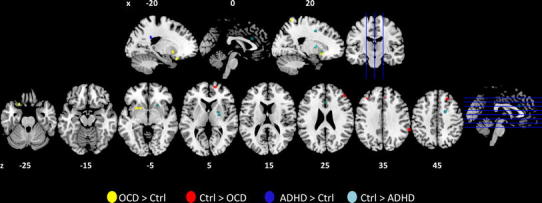
- Both disorders involve cortico-striato-thalamic circuit dysfunction, but with opposing patterns: ADHD shows reduced basal ganglia volume (especially lentiform nucleus and caudate) and ACC hypoactivation/diminished error-related negativity, whereas OCD shows increased basal ganglia volume in more recent studies and ACC overactivation/enhanced error-related negativity.
- In a Stop-Task meta-analysis, inhibitory deficits were medium-sized in both ADHD (g = 0.62) and OCD (g = 0.77); direct comparison found ADHD chose less frequently the larger, more delayed reward, while OCD showed impaired implicit learning, and ADHD was unimpaired in implicit learning.
- Genetics and neurochemistry diverge: ADHD heritability was estimated around 70–80% (or 60% in more recent approaches), with linkage evidence on chromosome 16q (CDH13) and chromosome 5 (DRD1, DAT1); OCD symptom heritability ranged from 0.45–0.65 in children and 0.27–0.47 in adults, with no significant genome-wide linkage but some evidence on chromosomes 1 and 10. The proposed neurotransmitter rank order is dopamine–noradrenaline–glutamate–serotonin for ADHD and serotonin–glutamate = dopamine–noradrenaline for OCD.
Methods
- Narrative review comparing structural/functional neuroimaging, neuropsychological, neurochemical, and genetic findings in OCD and ADHD, focusing on meta-analyses where possible.
- No primary sample or new data; synthesizes published studies, including rare direct comparisons such as paediatric fMRI studies by Rubia et al. (2010, 2011) and a neuropsychological comparison by Vloet et al. (2010).
- Main analysis is qualitative synthesis and contrast of shared versus disorder-specific mechanisms; no new statistical analysis is reported.
Limitations
- The paper states that only very few studies have investigated OCD and ADHD together or directly compared both within the same study, so many findings come from each disorder alone.
- The paper states that most studies used ICD-10 or DSM-IV, so confounding by degree of insight and by previous or present tic disorders could not be answered; future DSM-5-based studies are needed.
- Evident from the text: as a narrative review, no systematic search strategy, quality appraisal, or meta-analytic pooling is reported; direct comparison evidence is limited to small paediatric samples, and one OCD finding may be confounded by medication and low symptom severity in partly remitted patients.
Model-written summary. Check it against the paper before relying on it.
Integrity signals
Registry
Cites
Statistics
Figures
Verification
Claims the paper makes
16 Valid · 8 Not valid · 128 Not checked · 27 Own results and interpretations
Every source the paper cites for this claim was checked and supports it.
In the paper
“Sheppard et al. (2010) ascertained in a recent study an ADHD prevalence of 11.8 % in OCD-affected individuals.”
§ The neurobiological link between OCD and ADHD > Introduction
What the sources say
- Supportedcites Sheppard et al. 2010 matched to “ADHD prevalence and association with hoarding behaviors in childhood-onset OCD” (2010) source
The Discussion reports definite ADHD in 11.8% of the study’s OCD-affected sample. The figure refers to individuals with childhood-onset OCD without comorbid tic disorders, rather than to all individuals with OCD. (LLM, conf=0.94)
plainstates an association- Asserted: passes — The authors put it forward as true.
- Checkable: passes — It can be checked against evidence.
- Load-bearing: unclear — It is unclear whether the paper’s conclusions depend on it.
- Based: passes — The paper gives a reason why it holds.
- Supported
The cited sources support only part of this claim — read each source’s verdict below.
In the paper
“In contrast, performance monitoring and error and conflict processing in ADHD patients seem to induce less activation in the ACC as demonstrated by fMRI (Durston et al. 2003b; Rubia et al. 2010, 2005; Tamm et al. 2004) and ERP studies (Albrecht et al. 2010, 2008; Groen et al. 2008; Liotti et al. 2005; McLoughlin et al. 2009; van Meel et al. 2007).”
§ The neurobiological link between OCD and ADHD > Structural and functional abnormalities in OCD and ADHD
What the sources say
- Not checked yetcites Durston et al. 2003b
- Not checked yetcites Rubia et al. 2010 matched to “Disorder‐specific dysfunction in right inferior prefrontal cortex during two inhibition tasks in boys with attention‐deficit hyperactivity disorder compared to boys with obsessive–compulsive disorder” (2010) source
- Partly supportedcites Albrecht et al. 2010 matched to “Action monitoring in children with or without a family history of ADHD - Effects of gender on an endophenotype parameter” (2010) sourceExperimental — accuracy not yet measured
The Introduction reports diminished conflict-related N2 and error-related Ne signals in children with ADHD, particularly on demanding tasks. The paper's own Results compare unaffected siblings with controls. Neither those ERP findings nor the Introduction establish that the reduced signals reflect less activation specifically in the ACC; the fMRI studies are cited separately in the claiming sentence. (LLM, conf=0.86)
hedgedstates a cause- Asserted: passes — The authors put it forward as true.
- Checkable: passes — It can be checked against evidence.
- Load-bearing: passes — The paper’s conclusions depend on it.
- Based: passes — The paper gives a reason why it holds.
The cited sources support only part of this claim — read each source’s verdict below.
In the paper
“A review (Piras et al. 2013) and two meta-analyses (Radua and Mataix-Cols 2009, Rotge et al. 2010) pointed to relatively consistent patterns of increased basal ganglia volume in more recent studies.”
§ The neurobiological link between OCD and ADHD > Structural and functional abnormalities in OCD and ADHD
What the sources say
- Not checked yetcites Piras et al. 2013
- Supportedcites Radua and Mataix-Cols 2009 matched to “Voxel-wise meta-analysis of grey matter changes in obsessive-compulsive disorder” (2009) source
The Discussion (p. 7) says this meta-analysis found increased regional grey matter volume in the basal ganglia of people with OCD, particularly the putamen and caudate nucleus, and reports that sensitivity analyses supported the finding. It also notes that individual structural imaging studies had been inconsistent; the relatively consistent pattern is the meta-analytic finding, not a claim that every study agreed. (LLM, conf=0.87)
- Partly supportedcites Rotge et al. 2010 matched to “Gray Matter Alterations in Obsessive–Compulsive Disorder: An Anatomic Likelihood Estimation Meta-Analysis” (2010) sourceExperimental — accuracy not yet measured
The Discussion reports greater basal ganglia gray matter density in OCD patients, supporting the claimed pattern of increased basal ganglia gray matter. But it distinguishes density from volume: it says a prior volume meta-analysis found no basal ganglia change and cautions that factors other than volume can affect VBM results. Our copy therefore does not establish increased basal ganglia volume. (LLM, conf=0.87)
plainstates an association- Asserted: passes — The authors put it forward as true.
- Checkable: passes — It can be checked against evidence.
- Load-bearing: unclear — It is unclear whether the paper’s conclusions depend on it.
- Based: passes — The paper gives a reason why it holds.
The cited sources support only part of this claim — read each source’s verdict below.
In the paper
“Besides alterations in basal ganglia, the meta-analyses of structural differences between OCD patients and healthy controls also detected reduced grey matter in the frontal eye fields, the dorsolateral prefrontal cortex, and the medial frontal cortex, including the anterior cingulate cortex (ACC) (Radua and Mataix-Cols 2009), the left and right orbito-frontal cortex (OFC), and the supramarginal g”
§ The neurobiological link between OCD and ADHD > Structural and functional abnormalities in OCD and ADHD
What the sources say
- Partly supportedcites Radua and Mataix-Cols 2009 matched to “Voxel-wise meta-analysis of grey matter changes in obsessive-compulsive disorder” (2009) sourceExperimental — accuracy not yet measured
The Discussion (p. 7) reports reduced grey matter in dorsal mediofrontal/anterior cingulate gyri extending to the frontal eye fields, supporting those regions in the clause attached to this citation. It does not identify the dorsolateral prefrontal cortex as a separate site of reduction. The orbitofrontal and supramarginal regions appear after this citation in the printed sentence and are not assessed as claims attributed to this source. (LLM, conf=0.86)
- Not checked yetcites Rotge et al. 2009 matched to “Meta-analysis of brain volume changes in obsessive-compulsive disorder” (2009) source
- Partly supportedcites Rotge et al. 2010 matched to “Gray Matter Alterations in Obsessive–Compulsive Disorder: An Anatomic Likelihood Estimation Meta-Analysis” (2010) sourceExperimental — accuracy not yet measured
The Results (page not available) report reduced gray matter density in the frontal eye fields, dorsolateral prefrontal cortex, supramarginal gyrus, and medial anterior prefrontal cortex. They report greater—not reduced—density in the lateral orbitofrontal cortex. The paper does not report reduced anterior cingulate density as a finding of this meta-analysis; the citing sentence attaches a different citation to that region. (LLM, conf=0.90)
plainstates an association- Asserted: passes — The authors put it forward as true.
- Checkable: passes — It can be checked against evidence.
- Load-bearing: passes — The paper’s conclusions depend on it.
- Based: passes — The paper gives a reason why it holds.
- Partly supported
Every source the paper cites for this claim was checked and supports it.
In the paper
“However, learning from feedback seems intact when it leads to the avoidance of negative consequences (Endrass et al. 2011).”
§ The neurobiological link between OCD and ADHD > Neuropsychological aspects in OCD and ADHD > Decision-making and reward-related processing
What the sources say
- Supportedcites Endrass et al. 2011 matched to “Approach and avoidance learning in obsessive-compulsive disorder” (2011) source
The Abstract reports that OCD patients and comparison subjects did not differ during feedback learning in the acquisition phase. In the test phase, patients were better at avoiding stimuli associated with negative outcomes, supporting the claim that this form of feedback learning was intact. (LLM, conf=0.91)
hedged- Asserted: passes — The authors put it forward as true.
- Checkable: passes — It can be checked against evidence.
- Load-bearing: unclear — It is unclear whether the paper’s conclusions depend on it.
- Based: passes — The paper gives a reason why it holds.
- Supported
89 more claims · 5 with their cited sources checked
Create a free account to see all 179 claims and to verify the 204 references still open.
- It may state two separate claims as one. 66
- Probably not a substantial claim. 26
Claims other papers make about this one
Each is checked against this paper’s own text: does it say what the citing paper says it does?
The source backs part of the claim, not all of it — or backs it for a different population, condition or comparison.
In the citing paper
“On the other hand, symptoms of attention deficit-hyperactivity disorder and depressive symptoms are common in OCD (Pallanti et al., 2011) and may contribute to neuropsychological deficits (Brem et al., 2014; Moritz et al., 2001).”
From Externally orienting cues improve cognitive control in OCD (2024) · cites this paper as Brem et al., 2014
Experimental — accuracy not yet measured
Self-check
Percentages, sums and reported differences re-computed from the paper’s own numbers.
Each contradiction between two passages listed here was confirmed by an independent check.
Rated major: it would touch a result — a value a result rests on, reported and recomputed p-values on opposite sides of the significance level, two passages that conflict with no sign which is right, or a cited work retracted before this paper was published.
In the paper
§ The neurobiological link between OCD and ADHD > Genetic aspects in OCD and ADHD > Association studies
“no single SNP or polymorphism has been found to be affected in OCD, as found in the only GWAS published to date (Stewart et al. 2013b), in which no SNP reached genome-wide significance, as well as from the meta-analysis conducted by Taylor (2013).”
§ The neurobiological link between OCD and ADHD > Genetic aspects in OCD and ADHD > Association studies
“a significant association with the rs6311 A-allele carriers of the serotonin 2A receptor (HTR2A) with OCD was confirmed by a meta-analysis (Taylor 2013; Table 2).”
Rated minor: it would not touch a result — a value no result rests on, a p-value that stays on the same side of the significance level, or a conflict that is clerical, resolved elsewhere in the paper, or outside its own findings.
In the paper
§ The neurobiological link between OCD and ADHD > Genetic aspects in OCD and ADHD > Linkage studies
“Hanna et al. (2002) who found in a second GWL scan the maximum linkage signal on chromosome 10p15.”
§ The neurobiological link between OCD and ADHD > Genetic aspects in OCD and ADHD > Linkage studies
“| 9 | 9p24 | | GWL (Hanna et al. 2002) |”
Rated minor: it would not touch a result — a value no result rests on, a p-value that stays on the same side of the significance level, or a conflict that is clerical, resolved elsewhere in the paper, or outside its own findings.
In the paper
§ The neurobiological link between OCD and ADHD > Structural and functional abnormalities in OCD and ADHD
“as well as in adults with OCD (Hajcak et al. 2008; Santesso et al. 2006)”
§ The neurobiological link between OCD and ADHD > References
“Hajcak G Franklin ME Foa EB Simons RF Increased error-related brain activity in pediatric obsessive-compulsive disorder before and after treatment”
Citations
Cites
Cognitive and emotional influences in anterior cingulate cortex
Bush, G., Luu, P., & Posner, M. I. (2000) · Trends in Cognitive Sciences · doi:10.1016/s1364-6613(00)01483-2 · Cited by 6,259 · cited 2×
“The ACC has an important role in attentional and emotional processes (Bush et al. 2000; van Veen and Carter 2002a) but, moreover, is also involved in conflict detection and evaluation (Botvinick et al. 1999; Carter et al. 2000; Durston et al. 2003a; Rid- derinkhof et al. 2004; Ullsperger and von…”
BackgroundThe functional anatomy of basal ganglia disorders
Albin, R. L., Young, A. B., & Penney, J. B. (1989) · Trends in Neurosciences · doi:10.1016/0166-2236(89)90074-x · Cited by 5,353 · cited 3×
“Healthy individuals are able to suppress such reactions (Albin et al. 1989).”
BackgroundThe worldwide prevalence of ADHD: a systematic review and metaregression analysis
Polanczyk, G., de Lima, M. S., Horta, B. L., Biederman, J., & Rohde, L. A. (2007) · American Journal of Psychiatry · doi:10.1176/ajp.2007.164.6.942 · Cited by 5,346 · cited 2×
“2 % among children and adolescents (Polanczyk et al. 2007) using DSM-IV and DSM-5”
InfluentialGenetic dissection of complex traits: guidelines for interpreting and reporting linkage results
Lander, E., & Kruglyak, L. (1995) · Nature Genetics · doi:10.1038/ng1195-241 · Cited by 5,239 · cited 2×
“This might imply the similarity in dysfunction of impulse control in both disorders, caused by dysfunctions of the serotonergic pathways.”
BackgroundLesch, K.-P., Bengel, D., Heils, A., Sabol, S. Z., Greenberg, B. D., Petri, S., Benjamin, J., Müller, C. R., Hamer, D. H., & Murphy, D. L. (1996) · Science · doi:10.1126/science.274.5292.1527 · Cited by 5,162 · cited 2×
“In comparison with the S-allele, the L-allele has been reported to exert an increased transcriptional activity and an increased basal reuptake of 5-HT in vitro (Heils et al. 1996; Lesch et al. 1996; Murphy and Lesch 2008).”
BackgroundDiagnostic and Statistical Manual of Mental Disorders, 5th Edition
(2013) · American Psychiatric Association Publishing eBooks · doi:10.1176/appi.books.9780890425596.893619 · Cited by 4,383
Calamita, E., Schmid, M., Kunz, M., Ndebele-Murisa, M. R., Magadza, C. H. D., Nyambe, I., & Wehrli, B. (2019) · Figshare · doi:10.26181/6153922fe919c · Cited by 4,222
Functional architecture of basal ganglia circuits: neural substrates of parallel processing
Alexander, G. E., & Crutcher, M. D. (1990) · Trends in Neurosciences · doi:10.1016/0166-2236(90)90107-l · Cited by 4,131 · cited 1×
“The seminal work of Albin et al. (1989), Alexander and Crutcher (1990), DeLong et al. (1985) and others implicated various ‘‘loop-systems’’ for the various phenotypes of human and animal behaviour.”
BackgroundHolroyd, C. B., & Coles, M. G. H. (2002) · Psychological Review · doi:10.1037/0033-295x.109.4.679 · Cited by 4,027 · cited 1×
“Holroyd and Coles suggested that the Ne emerges when a phasic error signal originating from the mesolimbic dopamine system is processed in the ACC in order to modify performance and update behaviour (Hol- royd and Coles 2002).”
BackgroundKessler, R. C., Adler, L., Barkley, R., Biederman, J., Conners, C. K., Demler, O., Faraone, S. V., Greenhill, L. L., Howes, M. J., Secnik, K., et al. (2006) · American Journal of Psychiatry · doi:10.1176/ajp.2006.163.4.716 · Cited by 3,886 · cited 2×
“3 %) (Fayyad et al. 2007; Kessler et al. 2006).”
Research works printed but not linked: 2
- American Psychiatric Association Diagnostic and statistical manual of mental disorders, fourth edition (DSM-IV) 1994 Washington American Psychiatric Association
- Berger W Riederer P Riederer P Laux G Pöldinger W Neurotransmitter regelkreise Neuro-psychopharmaka Bd.1 1992 Wien Springer 225 271
Cited by
Manifesto for a European research network into Problematic Usage of the Internet
Fineberg, N., Demetrovics, Z., Stein, D., Ioannidis, K., Potenza, M., Grünblatt, E., Brand, M., Billieux, J., Carmi, L., King, D., et al. (2018) · European Neuropsychopharmacology · doi:10.1016/j.euroneuro.2018.08.004 · Cited by 334
Self-citationSharma, E., Sharma, L. P., Balachander, S., Lin, B., Manohar, H., Khanna, P., Lu, C., Garg, K., Thomas, T. L., Au, A. C. L., et al. (2021) · Frontiers in Psychiatry · doi:10.3389/fpsyt.2021.703701 · Cited by 190
“Bio-psycho-social commonalities across these disorders spanning genetic, temperamental (32, 33), and neuropsychological vulnerabilities (77) plausibly account for these observations.”
BackgroundNejati, V., Salehinejad, M. A., Nitsche, M. A., Najian, A., & Javadi, A.-H. (2020) · Journal of Attention Disorders · doi:10.1177/1087054717730611 · Cited by 163
Solmi, M., Collantoni, E., Meneguzzo, P., Degortes, D., Tenconi, E., & Favaro, A. (2018) · International Journal of Eating Disorders · doi:10.1002/eat.22884 · Cited by 119
Singer, H. S. (2019) · CONTINUUM Lifelong Learning in Neurology · doi:10.1212/con.0000000000000752 · Cited by 140
Fradkin, I., Adams, R. A., Parr, T., Roiser, J. P., & Huppert, J. D. (2020) · Psychological Review · doi:10.1037/rev0000188 · Cited by 89
Hauser, T. U., Iannaccone, R., Dolan, R. J., Ball, J., Hättenschwiler, J., Drechsler, R., Rufer, M., Brandeis, D., Walitza, S., & Brem, S. (2017) · Psychological Medicine · doi:10.1017/s0033291716003305 · Cited by 86
“Our findings of hyperactive RPE signals thus support recent genetic and other findings that suggest the dopaminergic system being involved in OCD pathogenesis (Denys et al. 2004a, b; Brem et al. 2014; Pauls et al. 2014).”
ResultSelf-citationHauser, T. U., Moutoussis, M., Iannaccone, R., Brem, S., Walitza, S., Drechsler, R., Dayan, P., & Dolan, R. J. (2017) · PLOS Computational Biology · doi:10.1371/journal.pcbi.1005440 · Cited by 85
Self-citationMusullulu, H. (2025) · Frontiers in Psychology · doi:10.3389/fpsyg.2025.1466088 · Cited by 107
“It is also stated that the comorbidity of ADHD with OCD is due to genetic transmission (Brem et al., 2014).”
Trans-diagnostic measurement of impulsivity and compulsivity: A review of self-report tools
Hook, R. W., Grant, J. E., Ioannidis, K., Tiego, J., Yücel, M., Wilkinson, P. O., & Chamberlain, S. R. (2020) · Neuroscience & Biobehavioral Reviews · doi:10.1016/j.neubiorev.2020.10.007 · Cited by 77
Jacobs, G. R., Voineskos, A. N., Hawco, C. S., Stefanik, L., Forde, N. J., Dickie, E. W., Lai, M., Szatmári, P., Schachar, R. J., Crosbie, J., et al. (2020) · Neuropsychopharmacology · doi:10.1038/s41386-020-00902-6 · Cited by 71
Grünblatt, E., Hauser, T. U., & Walitza, S. (2014) · Progress in Neurobiology · doi:10.1016/j.pneurobio.2014.07.003 · Cited by 49
“E. Grünblatt et al. / Progress in Neurobiology 121 (2014) 114–124 association between OCD and dopaminergic genes – such as the DAT1 VNTR gene variant – could be confirmed and only very small effect sizes have been shown for DAT1 in OCD so far (see review Brem et al., 2014).”
Self-citationSulkama, S., Puurunen, J., Salonen, M. K., Mikkola, S., Hakanen, E., Araujo, C., & Lohi, H. (2021) · Translational Psychiatry · doi:10.1038/s41398-021-01626-x · Cited by 53
Reinwald, J., Gass, N., Mallien, A. S., Sartorius, A., Becker, R., Sack, M., Falfán-Melgoza, C., von Hohenberg, C. C., Leo, D., Pfeiffer, N., et al. (2022) · Molecular Psychiatry · doi:10.1038/s41380-022-01471-4 · Cited by 45
“These disorders are often comorbid and present overlapping symptoms with common etiology [3, 4].”
BackgroundGender-Related Clinical Characteristics in Children and Adolescents with ADHD
Rossi, P. D., Pretelli, I., Menghini, D., D’Aiello, B., Vara, S. D., & Vicari, S. (2022) · Journal of Clinical Medicine · doi:10.3390/jcm11020385 · Cited by 56
“Finally, ADHD and obsessive-compulsive dimensions share some common neurobiological features, including dysfunctions in cortical–striatal–pallidal–thalamic circuits [35], and are more frequently present in boys during childhood [36].”
BackgroundThe biological origins of rituals: An interdisciplinary perspective
Tonna, M., Marchesi, C., & Parmigiani, S. (2019) · Neuroscience & Biobehavioral Reviews · doi:10.1016/j.neubiorev.2018.12.031 · Cited by 50
Singh, A., Anjankar, V. P., & Sapkale, B. (2023) · Cureus · doi:10.7759/cureus.48960 · Cited by 74
“OCD and ADHD frequently have chronic symptoms that last 40-50% of the time [26].”
BackgroundHigh resolution chromosomal microarray analysis in paediatric obsessive-compulsive disorder
Grünblatt, E., Oneda, B., Ekici, A. B., Ball, J., Geissler, J. M., Uebe, S., Romanos, M., Rauch, A. M., & Walitza, S. (2017) · BMC Medical Genomics · doi:10.1186/s12920-017-0299-5 · Cited by 38
Self-citationDescriptive phenotype of obsessive compulsive symptoms in males with Duchenne muscular dystrophy
Lee, A. J., Buckingham, E. T., Kauer, A. J., & Mathews, K. D. (2018) · Journal of Child Neurology · doi:10.1177/0883073818774439 · Cited by 38
“Attention-deficit hyperactivity disorder is also a known common comorbidity of obsessive compulsive disorder.(20,40) Some of the boys in our cohort who had obsessive compulsive disorder spectrum symptoms also had attentiondeficit hyperactivity disorder.”
Kohlrausch, F. B., Giori, I. G., Melo-Felippe, F. B., Vieira-Fonseca, T., Velarde, L. G. C., Andrade, J. B. D. S., & Fontenelle, L. F. (2016) · Psychiatry Research · doi:10.1016/j.psychres.2016.06.027 · Cited by 36
Self-reported and neurocognitive impulsivity in obsessive-compulsive disorder
Frydman, I., Mattos, P., de Oliveira‐Souza, R., Yücel, M., Chamberlain, S. R., Moll, J., & Fontenelle, L. F. (2019) · Comprehensive Psychiatry · doi:10.1016/j.comppsych.2019.152155 · Cited by 37
“Secondly, in light of previous studies showing increased rates of childhood attention deficit hyperactivity disorder (ADHD) symptoms in OCD patients [60], and several findings showing etiological and pathophysiological links between the two conditions [61], longitudinal studies could investigate whether increased self…”
BackgroundProximate and ultimate causes of ritual behavior
Tonna, M., Ponzi, D., Palanza, P., Marchesi, C., & Parmigiani, S. (2020) · Behavioural Brain Research · doi:10.1016/j.bbr.2020.112772 · Cited by 34
Zheng, H., Jia, F., Han, H., Wang, S., Guo, G., Quan, D., Li, G., & Huang, H. (2019) · European Neuropsychopharmacology · doi:10.1016/j.euroneuro.2018.12.010 · Cited by 28
Ortiz, A. E., Morer, Á., Moreno, E., Plana, M. T., Cordovilla, C., & Lázaro, L. (2015) · European Archives of Psychiatry and Clinical Neuroscience · doi:10.1007/s00406-015-0642-9 · Cited by 36
“As in the case of tic disorders, structural and functional imaging studies have revealed converging abnormalities in ADHD and OCD, with a failure of CST circuit function responsible for processes of cognitive control and performance monitoring [72].”
New insights and perspectives on the genetics of obsessive-compulsive disorder
Zai, G. C., Barta, C., Cath, D. C., Eapen, V., GELLER, D. A., & Grünblatt, E. (2019) · Psychiatric Genetics · doi:10.1097/ypg.0000000000000230 · Cited by 38
“The increased concentrations of choline measured by 1 H-MRS in the ACC of individuals with OCD have been associated with SNPs in the glutamate receptor AMPA1 gene ( GRIA1 ) (Ortiz et al. , 2016).”
BackgroundMethodResultInfluentialSelf-citationFits, Tantrums, and Rages in TS and Related Disorders
Budman, C. L., Rosen, M., & Shad, S. (2015) · Current Developmental Disorders Reports · doi:10.1007/s40474-015-0059-1 · Cited by 32
Carlisi, C. O., Norman, L., Murphy, C. M., Christakou, A., Chantiluke, K., Giampietro, V., Simmons, A., Brammer, M., Murphy, D. G., Mataix-Cols, D., et al. (2017) · Biological Psychiatry: Cognitive Neuroscience and Neuroimaging · doi:10.1016/j.bpsc.2016.12.005 · Cited by 26
“ical Psychiatry: Cognitive Neuroscience and Neuroimaging Novembe SEE COMMENTA including attention problems (7,8).”
Pagliaccio, D., Durham, K., Fitzgerald, K. D., & Marsh, R. (2020) · Biological Psychiatry Cognitive Neuroscience and Neuroimaging · doi:10.1016/j.bpsc.2020.10.019 · Cited by 37
A Review on P300 in Obsessive-Compulsive Disorder
Raggi, A., Lanza, G., & Ferri, R. (2021) · Frontiers in Psychiatry · doi:10.3389/fpsyt.2021.751215 · Cited by 22
Static and temporal dynamic changes of intrinsic brain activity in pediatric and adults OCD
Xu, Y., Zheng, R., Wei, Y., Chen, J., Guo, H., Wen, B., Dai, S., Zhang, Y., Cheng, J., & Han, S. (2022) · Journal of Affective Disorders · doi:10.1016/j.jad.2022.05.101 · Cited by 28
Bendriss, G., MacDonald, R. S., & McVeigh, C. (2023) · International Journal of Molecular Sciences · doi:10.3390/ijms241511978 · Cited by 55
Shisa7 phosphorylation regulates GABAergic transmission and neurodevelopmental behaviors
Wu, K., Shepard, R. D., Castellano, D., Han, W., Tian, Q., Dong, L., & Lü, W. (2022) · Neuropsychopharmacology · doi:10.1038/s41386-022-01334-0 · Cited by 23
The impact of attention deficit hyperactivity disorder in obsessive‐compulsive disorder subjects
Blanco‐Vieira, T., Santos, M. F. A., Ferrão, Y. A., Torres, A. R., Miguel, E. C., Bloch, M. H., Leckman, J. F., & do Rosário, M. C. (2019) · Depression and Anxiety · doi:10.1002/da.22898 · Cited by 27
Rohr, C. S., Bray, S., & Dewey, D. (2021) · Development and Psychopathology · doi:10.1017/s0954579421001449 · Cited by 23
“been associated with FC between sgACC and putamen/pallidum and activity in both structures has 19 been found to be aberrant during reward prediction in obsessive-compulsive disorder (74), a disorder 20 often comorbid with ADHD that like ADHD is a ‘disorder of control’ (75).”
BackgroundNo effect of acute tryptophan depletion on verbal declarative memory in young persons with ADHD
Zepf, F. D., Landgraf, M., Biskup, C. S., Dahmen, B., Poustka, F., Wöckel, L., & Stadler, C. (2013) · Acta Psychiatrica Scandinavica · doi:10.1111/acps.12089 · Cited by 19
Colzato, L. S., Hommel, B., Zhang, W., Roessner, V., & Beste, C. (2022) · Neuroscience & Biobehavioral Reviews · doi:10.1016/j.neubiorev.2022.104677 · Cited by 26
Hoarding in attention deficit hyperactivity disorder: Understanding the comorbidity
Lynch, F., McGillivray, J., Moulding, R., & Byrne, L. K. (2014) · Journal of Obsessive-Compulsive and Related Disorders · doi:10.1016/j.jocrd.2014.12.001 · Cited by 20
Genetic Variation Underpinning ADHD Risk in a Caribbean Community
Rozo, P. J. P., Acosta-López, J. E., Cervantes-Henríquez, M. L., Martínez-Banfi, M. L., Mejía-Segura, E., Sánchez-Rojas, M., Anaya-Romero, M., Acosta-Hoyos, A. J., Llinás, G. A. G., Mastronardi, C. A., et al. (2019) · Cells · doi:10.3390/cells8080907 · Cited by 19
“Despite that some of the genotyped markers have been reported as associated to ADHD [71], ADHD comorbidities [72,73], and ADHD endophenotypes [40], most genetic variants associated to ADHD have mainly been identified in populations with no African American background [14,15,74–77].”
BackgroundAggressiveness, ADHD-like behaviour, and environment influence repetitive behaviour in dogs
Sulkama, S., Salonen, M. K., Mikkola, S., Hakanen, E., Puurunen, J., Araujo, C., & Lohi, H. (2022) · Scientific Reports · doi:10.1038/s41598-022-07443-6 · Cited by 28
Gender non-binary adolescents’ somatic and mental health throughout 2020
Johansson, C., Kullgren, C., Bador, K., & Kerekes, N. (2022) · Frontiers in Psychology · doi:10.3389/fpsyg.2022.993568 · Cited by 21
Ritter, M. L., Guo, W., SAMUELS, J. F., Wang, Y., Nestadt, P. S., Krasnow, J., Greenberg, B. D., Fyer, A. J., McCracken, J. T., GELLER, D. A., et al. (2017) · Frontiers in Molecular Neuroscience · doi:10.3389/fnmol.2017.00083 · Cited by 24
“The comorbidity of ADHD and OCD was found to range vastly from 10% to 50% (Geller et al., 1996;Masi et al., 2006; Brem et al., 2014; Abramovitch et al., 2015).”
BackgroundNikolaus, S., Mamlins, E., Giesel, F. L., Schmitt, D. R., & Müller, H. (2021) · Reviews in the Neurosciences · doi:10.1515/revneuro-2021-0083 · Cited by 22
“The hypothesis of DA hyperactivity, furthermore, is supported by the finding of positive correlations between behavioral measures of hyperactivity and cerebrospinal fluid levels of DA metabolites in humans (Castellanos et al. 1994).”
ResultHoward, S. L., Beaudin, S. A., Strupp, B. J., & Smith, D. R. (2024) · Neurotoxicology and Teratology · doi:10.1016/j.ntt.2024.107337 · Cited by 15
King, J. A., Dowling, N. L., & Leow, F. H. (2016) · Australasian Psychiatry · doi:10.1177/1039856216671664 · Cited by 17
The Features of Comorbidity of Childhood ADHD in Patients With Obsessive Compulsive Disorder
Çelebi, F., Koyuncu, A., Ertekin, E., Alyanak, B., & Tükel, R. (2020) · Journal of Attention Disorders · doi:10.1177/1087054716669228 · Cited by 9
“Moreover, Geller et al. (2007a, 2007b) reported evidence of a familial relationship between ADHD and OCD.”
BackgroundInfluentialIbrahim, I., Nada, A. H., Asar, N. K., Ibrahim, R., Farouk, R. A., Al-Qiami, A., Nada, S. A., Oghyanous, P. A., & Noorbakhsh, S. A. (2024) · Experimental Gerontology · doi:10.1016/j.exger.2024.112551 · Cited by 12
“Obsessive-compulsive disorder (OCD) is the fourth most common mental disorder worldwide, with a lifetime prevalence rate of 2 – 3 % (Brem et al., 2014) (Bendriss et al., 2023), where a person has recurring, unwanted thoughts, ideas, or sensations (obsessions) and to get rid of these thoughts, they…”
BackgroundD’Addario, C., Macellaro, M., Bellia, F., Benatti, B., Annunzi, E., Palumbo, R., Conti, D., Fasciana, F., Vismara, M. E. M., Varinelli, A., et al. (2021) · Current Medicinal Chemistry · doi:10.2174/0929867328666211208115536 · Cited by 10
Hall, M. D., Gipson, K. S., Gipson, S. Y.-M. T., Colvin, M. K., Nguyen, S. T. T., & Greenberg, E. (2025) · Harvard Review of Psychiatry · doi:10.1097/hrp.0000000000000429 · Cited by 13
Genetics and epigenetics of attention deficit hyperactivity disorder
Mustafin, R. N., Enikeeva, R. F., Malykh, S. B., Valinurov, R. G., & Хуснутдинова, Э. К. (2018) · S S Korsakov Journal of Neurology and Psychiatry · doi:10.17116/jnevro2018118091106 · Cited by 11
Dogan-Sander, E., & Strauß, M. (2021) · Frontiers in Psychiatry · doi:10.3389/fpsyt.2021.649833 · Cited by 14
“On the basis of neuroimaging findings, structural and functional abnormalities in ADHD and OCD have been reported (26).”
BackgroundFocusing on cognitive potential as the bright side of mental atypicality
Colzato, L. S., Beste, C., & Hommel, B. (2022) · Communications Biology · doi:10.1038/s42003-022-03126-0 · Cited by 13
Varinelli, A., Caricasole, V., Pellegrini, L., Hall, N., Garg, K., Mpavaenda, D., Dell’Osso, B., Albert, U., the International College of Obsessive-Compulsive Spectrum Disorders (ICOCS) Expert Survey Workgroup, & Fineberg, N. A. (2022) · International Journal of Psychiatry in Clinical Practice · doi:10.1080/13651501.2021.1872646 · Cited by 9
Ameringen, M. V., Fineberg, N. A., Ravindran, A. V., Arnold, P. D., Beaulieu, S., Brakoulias, V., Brietzke, E. M., Dowlati, Y., Drummond, L. M., Ferretti, C. J., et al. (2026) · Journal of Psychiatric Research · doi:10.1016/j.jpsychires.2025.12.039 · Cited by 15
Self-citationTaormina, S. P., Galloway, M. P., & Rosenberg, D. R. (2016) · Journal of Developmental & Behavioral Pediatrics · doi:10.1097/dbp.0000000000000290 · Cited by 8
ADHD and Risk of Precocious Puberty: Considering the Impact of MPH
Liu, Y., Liao, Y., Chen, V. C., & Chen, Y. (2024) · Biomedicines · doi:10.3390/biomedicines12102304 · Cited by 9
“…some comorbid neuropsychiatric disorders, for example, autistic spectrum disorder, obsessive–compulsive disorder, intellectual disability, tics, anxiety disorder and epilepsy may share a common biologic basis with ADHD or have a unique and complex etiology that is distinct from ADHD alone [15–19].”
BackgroundAtomoxetine Induced Skin Picking: A Case Report
Kasar, N., & Yurteri, N. (2020) · Clinical Neuropharmacology · doi:10.1097/wnf.0000000000000379 · Cited by 10
“Given the results of preclinical, neuroimaging, and neurochemical studies and the effective use of antidopaminergic agents for augmentation treatment in OCD, dopamine is considered to be involved in OCD pathophysiology(15) along with serotonin.(16) The OCD symptoms have previously been reported”
BackgroundRelationship Between Sleep and Immunology in Attention Deficit Hyperactivity Disorder
Jaromirska, J., Sochal, M., Strzelecki, D., Białasiewicz, P., & Gabryelska, A. (2025) · International Journal of Molecular Sciences · doi:10.3390/ijms26167967 · Cited by 7
“The disorder is marked by increased comorbidity with learning disorders and autism spectrum [8]; autism spectrum and tic disorders [9]; tic disorders and obsessive–compulsive disorder [10]; obsessive–compulsive disorder and mood disorders [11]; and mood disorders [12].”
Borrego-Ruiz, A., & Borrego, J. J. (2025) · Children · doi:10.3390/children12081063 · Cited by 14
“Nevertheless, other genetic findings point to distinct etiological pathways, supporting a degree of divergence between ADHD and OCD [265].”
Drake, D. M., Zhen, D., Kerrebijn, I., Or, B., Gao, S. W., Afsharian, K., Tran, J., Bhatia, S., Cheng, A., & Wells, P. G. (2023) · Free Radical Biology and Medicine · doi:10.1016/j.freeradbiomed.2023.08.006 · Cited by 5
Carminati, G. G., Carminati, F., & Zecca, G. (2023) · Psychology · doi:10.4236/psych.2023.145044 · Cited by 6
Walitza, S., Gerlach, M., Romanos, M., & Renner, T. (2016) · Springer eBooks · doi:10.1007/978-3-662-48624-5_8 · Cited by 7
Self-citationExternally orienting cues improve cognitive control in OCD
Bednarek, L., Glover, S., Ma, X., Pittenger, C., & Pushkarskaya, H. (2024) · Journal of Behavior Therapy and Experimental Psychiatry · doi:10.1016/j.jbtep.2024.101959 · Cited by 4
Clarifying the prevalence of OCD: A response to reader comments
Pampaloni, I., Morris, L., Tyagi, H., Pessina, E., Marriott, S., Fischer, C., Mohamed, H., Govender, A., Chandler, A., & Pallanti, S. (2024) · Comprehensive Psychiatry · doi:10.1016/j.comppsych.2024.152492 · Cited by 4
Pacia, S. V. (2023) · Brain Sciences · doi:10.3390/brainsci13081176 · Cited by 4
“Because OCD often co-exists with psychiatric disorders like ADHD and schizophrenia, caution in attributing the spectral EEG findings purely to OCD is advised [33,34].”
BackgroundEfe, A., Kaba, D., Canlı, M. A., & Temeltürk, R. D. (2022) · Journal of Child and Adolescent Psychopharmacology · doi:10.1089/cap.2022.0007 · Cited by 7
Tiyatiye, B., & Akóṣílè, W. (2022) · Journal of Substance Use · doi:10.1080/14659891.2022.2148579 · Cited by 6
“While some studies have shown that stimulant treatment worsens OCD or compulsive behavior (Cabarkapa et al., 2019), it is important to note that similar neurobiology involving glutamatergic pathways under-pins both disorders (Brem et al., 2014).”
ResultKhachatryan, L., Khaletskaya, О. V., Skipetrova, L. A., Smirnov, I. I., & Kaminskaya, T. S. (2023) · S S Korsakov Journal of Neurology and Psychiatry · doi:10.17116/jnevro202312309251 · Cited by 4
Department of Psychiatry, P. U. S. O. M., Yücens, B., Kart, A., Department of Psychiatry, U. O. H. S., Tümkaya, S., & Department of Psychiatry, P. U. S. O. M. (2021) · Psychiatry and Clinical Psychopharmacology · doi:10.5152/pcp.2021.21200 · Cited by 3
Golubchik, P., & Weizman, A. (2020) · International Clinical Psychopharmacology · doi:10.1097/yic.0000000000000338 · Cited by 4
Çiçek, A. U., Ucuz, İ., Işık, C. M., & Temelli, G. (2023) · Clinical Child Psychology and Psychiatry · doi:10.1177/13591045231169137 · Cited by 6
“In these disorders, neuropsychological deficits have been documented in executive functions especially impaired inhibition, interference control, and planning, deficits in processing speed, vigilance, and working memory, decreased cognitive flexibility in switching, and cognitive alternation tasks (Brem et al., 2014;…”
BackgroundAnalysis of aperiodic activity in obsessive-compulsive disorder and major depression
Zhang, H., Najafabadi, A. J., Bagh, K., Colzato, L. S., & Hommel, B. (2025) · Scientific Reports · doi:10.1038/s41598-025-24328-6 · Cited by 3
Thalamocortical dysrhythmia and reward deficiency syndrome as uncertainty disorders
Ridder, D. D., & Vanneste, S. (2024) · Neuroscience · doi:10.1016/j.neuroscience.2024.11.002 · Cited by 2
Genetics of obsessive-compulsive disorder and Tourette disorder
Burton, C. L., Barta, C., Cath, D. C., GELLER, D. A., van den Heuvel, O. A., Shugart, Y. Y., Eapen, V., Grünblatt, E., & Zai, G. C. (2019) · Elsevier eBooks · doi:10.1016/b978-0-12-813176-3.00020-1 · Cited by 5
Self-citationADHD as a Specific Cause for Learning Disability
Pop-Jordanova, N. D. (2020) · IntechOpen eBooks · doi:10.5772/intechopen.91272 · Cited by 3
Neurodiversity in emergency medicine training: A double‐edged sword?
Sands, G. (2022) · Emergency Medicine Australasia · doi:10.1111/1742-6723.14043 · Cited by 2
Dubey, S., Ghosh, R., Dubey, M. J., Das, S., Chakraborty, A. P., Santra, A., Dutta, A., Roy, D., Pandit, A., Roy, B. K., et al. (2023) · Medical Research Archives · doi:10.18103/mra.v11i5.3919 · Cited by 3
“[28,29] A myriad of neurological manifestations characterize most neurometabolic diseases and inborn errors of metabolism.”
BackgroundMudgal, V., Mishra, S., Gupta, U. D., & Bagul, K. R. (2025) · Cureus · doi:10.7759/cureus.85131 · Cited by 2
“This growing understanding has opened new avenues for exploring dopamine-modulating agents in the management of OCD [7,8].”
Jankovic, J. J., Hallett, M., Okun, M. S., Comella, C., Fahn, S., & Goldman, J. G. (2021) · Elsevier eBooks · doi:10.1016/b978-0-323-31071-0.00015-9 · Cited by 2
Adult ADHD in Obsessive-Compulsive and Related Disorders
Pallanti, S., & Salerno, L. (2020) · Springer eBooks · doi:10.1007/978-3-030-39051-8_12 · Cited by 1
Bednarek, L., Glover, S. J., Ma, X., Pittenger, C., & Pushkarskaya, H. (2022) · medRxiv · doi:10.1101/2022.09.20.22279936 · Cited by 2
“Both are common comorbidities of OCD (Pallanti et al., 2011) that may contribute to neuropsychological deficits (Brem et al., 2014; Moritz et al., 2001).”
BackgroundWang, J., Lin, Y., Xiao, Y., Zhu, Y., Gao, J., & Zheng, H. (2026) · Sleep Medicine · doi:10.1016/j.sleep.2025.108685
García, O., & la Encarnación, A. M. D. (2015) · Dipòsit Digital de la Universitat de Barcelona (Universitat de Barcelona)
Störungen der Neurobiochemie und Signaltransduktion als Grundlage psychischer Erkrankungen
Riederer, P., Müller, W. E., Eckert, A., & Thome, J. (2017) · Springer eBooks · doi:10.1007/978-3-662-49295-6_8
Self-citationComparación de la respuesta inhibitoria en niños y adolescentes diagnosticados con TOC y TDAH
Maria Cristina Pinto, D., Campos, E. A., Contreras, J. N., Bedoya-Valderrama, L., & Ulzuru, A. (2017) · Universitas Psychologica · doi:10.11144/javeriana.upsy15-5.crin · Cited by 1
OBSERVATION AND GENETIC FOUNDATIONS OF THE BRAIN'S "AMBIGUITY RELIEF PROCESSES.
IJAR, & Carmazzi, A. F. (2017) · International Journal of Advanced Research · doi:10.21474/ijar01/5430
Exploring Polygenic Overlap Between ADHD and OCD
Ritter, M. L., & Shugart, Y. Y. (2018) · Translational bioinformatics · doi:10.1007/978-981-13-1071-3_2
Goldsmith, C. (2021) · Archives in Neurology & Neuroscience · doi:10.33552/ann.2021.10.000727
Störungen der Neurobiochemie und Signaltransduktion als Grundlage psychischer Erkrankungen
Riederer, P., Müller, W. E., Eckert, A., & Thome, J. (2016) · Springer eBooks · doi:10.1007/978-3-642-45028-0_8-1
Self-citationSivri, R. Ç., Kaya, F., Göker, Z., Eraslan, A. N., Görücü, R. A., & Yılmaz, A. (2024) · Turkish Journal of Pediatric Disease · doi:10.12956/tchd.1343976 · Cited by 2
Walitza, S., Smigielski, L., & Gerlach, M. (2023) · Springer eBooks · doi:10.1007/978-3-662-65267-1_8 · Cited by 2
Self-citationSharma, M. S., Ranga, S., Gupta, T., & Yash (2024) · International Journal of Scientific Research in Computer Science Engineering and Information Technology · doi:10.32628/cseit24102120
Obsessive-compulsive disorder from a cognitive-behavioural point of view
Konopka, A. (2024) · Psychiatria i Psychologia Kliniczna · doi:10.15557/pipk.2024.0021
Psychiatric Movement Disorders
Baumann‐Vogel, H., Kawohl, W., & Wolters, E. C. (2025) · Cambridge University Press eBooks · doi:10.1017/9781108989855.054
Pagliaccio, D. (2024) · Springer eBooks · doi:10.1007/978-3-031-32035-4_104-1
Mehta, K., & Sudhakar, S. K. (2025) · BMC Neurology · doi:10.1186/s12883-025-04102-x
Faro, A. L., Wolenski, R. A., Lee, C. B., Guvenek‐Cokol, P. E., Dickstein, D. P., & Fraire, M. G. (2025) · Children · doi:10.3390/children12040505
“Our data also strongly suggest that our sample struggles with clinically elevated levels of hyperactivity, cognitive challenges (inattention), and overall ADHD symptoms, which aligns with previous findings that ADHD is a common comorbidity observed in early-onset OCD [60].”
Zehra, U. U. B., Raza, R., Tindyala, E., Venkatesh, K. K., Mansoor, I., Zehra, M., Ejaz, A., Tanveer, F., Aslam, M., & Sadia, R. (2025) · medRxiv · doi:10.1101/2025.04.29.25325745 · Cited by 3
Özyurt, A., Ugurlu, M. M., Peker, O., Uğurlu, G. K., & Çayköylü, A. (2025) · Journal of Psychiatric Research · doi:10.1016/j.jpsychires.2025.05.066
Pagliaccio, D. (2025) · Springer eBooks · doi:10.1007/978-3-031-73368-0_104
Dursun, I. H., Kirkas, A., Bakay, H., Iyısoy, M. S., & Gıca, Ş. (2025) · European Journal of Neuroscience · doi:10.1111/ejn.70245
“A limited number of studies conducted on adults diagnosed with OCD have reported comorbidity rates for ADHD in the range of 0%–22.9% (Abramovitch, Dar, et al. 2015; Brem et al. 2014).”
Influential
Metadata
- Authors
- Brem, S., Grünblatt, E., Drechsler, R., Riederer, P., & Walitza, S.
- Affiliations
- University of Zurich (CH)
- Universitätsklinikum Würzburg (DE)
- Corresponding author
- Walitza, Susanne
- Venue
- ADHD Attention Deficit and Hyperactivity Disorders
- Published
- 2014-07-14
- Volume
- 6
- Issue
- 3
- Pages
- 175-202
- ISSN
- 1866-6116 (ISSN-L)
- 1866-6647
- PMC
- PMC4148591
- OpenAlex
- W2120678726
- Cited by
- 109
- References
- 346
- Citations by year
- 2026: 6 · 2025: 18 · 2024: 9 · 2023: 10 · 2022: 12 · 2021: 11 · 2020: 9 · 2019: 7 · 2018: 6 · 2017: 9 · 2016: 6 · 2015: 3 · 2014: 2
- FWCI
- 1.01
- Type
- journal article
- Language
- en
- Open access
- hybrid
- doi.org
- Locations
- ADHD Attention Deficit and Hyperactivity Disorders (publishedVersion, cc-by)
- PubMed Central (publishedVersion, cc-by)
- PubMed (publishedVersion)
- Zurich Open Repository and Archive (University of Zurich) (acceptedVersion, other-oa)
- reroDoc Digital Library (submittedVersion)
- Online Publication Service of Würzburg University (Würzburg University) (submittedVersion, cc-by)
- Repository for Publications and Research Data (ETH Zurich) (submittedVersion, cc-by)
- Zurich Open Repository and Archive (University of Zurich) (submittedVersion, other-oa)
- ETH Zürich Research Collection (cc-by)
- Zurich Open Repository and Archive (University of Zurich)
- Topics
- Social Sciences › Psychology › Clinical Psychology › Obsessive-Compulsive Spectrum Disorders
- Health Sciences › Medicine › Psychiatry and Mental health › Attention Deficit Hyperactivity Disorder
- Life Sciences › Neuroscience › Cognitive Neuroscience › Neural and Behavioral Psychology Studies
- Keywords
- obsessive-compulsive disorder, attention deficit hyperactivity disorder, comorbidities, executive function, brain networks, neuroimaging, neurochemistry, heritability, impulsivity, perseveration, disinhibition
- MeSH terms
- Attention Deficit Disorder with Hyperactivity, Brain, Humans, Magnetic Resonance Imaging, Obsessive-Compulsive Disorder, Functional Neuroimaging
About these checks
Registry, retraction, Cites and statistics results are computed, not judged, with one exception: a printed reference that no index lists is read once by a model before it counts as a citation error. Claims are extracted by a model and kept only when their quote appears verbatim in the text; each cited source is then checked, with a model’s help, for whether it says what the claim relies on. Those verdicts can be wrong — read the claim’s quote and the cited source before relying on one.
The claim verdicts this report counts are experimental: their accuracy is not yet measured.
A language model drew the claims from the paper on 2026-10-04, under version 3 of the claim definition (model deepseek-v4.1-flash, prompt extract-v3).
A second model labelled each claim on 2026-10-04 (model jev-1.13-20260917, definition revision gold-guideline-v0.2).
Cited sources are checked with a language model’s help (gpt-6-sol).
Statistics and arithmetic are recomputed, not judged.
Confidence bands are shown only for fields calibrated on our annotated test set. None is calibrated yet, so no band is shown.
What counts as a claim ›How we measure confidence ›How we check this ›
Are you an author, or do you see a problem with this page? Request a review
Data sources
Bibliographic data: Semantic Scholar, OpenAlex, Crossref.
Contains information from the Semantic Scholar Academic Graph Datasets, made available under the ODC Attribution License (ODC-BY 1.0).
Semantic Scholar’s data is described in: Kinney, R., et al. (2023). The Semantic Scholar Open Data Platform. arXiv:2301.10140.
