

Higher levels of physical fitness are associated with a reduced risk of suffering sarcopenic obesity and better perceived health among the elderly. The EXERNET multi-center study
Open accessThe DOI matches its Crossref record; 54 of the 54 references it cites were found in a registry or an index.
Abstract
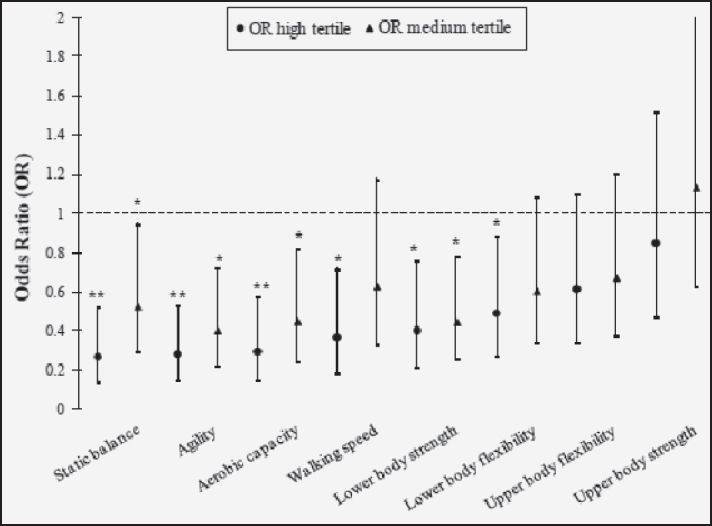
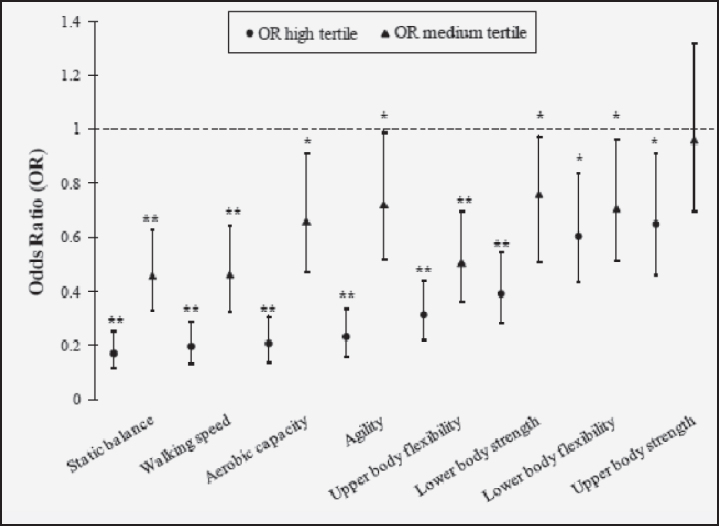
OBJECTIVE: To evaluate the associations between physical fitness levels, health related quality of life (HRQoL) and sarcopenic obesity (SO) and to analyze the usefulness of several physical fitness tests as a screening tool for detecting elderly people with an increased risk of suffering SO. DESIGN: Cross-sectional analysis of a population-based sample. SETTING: Non-institutionalized Spanish elderly participating in the EXERNET multi-centre study. PARTICIPANTS: 2747 elderly subjects aged 65 and older. MEASUREMENTS: Body weight, height and body mass index were evaluated in each subject. Body composition was measured by bioelectrical impedance. Four SO groups were created based on percentage of body fat and relative muscle mass; 1) normal group, 2) sarcopenic group, 3) obesity group and 4) SO group. Physical fitness was evaluated using 8 tests (balance, lower and upper body strength, lower and upper body flexibility, agility, walking speed and aerobic capacity). Three tertiles were created for each test based on the calculated scores. HRQoL was assessed using the EuroQol visual analogue scale. RESULTS: Participants with SO showed lower physical fitness levels compared with normal subjects. Better balance, agility, and aerobic capacity were associated to a lower risk of suffering SO in the fittest men (odds ratio < 0.30). In women, better balance, walking speed, and aerobic capacity were associated to a lower risk of suffering SO in the fittest women (odds ratio < 0.21) Superior perceived health was associated with better physical fitness performance. CONCLUSIONS: Higher levels of physical fitness were associated with a reduced risk of suffering SO and better perceived health among elderly. SO elderly people have lower physical functional levels than healthy counterparts.
Overview
The claims and statistics of this paper haven’t been checked yet.
Free: it reads the open-access text and checks the first 5 claims that cite a source we can check. Create a free account to check every claim.
Integrity signals
Registry
Cites
Statistics
Figures
Verification
Claims the paper makes
The claims and statistics of this paper haven’t been checked yet.
Free: it reads the open-access text and checks the first 5 claims that cite a source we can check. Create a free account to check every claim.
Claims other papers make about this one
Each is checked against this paper’s own text: does it say what the citing paper says it does?
The source backs part of the claim, not all of it — or backs it for a different population, condition or comparison.
In the citing paper
“The EuroQOL score was dependent on cardiovascular fitness rather than sarcopenic obesity237.”
From Sarcopenic obesity in older adults: aetiology, epidemiology and treatment strategies (2018) · cites this paper as [237]
Experimental — accuracy not yet measured
Self-check
Percentages, sums and reported differences re-computed from the paper’s own numbers.
The self-check needs the paper’s full text.
Citations
Cites
EuroQol: a new facility for the measurement of health-related quality of life
(1990) · Health Policy · doi:10.1016/0168-8510(90)90421-9 · Cited by 15,736
Sarcopenia: European consensus on definition and diagnosis
Cruz-Jentoft, A. J., Baeyens, J. P., Bauer, J. M., Boirie, Y., Cederholm, T., Landi, F., Martin, F. C., Michel, J.-P., Rolland, Y., Schneider, S. M., et al. (2010) · Age and Ageing · doi:10.1093/ageing/afq034 · Cited by 11,601
American College of Sports Medicine position stand
Otis, C. L. (1997) · Medical Entomology and Zoology · Cited by 4,407
Pollock, M. L., Gaesser, G. A., Butcher, J. D., Despr??s, J.-P., Dishman, R. K., Franklin, B. A., & Garber, C. E. (1998) · Medicine & Science in Sports & Exercise · doi:10.1097/00005768-199806000-00032 · Cited by 3,051
Lauretani, F., Russo, C. R., Bandinelli, S., Bartali, B., Cavazzini, C., Di Iorio, A., Corsi, A. M., Rantanen, T., Guralnik, J. M., & Ferrucci, L. (2003) · Journal of Applied Physiology · doi:10.1152/japplphysiol.00246.2003 · Cited by 1,946 · cited 1×
“Other researchers corroborate these results (43-45).”
The healthcare costs of sarcopenia in the United States
Janssen, I., Shepard, D. S., Katzmarzyk, P. T., & Roubenoff, R. (2004) · Journal of the American Geriatrics Society · doi:10.1111/j.1532-5415.2004.52014.x · Cited by 1,546 · cited 1×
“This phenomenon is associated with serious consequences for the individual, such as physical disability, comorbidities and mortality, and for society, increasing economic and social costs (1, 3).”
Estimation of skeletal muscle mass by bioelectrical impedance analysis
Janssen, I., Heymsfield, S. B., Baumgartner, R. N., & Ross, R. (2000) · Journal of Applied Physiology · doi:10.1152/jappl.2000.89.2.465 · Cited by 1,482
Aging of skeletal muscle: a 12-yr longitudinal study
Frontera, W. R., Hughes, V. A., Fielding, R. A., Fiatarone, M. A., Evans, W. J., & Roubenoff, R. (2000) · Journal of Applied Physiology · doi:10.1152/jappl.2000.88.4.1321 · Cited by 1,443 · cited 1×
“An important change in the musculoskeletal system, recognized among the elderly, is the loss of muscle mass (sarcopenia) and low muscle function (strength or performance) (1, 2).”
(2002) · Choice Reviews Online · doi:10.5860/choice.39-3447 · Cited by 1,098
Body Composition in Healthy Aging
BAUMGARTNER, R. N. (2000) · Annals of the New York Academy of Sciences · doi:10.1111/j.1749-6632.2000.tb06498.x · Cited by 1,078 · cited 1×
“(4), increasing the risk of developing overweight and obesity in the elderly population, with associated consequences such as cardio-metabolic complications, physical limitations, and worse health-related quality of life (5).”
Cited by
Sarcopenic obesity in older adults: aetiology, epidemiology and treatment strategies
Batsis, J. A., & Villareal, D. T. (2018) · Nature Reviews Endocrinology · doi:10.1038/s41574-018-0062-9 · Cited by 1,382
Definition and Diagnostic Criteria for Sarcopenic Obesity: ESPEN and EASO Consensus Statement
Donini, L. M., Busetto, L., Bischoff, S. C., Cederholm, T., Ballesteros-Pomar, M. D., Batsis, J. A., Bauer, J. M., Boirie, Y., Cruz-Jentoft, A. J., Dicker, D., et al. (2022) · Obesity Facts · doi:10.1159/000521241 · Cited by 1,019
Definition and diagnostic criteria for sarcopenic obesity: ESPEN and EASO consensus statement
Donini, L. M., Busetto, L., Bischoff, S. C., Cederholm, T., Ballesteros-Pomar, M. D., Batsis, J. A., Bauer, J. M., Boirie, Y., Cruz-Jentoft, A. J., Dicker, D., et al. (2022) · Clinical Nutrition · doi:10.1016/j.clnu.2021.11.014 · Cited by 566
Global prevalence of sarcopenic obesity in older adults: A systematic review and meta-analysis
Gao, Q., Mei, F., Shang, Y., Hu, K., Chen, F., Zhao, L., & Ma, B. (2021) · Clinical Nutrition · doi:10.1016/j.clnu.2021.06.009 · Cited by 376
Donini, L. M., Busetto, L., Bauer, J. M., Bischoff, S., Boirie, Y., Cederholm, T., Cruz-Jentoft, A. J., Dicker, D., Frühbeck, G., Giustina, A., et al. (2020) · Clinical Nutrition · doi:10.1016/j.clnu.2019.11.024 · Cited by 326
“(2015) [84] Spain 2747 645 2102 M 1⁄4 72.”
BackgroundInfluentialPolyzos, S. A., & Margioris, A. N. (2018) · Hormones · doi:10.1007/s42000-018-0049-x · Cited by 212
“[15, 43, 49, 56, 61], the existing data are few to draw any firm conclusions.”
BackgroundInfluentialFrailty and Physical Fitness in Elderly People: A Systematic Review and Meta-analysis
Navarrete‐Villanueva, D., Gómez‐Cabello, A., Marín-Puyalto, J., Moreno, L. A., Vicente‐Rodríguez, G., & Casajús, J. A. (2020) · Sports Medicine · doi:10.1007/s40279-020-01361-1 · Cited by 202
Self-citationIsanejad, M., Mursu, J., Sirola, J., Kröger, H., Rikkonen, T., Tuppurainen, M., & Erkkilä, A. T. (2016) · British Journal of Nutrition · doi:10.1017/s000711451600012x · Cited by 169
“In a study by Pedrero-Chamizo et al.(26), elderly men and women with sarcopaenic obesity showed lower physical fitness levels compared with non-sarcopaenic subjects(27).”
BackgroundPhysical Activity and Sarcopenic Obesity: Definition, Assessment, Prevalence and Mechanism
Lee, D.-C., Shook, R. P., Drenowatz, C., & Blair, S. N. (2016) · Future Science OA · doi:10.4155/fsoa-2016-0028 · Cited by 177
Sarcopenic Obesity: Epidemiologic Evidence, Pathophysiology, and Therapeutic Perspectives
Koliaki, C., Liatis, S., Dalamaga, M., & Kokkinos, A. (2019) · Current Obesity Reports · doi:10.1007/s13679-019-00359-9 · Cited by 176
Öztürk, Z. A., Türkbeyler, İ. H., Abiyev, A., Kul, S., Edizer, B., Yakaryılmaz, F. D., & Soylu, G. (2018) · Internal Medicine Journal · doi:10.1111/imj.13935 · Cited by 147
Gortan Cappellari, G., Guillet, C., Poggiogalle, E., Ballesteros Pomar, M. D., Batsis, J. A., Boirie, Y., Breton, I., Frara, S., Genton, L., Gepner, Y., et al. (2023) · Clinical Nutrition · doi:10.1016/j.clnu.2023.02.018 · Cited by 113
Aggio, D. A., Sartini, C., Papacosta, O., Lennon, L. T., Ash, S., Whincup, P. H., Wannamethee, S. G., & Jefferis, B. J. (2016) · Preventive Medicine · doi:10.1016/j.ypmed.2016.08.040 · Cited by 110
Sarcopenic obesity and metabolic syndrome in adult Caucasian subjects
Poggiogalle, E., Lubrano, C., Sergi, G., Coin, A., Gnessi, L., Mariani, S., Lenzi, A., & Donini, L. M. (2016) · The Journal of nutrition, health and aging · doi:10.1007/s12603-015-0638-1 · Cited by 106
“Decline in muscle mass typically occurs during aging, with a peak after the age of 60 (2); actually, this process already starts after the third decade, and can be exacerbated by sedentariness, often linked to obesity (2, 37).”
Wagenaar, C. A., Dekker, L. H., & Navis, G. J. (2021) · Clinical Nutrition · doi:10.1016/j.clnu.2021.01.005 · Cited by 105
Sarcopenic obesity: An appraisal of the current status of knowledge and management in elderly people
Molino, S., Dossena, M., Buonocore, D., & Verri, M. (2016) · The Journal of nutrition, health and aging · doi:10.1007/s12603-015-0631-8 · Cited by 91
“Pedrero-Chamizo et al., 2015 (78), demonstrated that higher levels of physical fitness are associated with a reduced risk of suffering SO and better perceived health among elderly.”
Physical activity and sarcopenia in older adults
Meier, N. F., & Lee, D.-C. (2019) · Aging Clinical and Experimental Research · doi:10.1007/s40520-019-01371-8 · Cited by 94
Yang, C.-W., Li, C.-I., Li, T.-C., Liu, C.-S., Lin, C.-H., Lin, W.-Y., & Lin, C.-C. (2015) · PLOS ONE · doi:10.1371/journal.pone.0132908 · Cited by 65
“It has been reported that fat mass was more strongly associated with mobility disability in very old men and women [32] and elders with sarcopenic obesity had poor physical fitness, such as static balance, walking speed, agility and aerobic capacity [33].”
BackgroundChiu, S.-C., Yang, R.-S., Yang, R.-J., & Chang, S.-F. (2018) · BMC Geriatrics · doi:10.1186/s12877-018-0714-6 · Cited by 63
“Prevalence of SO among elderly people in the general population has been estimated at 15%–30% [17, 18].”
BackgroundSarcopenic Obesity and Outcomes for Patients With Cancer
Liu, C., Liu, T., Deng, L., Zhang, Q., Song, M., Shi, J., Liu, C., Xie, H., Chen, Y., Lin, S., et al. (2024) · JAMA Network Open · doi:10.1001/jamanetworkopen.2024.17115 · Cited by 63
Sleep disturbance, obesity, physical fitness and quality of life in older women: EXERNET study group
Moreno-Vecino, B., Arija-Blázquez, A., Pedrero‐Chamizo, R., Gómez‐Cabello, A., Alegre, L. M., Pérez-López, F. R., González‐Gross, M., Casajús, J. A., Ara, I., & on behalf of the EXERNET Group (2017) · Climacteric · doi:10.1080/13697137.2016.1264934 · Cited by 56
Self-citationCurrent review of the SarQoL®: a health-related quality of life questionnaire specific to sarcopenia
Beaudart, C., Reginster, J.-Y., Geerinck, A., Locquet, M., & Bruyère, O. (2017) · Expert Review of Pharmacoeconomics & Outcomes Research · doi:10.1080/14737167.2017.1360768 · Cited by 39
“Reference Sarcopenia diagnostic criteria QoL tool(s) used Results Beaudart [27] EWGSOP [3] SF-36 EQ-5D EQ-VAS Poorer QoL of sarcopenic patients only for physical functioning No difference in QoL between groups No difference in QoL between groups Go [28] ALM/ht2 <2SD of the sex-specific means of young adults EQ-5D Lowe…”
BackgroundInfluentialLuo, Y., Wang, Y., Tang, S., Xu, L., Zhao, X., Han, M., Liu, Y., Xu, Y. J., & Han, B. (2024) · BMC Geriatrics · doi:10.1186/s12877-024-04952-z · Cited by 45
“The pooled prevalence of SO in older adults with and without a history of falls was 15% (95% CI: 10–22%, I 2 = 82%, P 0.01, 5 studies [9, 21, 27, 46, 51]) and 9% (95% CI: 9–14%, I 2 = 98%, P < 0.01, 5 studies [9, 21, 27, 46, 51]), respectively (Table 1).”
BackgroundMethodInfluentialMoreno-Vecino, B., Arija-Blázquez, A., Pedrero‐Chamizo, R., Alcázar, J., Gómez‐Cabello, A., Pérez-López, F. R., González‐Gross, M., Casajús, J. A., & Ara, I. (2015) · Maturitas · doi:10.1016/j.maturitas.2015.07.008 · Cited by 38
Self-citationAmesberger, G., Finkenzeller, T., Müller, E. A., & Würth, S. (2019) · Scandinavian Journal of Medicine and Science in Sports · doi:10.1111/sms.13377 · Cited by 40
“Does the aging process of 6 years lead to changes in correlations between the physical self-concept and corresponding parameters of physical fitness? (5).”
BackgroundEffect of 12-Week Swimming Training on Body Composition in Young Women
Charmas, M., & Gromisz, W. (2019) · International Journal of Environmental Research and Public Health · doi:10.3390/ijerph16030346 · Cited by 43
Sarcopenic obesity predicts nonremission of late‐life depression
Kokkeler, K. J. E., van den Berg, K. S., Comijs, H. C., Voshaar, R. C. O., & Marijnissen, R. M. (2019) · International Journal of Geriatric Psychiatry · doi:10.1002/gps.5121 · Cited by 32
“Physical activity is associated with a reduced risk of sarcopenic obesity and better perceived health among elderly.(52) Treatment of obesity itself, even by bariatric surgery in sarcopenic patients,(53) leads to a decrease in depression.”
BackgroundFonfría-Vivas, R., Pérez‐Ros, P., Barrachina-Igual, J., Pablos, A., & Martínez‐Arnau, F. M. (2023) · Aging Clinical and Experimental Research · doi:10.1007/s40520-023-02488-7 · Cited by 30
“[28].”
BackgroundInfluentialChang, S., & Chiu, S. (2020) · Journal of Clinical Nursing · doi:10.1111/jocn.15277 · Cited by 27
Mo, Y., Yang, C., Su, Y.-D., Dong, X., Deng, W., Liu, B., Yao, X., & Wang, X. (2022) · Age and Ageing · doi:10.1093/ageing/afab272 · Cited by 28
Cacciatore, S., Calvani, R., Marzetti, E., Coelho‐Júnior, H. J., Picca, A., Fratta, A. E., Esposito, I., Tosato, M., & Landi, F. (2024) · Maturitas · doi:10.1016/j.maturitas.2024.108011 · Cited by 25
Association of Physical Fitness Performance Tests and Anthropometric Indices in Taiwanese Adults
Chen, P., Chen, W., Wang, C., Yang, H.-F., Huang, W., Huang, H., & Chou, C. (2020) · Frontiers in Physiology · doi:10.3389/fphys.2020.583692 · Cited by 23
Yi, X., Fu, Y., Burns, R. D., & Ding, M. (2019) · International Journal of Environmental Research and Public Health · doi:10.3390/ijerph16132271 · Cited by 23
“The province comprises [25] 17 regions with different geographical and demographic characteristics.”
BackgroundHo, C., Lee, P.-F., Chen, H., Tseng, C.-Y., Hsieh, X.-Y., & Chiu, C. (2021) · BMC Geriatrics · doi:10.1186/s12877-021-02112-1 · Cited by 21
“This finding is inconsistent with studies that have discovered the influence of obesity on aerobic exercise capabilities [5, 11].”
ResultBae, J. H., Seo, J.-W., Li, X., Ahn, S., Sung, Y., & Kim, D. Y. (2024) · Scientific Reports · doi:10.1038/s41598-024-64742-w · Cited by 17
Olsson, S. J. G., Ekblom‐Bak, E., Ekblom, B. T., Kallings, L., Ekblom, Ö. B., & Börjesson, M. (2017) · Scandinavian Journal of Medicine and Science in Sports · doi:10.1111/sms.12943 · Cited by 22
Su, Y., Hsu, C.-T., Liang, C., Lee, P.-F., Lin, C.-F., Chen, H., & Ho, C. (2022) · BMC Geriatrics · doi:10.1186/s12877-022-02929-4 · Cited by 15
“One characteristic of aging is the degradation of the human musculoskeletal system, which leads to a decrease in muscle mass and lower muscle function [1, 2].”
BackgroundMulticomponent Training Improves the Quality of Life of Older Adults at Risk of Frailty
Moradell, A., Navarrete‐Villanueva, D., Fernández‐García, Á. I., Gusi, N., Pérez‐Gómez, J., González‐Gross, M., Ara, I., Casajús, J. A., Gómez‐Cabello, A., & Vicente‐Rodríguez, G. (2023) · Healthcare · doi:10.3390/healthcare11212844 · Cited by 15
“Moreover, in another sample of older adults, strength and walking speed showed a correlation with the EQ-VAS but not with flexibility, as we have observed [26].”
MethodSelf-citationSuhana Khatoon, B., Saravanan, D., Ganamurali, N., & Sabarathinam, S. (2023) · Diabetes & Metabolic Syndrome Clinical Research & Reviews · doi:10.1016/j.dsx.2023.102846 · Cited by 13
Hayati, M., Furtado, G. E., Nazarali, P., Sardroodian, M., Mohammadi, H., & Hosseinzadeh, M. (2025) · BMC Geriatrics · doi:10.1186/s12877-025-05858-0 · Cited by 12
Powell, M., Lara, J., Mocciaro, G., Prado, C. M. M., Battezzati, A., Leone, A., Tagliabue, A., Amicis, R. S. D., Vignati, L., Bertoli, S., et al. (2016) · Clinical Obesity · doi:10.1111/cob.12165 · Cited by 12
Guimarães, N. S., Reis, M. G., Tameirão, D. R., Cezar, N. O. D. C., Leopoldino, A. A. O., & Magno, L. A. V. (2024) · Geriatrics and gerontology international/Geriatrics & gerontology international · doi:10.1111/ggi.14918 · Cited by 10
“For example, interventions such as community physical activity programs, 22,23 subsidy policies for nutritious foods, 12 and integrating sarcopenia assessments into routine adult check-ups 24 have already been shown to be ef fi - cient in mitigating the prevalence of SO by encouraging the adoption…”
BackgroundOhashi, M., Watanabe, K., Hirano, T., Hasegawa, K., Katsumi, K., Shoji, H., Mizouchi, T., & Endo, N. (2019) · Spine · doi:10.1097/brs.0000000000003069 · Cited by 11
Guede-Rojas, F., Ríos, L. J. C., Fuentealba-Urra, S., Ríos, C. V., Ulloa-Díaz, D., Campos‐Jara, C., González, P. B., & Cuevas-Aburto, J. (2017) · Revista médica de Chile · doi:10.4067/s0034-98872017000100008 · Cited by 10
Ujihashi, T., Hori, K., Izuno, H., Fukuda, M., Sawada, M., Yoshimura, S., Hori, S., Uehara, F., Takano, H., & Ono, T. (2024) · Geriatrics · doi:10.3390/geriatrics9050131 · Cited by 7
“Previous research has shown that physical dexterity [38] and agility [39] decrease with age.”
BackgroundMartínez-Majolero, V. (2023) · Journal of Sport and Health Research · doi:10.58727/jshr.89971 · Cited by 6
Ayçiçek, G. Ş., Baş, A. O., Karabulut, E., & Halil, M. G. (2025) · Acta Clinica Belgica · doi:10.1080/17843286.2025.2583187 · Cited by 5
Carral, J. M. C., Vila, H., de Oliveira, I. M., Fuentes, G. R., Rodríguez, A. L., Silva, B., & Bezerra, P. (2024) · International Journal of Environmental Research and Public Health · doi:10.3390/ijerph21020201 · Cited by 5
Effects of Exercise on Physical Fitness in Older Adults with and Without Severe Cognitive Impairment
Ramos-Álvarez, O., Roldán-Aguilar, E. E., Altamiranda‐Saavedra, M., Marín, J. C., & Arufe-Giráldez, V. (2025) · Behavioral Sciences · doi:10.3390/bs15030351 · Cited by 5
Ghoch, M. E., Rossi, A. P., Verde, L., Barrea, L., Muscogiuri, G., Savastano, S., & Colao, A. (2022) · Panminerva Medica · doi:10.23736/s0031-0808.22.04784-x · Cited by 4
Quality of Life and Sarcopenia
Beaudart, C., Reginster, J., Bruyère, O., & Geerinck, A. (2021) · Wiley eBooks · doi:10.1002/9781119597896.ch21 · Cited by 7
Forte, P. M., Encarnação, S., Teixeira, J. E., Branquinho, L., Barbosa, T. M., Monteiro, A. M., & Pecos‐Martín, D. (2025) · Journal of Functional Morphology and Kinesiology · doi:10.3390/jfmk10030337 · Cited by 3
El esfuerzo físico y la salud en actividades recreativas y deportivas
Zapata, R. E. L., Jaimes, Y. C. C., Reyes, M., & Viviescas, B. J. B. (2018) · Respuestas · doi:10.22463/0122820x.1528 · Cited by 3
Kim, S. (2020) · Journal of Men s Health · doi:10.15586/jomh.v16i2.251 · Cited by 3
Does 12-Week Aerobics Training Influence Body Composition in Middle-Aged Women?
Charmas, M., & Dorota, R. (2022) · Polish Journal of Sport and Tourism · doi:10.2478/pjst-2022-0009 · Cited by 3
“Additionally, everything above shows that metabolic processes are slowing down leading to increased body fat, which in turn aff ects not only the mood but also increases the risk of metabolic diseases (including diabetes) [11-16].”
BackgroundSarcopenic obesity: epidemiology and cut-off values in the Ukrainian population
Grygorieva, N. V., Bystrytska, M. А., & Musiіenko, А. S. (2023) · Fìzìologìčnij žurnal · doi:10.15407/fz69.04.065 · Cited by 3
Prevalence of Sarcopenic Obesity in Elderly Population: A Meta-Analysis
Rupolo, V. L., Camargo, T. L., Pureza, I. R. D. O. M., Beretta, M. V., & Garcêz, A. (2024) · Current Aging Science · doi:10.2174/0118746098331277241101025928 · Cited by 2
Alcázar, J., Vila‐Maldonado, S., Pedrero‐Chamizo, R., Gómez‐Cabello, A., Espino, L., Gusi, N., Villa, G., González‐Gross, M., Casajús, J. A., & Ara, I. (2016) · Hispana · Cited by 2
Self-citationMartínez-Majolero, V., Sanz, B. M. U., Hernández-Sánchez, S., & Arroyo, D. (2023) · Healthcare · doi:10.3390/healthcare11152148 · Cited by 1
Torres, O. L. (2017) · UPM Digital Archive (Technical University of Madrid) · doi:10.20868/upm.thesis.47954 · Cited by 1
Vecino, B. M. (2015) · RUIdeRA - Institutional University Repository (University of Castilla-La Mancha)
Uibo, N. (2016) · DSpace repository (University of Tartu)
Influence of Sarcopenic and Dynapenic Obesity on Musculoskeletal Health and Function in Older Adults
Scott, D. S. (2016) · Springer eBooks · doi:10.1007/978-3-319-32417-3_4
Radžiūnas, K., Radžiūnienė, M., Čiuželis, T., Vainoras, A., & Poderys, J. (2017) · Journal of Vibroengineering · doi:10.21595/jve.2017.18518
“With appropriate physical fitness, the body tends to withstand greater physical loads [29].”
BackgroundJuvik, C. (2019) · NORA - Norwegian Open Research Archives
Functional ability of men aged 65 or more
Stijepić, I., Popović, T., & Sredić-Cartes, D. (2019) · Биомедицинска истраживања · doi:10.7251/bii1902172s
Which Factors Are Associated with Body Mass Index Among Elderly People Living at Home in France?
Saliba‐Serre, B., Davin, B., & Ferrandez, A. (2020) · Bulletins et Mémoires de la Société d anthropologie de Paris · doi:10.3166/bmsap-2020-0073
Identifying Risk Factors for Presarcopenia in Early Middle Age
Vlietstra, L., Meredith-Jones, K., de Lange, M., Guiney, H., & Waters, D. L. (2024) · Archives of Physical Medicine and Rehabilitation · doi:10.1016/j.apmr.2024.08.005
News in the diagnosis of sarcopenic obesity in older adults
Bielaková, K., & Ludka, O. (2024) · Vnitřní lékařství · doi:10.36290/vnl.2024.083
Monteagudo, P., Maria, A. D., Roldán, A., Monferrer-Marín, J., Hernandis, S. P., & Blasco-Lafarga, C. (2025) · American Journal of Lifestyle Medicine · doi:10.1177/15598276251401818
Luo, Y., Wang, Y., Tang, S., Xu, L., Zhao, X., Han, M., Liu, Y., Xu, Y., & Han, B. (2024) · Figshare · doi:10.6084/m9.figshare.26709950
Luo, Y., Wang, Y., Tang, S., Xu, L., Zhao, X., Han, M., Liu, Y., Xu, Y., & Han, B. (2024) · Figshare · doi:10.6084/m9.figshare.25670337
Luo, Y., Wang, Y., Tang, S., Xu, L., Zhao, X., Han, M., Liu, Y., Xu, Y., & Han, B. (2024) · Figshare · doi:10.6084/m9.figshare.26709956
Luo, Y., Wang, Y., Tang, S., Xu, L., Zhao, X., Han, M., Liu, Y., Xu, Y., & Han, B. (2024) · Figshare · doi:10.6084/m9.figshare.25670181
Luo, Y., Wang, Y., Tang, S., Xu, L., Zhao, X., Han, M., Liu, Y., Xu, Y., & Han, B. (2024) · Figshare · doi:10.6084/m9.figshare.26709953
Reilly, K. (2022) · Mspace (University of Manitoba)
Kopylov, A. E., Агарков, Н. М., & Abramov, A. A. (2025) · Russian Annals of Ophthalmology · doi:10.17116/oftalma202514106122
Soni, N. (2025) · Journal of Health Physiotherapy and Orthopaedics · doi:10.55522/jhpo.v2i6.0064
Ntovolis, Y., Skoufa, L., Evangelinou, C., & Barkoukis, V. (2026) · Sensors · doi:10.3390/s26061808
Metadata
- Authors
- Pedrero-Chamizo, R., Gómez-Cabello, A., Mélendez, A., Vila-Maldonado, S., Espino, L., Gusi, N., Villa, G., Casajús, J. A., González-Gross, M., & Ara, I.
- Affiliations
- Cabildo de Gran Canaria (ES)
- Universidad de Extremadura (ES)
- Universidad de León (ES)
- Universidad de Zaragoza (ES)
- Venue
- The Journal of nutrition, health and aging
- Publisher
- Elsevier BV
- Published
- 2015-02
- Volume
- 19
- Issue
- 2
- Pages
- 211-217
- ISSN
- 1279-7707 (ISSN-L)
- PMC
- PMC12877511
- OpenAlex
- W2052659735
- Cited by
- 76
- References
- 54
- Citations by year
- 2026: 1 · 2025: 6 · 2024: 15 · 2023: 7 · 2022: 5 · 2021: 5 · 2020: 5 · 2019: 10 · 2018: 5 · 2017: 6 · 2016: 6 · 2015: 5
- FWCI
- 3.78
- Type
- journal article
- Language
- en
- Open access
- hybrid
- doi.org
- Licence
- cc-by-nc-nd
- www.elsevier.com/tdm/userlicense/1.0/ (tdm)
- www.elsevier.com/legal/tdmrep-license (tdm)
- creativecommons.org/licenses/by-nc-nd/4.0/ (vor, 3237 d)
- Locations
- The journal of nutrition health & aging (publishedVersion, cc-by-nc-nd)
- Europe PMC (PubMed Central) (publishedVersion, cc-by-nc-nd)
- PubMed (publishedVersion)
- PubMed Central (publishedVersion, cc-by-nc-nd)
- Hispana (acceptedVersion, cc-by-nc-nd)
- LA Referencia (Red Federada de Repositorios Institucionales de Publicaciones Científicas) (submittedVersion, cc-by-nc-nd)
- UPM Digital Archive (Technical University of Madrid) (submittedVersion, cc-by-nc-nd)
- Zaguan (University of Zaragoza Repository) (submittedVersion)
- Topics
- Health Sciences › Medicine › Physiology (medical) › Nutrition and Health in Aging
- Health Sciences › Medicine › Geriatrics and Gerontology › Frailty in Older Adults
- Health Sciences › Medicine › Public Health, Environmental and Occupational Health › Physical Activity and Health
- Keywords
- sarcopenic obesity, physical fitness, health-related quality of life, older adults, balance, agility, cardiorespiratory fitness, walking speed, muscle strength, flexibility, health perception, screening tool, body composition, sex differences
- MeSH terms
- Adipose Tissue, Aged, Aged, 80 and over, Body Composition, Body Height, Body Weight, Cross-Sectional Studies, Female, Health, Humans, Male, Muscles, Obesity, Physical Fitness, Quality of Life, Spain, Geriatric Assessment, Body Mass Index, Walking, Risk Reduction Behavior, Sarcopenia
About these checks
Registry, retraction, Cites and statistics results are computed, not judged, with one exception: a printed reference that no index lists is read once by a model before it counts as a citation error. Claims are extracted by a model and kept only when their quote appears verbatim in the text; each cited source is then checked, with a model’s help, for whether it says what the claim relies on. Those verdicts can be wrong — read the claim’s quote and the cited source before relying on one.
Statistics and arithmetic are recomputed, not judged.
Confidence bands are shown only for fields calibrated on our annotated test set. None is calibrated yet, so no band is shown.
What counts as a claim ›How we measure confidence ›How we check this ›
Are you an author, or do you see a problem with this page? Request a review
Data sources
Bibliographic data: Semantic Scholar, OpenAlex, Crossref.
Contains information from the Semantic Scholar Academic Graph Datasets, made available under the ODC Attribution License (ODC-BY 1.0).
Semantic Scholar’s data is described in: Kinney, R., et al. (2023). The Semantic Scholar Open Data Platform. arXiv:2301.10140.
