

Obesity and muscle weakness as risk factors for mobility limitation in community-dwelling older Japanese women: A two-year follow-up investigation
Open accessThe DOI matches its Crossref record; 38 of the 38 references it cites were found in a registry or an index.
Abstract
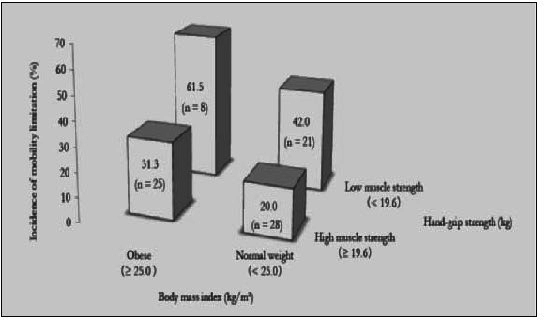
OBJECTIVES: To examine the combined association of obesity and low muscle strength with mobility limitation in older adults. DESIGN, SETTING AND PARTICIPANTS: This two-year follow-up longitudinal study included pooled data from 283 older community-dwelling Japanese women without mobility limitations who were 65 to 87 years of age (mean age 72.2 ± 5.0 years). MEASUREMENTS: Muscle strength was measured by hand-grip strength (HGS). The participants were categorized by HGS (high muscle strength: HGS ≥19.6 kg, low muscle strength: HGS <19.6 kg) and body mass index (BMI) (obese: BMI ≥25 kg/m2, normal weight: BMI <25 kg/m2). The main outcome was mobility limitation, assessed by a self-reported questionnaire (difficulty walking one-half mile or climbing 10 steps without resting). Multivariate logistic regression analysis was performed to determine the combined effect of HGS and BMI on mobility limitation, adjusting for age, exercise habits, medications, and knee pain. RESULTS: During the follow-up period, 82 of 283 participants (29.0%) developed mobility limitation. The adjusted odds ratios (95% confidence interval) for the incidence of mobility limitation were 1.53 (0.86-2.73) and 2.05 (1.08-3.91) in the obese and low muscle strength groups, respectively. Obesity combined with low muscle strength exhibited a significant and strong association with mobility limitation (odds ratio: 3.88, 1.08-13.91) compared with participants with normal weight and high muscle strength. CONCLUSION: Among community-dwelling older Japanese women, obesity alone was not associated with the incidence of mobility limitation, but when combined with low muscle weakness, the risk of developing mobility limitation was 3.9-fold greater than for the reference group.
Overview
The claims and statistics of this paper haven’t been checked yet.
Free: it reads the open-access text and checks the first 5 claims that cite a source we can check. Create a free account to check every claim.
Integrity signals
Registry
Cites
Statistics
Figures
Verification
Claims the paper makes
The claims and statistics of this paper haven’t been checked yet.
Free: it reads the open-access text and checks the first 5 claims that cite a source we can check. Create a free account to check every claim.
Claims other papers make about this one
Each is checked against this paper’s own text: does it say what the citing paper says it does?
The cited source says what the claim attributes to it.
In the citing paper
“High BMI and low muscle strength were related to limitation in mobility at 2-year follow-up (OR 3.88, 95% CI 1.08–13.91)212.”
From Sarcopenic obesity in older adults: aetiology, epidemiology and treatment strategies (2018) · cites this paper as [212]
In the citing paper
“Similarly, a 2-year follow-up longitudinal study from Japan reported a higher risk of developing mobility limitations in older women with dynapenic obesity than in participants without dynapenia or obesity (40). Obesity alone was not associated with the incidence of mobility limitations.”
From Health Consequences of Sarcopenic Obesity: A Narrative Review (2020) · cites this paper as [40]
Self-check
Percentages, sums and reported differences re-computed from the paper’s own numbers.
The self-check needs the paper’s full text.
Citations
Cites
Guralnik, J. M., Simonsick, E. M., Ferrucci, L., Glynn, R. J., Berkman, L. F., Blazer, D. G., Scherr, P. A., & Wallace, R. B. (1994) · Journal of Gerontology · doi:10.1093/geronj/49.2.m85 · Cited by 9,792 · cited 1×
“The validity of self-reported mobility limitation for predicting future disability, nursing home admission, and mortality was confirmed in a previous study (13).”
The metabolic phenotype in obesity: Fat mass, body fat distribution, and adipose tissue function
Goossens, G. H. (2017) · Obesity Facts · doi:10.1159/000471488 · Cited by 8,481
Lower-extremity function in persons over the age of 70 years as a predictor of subsequent disability
Guralnik, J. M., Ferrucci, L., Simonsick, E. M., Salive, M. E., & Wallace, R. B. (1995) · New England Journal of Medicine · doi:10.1056/nejm199503023320902 · Cited by 4,083
Lauretani, F., Russo, C. R., Bandinelli, S., Bartali, B., Cavazzini, C., Di Iorio, A., Corsi, A. M., Rantanen, T., Guralnik, J. M., & Ferrucci, L. (2003) · Journal of Applied Physiology · doi:10.1152/japplphysiol.00246.2003 · Cited by 1,946 · cited 4×
“However, the age-related loss of HGS has been shown to be comparable to that of lower extremity muscle strength (31, 33), and HGS has been shown to represent overall muscle strength (34); HGS additionally has the advantage of easy screening.”
InfluentialNew Criteria for `Obesity Disease' in Japan
The Examination Committee of Criter (2002) · Circulation Journal · doi:10.1253/circj.66.987 · Cited by 1,650
Midlife Hand Grip Strength as a Predictor of Old Age Disability
Rantanen, T. (1999) · JAMA · doi:10.1001/jama.281.6.558 · Cited by 1,476 · cited 2×
“Muscle strength has been reported to predispose individuals to mobility limitation (5).”
Translation, Adaptation, and Validation of the SF-36 Health Survey for Use in Japan
Fukuhara, S., Bito, S., Green, J., Hsiao, A., & Kurokawa, K. (1998) · Journal of Clinical Epidemiology · doi:10.1016/s0895-4356(98)00095-x · Cited by 1,341 · cited 2×
“The mean age was 72.2 ± 5.0 years, the mean BMI was 23.6 ± 3.3 kg/m 2 for BMI, and 12.1 ± 1.3 and 82.0 ± 17.1 were the average self-reported TMIG-IC and SF-36.”
InfluentialSarcopenic obesity: definition, cause and consequences
Stenholm, S., Harris, T. B., Rantanen, T., Visser, M., Kritchevsky, S. B., & Ferrucci, L. (2008) · Current Opinion in Clinical Nutrition and Metabolic Care · doi:10.1097/mco.0b013e328312c37d · Cited by 1,070 · cited 1×
“Obesity is also considered a risk factor for mobility limitation (9).”
Measurement of competence: reliability and validity of the TMIG Index of Competence
Koyano, W., Shibata, H., Nakazato, K., Haga, H., & Suyama, Y. (1991) · Archives of Gerontology and Geriatrics · doi:10.1016/0167-4943(91)90053-s · Cited by 923 · cited 3×
“A total score of less than 11 out of 13 points was used to indicate functional decline (17).”
InfluentialDisability in Older Adults: Evidence Regarding Significance, Etiology, and Risk
Fried, L. P., & Guralnik, J. M. (1997) · Journal of the American Geriatrics Society · doi:10.1111/j.1532-5415.1997.tb00986.x · Cited by 866 · cited 4×
“aMobility limitation, defined as the inability to walk safely and independently, is an important factor in the performance of activities of daily living (ADLs) and instrumental activities of daily living (IADLs) (1).”
Influential
Cited by
Sarcopenic obesity in older adults: aetiology, epidemiology and treatment strategies
Batsis, J. A., & Villareal, D. T. (2018) · Nature Reviews Endocrinology · doi:10.1038/s41574-018-0062-9 · Cited by 1,382
Health Consequences of Sarcopenic Obesity: A Narrative Review
Roh, E., & Choi, K. M. (2020) · Frontiers in Endocrinology · doi:10.3389/fendo.2020.00332 · Cited by 304
Ruhdorfer, A., Wirth, W., & Eckstein, F. (2016) · Osteoarthritis and Cartilage · doi:10.1016/j.joca.2016.10.026 · Cited by 51
Weak Grip Strength and Cognition Predict Functional Limitation in Older Europeans
Wang, T., Wu, Y., Li, W., Li, S., Sun, Y., Li, S., Zhang, D., & Tan, Q. (2018) · Journal of the American Geriatrics Society · doi:10.1111/jgs.15611 · Cited by 47
“91) of functional limitation than those with strong grip strength.(37) Another large-scale prospective occupational cohort study of 8,006 initially healthy men aged 45 to 68 from the Honolulu Heart Program and the Honolulu-Asia Aging Study showed that baseline grip strength predicted functional limitation and disabili…”
Otaki, N., Obayashi, K., Saeki, K., Kitagawa, M., Tone, N., & Kurumatani, N. (2016) · The journal of nutrition health & aging · doi:10.1007/s12603-016-0792-0 · Cited by 37
“Participants chose one answer from the following five categories: (1) every day, (2) 5–6 days/week, (3) 3–4 days/week, (4) 1–2 days/week and (5) never.”
Kuczmarski, M. F., Pohlig, R. T., Stave Shupe, E., Zonderman, A. B., & Evans, M. K. (2018) · The Journal of nutrition, health and aging · doi:10.1007/s12603-018-1006-8 · Cited by 30
“9 fold greater risk of developing mobility limitation (63).”
BackgroundSafety of a Combined WB-EMS and High-Protein Diet Intervention in Sarcopenic Obese Elderly Men
KEMMLER, W. K., von Stengel, S., Kohl, M., Rohleder, N., Bertsch, T., Sieber, C. C., Freiberger, E., & Kob, R. (2020) · Clinical Interventions in Aging · doi:10.2147/cia.s248868 · Cited by 31
Su, P., Ding, H., Zhang, W., Duan, G., Yang, Y., Long, J., Du, L., Xie, C., Jin, C., Hu, C., et al. (2016) · The journal of nutrition health & aging · doi:10.1007/s12603-016-0777-z · Cited by 22
“Some characteristics, such as education, marital status, nutrition status, and muscle strength, that were associated with ADL/ IADL disability, were not included in this survey (38-42).”
Demırdağ, F., Kolbaşı, E. N., Aykut, G. B., Güler, K. Y., Murat, S., Bahat, G., & Oğuz, A. (2021) · Archives of Gerontology and Geriatrics · doi:10.1016/j.archger.2021.104569 · Cited by 20
Kalu, M. E., Bello-Haas, V. P. M. D., Griffin, M., Boamah, S. A., Harris, J. E., Zaide, M., Rayner, D. G., Khattab, N., Bhatt, V., Goodin, C., et al. (2022) · European Journal of Physiotherapy · doi:10.1080/21679169.2022.2153303 · Cited by 15
Marín‐Jiménez, N., Bizzozero‐Peroni, B., Molina‐García, P., Ortega, F. B., Chaput, J., Zhang, K., Lang, J. J., McGrath, R. P., Tomkinson, G. R., Martínez-Vizcaíno, V., et al. (2026) · British Journal of Sports Medicine · doi:10.1136/bjsports-2024-109173 · Cited by 13
Effects of Lifestyle on Muscle Strength in a Healthy Danish Population
Bartels, E. M., Robertson, S., Danneskiold‐Samsøe, B., Appleyard, M., & Stockmarr, A. (2018) · Journal of Lifestyle Medicine · doi:10.15280/jlm.2018.8.1.16 · Cited by 10
“abled increases with lower muscle strength in an aging population [18-21].”
BackgroundShin, H. E., Jang, J. Y., Arai, H., Lim, W. S., Chen, L., Kim, M., & Won, C. W. (2025) · Experimental Gerontology · doi:10.1016/j.exger.2025.112936 · Cited by 9
Self-citationThe Association Between Walking Speed and Bone Turnover Markers in Older Adults
Orces, C. H. (2021) · Cureus · doi:10.7759/cureus.18019 · Cited by 4
“Finally, muscle strength which is associated with bone metabolism [23] and mobility limitation [24] was not included as a potential confounder in this study.”
Zhang, S., Otsuka, R., Tange, C., Nishita, Y., Shimokata, H., Satake, S., & Arai, H. (2023) · Journal of Cachexia Sarcopenia and Muscle · doi:10.1002/jcsm.13396 · Cited by 5
“12 Numerous studies on overweight/obesity, muscle strength, and functional limitations have con fi rmed that over-weight/obesity exacerbates age-related physical function limitations associated with the loss of muscle mass and strength.”
Functional Mobility of Community-Dwelling Older Persons: An Ethnographic Pre-Feasibility Study
Wisnesky, U. D. (2019) · ERA: Education and Research Archive (University of Alberta) · doi:10.7939/r3-h5j3-ha98 · Cited by 1
Influence of Sarcopenic and Dynapenic Obesity on Musculoskeletal Health and Function in Older Adults
Scott, D. S. (2016) · Springer eBooks · doi:10.1007/978-3-319-32417-3_4
Abidin, N. Z. (2021) · Nottingham ePrints (University of Nottingham)
(2022) · UpSpace Institutional Repository (University of Pretoria) · doi:10.25403/upresearchdata.23653434 · Cited by 1
Impact of Body Mass Index on Functional Recovery After Total Hip Arthroplasty: A Prospective Study
Ima, M., Kabata, T., Inoue, D., Yanagi, Y., Iyobe, T., Fujimaru, N., & Demura, S. (2026) · Arthroplasty Today · doi:10.1016/j.artd.2026.101986
“Previous studies have shown that obesity imposes increased physical load and reduced exercise tolerance, which may delay early rehabilitation and exacerbate postoperative difficulties [22-24].”
Metadata
- Authors
- Jung, S., Yabushita, N., Kim, M., Seino, S., Nemoto, M., Osuka, Y., Okubo, Y., Figueroa, R., & Tanaka, K.
- Affiliations
- University of Tsukuba (JP)
- Tokyo Metropolitan Institute of Gerontology (JP)
- Japan Society for the Promotion of Science (JP)
- Corresponding author
- Jung, Songee
- Venue
- The Journal of nutrition, health and aging
- Publisher
- Elsevier BV
- Published
- 2016-01
- Volume
- 20
- Issue
- 1
- Pages
- 28-34
- ISSN
- 1279-7707 (ISSN-L)
- PMC
- PMC12878959
- OpenAlex
- W614947839
- Cited by
- 18
- References
- 37
- Citations by year
- 2026: 2 · 2025: 1 · 2023: 1 · 2022: 1 · 2021: 2 · 2020: 2 · 2019: 1 · 2018: 4 · 2016: 4
- FWCI
- 2.42
- Type
- journal article
- Language
- en
- Open access
- hybrid
- doi.org
- Licence
- cc-by-nc-nd
- www.elsevier.com/tdm/userlicense/1.0/ (tdm)
- www.elsevier.com/legal/tdmrep-license (tdm)
- creativecommons.org/licenses/by-nc-nd/4.0/ (vor, 2902 d)
- Locations
- The journal of nutrition health & aging (publishedVersion, cc-by-nc-nd)
- Europe PMC (PubMed Central) (publishedVersion, cc-by-nc-nd)
- PubMed (publishedVersion)
- PubMed Central (publishedVersion, cc-by-nc-nd)
- Funders
- Japan Student Services Organization
- Japan Society for the Promotion of Science
- Topics
- Health Sciences › Medicine › Physiology (medical) › Nutrition and Health in Aging
- Health Sciences › Health Professions › Physical Therapy, Sports Therapy and Rehabilitation › Balance, Gait, and Falls Prevention
- Health Sciences › Medicine › Geriatrics and Gerontology › Frailty in Older Adults
- Keywords
- obesity, muscle weakness, mobility limitations, grip strength, body mass index, older women, community-dwelling older adults, Japanese women, risk factors
- MeSH terms
- Aged, Female, Follow-Up Studies, Humans, Japan, Longitudinal Studies, Motor Activity, Obesity, Surveys and Questionnaires, Risk Factors, Body Mass Index, Incidence, Odds Ratio, Walking, Hand Strength, Muscle Weakness, Mobility Limitation, Self Report
About these checks
Registry, retraction, Cites and statistics results are computed, not judged, with one exception: a printed reference that no index lists is read once by a model before it counts as a citation error. Claims are extracted by a model and kept only when their quote appears verbatim in the text; each cited source is then checked, with a model’s help, for whether it says what the claim relies on. Those verdicts can be wrong — read the claim’s quote and the cited source before relying on one.
Statistics and arithmetic are recomputed, not judged.
Confidence bands are shown only for fields calibrated on our annotated test set. None is calibrated yet, so no band is shown.
What counts as a claim ›How we measure confidence ›How we check this ›
Are you an author, or do you see a problem with this page? Request a review
Data sources
Bibliographic data: Semantic Scholar, OpenAlex, Crossref.
Contains information from the Semantic Scholar Academic Graph Datasets, made available under the ODC Attribution License (ODC-BY 1.0).
Semantic Scholar’s data is described in: Kinney, R., et al. (2023). The Semantic Scholar Open Data Platform. arXiv:2301.10140.
