

Dietary Protein Intake and Overall Diet Quality are Associated with Handgrip Strength in African American and White Adults
Open accessThe DOI matches its Crossref record; 70 of the 70 references it cites were found in a registry or an index.
Abstract
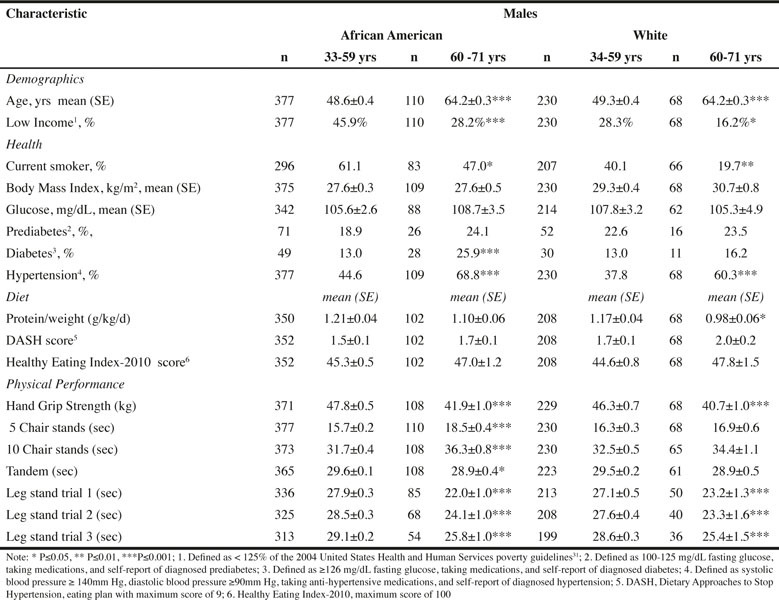
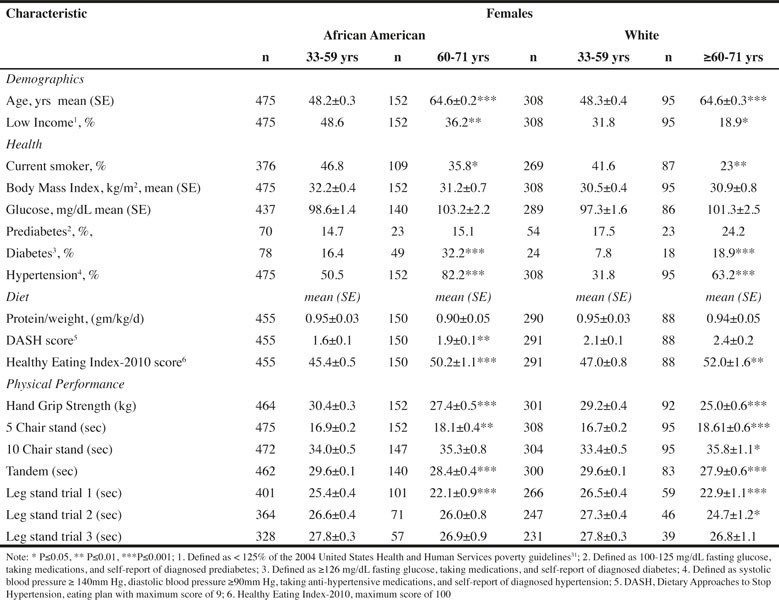
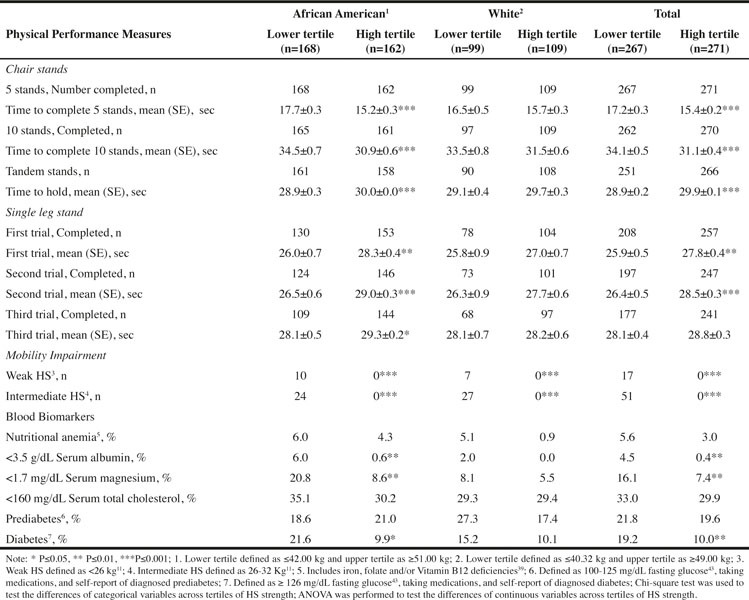
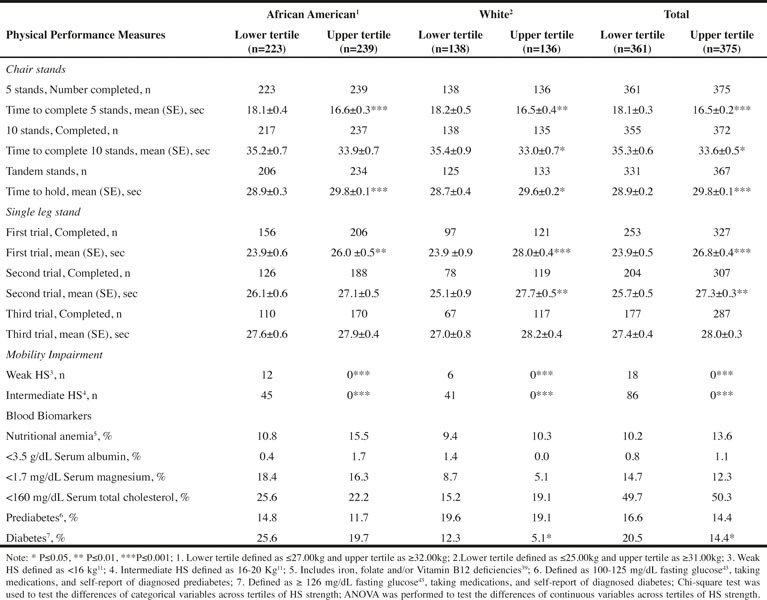
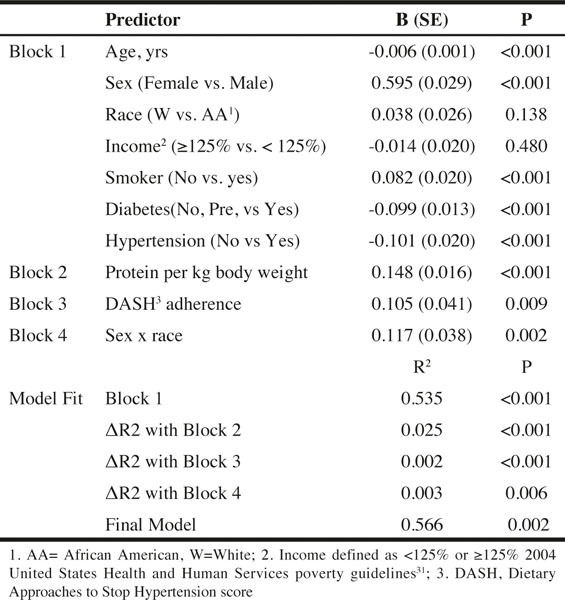
OBJECTIVE: To determine the association of handgrip strength (HS) with protein intake, diet quality, and nutritional and cardiovascular biomarkers in African American and White adults. DESIGN: Cross-sectional wave 3 (2009-2013) of the cohort Healthy Aging in Neighborhoods of Diversity across the Life Span (HANDLS) study. PARTICIPANTS: Socioeconomically diverse urban population of 2,468 persons aged 33 to 71 years. MEASUREMENTS: Socio-demographic correlates, dietary intakes and biomarkers, HS, physical performance measures were collected. HS was measured using a dynamometer with the dominant hand. Functional measures included chair, tandem, and single leg stands. Two 24-hour recalls were collected using the US Department of Agriculture Automated Multiple Pass Method. The total protein intake and diet quality, evaluated by adherence to the DASH eating plan and Healthy Eating Index-2010, were calculated. Biomarkers included nutritional anemia, and serum levels of albumin, cholesterol, magnesium, and glucose. RESULTS: The mean ±SE age of the sample was 52.3±0.2 years. Approximately 61% were African American and 57% were women. The mean ±SE HS of women was 29.1±0.2kg and for men was 45.9±0.4 kg. Protein, gm, per kg body weight for the women was 0.94±0.02 compared to 1.16 ±0.02 for men. After adjusting for socio-demographic factors, hypertension, and diabetes, HS/BMI ratio was significantly associated with protein intake per kg body weight (p<0.001) and diet quality, assessed by either the DASH adherence (p=0.009) or Health Eating Index-2010 (p=0.031) scores. For both men and women, participants in the upper tertile of HS maintained a single leg and tandem stances longer and completed 5 and 10 chair stands in shorter time compared to individuals in the lower HS tertile. Of the nutritional status indicators, the percent of men in the upper HS tertile with low serum magnesium and albumin, was significantly lower than those in the lower HS tertile [magnesium,7.4% vs 16.1%; albumin, 0.4% vs 4.5%]. The only difference observed for women was a lower percent of diabetes (14.4% for the upper HS tertile compared to 20.5% for the lower HS tertile. CONCLUSIONS: The findings confirm the role of protein and a healthful diet in the maintenance of muscle strength. In this community sample, HS was significantly associated with other physical performance measures but did not appear to be strongly associated with indicators of nutritional risk. These findings support the use of HS as a proxy for functional status and indicate the need for research to explore its role as a predictor of nutritional risk.
Overview
The claims and statistics of this paper haven’t been checked yet.
Free: it reads the open-access text and checks the first 5 claims that cite a source we can check. Create a free account to check every claim.
Integrity signals
Registry
Cites
Statistics
Figures
Verification
Claims the paper makes
The claims and statistics of this paper haven’t been checked yet.
Free: it reads the open-access text and checks the first 5 claims that cite a source we can check. Create a free account to check every claim.
Claims other papers make about this one
Each is checked against this paper’s own text: does it say what the citing paper says it does?
The source backs part of the claim, not all of it — or backs it for a different population, condition or comparison.
In the citing paper
“Also, growing evidence shows that handgrip strength is associated with total strength, bone mineral density, fractures, falls, cognitive impairment, depression levels, and overall diet quality. 112 , 113”
From Systematic review and meta-analysis of protein intake to support muscle mass and function in healthy adults (2022) · cites this paper as [113]
Experimental — accuracy not yet measuredThe source backs part of the claim, not all of it — or backs it for a different population, condition or comparison.
In the citing paper
“As mentioned, handgrip strength seems to be considered a potential marker related to several aspects of functional capacity and quality of life. 112 , 113”
From Systematic review and meta-analysis of protein intake to support muscle mass and function in healthy adults (2022) · cites this paper as [113]
Experimental — accuracy not yet measured
Self-check
Percentages, sums and reported differences re-computed from the paper’s own numbers.
The self-check needs the paper’s full text.
Citations
Cites
Guralnik, J. M., Simonsick, E. M., Ferrucci, L., Glynn, R. J., Berkman, L. F., Blazer, D. G., Scherr, P. A., & Wallace, R. B. (1994) · Journal of Gerontology · doi:10.1093/geronj/49.2.m85 · Cited by 9,792 · cited 1×
“Physical performance was measured by a modified short physical performance battery (SPPB) evaluation which included tests of standing balance tandem stand, chair stands, and single leg stands (36).”
MethodSontrop, J. M., Dixon, S. N., Garg, A. X., Buendia-Jimenez, I., Dohein, O., Huang, S.-H. S., & Clark, W. F. (2013) · American Journal of Nephrology · doi:10.1159/000350377 · Cited by 5,871
Roberts, H. C., Denison, H. J., Martin, H. J., Patel, H. P., Syddall, H., Cooper, C., & Sayer, A. A. (2011) · Age and Ageing · doi:10.1093/ageing/afr051 · Cited by 3,001 · cited 1×
“Universally, handgrip strength (HS), a muscle strength measurement (1), declines with age and predicts future disability and mortality (2-5).”
BackgroundStudenski, S. A., Peters, K. W., Alley, D. E., Cawthon, P. M., McLean, R. R., Harris, T. B., Ferrucci, L., Guralnik, J. M., Fragala, M. S., Kenny, A. M., et al. (2014) · The Journals of Gerontology: Series A · doi:10.1093/gerona/glu010 · Cited by 2,545 · cited 3×
“Evidence exists that muscle strength per body mass index (BMI) would be an appropriate relative strength index in clinical settings (1, 10-12).”
BackgroundMethodMoshfegh, A. J., Rhodes, D. G., Baer, D. J., Murayi, T., Clemens, J. C., Rumpler, W. V., Paul, D. R., Sebastian, R. S., Kuczynski, K. J., Ingwersen, L. A., et al. (2008) · The American Journal of Clinical Nutrition · doi:10.1093/ajcn/88.2.324 · Cited by 1,982 · cited 1×
“Dietary Method The United States Department of Agriculture (USDA) computerized Automated Multiple Pass Method was used to collect both 24-hour dietary recalls (37).”
MethodNutritional anaemias. Report of a WHO scientific group.
(1968) · PubMed · Cited by 1,711
Houston, D. K., Nicklas, B. J., Ding, J., Harris, T. B., Tylavsky, F. A., Newman, A. B., Lee, J. S., Sahyoun, N. R., Visser, M., & Kritchevsky, S. B. (2008) · The American Journal of Clinical Nutrition · doi:10.1093/ajcn/87.1.150 · Cited by 1,214
White, J. V., Guenter, P., Jensen, G., Malone, A., & Schofield, M. (2012) · Journal of the Academy of Nutrition and Dietetics · doi:10.1016/j.jand.2012.03.012 · Cited by 751 · cited 1×
“HS is one of the six characteristics included in the recommendations to diagnose adult malnutrition (8).”
BackgroundRoubenoff, R., & Hughes, V. A. (2000) · The Journals of Gerontology Series A: Biological Sciences and Medical Sciences · doi:10.1093/gerona/55.12.m716 · Cited by 685 · cited 1×
“Chronic low-grade inflammation and oxidative stress can trigger catabolism and increase protein turnover in skeletal muscle, reducing strength (54-56), as well as increase formation of reactive oxygen species resulting in an overload of the antioxidant defense system (57).”
BackgroundNutrition and physical activity in the prevention and treatment of sarcopenia: systematic review.
the IOF-ESCEO Sarcopenia Working Group, Beaudart, C., Dawson, A., Shaw, S. C., Harvey, N. C., Kanis, J. A., Binkley, N., Reginster, J. Y., Chapurlat, R., Chan, D. C., et al. (2017) · Osteoporosis International · doi:10.1007/s00198-017-3980-9 · Cited by 602 · cited 1×
“The literature provides evidence that dietary protein intake, as part of an overall healthful diet, and physical activity can help protect against age-related muscle loss and functional decline (17, 18, 48-53).”
Background
Research works printed but not linked: 2
- Iran J Kidney Dis. 2016 10 1
- Am Fam Physician. 2013 87 2
Cited by
Nunes, E. A., Colenso‐Semple, L., McKellar, S. R., Yau, T., Ali, M. U., Fitzpatrick‐Lewis, D., Sherifali, D., Gaudichon, C., Tomé, D., Atherton, P. J., et al. (2022) · Journal of Cachexia, Sarcopenia and Muscle · doi:10.1002/jcsm.12922 · Cited by 280
Nutrition and Muscle Strength, As the Key Component of Sarcopenia: An Overview of Current Evidence
Robinson, S., Granic, A., & Sayer, A. A. (2019) · Nutrients · doi:10.3390/nu11122942 · Cited by 93
“Consistent with this finding, a positive association between protein intake and muscle strength (expressed as kg/BMI) was also reported in a recent study of a diverse cohort (2468 adults aged 33 to 71 years) in the US [36].”
ResultDiet Quality Is Associated with Physical Performance and Special Forces Selection
Farina, E. K., Thompson, L., Knapik, J. J., Pasiakos, S. M., Lieberman, H. R., & McClung, J. P. (2019) · Medicine & Science in Sports & Exercise · doi:10.1249/mss.0000000000002111 · Cited by 66
Tak, Y. J., Lee, J. G., Yi, Y. H., Kim, Y. J., Lee, S., Cho, B. M., & Cho, Y. H. (2018) · Nutrients · doi:10.3390/nu10091180 · Cited by 48
“In addition, recent studies imply that HGS can be used as a predictor of nutritional status [9,10].”
BackgroundAlsaawi, T. A., Aldisi, D. A., Abulmeaty, M. M. A., Khattak, M. N. K., Alnaami, A. M., Sabico, S., & Al‐Daghri, N. M. (2022) · Nutrients · doi:10.3390/nu14091855 · Cited by 39
Kim, H., & Kwon, O. (2019) · Nutrients · doi:10.3390/nu11071487 · Cited by 39
“There is some evidence relating HGS to overall dietary quality indicators, such as the Healthy Eating Index (HEI) [15,21], Mediterranean Diet (MED) [22–24], Dietary Approaches to Stop Hypertension (DASH) [15], and Nordic Diet Score (NDS) [25], from European [22–25] and North American studies [15,21].”
BackgroundResultInfluentialOtten, L., Bosy‐Westphal, A., Ordemann, J., Rothkegel, E., Stobäus, N., Elbelt, U., & Norman, K. (2016) · European Journal of Clinical Nutrition · doi:10.1038/ejcn.2016.226 · Cited by 36
Healthy Eating Index-2015 Is Associated with Grip Strength among the US Adult Population
Bigman, G., & Ryan, A. S. (2021) · Nutrients · doi:10.3390/nu13103358 · Cited by 28
“In the Healthy Aging in Neighborhoods of Diversity across the Life Span (HANDLS) study among 2468 aged 33–71 years, the authors reported positive associations between the higher score in each predefined dietary pattern, DASH and HEI-2010, with better grip strength/BMI ratio [27].”
BackgroundResultJun, S., Cowan, A., Dwyer, J. T., Campbell, W. W., Thalacker‐Mercer, A. E., Gahche, J. J., & Bailey, R. L. (2021) · Journal of Nutrition · doi:10.1093/jn/nxab288 · Cited by 34
Esmaeily, Z., Tajary, Z., Daei, S., Rezaei, M., Eyvazkhani, A., Motlagh, A. D., & Palmowski, A. (2021) · Journal of Nutritional Science · doi:10.1017/jns.2021.12 · Cited by 21
“Disorders Diabetes 19 (38) 31 (62) 0·52”
Association of dietary approaches to stop hypertension eating style and risk of sarcopenia
Soltani, S., Hashemi, R., Heshmat, R., Motlagh, A. D., & Esmaillzadeh, A. (2020) · Scientific Reports · doi:10.1038/s41598-020-76452-0 · Cited by 21
Associations between dietary patterns and physical fitness among Chinese elderly
Lyu, Y., Yu, X., Yuan, H., Yi, X., Dong, X., Ding, M., Lin, X., & Wang, B. (2020) · Public Health Nutrition · doi:10.1017/s136898002000333x · Cited by 17
“Several studies have explored the association between food nutrients and physical fitness (13) , including protein, dietary fibre, vitamin D and some antioxidants (14 – 17) .”
BackgroundLee, S. (2019) · Journal of the American College of Nutrition · doi:10.1080/07315724.2019.1691955 · Cited by 14
Hiol, A. N., von Hurst, P. R., Conlon, C. A., & Beck, K. L. (2023) · Journal of Nutritional Science · doi:10.1017/jns.2023.76 · Cited by 15
Kuczmarski, M. F., Beydoun, M. A., Georgescu, M. F., Hooten, N. N., Mode, N. A., Evans, M. K., & Zonderman, A. B. (2023) · Nutrients · doi:10.3390/nu15214598 · Cited by 14
“Yet, among the HANDLS study participants, those whose diets had better quality had lower 10-year atherosclerotic cardiovascular health [23] and greater handgrip strength [24].”
BackgroundSelf-citationKim, M., Choi, M., & Bae, Y. (2023) · BMC Geriatrics · doi:10.1186/s12877-023-04016-8 · Cited by 11
“Many studies have reported a link between GS and intake of specific nutrients, including proteins [2], vitamin D [3], and antioxidants [4].”
BackgroundLi, Y., Gu, W., Hao, W., Xu, Y., Li, K., Zhao, Y., & Huang, Q. (2025) · Frontiers in Nutrition · doi:10.3389/fnut.2025.1583795 · Cited by 13
Kuczmarski, M. F., Orsega-Smith, E. M., Mode, N. A., Rawal, R., Evans, M. K., & Zonderman, A. B. (2021) · Nutrients · doi:10.3390/nu13061824 · Cited by 9
“Previous research with the HANDLS study sample revealed that eating patterns that are more consistent with the Healthy Eating Index and DASH diet quality indices, even though they were suboptimal quality, were associated with lower 10-year cardiovascular risk [59].”
MethodSelf-citationPasdar, Y., Moradi, S., Saedi, S., Moradinazar, M., Rahmani, N., Hamzeh, B., & Najafi, F. (2022) · Scientific Reports · doi:10.1038/s41598-022-16120-7 · Cited by 7
Kuczmarski, M. F., Beydoun, M. A., Zonderman, A. B., & Evans, M. K. (2022) · Journal of Nutrition in Gerontology and Geriatrics · doi:10.1080/21551197.2022.2070321 · Cited by 5
“Income was not associated with HS/BMI.”
MethodSelf-citationGerber, M., Filippou, K., Knappe, F., Morres, I. D., Tzormpatzakis, E., Havas, E., Seelig, H., Colledge, F., Ludyga, S., Meier, M., et al. (2023) · Scientific Reports · doi:10.1038/s41598-023-48032-5 · Cited by 6
“These factors include socioeconomic status 84 , smoking 85 , dietary behaviour 86,87 , and time of the day 88 .”
BackgroundNutritional Risk in Oculopharyngeal Muscular Dystrophy: Beyond Dysphagia
Forgues, C., Fortin, J., Gagnon, C., Brisson, J., Mathieu, J., Brais, B., & Côté, C. (2021) · Canadian Journal of Dietetic Practice and Research · doi:10.3148/cjdpr-2021-003 · Cited by 4
Gaspareto, N., Previdelli, Á. N., Laurentino, G. C., & de Aquino, R. D. C. (2021) · Ageing International · doi:10.1007/s12126-021-09465-3 · Cited by 3
Marini, A. C. B., Motobu, R. D., Freitas, A. T. V. D. S., Laviano, A., Pichard, C., & Pimentel, G. D. (2019) · Clinical Nutrition ESPEN · doi:10.1016/j.clnesp.2019.05.017 · Cited by 2
BODY MASS INDEX, PROTEIN INTAKE AND HAND GRIP STRENGTH AMONG YOUTH
Fitriani, A., & Purwaningtyas, D. R. (2020) · Jurnal Kesmas (Kesehatan Masyarakat) Khatulistiwa · doi:10.29406/jkmk.v7i4.2254 · Cited by 6
Kuczmarski, M. F., Orsega-Smith, E. M., Beydoun, M. A., Evans, M. K., & Zonderman, A. B. (2025) · Nutrients · doi:10.3390/nu17111900 · Cited by 2
“Our previous research found that high diet quality, along with total protein and essential amino acid intakes, were associated with better handgrip strength relative to body mass index (BMI) [19,20].”
InfluentialSelf-citationKuczmarski, M. F., Cotugna, N., Evans, M. K., & Zonderman, A. B. (2025) · Dietetics · doi:10.3390/dietetics4010010 · Cited by 1
“HANDLS study participants with better diet quality, compared to those with poor quality, had a lower risk for cardiovascular disease [31], frailty [32], and greater muscle strength, measured by hand grip, a marker for nutritional status [33].”
Self-citationWeak Hand Grip Strength Is Associated with Alexithymia in Outpatients in a Mexican Population
Mendoza, A. D. G., Fresán, A., González‐Castro, T. B., Pool-García, S., Tovilla‐Zárate, C. A., Castillo-Ávila, R. G., Vázquez, P. I. A., López‐Narváez, M. L., & Nicolini, H. (2022) · Brain Sciences · doi:10.3390/brainsci12050576 · Cited by 2
“In this sense, a reduction in brain-derived neurotrophic factors has been associated with the genesis of common mental health-related traits [57,58].”
BackgroundPasdar, Y., Moradi, S., Saedi, S., Hamzeh, B., & Najafi, F. (2022) · Research Square · doi:10.21203/rs.3.rs-1199363/v1
Kang, J., & Bae, Y. (2023) · Journal of Biotechnology and Bioindustry · doi:10.37503/jbb.2023.11.53
Metadata
- Authors
- Kuczmarski, M. F., Pohlig, R. T., Stave Shupe, E., Zonderman, A. B., & Evans, M. K.
- Affiliations
- University of Delaware (US)
- National Institutes of Health (US)
- Corresponding author
- Kuczmarski, Marie Fanelli
- Venue
- The Journal of nutrition, health and aging
- Publisher
- Elsevier BV
- Published
- 2018-06
- Volume
- 22
- Issue
- 6
- Pages
- 700-709
- ISSN
- 1279-7707 (ISSN-L)
- PMC
- PMC5984956
- OpenAlex
- W2791318729
- Cited by
- 30
- References
- 70
- Citations by year
- 2025: 3 · 2023: 5 · 2022: 6 · 2021: 6 · 2020: 3 · 2019: 5 · 2018: 1
- FWCI
- 3.57
- Type
- journal article
- Language
- en
- Open access
- hybrid
- doi.org
- Licence
- cc-by
- www.elsevier.com/tdm/userlicense/1.0/ (tdm)
- www.elsevier.com/legal/tdmrep-license (tdm)
- creativecommons.org/licenses/by/4.0/ (vor)
- Locations
- The journal of nutrition health & aging (publishedVersion, cc-by)
- Europe PMC (PubMed Central) (publishedVersion, other-oa)
- PubMed Central (publishedVersion, cc-by)
- PubMed (publishedVersion)
- Funders
- National Institutes of Health
- National Institute on Aging (Z01AG000194)
- Topics
- Health Sciences › Medicine › Public Health, Environmental and Occupational Health › Nutritional Studies and Diet
- Health Sciences › Medicine › Physiology (medical) › Nutrition and Health in Aging
- Health Sciences › Nursing › Nutrition and Dietetics › Muscle metabolism and nutrition
- Keywords
- grip strength, protein intake, diet quality, DASH diet, Healthy Eating Index, physical performance, functional mobility, serum magnesium, serum albumin, nutritional anemia, cardiovascular biomarkers, African American adults, sex differences, urban adults, hypertension, diabetes mellitus, body mass index, nutritional status, cardiovascular risk factors, socioeconomic diversity
- MeSH terms
- Diet, Healthy, Adult, Aged, Black or African American, Blood Glucose, Body Weight, Cholesterol, Cross-Sectional Studies, Diet, Dietary Proteins, Female, Humans, Hypertension, Magnesium, Male, Middle Aged, Nutritional Status, United States, Urban Population, Cohort Studies, Body Mass Index, Hand Strength
About these checks
Registry, retraction, Cites and statistics results are computed, not judged, with one exception: a printed reference that no index lists is read once by a model before it counts as a citation error. Claims are extracted by a model and kept only when their quote appears verbatim in the text; each cited source is then checked, with a model’s help, for whether it says what the claim relies on. Those verdicts can be wrong — read the claim’s quote and the cited source before relying on one.
Statistics and arithmetic are recomputed, not judged.
Confidence bands are shown only for fields calibrated on our annotated test set. None is calibrated yet, so no band is shown.
What counts as a claim ›How we measure confidence ›How we check this ›
Are you an author, or do you see a problem with this page? Request a review
Data sources
Bibliographic data: Semantic Scholar, OpenAlex, Crossref.
Contains information from the Semantic Scholar Academic Graph Datasets, made available under the ODC Attribution License (ODC-BY 1.0).
Semantic Scholar’s data is described in: Kinney, R., et al. (2023). The Semantic Scholar Open Data Platform. arXiv:2301.10140.
