

The DOI matches its Crossref record; 37 of the 37 references it cites were found in a registry or an index.
Factors Associated with Attrition from Mindfulness-Based Cognitive Therapy in Patients with a History of Suicidal Depression
Open accessAbstract
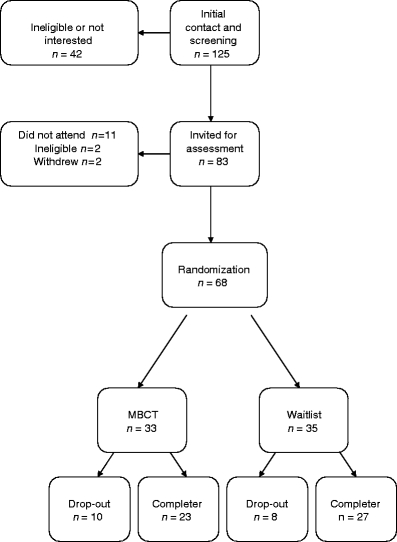
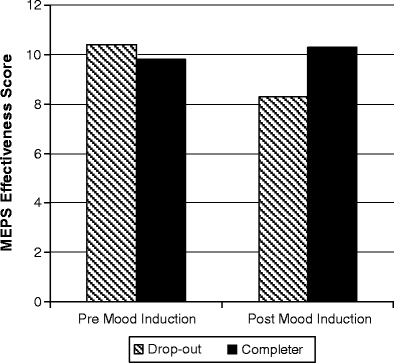
We report data from a randomised controlled trial of mindfulness-based cognitive therapy to pilot procedures for people with a history of suicidal ideation or behaviour, focusing in particular on the variables that distinguish those who complete an adequate 'dose' of treatment, from those who drop out. Sixty-eight participants were randomised to either immediate treatment with mindfulness-based cognitive therapy (MBCT) (n = 33) or to the waitlist (n = 36) arm of the trial. In addition to collecting demographic and clinical information, we assessed participants' cognitive reactivity using the means end problem-solving task, completed before and after a mood induction procedure. Ten participants dropped out of treatment, and eight dropped out of the waitlist condition. Those who dropped out of MBCT were significantly younger than those who completed treatment, less likely to be on antidepressants, had higher levels of depressive rumination and brooding and showed significantly greater levels of problem-solving deterioration following mood challenge. None of these factors distinguished participants in the waiting list condition who remained in the study from those who dropped out. Our results suggest that individuals with high levels of cognitive reactivity, brooding and depressive rumination may find it particularly difficult to engage with MBCT, although paradoxically they are likely to have the most to gain from the development of mindfulness skills if they remain in class. Addressing how such patients can be best prepared for treatment and supported to remain in treatment when difficulties arise is an important challenge.
Overview
The claims and statistics of this paper haven’t been checked yet.
Run the check — free, no account needed. It reads the open-access text and checks the sources it cites.
Integrity signals
Registry
Cites
Statistics
Figures
Verification
Claims the paper makes
The claims and statistics of this paper haven’t been checked yet.
Run the check — free, no account needed. It reads the open-access text and checks the sources it cites.
Claims other papers make about this one
Each is checked against this paper’s own text: does it say what the citing paper says it does?
The source backs part of the claim, not all of it — or backs it for a different population, condition or comparison.
In the citing paper
“A study by Crane and Williams70 on MBCT attrition in a community population found that those who dropped out of MBCT were significantly younger than those who completed treatment, less likely to be on antidepressants, had higher levels of depressive rumination and brooding, and showed significantly greater levels of problem-solving deterioration following mood challenge.”
From Treatment Engagement and Outcomes of Mindfulness-Based Cognitive Therapy for Veterans with Psychiatric Disorders (2019) · cites this paper as [70]
Experimental — accuracy not yet measured
Self-check
Percentages, sums and reported differences re-computed from the paper’s own numbers.
The self-check needs the paper’s full text.
Citations
Cites
(1998) · The Journal of Clinical Psychiatry · Cited by 19,139
(1998) · PubMed · Cited by 10,216
The mini international neuropsychiatric interview
Lecrubier, Y., Sheehan, D. V., Hergueta, T., & Weiller, E. (1998) · European Psychiatry · doi:10.1016/s0924-9338(99)80239-9 · Cited by 5,899
Rumination reconsidered: a psychometric analysis.
Treynor, W., Gonzalez, R., & Nolen-Hoeksema, S. (2003) · Cognitive Therapy and Research · doi:10.1023/a:1023910315561 · Cited by 3,808 · cited 6×
“…(five items, described by the authors as ‘moody pondering’ e.g. “think ‘why can’t I handle things better?’”) and reflection (five items referring to neutrally valenced pondering, e.g. ‘analyse recent events to try and understand why you are depressed’; see Treynor et al. 2003 for factor analysis).”
BackgroundInfluential(2001) · Cited by 3,666
Self-citationNolen-Hoeksema, S., & Morrow, J. (1991) · Journal of Personality and Social Psychology · doi:10.1037/0022-3514.61.1.115 · Cited by 3,276
Prevention of relapse/recurrence in major depression by mindfulness-based cognitive therapy.
Teasdale, J. D., Segal, Z. V., Williams, J. M. G., Ridgeway, V. A., Soulsby, J. M., & Lau, M. A. (2000) · Journal of Consulting and Clinical Psychology · doi:10.1037/0022-006x.68.4.615 · Cited by 3,236 · cited 4×
“Two previous trials of MBCT for recurrent depression have demonstrated that the treatment significantly reduces the risk of relapse over a 12-month period in those with three or more depressive episodes (Ma and Teasdale 2004; Teasdale et al. 2000), with a more recent trial demonstrating that MBCT has equivalent result…”
ResultInfluentialSelf-citation(1997) · American Psychiatric Press eBooks · Cited by 3,056
Self-citationRudd (2006) · doi:10.1002/(issn)1097-4679 · Cited by 2,635
Lezak, M. D., Howieson, D. B., Bigler, E. D., & Tranel, D. (1995) · Cited by 1,840
Research works printed but not linked: 5
- Beck, A. T., & Steer, R. A. (1990). Beck anxiety inventory manual. San Antonio: Psychological.
- Beck, A. T., Steer, R. A., & Brown, G. K. (1996). Manual for the BDI-II. San Antonio: Psychological.
- Lynch, G. V. (2004). Patient variables associated with treatment completion in mindfulness meditation-based stress reduction (MBSR) treatment for fibromyalgia: implications for prescriptive matching and participation enhancement. Unpublished doctoral dissertation, University of Louisville, Kentucky, USA.
- NICE. (2009). Depression: The treatment and management of depression in adults (update). UK: National Institute for Health and Clinical Excellence.
- Platt, J. J., Spivak, G., & Bloom, W. (Eds.). (1978). Manual for the Means-End Problem Solving (MEPS) procedure: A measure of interpersonal problem-solving skill. Philadelphia: Hahnemann Medical College Hospital.
Cited by
Sorted by citations
Items 101–122 of 122
An exploration of adverse experiences in mindfulness meditation
Pillai, S. (2016) · TSpace (University of Toronto) · Cited by 1
Ie, A., Ngnoumen, C. T., & Langer, E. J. (2011) · Oxford University Press eBooks · doi:10.1093/obo/9780199828340-0036 · Cited by 1
Personalizing Practice using Preferences for Meditation Anchor ModalityPreprint
Anderson, T., & Farb, N. A. S. (2017) · doi:10.31234/osf.io/n75pk · Cited by 1
van Burken, P. (2017) · Bohn Stafleu van Loghum eBooks · doi:10.1007/978-90-368-0699-2_10
Anclair, M. (2017) · KTH Publication Database DiVA (KTH Royal Institute of Technology)
MINDFULNESS, SHAME, AND ATTRITION IN A DIALECTICAL BEHAVIOR THERAPY OUTPATIENT SAMPLE
DeLong, L. B. (2017) · KU ScholarWorks (The University of Kansas)
Impact of Naturalistic and Urban Environment on Mindfulness Practice in Reducing Rumination
Lee, N., Chatzisarantis, N. L. D., & McMahon, A. (2021) · Advanced Research in Psychology · doi:10.46412/001c.21398
Examining Treatment Acceptability of an Eight-Week Mindfulness-Based Stress Reduction Protocol
Palmer, B. (2021) · TopSCHOLAR (Western Kentucky University)
El engagement del turista senior en el destino turístico, de las expectativas al ewom
Gómez Aguilella, M. J. (2022) · doi:10.6035/14119.2022.164261
Concomitant effects of Mindfulness: The Mindfulness Strategies and Difficulties QuestionnairePreprint
O’Driscoll, C., bhansali, A., Bell, V., & Shaikh, M. (2018) · OSF Preprints (OSF Preprints) · doi:10.31219/osf.io/2juzc
Mindfulness-Based Therapies with Bipolar Disorder
Russell, T. A. (2024) · Springer eBooks · doi:10.1007/978-3-031-63349-2_13
Mindfulness and the Practice of Counseling
Cashwell, C. S., & Young, J. S. (2025) · Wiley eBooks · doi:10.1002/9781394347254.ch11
Hamilton, J., Brennan, K., Brown, D., & Barnhofer, T. (2025) · Mindfulness · doi:10.1007/s12671-025-02598-5
“This aligns with prior research indicating that time demands and symptom-related disen-gagement are common barriers in mindfulness interventions (Carmody & Baer, 2007; Crane & Williams, 2010, Marks et al., 2022).”
Kim, T., Yoon, H., & Kim, S. H. (2025) · Frontiers in Psychiatry · doi:10.3389/fpsyt.2025.1530532
Mindfulness-Based Cognitive Therapy: Basic to an update 2023
Kosulwit, L. (2023) · Asian Medical Journal and Alternative Medicine · doi:10.70933/2773-9465.1082
Velert-Jiménez, S., Sánchez-Sánchez, H. A., Valero‐Moreno, S., Blasko-Ochoa, I., Gil‐Gómez, J., & Montoya-Castilla, I. (2025) · Entertainment Computing · doi:10.1016/j.entcom.2025.101075 · Cited by 1
Antrenör-Sporcu İlişkisinin Psikodinamik Yapısı
Aktaş, F., & Demir, E. (2026) · Özgür Yayınları eBooks · doi:10.58830/ozgur.pub1271.c5190
Cone, A., Zuzick, S., Durinski, T., Yates, E., Simonian, N., & Reggente, N. (2026) · npj Digital Medicine · doi:10.1038/s41746-026-02555-z
“…prevention 27 yet reveal a therapeutic paradox: populations experiencing the greatest bene fi t — those with depressive rumination, cognitive reactivity, or chronic pain 28 – 30 — simultaneously exhibit the most pronounced adherence dif fi culties, even among highly motivated practitioners 31,32 .”
Daosang, W., Surit, P., & Wasuntarawat, C. (2026) · Mindfulness · doi:10.1007/s12671-026-02818-6
“Furthermore, a study (Crane & Williams, 2010) showed that attrition from structured MBI programs typically occurs early in the process, often within the first few weeks following the commencement of the intervention, especially in young adults.”
Wardęszkiewicz, J., Holas, P., & Budziszewska, M. (2026) · Research Square · doi:10.21203/rs.3.rs-10271036/v1
Mindfulness-Based Intervention for Depression
Yun, J.-A. (2026) · Springer eBooks · doi:10.1007/978-981-95-7147-5_17
Mesghina, A., & Richland, L. E. (2026) · Mindfulness · doi:10.1007/s12671-026-02995-4
Metadata
- Authors
- Crane, C., & Williams, J. M. G.
- Affiliations
- Warneford Hospital (GB)
- Corresponding author
- Crane, Catherine
- Venue
- Mindfulness
- Published
- 2010-03
- Volume
- 1
- Issue
- 1
- Pages
- 10-20
- ISSN
- 1868-8527 (ISSN-L)
- 1868-8535
- PMC
- PMC2987524
- OpenAlex
- W2155494147
- Cited by
- 123
- References
- 37
- Citations by year
- 2026: 9 · 2025: 10 · 2024: 9 · 2023: 6 · 2022: 11 · 2021: 8 · 2020: 9 · 2019: 7 · 2018: 10 · 2017: 10 · 2016: 11 · 2015: 5 · 2014: 6 · 2013: 3 · 2012: 6
- FWCI
- 4.21
- Type
- journal article
- Language
- en
- Open access
- hybrid
- doi.org
- Licence
- cc-by-nc
- Locations
- Mindfulness (publishedVersion, cc-by-nc)
- PubMed Central (publishedVersion, cc-by-nc)
- PubMed (publishedVersion)
- Topics
- Social Sciences › Psychology › Clinical Psychology › Mindfulness and Compassion Interventions
- Social Sciences › Psychology › Experimental and Cognitive Psychology › Anxiety, Depression, Psychometrics, Treatment, Cognitive Processes
- Social Sciences › Psychology › Clinical Psychology › Psychotherapy Techniques and Applications
- Keywords
- mindfulness-based cognitive therapy, treatment discontinuation, suicidal depression, suicidal ideation, cognitive reactivity, brooding, depressive rumination, mood induction, predictors of treatment dropout, antidepressant use, treatment engagement
About these checks
Registry, retraction, Cites and statistics results are computed, not judged, with one exception: a printed reference that no index lists is read once by a model before it counts as a citation error. Claims are extracted by a model and kept only when their quote appears verbatim in the text; each cited source is then checked, with a model’s help, for whether it says what the claim relies on. Those verdicts can be wrong — read the claim’s quote and the cited source before relying on one.
Statistics and arithmetic are recomputed, not judged.
Confidence bands are shown only for fields calibrated on our annotated test set. None is calibrated yet, so no band is shown.
What counts as a claim ›How we measure confidence ›How we check this ›
Are you an author, or do you see a problem with this page? Request a review
