

The DOI matches its Crossref record; 37 of the 37 references it cites were found in a registry or an index.
Factors Associated with Attrition from Mindfulness-Based Cognitive Therapy in Patients with a History of Suicidal Depression
Open accessAbstract
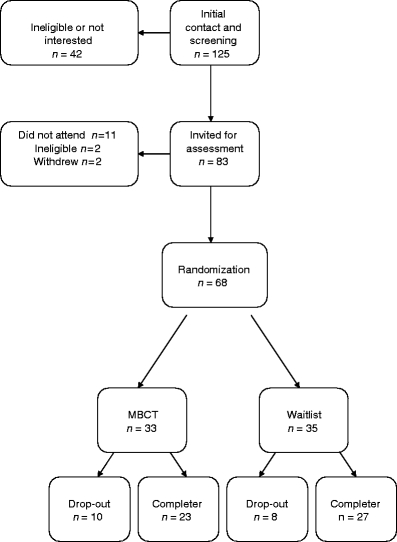
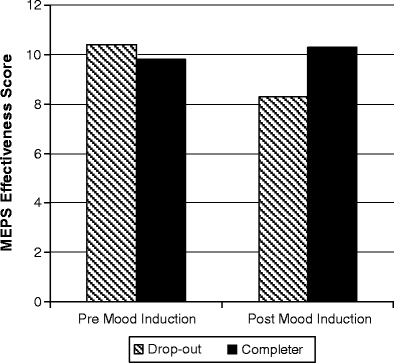
We report data from a randomised controlled trial of mindfulness-based cognitive therapy to pilot procedures for people with a history of suicidal ideation or behaviour, focusing in particular on the variables that distinguish those who complete an adequate 'dose' of treatment, from those who drop out. Sixty-eight participants were randomised to either immediate treatment with mindfulness-based cognitive therapy (MBCT) (n = 33) or to the waitlist (n = 36) arm of the trial. In addition to collecting demographic and clinical information, we assessed participants' cognitive reactivity using the means end problem-solving task, completed before and after a mood induction procedure. Ten participants dropped out of treatment, and eight dropped out of the waitlist condition. Those who dropped out of MBCT were significantly younger than those who completed treatment, less likely to be on antidepressants, had higher levels of depressive rumination and brooding and showed significantly greater levels of problem-solving deterioration following mood challenge. None of these factors distinguished participants in the waiting list condition who remained in the study from those who dropped out. Our results suggest that individuals with high levels of cognitive reactivity, brooding and depressive rumination may find it particularly difficult to engage with MBCT, although paradoxically they are likely to have the most to gain from the development of mindfulness skills if they remain in class. Addressing how such patients can be best prepared for treatment and supported to remain in treatment when difficulties arise is an important challenge.
Overview
The claims and statistics of this paper haven’t been checked yet.
Run the check — free, no account needed. It reads the open-access text and checks the sources it cites.
Integrity signals
Registry
Cites
Statistics
Figures
Verification
Claims the paper makes
The claims and statistics of this paper haven’t been checked yet.
Run the check — free, no account needed. It reads the open-access text and checks the sources it cites.
Claims other papers make about this one
Each is checked against this paper’s own text: does it say what the citing paper says it does?
The source backs part of the claim, not all of it — or backs it for a different population, condition or comparison.
In the citing paper
“A study by Crane and Williams70 on MBCT attrition in a community population found that those who dropped out of MBCT were significantly younger than those who completed treatment, less likely to be on antidepressants, had higher levels of depressive rumination and brooding, and showed significantly greater levels of problem-solving deterioration following mood challenge.”
From Treatment Engagement and Outcomes of Mindfulness-Based Cognitive Therapy for Veterans with Psychiatric Disorders (2019) · cites this paper as [70]
Experimental — accuracy not yet measured
Self-check
Percentages, sums and reported differences re-computed from the paper’s own numbers.
The self-check needs the paper’s full text.
Citations
Cites
(1998) · The Journal of Clinical Psychiatry · Cited by 19,139
(1998) · PubMed · Cited by 10,216
The mini international neuropsychiatric interview
Lecrubier, Y., Sheehan, D. V., Hergueta, T., & Weiller, E. (1998) · European Psychiatry · doi:10.1016/s0924-9338(99)80239-9 · Cited by 5,899
Rumination reconsidered: a psychometric analysis.
Treynor, W., Gonzalez, R., & Nolen-Hoeksema, S. (2003) · Cognitive Therapy and Research · doi:10.1023/a:1023910315561 · Cited by 3,808 · cited 6×
“…(five items, described by the authors as ‘moody pondering’ e.g. “think ‘why can’t I handle things better?’”) and reflection (five items referring to neutrally valenced pondering, e.g. ‘analyse recent events to try and understand why you are depressed’; see Treynor et al. 2003 for factor analysis).”
BackgroundInfluential(2001) · Cited by 3,666
Self-citationNolen-Hoeksema, S., & Morrow, J. (1991) · Journal of Personality and Social Psychology · doi:10.1037/0022-3514.61.1.115 · Cited by 3,276
Prevention of relapse/recurrence in major depression by mindfulness-based cognitive therapy.
Teasdale, J. D., Segal, Z. V., Williams, J. M. G., Ridgeway, V. A., Soulsby, J. M., & Lau, M. A. (2000) · Journal of Consulting and Clinical Psychology · doi:10.1037/0022-006x.68.4.615 · Cited by 3,236 · cited 4×
“Two previous trials of MBCT for recurrent depression have demonstrated that the treatment significantly reduces the risk of relapse over a 12-month period in those with three or more depressive episodes (Ma and Teasdale 2004; Teasdale et al. 2000), with a more recent trial demonstrating that MBCT has equivalent result…”
ResultInfluentialSelf-citation(1997) · American Psychiatric Press eBooks · Cited by 3,056
Self-citationRudd (2006) · doi:10.1002/(issn)1097-4679 · Cited by 2,635
Lezak, M. D., Howieson, D. B., Bigler, E. D., & Tranel, D. (1995) · Cited by 1,840
Carmody, J., & Baer, R. A. (2008) · Journal of Behavioral Medicine · doi:10.1007/s10865-007-9130-7 · Cited by 1,823 · cited 1×
“Similarly Carmody and Baer (2008) reported drop-out figures for participants attending MBSR classes at the University of Massachusetts Medical School in 2006 who consented to participate in a research study exploring the effects of home practice on outcome.”
Background(1997) · American Psychiatric Press eBooks · Cited by 1,436
Self-citationMa, S. H., & Teasdale, J. D. (2004) · Journal of Consulting and Clinical Psychology · doi:10.1037/0022-006x.72.1.31 · Cited by 1,390 · cited 6×
“…from those who remained in treatment: having a history of two, rather than three or more episodes of depression (associated with increased likelihood of dropout; Ma and Teasdale 2004) and having a history of attempted suicide (associated with increased likelihood of dropout; Kuyken et al. 2008).”
BackgroundResultInfluentialJournal of Consulting and Clinical Psychology
Rice, T. K., & Wallace, D. (2008) · Wiley eBooks · doi:10.1002/9780470373699.speced1159 · Cited by 1,192
Cognitive Therapy for the Prevention of Suicide Attempts: A Randomized Controlled Trial
Brown, G. K., Ten Have, T., Henriques, G. R., Xie, S. X., Hollander, J. E., & Beck, A. T. (2005) · JAMA · doi:10.1001/jama.294.5.563 · Cited by 1,045 · cited 2×
“Finally Brown et al. (2005) managed to retain almost all the participants in their trial of cognitive therapy for suicide attempters (only two out of 60 did not attend cognitive therapy) but did so in the context of very intensive efforts including the use of study case managers.”
BackgroundMindfulness-based cognitive therapy to prevent relapse in recurrent depression.
Kuyken, W., Byford, S., Taylor, R. S., Watkins, E., Holden, E., White, K., Barrett, B., Byng, R., Evans, A., Mullan, E., et al. (2008) · Journal of Consulting and Clinical Psychology · doi:10.1037/a0013786 · Cited by 770 · cited 6×
“…from those who remained in treatment: having a history of two, rather than three or more episodes of depression (associated with increased likelihood of dropout; Ma and Teasdale 2004) and having a history of attempted suicide (associated with increased likelihood of dropout; Kuyken et al. 2008).”
BackgroundResultInfluentialThe Handbook of health behavior change
(2009) · Choice Reviews Online · doi:10.5860/choice.46-6233 · Cited by 616
Differential Relapse Following Cognitive Therapy and Pharmacotherapy for Depression
Evans, M. D. (1992) · Archives of General Psychiatry · doi:10.1001/archpsyc.1992.01820100046009 · Cited by 476 · cited 2×
“Although these levels of dropout compare favourably with dropout from treatment trials for patients with acute depression (e.g. Evans et al. 1992, 40% attrition by 12 weeks for antidepressants and/or cognitive therapy; Warden et al. 2009, Star*D, 27% attrition by 12 weeks for antidepressant…”
BackgroundWarrington, E. K. (1977) · Journal of Neurology Neurosurgery & Psychiatry · doi:10.1136/jnnp.40.8.832-c · Cited by 362
Mindfulness-based cognitive therapy for depression: A new approach for preventing relapse
Barnhofer, T. (2002) · Zeitschrift für Klinische Psychologie und Psychotherapie · doi:10.1026//1616-3443.31.4.298 · Cited by 338
Daughters, S. B., Lejuez, C. W., Bornovalova, M. A., Kahler, C. W., Strong, D. R., & Brown, R. A. (2005) · Journal of Abnormal Psychology · doi:10.1037/0021-843x.114.4.729 · Cited by 336 · cited 1×
“Research in substance abuse populations shows that low levels of psychological distress tolerance predict early dropout from treatment (Daughters et al. 2005), and it would be interesting in future research to explore the extent to which the same is true of MBCT.”
BackgroundWilliams, J. M. G., Alatiq, Y., Crane, C., Barnhofer, T., Fennell, M. J. V., Duggan, D. S., Hepburn, S., & Goodwin, G. M. (2008) · Journal of Affective Disorders · doi:10.1016/j.jad.2007.08.022 · Cited by 327 · cited 2×
“This trial was conducted as a feasibility and acceptability study, and the main outcomes have been reported elsewhere (Williams et al. 2008, primary outcomes; Crane et al. 2008; Hepburn et al. 2009, secondary outcomes).”
MethodSelf-citationWilliams, J. M. G., Barnhofer, T., Crane, C., & Beck, A. T. (2005) · Journal of Abnormal Psychology · doi:10.1037/0021-843x.114.3.421 · Cited by 250 · cited 5×
“Previous research has shown that it is problem-solving effectiveness, rather than number of relevant means, which differentiates participants with a history of suicidal ideation from those with a history of non-suicidal depression (Williams et al. 2005).”
BackgroundResultInfluentialSelf-citationA qualitative study of mindfulness‐based cognitive therapy for depression
Mason, O., & Hargreaves, I. (2001) · British Journal of Medical Psychology · doi:10.1348/000711201160911 · Cited by 242 · cited 1×
“The support provided by the group and the realisation of not being alone in suffering from depression have been repeatedly identified as core to the experience of MBCT in qualitative studies (e.g. Mason and Hargreaves 2001; Allen et al. 2009).”
BackgroundMindfulness‐Based cognitive therapy for prevention of recurrence of suicidal behavior
Williams, J. M. G., Duggan, D. S., Crane, C., & Fennell, M. J. V. (2005) · Journal of Clinical Psychology · doi:10.1002/jclp.20223 · Cited by 235 · cited 1×
“Although MBCT may hold promise for these patients (e.g. Williams et al. 2006), difficulties with engagement and retention in treatment can be pronounced.”
BackgroundSelf-citationA systematic review of the relationship between rumination and suicidality
Morrison, R., & O'Connor, R. C. (2008) · Suicide and Life-Threatening Behavior · doi:10.1521/suli.2008.38.5.523 · Cited by 231 · cited 1×
“…psychological treatment, and might also be a marker of more generally elevated levels of cognitive reactivity There is growing evidence that suicidality is also associated with increased levels of rumination (see Morrison and O’Connor 2008 for a systematic review of the literature in this area).”
BackgroundTYRER, P., THOMPSON, S., SCHMIDT, U., JONES, V., KNAPP, M., DAVIDSON, K., CATALAN, J., AIRLIE, J., BAXTER, S., BYFORD, S., et al. (2003) · Psychological Medicine · doi:10.1017/s0033291703008171 · Cited by 190 · cited 1×
“For example, in the POPMACT trial of brief CBT for suicide attempters, 38% of those allocated to CBT treatment failed to attend even one treatment session (Tyrer et al. 2003).”
Westbrook, D., & Kirk, J. (2005) · Behaviour Research and Therapy · doi:10.1016/j.brat.2004.09.006 · Cited by 183 · cited 3×
“Although these levels of dropout compare favourably with dropout from treatment trials for patients with acute depression (e.g. Evans et al. 1992, 40% attrition by 12 weeks for antidepressants and/or cognitive therapy; Warden et al. 2009, Star*D, 27% attrition by 12 weeks for antidepressant treatment) and dropout from…”
BackgroundInfluentialEffectiveness of an outpatient intervention targeting suicidal young adults: Preliminary results.
Rudd, M. D., Rajab, M. H., Orman, D. T., Stulman, D. A., Joiner, T., & Dixon, W. A. (1996) · Journal of Consulting and Clinical Psychology · doi:10.1037/0022-006x.64.1.179 · Cited by 182 · cited 2×
“Rudd et al. (1996) found a 21% drop-out rate in a treatment study of young suicidal adults.”
BackgroundCompliance with an outpatient stress reduction program: rates and predictors of program completion
Kabat-Zinn, J., & Chapman-Waldrop, A. (1988) · Journal of Behavioral Medicine · doi:10.1007/bf00844934 · Cited by 169 · cited 2×
“For example, Kabat-Zinn and Chapman-Waldrop (1988) reviewed adherence in a standard 8-week MBSR programme over a 2-year period and found an average completion rate of 76%, with 9% attending no sessions and a further 15% dropping out after the beginning of the programme, usually within the first few…”
MethodAllen, M., Bromley, A., Kuyken, W., & Sonnenberg, S. J. (2009) · Behavioural and Cognitive Psychotherapy · doi:10.1017/s135246580999004x · Cited by 160 · cited 1×
“The support provided by the group and the realisation of not being alone in suffering from depression have been repeatedly identified as core to the experience of MBCT in qualitative studies (e.g. Mason and Hargreaves 2001; Allen et al. 2009).”
BackgroundCrane, C., Barnhofer, T., Duggan, D. S., Hepburn, S., Fennell, M. V., & Williams, J. M. G. (2008) · Cognitive Therapy and Research · doi:10.1007/s10608-008-9193-y · Cited by 100 · cited 1×
“This trial was conducted as a feasibility and acceptability study, and the main outcomes have been reported elsewhere (Williams et al. 2008, primary outcomes; Crane et al. 2008; Hepburn et al. 2009, secondary outcomes).”
MethodSelf-citationThe Handbook of Health Behavior Change
Cradock, A. L. I., Lewis, K. H., & Moore, J. B. (2024) · Springer Publishing Company eBooks · doi:10.1891/9780826142658 · Cited by 77
Hepburn, S. R., Crane, C., Barnhofer, T., Duggan, D. S., Fennell, M. J. V., & Williams, J. M. G. (2009) · British Journal of Clinical Psychology · doi:10.1348/014466509x414970 · Cited by 73 · cited 2×
“This trial was conducted as a feasibility and acceptability study, and the main outcomes have been reported elsewhere (Williams et al. 2008, primary outcomes; Crane et al. 2008; Hepburn et al. 2009, secondary outcomes).”
MethodSelf-citationEngagement and retention in specialist services for people with personality disorder
Crawford, M., Price, K., Gordon, F., Josson, M., Taylor, B., BATEMAN, A. W., Fonagy, P., Tyrer, P. J., & Moran, P. (2008) · Acta Psychiatrica Scandinavica · doi:10.1111/j.1600-0447.2008.01306.x · Cited by 58 · cited 1×
“A similar finding has been observed for dropout from personality disorder services (Crawford et al. 2009) with whom our population of previously suicidal patients may have some overlap.”
BackgroundCognitive Behavioural Therapy Supervision: Recommended Practice
Pretorius, W. M. (2006) · Behavioural and Cognitive Psychotherapy · doi:10.1017/s1352465806002876 · Cited by 58
Income and attrition in the treatment of depression: a STAR*D report
Warden, D., Rush, A. J., Wisniewski, S. R., Lesser, I. M., Thase, M. E., Balasubramani, G. K., Shores‐Wilson, K., Nierenberg, A. A., & Trivedi, M. H. (2009) · Depression and Anxiety · doi:10.1002/da.20541 · Cited by 55 · cited 3×
“…treatment trials for patients with acute depression (e.g. Evans et al. 1992, 40% attrition by 12 weeks for antidepressants and/or cognitive therapy; Warden et al. 2009, Star*D, 27% attrition by 12 weeks for antidepressant treatment) and dropout from cognitive behavioural therapy (CBT) as part of…”
Background
Research works printed but not linked: 5
- Beck, A. T., & Steer, R. A. (1990). Beck anxiety inventory manual. San Antonio: Psychological.
- Beck, A. T., Steer, R. A., & Brown, G. K. (1996). Manual for the BDI-II. San Antonio: Psychological.
- Lynch, G. V. (2004). Patient variables associated with treatment completion in mindfulness meditation-based stress reduction (MBSR) treatment for fibromyalgia: implications for prescriptive matching and participation enhancement. Unpublished doctoral dissertation, University of Louisville, Kentucky, USA.
- NICE. (2009). Depression: The treatment and management of depression in adults (update). UK: National Institute for Health and Clinical Excellence.
- Platt, J. J., Spivak, G., & Bloom, W. (Eds.). (1978). Manual for the Means-End Problem Solving (MEPS) procedure: A measure of interpersonal problem-solving skill. Philadelphia: Hahnemann Medical College Hospital.
Cited by
Sorted by citations
Williams, J. M. G., Crane, C., Barnhofer, T., Brennan, K., Duggan, D. S., Fennell, M. J. V., Hackmann, A., Krusche, A., Muse, K., Von Rohr, I. R., et al. (2014) · Journal of Consulting and Clinical Psychology · doi:10.1037/a0035036 · Cited by 420
“We informed participants’ general practitioners of their patients’ allocated treatment, the dates of treatment sessions (if applicable), and the point at which patients ended their participation in the trial.”
Self-citationDoing no harm in mindfulness-based programs: Conceptual issues and empirical findings
Baer, R., Crane, C., Miller, E., & Kuyken, W. (2019) · Clinical Psychology Review · doi:10.1016/j.cpr.2019.01.001 · Cited by 307
Self-citationMARCHAND, W. R. (2012) · Journal of Psychiatric Practice® · doi:10.1097/01.pra.0000416014.53215.86 · Cited by 305
Prospects for a clinical science of mindfulness-based intervention
Dimidjian, S., & Segal, Z. V. (2015) · American Psychologist · doi:10.1037/a0039589 · Cited by 291
Mindfulness-Based Cognitive Therapy: Theory and Practice
Sipe, W. E. B., & Eisendrath, S. J. (2012) · The Canadian Journal of Psychiatry · doi:10.1177/070674371205700202 · Cited by 285
Metadata
- Authors
- Crane, C., & Williams, J. M. G.
- Affiliations
- Warneford Hospital (GB)
- Corresponding author
- Crane, Catherine
- Venue
- Mindfulness
- Published
- 2010-03
- Volume
- 1
- Issue
- 1
- Pages
- 10-20
- ISSN
- 1868-8527 (ISSN-L)
- 1868-8535
- PMC
- PMC2987524
- OpenAlex
- W2155494147
- Cited by
- 123
- References
- 37
- Citations by year
- 2026: 9 · 2025: 10 · 2024: 9 · 2023: 6 · 2022: 11 · 2021: 8 · 2020: 9 · 2019: 7 · 2018: 10 · 2017: 10 · 2016: 11 · 2015: 5 · 2014: 6 · 2013: 3 · 2012: 6
- FWCI
- 4.21
- Type
- journal article
- Language
- en
- Open access
- hybrid
- doi.org
- Licence
- cc-by-nc
- Locations
- Mindfulness (publishedVersion, cc-by-nc)
- PubMed Central (publishedVersion, cc-by-nc)
- PubMed (publishedVersion)
- Topics
- Social Sciences › Psychology › Clinical Psychology › Mindfulness and Compassion Interventions
- Social Sciences › Psychology › Experimental and Cognitive Psychology › Anxiety, Depression, Psychometrics, Treatment, Cognitive Processes
- Social Sciences › Psychology › Clinical Psychology › Psychotherapy Techniques and Applications
- Keywords
- mindfulness-based cognitive therapy, treatment discontinuation, suicidal depression, suicidal ideation, cognitive reactivity, brooding, depressive rumination, mood induction, predictors of treatment dropout, antidepressant use, treatment engagement
About these checks
Registry, retraction, Cites and statistics results are computed, not judged, with one exception: a printed reference that no index lists is read once by a model before it counts as a citation error. Claims are extracted by a model and kept only when their quote appears verbatim in the text; each cited source is then checked, with a model’s help, for whether it says what the claim relies on. Those verdicts can be wrong — read the claim’s quote and the cited source before relying on one.
Statistics and arithmetic are recomputed, not judged.
Confidence bands are shown only for fields calibrated on our annotated test set. None is calibrated yet, so no band is shown.
What counts as a claim ›How we measure confidence ›How we check this ›
Are you an author, or do you see a problem with this page? Request a review
