

The DOI matches its Crossref record; 26 of the 26 references it cites were found in a registry or an index.
Diagnostic Value of Urinary Steroid Profiling in the Evaluation of Adrenal Tumors
Open accessAbstract
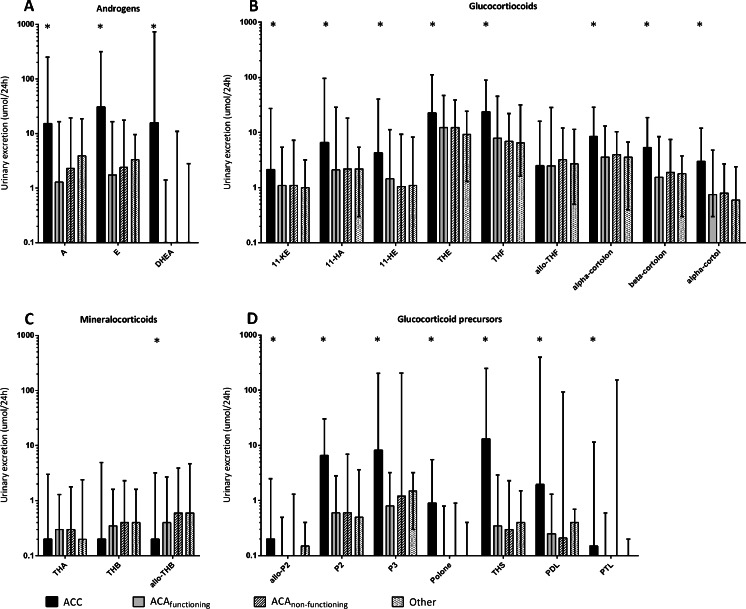
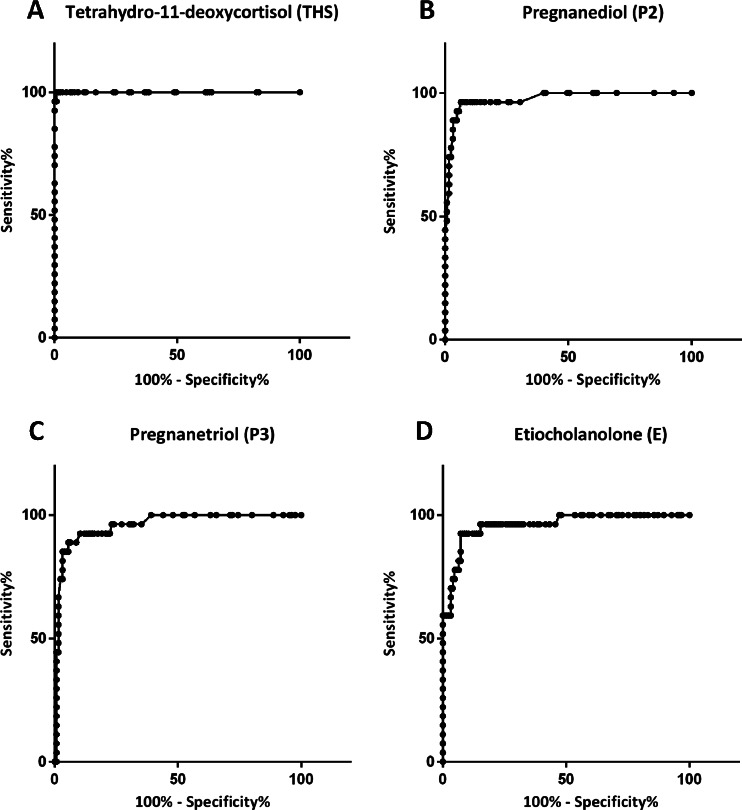
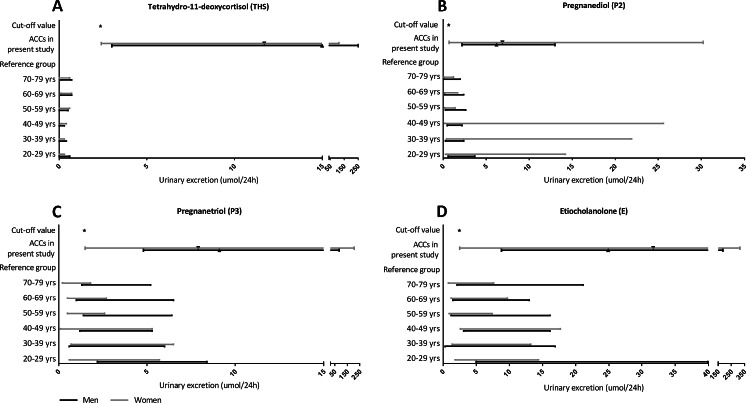
Radiological examination may unexpectedly reveal an adrenal mass. Current algorithms for differentiating between benign and malignant lesions mainly rely on size and densitometry on unenhanced CT, which have limited specificity. We examined the diagnostic value of urinary steroid profiling by gas chromatography/mass-spectrometry (GC/MS) in differentiating between benign and malignant adrenal tumors. A retrospective study in two referral centers for patients with adrenal disease was performed. All urinary steroid profiles ordered for evaluation of an adrenal tumor between January 2000 and November 2011 were examined. Patients were diagnosed with adrenal cortical carcinoma (ACC), adrenal cortical adenoma (ACA), or other adrenal mass. Results of hormonal measurements, imaging studies, pathology reports, and clinical outcome were retrieved from medical records. The diagnostic value of individual urinary steroid metabolites was determined by receiver operating characteristics analysis. Cut-off values were compared to reference values from an age and gender-standardized population of healthy controls. Eighteen steroid metabolites were excreted in significantly higher concentrations in patients with ACC (n = 27) compared to patients with ACA (n = 107) or other adrenal conditions (n = 18). Tetrahydro-11-deoxycortisol (THS) at a cut-off value of 2.35 μmol/24 h differentiated ACC from other adrenal disorders with 100% sensitivity and 99% specificity. Elevated urinary excretion of THS was associated with a very high sensitivity and specificity to differentiate between an ACC and a benign adrenal mass. Urinary steroid profiling might be a useful diagnostic test for the evaluation of patients with an adrenal incidentaloma.
Overview
The claims and statistics of this paper haven’t been checked yet.
Run the check — free, no account needed. It reads the open-access text and checks the sources it cites.
Integrity signals
Registry
Cites
Statistics
Figures
Verification
Claims the paper makes
The claims and statistics of this paper haven’t been checked yet.
Run the check — free, no account needed. It reads the open-access text and checks the sources it cites.
Claims other papers make about this one
Each is checked against this paper’s own text: does it say what the citing paper says it does?
In the citing paper
“All studies identified THS as the most informative steroid marker indicative of ACC.”
From Adrenal incidentaloma (2020) · cites this paper as [348]
In the citing paper
“They performed GC-MS analysis of 22 steroid metabolites and identified 15 individual steroid markers with a sensitivity of 90% or above in detecting ACC, with the 11-deoxycortisol metabolite (THS) again representing the most informative marker.”
From Adrenal incidentaloma (2020) · cites this paper as [348]
In the citing paper
“In particular, the cosecretion of a distinct combination of glucocorticoid and androgen metabolites is emerging as a sensitive diagnostic tool for ACC (342,348,349).”
From Adrenal incidentaloma (2020) · cites this paper as [348]
In the citing paper
“Additionally, recent retrospective studies employing GC-MS–based urine steroid profiling revealed that ACCs present a unique steroidogenic “signature” characterized by accumulation of steroid hormone precursors (1, 154, 155) (Fig. 8E).”
From Steroid Metabolome Analysis in Disorders of Adrenal Steroid Biosynthesis and Metabolism (2019) · cites this paper as [154]
Self-check
Percentages, sums and reported differences re-computed from the paper’s own numbers.
The self-check needs the paper’s full text.
Citations
Cites
The Molecular Biology, Biochemistry, and Physiology of Human Steroidogenesis and Its Disorders
Miller, W. L., & Auchus, R. J. (2011) · Endocrine Reviews · doi:10.1210/er.2010-0013 · Cited by 2,458 · cited 3×
“These reactions, catalyzed by CYP11B1 (11-deoxycortisol→cortisol) and CYP11B2 (11-deoxycorticosterone→aldosterone), take place on the inner mitochondrial membrane (IMM) and are stimulated by ACTH [22].”
BackgroundInfluentialThe Incidentally Discovered Adrenal Mass
Young, W. F. (2007) · New England Journal of Medicine · doi:10.1056/nejmcp065470 · Cited by 1,090
Management of the clinically inapparent adrenal mass ("incidentaloma")
Grumbach, M. M., Biller, B. M. K., Braunstein, G. D., Campbell, K. K., Carney, J. A., Godley, P. A., Harris, E. L., Lee, J. K. T., Oertel, Y. C., Posner, M. C., et al. (2003) · Annals of Internal Medicine · doi:10.7326/0003-4819-138-5-200303040-00013 · Cited by 945
Robinson, R. (1993) · BMJ · doi:10.1136/bmj.307.6907.793 · Cited by 819
Pathologic features of prognostic significance in adrenocortical carcinoma
Weiss, L. M., Medeiros, L. J., & Vickery, A. L. (1989) · The American Journal of Surgical Pathology · doi:10.1097/00000478-198903000-00004 · Cited by 818 · cited 1×
“In patients with ACC, the Weiss score (a set of nine histopathological criteria with prognostic value in adrenocortical tumors) was extracted from the original pathology reports and disease progression was staged according to the European Network for Study of Adrenal Tumors (ENSAT) staging system [16, 17].”
MethodThe clinically inapparent adrenal mass: update in diagnosis and management
Mansmann, G., Lau, J., Balk, E., Rothberg, M., Miyachi, Y., & Bornstein, S. R. (2004) · Endocrine Reviews · doi:10.1210/er.2002-0031 · Cited by 781
Prevalence of adrenal incidentaloma in a contemporary computerized tomography series
Bovio, S., Cataldi, A., Reimondo, G., Sperone, P., Novello, S., Berruti, A., Borasio, P., Fava, C., Dogliotti, L., Scagliotti, G. V., et al. (2006) · Journal of Endocrinological Investigation · doi:10.1007/bf03344099 · Cited by 712
Fassnacht, M., Johanssen, S., Quinkler, M., Bucsky, P., Willenberg, H. S., Beuschlein, F., Terzolo, M., Mueller, H., Hahner, S., Allolio, B., et al. (2009) · Cancer · doi:10.1002/cncr.24030 · Cited by 695
Steroidogenic enzymes: Structure, function, and role in regulation of steroid hormone biosynthesis
Hanukoglu, I. (1992) · The Journal of Steroid Biochemistry and Molecular Biology · doi:10.1016/0960-0760(92)90307-5 · Cited by 577
AME Position Statement on adrenal incidentaloma
Terzolo, M., Stigliano, A., Chiodini, I., Loli, P., Furlani, L., Arnaldi, G., Reimondo, G., Pia, A., Toscano, V., Zini, M., et al. (2011) · European Journal of Endocrinology · doi:10.1530/eje-10-1147 · Cited by 523
Cited by
Sorted by citations
Fassnacht, M., Arlt, W., Bancos, I., Dralle, H., Newell-Price, J., Sahdev, A., Tabarin, A., Terzolo, M., Tsagarakis, S., & Dekkers, O. M. (2016) · European Journal of Endocrinology · doi:10.1530/eje-16-0467 · Cited by 1,566
Faßnacht, M., Dekkers, O. M., Else, T., Baudin, É., Berruti, A., de Krijger, R. R., Haak, H. R., Mihai, R., Assié, G., & Terzolo, M. (2018) · European Journal of Endocrinology · doi:10.1530/eje-18-0608 · Cited by 976
Self-citationFaßnacht, M., Tsagarakis, S., Terzolo, M., Tabarin, A., Sahdev, A., Newell-Price, J. D. C., Pelsma, I. C. M., Marina, L., Lorenz, K., Bancos, I., et al. (2023) · European Journal of Endocrinology · doi:10.1093/ejendo/lvad066 · Cited by 849
Faßnacht, M., Assié, G., Baudin, É., Eisenhofer, G., de la Fouchardière, C., Haak, H. R., de Krijger, R. R., Porpiglia, F., Terzolo, M., & Berruti, A. (2020) · Annals of Oncology · doi:10.1016/j.annonc.2020.08.2099 · Cited by 446
Self-citationSherlock, M., Scarsbrook, A., Abbas, A., Fraser, S., Limumpornpetch, P., Dineen, R., & Stewart, P. M. (2020) · Endocrine Reviews · doi:10.1210/endrev/bnaa008 · Cited by 347
“In particular, the cosecretion of a distinct combination of glucocorticoid and androgen metabolites is emerging as a sensitive diagnostic tool for ACC (342,348,349).”
Background
Metadata
- Authors
- Kerkhofs, T. M. A., Kerstens, M. N., Kema, I. P., Willems, T. P., & Haak, H. R.
- Affiliations
- Máxima Medisch Centrum (NL)
- University Medical Center Groningen (NL)
- Maastricht University Medical Centre (NL)
- Corresponding author
- Kerkhofs, T. M. A.
- Venue
- Hormones and Cancer
- Published
- 2015-05-19
- Volume
- 6
- Issue
- 4
- Pages
- 168-175
- ISSN
- 1868-8497 (ISSN-L)
- 1868-8500
- PMC
- PMC4486399
- OpenAlex
- W1829257219
- Cited by
- 102
- References
- 26
- Citations by year
- 2026: 3 · 2025: 5 · 2024: 7 · 2023: 10 · 2022: 10 · 2021: 9 · 2020: 16 · 2019: 12 · 2018: 10 · 2017: 7 · 2016: 7 · 2015: 6
- FWCI
- 10.08
- Type
- journal article
- Language
- en
- Open access
- hybrid
- doi.org
- Locations
- Hormones and Cancer (publishedVersion, cc-by)
- Europe PMC (PubMed Central) (publishedVersion, cc-by)
- PubMed Central (publishedVersion, cc-by)
- PubMed (publishedVersion)
- Research Publications (Maastricht University) (publishedVersion, cc-by)
- University of Groningen research database (University of Groningen / Centre for Information Technology) (submittedVersion, cc-by)
- Research Publications (Maastricht University) (submittedVersion, other-oa)
- Topics
- Health Sciences › Medicine › Surgery › Adrenal and Paraganglionic Tumors
- Health Sciences › Medicine › Endocrinology, Diabetes and Metabolism › Adrenal Hormones and Disorders
- Health Sciences › Medicine › Endocrinology, Diabetes and Metabolism › Hormonal Regulation and Hypertension
- Keywords
- urinary steroid profiling, adrenal tumors, adrenocortical carcinoma, adrenal adenoma, adrenal incidentaloma, benign versus malignant differentiation, diagnostic accuracy, gas chromatography-mass spectrometry
- MeSH terms
- Adrenal Cortex Neoplasms, Adult, Aged, Carcinoma, Cortodoxone, Female, Humans, Male, Middle Aged, Prognosis, Steroids, Cohort Studies
About these checks
Registry, retraction, Cites and statistics results are computed, not judged, with one exception: a printed reference that no index lists is read once by a model before it counts as a citation error. Claims are extracted by a model and kept only when their quote appears verbatim in the text; each cited source is then checked, with a model’s help, for whether it says what the claim relies on. Those verdicts can be wrong — read the claim’s quote and the cited source before relying on one.
Statistics and arithmetic are recomputed, not judged.
Confidence bands are shown only for fields calibrated on our annotated test set. None is calibrated yet, so no band is shown.
What counts as a claim ›How we measure confidence ›How we check this ›
Are you an author, or do you see a problem with this page? Request a review
