

Supporting Literacy and Digital Literacy Development in Early Childhood Education Using Storytelling Activities
Open accessThe DOI matches its Crossref record; 67 of the 74 references it cites were found in a registry or an index; 5 of the 24 sources its claims cite were checked for support.
Abstract
Educators have increasingly adopted formalized approaches for teaching literacy skills in early childhood education. In line with an emergent critique of this approach, the present study investigated the design and effectiveness of a literacy intervention that blended Gagné’s nine events of instructional design with storytelling. Three classes in a public preschool in Indonesia participated in an experimental study involving 45 children, aged 5–6 years. Across 3 weeks, one experimental condition received storytelling activities and a second experimental condition received digital storytelling activities. The control condition received regular literacy classroom activities. Before, and after, the 3-week storytelling intervention, measures of literacy and digital literacy skills were administered to all groups. In the digital storytelling condition, children’s literacy skills increased significantly compared to children in the control condition. Other exploratory data analyses suggested that both types of storytelling activities enhanced digital literacy skills. The findings need to be replicated with an extended series of storytelling activities that involve larger groups of participants.
Overview
CoChat Summary
TL;DR
This quasi-experimental study in an Indonesian public preschool tested whether oral or digital storytelling activities, structured around Gagné's nine events of instruction, improved literacy and digital literacy in 5- to 6-year-olds. Digital storytelling produced significantly greater literacy gains than the control condition, and both storytelling conditions showed gains in digital literacy.
Key findings
- Literacy posttest scores differed significantly between conditions, H(36) = 8.26, p = 0.016; the control vs. digital storytelling comparison was significant with a large effect, U(25) = 128.50, z = 2.82, p = 0.005, r = 0.56. No differences were found between control and oral storytelling, or between the two storytelling conditions.
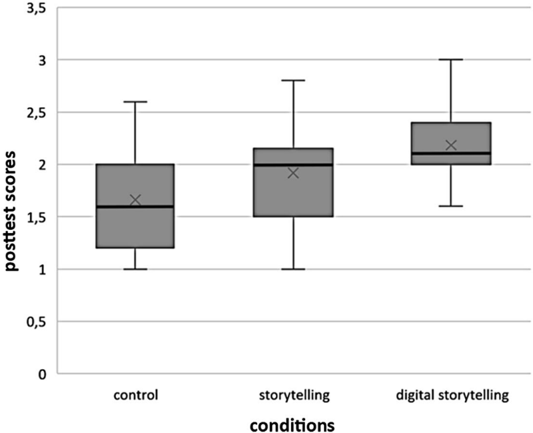
- Literacy learning gains (Lgain) were M = 0.03 (SD = 0.08) for control, M = 0.20 (SD = 0.19) for oral storytelling, and M = 0.38 (SD = 0.18) for digital storytelling; ANOVA F(2, 33) = 14.74, p < 0.001, with large effects for control vs. storytelling (d = 1.17), control vs. digital storytelling (d = 2.53), and digital vs. oral storytelling (d = 0.97).
- Digital literacy posttest scores were M = 2.04 (SD = 0.22) control, M = 2.80 (SD = 0.28) oral storytelling, and M = 3.00 (SD = 0.42) digital storytelling; control vs. storytelling U(10) = 24.50, z = 2.58, p = 0.008, r = 0.82, and control vs. digital storytelling U(10) = 25, z = 2.65, p = 0.008, r = 0.84. The two experimental conditions did not differ significantly.
- Digital literacy learning gains (DLgain) were M = 0.16 (SD = 0.09) control, M = 0.88 (SD = 0.18) storytelling, and M = 1.12 (SD = 0.23) digital storytelling; ANOVA F(2, 14) = 40.70, p < 0.001, with large effects for control vs. storytelling (d = 5.06) and control vs. digital storytelling (d = 5.50).
Methods
- Quasi-experimental design with three conditions in three classrooms of a public preschool in Indonesia: control (regular literacy activities), oral storytelling, and digital storytelling. Classrooms were randomly assigned to conditions; all used the same curriculum.
- Participants were 45 children (25 girls, 20 boys), average age 5.39 years (SD = 0.41). The intervention spanned three storytelling sessions over 3 weeks on the theme "Me" ("My Name," "My Birthday," "My Hobby"), with identical story lines across experimental conditions and activities following Gagné's events of instruction. Analyses used complete data from 37 children; digital literacy measures were gathered from 15 randomly chosen children (five per condition).
- Literacy was assessed on alphabet knowledge, phonological awareness, and print awareness using a 4-point rubric (pretest α = 0.63, posttest α = 0.79); digital literacy assessed cognitive and socio-emotional dimensions (pretest α = 0.65, posttest α = 0.87). Nonparametric tests (Kruskal-Wallis, Mann-Whitney with Bonferroni-corrected alpha of 0.017) and ANOVA with Tukey HSD on gain scores were used.
Limitations
- The authors state the digital literacy portion was exploratory and involved only a small sample of children, and recommend larger samples for more definitive conclusions.
- The authors note that storytelling activities were led by the experimenter while control activities were taught by the classroom teacher (with each serving as the other's assistant), a methodological limitation adopted to minimize disruption of the control classroom.
- The authors state findings need replication with an extended series of storytelling activities involving larger groups, and caution that future studies should reduce the possible novelty effect of digital storytelling (evident in the text as a concern rather than a demonstrated confound).
Model-written summary. Check it against the paper before relying on it.
Integrity signals
Registry
Cites
Statistics
Figures
Verification
Claims the paper makes
5 Valid · 1 Not valid · 14 Not checked · 49 Own results and interpretations
The cited sources support only part of this claim — read each source’s verdict below.
In the paper
“Storytelling can also promote writing skills by encouraging children to create their own stories, modify stories that they have heard, and even write plays based on familiar tales (Cassell 2004;Nicolopoulou et al. 2015).”
§ Supporting Literacy and Digital Literacy Development in Early Childhood Education Using Storytelling Activities > Storytelling and Digital Storytelling
What the sources say
- Not checked — no full text of the sourcecites Cassell 2004 matched to “Towards a model of technology and literacy development: Story listening systems” (2004) source
- Partly supportedcites Nicolopoulou et al. 2015 matched to “Using a narrative- and play-based activity to promote low-income preschoolers’ oral language, emergent literacy, and social competence” (2015) sourceExperimental — accuracy not yet measured
The Storytelling and Story-Acting Practice section (page unavailable) describes children composing stories, reworking elements of stories they have heard, and having an adult write down their dictation. The Discussion reports improved print and word awareness, but the paper does not establish improved writing skills or describe children writing plays based on familiar tales; they act out stories instead. (LLM, conf=0.87)
plainstates a cause- Asserted: passes — The authors put it forward as true.
- Checkable: passes — It can be checked against evidence.
- Load-bearing: passes — The paper’s conclusions depend on it.
- Based: passes — The paper gives a reason why it holds.
A result the paper reports from its own data — it cites no other source for it, so there is none to check. The quote shows it is in the paper.
In the paper
“In the digital storytelling condition, children's literacy skills increased significantly compared to children in the control condition.”
§ Supporting Literacy and Digital Literacy Development in Early Childhood Education Using Storytelling Activities > Abstract
plainstates a cause- Asserted: passes — The authors put it forward as true.
- Checkable: passes — It can be checked against evidence.
- Load-bearing: passes — The paper’s conclusions depend on it.
- Based: passes — The paper gives a reason why it holds.
A result the paper reports from its own data — it cites no other source for it, so there is none to check. The quote shows it is in the paper.
In the paper
“Other exploratory data analyses suggested that both types of storytelling activities enhanced digital literacy skills.”
§ Supporting Literacy and Digital Literacy Development in Early Childhood Education Using Storytelling Activities > Abstract
hedgedstates a cause- Asserted: passes — The authors put it forward as true.
- Checkable: passes — It can be checked against evidence.
- Load-bearing: passes — The paper’s conclusions depend on it.
- Based: passes — The paper gives a reason why it holds.
A result the paper reports from its own data — it cites no other source for it, so there is none to check. The quote shows it is in the paper.
In the paper
“In contrast, there was a statistically significant difference on the literacy posttest between conditions, H (36) = 8.26, p = 0.016.”
§ Supporting Literacy and Digital Literacy Development in Early Childhood Education Using Storytelling Activities > Development of Literacy Skills
plain- Asserted: passes — The authors put it forward as true.
- Checkable: passes — It can be checked against evidence.
- Load-bearing: passes — The paper’s conclusions depend on it.
- Based: passes — The paper gives a reason why it holds.
A result the paper reports from its own data — it cites no other source for it, so there is none to check. The quote shows it is in the paper.
In the paper
“In addition, the analysis showed that there was no significant difference for DLgain between the digital storytelling compared to the storytelling condition, p = 0.051.”
§ Supporting Literacy and Digital Literacy Development in Early Childhood Education Using Storytelling Activities > Development of Digital Literacy Skills
plain- Asserted: passes — The authors put it forward as true.
- Checkable: passes — It can be checked against evidence.
- Load-bearing: passes — The paper’s conclusions depend on it.
- Based: passes — The paper gives a reason why it holds.
24 more claims
Create a free account to see all 69 claims and to verify the 4 references still open.
- Probably not a substantial claim. 27
- It may state two separate claims as one. 24
- The quote only partly states this claim. 1
Statistics that don’t add up
Each reported p-value recomputed from its test statistic and degrees of freedom, each partial η² from its F, and each ratio, mean difference or B printed with a p checked against its own confidence interval.
Rated minor: it would not touch a result — a value no result rests on, a p-value that stays on the same side of the significance level, or a conflict that is clerical, resolved elsewhere in the paper, or outside its own findings.
In the paper
“,z = 0.485, p = 0.485”
§ Supporting Literacy and Digital Literacy Development in Early Childhood Education Using Storytelling Activities > Development of Literacy Skills
Reported p = .485 · recomputed p = .628
Statistics recomputed
Every reported test result, recomputed from its test statistic and degrees of freedom. A result shows as not adding up only once an independent check has confirmed it.
- Doesn’t add upz = 0.485reported p = .485 · recomputed p = .628
“,z = 0.485, p = .485”
- Not confirmedz = 2.58reported p = .008 · recomputed p = .010
“,z = 2.58, p = .008”
- Consistentz = 2.82reported p = .005 · recomputed p = .005
“,z = 2.82, p = .005”
- Consistentz = 0.193reported p = .847 · recomputed p = .847
“,z = 0.193, p = .847”
- ConsistentF(2, 33) = 14.74reported p < .001 · recomputed p < .001
“F (2, 33) = 14.74, p < .001”
3 more recomputed tests
Create a free account to see every test the Stats check recomputed.
Self-check
Percentages, sums and reported differences re-computed from the paper’s own numbers.
Each contradiction between two passages listed here was confirmed by an independent check.
Rated minor: it would not touch a result — a value no result rests on, a p-value that stays on the same side of the significance level, or a conflict that is clerical, resolved elsewhere in the paper, or outside its own findings.
In the paper
“The ANOVA for DLgain showed that there was a statistically significant difference between conditions, F (2, 14) = 40.70,p < 0.001.”
§ Supporting Literacy and Digital Literacy Development in Early Childhood Education Using Storytelling Activities > Development of Digital Literacy Skills
Reported 14 · recomputed 12
Rated minor: it would not touch a result — a value no result rests on, a p-value that stays on the same side of the significance level, or a conflict that is clerical, resolved elsewhere in the paper, or outside its own findings.
In the paper
§ Supporting Literacy and Digital Literacy Development in Early Childhood Education Using Storytelling Activities > Development of Literacy Skills
“These mean scores showed that the overall scores of the participants in all three conditions at pretest and posttest were below the mid-scale value of 2.”
§ Key skills assessed 0 point 1 point 2 points 3 points 4 points 1 Phonological awareness identifies initial sound of words; oral presentation Needs help to identify initial sound 1-4 words identified 5-6 words identified 7-8 words identified 9-10 words identified 2 Print awareness and early comprehension know own name; oral presentation Needs help to say own name Own name said clearly Own name said clearly; spells it correctly; Own name said clearly; spells it correctly; writes name from example Own name said clearly; spells it correctly; writes name without example 3 Alphabet recognition recognizes letters; written (storybook) Needs cues to recognize any letters in a storybook 1-4 letters recognized in a storybook 5-6 letters recognized in a storybook 7-8 letters recognized in a storybook 9-10 letters recognized in a storybook 4 Print awareness recognizes daily words; written presentation (storybook) Needs help to recognize any words in a storybook 1 word recognized in a storybook 2-3 words recognized in a storybook 4-5 words recognized in a storybook 6 words recognized in a storybook 5 Print awareness recognizes names in written form; written presentation Needs help to recognize friend's name on attendance list Friend's name recognized on attendance list 2-3 names recognized on attendance list 4-5 names recognized on attendance list 6 names recognized on attendance list Contains information on: what, who, where, when, how, why 3 Read a picture (cognitive) Needs help to identify features observed in a picture Identifies 2 features observed in a picture(s) Mentions 2 features observed in picture; infers story of picture Mentions 3-4 features observed in pictures; infers story of two pictures Mentions 3-4 features observed in pictures; infers story of three pictures 4 Recognize own identity (socio-emotional) Needs help to mention own full name Mentions own full name Mentions own full name and age Mentions own full name clearly; age and own birthday (incomplete) Mentions own full name clearly; age own birthday (complete: date, month, and year) 5 Engage in conversation (socio-emotional) Passively responds to questions Needs reminders to follow etiquette of conversation Needs reminders to follow some etiquette rules of conversation Needs reminders to follow a few etiquette rules of conversation Follows all rules of conversation (e.g., maintains eye contact; waits for his/her turn to speak; asks correctly; and responds correctly)
“| Digital storytelling group (n = 12) | 1.80 (0.32) | 2.18 (0.34) |”
Rated minor: it would not touch a result — a value no result rests on, a p-value that stays on the same side of the significance level, or a conflict that is clerical, resolved elsewhere in the paper, or outside its own findings.
In the paper
§ Supporting Literacy and Digital Literacy Development in Early Childhood Education Using Storytelling Activities > Development of Literacy Skills
“The ANOVA for Lgain scores showed that there was a statistically significant difference between conditions, F (2, 33) = 14.74, p < 0.001.”
§ Supporting Literacy and Digital Literacy Development in Early Childhood Education Using Storytelling Activities > Data Analysis
“Only complete data for the 37 children who completed all assessment tasks were used in the final analyses.”
Rated minor: it would not touch a result — a value no result rests on, a p-value that stays on the same side of the significance level, or a conflict that is clerical, resolved elsewhere in the paper, or outside its own findings.
In the paper
§ Supporting Literacy and Digital Literacy Development in Early Childhood Education Using Storytelling Activities > Development of Digital Literacy Skills
“The ANOVA for DLgain showed that there was a statistically significant difference between conditions, F (2, 14) = 40.70,p < 0.001.”
§ Supporting Literacy and Digital Literacy Development in Early Childhood Education Using Storytelling Activities > Development of Digital Literacy Skills
“The pretest results showed that all participants (n = 15) in the three conditions (control, oral storytelling, digital storytelling) had comparable digital skills at the start of the activities”
Rated minor: it would not touch a result — a value no result rests on, a p-value that stays on the same side of the significance level, or a conflict that is clerical, resolved elsewhere in the paper, or outside its own findings.
In the paper
§ Supporting Literacy and Digital Literacy Development in Early Childhood Education Using Storytelling Activities > Development of Digital Literacy Skills
“In contrast, a statistically significant difference was found on the posttest, H (15) = 9.40, p = 0.09.”
§ Supporting Literacy and Digital Literacy Development in Early Childhood Education Using Storytelling Activities > Data Analysis
“two-tailed tests were used with alpha set at 0.017 (0.05/3)”
Citations
Cites
Statistical Power Analysis for the Behavioral Sciences
Muller, K. (1989) · Technometrics · doi:10.1080/00401706.1989.10488618 · Cited by 99,167
Statistical power analysis for the behavioral sciences
(1990) · Computers, Environment and Urban Systems · doi:10.1016/0198-9715(90)90050-4 · Cited by 65,269
Statistical Power Analysis for the Behavioral Sciences (2nd ed.).
Lachenbruch, P. A., & Cohen, J. (1989) · Journal of the American Statistical Association · doi:10.2307/2290095 · Cited by 37,395
(2017) · Cited by 16,319
Nine Ways to Reduce Cognitive Load in Multimedia Learning
Mayer, R. E., & Moreno, R. (2003) · Educational Psychologist · doi:10.1207/s15326985ep3801_6 · Cited by 4,207
Digital Storytelling: A Powerful Technology Tool for the 21st Century Classroom
Robin, B. R. (2008) · Theory Into Practice · doi:10.1080/00405840802153916 · Cited by 1,485 · cited 3×
“Generally, digital storytelling revolves around presenting short, personal narratives (Meadows 2003) that combine images with text, narration, voice, and music (Robin 2008).”
Background(2000) · Medical Entomology and Zoology · Cited by 900
Digital storytelling: a meaningful technology-integrated approach for engaged student learning
Sadik, A. (2008) · Educational Technology Research and Development · doi:10.1007/s11423-008-9091-8 · Cited by 802
(2016) · doi:10.3389/fpsyg · Cited by 801
DigEuLit: Concepts and Tools for Digital Literacy Development
Martin, A., & Grudziecki, J. (2006) · Innovation in Teaching and Learning in Information and Computer Sciences · doi:10.11120/ital.2006.05040249 · Cited by 682
Research works printed but not linked: 8
- 1. Agosto, D. (2016). Why storytelling matters. Children and Libraries, 14(2), 21-26. https ://doi. org/10.5860/cal.14n2. · DOI
- 13. Egan, K. (1985). Teaching as storytelling: A non-mechanistic approach to planning teaching. Journal of Curriculum Studies, 17(4), 397-406. https ://doi.org/10.1080/00220 27850 17040 · doi:10.1080/00220
- 14. Egan, K. (1986). Teaching as storytelling: An alternate approach to teaching and curriculum in the ele- mentary school. Chicago: University of Chicago Press.
- 24. Katuscáková, M., & Katuscák, M. (2013). The effectiveness of storytelling in transferring different types of knowledge. Paper Presented at the European Conference on Knowledge Management, Kidmore End.
- 41. NAEYC. (1998). Learning to read and write: Developmentally appropriate practices for young children. Young Children, 53(4), 30-46.
- Porter, B. (2005). Digitales: The art of telling digital stories. Denver: Bernajean Porter Consulting.
- 60. Smith, P. L., & Ragan, T. J. (2005). Instructional design (3rd ed.). Danvers: Wiley.
- 65. Wood, J., & McLemore, B. (2001). Critical components in early literacy-knowledge of the letters of the alphabet and phonics instruction. The Florida Reading Quarterly, 38(2), 1-8.
Cited by
Maureen, I. Y., van der Meij, H., & de Jong, T. (2020) · International Journal of Early Childhood · doi:10.1007/s13158-020-00263-7 · Cited by 165
Self-citationHalimah, L., Arifin, R. R. M., Yuliariatiningsih, M. S., et al. (2020) · Cogent Education · doi:10.1080/2331186x.2020.1794495 · Cited by 71
Digital Skills as a Significant Factor of Human Resources Development
Štofková, J., Poliaková, A., Štofková, K. R., Malega, P., Krejnus, M., Biňasová, V., & Daneshjo, N. (2022) · Sustainability · doi:10.3390/su142013117 · Cited by 155
The Mission of Early Childhood Education in the Anthropocene
Wolff, L.-A., Skarstein, T. H. S., & Skarstein, F. (2020) · Education Sciences · doi:10.3390/educsci10020027 · Cited by 103
Liu, S., Reynolds, B. L., Thomas, N., & Soyoof, A. (2024) · SAGE Open · doi:10.1177/21582440241230850 · Cited by 193
Νικολοπούλου, Κ., Akriotou, D., & Gialamas, V. (2019) · Early Childhood Education Journal · doi:10.1007/s10643-019-00950-8 · Cited by 71
Technology education in early childhood education: a systematic review
Su, J., Zhong, Y., & Chen, X. (2023) · Interactive Learning Environments · doi:10.1080/10494820.2022.2160470 · Cited by 42
Evaluating storytelling activities for early literacy development
Maureen, I. Y., van der Meij, H., & de Jong, T. (2021) · International Journal of Early Years Education · doi:10.1080/09669760.2021.1933917 · Cited by 101
Self-citationFan, M., Cui, X., Hao, J., Ye, R., Ma, W., Tong, X., & Li, M. (2024) · CHI Conference Extended Abstracts on Human Factors in Computing Systems (CHI EA) · doi:10.1145/3613905.3651118 · Cited by 56
Emotions and digital storytelling in the educational context: A systematic review
Sarıca, H. Ç. (2023) · Review of Education · doi:10.1002/rev3.3430 · Cited by 55
Purnama, S., Ulfah, M., Ramadani, L., Rahmatullah, B., & Ahmad, I. F. (2022) · JPUD - Jurnal Pendidikan Usia Dini · doi:10.21009/jpud.161.02 · Cited by 68
Digital and Media Literacies in the Polish Education System—Pre- and Post-COVID-19 Perspective
Cicha, K., Rutecka, P., Rizun, M., & Strzelecki, A. (2021) · Education Sciences · doi:10.3390/educsci11090532 · Cited by 46
Norman, A. (2023) · Review of Education · doi:10.1002/rev3.3423 · Cited by 68
Electronic Comics in Elementary School Science Learning for Marine Conservation
(2019) · Jurnal Pendidikan IPA Indonesia · doi:10.15294/jpii.v8i4.19377 · Cited by 23
“Maureen et al. (2018) argued that measurement of both literacy and digital literacy has taken into account two critical considerations: (1) a focus on content and measured aspects, in order to be able to evaluate the effectivity of the designed activities; (2) establishing a non-time-limited…”
BackgroundMethodMetin, Ş., Kalyenci, D., Başaran, M., Relkin, E., & BİLİR, B. (2024) · Early Childhood Education Journal · doi:10.1007/s10643-024-01728-3 · Cited by 38
Digital Stories with Children : Examining Digital Storytelling as a Pedagogical Process in ECEC
Merjovaara, O., Nousiainen, T., Turja, L., & Isotalo, S. (2020) · Journal of Early Childhood Education Research · Cited by 46
Fan, M., Cui, X., Ma, W., Li, H., Tong, X., Yang, L., & Wang, Y. (2025) · CHI Conference on Human Factors in Computing Systems · doi:10.1145/3706598.3713478 · Cited by 34
The effect of digital storytelling on digital literacy, 21st century skills and achievement
Kaptan, E., & Çakır, R. (2024) · Education and Information Technologies · doi:10.1007/s10639-024-13287-6 · Cited by 41
“In the literature, it has been found that digital storytelling positively affects digital literacy skills (Eroğlu & Okur, 2021 ; Çetin, 2021; Chiang, 2020; Churchill, 2020; Maureen et al., 2020 ; Hausknecht & Kaufman, 2018; Maureen et al., 2018 ; Chan et al., 2017).”
Incorporating Technology into Instruction in Early Childhood Classrooms: a Systematic Review
Paul, C. D., Hansen, S. G., Marelle, C., & Wright, M. (2023) · Advances in Neurodevelopmental Disorders · doi:10.1007/s41252-023-00316-7 · Cited by 58
Alderbashi, K. Y. (2021) · Research on humanities and social sciences · doi:10.7176/rhss/11-10-03 · Cited by 37
Xiao, M., Amzah, F., & Rong, W. (2023) · International Journal of Learning Teaching and Educational Research · doi:10.26803/ijlter.22.2.10 · Cited by 30
PENERAPAN METODE STORYTELLING DALAM PEMBELAJARAN DI MI/SD
Maknun, L., & Adelia, F. (2023) · JURNAL JIPDAS (JURNAL ILMIAH PENDIDIKAN DASAR) · doi:10.37081/jipdas.v3i1.1283 · Cited by 16
Assauri, M. S. A., Haerazi, H., Sandiarsa, K. D., & Pramoolsook, I. (2022) · Journal of Language and Literature Studies · doi:10.36312/jolls.v2i2.615 · Cited by 26
Aktürk, A. A., & Akman, M. B. (2024) · Journal of Child and Family Studies · doi:10.1007/s10826-024-02888-x · Cited by 27
The Dragon, the Knight and the Princess: Folklore in Early Childhood Disaster Education
Rahiem, M. D. H., & Rahim, H. (2020) · International Journal of Learning Teaching and Educational Research · doi:10.26803/ijlter.19.8.4 · Cited by 37
Díaz-Burgos, A., Sánchez, J. N. G., Álvarez-Fernández, M.-L., & Brito‐Costa, S. (2023) · Sustainability · doi:10.3390/su16010051 · Cited by 23
Hurtado‐Mazeyra, A., Oviedo, O. M. A., Núñez-Pacheco, R., & Almenara, J. C. (2023) · Revista de Educación a Distancia (RED) · doi:10.6018/red.536641 · Cited by 27
Gender Differences in Teachers' Digital Literacy Skills in Teaching STEAM
Adeoye, M. A. (2023) · Journal of Education Technology · doi:10.23887/jet.v7i3.66847 · Cited by 20
Palomino, M. C. P. (2020) · Formación universitaria · doi:10.4067/s0718-50062020000500257 · Cited by 43
Integrating Digital Literacy to Enhance Emotional and Social Skills in Education
Demirdiş, B. (2024) · Advances in educational technologies and instructional design book series · doi:10.4018/979-8-3693-7555-6.ch001 · Cited by 26
Maruf, N., & Kuchakovska, H. A. (2023) · JEELS (Journal of English Education and Linguistics Studies) · doi:10.30762/jeels.v10i2.912 · Cited by 33
Dewi, C. (2022) · Journal of Education Technology · doi:10.23887/jet.v6i2.44160 · Cited by 40
Analyzing the Emerging Trends of Digital Literacy Among Muslim Students Zahid Hussain
Hussain, Z. (2023) · Advances in Social Science, Education and Humanities Research/Advances in social science, education and humanities research · doi:10.2991/978-2-38476-044-2_14 · Cited by 18
Digital Storytelling in Early Mathematics Education
Ulutaş, İ., Çakmak, E. K., COŞGUN, A. A., Polat, E. B., Aydin, F., Engin, K., Kayabaşı, E., & Özcan, S. (2022) · Lecture notes in educational technology · doi:10.1007/978-981-19-0568-1_17 · Cited by 9
Analisis Penggunaan Media Puppet Show untuk Peningkatan Kemampuan Menyimak dan Bercerita Siswa
Nurhanani, Z., Wiyono, B. B., & Nurchasanah, N. (2020) · Jurnal Pendidikan Teori Penelitian dan Pengembangan · doi:10.17977/jptpp.v5i7.13812 · Cited by 8
Pasqualotto, A., & Filosofi, F. (2023) · Research on Education and Media · doi:10.2478/rem-2023-0023 · Cited by 14
Buku Pengayaan Pembelajaran Cerita Fabel Berbasis Literasi untuk Siswa Sekolah Dasar
Nuha, M. F., Pratiwi, Y., & Nurchasanah, N. (2019) · Jurnal Pendidikan Teori Penelitian dan Pengembangan · doi:10.17977/jptpp.v4i2.11932 · Cited by 7
Puspitasari, N. A., Damaianti, V. S., Syihabuddin, S., et al. (2023) · International Journal of Learning Teaching and Educational Research · doi:10.26803/ijlter.22.8.14 · Cited by 6
Wirth, A., Lohr, A., Sailer, M., & Niklas, F. (2023) · Edition ZfE · doi:10.1007/978-3-658-37895-0_2 · Cited by 10
Literature and Project-Based Learning and Learning Outcomes of Young Children
Prachagool, V. (2021) · International Education Studies · doi:10.5539/ies.v14n12p93 · Cited by 6
Xu, M., & Stefaniak, J. E. (2021) · TechTrends · doi:10.1007/s11528-021-00588-7 · Cited by 8
Mapping the evolution of early childhood technology: A bibliometric analysis
Aydin, F. (2024) · Education and Information Technologies · doi:10.1007/s10639-024-13153-5 · Cited by 11
Sriwahyuni, E., & Eliza, D. (2024) · JPI (Jurnal Pendidikan Indonesia) · doi:10.23887/jpiundiksha.v13i2.75873 · Cited by 13
Pre-Service Teachers’ Perception of Digital Literacy
Sudana, P. A. P., Santosa, M. H., Ratminingsih, N. M., et al. (2024) · Journal of Education Technology · doi:10.23887/jet.v7i4.68867 · Cited by 5
Purnama, S. (2021) · Jurnal Pendidikan Islam · doi:10.14421/jpi.2021.102.279-298 · Cited by 11
Maureen, I. Y. (2020) · doi:10.3990/1.9789036551144 · Cited by 7
Self-citationFadzil, H. M., Basar, A., & Ahmad, Z. (2025) · Journal of Early Childhood Teacher Education · doi:10.1080/10901027.2025.2581017 · Cited by 6
Fradana, A. N., Suwarta, N., & Sotlikova, R. (2025) · Journal of Language and Literature Studies · doi:10.36312/jolls.v5i1.2635 · Cited by 15
Voillot, M., Matuszewski, B., Chevrier, J., & Bevilacqua, F. P. (2024) · International Conference on Movement and Computing (MOCO) · doi:10.1145/3658852.3659070 · Cited by 5
Fadhli, M., Kuswandi, D., Utami, P. S., et al. (2023) · JTP - Jurnal Teknologi Pendidikan · doi:10.21009/jtp.v25i3.38388 · Cited by 4
Banten, S. S., & Asmayawati, A. (2023) · International Journal of Current Science Research and Review · doi:10.47191/ijcsrr/v6-i11-25 · Cited by 13
Hurtado‐Mazeyra, A., Afata-Ataucuri, K. E., Ancasi-Villagomez, G. S., & Núñez-Pacheco, R. (2022) · Edutec Revista Electrónica de Tecnología Educativa · doi:10.21556/edutec.2022.79.2329 · Cited by 10
Dijital Hikaye Anlatımının Disiplinlerarası Öğretim Bağlamında Kullanım Durumları
Bahadır, H., Tüfekçi, A., & Çakır, H. (2021) · Muğla Sıtkı Koçman Üniversitesi Eğitim Fakültesi Dergisi · doi:10.21666/muefd.858098 · Cited by 7
AlMohtadi, R., Alghazo, K., Almazaydeh, L. H., et al. (2023) · World Journal on Educational Technology Current Issues · doi:10.18844/wjet.v15i1.7630 · Cited by 3
Digital Fairy Tales: Children's Literacy Development During the Covid-19 Pandemic
Dewi, N. P. S., & Sugito, S. (2022) · Indonesian Journal Of Educational Research and Review · doi:10.23887/ijerr.v5i2.49066 · Cited by 3
Mavi, D., & Erbay, F. (2021) · JUCS - Journal of Universal Computer Science · doi:10.3897/jucs.68942 · Cited by 5
Ibadango-Galeano, E., Chagna, L. V. V., Gallegos-Varela, M. C., Vélez-Meza, M., & Placencia-Enriquez, E. (2021) · Communications in computer and information science · doi:10.1007/978-3-030-71503-8_12 · Cited by 4
Xie, J., Su, B., ZHANG, R., et al. (2020) · Revista de Cercetare si Interventie Sociala · doi:10.33788/rcis.71.7 · Cited by 3
Fajrie, N., Sutono, S. B., Purbasari, I., Mustofa, H. A., & Faresta, R. A. (2025) · Multidisciplinary Science Journal · doi:10.31893/multiscience.2025577 · Cited by 7
Alsheikh, N. O., Opoku, M. P., Alhosani, N. M., Elhoweris, H., Anwahi, N., Alkarbi, A., Alseiari, S., & Moustafa, A. (2025) · Teacher Development · doi:10.1080/13664530.2025.2495873 · Cited by 2
Han, S., & Kim, K. (2025) · The Asia-Pacific Education Researcher · doi:10.1007/s40299-025-00979-x · Cited by 4
Fostering Early Childhood Literacy: The Crucial Role of Family Environments
Kurniawati, F., Motimona, P. D., & Maryatun, I. B. (2024) · Indonesian Journal Of Educational Research and Review · doi:10.23887/ijerr.v7i3.67982 · Cited by 2
Li-an, W., Mayusoh, C., & Inkuer, A. (2024) · Journal of Information Systems Engineering & Management · doi:10.55267/iadt.07.14748 · Cited by 5
Faktor yang Mempengaruhi Pengembangan Literasi Digital pada Anak Usia Dini di Indonesia
Sipahutar, R. J. (2023) · Jurnal Usia Dini · doi:10.24114/jud.v9i1.47817 · Cited by 2
Technology for the CLIL Preschool
Laborda, J. G., Madarova, S., & Martínez, C. C. (2023) · Springer international handbooks of education · doi:10.1007/978-3-031-04768-8_31 · Cited by 2
Fostering Peace and Harmony Through Indonesian Heroes’ Stories: A Systematic Review of Literature
Parlindungan, F., Rifai, I., Nuthihar, R., et al. (2023) · Advances in Social Science, Education and Humanities Research/Advances in social science, education and humanities research · doi:10.2991/978-2-38476-060-2_32 · Cited by 2
Fachmi, T., Kustiwa, D. R., & Hani, N. U. (2022) · Jurnal Pendidikan Anak Usia Dini Undiksha · doi:10.23887/paud.v10i2.49307 · Cited by 3
Gaviño, I. B., & Chua, E. N. (2022) · International Journal of Research Publications · doi:10.47119/ijrp1001061820223708 · Cited by 2
Evaluation of Web-based Digital Storytelling Tools for Early Childhood Education
Manousi, M., & Prentzas, J. (2021) · International Conference on Computational Science and Computational Intelligence (CSCI) · doi:10.1109/csci54926.2021.00208 · Cited by 5
The Effect of Kaneta Media Implementation on the Early Reading Ability of Children
Zahroh, V. F., & Aulina, C. N. (2021) · AWLADY Jurnal Pendidikan Anak · doi:10.24235/awlady.v7i2.7941 · Cited by 2
(2020) · British Journal of Education · doi:10.37745/bje/vol8.no3.pp1-15.2020 · Cited by 5
Xu, J., & Salmon, Á. K. (2026) · Early Childhood Education Journal · doi:10.1007/s10643-026-02254-0 · Cited by 1
Digital literacy in early childhood education: trends, patterns, challenges and future directions
Adiarti, W., Hutagalung, F. D., Hai-Leng, C., & Asriadi, M. (2026) · Learning Futures and Emerging Technologies · doi:10.1108/lfet-04-2025-0054 · Cited by 5
Sitter, K. C., Allemang, B. A., Young, A. P. E., & Herrera, A. (2024) · Disabilities · doi:10.3390/disabilities4040056 · Cited by 3
Rahmania, U. G., Safitri, R. R., Putri, A. F., Nurohman, S., & Salehudin, A. (2024) · Indonesian Journal Of Educational Research and Review · doi:10.23887/ijerr.v7i2.79797 · Cited by 13
Early Language Literacy and Numeracy Skills of Kindergarten Learners in Talakag Bukidnon
Lavador, R. F. M., Ferenal, E. S., & Comon, J. D. (2024) · American Journal of Arts and Human Science · doi:10.54536/ajahs.v3i3.3198 · Cited by 14
Digital Storytelling: A Catalyst to Enhance English Language Learning in Malaysia
Lim, G. F. C., & Hashim, H. B. (2024) · International Journal of Academic Research in Business and Social Sciences · doi:10.6007/ijarbss/v14-i1/20515 · Cited by 5
Strengthening Early Childhood Literacy Through Storytelling Activities
Fauziah, K., & Ramadhan, C. S. (2023) · Proceeding International Conference of Community Service · doi:10.18196/iccs.v1i2.167 · Cited by 1
Dongeng sebagai Media Pembentuk Karakter Anti Perundungan pada Anak Usia Dini
Praditama, A. G., Kusmiatun, A., & Rahayu, D. H. (2023) · Jurnal Obsesi Jurnal Pendidikan Anak Usia Dini · doi:10.31004/obsesi.v7i6.4264 · Cited by 8
Early Literacy Intervention Program: Closing the Linguistic Gap of Socially Disadvantaged Children
Peixoto, V., Alegria, R. F. D. G., & Pestana, P. M. (2023) · Advances in educational marketing, administration, and leadership book series · doi:10.4018/978-1-6684-8737-2.ch009 · Cited by 4
DIGITAL LITERACY IN CARTOONS: "DIGITAL CREW" AS AN EXAMPLE
Kapucu, M. S., & Özcan, H. (2022) · European Journal of Education Studies · doi:10.46827/ejes.v9i2.4183 · Cited by 2
Rahiem, M. D. H., & Mu’ti, A. (2026) · De Gruyter eBooks · doi:10.1515/9783112221570-012
Mavhandu, T. P. (2026) · IGI Global eBooks · doi:10.4018/979-8-3373-8152-7.ch004
Digital storytelling in early childhood education: teachers’ experiences
Aktürk, A. A., & Sayan, M. Z. (2026) · Early Years Journal of International Research and Development · doi:10.1080/09575146.2026.2663821
Zhu, B., & Tian, M. (2026) · IEEE International Conference on AI Engineering and Innovations (AIEI) · doi:10.1109/aiei69164.2026.11497607
The impact of digital literacy on cognitive development in early childhood
Shahzadi, M., & Shahzadi, M. (2026) · Educational Management and Advancement Journal · doi:10.67958/edumaj.v1i1.42
Frühkindliche Medienbildung im digitalen Zeitalter: Chancen erkennen und gestalten
Philipp, J. J., Heinz, A., & Kunze, S. (2026) · merz | medien + erziehung · doi:10.21240/merz/2026.1.31
Systematic scoping review into educational linguistics praxis in language learning and teaching
Chen, B., & Guo, W. (2025) · Southern African Linguistics and Applied Language Studies · doi:10.2989/16073614.2025.2566084 · Cited by 1
Yusnidar, Y., Kurniawan, D. A., Triani, E., Azzahra, M. Z., & Nawahdani, A. M. (2025) · International Journal of Elementary Education · doi:10.23887/ijee.v9i3.83231
Okul Öncesi Dönemde Masal Anlatıcılığı: Öğretmen Görüşleri ve Uygulama Deneyimleri
Arabacı, M., & Aydoğan, Y. (2025) · Milli Eğitim Dergisi · doi:10.37669/milliegitim.1564173
Erken Çocuklukta Dijital Zekâ Çalışmaları: Sistematik Bir Derleme
Ünal, M., & Kandır, A. (2025) · Türk Eğitim Bilimleri Dergisi · doi:10.37217/tebd.1414553
Murshidi, G. H. A., AlDhaheri, R. T., Miriam, C., AlMaghribi, F., Zaabi, A. A., & Ahmad, D. (2025) · Forum for Linguistic Studies · doi:10.30564/fls.v7i1.7613
The meanings of authenticity in early childhood education: A systematic review
Bin, W., Callahan, S., Pale, M., & Goff, W. (2025) · Social Sciences & Humanities Open · doi:10.1016/j.ssaho.2025.101850 · Cited by 6
Pengembangan Modul Ajar Dasar Literasi dengan Pendekatan Culturally Responsive Teaching
Sulistyaningrum, C. F., & Kastuhandani, F. C. (2024) · Jurnal Riset dan Inovasi Pembelajaran · doi:10.51574/jrip.v4i2.1722
Widyaswari, M., Susilo, H., Susanto, S. F., et al. (2024) · KOLOKIUM Jurnal Pendidikan Luar Sekolah · doi:10.24036/kolokium.v12i1.825
Staffans, E., Ström, K., & Björklund, S. (2024) · Journal of International Special Needs Education · doi:10.9782/jisne-d-22-00002 · Cited by 3
Syamsuardi, S., Herlina, H., Rusmayadi, R., Sadaruddin, S., & Hasmawaty, H. (2023) · Golden Age Jurnal Ilmiah Tumbuh Kembang Anak Usia Dini · doi:10.14421/jga.2023.84-07
Wang, C. (2023) · Journal of Information Systems Engineering & Management · doi:10.55267/iadt.07.13971 · Cited by 2
The Role of E-learning Experiences in Supporting Young Learners’ Literacy Development
(2022) · Journal of Educational Research and Policies · doi:10.53469/jerp.2022.04(10).23
Metadata
- Authors
- Maureen, I. Y., van der Meij, H., & de Jong, T.
- Affiliations
- Universitas Negeri Surabaya (ID)
- Corresponding author
- Maureen, Irena Y.
- ORCID
- Maureen, Irena Y.
- Venue
- International Journal of Early Childhood
- Published
- 2018-10-16
- Volume
- 50
- Issue
- 3
- Pages
- 371-389
- ISSN
- 0020-7187 (ISSN-L)
- 1878-4658
- OpenAlex
- W2897637279
- Cited by
- 110
- References
- 74
- Citations by year
- 2026: 10 · 2025: 12 · 2024: 19 · 2023: 26 · 2022: 12 · 2021: 15 · 2020: 13 · 2019: 3
- FWCI
- 13.67
- Type
- journal article
- Language
- en
- Open access
- hybrid
- doi.org
- Licence
- cc-by
- creativecommons.org/licenses/by/4.0 (tdm)
- Locations
- International Journal of Early Childhood (publishedVersion, cc-by)
- University of Twente Research Information (publishedVersion, cc-by)
- University of Twente Research Information (submittedVersion, cc-by)
- Funders
- Kementerian Riset Teknologi Dan Pendidikan Tinggi Republik Indonesia
- Topics
- Social Sciences › Education › Digital Storytelling and Education
- Social Sciences › Education › Early Childhood Education and Development
- Social Sciences › Education › Educational Methods and Media Use
- Keywords
- literacy development, digital literacy, storytelling, digital storytelling, early childhood education, preschool children, literacy intervention, instructional design
About these checks
Registry, retraction, Cites and statistics results are computed, not judged, with one exception: a printed reference that no index lists is read once by a model before it counts as a citation error. Claims are extracted by a model and kept only when their quote appears verbatim in the text; each cited source is then checked, with a model’s help, for whether it says what the claim relies on. Those verdicts can be wrong — read the claim’s quote and the cited source before relying on one.
The claim verdicts this report counts are experimental: their accuracy is not yet measured.
A language model drew the claims from the paper on 2026-09-28, under version 3 of the claim definition (prompt extract-v3).
A second model labelled each claim on 2026-09-28 (model jev-1.13-20260917, definition revision gold-guideline-v0.2).
Cited sources are checked with a language model’s help (gpt-6-sol).
Statistics and arithmetic are recomputed, not judged.
Confidence bands are shown only for fields calibrated on our annotated test set. None is calibrated yet, so no band is shown.
What counts as a claim ›How we measure confidence ›How we check this ›
Are you an author, or do you see a problem with this page? Request a review
Data sources
Bibliographic data: Semantic Scholar, OpenAlex, Crossref.
Contains information from the Semantic Scholar Academic Graph Datasets, made available under the ODC Attribution License (ODC-BY 1.0).
Semantic Scholar’s data is described in: Kinney, R., et al. (2023). The Semantic Scholar Open Data Platform. arXiv:2301.10140.
