

Intellectually Humble, but Prejudiced People. A Paradox of Intellectual Virtue
Open accessThe DOI matches its Crossref record; 78 of the 83 references it cites were found in a registry or an index.
Abstract
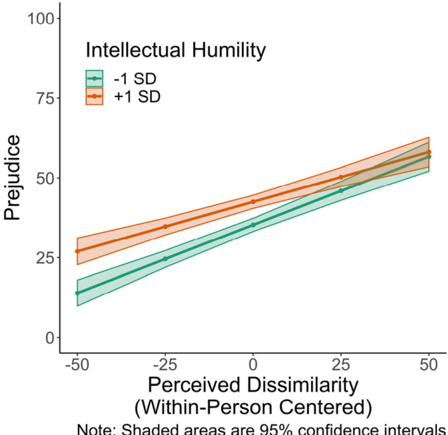
Intellectual humility has attracted attention in both philosophy and psychology. Philosophers have clarified the nature of intellectual humility as an epistemic virtue; and psychologists have developed scales for measuring people’s intellectual humility. Much less attention has been paid to the potential effects of intellectual humility on people’s negative attitudes and to its relationship with prejudice-based epistemic vices. Here we fill these gaps by focusing on the relationship between intellectual humility and prejudice. To clarify this relationship, we conducted four empirical studies. The results of these studies show three things. First, people are systematically prejudiced towards members of groups perceived as dissimilar. Second, intellectual humility weakens the association between perceived dissimilarity and prejudice. Third, more intellectual humility is associated with more prejudice overall. We show that this apparently paradoxical pattern of results is consistent with the idea that it is both psychologically and rationally plausible that one person is at the same time intellectually humble, epistemically virtuous and strongly prejudiced.
Overview
The claims and statistics of this paper haven’t been checked yet.
Free: it reads the open-access text and checks the first 5 claims that cite a source we can check. Create a free account to check every claim.
Integrity signals
Registry
Cites
Statistics
Figures
Verification
Claims the paper makes
The claims and statistics of this paper haven’t been checked yet.
Free: it reads the open-access text and checks the first 5 claims that cite a source we can check. Create a free account to check every claim.
Claims other papers make about this one
Each is checked against this paper’s own text: does it say what the citing paper says it does?
The cited source says what the claim attributes to it.
In the citing paper
“Although intellectually humbler people are capable of intergroup prejudice 104 , they are more willing to question themselves and to consider rival viewpoints 104 .”
From Predictors and consequences of intellectual humility (2022) · cites this paper as [104]
Self-check
Percentages, sums and reported differences re-computed from the paper’s own numbers.
The self-check needs the paper’s full text.
Citations
Cites
Conducting Meta-Analyses in R with the metafor Package
Viechtbauer, W. (2010) · Journal of Statistical Software · doi:10.18637/jss.v036.i03 · Cited by 20,464 · cited 1×
“Because the key effect of interest is the same in each study, we conducted a fixed-effects meta-analysis using the rma function in the R packagemetafor (Viechtbauer 2010) that computes ameta-analytic average across all of the effects in each analysis reported in all four studies.”
Method(1954) · Cited by 15,935
(2011) · Cited by 14,317
Epistemic Injustice: Power and the Ethics of Knowing
Fricker, M. (2007) · doi:10.1093/acprof:oso/9780198237907.001.0001 · Cited by 9,198 · cited 3×
“We want to examine whether prejudice is always intellectual vicious, “epistemically unjust” (Fricker 2007), or “epistemically irrational” (Arpaly 2003) when directed towards certain social groups one perceives as dissimilar. First of all, Fricker’s (2007) account of testimonial injustice is specifically concerned with…”
BackgroundValidation of the five-factor model of personality across instruments and observers.
McCrae, R. R., & Costa, P. T. (1987) · Journal of Personality and Social Psychology · doi:10.1037/0022-3514.52.1.81 · Cited by 6,404 · cited 1×
“…shows that the general trait of intellectual humility is associated with such personality traits as “Openness to experience”, “Conscientiousness” and “Agreeableness” of the Five-Factor Model (McCrae and Costa 1987), and the “Honesty-Humility” dimension of the HEXACO model (Ashton and Lee 2005).”
BackgroundDual-Process Theories of Higher Cognition: Advancing the Debate
Evans, J. S. B. T., & Stanovich, K. E. (2013) · Perspectives on Psychological Science · doi:10.1177/1745691612460685 · Cited by 4,271
The empirical case for two systems of reasoning.
Sloman, S. A. (1996) · Psychological Bulletin · doi:10.1037//0033-2909.119.1.3 · Cited by 3,848 · cited 1×
“…1 processes are typically understood as being intuitive, fast, automatic, nonconscious, effortless, contextualized, and error-prone, and Type 2 as reflective, slow, deliberate, cogitative, effortful, decontextualized, and normatively correct (Sloman 1996; Kahneman 2011; Evans and Stanovich 2013).”
BackgroundAt what sample size do correlations stabilize?
Schönbrodt, F. D., & Perugini, M. (2013) · Journal of Research in Personality · doi:10.1016/j.jrp.2013.05.009 · Cited by 2,232 · cited 1×
“We aimed to collect data from more than 250 participants, the sample size at which correlations tend to stabilize (Schönbrodt and Perugini 2013).”
MethodVirtues of the Mind: An Inquiry into the Nature of Virtue and the Ethical Foundations of Knowledge
Zagzebski, L. T. (1996) · Cambridge University Press eBooks · doi:10.1017/cbo9781139174763 · Cited by 2,211
SPERBER, D., CLÉMENT, F., HEINTZ, C., MASCARO, O., MERCIER, H., ORIGGI, G., & WILSON, D. (2010) · Mind & Language · doi:10.1111/j.1468-0017.2010.01394.x · Cited by 1,795
Research works printed but not linked: 4
- Alfano, M. (forthcoming). Nietzsche's Moral Psychology Cambridge University Press.
- Aronson, E., T.D. Wilson, and R.M. Akert. 2010. Social Psychology (7th). New York: Prentice Hall.
- Arpaly, N. 2003. Unprincipled virtue: An inquiry intoMoral agency. Oxford: Oxford University Press.
- Nietzsche, F. (1878/1986). Human, All Too Human. Translated by R. J. Hollingdale. Cambridge University Press.
Cited by
Predictors and consequences of intellectual humility
Porter, T., Elnakouri, A., Meyers, E. A., Shibayama, T., Jayawickreme, E., & Grossmann, I. (2022) · Nature Reviews Psychology · doi:10.1038/s44159-022-00081-9 · Cited by 248
Toward an understanding of collective intellectual humility
Krumrei-Mancuso, E. J., Pärnamets, P., Bland, S., Astola, M., Cichocka, A. K., de Ridder, J., Mercier, H., Meyer, M., O’Connor, C., Porter, T., et al. (2024) · Trends in Cognitive Sciences · doi:10.1016/j.tics.2024.09.006 · Cited by 39
Insight in the Conspiracist’s Mind
de Cruys, S. V., Bervoets, J., Gadsby, S., Gijbels, D., & Poels, K. (2023) · Personality and Social Psychology Review · doi:10.1177/10888683231203145 · Cited by 25
“…such conclusions can easily lead us into the so-called Enlightenment trap (Gray et al., 2022), where we paint ourselves as the ones with intellectual modesty, while they have the “foreclosed mind” (but where the “humble ones” may turn out to be the more prejudiced ones; see Colombo et al., 2021).”
BackgroundIntellectual humility is reliably associated with constructive responses to conflict
Koetke, J., Schumann, K., Welker, K. M., & Coleman, P. T. (2024) · PLoS ONE · doi:10.1371/journal.pone.0309848 · Cited by 24
Fake News, Conspiracy Theorizing, and Intellectual Vice
Meyer, M., & Alfano, M. (2022) · Routledge eBooks · doi:10.4324/9780367808952-32 · Cited by 20
Analysis of Scales and Measures of Moral Virtues: A Systematic Review
Ames, M. C. F. D. C., Serafim, M. C., & Martins, F. F. (2022) · Revista de Administração Contemporânea · doi:10.1590/1982-7849rac2022190379.por · Cited by 18
Abedin, E., Ferreira, M., Reimann, R., Cheong, M., Grossmann, I., & Alfano, M. (2023) · Acta Psychologica · doi:10.1016/j.actpsy.2023.103979 · Cited by 16
Intellectual humility links to metacognitive ability
Fischer, H., Kause, A., & Huff, M. (2025) · Personality and Individual Differences · doi:10.1016/j.paid.2024.113028 · Cited by 16
Impact of Intellectual Humility on Interpersonal Conflicts and Narcissism among Teachers
Mukhtar, I., Rehman, M., Lashari, B., & Bibi, S. (2023) · Academy of Education and Social Sciences Review · doi:10.48112/aessr.v3i1.441 · Cited by 10
“I Know that I don’t Know Anything”. Socio-Cognitive Antecedents of the Radicalization
Khukhlaev, O. E., & Pavlova, O. S. (2021) · Social Psychology and Society · doi:10.17759/sps.2021120307 · Cited by 10
Faith in Development: Mixed-Method Studies on Worldviews and Religious Styles
Streib, H., & Hood, R. W. J. (2024) · Bielefeld University Press / transcript Verlag eBooks · doi:10.14361/9783839471234 · Cited by 10
Intellectual Humility Without Open-Mindedness: How to Respond to Extremist Views
Peters, K., Turner, C., & Battaly, H. D. (2025) · Episteme · doi:10.1017/epi.2024.63 · Cited by 6
Intellectual humility: On recognizing our limits
Porter, T. (2024) · Advances in experimental social psychology · doi:10.1016/bs.aesp.2024.10.005 · Cited by 5
Mindshaping and Intellectual Virtues
Tanesini, A. (2022) · Routledge eBooks · doi:10.4324/9780367808952-19 · Cited by 3
Misinformation Beliefs, Intellectual Humility, and Vaccine Attitudes and Status
Bossert, A., & Jongman-Sereno, K. P. (2024) · Psi Chi Journal of Psychological Research · doi:10.24839/2325-7342.jn29.2.158 · Cited by 3
“Indeed, people high in IH are more willing to question themselves and consider rival viewpoints (Colombo et al., 2021).”
Steppacher, A., Bullik, R., & Keller, B. (2024) · Bielefeld University Press / transcript Verlag eBooks · doi:10.14361/9783839471234-013 · Cited by 2
Humility, Conception and Measurement
Wnuk, M. (2025) · Academic Journal of Interdisciplinary Studies · doi:10.36941/ajis-2025-0002 · Cited by 1
Krumrei-Mancuso, E. J. (2025) · doi:10.21428/e2759450.f00bd0fc · Cited by 1
The Effects of Intellectually Humble Communication in Online Political Discussions
Montez, D., & Montez, D. (2024) · UA Campus Repository (The University of Arizona) · Cited by 1
EXPLORING THE POSITIVE ENGAGEMENT OF OPPOSING IDEAS THROUGH INTELLECTUAL DISPOSITIONS
Zhang, Q. (2024) · WakeSpace Scholarship (Wake Forest University) · Cited by 1
فعالية برنامج إرشادي قائم على مهارات الأنا الهادئة في تنمية التواضع الفکري لدى طلاب الجامعة
الضبع, ف. ع. ا., & عبادي, ع. س. (2021) · المجلة التربوية لکلية التربية بسوهاج · doi:10.21608/edusohag.2021.168269
Moral Humility Reduces Political DivisionsPreprint
Vallabha, S., & Brandt, M. J. (2024) · PsyArXiv (OSF Preprints) · doi:10.31234/osf.io/5r6fw
Self-citationAlmeida, A., Sonkin, S., Prem, S., Poerio, M., & Silva, E. (2024) · Psi Beta Research Journal - Brief Reports · doi:10.54581/urvz2427
Intellectual humility: Perspectives of early career academics in South Africa
Veldkornet, O., Werner, A., & Macpherson, W. E. (2025) · SA Journal of Industrial Psychology · doi:10.4102/sajip.v51i0.2317
Towards an Understanding of Collective Intellectual HumilityPreprint
O’Connor, C. (2024) · PhilSci-Archive (University of Pittsburgh)
Ökten, I. O., Lombard, J., Harkness, A., & Gullesserian, M. C. (2026) · Personality and Individual Differences · doi:10.1016/j.paid.2026.113729
Segmenting support for artificial intelligence: Exploring socio-epistemic orientations
Eom, D., Zhu, Y. E., Mackey, C. D., Evans, J. H., Newman, T. P., Scheufele, D. A., & Brossard, D. (2026) · Computers in Human Behavior Reports · doi:10.1016/j.chbr.2026.101226
Metadata
- Authors
- Colombo, M., Strangmann, K., Houkes, L., Kostadinova, Z., & Brandt, M. J.
- Affiliations
- Tilburg University (NL)
- Corresponding author
- Colombo, Matteo
- Venue
- Review of Philosophy and Psychology
- Published
- 2020-07-08
- Volume
- 12
- Issue
- 2
- Pages
- 353-371
- ISSN
- 1878-5158 (ISSN-L)
- 1878-5166
- OpenAlex
- W3041378654
- Cited by
- 19
- References
- 83
- Citations by year
- 2026: 2 · 2025: 5 · 2024: 4 · 2023: 2 · 2022: 4 · 2021: 2
- FWCI
- 2.68
- Type
- journal article
- Language
- en
- Open access
- hybrid
- doi.org
- Licence
- cc-by
- creativecommons.org/licenses/by/4.0 (tdm)
- creativecommons.org/licenses/by/4.0 (vor)
- Locations
- Review of Philosophy and Psychology (publishedVersion, cc-by)
- Research portal (Tilburg University) (publishedVersion, cc-by)
- Tilburg University Research Portal (submittedVersion, cc-by)
- Data Archiving and Networked Services (DANS) (submittedVersion, cc-by)
- Funders
- Tilburg University
- Topics
- Social Sciences › Sociology and Political Science › Social and Intergroup Psychology
- Social Sciences › Psychology › Social Psychology › Forgiveness and Related Behaviors
- Social Sciences › Arts and Humanities › Philosophy › Epistemology, Ethics, and Metaphysics
- Keywords
- intellectual humility, prejudice, intellectual virtues, epistemic vices, perceived dissimilarity, intergroup attitudes
About these checks
Registry, retraction, Cites and statistics results are computed, not judged, with one exception: a printed reference that no index lists is read once by a model before it counts as a citation error. Claims are extracted by a model and kept only when their quote appears verbatim in the text; each cited source is then checked, with a model’s help, for whether it says what the claim relies on. Those verdicts can be wrong — read the claim’s quote and the cited source before relying on one.
Statistics and arithmetic are recomputed, not judged.
Confidence bands are shown only for fields calibrated on our annotated test set. None is calibrated yet, so no band is shown.
What counts as a claim ›How we measure confidence ›How we check this ›
Are you an author, or do you see a problem with this page? Request a review
Data sources
Bibliographic data: Semantic Scholar, OpenAlex, Crossref.
Contains information from the Semantic Scholar Academic Graph Datasets, made available under the ODC Attribution License (ODC-BY 1.0).
Semantic Scholar’s data is described in: Kinney, R., et al. (2023). The Semantic Scholar Open Data Platform. arXiv:2301.10140.
