

Intellectually Humble, but Prejudiced People. A Paradox of Intellectual Virtue
Open accessThe DOI matches its Crossref record; 78 of the 83 references it cites were found in a registry or an index.
Abstract
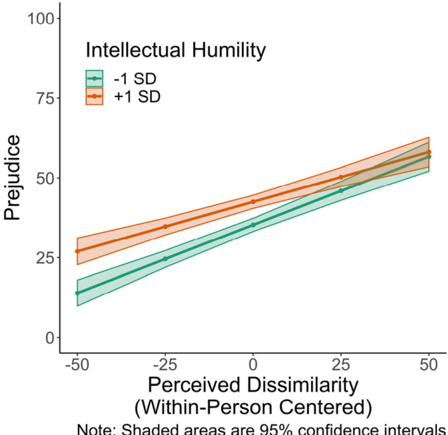
Intellectual humility has attracted attention in both philosophy and psychology. Philosophers have clarified the nature of intellectual humility as an epistemic virtue; and psychologists have developed scales for measuring people’s intellectual humility. Much less attention has been paid to the potential effects of intellectual humility on people’s negative attitudes and to its relationship with prejudice-based epistemic vices. Here we fill these gaps by focusing on the relationship between intellectual humility and prejudice. To clarify this relationship, we conducted four empirical studies. The results of these studies show three things. First, people are systematically prejudiced towards members of groups perceived as dissimilar. Second, intellectual humility weakens the association between perceived dissimilarity and prejudice. Third, more intellectual humility is associated with more prejudice overall. We show that this apparently paradoxical pattern of results is consistent with the idea that it is both psychologically and rationally plausible that one person is at the same time intellectually humble, epistemically virtuous and strongly prejudiced.
Overview
The claims and statistics of this paper haven’t been checked yet.
Free: it reads the open-access text and checks the first 5 claims that cite a source we can check. Create a free account to check every claim.
Integrity signals
Registry
Cites
Statistics
Figures
Verification
Claims the paper makes
The claims and statistics of this paper haven’t been checked yet.
Free: it reads the open-access text and checks the first 5 claims that cite a source we can check. Create a free account to check every claim.
Claims other papers make about this one
Each is checked against this paper’s own text: does it say what the citing paper says it does?
The cited source says what the claim attributes to it.
In the citing paper
“Although intellectually humbler people are capable of intergroup prejudice 104 , they are more willing to question themselves and to consider rival viewpoints 104 .”
From Predictors and consequences of intellectual humility (2022) · cites this paper as [104]
Self-check
Percentages, sums and reported differences re-computed from the paper’s own numbers.
The self-check needs the paper’s full text.
Citations
Cites
Conducting Meta-Analyses in R with the metafor Package
Viechtbauer, W. (2010) · Journal of Statistical Software · doi:10.18637/jss.v036.i03 · Cited by 20,464 · cited 1×
“Because the key effect of interest is the same in each study, we conducted a fixed-effects meta-analysis using the rma function in the R packagemetafor (Viechtbauer 2010) that computes ameta-analytic average across all of the effects in each analysis reported in all four studies.”
Method(1954) · Cited by 15,935
(2011) · Cited by 14,317
Epistemic Injustice: Power and the Ethics of Knowing
Fricker, M. (2007) · doi:10.1093/acprof:oso/9780198237907.001.0001 · Cited by 9,198 · cited 3×
“We want to examine whether prejudice is always intellectual vicious, “epistemically unjust” (Fricker 2007), or “epistemically irrational” (Arpaly 2003) when directed towards certain social groups one perceives as dissimilar. First of all, Fricker’s (2007) account of testimonial injustice is specifically concerned with…”
BackgroundValidation of the five-factor model of personality across instruments and observers.
McCrae, R. R., & Costa, P. T. (1987) · Journal of Personality and Social Psychology · doi:10.1037/0022-3514.52.1.81 · Cited by 6,404 · cited 1×
“…shows that the general trait of intellectual humility is associated with such personality traits as “Openness to experience”, “Conscientiousness” and “Agreeableness” of the Five-Factor Model (McCrae and Costa 1987), and the “Honesty-Humility” dimension of the HEXACO model (Ashton and Lee 2005).”
BackgroundDual-Process Theories of Higher Cognition: Advancing the Debate
Evans, J. S. B. T., & Stanovich, K. E. (2013) · Perspectives on Psychological Science · doi:10.1177/1745691612460685 · Cited by 4,271
The empirical case for two systems of reasoning.
Sloman, S. A. (1996) · Psychological Bulletin · doi:10.1037//0033-2909.119.1.3 · Cited by 3,848 · cited 1×
“…1 processes are typically understood as being intuitive, fast, automatic, nonconscious, effortless, contextualized, and error-prone, and Type 2 as reflective, slow, deliberate, cogitative, effortful, decontextualized, and normatively correct (Sloman 1996; Kahneman 2011; Evans and Stanovich 2013).”
BackgroundAt what sample size do correlations stabilize?
Schönbrodt, F. D., & Perugini, M. (2013) · Journal of Research in Personality · doi:10.1016/j.jrp.2013.05.009 · Cited by 2,232 · cited 1×
“We aimed to collect data from more than 250 participants, the sample size at which correlations tend to stabilize (Schönbrodt and Perugini 2013).”
MethodVirtues of the Mind: An Inquiry into the Nature of Virtue and the Ethical Foundations of Knowledge
Zagzebski, L. T. (1996) · Cambridge University Press eBooks · doi:10.1017/cbo9781139174763 · Cited by 2,211
SPERBER, D., CLÉMENT, F., HEINTZ, C., MASCARO, O., MERCIER, H., ORIGGI, G., & WILSON, D. (2010) · Mind & Language · doi:10.1111/j.1468-0017.2010.01394.x · Cited by 1,795
Intergroup Threat and Outgroup Attitudes: A Meta-Analytic Review
Riek, B. M., Mania, E. W., & Gaertner, S. L. (2006) · Personality and Social Psychology Review · doi:10.1207/s15327957pspr1004_4 · Cited by 1,588 · cited 1×
“…members of a given group hold different values and worldviews is associated with prejudice towards those group members (Haddock et al. 1993; Henry and Reyna 2007; Riek et al. 2006; De Rooij et al. 2018; Sidanius et al. 2016; Stephan et al. 2000; Stephan et al. 1998; Velasco González et al. 2008).”
BackgroundSocial norms and the expression and suppression of prejudice: The struggle for internalization.
Crandall, C. S., Eshleman, A. K., & O’Brien, L. T. (2002) · Journal of Personality and Social Psychology · doi:10.1037//0022-3514.82.3.359 · Cited by 1,162 · cited 1×
“Consistently with existing work in philosophy and psychology, we defined prejudice as a negative evaluation of a group or an individual based on group membership (e.g., Aronson et al. 2010; Begby 2013; Brown 2010; Crandall et al. 2002; Fricker 2007).”
Personality and Prejudice: A Meta-Analysis and Theoretical Review
Sibley, C. G., & Duckitt, J. (2008) · Personality and Social Psychology Review · doi:10.1177/1088868308319226 · Cited by 1,126
Mini Meta‐Analysis of Your Own Studies: Some Arguments on Why and a Primer on How
Goh, J. X., Hall, J. A., & Rosenthal, R. (2016) · Social and Personality Psychology Compass · doi:10.1111/spc3.12267 · Cited by 994 · cited 1×
“See Goh et al. (2016) for additional information about the benefits of such a “mini meta-analysis”.”
BackgroundWolf, S. (1982) · The Journal of Philosophy · doi:10.2307/2026228 · Cited by 917
Epistemic Justice as a Virtue of Social Institutions
Anderson, E. (2012) · Social Epistemology · doi:10.1080/02691728.2011.652211 · Cited by 882 · cited 2×
“Understood in terms of this key psychological phenomenon, prejudice has been characterized as an epistemic vice that impedes the pursuit of epistemic goods (Anderson 2012; Battaly 2017; Cassam 2016).”
BackgroundIs actual similarity necessary for attraction? A meta-analysis of actual and perceived similarity
Montoya, R. M., Horton, R. S., & Kirchner, J. (2008) · Journal of Social and Personal Relationships · doi:10.1177/0265407508096700 · Cited by 855 · cited 1×
“This work consistently showed that when an individual was described as having more similar beliefs and attitudes to participants, the participants liked the individual more (for a meta-analysis see Montoya et al. 2008).”
ResultPrejudice: Its Social Psychology
Campbell, C., & Brown, R. (1997) · The British Journal of Sociology · doi:10.2307/591756 · Cited by 784
Unprincipled virtue: an inquiry into moral agency
(2004) · Choice Reviews Online · doi:10.5860/choice.41-2727 · Cited by 776 · cited 1×
“We want to examine whether prejudice is always intellectual vicious, “epistemically unjust” (Fricker 2007), or “epistemically irrational” (Arpaly 2003) when directed towards certain social groups one perceives as dissimilar.”
BackgroundPrejudice: its social psychology
(1996) · Choice Reviews Online · doi:10.5860/choice.33-5980 · Cited by 709
Prejudice its social psychology
Brown, R. (2010) · Cited by 676
Assessing the structure of prejudicial attitudes: The case of attitudes toward homosexuals.
Haddock, G., Zanna, M. P., & Esses, V. M. (1993) · Journal of Personality and Social Psychology · doi:10.1037//0022-3514.65.6.1105 · Cited by 652 · cited 1×
“…examined how perceiving that members of a given group hold different values and worldviews is associated with prejudice towards those group members (Haddock et al. 1993; Henry and Reyna 2007; Riek et al. 2006; De Rooij et al. 2018; Sidanius et al. 2016; Stephan et al. 2000; Stephan et al. 1998;…”
BackgroundIntellectual Humility: Owning Our Limitations
Whitcomb, D., Battaly, H., Baehr, J., & Howard‐Snyder, D. (2017) · Philosophy and Phenomenological Research · doi:10.1111/phpr.12228 · Cited by 610
Humility: Theoretical Perspectives, Empirical Findings and Directions for Future Research
Tangney, J. P. (2000) · Journal of Social and Clinical Psychology · doi:10.1521/jscp.2000.19.1.70 · Cited by 604 · cited 1×
“According to a family of virtue approaches to epistemology (Code 1987; Montmarquet 1993; Zagzebski 1996, 155; Roberts and Wood 2003; Sosa 2007), these traits constitute an intellectual virtue, the virtue of intellectual humility (for reviews see Snow 2018; Tangney 2000).”
BackgroundByrne, D. (1969) · Advances in Experimental Social Psychology · doi:10.1016/s0065-2601(08)60076-3 · Cited by 595 · cited 3×
“com database, Christen et al. (2014) found that ‘prejudiced’ is one of the most common words opposite in meaning to ‘intellectually humble’ (see also Alfano et al.”
BackgroundResultEpistemic Virtue and Doxastic Responsibility
Montmarquet, J. A. (1992) · Cited by 586
Cognitive and Interpersonal Features of Intellectual Humility
Leary, M. R., Diebels, K. J., Davisson, E. K., Jongman-Sereno, K. P., Isherwood, J. C., Raimi, K. T., Deffler, S. A., & Hoyle, R. H. (2017) · Personality and Social Psychology Bulletin · doi:10.1177/0146167217697695 · Cited by 539 · cited 4×
“…evidence that existing intellectual humility scales construe intellectual humility as an intellectual virtue and that we should expect a negative association between people’s degree of intellectual humility and the strength of their prejudice (Krumrei-Mancuso and Rouse 2016; Leary et al. 2017).”
BackgroundInfluentialIntellectual Virtues: An Essay in Regulative Epistemology
Marcum, J. A. (2007) · Cited by 508
Prejudice toward Immigrants to Spain and Israel: An Integrated Threat Theory Analysis
Stephan, W. G., Ybarra, O., Martnez, C. M., Schwarzwald, J., & Tur-Kaspa, M. (1998) · Journal of Cross-Cultural Psychology · doi:10.1177/0022022198294004 · Cited by 506 · cited 1×
“…members of a given group hold different values and worldviews is associated with prejudice towards those group members (Haddock et al. 1993; Henry and Reyna 2007; Riek et al. 2006; De Rooij et al. 2018; Sidanius et al. 2016; Stephan et al. 2000; Stephan et al. 1998; Velasco González et al. 2008).”
BackgroundHonesty‐Humility, the Big Five, and the Five‐Factor Model
Ashton, M. C., & Lee, K. (2005) · Journal of Personality · doi:10.1111/j.1467-6494.2005.00351.x · Cited by 476 · cited 2×
“…shows that the general trait of intellectual humility is associated with such personality traits as “Openness to experience”, “Conscientiousness” and “Agreeableness” of the Five-Factor Model (McCrae and Costa 1987), and the “Honesty-Humility” dimension of the HEXACO model (Ashton and Lee 2005).”
Background(2008) · doi:10.1348/014466608x284443 · Cited by 467 · cited 2×
“For example, multiple lines of research in social psychology have examined how perceiving that members of a given group hold different values and worldviews is associated with prejudice towards those group members (Haddock et al. 1993; Henry and Reyna 2007; Riek et al. 2006; De Rooij et al. 2018; Sidanius et al. 2016;…”
BackgroundSimilarity, credibility, and attitude change: A review and a theory.
Simons, H. W., Berkowitz, N. N., & Moyer, R. J. (1970) · Psychological Bulletin · doi:10.1037/h0028429 · Cited by 426
Rapid responding increases belief bias: Evidence for the dual-process theory of reasoning
Evans, J. S. B. T., & Curtis-Holmes, J. (2005) · Thinking & Reasoning · doi:10.1080/13546780542000005 · Cited by 418 · cited 1×
“By burdening participants’ cognitive resources with time pressure while they were making judgements, we aimed at reducing the possibility they could recruit Type 2 processes (e.g., De Neys 2006; Evans and Curtis-Holmes 2005).”
Background(2020) · Encyclopedia of Personality and Individual Differences · doi:10.1007/978-3-319-24612-3_300293 · Cited by 412 · cited 1×
“…associated with having the thought that the epistemic status of their beliefs or their cognitive abilities are better than those of others (e.g., Alicke and Govorun 2005); and having negative feelings or attitudes towards others based on their group membership can contribute to testimonial…”
BackgroundThe Development and Validation of the Comprehensive Intellectual Humility Scale
Krumrei-Mancuso, E. J., & Rouse, S. V. (2016) · Journal of Personality Assessment · doi:10.1080/00223891.2015.1068174 · Cited by 386 · cited 2×
“…evidence that existing intellectual humility scales construe intellectual humility as an intellectual virtue and that we should expect a negative association between people’s degree of intellectual humility and the strength of their prejudice (Krumrei-Mancuso and Rouse 2016; Leary et al. 2017).”
BackgroundIntegrated Threat Theory and Intercultural Attitudes: Mexico and the United States
Stephan, W. G., Diaz-Loving, R., & Duran, A. (2000) · Journal of Cross-Cultural Psychology · doi:10.1177/0022022100031002006 · Cited by 376 · cited 1×
“…members of a given group hold different values and worldviews is associated with prejudice towards those group members (Haddock et al. 1993; Henry and Reyna 2007; Riek et al. 2006; De Rooij et al. 2018; Sidanius et al. 2016; Stephan et al. 2000; Stephan et al. 1998; Velasco González et al. 2008).”
BackgroundMOSER, P. K. (1988) · Philosophical Books · doi:10.1111/j.1468-0149.1988.tb02052.x · Cited by 338
Koch, A., Imhoff, R., Dotsch, R., Unkelbach, C., & Alves, H. (2016) · Journal of Personality and Social Psychology · doi:10.1037/pspa0000046 · Cited by 309 · cited 3×
“Thus, some social groups are based 3 We collected additional data because we had leftover funds in our budget. on how people are, while others are based on how people behave or see the world” (Koch et al. 2016, 678).”
BackgroundMethodGroup-Based Trust in Strangers: The Role of Stereotypes and Expectations
Foddy, M., Platow, M. J., & Yamagishi, T. (2009) · Psychological Science · doi:10.1111/j.1467-9280.2009.02312.x · Cited by 298 · cited 1×
“Selective trust, exclusively based on in-group/our-group affiliation (Foddy et al. 2009), can promote successful and responsible inquiry on the basis of a division of cognitive labour and also by helping us filter quickly, and sometimes reliably, the information that we receive from others (see…”
BackgroundCassam, Q. (2016) · The Monist · doi:10.1093/monist/onv034 · Cited by 273 · cited 3×
“For example, prejudice may reduce your intrinsic motivation to find things out, to recognize your own intellectual limitations and to acknowledge the merits of other people’s views (Zagzebski 1996, 152; Cassam 2016; Kidd 2017).”
BackgroundSocial Perception and Social Reality: Why Accuracy Dominates Bias and Self-Fulfilling Prophecy
Jussim, L. (2012) · doi:10.1093/acprof:oso/9780195366600.001.0001 · Cited by 271 · cited 1×
“…starts by pointing out that the stereotypes constituting prejudices do not have the form of universal generalizations; instead, they are akin to generic judgements that are sometimes supported by available evidence, and that are oft accurate, helping us navigate the social world (Jussim 2012).”
BackgroundDriver, J. (1989) · The Journal of Philosophy · doi:10.2307/2027146 · Cited by 262 · cited 1×
“…problems and unreliable memory, then this person should be less prejudiced towards diverse groups of people and their different views and values (cf., Driver 1989; Roberts and Wood 2007; Spiegel 2012; Tanesini 2018, for accounts emphasizing the social-motivational dimension of intellectual…”
BackgroundImplicit race attitudes predict trustworthiness judgments and economic trust decisions
Stanley, D. A., Sokol-Hessner, P., Banaji, M. R., & Phelps, E. A. (2011) · Proceedings of the National Academy of Sciences · doi:10.1073/pnas.1014345108 · Cited by 258 · cited 1×
“…prejudiced towards members of a group is positively correlated with not trusting their testimony, but it is not obvious when this correlation actually holds, how strong it is, and to what extent IH may attenuate it (for some suggestive evidence see, e.g., Simon et al. 1970; Stanley et al. 2011).”
BackgroundDe Neys, W. (2006) · Quarterly Journal of Experimental Psychology · doi:10.1080/02724980543000123 · Cited by 226 · cited 1×
“By burdening participants’ cognitive resources with time pressure while they were making judgements, we aimed at reducing the possibility they could recruit Type 2 processes (e.g., De Neys 2006; Evans and Curtis-Holmes 2005).”
BackgroundVirtue Ethics and Confucianism
(2013) · Routledge eBooks · doi:10.4324/9780203522653 · Cited by 209
Jussim, L. (2017) · Behavioral and Brain Sciences · doi:10.1017/s0140525x1500062x · Cited by 187
HIGHER-ORDER EPISTEMIC ATTITUDES AND INTELLECTUAL HUMILITY
Hazlett, A. (2012) · Episteme · doi:10.1017/epi.2012.11 · Cited by 181 · cited 1×
“…be the positive epistemic status of one’s own beliefs” (25).2 On this account, people’s degree of intellectual humility would be determined by their higher order attitudes towards both their own views and attitudes, and the views and attitudes of other people (see also Hazlett 2012; Church 2016).”
BackgroundRoberts, R. C., & Wood, W. J. (2003) · Intellectual Virtue · doi:10.1093/acprof:oso/9780199252732.003.0012 · Cited by 170 · cited 1×
“According to a family of virtue approaches to epistemology (Code 1987; Montmarquet 1993; Zagzebski 1996, 155; Roberts and Wood 2003; Sosa 2007), these traits constitute an intellectual virtue, the virtue of intellectual humility (for reviews see Snow 2018; Tangney 2000).”
BackgroundDevelopment and validation of a multi-dimensional measure of intellectual humility
Alfano, M., Iurino, K., Stey, P., Robinson, B., Christen, M., Yu, F., & Lapsley, D. (2017) · PLOS ONE · doi:10.1371/journal.pone.0182950 · Cited by 167 · cited 5×
“(2014) found that ‘prejudiced’ is one of the most common words opposite in meaning to ‘intellectually humble’ (see also Alfano et al. 2017). Similarly, Gregg et al. (2008) surveyed everyday conceptions of the meaning of ‘being modest’. They found that prototypical features of individuals described as ‘modest’ include…”
BackgroundInfluentialPersonality and Prejudice: Extension to the HEXACO Personality Model
Sibley, C. G., Harding, J. F., Perry, R., Asbrock, F., & Duckitt, J. H. (2010) · European Journal of Personality · doi:10.1002/per.750 · Cited by 156 · cited 1×
“Openness, Agreeableness and Honest-humility, in particular, tend to be related to lower levels of prejudice (Sibley and Duckitt 2008; Sibley et al. 2010).”
BackgroundEveryday Conceptions of Modesty: A Prototype Analysis
Gregg, A. P., Hart, C. M., Sedikides, C., & Kumashiro, M. (2008) · Personality and Social Psychology Bulletin · doi:10.1177/0146167208316734 · Cited by 147
Brandt, M. J., Chambers, J. R., Crawford, J. T., Wetherell, G. A., & Reyna, C. (2015) · Journal of Personality and Social Psychology · doi:10.1037/pspp0000055 · Cited by 144 · cited 9×
“…on a scale from 0 to 100 the extent to which they perceived each social group as having attitudes, values, or political or social beliefs dissimilar from their own (0 = Not at all different; 100 = Very different), a measure also previously used in psychological research (e.g., Brandt et al. 2015).”
BackgroundMethodResultInfluentialSelf-citationIntellectual Humility as Attitude
Tanesini, A. (2018) · Philosophy and Phenomenological Research · doi:10.1111/phpr.12326 · Cited by 143 · cited 1×
“…and unreliable memory, then this person should be less prejudiced towards diverse groups of people and their different views and values (cf., Driver 1989; Roberts and Wood 2007; Spiegel 2012; Tanesini 2018, for accounts emphasizing the social-motivational dimension of intellectual humility).”
BackgroundHoyle, R. H., Davisson, E. K., Diebels, K. J., & Leary, M. R. (2016) · Personality and Individual Differences · doi:10.1016/j.paid.2016.03.043 · Cited by 140 · cited 2×
“So, for example, if you are intellectually humble in the domain of psychological science, that does not mean you must be intellectually humble in other subject domains such as politics, philosophy or geography (Hoyle et al. 2016).”
BackgroundOpen-mindedness and intellectual humility
Spiegel, J. S. (2012) · Theory and Research in Education · doi:10.1177/1477878512437472 · Cited by 139 · cited 1×
“…and unreliable memory, then this person should be less prejudiced towards diverse groups of people and their different views and values (cf., Driver 1989; Roberts and Wood 2007; Spiegel 2012; Tanesini 2018, for accounts emphasizing the social-motivational dimension of intellectual humility).”
BackgroundWorldview conflict and prejudice
Brandt, M. J., & Crawford, J. T. (2019) · Advances in experimental social psychology · doi:10.1016/bs.aesp.2019.09.002 · Cited by 139
Self-citationDistinguishing intellectual humility and general humility
Davis, D. E., Rice, K., McElroy, S., DeBlaere, C., Choe, E., Van Tongeren, D. R., & Hook, J. N. (2016) · The Journal of Positive Psychology · doi:10.1080/17439760.2015.1048818 · Cited by 134
Bergh, R., Akrami, N., Sidanius, J., & Sibley, C. G. (2016) · Journal of Personality and Social Psychology · doi:10.1037/pspi0000064 · Cited by 112 · cited 2×
“Although some forms of prejudice focus on particular types of target groups (e.g., low status groups; Bergh et al. 2016) or on negative evaluations that are inaccurate or unjustified (Allport 1954), our studies focused on the key psychological phenomenon, groupbased negative evaluations, as it occurs across a range of…”
BackgroundMeasuring Prejudice, Stereotypes and Discrimination
Correll, J., Judd, C. M., Park, B., & Wittenbrink, B. (2010) · The SAGE Handbook of Prejudice, Stereotyping and Discrimination · doi:10.4135/9781446200919.n3 · Cited by 111 · cited 1×
“Feeling thermometers are a widely used, reliable measure of prejudice in the psychology literature (Correll et al. 2010) that map onto the definition of prejudice as negative evaluations based on group membership.”
BackgroundWho Is Prejudiced, and Toward Whom? The Big Five Traits and Generalized Prejudice
Crawford, J. T., & Brandt, M. J. (2019) · Personality and Social Psychology Bulletin · doi:10.1177/0146167219832335 · Cited by 105 · cited 1×
“…only measures prejudice towards a limited number of target groups and these target groups tend to be relatively unconventional or low status groups (e.g., racial minorities, members of the LGBTQ community, immigrants) (Brandt et al. 2015; Brandt and Crawford 2019; Crawford and Brandt 2019).”
BackgroundSelf-citationValue Judgments: The Impact of Perceived Value Violations on American Political Attitudes
Henry, P. J., & Reyna, C. (2007) · Political Psychology · doi:10.1111/j.1467-9221.2007.00569.x · Cited by 100 · cited 1×
“…that members of a given group hold different values and worldviews is associated with prejudice towards those group members (Haddock et al. 1993; Henry and Reyna 2007; Riek et al. 2006; De Rooij et al. 2018; Sidanius et al. 2016; Stephan et al. 2000; Stephan et al. 1998; Velasco González et al.…”
BackgroundBiased Assimilation: Effects of Assumptions and Expectations on the Interpretation of New Evidence
Lord, C. G., & Taylor, C. A. (2009) · Social and Personality Psychology Compass · doi:10.1111/j.1751-9004.2009.00203.x · Cited by 89 · cited 1×
“When they do, prejudices can become epistemically insidious, as they “quite reasonably come to control the assessment and interpretation of new evidence” (Begby 2013, 90; for some relevant empirical evidence see Lord and Taylor 2009).”
BackgroundBegby, E., & Philosophy Documentation Center (2013) · Thought: A Journal of Philosophy · doi:10.1002/tht3.71 · Cited by 86 · cited 4×
“Begby (2013) explains that some prejudices become entrenched background beliefs based on support from multiple sources of evidence.”
BackgroundInfluentialIntellectual Humility: An introduction to the philosophy and science
Church, I. M., & Samuelson, P. L. (2017) · Bloomsbury Publishing Plc eBooks · doi:10.5040/9781474236775 · Cited by 78 · cited 2×
“’s (2015) limitation owing account and Church and Samuelson’s (2017) doxastic account.”
BackgroundResultTestimonial Injustice, Epistemic Vice, and Vice Epistemology
Battaly, H. D. (2017) · Routledge eBooks · doi:10.4324/9781315212043-22 · Cited by 74
Sidanius, J., Kteily, N., Levin, S., Pratto, F., & Obaidi, M. (2015) · Group Processes & Intergroup Relations · doi:10.1177/1368430215577224 · Cited by 59 · cited 1×
“…members of a given group hold different values and worldviews is associated with prejudice towards those group members (Haddock et al. 1993; Henry and Reyna 2007; Riek et al. 2006; De Rooij et al. 2018; Sidanius et al. 2016; Stephan et al. 2000; Stephan et al. 1998; Velasco González et al. 2008).”
BackgroundThe Doxastic Account of Intellectual Humility
Church, I. M., & Romanian Academy - Iasi Branch (2016) · Logos & Episteme · doi:10.5840/logos-episteme20167441 · Cited by 59 · cited 1×
“…be the positive epistemic status of one’s own beliefs” (25).2 On this account, people’s degree of intellectual humility would be determined by their higher order attitudes towards both their own views and attitudes, and the views and attitudes of other people (see also Hazlett 2012; Church 2016).”
BackgroundStudying a Heterogeneous Array of Target Groups Can Help Us Understand Prejudice
Brandt, M. J., & Crawford, J. T. (2019) · Current Directions in Psychological Science · doi:10.1177/0963721419830382 · Cited by 57 · cited 1×
“…only measures prejudice towards a limited number of target groups and these target groups tend to be relatively unconventional or low status groups (e.g., racial minorities, members of the LGBTQ community, immigrants) (Brandt et al. 2015; Brandt and Crawford 2019; Crawford and Brandt 2019).”
BackgroundSelf-citationApt belief and reflective knowledge
Sosa, E. (2007) · Cited by 52
Intellectual humility's links to religion and spirituality and the role of authoritarianism
Krumrei-Mancuso, E. J. (2018) · Personality and Individual Differences · doi:10.1016/j.paid.2018.03.037 · Cited by 38 · cited 1×
“…Humility scales also tend to be moderately related to tolerance of other people and their viewpoints, to lower levels of authoritarianism (e.g., Krumrei-Mancuso 2018) and dogmatism (e.g., Leary et al. 2017), which are two constructs that are often linked with prejudice and epistemic vice…”
BackgroundOrigins of Value Conflict: Babies Do Not Agree to Disagree
Wynn, K. (2015) · Trends in Cognitive Sciences · doi:10.1016/j.tics.2015.08.018 · Cited by 30 · cited 1×
“Contemporary theoretical perspectives are also consistent with this idea (e.g., Wynn 2016), although they often assess the links between perceived dissimilarity and prejudice (i.e. the opposites of similarity and liking).”
Backgroundde Rooij, E. A., Goodwin, M., & Pickup, M. A. (2017) · Political Science Research and Methods · doi:10.1017/psrm.2017.24 · Cited by 24 · cited 1×
“…members of a given group hold different values and worldviews is associated with prejudice towards those group members (Haddock et al. 1993; Henry and Reyna 2007; Riek et al. 2006; De Rooij et al. 2018; Sidanius et al. 2016; Stephan et al. 2000; Stephan et al. 1998; Velasco González et al. 2008).”
BackgroundSnow, N. E. (2018) · Routledge eBooks · doi:10.4324/9781315712550-16 · Cited by 21 · cited 1×
“According to a family of virtue approaches to epistemology (Code 1987; Montmarquet 1993; Zagzebski 1996, 155; Roberts and Wood 2003; Sosa 2007), these traits constitute an intellectual virtue, the virtue of intellectual humility (for reviews see Snow 2018; Tangney 2000).”
BackgroundRoberts, R. C., & Wood, W. J. (2007) · Oxford University Press eBooks · doi:10.1093/acprof:oso/9780199283675.003.0001 · Cited by 16
Testimonial Injustice, Epistemic Vice, and Vice Epistemology
Battaly, H. D. (2017) · doi:10.4324/9781315212043.ch21 · Cited by 14 · cited 1×
“Understood in terms of this key psychological phenomenon, prejudice has been characterized as an epistemic vice that impedes the pursuit of epistemic goods (Anderson 2012; Battaly 2017; Cassam 2016).”
BackgroundThe Semantic Space of Intellectual Humility
Christen, M., Alfano, M., & Robinson, B. (2014) · Zurich Open Repository and Archive (University of Zurich) · doi:10.5167/uzh-103386 · Cited by 11 · cited 1×
“Focusing on synonyms and antonyms of ‘intellectual humility’ from the thesaurus.com database, Christen et al. (2014) found that ‘prejudiced’ is one of the most common words opposite in meaning to ‘intellectually humble’ (see also Alfano et al. 2017).”
Background(2013) · Routledge eBooks · doi:10.4324/9780203522653-27 · Cited by 5
Epistemic Vices in Public Debate: The Case of ‘New Atheism’
Kidd, I. J. (2017) · Sophia studies in cross-cultural philosophy of traditions and cultures · doi:10.1007/978-3-319-54964-4_4 · Cited by 5 · cited 1×
“For example, prejudice may reduce your intrinsic motivation to find things out, to recognize your own intellectual limitations and to acknowledge the merits of other people’s views (Zagzebski 1996, 152; Cassam 2016; Kidd 2017).”
Background
Research works printed but not linked: 4
- Alfano, M. (forthcoming). Nietzsche's Moral Psychology Cambridge University Press.
- Aronson, E., T.D. Wilson, and R.M. Akert. 2010. Social Psychology (7th). New York: Prentice Hall.
- Arpaly, N. 2003. Unprincipled virtue: An inquiry intoMoral agency. Oxford: Oxford University Press.
- Nietzsche, F. (1878/1986). Human, All Too Human. Translated by R. J. Hollingdale. Cambridge University Press.
Cited by
Predictors and consequences of intellectual humility
Porter, T., Elnakouri, A., Meyers, E. A., Shibayama, T., Jayawickreme, E., & Grossmann, I. (2022) · Nature Reviews Psychology · doi:10.1038/s44159-022-00081-9 · Cited by 248
Toward an understanding of collective intellectual humility
Krumrei-Mancuso, E. J., Pärnamets, P., Bland, S., Astola, M., Cichocka, A. K., de Ridder, J., Mercier, H., Meyer, M., O’Connor, C., Porter, T., et al. (2024) · Trends in Cognitive Sciences · doi:10.1016/j.tics.2024.09.006 · Cited by 39
Insight in the Conspiracist’s Mind
de Cruys, S. V., Bervoets, J., Gadsby, S., Gijbels, D., & Poels, K. (2023) · Personality and Social Psychology Review · doi:10.1177/10888683231203145 · Cited by 25
“…such conclusions can easily lead us into the so-called Enlightenment trap (Gray et al., 2022), where we paint ourselves as the ones with intellectual modesty, while they have the “foreclosed mind” (but where the “humble ones” may turn out to be the more prejudiced ones; see Colombo et al., 2021).”
BackgroundIntellectual humility is reliably associated with constructive responses to conflict
Koetke, J., Schumann, K., Welker, K. M., & Coleman, P. T. (2024) · PLoS ONE · doi:10.1371/journal.pone.0309848 · Cited by 24
Fake News, Conspiracy Theorizing, and Intellectual Vice
Meyer, M., & Alfano, M. (2022) · Routledge eBooks · doi:10.4324/9780367808952-32 · Cited by 20
Metadata
- Authors
- Colombo, M., Strangmann, K., Houkes, L., Kostadinova, Z., & Brandt, M. J.
- Affiliations
- Tilburg University (NL)
- Corresponding author
- Colombo, Matteo
- Venue
- Review of Philosophy and Psychology
- Published
- 2020-07-08
- Volume
- 12
- Issue
- 2
- Pages
- 353-371
- ISSN
- 1878-5158 (ISSN-L)
- 1878-5166
- OpenAlex
- W3041378654
- Cited by
- 19
- References
- 83
- Citations by year
- 2026: 2 · 2025: 5 · 2024: 4 · 2023: 2 · 2022: 4 · 2021: 2
- FWCI
- 2.68
- Type
- journal article
- Language
- en
- Open access
- hybrid
- doi.org
- Licence
- cc-by
- creativecommons.org/licenses/by/4.0 (tdm)
- creativecommons.org/licenses/by/4.0 (vor)
- Locations
- Review of Philosophy and Psychology (publishedVersion, cc-by)
- Research portal (Tilburg University) (publishedVersion, cc-by)
- Tilburg University Research Portal (submittedVersion, cc-by)
- Data Archiving and Networked Services (DANS) (submittedVersion, cc-by)
- Funders
- Tilburg University
- Topics
- Social Sciences › Sociology and Political Science › Social and Intergroup Psychology
- Social Sciences › Psychology › Social Psychology › Forgiveness and Related Behaviors
- Social Sciences › Arts and Humanities › Philosophy › Epistemology, Ethics, and Metaphysics
- Keywords
- intellectual humility, prejudice, intellectual virtues, epistemic vices, perceived dissimilarity, intergroup attitudes
About these checks
Registry, retraction, Cites and statistics results are computed, not judged, with one exception: a printed reference that no index lists is read once by a model before it counts as a citation error. Claims are extracted by a model and kept only when their quote appears verbatim in the text; each cited source is then checked, with a model’s help, for whether it says what the claim relies on. Those verdicts can be wrong — read the claim’s quote and the cited source before relying on one.
Statistics and arithmetic are recomputed, not judged.
Confidence bands are shown only for fields calibrated on our annotated test set. None is calibrated yet, so no band is shown.
What counts as a claim ›How we measure confidence ›How we check this ›
Are you an author, or do you see a problem with this page? Request a review
Data sources
Bibliographic data: Semantic Scholar, OpenAlex, Crossref.
Contains information from the Semantic Scholar Academic Graph Datasets, made available under the ODC Attribution License (ODC-BY 1.0).
Semantic Scholar’s data is described in: Kinney, R., et al. (2023). The Semantic Scholar Open Data Platform. arXiv:2301.10140.
