

New avenues for systematically inferring cell-cell communication: through single-cell transcriptomics data
Open accessThe DOI matches its Crossref record; 88 of the 88 references it cites were found in a registry or an index.
Abstract
For multicellular organisms, cell-cell communication is essential to numerous biological processes. Drawing upon the latest development of single-cell RNA-sequencing (scRNA-seq), high-resolution transcriptomic data have deepened our understanding of cellular phenotype heterogeneity and composition of complex tissues, which enables systematic cell-cell communication studies at a single-cell level. We first summarize a common workflow of cell-cell communication study using scRNA-seq data, which often includes data preparation, construction of communication networks, and result validation. Two common strategies taken to uncover cell-cell communications are reviewed, e.g., physically vicinal structure-based and ligand-receptor interaction-based one. To conclude, challenges and current applications of cell-cell communication studies at a single-cell resolution are discussed in details and future perspectives are proposed.
Overview
The claims and statistics of this paper haven’t been checked yet.
Free: it reads the open-access text and checks the first 5 claims that cite a source we can check. Create a free account to check every claim.
Integrity signals
Registry
Cites
Statistics
Figures
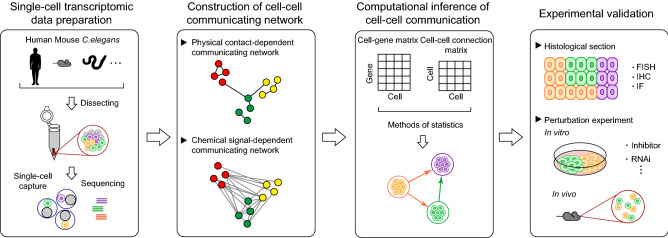
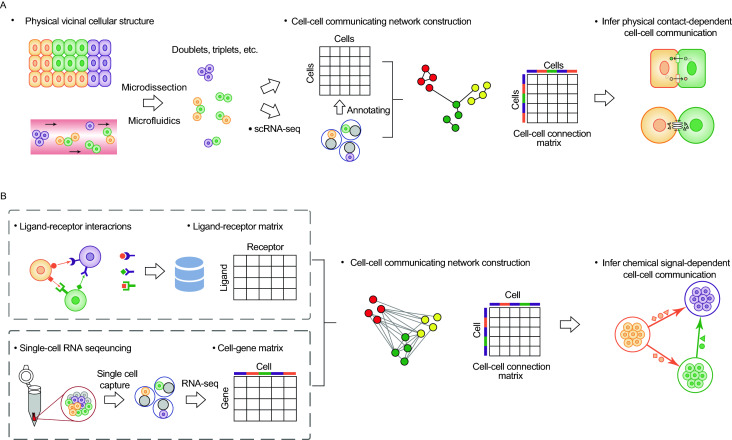
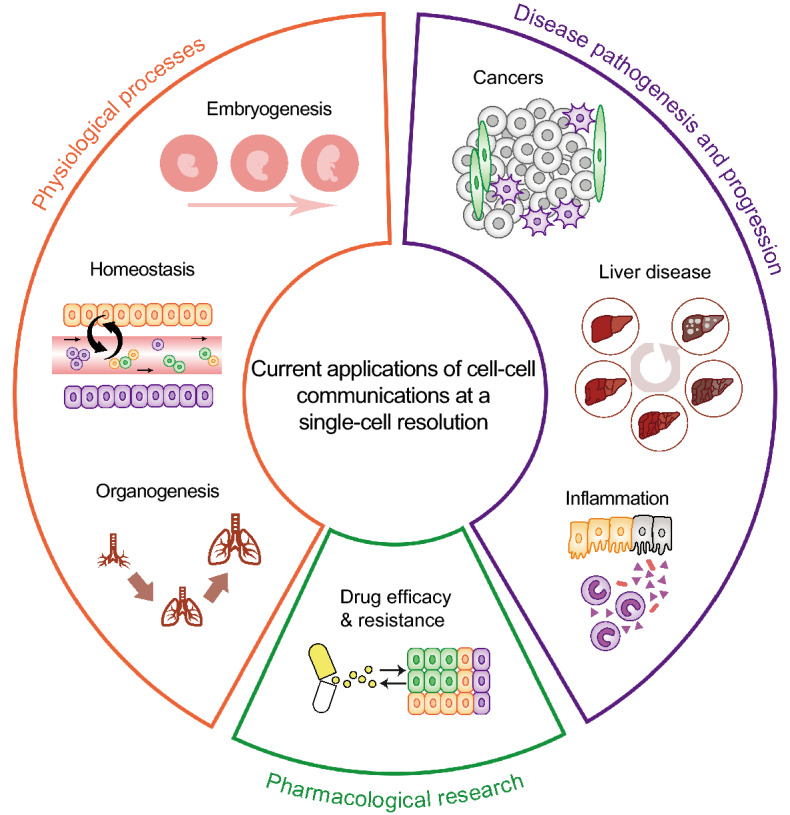
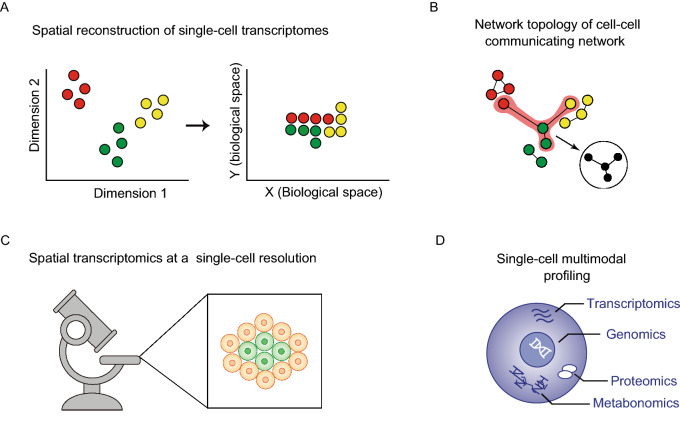
Verification
Claims the paper makes
The claims and statistics of this paper haven’t been checked yet.
Free: it reads the open-access text and checks the first 5 claims that cite a source we can check. Create a free account to check every claim.
Claims other papers make about this one
Each is checked against this paper’s own text: does it say what the citing paper says it does?
In the citing paper
“Yet, scRNA-seq data inherently contains gene expression information that could be used to infer such intercellular communications6,7.”
From Inference and analysis of cell-cell communication using CellChat (2021) · cites this paper as [6]
Self-check
Percentages, sums and reported differences re-computed from the paper’s own numbers.
The self-check needs the paper’s full text.
Citations
Cites
Network biology: understanding the cell's functional organization
Barabási, A.-L., & Oltvai, Z. N. (2004) · Nature Reviews Genetics · doi:10.1038/nrg1272 · Cited by 7,903 · cited 1×
“Analysis on network topology and features may help scientists predict system behavior (Albert et al., 2000; Barabasi and Oltvai 2004; Xue et al., 2020).”
BackgroundError and attack tolerance of complex networks
Albert, R., Jeong, H., & Barabási, A.-L. (2000) · Nature · doi:10.1038/35019019 · Cited by 7,534 · cited 1×
“Analysis on network topology and features may help scientists predict system behavior (Albert et al., 2000; Barabasi and Oltvai 2004; Xue et al., 2020).”
BackgroundMassively parallel digital transcriptional profiling of single cells
Zheng, G. X. Y., Terry, J. M., Belgrader, P., Ryvkin, P., Bent, Z. W., Wilson, R., Ziraldo, S. B., Wheeler, T. D., McDermott, G. P., Zhu, J., et al. (2017) · Nature Communications · doi:10.1038/ncomms14049 · Cited by 7,353 · cited 4×
“Brie fl y, during the data acquisition, the single-cell transcriptomic data of the specimen are collected through various scRNA-seq platforms, including the widely-used 10x Genomics (Zheng et al., 2017), as well as CEL-seq (Hashimshony et al., 2012), Smart-seq2 (Picelli et al., 2013), MARS-seq (Jaitin et al., 2014), et…”
InfluentialHighly parallel genome-wide expression profiling of individual cells using nanoliter droplets.
Macosko, E. Z., Basu, A., Satija, R., Nemesh, J., Shekhar, K., Goldman, M., Tirosh, I., Bialas, A. R., Kamitaki, N., Martersteck, E. M., et al. (2015) · Cell · doi:10.1016/j.cell.2015.05.002 · Cited by 7,110 · cited 2×
“…RNA sequencing (scRNA-seq) have enabled the simultaneous classi fi cation of thousands of cells in a single assay based on transcriptome pro fi ling (Macosko et al., 2015; Klein et al., 2015), which result in the characterization of several novel or rare cell-types that have been limitedly reported…”
MethodSpatial reconstruction of single-cell gene expression data
Satija, R., Farrell, J. A., Gennert, D., Schier, A. F., & Regev, A. (2015) · Nature Biotechnology · doi:10.1038/nbt.3192 · Cited by 7,055 · cited 1×
“Fortu-nately, spatial reconstruction of single-cell transcriptomes has attracted much attention recently and future improvements in this area may help address the limitations (Satija et al., 2015; Halpern et al., 2017; Nitzan et al., 2019).”
BackgroundError and attack tolerance of complex networks
Albert, R., Jeong, H., & Barabási, A.-Ĺ. (2000) · RePEc: Research Papers in Economics · Cited by 6,460
Aran, D., Looney, A. P., Liu, L., Wu, E., Fong, V., Hsu, A., Chak, S., Naikawadi, R. P., Wolters, P. J., Abate, A. R., et al. (2019) · Nature Immunology · doi:10.1038/s41590-018-0276-y · Cited by 4,984 · cited 2×
“The common practice is to identify cell types with the known cell markers based on the pre-computed cell clusters such as scCATCH (Shao et al., 2020), or to mark cells by comparing the similarity of single-cell expression pro fi les with reference database using Sin-gleR Aran et al. (2019) and scMap (Kiselev et al., 20…”
MethodDissecting the multicellular ecosystem of metastatic melanoma by single-cell RNA-seq
Tirosh, I., Izar, B., Prakadan, S. M., Wadsworth, M. H., Treacy, D., Trombetta, J. J., Rotem, A., Rodman, C., Lian, C., Murphy, G., et al. (2016) · Science · doi:10.1126/science.aad0501 · Cited by 4,944 · cited 2×
“…et al., 2018), and organogenesis (Cohen et al., 2018; Scott and Guilliams 2018), as well as disease pathogenesis and progression for cancers (Tirosh et al., 2016; Kumar et al., 2018), liver diseases (Xiong et al., 2019) and in fl ammation (Duan et al., 2018; Martin et al., 2019), and…”
BackgroundInsights into the regulation of protein abundance from proteomic and transcriptomic analyses
Vogel, C., & Marcotte, E. M. (2012) · Nature Reviews Genetics · doi:10.1038/nrg3185 · Cited by 4,195 · cited 1×
“…scRNA-seq techniques (Cao et al., 2017), it has been a common practice to use mRNA concentrations as proxies for the concentrations and activities of the corresponding proteins, assuming that gene expression levels are the main determinant of protein abundances (Vogel and Marcotte 2012).”
MethodEfremova, M., Vento-Tormo, M., Teichmann, S. A., & Vento-Tormo, R. (2020) · Nature Protocols · doi:10.1038/s41596-020-0292-x · Cited by 3,449 · cited 2×
“…(Ramilowski et al., 2015), which enables the use of scRNA-seq to construct cell-cell communicating network based on differentially expressed gene levels of ligands and receptors to infer potential cell-cell communications such as CellPhoneDB (Efremova et al., 2020) and SoptSC (Wang et al., 2019).”
Background
Research works printed but not linked: 2
- Cao J Packer JS Ramani V Cusanovich DA Huynh C Daza R Qiu X Lee C Furlan SN Steemers FJ Comprehensive single-cell transcriptional profiling of a multicellular organism Science 2017 357 661 667 28818938 PMC5894354 · doi:10.1126/science.aam8940 · Paper page
- Zhang L Vertes A Single-cell mass spectrometry approaches to explore cellular heterogeneity Angew Chem Int Ed Engl 2018 57 4466 4477 29218763 · DOI · Paper page
Cited by
Inference and analysis of cell-cell communication using CellChat
Jin, S., Guerrero-Juarez, C. F., Zhang, L., Chang, I., Ramos, R., Kuan, C.-H., Myung, P., Plikus, M. V., & Nie, Q. (2021) · Nature Communications · doi:10.1038/s41467-021-21246-9 · Cited by 8,409
CellChat for systematic analysis of cell–cell communication from single-cell transcriptomics
Jin, S., Plikus, M. V., & Nie, Q. (2025) · Nature Protocols · doi:10.1038/s41596-024-01045-4 · Cited by 1,448
Deciphering cell–cell interactions and communication from gene expression
Armingol, E., Officer, A., Harismendy, O., & Lewis, N. E. (2021) · Nature Reviews Genetics · doi:10.1038/s41576-020-00292-x · Cited by 1,267
Cell-cell communication: New insights and clinical implications
Su, J., Song, Y., Zhu, Z., Huang, X., Fan, J., Qiao, J., & Mao, F. (2024) · Signal Transduction and Targeted Therapy · doi:10.1038/s41392-024-01888-z · Cited by 433
CellTalkDB: a manually curated database of ligand–receptor interactions in humans and mice
Shao, X., Liao, J., Li, C., Lu, X., Cheng, J., & Fan, X. (2021) · Briefings in Bioinformatics · doi:10.1093/bib/bbaa269 · Cited by 292
Self-citation
Metadata
- Authors
- Shao, X., Lu, X., Liao, J., Chen, H., & Fan, X.
- Venue
- Protein & Cell
- Publisher
- Oxford University Press (OUP)
- Published
- 2020-05-21
- Volume
- 11
- Issue
- 12
- Pages
- 866-880
- ISSN
- 1674-800X (ISSN-L)
- 1674-8018
- PMC
- PMC7719148
- OpenAlex
- W3026876979
- Cited by
- 159
- References
- 88
- FWCI
- 5.39
- Type
- journal article
- Language
- en
- Open access
- gold
- Licence
- creativecommons.org/licenses/by/4.0 (tdm)
- creativecommons.org/licenses/by/4.0 (vor)
About these checks
Registry, retraction, Cites and statistics results are computed, not judged, with one exception: a printed reference that no index lists is read once by a model before it counts as a citation error. Claims are extracted by a model and kept only when their quote appears verbatim in the text; each cited source is then checked, with a model’s help, for whether it says what the claim relies on. Those verdicts can be wrong — read the claim’s quote and the cited source before relying on one.
Statistics and arithmetic are recomputed, not judged.
Confidence bands are shown only for fields calibrated on our annotated test set. None is calibrated yet, so no band is shown.
What counts as a claim ›How we measure confidence ›How we check this ›
Are you an author, or do you see a problem with this page? Request a review
Data sources
Bibliographic data: Semantic Scholar, OpenAlex, Crossref.
Contains information from the Semantic Scholar Academic Graph Datasets, made available under the ODC Attribution License (ODC-BY 1.0).
Semantic Scholar’s data is described in: Kinney, R., et al. (2023). The Semantic Scholar Open Data Platform. arXiv:2301.10140.
