

Added value of double reading in diagnostic radiology,a systematic review
Open accessThe DOI matches its Crossref record; 174 of the 174 references it cites were found in a registry or an index.
Abstract
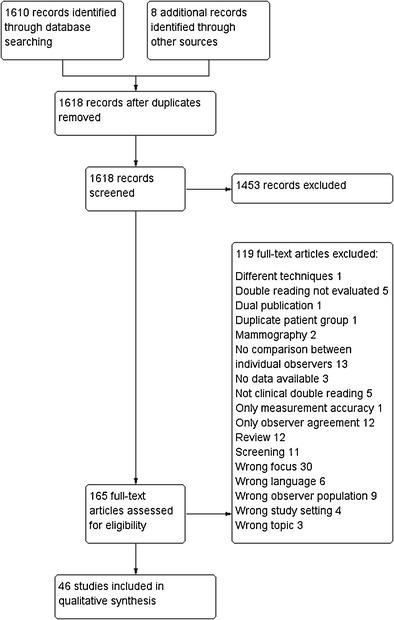
OBJECTIVES: Double reading in diagnostic radiology can find discrepancies in the original report, but a systematic program of double reading is resource consuming. There are conflicting opinions on the value of double reading. The purpose of the current study was to perform a systematic review on the value of double reading. METHODS: A systematic review was performed to find studies calculating the rate of misses and overcalls with the aim of establishing the added value of double reading by human observers. RESULTS: The literature search resulted in 1610 hits. After abstract and full-text reading, 46 articles were selected for analysis. The rate of discrepancy varied from 0.4 to 22% depending on study setting. Double reading by a sub-specialist, in general, led to high rates of changed reports. CONCLUSIONS: The systematic review found rather low discrepancy rates. The benefit of double reading must be balanced by the considerable number of working hours a systematic double-reading scheme requires. A more profitable scheme might be to use systematic double reading for selected, high-risk examination types. A second conclusion is that there seems to be a value of sub-specialisation for increased report quality. A consequent implementation of this would have far-reaching organisational effects. KEY POINTS: • In double reading, two or more radiologists read the same images. • A systematic literature review was performed. • The discrepancy rates varied from 0.4 to 22% in various studies. • Double reading by sub-specialists found high discrepancy rates.
Overview
The claims and statistics of this paper haven’t been checked yet.
Free: it reads the open-access text and checks the first 5 claims that cite a source we can check. Create a free account to check every claim.
Integrity signals
Registry
Cites
Statistics
Figures
Verification
Claims the paper makes
The claims and statistics of this paper haven’t been checked yet.
Free: it reads the open-access text and checks the first 5 claims that cite a source we can check. Create a free account to check every claim.
Claims other papers make about this one
Each is checked against this paper’s own text: does it say what the citing paper says it does?
The source backs part of the claim, not all of it — or backs it for a different population, condition or comparison.
In the citing paper
“However, in a clinical setting, physicians often receive advice from colleagues, or are asked to re-review cases from someone else to give a second opinion13,14.”
From Non-task expert physicians benefit from correct explainable AI advice when reviewing X-rays (2023) · cites this paper as [14]
Experimental — accuracy not yet measured
Self-check
Percentages, sums and reported differences re-computed from the paper’s own numbers.
The self-check needs the paper’s full text.
Citations
Cites
Audit and feedback: effects on professional practice and healthcare outcomes
Ivers, N., Jamtvedt, G., Flottorp, S., Young, J. M., Odgaard-Jensen, J., French, S. D., O'Brien, M. A., Johansen, M., Grimshaw, J., & Oxman, A. D. (2012) · Cochrane Database of Systematic Reviews · doi:10.1002/14651858.cd000259.pub3 · Cited by 5,485
Error and discrepancy in radiology: inevitable or avoidable?
Brady, A. P. (2017) · Insights into Imaging · doi:10.1007/s13244-016-0534-1 · Cited by 570
Johnson, C. D., Harmsen, W. S., Wilson, L. A., Maccarty, R. L., Welch, T. J., Ilstrup, D. M., & Ahlquist, D. A. (2003) · Gastroenterology · doi:10.1016/s0016-5085(03)00894-1 · Cited by 351
Rubin, G. D., Lyo, J. K., Paik, D. S., Sherbondy, A. J., Chow, L. C., Leung, A. N., Mindelzun, R., Schraedley-Desmond, P. K., Zinck, S. E., Naidich, D. P., et al. (2005) · Radiology · doi:10.1148/radiol.2341040589 · Cited by 259 · cited 1×
“& In chest CT for pulmonary nodules, double reading increased sensitivity [8, 22, 23], but computer-aided diagnosis (CAD) was even more beneficial [8, 22].”
BackgroundGarland, L. H. (1949) · Radiology · doi:10.1148/52.3.309 · Cited by 239 · cited 1×
“The concept of observer variation in radiology was introduced in the late 1940’s when tuberculosis screening with mass chest radiography was evaluated [3, 4].”
BackgroundRADPEER quality assurance program: a multifacility study of interpretive disagreement rates
Borgstede, J. P., Lewis, R. S., Bhargavan, M., & Sunshine, J. H. (2004) · Journal of the American College of Radiology · doi:10.1016/s1546-1440(03)00002-4 · Cited by 203
Variation between experienced observers in the interpretation of accident and emergency radiographs.
Robinson, P. J., Wilson, D., Coral, A., Murphy, A., & Verow, P. (1999) · The British Journal of Radiology · doi:10.1259/bjr.72.856.10474490 · Cited by 162 · cited 1×
“& Two articles quoted 3–9% disagreement between observers in general radiography [30, 31].”
BackgroundDetection of flat lesions in the colon with CT colonography
Fidler, J. L., Johnson, C. D., MacCarty, R. L., Welch, T. L., Hara, A. K., & Harmsen, W. S. (2002) · Abdominal Imaging · doi:10.1007/s00261-001-0171-z · Cited by 150
Birkelo, C. C., & CHAMBERLAIN, W. E. (1947) · JAMA · doi:10.1001/jama.1947.02880060001001 · Cited by 144 · cited 2×
“The concept of observer variation in radiology was introduced in the late 1940’s when tuberculosis screening with mass chest radiography was evaluated [3, 4].”
BackgroundAccuracy and Its Relationship to Experience in the Interpretation of Chest Radiographs
Herman, P. G., & Hessel, S. J. (1975) · Investigative Radiology · doi:10.1097/00004424-197501000-00008 · Cited by 139
Cited by
Items 101–117 of 117
Pervaiz, M., Umer, U. S., Abdullah, M., Ghaus, G., Khan, M. K., & Rehman, H. U. (2024) · Journal of Gandhara Medical and Dental Science · doi:10.37762/jgmds.11-4.567
“13 Several factors contribute to inter-observer variability in radiology interpretation.”
BackgroundImpact of Grazing Tibetan Pigs on Soil Quality
Wu, G., Wang, H., Duan, M., Ze, L., Dong, S., Zhang, H., Wang, K., Tan, Z., & Shang, P. (2024) · Agriculture · doi:10.3390/agriculture14112096
Value of Neuroradiology Second Reads of CT Scans for Hyperparathyroidism
Bravo, J., Bouvet, M., Chang, J., & Bykowski, J. (2025) · Journal of Clinical Medicine · doi:10.3390/jcm14092865
“The use of multi-phase parathyroid neck CT protocols has increased over the past 20 years [9,10]; however, it is still not a routine order at all community-based imaging sites.”
Wu, H., Li, M., Chen, J., Fan, X., He, M., Ji, Z., Wang, H., & Yin, X. (2025) · BMC Medical Education · doi:10.1186/s12909-025-07573-1 · Cited by 1
Detection of Suspicious Microcalcification Clusters in Mammography: A Patch Classification Approach
Mračko, A., Gabrisova, A., Narova, D., Cimrák, I., & Vanovcanova, L. (2025) · Conference of Open Innovations Association (FRUCT) · doi:10.23919/fruct67853.2025.11239086
“A screening mammography must be evaluated independently by two radiologists [5].”
When One Fracture Hides Another: A Case Highlighting Cognitive Bias in Trauma Reporting
Rehman, A., Javed, M., Hameed, R. A., & Rahman, A. U. (2025) · Cureus · doi:10.7759/cureus.97715
“…identified only when a different radiologist retrospectively reviewed the prior imaging during reporting of an unrelated shoulder radiograph, underscoring the importance of second-reader review, re-evaluation of prior imaging in symptomatic patients, and vigilance against cognitive biases [8].”
A multicenter evaluation of a human-in-the-loop workflow for clinical report quality assurancePreprint
Liang, X., He, H., Liu, C., Sang, R., Zhu, J., Wang, X., Hou, W., Li, D., Wang, J., Li, Y., et al. (2025) · SSRN Electronic Journal · doi:10.2139/ssrn.5960740
Shen, H., Wu, T., Wang, F., Fang, J., Li, Y., Wu, X., Liu, S., Chen, L., Ren, Q., Meng, X., et al. (2026) · Journal of Medical Internet Research · doi:10.2196/86841 · Cited by 2
“Traditional proofreading methods, such as double-reading by senior radiologists, are effective but time-consuming and often impractical in fast-paced emergency settings [8].”
Medical decluttering: what it is and why it is important
Sirignano, A., Murri, F., Ruggiu, L., Cece, M., Biondi‐Zoccai, G., Boni, M., & Versaci, F. (2026) · Panminerva Medica · doi:10.23736/s0031-0808.26.05427-3
Diagnostic Errors in Pediatric Neuroradiology: Illustrative Examples and Improvement Considerations
Goldman-Yassen, A. E., Lall, N., Dekmar, B. F., & Kadom, N. (2026) · AJNR Clinical Practice · doi:10.3174/cp.a0001
Koskan, A. M., Guzman-Clark, J., Ball, S. L., Renger, R. F., & Dev, S. (2026) · Frontiers in Cardiovascular Medicine · doi:10.3389/fcvm.2026.1810173
Park, S., Jung, J. I., Han, K., Beck, K. S., Jang, J., & Chang, S. (2026) · Korean Journal of Radiology · doi:10.3348/kjr.2025.1681
“Double reading was associated with a lower rate of missed detection, which is consistent with previous literature [31].”
Computation in Memory for Reliable and Energy-Efficient Diabetic Retinopathy Screening
Diware, S., Chilakala, K., & Bishnoi, R. (2025) · Springer eBooks · doi:10.1007/978-3-032-09253-3_8
Codlin, A. J., Dao, T. P., Vo, L. N. Q., Forse, R., Nguyen, B. H., Trinh, P. N., Dang, H. T. M., Nguyen, L. H., Nguyen, H. B., Dinh, L. V., et al. (2026) · BMJ Public Health · doi:10.1136/bmjph-2026-005566
Liang, X., He, H., Liu, C., Sang, R., Zhu, J., Wang, X., Hou, W., Li, D., Wang, J., Li, Y., et al. (2026) · Academic Radiology · doi:10.1016/j.acra.2026.09.069
Burti, S., Zotti, A., Coghlan, S., & Banzato, T. (2026) · Frontiers in Veterinary Science · doi:10.3389/fvets.2026.1978054
“Observer-performance studies, eye-tracking analyses, search-pattern research, double-reading protocols, workload studies, and secondary-interpretation analyses all contributed to the understanding that diagnostic interpretation is itself a measurable scientific process (16, 19, 34–36).”
Metadata
- Authors
- Geijer, H., & Geijer, M.
- Affiliations
- Örebro University (SE)
- Lund University (SE)
- Corresponding author
- Geijer, Håkan
- Venue
- Insights into Imaging
- Published
- 2018-03-28
- Volume
- 9
- Issue
- 3
- Pages
- 287-301
- ISSN
- 1869-4101 (ISSN-L)
- PMC
- PMC5990995
- OpenAlex
- W2794467195
- Cited by
- 117
- References
- 174
- Citations by year
- 2026: 12 · 2025: 18 · 2024: 19 · 2023: 23 · 2022: 9 · 2021: 17 · 2020: 12 · 2019: 7
- FWCI
- 1.40
- Type
- journal article
- Language
- en
- Open access
- gold
- doi.org
- Licence
- cc-by
- creativecommons.org/licenses/by/4.0 (tdm)
- Locations
- Insights into Imaging (publishedVersion, cc-by)
- Europe PMC (PubMed Central) (publishedVersion, cc-by)
- PubMed Central (publishedVersion, cc-by)
- PubMed (publishedVersion)
- DOAJ (DOAJ: Directory of Open Access Journals) (submittedVersion, cc-by-sa)
- Lund University Publications (Lund University) (submittedVersion)
- Funders
- Örebro Universitet
- Topics
- Health Sciences › Medicine › Radiology, Nuclear Medicine and Imaging › Radiology practices and education
- Health Sciences › Medicine › Health Informatics › Artificial Intelligence in Healthcare and Education
- Health Sciences › Health Professions › General Health Professions › Healthcare cost, quality, practices
- Keywords
- double reading, diagnostic radiology, missed diagnosis, reporting quality
About these checks
Registry, retraction, Cites and statistics results are computed, not judged, with one exception: a printed reference that no index lists is read once by a model before it counts as a citation error. Claims are extracted by a model and kept only when their quote appears verbatim in the text; each cited source is then checked, with a model’s help, for whether it says what the claim relies on. Those verdicts can be wrong — read the claim’s quote and the cited source before relying on one.
Statistics and arithmetic are recomputed, not judged.
Confidence bands are shown only for fields calibrated on our annotated test set. None is calibrated yet, so no band is shown.
What counts as a claim ›How we measure confidence ›How we check this ›
Are you an author, or do you see a problem with this page? Request a review
Data sources
Bibliographic data: Semantic Scholar, OpenAlex, Crossref.
Contains information from the Semantic Scholar Academic Graph Datasets, made available under the ODC Attribution License (ODC-BY 1.0).
Semantic Scholar’s data is described in: Kinney, R., et al. (2023). The Semantic Scholar Open Data Platform. arXiv:2301.10140.
