

The DOI matches its Crossref record; 25 of the 25 references it cites were found in a registry or an index; 19 of the 28 sources its claims cite were checked for support.
Non-task expert physicians benefit from correct explainable AI advice when reviewing X-rays
Open accessAbstract
Artificial intelligence (AI)-generated clinical advice is becoming more prevalent in healthcare. However, the impact of AI-generated advice on physicians’ decision-making is underexplored. In this study, physicians received X-rays with correct diagnostic advice and were asked to make a diagnosis, rate the advice’s quality, and judge their own confidence. We manipulated whether the advice came with or without a visual annotation on the X-rays, and whether it was labeled as coming from an AI or a human radiologist. Overall, receiving annotated advice from an AI resulted in the highest diagnostic accuracy. Physicians rated the quality of AI advice higher than human advice. We did not find a strong effect of either manipulation on participants’ confidence. The magnitude of the effects varied between task experts and non-task experts, with the latter benefiting considerably from correct explainable AI advice. These findings raise important considerations for the deployment of diagnostic advice in healthcare.
Overview
CoChat Summary
TL;DR
In an online experiment with physicians reviewing chest X-rays, correct diagnostic advice that was annotated and labeled as AI-generated was associated with higher diagnostic accuracy, especially for non-task experts. Explainability improved accuracy and quality ratings for IM/EM physicians, while AI-labeled advice increased radiologists’ confidence but not their accuracy.
Key findings
- Overall, annotated advice and AI-labeled advice were associated with higher diagnostic accuracy: annotated OR = 2.30 (95% CI 1.37–3.85, p = 0.002); AI source OR = 2.10 (95% CI 1.22–3.59, p = 0.007); task experts performed better than non-task experts, OR = 2.20 (95% CI 1.40–3.47, p = 0.001).
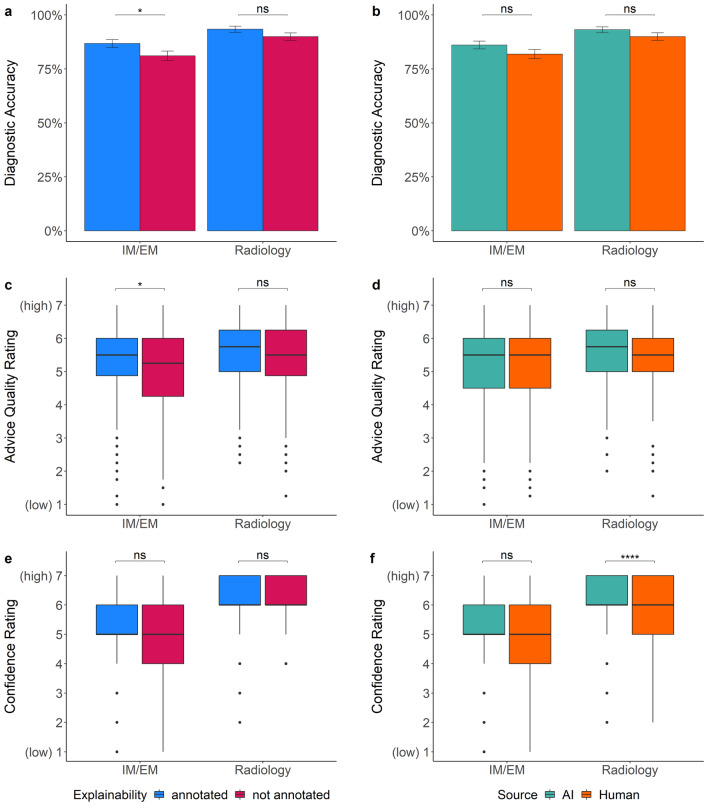
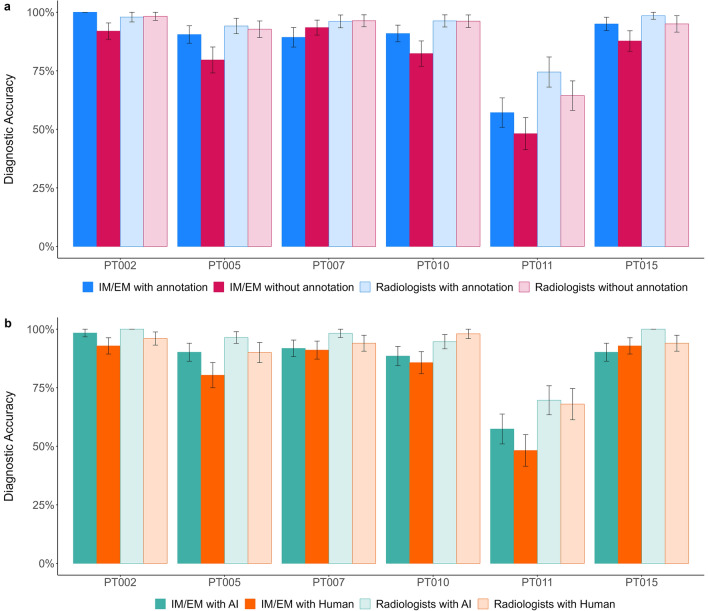
- Non-task experts (IM/EM physicians) improved mean diagnostic performance by 5.66% with annotated advice (p = 0.042); radiologists improved by 3.41% but this was non-significant (p = 0.120). AI-labeled advice improved performance by 4.22% for non-experts and 3.15% for experts, both non-significant (p = 0.129 and p = 0.155).
- Annotated advice raised advice-quality ratings overall (estimate = 0.25, p = 0.001); among non-task experts it was 0.24 points higher (p = 0.011), while for task experts it was 0.11 points higher but non-significant (p = 0.195). Source of advice did not significantly affect quality ratings (p = 0.645 for IM/EM; p = 0.812 for radiology).
- Radiologists reported 0.32 points higher confidence when advice was labeled as AI vs. human (p < 0.0001); IM/EM physicians’ confidence was only 0.06 points higher (p = 0.497). Highest accuracy occurred with annotated AI advice: non-task experts M = 86.84, SD = 33.89; task experts M = 94.61, SD = 22.64.
Methods
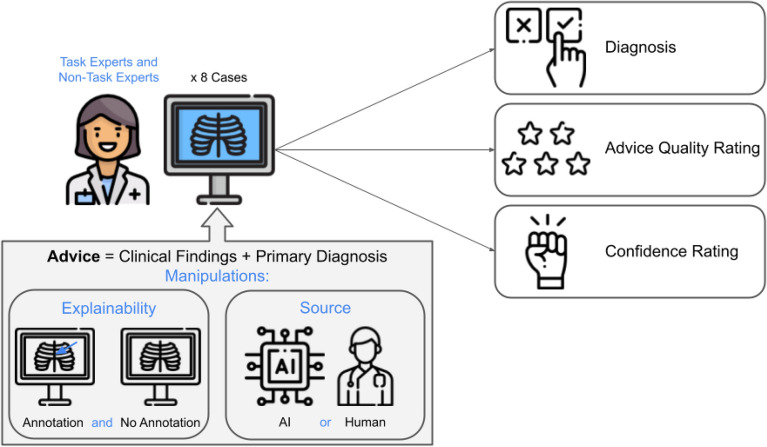
- Pre-registered online 2 × 2 mixed factorial experiment: explainability manipulated within subjects (annotated vs. non-annotated X-rays) and source manipulated between subjects (AI “CHEST-AI” vs. human radiologist “Dr. S. Johnson”). Participants reviewed eight chest X-ray cases from MIMIC-CXR with patient vignettes and correct diagnostic advice; six cases were analyzed because two could not be unambiguously assigned to the explainability condition.
- N = 223 physicians finished the experiment and were included: 117 IM/EM physicians classified as non-task experts and 106 radiologists classified as task experts. The mixed-effects models reported NID = 222, NPATIENTID = 6, and 1,332 observations.
- Three mixed-effects regression models were run: logistic regression for diagnostic accuracy and linear regression for advice-quality ratings and confidence. Predictors included explainability, source, task expertise, their interaction, and control variables, with random effects for participant and patient case.
Limitations
- The paper states: the experiment was online and diagnoses did not affect real patient treatment; only eight cases were presented and only six analyzed; the sample fell short of the a priori power target (planned 128 IM/EM and 128 radiologists; recruited 117 and 106); task-expert accuracy was high, limiting room for improvement; and prior-study participation could not be fully ruled out, though data were collected two years later.
- The paper also states that only correct advice was provided, so it could not test how explanations affect reliance when AI advice is incorrect; the authors note that participants strongly relied on any advice and that more research is needed on incorrect advice.
- Evident from the text: the source manipulation was between-subjects, so source effects may be confounded with individual differences, and the study used a limited set of curated cases, which narrows generalizability.
Model-written summary. Check it against the paper before relying on it.
Integrity signals
Registry
Cites
Statistics
Figures
Verification
Claims the paper makes
14 Valid · 1 Not valid · 2 Not checked · 76 Own results and interpretations
The cited sources support only part of this claim — read each source’s verdict below.
In the paper
“The limited work that does investigate whether AI-CDSS have actual clinical benefits is inconclusive2,5,6, suggesting that the technology might not automatically lead to better patient outcomes.”
§ Non-task expert physicians benefit from correct explainable AI advice when reviewing X-rays > Introduction
What the sources say
- Partly supportedcites [2] van Leeuwen, K. G., Schalekamp, S., Rutten, M. J. C. M., van Ginneken, B. & de Rooij, M. Artificial intelligence in radiology: 100 commercially available products and their scientific evidence. Eur. Radiol. 31, 3797–3804 (2021). sourceExperimental — accuracy not yet measured
The Results > Evidence and Discussion (pages unavailable) show that relatively few studies assessed clinical impact and that the impact of most products in clinical practice remains unknown. The paper does not characterize the findings of the studies that did investigate clinical impact as inconclusive; it says 18 products had evidence of potential clinical impact. Its scope is commercially available AI software in radiology, not AI-CDSS generally. (LLM, conf=0.82)
- Not checked — no full text of the sourcecites [5] Tariq, A. et al. Current clinical applications of artificial intelligence in radiology and their best supporting evidence. J. Am. Coll. Radiol. 17, 1371–1381 (2020). source
- Partly supportedcites [6] van Leeuwen, K. G., de Rooij, M., Schalekamp, S., van Ginneken, B. & Rutten, M. J. C. M. How does artificial intelligence in radiology improve efficiency and health outcomes?. Pediatr. Radiol. https://doi.org/10.1007/s00247-021-05114-8 (2021). sourceExperimental — accuracy not yet measured
The Introduction reports that prospective research on benefits in clinical practice covered only 18 of 100 radiology AI products evaluated. The Discussion says impact has been proved in only a limited number of cases, and the Conclusion says little is known about effects on health outcomes. This supports the claim that evidence is limited and conclusions remain uncertain for radiology AI, but does not establish the same conclusion for AI clinical decision-support systems generally. (LLM, conf=0.83)
hedged- Asserted: passes — The authors put it forward as true.
- Checkable: passes — It can be checked against evidence.
- Load-bearing: passes — The paper’s conclusions depend on it.
- Based: passes — The paper gives a reason why it holds.
- Partly supported
The cited sources support only part of this claim — read each source’s verdict below.
In the paper
“but few studies have investigated these products' actual clinical impact (e.g., physicians’ diagnostic performance and patient outcomes) when implemented in a natural clinical setting2.”
§ Non-task expert physicians benefit from correct explainable AI advice when reviewing X-rays > Introduction
What the sources say
- Partly supportedcites [2] van Leeuwen, K. G., Schalekamp, S., Rutten, M. J. C. M., van Ginneken, B. & de Rooij, M. Artificial intelligence in radiology: 100 commercially available products and their scientific evidence. Eur. Radiol. 31, 3797–3804 (2021). sourceExperimental — accuracy not yet measured
The Results > Evidence section reports that only 64 of 237 studies, involving 18 of 100 products, assessed aspects of potential clinical impact; it also says 192 studies were retrospective. Table 1 includes radiologist performance and patient outcomes among its clinical-impact measures. The paper does not establish how many studies assessed actual impact after implementation in a natural clinical setting, and its scope is commercial radiology AI products rather than AI-CDSS products generally. Page numbers are unavailable in our copy. (LLM, conf=0.84)
plain- Asserted: passes — The authors put it forward as true.
- Checkable: passes — It can be checked against evidence.
- Load-bearing: passes — The paper’s conclusions depend on it.
- Based: passes — The paper gives a reason why it holds.
- Partly supported
The cited sources support only part of this claim — read each source’s verdict below.
In the paper
“Previous research has shown that providing case-by-case explanations indeed increases trust in and reliance on the advice, even when the advice is incorrect8.”
§ Non-task expert physicians benefit from correct explainable AI advice when reviewing X-rays > Introduction
What the sources say
- Partly supportedcites [8] Jacobs, M. et al. How machine-learning recommendations influence clinician treatment selections: The example of antidepressant selection. Transl. Psychiatry 11, 1–9 (2021). sourceExperimental — accuracy not yet measured
The Discussion (page unavailable) says explanations may increase trust and can lead to overreliance; the Results report lower treatment-selection accuracy when incorrect recommendations had feature-based explanations. But the paper does not establish that case-by-case explanations increased both trust and reliance: it found no significant effect of explanation type on confidence or perceived ML utility, and the reported accuracy comparison was against no recommendation, not against unexplained advice. (LLM, conf=0.86)
boostedstates a cause- Asserted: passes — The authors put it forward as true.
- Checkable: passes — It can be checked against evidence.
- Load-bearing: passes — The paper’s conclusions depend on it.
- Based: passes — The paper gives a reason why it holds.
- Partly supported
Every source the paper cites for this claim was checked and supports it.
In the paper
“This finding does not confirm the results from a previous study using the same materials, in which task experts did show algorithm aversion by rating the quality of AI advice lower than human advice7.”
§ Non-task expert physicians benefit from correct explainable AI advice when reviewing X-rays > Discussion
What the sources say
- Supportedcites [7] Gaube, S. et al. Do as AI say: Susceptibility in deployment of clinical decision-aids. NPJ. Digit. Med. 4, 1–8 (2021). source
The Results section, “Advice quality ratings display algorithmic aversion in experts,” reports that task experts rated advice significantly lower in quality when it was presented as coming from AI rather than a human. The paper identifies those task experts as radiologists. Whether the citing study used the same materials is the citing authors’ description of their own study, not a finding attributed to this source. (LLM, conf=0.92)
plain- Asserted: passes — The authors put it forward as true.
- Checkable: passes — It can be checked against evidence.
- Load-bearing: passes — The paper’s conclusions depend on it.
- Based: passes — The paper gives a reason why it holds.
- Supported
The cited sources support only part of this claim — read each source’s verdict below.
In the paper
“Our participants strongly relied on any advice given to them.”
§ Non-task expert physicians benefit from correct explainable AI advice when reviewing X-rays > Discussion
What the sources say
- Partly supportedcites [7] Gaube, S. et al. Do as AI say: Susceptibility in deployment of clinical decision-aids. NPJ. Digit. Med. 4, 1–8 (2021). sourceExperimental — accuracy not yet measured
The Discussion reports a general tendency for physicians to agree with diagnostic advice, whether presented as coming from AI or a human, and says they often failed to dismiss inaccurate advice. It does not establish that participants strongly relied on any advice given to them: reliance varied across physicians and cases, and the study tested diagnostic advice in a specific clinical task. (LLM, conf=0.84)
boostedstates a cause- Asserted: passes — The authors put it forward as true.
- Checkable: passes — It can be checked against evidence.
- Load-bearing: passes — The paper’s conclusions depend on it.
- Based: passes — The paper gives a reason why it holds.
- Partly supported
37 more claims
Create a free account to see all 93 claims and every source verdict.
- Probably not a substantial claim. 40
- It may state two separate claims as one. 18
- The quote only partly states this claim. 1
Claims other papers make about this one
Each is checked against this paper’s own text: does it say what the citing paper says it does?
The source backs part of the claim, not all of it — or backs it for a different population, condition or comparison.
In the citing paper
“For instance, physicians with substantial expertise in diagnosing a disease may have better epistemic access (e.g., they will know better when a system is making incorrect diagnoses) than physicians with little expertise [29].”
From On the Quest for Effectiveness in Human Oversight: Interdisciplinary Perspectives (2024) · cites this paper as [29]
Experimental — accuracy not yet measured
Self-check
Percentages, sums and reported differences re-computed from the paper’s own numbers.
Each contradiction between two passages listed here was confirmed by an independent check.
Rated minor: it would not touch a result — a value no result rests on, a p-value that stays on the same side of the significance level, or a conflict that is clerical, resolved elsewhere in the paper, or outside its own findings.
In the paper
§ Non-task expert physicians benefit from correct explainable AI advice when reviewing X-rays > Results > Non-task experts preferred explainable advice
“Task experts rated the quality of the annotated advice on average 0.11 points higher, but the mean difference was statistically non-significant (p = 0.195, see Fig. 2d).”
§ Non-task expert physicians benefit from correct explainable AI advice when reviewing X-rays > Results > Non-task experts benefited from correct explainable AI advice
“Plot (c) displays that non-task experts rated the quality of annotated advice higher than non-annotated advice (pIM/EM = 0.011, pRadiology = 0.195). In (d), it is shown that there was no evidence that the source of advice had an effect on the quality rating (pIM/EM = 0.645, pRadiology = 0.812).”
Citations
Cites
Algorithm aversion: People erroneously avoid algorithms after seeing them err.
Dietvorst, B. J., Simmons, J. P., & Massey, C. (2015) · Journal of Experimental Psychology: General · doi:10.1037/xge0000033 · Cited by 3,232
Algorithm appreciation: People prefer algorithmic to human judgment
Logg, J. M., Minson, J. A., & Moore, D. A. (2019) · Organizational Behavior and Human Decision Processes · doi:10.1016/j.obhdp.2018.12.005 · Cited by 2,061
MIMIC-CXR, a de-identified publicly available database of chest radiographs with free-text reports
Johnson, A. E. W., Pollard, T. J., Berkowitz, S. J., Greenbaum, N. R., Lungren, M. P., Deng, C.-Y., Mark, R. G., & Horng, S. (2019) · Scientific Data · doi:10.1038/s41597-019-0322-0 · Cited by 1,816
The false hope of current approaches to explainable artificial intelligence in health care
Ghassemi, M., Oakden-Rayner, L., & Beam, A. L. (2021) · The Lancet Digital Health · doi:10.1016/s2589-7500(21)00208-9 · Cited by 1,724
Self-citationRajpurkar, P., Irvin, J., Ball, R. L., Zhu, K., Yang, B., Mehta, H., Duan, T., Ding, D., Bagul, A., Langlotz, C. P., et al. (2018) · PLOS Medicine · doi:10.1371/journal.pmed.1002686 · Cited by 1,449 · cited 3×
“The present study had three dependent variables: (1) diagnostic accuracy, (2) advice quality ratings, and (3) confidence in the diagnosis:”
MethodDo as AI say: susceptibility in deployment of clinical decision-aids
Gaube, S., Suresh, H., Raue, M., Merritt, A., Berkowitz, S. J., Lermer, E., Coughlin, J. F., Guttag, J. V., Colak, E., & Ghassemi, M. (2021) · npj Digital Medicine · doi:10.1038/s41746-021-00385-9 · Cited by 543
Self-citationvan Leeuwen, K. G., Schalekamp, S., Rutten, M. J. C. M., van Ginneken, B., & de Rooij, M. (2021) · European Radiology · doi:10.1007/s00330-021-07892-z · Cited by 461 · cited 3×
“The present study had three dependent variables: (1) diagnostic accuracy, (2) advice quality ratings, and (3) confidence in the diagnosis:”
MethodLee, H., Yune, S., Mansouri, M., Kim, M., Tajmir, S. H., Guerrier, C. E., Ebert, S. A., Pomerantz, S. R., Romero, J. M., Kamalian, S., et al. (2018) · Nature Biomedical Engineering · doi:10.1038/s41551-018-0324-9 · Cited by 441
Jacobs, M., Pradier, M. F., McCoy, T. H., Perlis, R. H., Doshi-Velez, F., & Gajos, K. Z. (2021) · Translational Psychiatry · doi:10.1038/s41398-021-01224-x · Cited by 247
How does artificial intelligence in radiology improve efficiency and health outcomes?
van Leeuwen, K. G., de Rooij, M., Schalekamp, S., van Ginneken, B., & Rutten, M. J. C. M. (2022) · Pediatric Radiology · doi:10.1007/s00247-021-05114-8 · Cited by 236
Cited by
The current and future state of AI interpretation of medical images
Rajpurkar, P., & Lungren, M. P. (2023) · New England Journal of Medicine · doi:10.1056/nejmra2301725 · Cited by 443
Rosenbacke, R., Melhus, Å., McKee, M., & Stuckler, D. (2024) · JMIR AI · doi:10.2196/53207 · Cited by 305
“Gaube et al [33] found no difference in trust between experts and nonexperts but reported that the performance of nonexperts who drew upon XAI was superior in clinical practice.”
BackgroundGomez, C., Cho, S. M., Ke, S., Huang, C.-M., & Unberath, M. (2025) · Frontiers in Computer Science · doi:10.3389/fcomp.2024.1521066 · Cited by 209
Large Language Model in Creative Work: The Role of Collaboration Modality and User Expertise
Chen, Z., & Chan, J. (2024) · Management Science · doi:10.1287/mnsc.2023.03014 · Cited by 204
Heterogeneity and predictors of the effects of AI assistance on radiologists
Yu, F., Moehring, A., Banerjee, O., Salz, T., Agarwal, N., & Rajpurkar, P. (2024) · Nature Medicine · doi:10.1038/s41591-024-02850-w · Cited by 200
Metadata
- Authors
- Gaube, S., Suresh, H., Raue, M., Lermer, E., Koch, T. K., Hudecek, M. F. C., Ackery, A. D., Grover, S. C., Coughlin, J. F., Frey, D., Kitamura, F. C., Ghassemi, M., & Colak, E.
- Affiliations
- University Hospital Regensburg (DE)
- MIT Computer Science and Artificial Intelligence Laboratory (US)
- Massachusetts Institute of Technology (US)
- Technische Hochschule Augsburg (DE)
- Ludwig-Maximilians-Universität München (DE)
- University of Regensburg (DE)
- St. Michael's Hospital (CA)
- Universidade Federal de São Paulo (BR)
- Vector Institute (CA)
- Corresponding author
- Gaube, Susanne
- ORCID
- Venue
- Scientific Reports
- Published
- 2023-01-25
- Volume
- 13
- Issue
- 1
- Pages
- 1383-1383
- ISSN
- 2045-2322 (ISSN-L)
- PMC
- PMC9876883
- OpenAlex
- W4317935575
- Cited by
- 92
- References
- 25
- Citations by year
- 2026: 20 · 2025: 29 · 2024: 27 · 2023: 16
- FWCI
- 3.66
- Type
- journal article
- Language
- en
- Open access
- gold
- doi.org
- Licence
- cc-by
- creativecommons.org/licenses/by/4.0 (tdm)
- creativecommons.org/licenses/by/4.0 (vor)
- Locations
- Scientific Reports (publishedVersion, cc-by)
- PubMed Central (publishedVersion, cc-by)
- PubMed (publishedVersion)
- UCL Discovery (University College London) (submittedVersion, cc-by)
- DOAJ (DOAJ: Directory of Open Access Journals) (submittedVersion, cc-by-sa)
- University of Regensburg Publication Server (University of Regensburg) (submittedVersion)
- Funders
- Volkswagen Foundation (98525)
- Ludwig-Maximilians-Universität München
- Topics
- Health Sciences › Medicine › Health Informatics › Artificial Intelligence in Healthcare and Education
- Physical Sciences › Computer Science › Artificial Intelligence › Explainable Artificial Intelligence (XAI)
- Health Sciences › Medicine › Family Practice › Clinical Reasoning and Diagnostic Skills
- Keywords
- explainable AI, radiology, X-ray interpretation, physician decision-making, diagnostic accuracy, visual annotation, diagnostic confidence, human-AI collaboration
- MeSH terms
- Radiologists, Artificial Intelligence, Humans, Physicians, Radiography, X-Rays
About these checks
Registry, retraction, Cites and statistics results are computed, not judged, with one exception: a printed reference that no index lists is read once by a model before it counts as a citation error. Claims are extracted by a model and kept only when their quote appears verbatim in the text; each cited source is then checked, with a model’s help, for whether it says what the claim relies on. Those verdicts can be wrong — read the claim’s quote and the cited source before relying on one.
The claim verdicts this report counts are experimental: their accuracy is not yet measured.
A language model drew the claims from the paper on 2026-10-10, under version 3 of the claim definition (model deepseek-v4.1-flash, prompt extract-v3).
A second model labelled each claim on 2026-10-10 (model jev-1.13-20260917, definition revision gold-guideline-v0.2).
Cited sources are checked with a language model’s help (gpt-6-sol).
Statistics and arithmetic are recomputed, not judged.
Confidence bands are shown only for fields calibrated on our annotated test set. None is calibrated yet, so no band is shown.
What counts as a claim ›How we measure confidence ›How we check this ›
Are you an author, or do you see a problem with this page? Request a review
How to cite
Cite CoChat for the checks on this page, and the paper for its own findings.
- This page
- CoChat. (2026). Citation check: Non-task expert physicians benefit from correct explainable AI advice when reviewing X-rays. https://app.cochat.ai/papers/10.1038/s41598-023-28633-w
- The paper
- Gaube, S., Suresh, H., Raue, M., Lermer, E., Koch, T. K., Hudecek, M. F. C., Ackery, A. D., Grover, S. C., Coughlin, J. F., Frey, D., Kitamura, F. C., Ghassemi, M., & Colak, E. (2023). Non-task expert physicians benefit from correct explainable AI advice when reviewing X-rays. Scientific Reports. https://doi.org/10.1038/s41598-023-28633-w
Data sources
Bibliographic data: Semantic Scholar, OpenAlex, Crossref.
Contains information from the Semantic Scholar Academic Graph Datasets, made available under the ODC Attribution License (ODC-BY 1.0).
Semantic Scholar’s data is described in: Kinney, R., et al. (2023). The Semantic Scholar Open Data Platform. arXiv:2301.10140.
