

Added value of double reading in diagnostic radiology,a systematic review
Open accessThe DOI matches its Crossref record; 174 of the 174 references it cites were found in a registry or an index.
Abstract
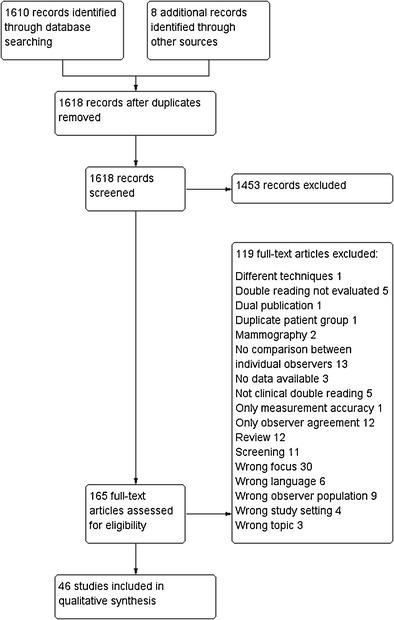
OBJECTIVES: Double reading in diagnostic radiology can find discrepancies in the original report, but a systematic program of double reading is resource consuming. There are conflicting opinions on the value of double reading. The purpose of the current study was to perform a systematic review on the value of double reading. METHODS: A systematic review was performed to find studies calculating the rate of misses and overcalls with the aim of establishing the added value of double reading by human observers. RESULTS: The literature search resulted in 1610 hits. After abstract and full-text reading, 46 articles were selected for analysis. The rate of discrepancy varied from 0.4 to 22% depending on study setting. Double reading by a sub-specialist, in general, led to high rates of changed reports. CONCLUSIONS: The systematic review found rather low discrepancy rates. The benefit of double reading must be balanced by the considerable number of working hours a systematic double-reading scheme requires. A more profitable scheme might be to use systematic double reading for selected, high-risk examination types. A second conclusion is that there seems to be a value of sub-specialisation for increased report quality. A consequent implementation of this would have far-reaching organisational effects. KEY POINTS: • In double reading, two or more radiologists read the same images. • A systematic literature review was performed. • The discrepancy rates varied from 0.4 to 22% in various studies. • Double reading by sub-specialists found high discrepancy rates.
Overview
The claims and statistics of this paper haven’t been checked yet.
Free: it reads the open-access text and checks the first 5 claims that cite a source we can check. Create a free account to check every claim.
Integrity signals
Registry
Cites
Statistics
Figures
Verification
Claims the paper makes
The claims and statistics of this paper haven’t been checked yet.
Free: it reads the open-access text and checks the first 5 claims that cite a source we can check. Create a free account to check every claim.
Claims other papers make about this one
Each is checked against this paper’s own text: does it say what the citing paper says it does?
The source backs part of the claim, not all of it — or backs it for a different population, condition or comparison.
In the citing paper
“However, in a clinical setting, physicians often receive advice from colleagues, or are asked to re-review cases from someone else to give a second opinion13,14.”
From Non-task expert physicians benefit from correct explainable AI advice when reviewing X-rays (2023) · cites this paper as [14]
Experimental — accuracy not yet measured
Self-check
Percentages, sums and reported differences re-computed from the paper’s own numbers.
The self-check needs the paper’s full text.
Citations
Cites
Audit and feedback: effects on professional practice and healthcare outcomes
Ivers, N., Jamtvedt, G., Flottorp, S., Young, J. M., Odgaard-Jensen, J., French, S. D., O'Brien, M. A., Johansen, M., Grimshaw, J., & Oxman, A. D. (2012) · Cochrane Database of Systematic Reviews · doi:10.1002/14651858.cd000259.pub3 · Cited by 5,485
Error and discrepancy in radiology: inevitable or avoidable?
Brady, A. P. (2017) · Insights into Imaging · doi:10.1007/s13244-016-0534-1 · Cited by 570
Johnson, C. D., Harmsen, W. S., Wilson, L. A., Maccarty, R. L., Welch, T. J., Ilstrup, D. M., & Ahlquist, D. A. (2003) · Gastroenterology · doi:10.1016/s0016-5085(03)00894-1 · Cited by 351
Rubin, G. D., Lyo, J. K., Paik, D. S., Sherbondy, A. J., Chow, L. C., Leung, A. N., Mindelzun, R., Schraedley-Desmond, P. K., Zinck, S. E., Naidich, D. P., et al. (2005) · Radiology · doi:10.1148/radiol.2341040589 · Cited by 259 · cited 1×
“& In chest CT for pulmonary nodules, double reading increased sensitivity [8, 22, 23], but computer-aided diagnosis (CAD) was even more beneficial [8, 22].”
BackgroundGarland, L. H. (1949) · Radiology · doi:10.1148/52.3.309 · Cited by 239 · cited 1×
“The concept of observer variation in radiology was introduced in the late 1940’s when tuberculosis screening with mass chest radiography was evaluated [3, 4].”
BackgroundRADPEER quality assurance program: a multifacility study of interpretive disagreement rates
Borgstede, J. P., Lewis, R. S., Bhargavan, M., & Sunshine, J. H. (2004) · Journal of the American College of Radiology · doi:10.1016/s1546-1440(03)00002-4 · Cited by 203
Variation between experienced observers in the interpretation of accident and emergency radiographs.
Robinson, P. J., Wilson, D., Coral, A., Murphy, A., & Verow, P. (1999) · The British Journal of Radiology · doi:10.1259/bjr.72.856.10474490 · Cited by 162 · cited 1×
“& Two articles quoted 3–9% disagreement between observers in general radiography [30, 31].”
BackgroundDetection of flat lesions in the colon with CT colonography
Fidler, J. L., Johnson, C. D., MacCarty, R. L., Welch, T. L., Hara, A. K., & Harmsen, W. S. (2002) · Abdominal Imaging · doi:10.1007/s00261-001-0171-z · Cited by 150
Birkelo, C. C., & CHAMBERLAIN, W. E. (1947) · JAMA · doi:10.1001/jama.1947.02880060001001 · Cited by 144 · cited 2×
“The concept of observer variation in radiology was introduced in the late 1940’s when tuberculosis screening with mass chest radiography was evaluated [3, 4].”
BackgroundAccuracy and Its Relationship to Experience in the Interpretation of Chest Radiographs
Herman, P. G., & Hessel, S. J. (1975) · Investigative Radiology · doi:10.1097/00004424-197501000-00008 · Cited by 139
Cited by
Wang, X., Shen, T., Yang, S., Lan, J., Xu, Y., Wang, M., Zhang, J., & Han, X. (2021) · NeuroImage: Clinical · doi:10.1016/j.nicl.2021.102785 · Cited by 192
“A more commonly adopted peer review process is the retrospective double reading of cases, as implemented by the American College of Radiology’s RadPeer program [22].”
MethodArtificial Intelligence in Radiology—Ethical Considerations
Brady, A. P., & Neri, E. (2020) · Diagnostics · doi:10.3390/diagnostics10040231 · Cited by 150
“Furthermore, not all radiologists will come to the same conclusion about an imaging study; ground truth labelling accuracy can be enhanced by combining interpretations by more than one radiologist [17].”
BackgroundMandating Limits on Workload, Duty, and Speed in Radiology
Alexander, R. G., Waite, S., Bruno, M. A., Krupinski, E. A., Berlin, L., Macknik, S. L., & Martínez‐Conde, S. (2022) · Radiology · doi:10.1148/radiol.212631 · Cited by 168
“In a systemic review of double reading, Geijer and Geijer (104) found that the rate of discrepancy ranged from insignificant to over 22% depending on the study setting.”
BackgroundGenerative Artificial Intelligence for Chest Radiograph Interpretation in the Emergency Department
Huang, J., Neill, L., Wittbrodt, M., Melnick, D., Klug, M., Thompson, M., Bailitz, J., Loftus, T., Malik, S., Phull, A., et al. (2023) · JAMA Network Open · doi:10.1001/jamanetworkopen.2023.36100 · Cited by 113
Non-task expert physicians benefit from correct explainable AI advice when reviewing X-rays
Gaube, S., Suresh, H., Raue, M., Lermer, E., Koch, T. K., Hudecek, M. F. C., Ackery, A. D., Grover, S. C., Coughlin, J. F., Frey, D., et al. (2023) · Scientific Reports · doi:10.1038/s41598-023-28633-w · Cited by 92
Winder, M., Owczarek, A. J., Chudek, J. T., Pilch-Kowalczyk, J., & Baron, J. (2021) · Healthcare · doi:10.3390/healthcare9111557 · Cited by 117
“The discrepancies between results of a single and double reading of imaging studies by radiologists can differ by as much as 22%, indicating a significant advantage of the latter method [38].”
BackgroundRao, B., Zohrabian, V. M., Cedeño, P. A., Saha, A., Pahade, J. K., & Davis, M. A. (2020) · Academic Radiology · doi:10.1016/j.acra.2020.01.035 · Cited by 96
Liang, C.-H., Liu, Y.-C., Wu, M.-T., Garcia-Castro, F., Alberich-Bayarri, A., & Wu, F.-Z. (2020) · Clinical Radiology · doi:10.1016/j.crad.2019.08.005 · Cited by 69
Patel, A. G., Pizzitola, V. J., Johnson, C. D., Zhang, N., & Patel, M. D. (2020) · Radiology · doi:10.1148/radiol.2020201558 · Cited by 60
Abadia, A. F., Yacoub, B., Stringer, N., Snoddy, M., Kocher, M., Schoepf, U. J., Aquino, G. J., Kabakus, I., Dargis, D., Hoelzer, P., et al. (2022) · Journal of Thoracic Imaging · doi:10.1097/rti.0000000000000613 · Cited by 46
“22,23 We believed it was just as important to test the algo-rithm ’ s ability to ignore image noise as it was to test its performance on detecting nodules.”
BackgroundCabitza, F., Campagner, A., & Sconfienza, L. M. (2021) · Health Information Science and Systems · doi:10.1007/s13755-021-00138-8 · Cited by 39
Marine, M. B., & Forbes-Amrhein, M. M. (2021) · Pediatric Radiology · doi:10.1007/s00247-020-04945-1 · Cited by 41
Buls, N., Watté, N., Nieboer, K., Ilsen, B., & Mey, J. D. (2021) · Physica Medica · doi:10.1016/j.ejmp.2021.03.015 · Cited by 40
“In addition, retrospective peer reviewing of cases does not immediate improve the patient ’ s clinical outcome, especially not in an acute setting [9-11].”
BackgroundEvans, J., Sapsford, M., McDonald, S., Poole, K. E. S., Raine, T., & Jadon, D. R. (2021) · Therapeutic Advances in Musculoskeletal Disease · doi:10.1177/1759720x21996973 · Cited by 31
Kim, Y., Park, J. Y., Hwang, E. J., Lee, S. M., & Park, C. M. (2021) · Journal of Thoracic Disease · doi:10.21037/jtd-21-1342 · Cited by 31
“Double-reading is generally considered to be of added value in diagnostic radiology (56), and high-accuracy AI can act as a competent second reader to reduce perceptual errors (57).”
BackgroundBachmann, R., Gunes, G., Hangaard, S., Nexmann, A., Lisouski, P., Boesen, M., Lundemann, M., & Baginski, S. G. (2023) · BJR|Open · doi:10.1093/bjro/tzae011 · Cited by 39
“10 16-20 Our aim in this study was to investigate the diagnostic fracture detection performance of readers from various medical groups, including radiographers, nurses, and medical doctors, 21 all with close affiliation to A&E departments without and with support from a new commercially available…”
BackgroundA simplified cluster model and a tool adapted for collaborative labeling of lung cancer CT scans
Morozov, S. P., Gombolevskiy, V. А., Elizarov, A. B., Гусев, М. А., Novik, V. P., Prokudaylo, S., Bardin, A. S., Popov, E. V., Ledikhova, N. V., Chernina, V., et al. (2021) · Computer Methods and Programs in Biomedicine · doi:10.1016/j.cmpb.2021.106111 · Cited by 24
Xu, X., Jia, Q., Yuan, H., Qiu, H., Dong, Y., Xie, W., Yao, Z., Zhang, J., Nie, Z., Li, X., et al. (2023) · Medical Image Analysis · doi:10.1016/j.media.2023.102953 · Cited by 27
Chung, R., Rosenkrantz, A. B., & Shanbhogue, K. (2020) · Abdominal Radiology · doi:10.1007/s00261-020-02587-3 · Cited by 23
Under-exploration of three-dimensional images leads to search errors for small salient targets
Lago, M. A., Jonnalagadda, A., Abbey, C. K., Barufaldi, B. B., Bakic, P. R., Maidment, A. D. A., Leung, W. K., Weinstein, S. P., Englander, B. S., & Eckstein, M. P. (2021) · Current Biology · doi:10.1016/j.cub.2020.12.029 · Cited by 22
Lim, C. H., Park, S. B., Kim, H. K., Choi, Y. S., Kim, J., Ahn, Y. C., Ahn, M., & Choi, J. Y. (2022) · Cancers · doi:10.3390/cancers14030632 · Cited by 21
“These errors could be decreased with double reading per FDG PET/CT scan used in our imaging reports system [44].”
BackgroundMeasuring appropriateness of diagnostic imaging: a scoping review
Walther, F., Eberlein-Gonska, M., Hoffmann, R., Schmitt, J. M., & Blum, S. F. U. (2023) · Insights into Imaging · doi:10.1186/s13244-023-01409-6 · Cited by 30
The use of large language models in detecting Chinese ultrasound report errors
Yan, Y., Wang, K., Feng, B., Yao, J., Jiang, T., Jin, Z., Zheng, Y., Zhou, Y., Chen, C., Sui, L., et al. (2025) · npj Digital Medicine · doi:10.1038/s41746-025-01468-7 · Cited by 26
Lee, J. H., Hwang, E. J., Kim, H., & Park, C. M. (2022) · Translational Lung Cancer Research · doi:10.21037/tlcr-21-1012 · Cited by 26
“Although it is commonly accepted that DL algorithms bring an added value thanks to their higher diagnostic or predictive performance (103,104), human-DL collaboration to achieve certain goals remains poorly understood (105,106), and further research is warranted to investigate this interaction to…”
Reliable and Energy-Efficient Diabetic Retinopathy Screening Using Memristor-Based Neural Networks
Diware, S., Chilakala, K., Joshi, R., Hamdioui, S., & Bishnoi, R. (2024) · IEEE Access · doi:10.1109/access.2024.3383014 · Cited by 22
“…category involves works that use large training datasets like EyePACS [42] or DDR [13] but do not use an Double reading is a process where two specialists (readers) independently analyze the same recording (e.g. retinal image) and exchange their insights to provide a unified diagnosis [44], [45].”
BackgroundA Context-Dependent CNN-Based Framework for Multiple Sclerosis Segmentation in MRI
Placidi, G., Cinque, L., Foresti, G. L., Galassi, F., Mignosi, F., Nappi, M., & Polsinelli, M. (2024) · International Journal of Neural Systems · doi:10.1142/s0129065725500066 · Cited by 21
“71 The resulting classi¯ed volume was a three-value data set, so the Union operation did follow the traditional binary union rules.”
Radiograph Interpretation Discrepancies in a Community Hospital Emergency Department
Tranovich, M. J., Gooch, C., & Dougherty, J. M. (2019) · Western Journal of Emergency Medicine · doi:10.5811/westjem.2019.1.41375 · Cited by 19
An Overview of Artificial Intelligence Applications in Liver and Pancreatic Imaging
Cardobi, N., Palù, A. D., Pedrini, F., Beleù, A., Nocini, R., Robertis, R. D., Ruzzenente, A., Salvia, R., Montemezzi, S., & D’Onofrio, M. (2021) · Cancers · doi:10.3390/cancers13092162 · Cited by 25
“Moreover, every AI model ground truth should be generated by more than one radiologist in order to increase the accuracy of the model itself [68,69].”
MethodTopff, L., Steltenpool, S., Ranschaert, E. R., Ramanauskas, N., de Menezes, R. X., Visser, J. J., Beets‐Tan, R. G. H., & Hartkamp, N. S. (2024) · European Radiology · doi:10.1007/s00330-024-10676-w · Cited by 27
“However, peer review is a time-consuming task and previously reported discrepancy rates between readers were rather low [12].”
ResultHustinx, R. (2019) · European Journal of Nuclear Medicine and Molecular Imaging · doi:10.1007/s00259-019-04371-y · Cited by 18
How Do American Radiology Institutions Deal With Second Opinion Consultations on Outside Studies?
Khoshpouri, P., Khoshpouri, P., Yousem, K. P., & Yousem, D. M. (2019) · American Journal of Roentgenology · doi:10.2214/ajr.19.21805 · Cited by 17
Repeatability and reproducibility of comparison decisions by firearms examiners
Monson, K. L., Smith, E. D., & Peters, E. M. (2023) · Journal of Forensic Sciences · doi:10.1111/1556-4029.15318 · Cited by 21
Pierre, K., Gupta, M., Raviprasad, A. G., Razavi, S. M. S., Patel, A. B., Peters, K., Hochhegger, B., Mancuso, A., & Forghani, R. (2023) · Expert Review of Anticancer Therapy · doi:10.1080/14737140.2023.2286001 · Cited by 19
“While ‘double-reading’ approaches where a second radiologist reviews the scan may reduce errors, such approaches are not feasible on a large-scale for a number of practical reasons, including expert availability and costs [18,20].”
BackgroundTing, F. I. L., Sacdalan, D. B., Tampo, M. M. T., Apellido, R. T., Monroy, H. J., III, Sacdalan, M. D., & Sacdalan, D. L. (2020) · JCO Global Oncology · doi:10.1200/jgo.19.00332 · Cited by 20
“Proximal colon cancers are more likely to have microsatellite instability, a CpG island methylator phenotype, and KRAS mutations, whereas distal colon and rectal tumors are more likely to have a p53 mutation compared with proximal colon cancers.(17,18) Aside from studies that show that high levels of microsatellite in…”
BackgroundResultBody MRI Subspecialty Reinterpretations at a Tertiary Care Center: Discrepancy Rates and Error Types
Kostrubiak, D. E., DeHay, P. W., Ali, N. S., D’Agostino, R., Keating, D. P., Tam, J. K., & Akselrod, D. G. (2020) · American Journal of Roentgenology · doi:10.2214/ajr.20.22797 · Cited by 15
Conte, A., Morabito, S., Dennis, R., & Murgia, D. (2020) · Veterinary Surgery · doi:10.1111/vsu.13521 · Cited by 12
Huhtanen, J. T., Nyman, M. J., Sequeiros, R. T. B., Koskinen, S. K., Pudas, T. K., Kajander, S. A., Niemi, P., Löyttyniemi, E., Aronen, H. J., & Hirvonen, J. (2023) · Diagnostics · doi:10.3390/diagnostics13203207 · Cited by 12
“Double (dual) reading was used, which has been shown to be an effective but also time-consuming way of finding discrepancies in radiology reports [15].”
Mammography Datasets for Neural Networks—Survey
Mračko, A., Vanovcanova, L., & Cimrák, I. (2023) · Journal of Imaging · doi:10.3390/jimaging9050095 · Cited by 42
“Additionally, double reading [5] is applied, wherein two radiologists independently read the same mammograms to reduce errors and increase the quality of annotation.”
MethodIannessi, A., & Beaumont, H. (2023) · Frontiers in Oncology · doi:10.3389/fonc.2023.988784 · Cited by 9
“(30) documented the variability between two readers when they have differing experience, background, or interpretation of guidelines.”
BackgroundSchaffer, A. C., Zawi, T., Einbinder, J. S., Sato, L., & Sodickson, A. D. (2024) · Radiology · doi:10.1148/radiol.232806 · Cited by 8
Brown, E. G., Adkins, E. S., Mattei, P., Hoffer, F. A., Wootton‐Gorges, S. L., London, W. B., Naranjo, A. H., Schmidt, M. L., Hogarty, M. D., Irwin, M. S., et al. (2024) · Journal of Pediatric Surgery · doi:10.1016/j.jpedsurg.2024.161896 · Cited by 8
Sun, L., Fan, Y., Shi, S. R., Sun, M., Ma, Y., Zhang, K., Zhang, F., Liu, H., Yu, T., Tong, H., et al. (2025) · PLoS ONE · doi:10.1371/journal.pone.0316732 · Cited by 16
Grogan, A., Loveday, B. P. T., Michael, M., Wong, H., Gibbs, P., Thomson, B. N. J., Lee, B., & Ko, H. S. (2022) · ANZ Journal of Surgery · doi:10.1111/ans.17787 · Cited by 8
Elsholtz, F. H. J., Ro, S.-R., Shnayien, S., Dinkelborg, P. H., Hamm, B., & Schaafs, L.-A. (2021) · Dentomaxillofacial Radiology · doi:10.1259/dmfr.20210168 · Cited by 8
Combs, C. A., Lee, R. C., Lee, S. Y., Amara, S., & Balogun, O. A. (2024) · Journal of Clinical Medicine · doi:10.3390/jcm13226895 · Cited by 7
Robinson, J. D., Kessler, R. A., Vrablik, M. E., Vrablik, M. C., Hippe, D. S., Hall, M. K., Mitchell, S. H., & Linnau, K. F. (2022) · Journal of the American College of Radiology · doi:10.1016/j.jacr.2022.05.031 · Cited by 7
Vasilev, Y. A., Vladzymyrskyy, A. V., Arzamasov, K. M., Дмитриевич, П. Л., & Михайлович, Ш. И. (2023) · ЗДОРОВЬЕ НАСЕЛЕНИЯ И СРЕДА ОБИТАНИЯ - ЗНиСО / PUBLIC HEALTH AND LIFE ENVIRONMENT · doi:10.35627/2219-5238/2023-31-11-23-32 · Cited by 8
Liao, M., & Tan, N. (2020) · Current Problems in Diagnostic Radiology · doi:10.1067/j.cpradiol.2020.09.017 · Cited by 7
Human-AI Complementarity in Diagnostic Radiology: The Case of Double Reading
Wagner, I. A., & Chakradeo, K. (2025) · Philosophy & Technology · doi:10.1007/s13347-025-00886-5 · Cited by 11
“Radiologists are therefore keen to reduce their error rates as much as possible and employ various strategies to do so, one of the most effective being “double-reading” (Euler-Chelpin et al., 2018; Geijer & Geijer, 2018).”
The use of computer vision for the mammography preventive research
Arzamasov, K. M., Vasilev, Y. A., Vladzymyrskyy, A. V., Omelyanskaya, O. V., Bobrovskaya, T., Семенов, С. С., Четвериков, С. Ф., Kirpichev, Y., Pavlov, N. A., & Андрейченко, А. Е. (2023) · Russian Journal of Preventive Medicine · doi:10.17116/profmed202326061117 · Cited by 9
Radiologist age and diagnostic errors
Lamoureux, C., Hanna, T. N., Callaway, E., Bruno, M. A., Weber, S., Sprecher, D., & Johnson, T. D. (2023) · Emergency Radiology · doi:10.1007/s10140-023-02158-1 · Cited by 6
Harreld, J. H., Kaufman, R. A., Kang, G., Marón, G. M., Mitchell, W., Thompson, J. W., & Srinivasan, A. (2020) · Pediatric Blood & Cancer · doi:10.1002/pbc.28676 · Cited by 7
Amin, M., Alhatamleh, S., Sindiani, A., Mhanna, H. Y. A., Madain, R., Anakreh, D., Alishwait, A., Akhdar, H., Alanazi, S. F., & Sandougah, K. J. (2025) · IEEE Access · doi:10.1109/access.2025.3606260 · Cited by 7
Nervil, G. G., Ternov, N. K., Lorentzen, H. F., Kromann, C. B., Ingvar, Å., Nielsen, K., Tolsgaard, M. G., Vestergaard, T., & Hölmich, L. R. (2024) · Journal of Telemedicine and Telecare · doi:10.1177/1357633x241286003 · Cited by 6
Comparison of thoracic computed tomography and surgical reports in dogs and cats
Brložnik, M., Immler, M., Prüllage, M. L., Grünzweil, O. M., Lyrakis, M., Ludewig, E., & Kneissl, S. M. (2025) · Frontiers in Veterinary Science · doi:10.3389/fvets.2025.1566436 · Cited by 5
Time Requirement and Feasibility of a Systematic Quality Peer Review of Reporting in Radiology
Maurer, M. H., Brönnimann, M. P., Schroeder, C., Ghadamgahi, E., Streitparth, F., Heverhagen, J. T., Leichtle, A. B., de Bucourt, M., & Meyl, T. P. (2020) · RöFo - Fortschritte auf dem Gebiet der Röntgenstrahlen und der bildgebenden Verfahren · doi:10.1055/a-1178-1113 · Cited by 5
“, Sweden and Norway) double reading for different radiological examination procedures is widespread, extensive data is available which show high discrepancy rates of up to over 20% between the compared radiological reports [14, 15].”
BackgroundResultTeleradiology: An opportunity to improve outcomes in pulmonary fibrosis
Bertolini, A., Capaccione, K. M., Austin, J. H. M., Blum, A., Padilla, M. L., D’Souza, B. M., Yankelevitz, D. F., Henschke, C. I., & Salvatore, M. M. (2019) · Clinical Imaging · doi:10.1016/j.clinimag.2019.05.011 · Cited by 5
Why don’t we inform patients about the risk of diagnostic errors?
Kasalak, Ö., Pennings, J. P., den Akker, J. W. O., Yakar, D., & Kwee, T. C. (2023) · European Journal of Radiology · doi:10.1016/j.ejrad.2023.110956 · Cited by 5
Pierre, K., Slater, R. M., Raviprasad, A. G., Griffin, I. T., Talati, J., Mathelier, M., Sistrom, C. L., Mancuso, A., & Sabat, S. B. (2023) · Current Problems in Diagnostic Radiology · doi:10.1067/j.cpradiol.2023.08.011 · Cited by 4
Sulaja, J. S., Kannath, S. K., Kalaparti, V., & Thomas, B. (2024) · The Neuroradiology Journal · doi:10.1177/19714009241269491 · Cited by 4
“10 – 12 Recently the authors have demonstrated the relationship between memory and cognitive impairment with resting state networks in DAVF, which again suggested appropriate early intervention is essential to prevent or reverse these changes.”
Machagge, H., Mrita, F. S., Muhamedhussen, M., Haonga, B. T., & Mcharo, C. N. (2021) · Open Journal of Orthopedics · doi:10.4236/ojo.2021.1112034 · Cited by 4
“MRI results are operator dependent hence the more the skilled and experienced the operator is, the better capability of depicting of the lesion, as elaborated by Geijer [41].”
BackgroundWho should do as AI say? Only non-task expert physicians benefit from correct explainable AI advice
Gaube, S., Suresh, H., Raue, M., Lermer, E., Koch, T., Hudecek, M., Ackery, A. D., Grover, S. C., Coughlin, J. F., Frey, D., et al. (2022) · doi:10.21203/rs.3.rs-1687219/v1 · Cited by 3
Can we predict discordant RECIST 1.1 evaluations in double read clinical trials?
Beaumont, H., & Iannessi, A. (2023) · Frontiers in Oncology · doi:10.3389/fonc.2023.1239570 · Cited by 3
“The monitoring of observers ’ variability through the adjudication rate requires a burdensome process, which all stakeholders aim to make cost-effective (5, 6), with the goal of minimizing inter-reader discordances.”
BackgroundAbed, S., Hergan, K., Pfaff, J. A. R., Dörrenberg, J., Brandstetter, L., & Gradl, J. (2025) · The Neuroradiology Journal · doi:10.1177/19714009251346477 · Cited by 8
“35 36 – 39 Strengths and weaknesses of the study Several limitations should be addressed when interpreting our results.”
Frequency and Clinical Utility of Alerts for Intra-Institutional Radiologist Discrepant Opinions
DiPiro, P. J., Licaros, A., Zhao, A. H., Glazer, D. I., Healey, M. J., Curley, P. J., Giess, C. S., & Khorasani, R. (2023) · Journal of the American College of Radiology · doi:10.1016/j.jacr.2022.12.021 · Cited by 3
Chernina, V., Belyaev, M., Silin, A. Y., Avetisov, I. O., Pyatnitskiy, I., Petrash, E. A., Basova, M. V., Sinitsyn, V. E., Omelyanovskiy, V. V., & Gombolevskiy, V. А. (2023) · Digital Diagnostics · doi:10.17816/dd321963 · Cited by 8
Muktha Rawath, R., Agrawal, A., & Kalyanpur, A. (2024) · Emergency Radiology · doi:10.1007/s10140-024-02264-8 · Cited by 3
“However, dual read would place additional strain on the already overburdened radiologist pool [7, 9].”
Zahari, R., Cox, J., & Obara, B. (2024) · IEEE Journal of Biomedical and Health Informatics · doi:10.1109/jbhi.2024.3446040 · Cited by 3
“Similarly, Geijer and Geijer [9] conducted a systematic review and found that double reading by a sub-specialist led to high rates of changed reports, indicating a substantial improvement in diagnostic accuracy.”
BackgroundKhan, M., Khan, N., Noor, S., Hussain, A., Rahman, H. U., Irshad, S., & Khan, F. A. (2024) · Journal of Gandhara Medical and Dental Science · doi:10.37762/jgmds.11-4.616 · Cited by 3
The clinical value of second-opinion reporting by subspecialist musculoskeletal radiologists
Patel, A., & Isaac, A. (2025) · European Journal of Radiology · doi:10.1016/j.ejrad.2025.112262 · Cited by 2
Chupetlovska, K., Lipman, K. B. W. G., Bodalal, Z., Aricò, F. M., Topff, L., Maas, M., & Trebeschi, S. (2025) · European Journal of Radiology Artificial Intelligence · doi:10.1016/j.ejrai.2025.100053 · Cited by 2
Optimizing Radiology Resident Competency in Pediatric Musculoskeletal Radiograph Interpretation
Boutis, K., Starvaggi, C. A., Doria, A. S., Bouchard, M. L., Camp, M. W., Taylor, J. L., Hauge, C. J., Carter, O., & Stimec, J. (2026) · Academic Radiology · doi:10.1016/j.acra.2025.12.005 · Cited by 2
Casabó-Vallés, G., Aldecoa, R., Pérez-Machado, G., Egea-Gámez, R. M., Sánchez‐Raya, J., Vilalta‐Vidal, I., Rubio-Belmar, P. A., Galán‐Olleros, M., Salat‐Batlle, J., Martín, C. F., et al. (2026) · The Spine Journal · doi:10.1016/j.spinee.2026.01.010 · Cited by 4
Papale, A., Lopiano, G., Campagner, A., & Cabitza, F. (2026) · Technologies · doi:10.3390/technologies14060366 · Cited by 2
Ethical issues deriving from the delayed adoption of artificial intelligence in medical imaging
Placidi, G. (2022) · AI and Ethics · doi:10.1007/s43681-022-00139-7 · Cited by 2
“This last point is important: in radiology, “double reading” has proven to increase the quality of diagnosis but it is normally recommended just for selected, high-risk examinations since, for an extensive usage, it would require too many human resources [14].”
BackgroundQuantitative Approach to Quality Review of Prenatal Ultrasound Examinations: Fetal Biometry
Combs, C. A., Amara, S., Kline, C., Balogun, O. A., & Bowman, Z. S. (2024) · Journal of Clinical Medicine · doi:10.3390/jcm13164860 · Cited by 5
“In RADPEER studies, the rates of discrepancy between the initial reading and the second reading are typically less than 10%, and most of these are judged not to be clinically significant [17,19,23].”
BackgroundNaming and Diffusing the Understanding Objection in Healthcare Artificial Intelligence
Wadden, J. J. (2024) · Canadian Journal of Bioethics · doi:10.7202/1114958ar · Cited by 2
Balasubramaniam, R., Drinkwater, K. J., Beavon, M., Greenhalgh, R., Barrett, A., Bhagat, A., Chiphang, A., Devaraj, A., Elstob, A., Kamalasanan, A., et al. (2025) · Clinical Radiology · doi:10.1016/j.crad.2025.106919 · Cited by 2
Doyle, S. P., Duszak, R., Heilbrun, M. E., Saindane, A. M., & Sadigh, G. (2021) · Journal of the American College of Radiology · doi:10.1016/j.jacr.2021.07.002 · Cited by 2
Second thoughts: Emergency clinicians see value in secondary interpretations
Danda, D., & Mezrich, J. L. (2020) · Clinical Imaging · doi:10.1016/j.clinimag.2020.05.036 · Cited by 2
Placidi, G., Cinque, L., Mignosi, F., & Polsinelli, M. (2021) · arXiv (Cornell University) · Cited by 2
Errors and fallibility in radiology: X-ray readings and expert radiologists, 1947–1960
Lysen, F. (2023) · BJHS Themes · doi:10.1017/bjt.2023.5 · Cited by 1
Crone, A. M., VanZant, J., Boutselis, A. G., & Steenburg, S. D. (2025) · Emergency Radiology · doi:10.1007/s10140-025-02421-7 · Cited by 1
“This may be due to the institutional differences in overread procedures [5 ] or due to difficulties with reimbursement [ 6]. that the lack of blinding of the initial report was associated with a lower major discrepancy rate (2.0% vs. 12.1% for blind reading), suggesting that access to the original…”
InfluentialYoshida, K., Takamatsu, A., Tanaka, R., Tetsuo, M., Choppin, A., Tonouchi, A., Kobayashi, S., & Kobayashi, T. (2026) · Japanese Journal of Radiology · doi:10.1007/s11604-026-01973-z · Cited by 1
“For this reason, images are often read independently by two physicians, a practice commonly referred to as a double-reading system [7 ].”
Ludwig, D. R., Petraglia, F. W., Shetty, A. S., & Yano, M. (2021) · Abdominal Radiology · doi:10.1007/s00261-021-02950-y · Cited by 1
Faraj, A. A., Andrews, M., & Li, W. (2021) · Acta Orthopaedica Belgica · doi:10.52628/87.1.09 · Cited by 1
“It also increases hip range of motion and reduces the risk of dislocation and polyethylene wear (5).”
BackgroundUnderstanding and Embracing Error in Diagnostic Radiology
Batheja, V., Javan, R., & Awan, O. A. R. (2024) · Academic Radiology · doi:10.1016/j.acra.2024.07.023 · Cited by 1
Concurrent Chest and Abdominal CT: Managing Pitfalls of Splitting Interpretation by Subspecialty
Kelm, Z. S., Ron, E. D., Olson, M. C., Welle, C. L., Johnson, T. F., & Boyum, J. H. (2025) · Radiographics · doi:10.1148/rg.240069 · Cited by 1
Ensuring Appropriateness of Pediatric Second Opinion Consultations
Glavis‐Bloom, J., Yang, U., Nahl, D., Goodarzian, F., & Sura, A. S. (2019) · Current Problems in Diagnostic Radiology · doi:10.1067/j.cpradiol.2019.05.009 · Cited by 1
Agreement on grading of normal clivus using magnetic resonance imaging among radiologists
Tinnut, S., Galassi, W., Oilmungmool, N., & Chattrapiban, T. (2022) · European Journal of Radiology Open · doi:10.1016/j.ejro.2022.100395 · Cited by 1
Paediatric gonad shielding in pelvic radiography: A systematic review and meta-analysis
Freeman, A. (2022) · Radiography · doi:10.1016/j.radi.2022.06.009 · Cited by 1
Chernina, V., Belyaev, M., Silin, A. Y., Avetisov, I. O., Pyatnitskiy, I., Petrash, E. A., Basova, M. V., Sinitsyn, V. E., Omelyanovsky, V. V., & Gombolevskiy, V. А. (2023) · medRxiv · doi:10.1101/2023.04.19.23288584 · Cited by 1
The Importance of a Comprehensive Review of Radiological Images: A Case of Pseudomonas Empyema
Sasaki, T., Honda, H., Yaita, K., ARIMA, Y., Takabatake, Y., & Yamamoto, K. (2019) · The Kurume Medical Journal · doi:10.2739/kurumemedj.ms661012
“To reduce radiologic diagnostic delay and errors, a double reading [5] of images by the attending physicians and other specialists, specialized checklists depending on the body part imaged [5,6] and cognitive debiasing [6] might be effective.”
BackgroundWITHDRAWN: Radiology Extenders: Impact on Throughput and Accuracy for Routine Chest Radiographs
Borthakur, A., Barbosa, E. M., Katz, S. I., Knollmann, F. D., Kahn, C. E., Schnall, M. D., & Litt, H. I. (2020) · Journal of the American College of Radiology · doi:10.1016/j.jacr.2020.09.044
RetractedUtility of dual read in the setting of prostate MRI interpretation
Harfouch, N., Peti, S., Sharma, R., Chacko, J., Emmanuel, G., Hayim, M., & Yarmish, G. M. (2023) · Abdominal Radiology · doi:10.1007/s00261-023-03853-w
“This led to the conclusion that it may be more efficient to have sub-specialists read rather than performing double reads [18].”
BackgroundSchechter, M. S., Kanmaniraja, D., Berkenblit, R. G., Ye, K. Q., Shamah, S., Janmey, V., Yee, J., & Ricci, Z. J. (2023) · Clinical Imaging · doi:10.1016/j.clinimag.2023.109988
Guo, L. J., Cheng, G., Wang, L., Zheng, B., Jaeger, S., Giger, M. L., Fuhrman, J. D., Li, H., Divekar, A., Xiao, Q., et al. (2024) · SPIE Medical Imaging: Computer-Aided Diagnosis · doi:10.1117/12.3005136
“With the metric of AUC, the AI system was also reported to obtain a higher value than pooled observers alone 3 .”
BackgroundResultInfluential
Metadata
- Authors
- Geijer, H., & Geijer, M.
- Affiliations
- Örebro University (SE)
- Lund University (SE)
- Corresponding author
- Geijer, Håkan
- Venue
- Insights into Imaging
- Published
- 2018-03-28
- Volume
- 9
- Issue
- 3
- Pages
- 287-301
- ISSN
- 1869-4101 (ISSN-L)
- PMC
- PMC5990995
- OpenAlex
- W2794467195
- Cited by
- 117
- References
- 174
- Citations by year
- 2026: 12 · 2025: 18 · 2024: 19 · 2023: 23 · 2022: 9 · 2021: 17 · 2020: 12 · 2019: 7
- FWCI
- 1.40
- Type
- journal article
- Language
- en
- Open access
- gold
- doi.org
- Licence
- cc-by
- creativecommons.org/licenses/by/4.0 (tdm)
- Locations
- Insights into Imaging (publishedVersion, cc-by)
- Europe PMC (PubMed Central) (publishedVersion, cc-by)
- PubMed Central (publishedVersion, cc-by)
- PubMed (publishedVersion)
- DOAJ (DOAJ: Directory of Open Access Journals) (submittedVersion, cc-by-sa)
- Lund University Publications (Lund University) (submittedVersion)
- Funders
- Örebro Universitet
- Topics
- Health Sciences › Medicine › Radiology, Nuclear Medicine and Imaging › Radiology practices and education
- Health Sciences › Medicine › Health Informatics › Artificial Intelligence in Healthcare and Education
- Health Sciences › Health Professions › General Health Professions › Healthcare cost, quality, practices
- Keywords
- double reading, diagnostic radiology, missed diagnosis, reporting quality
About these checks
Registry, retraction, Cites and statistics results are computed, not judged, with one exception: a printed reference that no index lists is read once by a model before it counts as a citation error. Claims are extracted by a model and kept only when their quote appears verbatim in the text; each cited source is then checked, with a model’s help, for whether it says what the claim relies on. Those verdicts can be wrong — read the claim’s quote and the cited source before relying on one.
Statistics and arithmetic are recomputed, not judged.
Confidence bands are shown only for fields calibrated on our annotated test set. None is calibrated yet, so no band is shown.
What counts as a claim ›How we measure confidence ›How we check this ›
Are you an author, or do you see a problem with this page? Request a review
Data sources
Bibliographic data: Semantic Scholar, OpenAlex, Crossref.
Contains information from the Semantic Scholar Academic Graph Datasets, made available under the ODC Attribution License (ODC-BY 1.0).
Semantic Scholar’s data is described in: Kinney, R., et al. (2023). The Semantic Scholar Open Data Platform. arXiv:2301.10140.
