

Episodic Real-Time CGM Use in Adults with Type 2 Diabetes: Results of a Pilot Randomized Controlled Trial
Open accessThe DOI matches its Crossref record; 36 of the 38 references it cites were found in a registry or an index.
Abstract
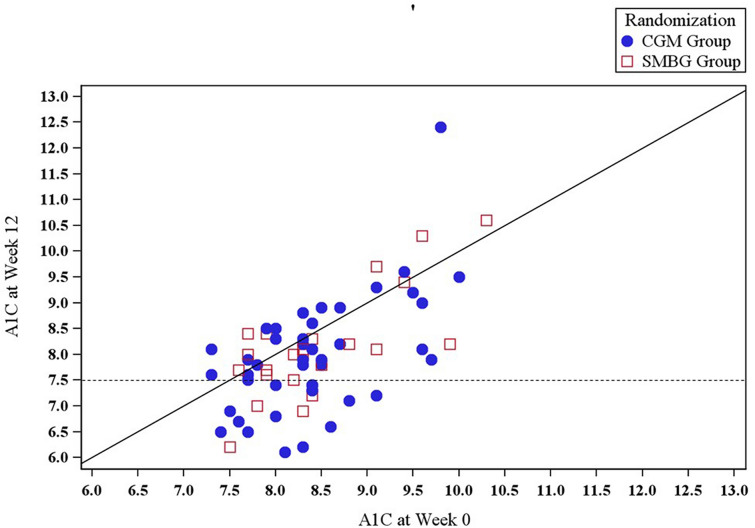
INTRODUCTION: Resistance to initiating insulin therapy is common for people with type 2 diabetes (T2D) using multiple oral agents, resulting in sustained poor glycemic control. We explored a non-pharmacologic option and examined whether adults with T2D and elevated hemoglobin A1c (HbA1c) who were using multiple, non-insulin antihyperglycemics could obtain glycemic benefit from limited, episodic use of real-time continuous glucose monitoring (rtCGM). METHODS: A randomized, pilot trial enrolled patients with T2D who were using two or more non-insulin therapies and had HbA1c values of 7.8-10.5%. Following a baseline, 10-day, blinded CGM session, participants were randomized 2:1, rtCGM or self-monitoring of blood glucose (SMBG). Medication changes were not made during the 12-week study unless required for safety; benefits would result from lifestyle changes. The rtCGM group used unblinded rtCGM for three sessions at weeks 0, 4, and 8, and the control group managed diabetes with SMBG and wore blinded rtCGM at week 8. Glycemic endpoints were assessed. RESULTS: Seventy participants were enrolled from eight North American sites and data were available from 68 (n = 45 rtCGM; n = 23 SMBG). Median (IQR) baseline HbA1c was 8.4 (0.8)% and 8.3 (1.2)% and median (IQR) change in HbA1c at week 12 was - 0.5 (1.3)% and - 0.2 (1.1)% for the rtCGM and SMBG groups, respectively (between-group difference p = 0.74). More than one-third (34.1%) of the rtCGM group vs 17.4% of the SMBG group reached the HbA1c goal of less than 7.5% at week 12 (between-group difference p = 0.12). Compared to run-in, mean (SD) time in range (TIR 70-180 mg/dL) at week 8 increased for the rtCGM group (56.3 [24.5]% vs 63.1 [25.5]%) while it decreased for the SMBG group (68.4 [21.5]% vs 55.1 [30.3]%). HbA1c reductions were not sustained at month 9. CONCLUSION: In this pilot study, limited episodic rtCGM use in people failing multiple non-insulin therapies resulted in modest, short-term glycemic benefits.
Overview
The claims and statistics of this paper haven’t been checked yet.
Free: it reads the open-access text and checks the first 5 claims that cite a source we can check. Create a free account to check every claim.
Integrity signals
Registry
Cites
Statistics
Figures
Verification
Claims the paper makes
The claims and statistics of this paper haven’t been checked yet.
Free: it reads the open-access text and checks the first 5 claims that cite a source we can check. Create a free account to check every claim.
Claims other papers make about this one
Each is checked against this paper’s own text: does it say what the citing paper says it does?
In the citing paper
“RCT data on rtCGM use in individuals with type 2 diabetes on MDI (59), mixed therapies (10, 60), and basal insulin (61,62) have consistently shown reductions in A1C levels and increases in TIR (70-180 mg/dL [3.9-10 mmol/L]) but not a reduction in rates of hypoglycemia (63).”
From 7. Diabetes Technology: Standards of Care in Diabetes—2025 (2025) · cites this paper as [62]
Self-check
Percentages, sums and reported differences re-computed from the paper’s own numbers.
The self-check needs the paper’s full text.
Citations
Cites
A systematic review of adherence with medications for diabetes
Cramer, J. A. (2004) · Diabetes Care · doi:10.2337/diacare.27.5.1218 · Cited by 1,203
9. Pharmacologic Approaches to Glycemic Treatment: Standards of Medical Care in Diabetes—2020
American Diabetes Association (2020) · Diabetes Care · doi:10.2337/dc20-s009 · Cited by 914
Beck, R. W., Riddlesworth, T. D., Ruedy, K., Ahmann, A., Haller, S., Kruger, D., McGill, J. B., Polonsky, W., Price, D., Aronoff, S., et al. (2017) · Annals of Internal Medicine · doi:10.7326/m16-2855 · Cited by 635
Self-citationKarter, A. J., Ferrara, A., Darbinian, J. A., Ackerson, L. M., & Selby, J. V. (2000) · Diabetes Care · doi:10.2337/diacare.23.4.477 · Cited by 487 · cited 1×
“Many insurers provide limited coverage for test strips for most non-insulin users and, even with coverage, few patients with T2D perform SMBG at the recommended frequency [25].”
BackgroundImprovement in Glycemic Excursions With a Transcutaneous, Real-Time Continuous Glucose Sensor
Garg, S., Zisser, H., Schwartz, S., Bailey, T., Kaplan, R., Ellis, S., & Jovanovic, L. (2006) · Diabetes Care · doi:10.2337/diacare.29.01.06.dc05-1686 · Cited by 433
Vigersky, R. A., Fonda, S. J., Chellappa, M., Walker, M. S., & Ehrhardt, N. M. (2012) · Diabetes Care · doi:10.2337/dc11-1438 · Cited by 301
Meal-Related Structured Self-Monitoring of Blood Glucose
Schwedes, U., Siebolds, M., Mertes, G., & For the SMBG Study Group (2002) · Diabetes Care · doi:10.2337/diacare.25.11.1928 · Cited by 300
Montvida, O., Shaw, J., Atherton, J. J., Stringer, F., & Paul, S. K. (2018) · Diabetes Care · doi:10.2337/dc17-1414 · Cited by 250 · cited 1×
“most patients require a second-line antidiabetic drug [4].”
BackgroundClinical inertia to insulin initiation and intensification in the UK: A focused literature review
Khunti, K., & Millar-Jones, D. (2017) · Primary Care Diabetes · doi:10.1016/j.pcd.2016.09.003 · Cited by 235
Ehrhardt, N. M., Chellappa, M., Walker, M. S., Fonda, S. J., & Vigersky, R. A. (2011) · Journal of Diabetes Science and Technology · doi:10.1177/193229681100500320 · Cited by 199 · cited 3×
“Unlike the Vigersky study [27, 28], the observed HbA1c reduction diminished after rtCGM was withdrawn.”
BackgroundMethodResultDavidson, M. B., Castellanos, M., Kain, D., & Duran, P. (2005) · The American Journal of Medicine · doi:10.1016/j.amjmed.2004.12.006 · Cited by 178
DURÁN, A., MARTÍN, P., RUNKLE, I., PÉREZ, N., ABAD, R., FERNÁNDEZ, M., DEL VALLE, L., SANZ, M. F., & CALLE‐PASCUAL, A. L. (2010) · Journal of Diabetes · doi:10.1111/j.1753-0407.2010.00081.x · Cited by 156
Young, L. A., Buse, J. B., Weaver, M. A., Vu, M. B., Mitchell, C. M., Blakeney, T., Grimm, K., Rees, J., Niblock, F., Donahue, K. E., et al. (2017) · JAMA Internal Medicine · doi:10.1001/jamainternmed.2017.1233 · Cited by 148
Khunti, K., Damci, T., Meneghini, L., Pan, C. Y., Yale, J. ‐., & on behalf of the SOLVE Study Group (2012) · Diabetes, Obesity and Metabolism · doi:10.1111/j.1463-1326.2012.01602.x · Cited by 114
Bergenstal, R. M., Layne, J. E., Zisser, H., Gabbay, R. A., Barleen, N. A., Lee, A. A., Majithia, A. R., Parkin, C. G., & Dixon, R. F. (2021) · Diabetes Technology & Therapeutics · doi:10.1089/dia.2020.0396 · Cited by 110
Towfigh, A., Romanova, M., Weinreb, J. E., Munjas, B. A., Suttorp, M. J., Zhou, A., & Shekelle, P. (2008) · PubMed · Cited by 101
Cox, D. J., Banton, T., Moncrief, M., Conaway, M., Diamond, A., & McCall, A. L. (2020) · Journal of the Endocrine Society · doi:10.1210/jendso/bvaa118 · Cited by 82 · cited 1×
“[29] looked at the benefit of a formal, group-oriented, structured education program in conjunction with rtCGM (worn for five sessions) in 30 subjects with early T2D and found that participants using rtCGM successfully modified their diets and lowered their HbA1c on the basis of their CGM data and the structured educa…”
MethodA virtual type 2 diabetes clinic using continuous glucose monitoring and endocrinology visits
Dixon, R. F., Zisser, H., Layne, J. E., Barleen, N. A., Miller, D. P., Moloney, D. P., Majithia, A. R., Gabbay, R. A., & Riff, J. (2020) · Journal of Diabetes Science and Technology · doi:10.1177/1932296819888662 · Cited by 80
Self-Monitoring of Blood Glucose in Noninsulin-Using Type 2 Diabetic Patients
Polonsky, W. H., & Fisher, L. (2013) · Diabetes Care · doi:10.2337/dc12-0731 · Cited by 77 · cited 1×
“In these studies, SMBG is performed before and after meals, providing participants immediate feedback about their food choices [21, 22].”
BackgroundMata‐Cases, M., Franch‐Nadal, J., Real, J., Gratacòs, M., López‐Simarro, F., Khunti, K., & Mauricio, D. (2018) · Diabetes, Obesity and Metabolism · doi:10.1111/dom.13045 · Cited by 72
Self-Monitoring of Blood Glucose in Noninsulin-Using Type 2 Diabetic Patients
Malanda, U. L., Bot, S. D., & Nijpels, G. (2013) · Diabetes Care · doi:10.2337/dc12-0831 · Cited by 65
Desai, U. S., Kirson, N. Y., Kim, J., Khunti, K., King, S. B., Trieschman, E. J., Hellstern, M., Hunt, P. R., & Mukherjee, J. (2018) · Diabetes Care · doi:10.2337/dc17-0662 · Cited by 59
Fast-Acting Insulin Aspart Use with the MiniMed TM 670G System
Hsu, L., Buckingham, B., Basina, M., Ekhlaspour, L., von Eyben, R., Wang, J., & Lal, R. A. (2021) · Diabetes Technology & Therapeutics · doi:10.1089/dia.2020.0083 · Cited by 57
Treatment intensification for patients with type 2 diabetes and poor glycaemic control
Fu, A. Z., & Sheehan, J. J. (2016) · Diabetes, Obesity and Metabolism · doi:10.1111/dom.12683 · Cited by 51
Patients who self-monitor blood glucose and their unused testing results.
Grant, R. W., Huang, E. S., Wexler, D. J., Laiteerapong, N., Warton, E. M., Moffet, H. H., & Karter, A. J. (2015) · PubMed · Cited by 45
Self-monitoring of blood glucose in tablet-treated type 2 diabetic patients (ZODIAC).
Kleefstra, N., Hortensius, J., Logtenberg, S. J. J., Slingerland, R. J., Groenier, K. H., Houweling, S. T., Gans, R. O. B., van Ballegooie, E., & Bilo, H. J. G. (2010) · PubMed · Cited by 41
Meneghini, L. F., Mauricio, D., Orsi, E., Lalic, N. M., Cali, A. M. G., Westerbacka, J., Stella, P., Candelas, D., Pilorget, V., Perfetti, R., et al. (2019) · Diabetes, Obesity and Metabolism · doi:10.1111/dom.13673 · Cited by 36
van der Linden, J., Welsh, J. B., Hirsch, I. B., & Garg, S. K. (2021) · Diabetes Technology & Therapeutics · doi:10.1089/dia.2020.0649 · Cited by 27
Beck, R. W., & Riddlesworth, T. D. (2018) · Annals of Internal Medicine · doi:10.7326/l17-0706 · Cited by 26
Time to Insulin Initiation in Type 2 Diabetes Patients in 2010/2011 and 2016/2017 in Germany
Kostev, K., Gölz, S., Scholz, B.-M., Kaiser, M., & Pscherer, S. (2019) · Journal of Diabetes Science and Technology · doi:10.1177/1932296819835196 · Cited by 23
Kostev, K., Dippel, F. W., & Rathmann, W. (2015) · Diabetes, Metabolic Syndrome and Obesity: Targets and Therapy · doi:10.2147/dmso.s76855 · Cited by 21
Canivell, S., Mata‐Cases, M., Real, J., Franch‐Nadal, J., Vlacho, B., Khunti, K., Gratacòs, M., & Mauricio, D. (2019) · Diabetes Obesity and Metabolism · doi:10.1111/dom.13663 · Cited by 21
Price, D. A., & Walker, T. C. (2016) · touchREVIEWS in Endocrinology · doi:10.17925/ee.2016.12.01.24 · Cited by 20 · cited 1×
“While SMBG may be effective if the data are used to modify behavior and treatment, there are numerous barriers to SMBG testing [24].”
BackgroundSelf-citationPantalone, K. M., Misra‐Hebert, A. D., Hobbs, T. M., Ji, X., Kong, S. X., Milinovich, A., Weng, W., Bauman, J. M., Ganguly, R., Burguera, B. G., et al. (2019) · Diabetic Medicine · doi:10.1111/dme.13900 · Cited by 15
Garg, S. (2006) · Diabetes Care · doi:10.2337/diacare.29.1.44 · Cited by 13
Weaver, M. A., Buse, J. B., Grimm, K., Blakeney, T., Vu, M. B., Mitchell, C. M., Rees, J., Niblock, F., Donahue, K. E., & Young, L. A. (2020) · Carolina Digital Repository (University of North Carolina at Chapel Hill) · doi:10.17615/81r9-8j17 · Cited by 12
Cited by
7. Diabetes Technology: Standards of Medical Care in Diabetes—2022
American Diabetes Association Professional Practice Committee (2022) · Diabetes Care · doi:10.2337/dc22-s007 · Cited by 358
“RCT data on rtCGM use in individuals with type 2 diabetes on MDI (58), mixed therapies (59,60), and basal insulin (61,62) have consistently shown reductions in A1C but not a reduction in rates of hypoglycemia.”
Method7. Diabetes Technology: Standards of Care in Diabetes—2025
American Diabetes Association Professional Practice Committee, ElSayed, N. A., McCoy, R. G., Aleppo, G., Balapattabi, K., Beverly, E. A., Briggs Early, K., Bruemmer, D., Echouffo-Tcheugui, J. B., Ekhlaspour, L., et al. (2025) · Diabetes Care · doi:10.2337/dc25-s007 · Cited by 348
7. Diabetes Technology: Standards of Care in Diabetes — 2023
ElSayed, N. A., Aleppo, G., Aroda, V. R., Bannuru, R. R., Brown, F. M., Bruemmer, D., Collins, B. S., Hilliard, M. E., Isaacs, D., Johnson, E. L., et al. (2023) · Diabetes Care · doi:10.2337/dc23-s007 · Cited by 301
7. Diabetes Technology: Standards of Care in Diabetes—2024
American Diabetes Association Professional Practice Committee, ElSayed, N. A., Aleppo, G., Bannuru, R. R., Bruemmer, D., Collins, B. S., Ekhlaspour, L., Hilliard, M. E., Johnson, E. L., Khunti, K., et al. (2024) · Diabetes Care · doi:10.2337/dc24-s007 · Cited by 281
9. pharmacologic approaches to glycemic treatment: standards of care in diabetes—2026
American Diabetes Association Professional Practice Committee for Diabetes*, Bajaj, M., McCoy, R. G., Balapattabi, K., Bannuru, R. R., Bellini, N. J., Bennett, A. K., Beverly, E. A., Briggs Early, K., ChallaSivaKanaka, S., et al. (2026) · Diabetes Care · doi:10.2337/dc26-s009 · Cited by 263
Metadata
- Authors
- Price, D. A., Deng, Q., Kipnes, M., & Beck, S. E.
- Affiliations
- Dexcom (United States) (US)
- Diabetes & Glandular Disease Clinic (US)
- Corresponding author
- Price, David A.
- ORCID
- Price, David A.
- Venue
- Diabetes Therapy
- Published
- 2021-06-04
- Volume
- 12
- Issue
- 7
- Pages
- 2089-2099
- ISSN
- 1869-6953 (ISSN-L)
- 1869-6961
- PMC
- PMC8177263
- OpenAlex
- W3164960050
- Cited by
- 77
- References
- 38
- Citations by year
- 2026: 14 · 2025: 21 · 2024: 19 · 2023: 14 · 2022: 6 · 2021: 3
- FWCI
- 7.84
- Type
- journal article
- Language
- en
- Open access
- gold
- doi.org
- Licence
- cc-by-nc
- creativecommons.org/licenses/by-nc/4.0 (tdm)
- creativecommons.org/licenses/by-nc/4.0 (vor)
- Locations
- Diabetes Therapy (publishedVersion, cc-by-nc)
- PubMed Central (publishedVersion, cc-by-nc)
- PubMed (publishedVersion)
- Funders
- Dexcom
- Topics
- Health Sciences › Medicine › Endocrinology, Diabetes and Metabolism › Diabetes Management and Research
- Health Sciences › Medicine › Endocrinology, Diabetes and Metabolism › Diabetes Treatment and Management
- Health Sciences › Medicine › Endocrinology, Diabetes and Metabolism › Diabetes Management and Education
- Keywords
- type 2 diabetes, real-time continuous glucose monitoring, self-monitoring of blood glucose, glycemic control, HbA1c, time in range, lifestyle intervention, adults with diabetes, HbA1c reduction
About these checks
Registry, retraction, Cites and statistics results are computed, not judged, with one exception: a printed reference that no index lists is read once by a model before it counts as a citation error. Claims are extracted by a model and kept only when their quote appears verbatim in the text; each cited source is then checked, with a model’s help, for whether it says what the claim relies on. Those verdicts can be wrong — read the claim’s quote and the cited source before relying on one.
Statistics and arithmetic are recomputed, not judged.
Confidence bands are shown only for fields calibrated on our annotated test set. None is calibrated yet, so no band is shown.
What counts as a claim ›How we measure confidence ›How we check this ›
Are you an author, or do you see a problem with this page? Request a review
Data sources
Bibliographic data: Semantic Scholar, OpenAlex, Crossref.
Contains information from the Semantic Scholar Academic Graph Datasets, made available under the ODC Attribution License (ODC-BY 1.0).
Semantic Scholar’s data is described in: Kinney, R., et al. (2023). The Semantic Scholar Open Data Platform. arXiv:2301.10140.
