

Real-World Evaluation of GLP-1 Receptor Agonist Therapy Persistence, Adherence and Therapeutic Inertia Among Obese Adults with Type 2 Diabetes
Open accessThe DOI matches its Crossref record; 31 of the 31 references it cites were found in a registry or an index.
Abstract
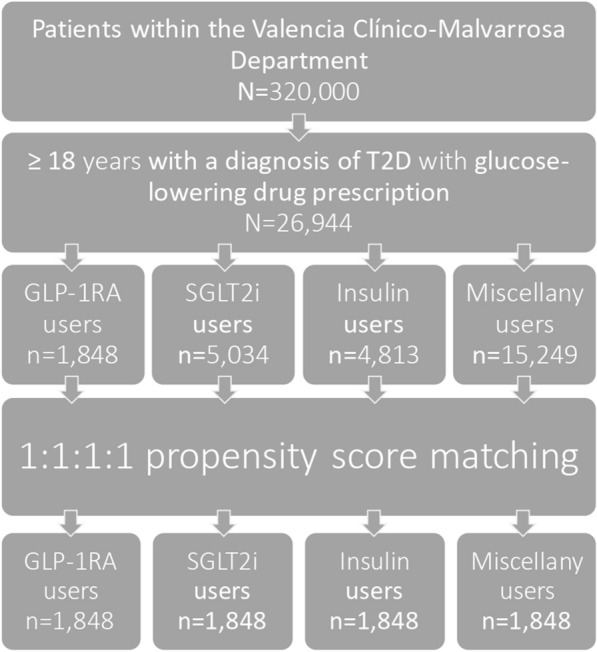
INTRODUCTION: In type 2 diabetes (T2D), key barriers to optimal glycaemic control include lack of persistence with treatment, reduced medication adherence and therapeutic inertia. This study aimed to assess the impact of these barriers in obese adults with type 2 diabetes treated with a GLP-1 receptor agonist (GLP-1RA) and compare them against other glucose-lowering agents in a real-world setting. METHODS: A retrospective study was conducted using electronic medical records from 2014 to 2019 for adults with T2D at the Valencia Clínico-Malvarrosa Department of Health (Valencia, Spain). Four study groups were established: all GLP-1RA users, SGLT2i users, insulin users and other glucose-lowering agent users (miscellany group). To account for imbalance between groups, propensity score matching (PSM) including age, gender and pre-existing cardiovascular disease was performed. Chi-square tests were used for comparisons between groups. Time to first intensification was calculated using competing risk analysis. RESULTS: Among the 26,944 adults with T2D, 7392 individuals were selected following PSM, with 1848 patients in each group. At 2 years, GLP-1RA users were less persistent than non-users (48.4% versus 72.7%, p < 0.0001) but more adherent (73.8% versus 68.9%, respectively, p < 0.0001). A greater proportion of persistent GLP-1RA users than non-persistent users exhibited reduced HbA1c (40.5% versus 18.6%, respectively, p < 0.0001), but no differences in cardiovascular outcomes and death were found. Overall, therapeutic inertia was observed in 38.0% of the study population. The large majority of GLP-1RA users received treatment intensification, whereas only 50.0% of GLP-1RA non-users were intensified. CONCLUSION: Under real-life conditions, obese adults with T2D persistently treated with GLP-1RA showed improved glycaemic control. Despite benefits, persistence with GLP-1RA was limited after 2 years. Additionally, therapeutic inertia occurred in two out of three study participants. Strategies to facilitate medication adherence, persistence and treatment intensification in people with T2D should be made a priority in order to achieve and maintain glycaemic targets and improve outcomes in this population. TRAIL REGISTRATION: Study registered in clinicaltrials.org with the identifier NCT05535322.
Overview
The claims and statistics of this paper haven’t been checked yet.
Free: it reads the open-access text and checks the first 5 claims that cite a source we can check. Create a free account to check every claim.
Integrity signals
Registry
Cites
Statistics
Figures
Verification
Claims the paper makes
The claims and statistics of this paper haven’t been checked yet.
Free: it reads the open-access text and checks the first 5 claims that cite a source we can check. Create a free account to check every claim.
Claims other papers make about this one
Each is checked against this paper’s own text: does it say what the citing paper says it does?
The cited source doesn’t support the claim as written.
In the citing paper
“While the persistence to the use of GLP‐1RAs does not seem worse compared with many other drugs,”
From Real‐world evidence on the utilization, clinical and comparative effectiveness, and adverse effects of newer GLP ‐ 1RA ‐based weight‐loss therapies (2025) · cites this paper as [29]
Checked by a reasoning model — may be wrong.
Experimental — accuracy not yet measuredThe cited source says what the claim attributes to it.
In the citing paper
“For T2D populations, studies suggested persistent drug use (i.e., no full discontinuation) in about 80% of users after 1 year in European settings, 29 , 30 but only in about 50% in Israel 31 and the United States. 32”
From Real‐world evidence on the utilization, clinical and comparative effectiveness, and adverse effects of newer GLP ‐ 1RA ‐based weight‐loss therapies (2025) · cites this paper as [29]
The cited source says what the claim attributes to it.
In the citing paper
“a substantial proportion cease treatment early on. 29 , 30 , 31 , 35”
From Real‐world evidence on the utilization, clinical and comparative effectiveness, and adverse effects of newer GLP ‐ 1RA ‐based weight‐loss therapies (2025) · cites this paper as [29]
Self-check
Percentages, sums and reported differences re-computed from the paper’s own numbers.
The self-check needs the paper’s full text.
Citations
Cites
Gupta, A., & Uribarri, J. (2016) · Hormone Research in Paediatrics · doi:10.1159/000444053 · Cited by 4,006
Kristensen, S. L., Rørth, R., Jhund, P. S., Docherty, K. F., Sattar, N., Preiss, D., Køber, L., Petrie, M. C., & McMurray, J. J. V. (2019) · The Lancet Diabetes & Endocrinology · doi:10.1016/s2213-8587(19)30249-9 · Cited by 1,663
6. Glycemic Targets: Standards of Medical Care in Diabetes—2022
American Diabetes Association Professional Practice Committee (2022) · Diabetes Care · doi:10.2337/dc22-s006 · Cited by 1,403
Cardiovascular and renal outcomes with efpeglenatide in type 2 diabetes
Gerstein, H. C., Sattar, N., Rosenstock, J., Ramasundarahettige, C., Pratley, R., Lopes, R. D., Lam, C. S. P., Khurmi, N. S., Heenan, L., Del Prato, S., et al. (2021) · New England Journal of Medicine · doi:10.1056/nejmoa2108269 · Cited by 829
Polonsky, W., & Henry, R. (2016) · Patient Preference and Adherence · doi:10.2147/ppa.s106821 · Cited by 784 · cited 1×
“Key barriers to optimal glycaemic control include nonadherence to diabetes therapy and lack of persistence with treatment over time, which represent an area of concern in the management of type 2 diabetes [4].”
BackgroundCramer, J. A., Benedict, Á., Muszbek, N., Keskinaslan, A., & Khan, Z. M. (2007) · International Journal of Clinical Practice · doi:10.1111/j.1742-1241.2007.01630.x · Cited by 487 · cited 1×
“Persistence with treatment is the duration between treatment initiation and discontinuation despite continuing to be prescribed the medication [7].”
BackgroundKhunti, K., Gomes, M. B., Pocock, S., Shestakova, M. V., Pintat, S., Fenici, P., Hammar, N., & Medina, J. (2018) · Diabetes, Obesity and Metabolism · doi:10.1111/dom.13088 · Cited by 367 · cited 1×
“To the same extent, the non-intensification of treatment after suboptimal glycaemic control (therapeutic inertia) should also be evaluated considering its impact on the management and control of chronic conditions such as diabetes [16].”
BackgroundAssociation between adherence to pharmacotherapy and outcomes in type 2 diabetes: a meta-analysis
Khunti, K., Seidu, S., Kunutsor, S., & Davies, M. (2017) · Diabetes Care · doi:10.2337/dc16-1925 · Cited by 231 · cited 2×
“Treatment adherence, defined as compliance with the prescribed dosing schedule during the observation period, can be indirectly quantified by assessing the proportion of days within a treatment period that are covered by the amount of medication that was accessed by the patient [10].”
Backgroundde Pablos‐Velasco, P., Parhofer, K. G., Bradley, C., Eschwège, E., Gönder-Frederick, L., Maheux, P., Wood, I., & Simon, D. (2014) · Clinical Endocrinology · doi:10.1111/cen.12119 · Cited by 218
Khunti, S., Khunti, K., & Seidu, S. (2019) · Therapeutic Advances in Endocrinology and Metabolism · doi:10.1177/2042018819844694 · Cited by 182
McGovern, A., Tippu, Z., Hinton, W., Munro, N., Whyte, M., & de Lusignan, S. (2018) · Diabetes, Obesity and Metabolism · doi:10.1111/dom.13160 · Cited by 166
Longitudinal effects of medication nonadherence on glycemic control
Egede, L. E., Gebregziabher, M., Echols, C., & Lynch, C. P. (2014) · Annals of Pharmacotherapy · doi:10.1177/1060028014526362 · Cited by 146
Guerci, B., Chanan, N., Kaur, S., Jasso-Mosqueda, J. G., & Lew, E. (2019) · Diabetes Therapy · doi:10.1007/s13300-019-0590-x · Cited by 106 · cited 4×
“The greater complexity of insulin treatment compared to oral medication, the association of lower persistence rates with type 2 diabetes treatment and the higher risk of hypoglycaemia experienced with insulin may have contributed to these findings [8].”
BackgroundResultInfluentialBuysman, E. K., Liu, F., Hammer, M., & Langer, J. (2015) · Advances in Therapy · doi:10.1007/s12325-015-0199-z · Cited by 101
Huthmacher, J. A., Meier, J. J., & Nauck, M. A. (2020) · Diabetes Care · doi:10.2337/dc20-0498 · Cited by 91
Evans, M., Engberg, S., Faurby, M., Fernandes, J. D. D. R., Hudson, P., & Polonsky, W. (2022) · Diabetes, Obesity and Metabolism · doi:10.1111/dom.14603 · Cited by 90
Adherence and persistence rates of major antidiabetic medications: a review
Lee, D. S. U., & Lee, H. (2022) · Diabetology & Metabolic Syndrome · doi:10.1186/s13098-022-00785-1 · Cited by 72
Pasternak, B., Wintzell, V., Eliasson, B., Svensson, A.-M., Franzén, S., Gudbjörnsdottir, S., Hveem, K., Jonasson, C., Melbye, M., Svanström, H., et al. (2020) · Diabetes Care · doi:10.2337/dc19-2088 · Cited by 69
Uzoigwe, C., Liang, Y., Whitmire, S., & Paprocki, Y. (2021) · Diabetes Therapy · doi:10.1007/s13300-021-01053-7 · Cited by 62
Real-World Insulin Treatment Persistence among Patients with Type 2 Diabetes
Wei, W., Pan, C., Xie, L., & Başer, O. (2013) · Endocrine Practice · doi:10.4158/ep13159.or · Cited by 59 · cited 1×
“Indeed, reduced treatment persistence and adherence have been associated with inadequate glycaemic control and, consequently, with an increase in demand on healthcare resources [5, 6].”
BackgroundLongato, E., Di Camillo, B., Sparacino, G., Tramontan, L., Avogaro, A., & Fadini, G. P. (2020) · Cardiovascular Diabetology · doi:10.1186/s12933-020-01049-w · Cited by 57
Nguyen, H., Dufour, R., & Caldwell-Tarr, A. (2017) · Advances in Therapy · doi:10.1007/s12325-016-0470-y · Cited by 52
Jermendy, G., Kiss, Z., Rokszin, G., Abonyi‐Tóth, Z., Wittmann, I., & Kempler, P. (2018) · Diabetes Therapy · doi:10.1007/s13300-018-0483-4 · Cited by 37
Mody, R., Yu, M., Nepal, B., Konig, M., & Grabner, M. (2021) · Diabetes, Obesity and Metabolism · doi:10.1111/dom.14195 · Cited by 35
Outcomes and Treatment Patterns of Adding a Third Agent to 2 OADs in Patients with Type 2 Diabetes
Levin, P. A., Wei, W., Zhou, S., Xie, L., & Baser, O. (2014) · Journal of Managed Care Pharmacy · doi:10.18553/jmcp.2014.20.5.501 · Cited by 34 · cited 1×
“A retrospective real-world study conducted in the US that recruited almost 52,000 type 2 diabetes patients treated with two oral antidiabetic agents found that individuals initiating a third oral agent were more persistent than those initiating insulin after a 2-year period [21].”
BackgroundLin, J., Lingohr-Smith, M., & Fan, T. (2016) · ClinicoEconomics and Outcomes Research · doi:10.2147/ceor.s117200 · Cited by 31
Durden, E., Liang, M., Fowler, R., Panton, U. H., & Mocevic, E. (2019) · Journal of Managed Care & Specialty Pharmacy · doi:10.18553/jmcp.2019.18429 · Cited by 30
Morieri, M. L., Avogaro, A., & Fadini, G. P. (2020) · Diabetes, Metabolic Syndrome and Obesity: Targets and Therapy · doi:10.2147/dmso.s216054 · Cited by 25
Alexopoulos, A.-S., & Buse, J. B. (2019) · Metabolism · doi:10.1016/j.metabol.2019.06.012 · Cited by 24 · cited 2×
“GLP-1RA represents the first recommended injectable therapy after the failure of oral glucose-lowering agents, even before starting basal insulin therapy [11].”
BackgroundCohen, C. M., Chodick, G., Husemoen, L. L. N., Rhee, N. A., Shalev, V., & Karasik, A. (2019) · Diabetes Therapy · doi:10.1007/s13300-019-0583-9 · Cited by 13
Cited by
Thomsen, R. W., Mailhac, A., Løhde, J. B., & Pottegård, A. (2025) · Diabetes Obesity and Metabolism · doi:10.1111/dom.16364 · Cited by 207
Fiscal impact of expanded Medicare coverage for GLP-1 receptor agonists to treat obesity
Hwang, J. H., Laiteerapong, N., Huang, E. S., Mozaffarian, D., Fendrick, A. M., & Kim, D. D. (2025) · JAMA Health Forum · doi:10.1001/jamahealthforum.2025.0905 · Cited by 43
Giannakogeorgou, A., & Roden, M. (2024) · Alimentary Pharmacology & Therapeutics · doi:10.1111/apt.17848 · Cited by 30
Scheen, A. J. (2024) · Expert Opinion on Drug Safety · doi:10.1080/14740338.2024.2354885 · Cited by 19
Weight Loss Blockbuster Development: A Role for Unimolecular Polypharmacology
Zhou, Q., Li, G., Hang, K., Li, J., Yang, D., & Wang, M. (2024) · The Annual Review of Pharmacology and Toxicology · doi:10.1146/annurev-pharmtox-061324-011832 · Cited by 16
Metadata
- Authors
- Palanca, A., Ampudia-Blasco, F. J., Calderón, J. M., Sauri, I., Martinez-Hervás, S., Trillo, J. L., Redón, J., & Real, J. T.
- Affiliations
- Centro de Investigación Biomédica en Red Diabetes y Enfermedades Metabólicas Asociadas (ES)
- INCLIVA Health Research Institute (ES)
- Universitat de València (ES)
- Corresponding author
- Palanca, Ana
- Venue
- Diabetes Therapy
- Published
- 2023-02-27
- Volume
- 14
- Issue
- 4
- Pages
- 723-736
- ISSN
- 1869-6953 (ISSN-L)
- 1869-6961
- PMC
- PMC10064368
- OpenAlex
- W4322495046
- Cited by
- 48
- References
- 31
- Citations by year
- 2026: 15 · 2025: 17 · 2024: 14 · 2023: 2
- FWCI
- 9.85
- Type
- journal article
- Language
- en
- Open access
- gold
- doi.org
- Licence
- cc-by-nc
- creativecommons.org/licenses/by-nc/4.0 (tdm)
- creativecommons.org/licenses/by-nc/4.0 (vor)
- Locations
- Diabetes Therapy (publishedVersion, cc-by-nc)
- PubMed Central (publishedVersion, cc-by-nc)
- PubMed (publishedVersion)
- Funders
- Novo Nordisk Pharma
- Topics
- Health Sciences › Medicine › Endocrinology, Diabetes and Metabolism › Diabetes Treatment and Management
- Health Sciences › Medicine › Family Practice › Medication Adherence and Compliance
- Health Sciences › Medicine › Endocrinology, Diabetes and Metabolism › Diabetes Management and Research
- Keywords
- type 2 diabetes, obesity, GLP-1 receptor agonists, treatment persistence, medication adherence, therapeutic inertia, glycemic control, HbA1c, treatment intensification, SGLT2 inhibitors, insulin therapy, glucose-lowering agents, real-world evidence, cardiovascular outcomes, mortality, competing risk analysis, propensity score matching, treatment discontinuation, treatment switching
About these checks
Registry, retraction, Cites and statistics results are computed, not judged, with one exception: a printed reference that no index lists is read once by a model before it counts as a citation error. Claims are extracted by a model and kept only when their quote appears verbatim in the text; each cited source is then checked, with a model’s help, for whether it says what the claim relies on. Those verdicts can be wrong — read the claim’s quote and the cited source before relying on one.
Statistics and arithmetic are recomputed, not judged.
Confidence bands are shown only for fields calibrated on our annotated test set. None is calibrated yet, so no band is shown.
What counts as a claim ›How we measure confidence ›How we check this ›
Are you an author, or do you see a problem with this page? Request a review
Data sources
Bibliographic data: Semantic Scholar, OpenAlex, Crossref.
Contains information from the Semantic Scholar Academic Graph Datasets, made available under the ODC Attribution License (ODC-BY 1.0).
Semantic Scholar’s data is described in: Kinney, R., et al. (2023). The Semantic Scholar Open Data Platform. arXiv:2301.10140.
