

The DOI matches its Crossref record; 139 of the 141 references it cites were found in a registry or an index.
The Gut Microbiome as Therapeutic Target in Central Nervous System Diseases: Implications for Stroke
Open accessAbstract
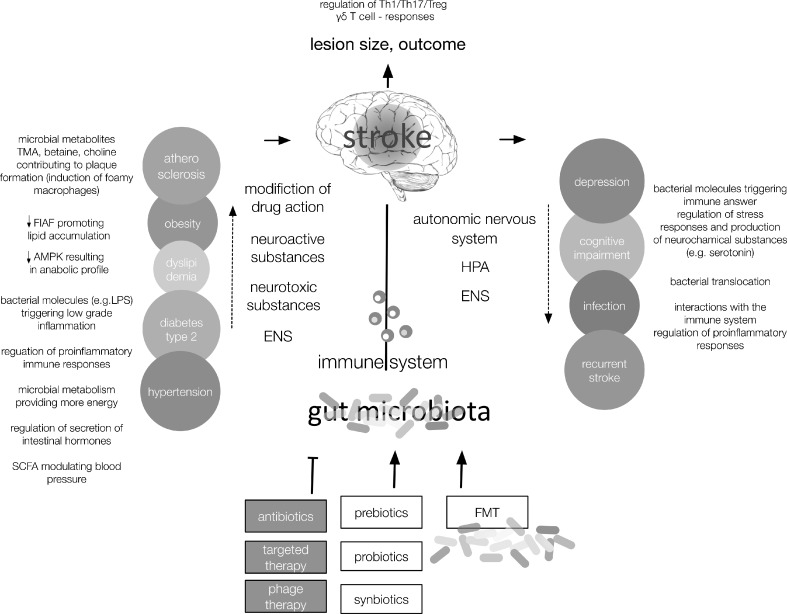
Research on commensal microbiota and its contribution to health and disease is a new and very dynamically developing field of biology and medicine. Recent experimental and clinical investigations underscore the importance of gut microbiota in the pathogenesis and course of stroke. Importantly, microbiota may influence the outcome of cerebral ischemia by modulating central nervous system antigen-specific immune responses. In this review we summarize studies linking gut microbiota with physiological function and disorders of the central nervous system. Based on these insights we speculate about targeting the gut microbiome in order to treat stroke.
Overview
The claims and statistics of this paper haven’t been checked yet.
Run the check — free, no account needed. It reads the open-access text and checks the sources it cites.
Integrity signals
Registry
Cites
Statistics
Figures
Verification
Claims the paper makes
The claims and statistics of this paper haven’t been checked yet.
Run the check — free, no account needed. It reads the open-access text and checks the sources it cites.
Claims other papers make about this one
Each is checked against this paper’s own text: does it say what the citing paper says it does?
In the citing paper
“Several different microbiome-targeted approaches, including prebiotic, probiotic, and FMT strategies, have shown promising results for a variety of GI conditions in preclinical and clinical models and could be extended to pathologies involving microglia in the near future (Fond et al., 2015; Winek et al., 2016).”
From Microbiome–microglia connections via the gut–brain axis (2019) · cites this paper as Winek et al., 2016
In the citing paper
“compared with specific-pathogen-free (SPF) mice, germ-free (GF) mice show social communication disorders and increased anxiety behaviors, and these abnormal social behaviors are corrected after the mice are colonized with normal microbiota”
Self-check
Percentages, sums and reported differences re-computed from the paper’s own numbers.
The self-check needs the paper’s full text.
Citations
Cites
Dermyshi, E., Wang, Y., Yan, C., Hong, W., Qiu, G., Gong, X., & Zhang, T. (2017) · Neonatology · doi:10.1159/000454668 · Cited by 24,586
A core gut microbiome in obese and lean twins
Turnbaugh, P. J., Hamady, M., Yatsunenko, T., Cantarel, B. L., Duncan, A., Ley, R. E., Sogin, M. L., Jones, W. J., Roe, B. A., Affourtit, J. P., et al. (2009) · Nature · doi:10.1038/nature07540 · Cited by 7,823
The gut microbiota as an environmental factor that regulates fat storage
Bäckhed, F., Ding, H., Wang, T., Hooper, L. V., Koh, G. Y., Nagy, A., Semenkovich, C. F., & Gordon, J. I. (2004) · Proceedings of the National Academy of Sciences · doi:10.1073/pnas.0407076101 · Cited by 6,245
Gut flora metabolism of phosphatidylcholine promotes cardiovascular disease
Wang, Z., Klipfell, E., Bennett, B. J., Koeth, R., Levison, B. S., DuGar, B., Feldstein, A. E., Britt, E. B., Fu, X., Chung, Y.-M., et al. (2011) · Nature · doi:10.1038/nature09922 · Cited by 5,597
EVOLUTION AND MEASUREMENT OF SPECIES DIVERSITY
WHITTAKER, R. H. (1972) · Taxon · doi:10.2307/1218190 · Cited by 5,398
Mind-altering microorganisms: the impact of the gut microbiota on brain and behaviour
Cryan, J. F., & Dinan, T. G. (2012) · Nature Reviews Neuroscience · doi:10.1038/nrn3346 · Cited by 4,572
Intestinal microbiota metabolism of l-carnitine, a nutrient in red meat, promotes atherosclerosis
Koeth, R. A., Wang, Z., Levison, B. S., Buffa, J. A., Org, E., Sheehy, B. T., Britt, E. B., Fu, X., Wu, Y., Li, L., et al. (2013) · Nature Medicine · doi:10.1038/nm.3145 · Cited by 4,386
Commensal Bifidobacterium promotes antitumor immunity and facilitates anti–PD-L1 efficacy
Sivan, A., Corrales, L., Hubert, N., Williams, J. B., Aquino-Michaels, K., Earley, Z. M., Benyamin, F. W., Man Lei, Y., Jabri, B., Alegre, M.-L., et al. (2015) · Science · doi:10.1126/science.aac4255 · Cited by 3,888 · cited 1×
“ed success of antitumor therapy with anti-programmed celldeath-ligand 1 by boosting T-cell responses [134].”
BackgroundBravo, J. A., Forsythe, P., Chew, M. V., Escaravage, E., Savignac, H. M., Dinan, T. G., Bienenstock, J., & Cryan, J. F. (2011) · Proceedings of the National Academy of Sciences · doi:10.1073/pnas.1102999108 · Cited by 3,888
Duodenal Infusion of Donor Feces for Recurrent Clostridium difficile
van Nood, E., Vrieze, A., Nieuwdorp, M., Fuentes, S., Zoetendal, E. G., de Vos, W. M., Visser, C. E., Kuijper, E. J., Bartelsman, J. F. W. M., Tijssen, J. G. P., et al. (2013) · New England Journal of Medicine · doi:10.1056/nejmoa1205037 · Cited by 3,708
Research works printed but not linked: 1
- Dickson, 2016, The premature invocation of a ‘gut-lung axis' may obscure the direct effects of respiratory microbiota on pneumonia susceptibility, Gut
Cited by
Sorted by citations
Cryan, J. F., O'Riordan, K. J., Cowan, C. S. M., Sandhu, K. V., Bastiaanssen, T. F. S., Boehme, M., Codagnone, M. G., Cussotto, S., Fulling, C., Golubeva, A. V., et al. (2019) · Physiological Reviews · doi:10.1152/physrev.00018.2018 · Cited by 5,286
A Comprehensive Review on the Role of the Gut Microbiome in Human Neurological Disorders
Sorboni, S. G., Moghaddam, H. S., Esfehani, R. J., & Soleimanpour, S. (2022) · Clinical Microbiology Reviews · doi:10.1128/cmr.00338-20 · Cited by 586
Tryptophan metabolism and gut-brain homeostasis
Roth, W., Zadeh, K., Vekariya, R., Ge, Y., & Mohamadzadeh, M. (2021) · International Journal of Molecular Sciences · doi:10.3390/ijms22062973 · Cited by 519
Microbiome–microglia connections via the gut–brain axis
Abdel-Haq, R., Schlachetzki, J. C. M., Glass, C. K., & Mazmanian, S. K. (2019) · Journal of Experimental Medicine · doi:10.1084/jem.20180794 · Cited by 471
The progress of gut microbiome research related to brain disorders
Zhu, S., Jiang, Y., Xu, K., Cui, M., Ye, W., Zhao, G., Jin, L., & Chen, X. (2020) · Journal of Neuroinflammation · doi:10.1186/s12974-020-1705-z · Cited by 419
Metadata
- Authors
- Winek, K., Dirnagl, U., & Meisel, A.
- Affiliations
- Center for Stroke Research Berlin (DE)
- German Center for Neurodegenerative Diseases (DE)
- Corresponding author
- Meisel, Andreas
- Venue
- Neurotherapeutics
- Publisher
- Elsevier BV
- Published
- 2016-10
- Volume
- 13
- Issue
- 4
- Pages
- 762-774
- ISSN
- 1878-7479 (ISSN-L)
- PMC
- PMC5081128
- OpenAlex
- W2528944013
- Cited by
- 108
- References
- 141
- Citations by year
- 2026: 4 · 2025: 10 · 2024: 7 · 2023: 8 · 2022: 12 · 2021: 15 · 2020: 17 · 2019: 16 · 2018: 9 · 2017: 9 · 2016: 1
- FWCI
- 1.05
- Type
- journal article
- Language
- en
- Open access
- hybrid
- doi.org
- Licence
- Locations
- Neurotherapeutics (publishedVersion, cc-by)
- PubMed Central (publishedVersion, cc-by)
- PubMed (publishedVersion)
- DZNE Pub (submittedVersion, other-oa)
- Funders
- Deutsche Forschungsgemeinschaft (NeuroCure Cluster of Excellence, Exc 257, Collaborative Research Centres SFB-TRR 84)
- Center for Stroke Research Berlin (01 EO 08 01)
- Topics
- Life Sciences › Biochemistry, Genetics and Molecular Biology › Molecular Biology › Gut microbiota and health
- Life Sciences › Neuroscience › Neurology › Neuroinflammation and Neurodegeneration Mechanisms
- Health Sciences › Dentistry › Periodontics › Oral microbiology and periodontitis research
- Keywords
- gut microbiota, stroke, cerebral ischemia, central nervous system disorders, commensal microbiota, immune response, microbiome-targeted therapy, neuroinflammation
- MeSH terms
- Gastrointestinal Microbiome, Animals, Brain, Central Nervous System Diseases, Humans, Microbiota
About these checks
Registry, retraction, Cites and statistics results are computed, not judged, with one exception: a printed reference that no index lists is read once by a model before it counts as a citation error. Claims are extracted by a model and kept only when their quote appears verbatim in the text; each cited source is then checked, with a model’s help, for whether it says what the claim relies on. Those verdicts can be wrong — read the claim’s quote and the cited source before relying on one.
Statistics and arithmetic are recomputed, not judged.
Confidence bands are shown only for fields calibrated on our annotated test set. None is calibrated yet, so no band is shown.
What counts as a claim ›How we measure confidence ›How we check this ›
Are you an author, or do you see a problem with this page? Request a review
