

CSE1L, DIDO1 and RBM39 in colorectal adenoma to carcinoma progression
Open accessThe DOI matches its Crossref record; 49 of the 49 references it cites were found in a registry or an index.
Abstract
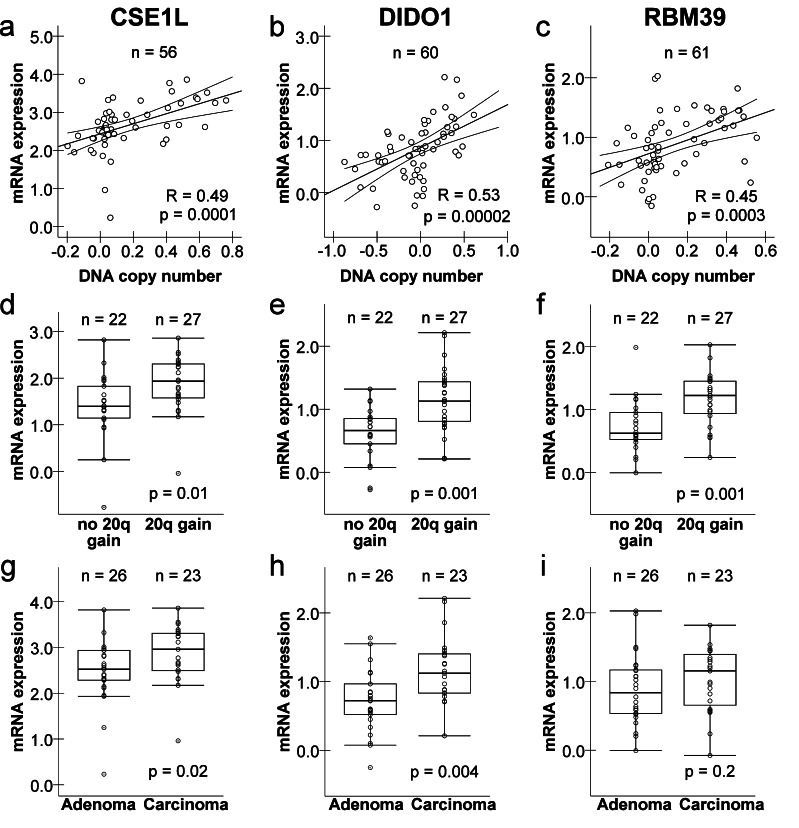
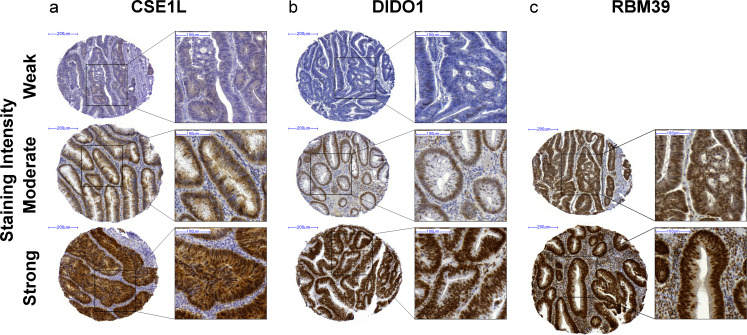
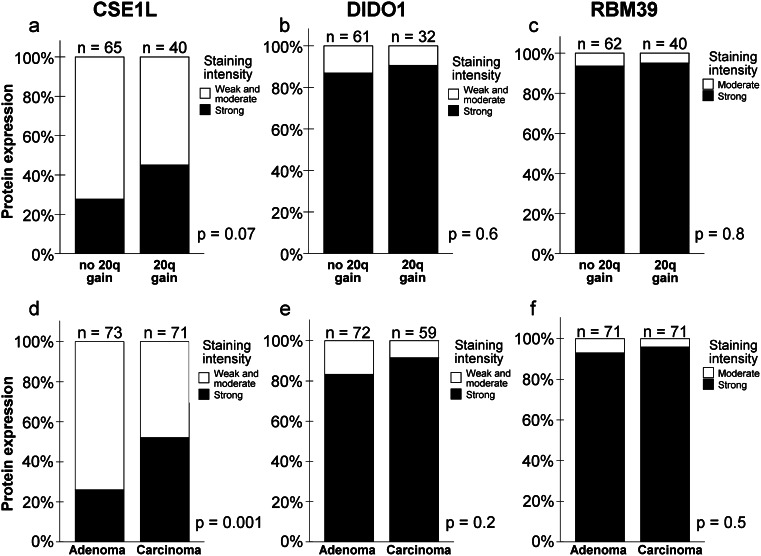
BACKGROUND: Gain of chromosome 20q is an important factor in the progression from colorectal adenomas to carcinomas. Genes that drive 20q gain are expected to show correlation of mRNA and protein expression levels with 20q DNA copy number status while functionally influencing cancer processes. CSE1L, DIDO1 and RBM39 are located on the 20q amplicon and affect processes such as cell viability and anchorage-independent growth in colorectal cancer. This study aimed to investigate whether CSE1L, DIDO1 and RBM39 may drive 20q amplification. METHODS: Protein expression levels were examined by immunohistochemical evaluation of tissue microarrays containing a series of colorectal adenoma and carcinoma samples, which were characterized by genome-wide (microarray-based) DNA and mRNA profiling. RESULTS: CSE1L, DIDO1 and RBM39 mRNA expression levels correlated with chromosome 20q DNA copy number status. CSE1L protein expression was not associated with 20q gain, although its expression was increased in carcinomas compared to adenomas. DIDO1 and RBM39 protein expression was quite strong in the majority of tumors irrespective of 20q DNA copy number status. CONCLUSION: The lack of correlation between protein expression levels and 20q DNA copy number status implies that CSE1L, DIDO1 and RBM39 are merely passengers rather than drivers of chromosome 20q gain in colorectal adenoma-to-carcinoma progression.
Overview
The claims and statistics of this paper haven’t been checked yet.
Free: it reads the open-access text and checks the first 5 claims that cite a source we can check. Create a free account to check every claim.
Integrity signals
Registry
Cites
Statistics
Figures
Verification
Claims the paper makes
The claims and statistics of this paper haven’t been checked yet.
Free: it reads the open-access text and checks the first 5 claims that cite a source we can check. Create a free account to check every claim.
Claims other papers make about this one
Each is checked against this paper’s own text: does it say what the citing paper says it does?
The source backs part of the claim, not all of it — or backs it for a different population, condition or comparison.
In the citing paper
“RBM39 is upregulated in numerous cancers including solid and haematological malignancies (Sillars-Hardebol et al. 2012;chai et al. 2014;Mercier et al. 2014;campbell et al. 2018;wang et al. 2019;tong et al. 2020).”
From From serendipity to strategy: molecular glue degraders in cancer therapeutics (2025) · cites this paper as Sillars-Hardebol et al. 2012
Experimental — accuracy not yet measured
Self-check
Percentages, sums and reported differences re-computed from the paper’s own numbers.
The self-check needs the paper’s full text.
Citations
Cites
Jemal, A., Siegel, R., Ward, E., Hao, Y., Xu, J., & Thun, M. J. (2009) · CA: A Cancer Journal for Clinicians · doi:10.3322/caac.20006 · Cited by 9,709
Oncomirs—MicroRNAs with a role in cancer
Esquela-Kerscher, A., & Slack, F. J. (2006) · Nature Reviews Cancer · doi:10.1038/nrc1840 · Cited by 5,884
Towards a knowledge-based Human Protein Atlas
Uhlen, M., Oksvold, P., Fagerberg, L., Lundberg, E., Jonasson, K., Forsberg, M., Zwahlen, M., Kampf, C., Wester, K., Hober, S., et al. (2010) · Nature Biotechnology · doi:10.1038/nbt1210-1248 · Cited by 2,440
Self-citationA Human Protein Atlas for Normal and Cancer Tissues Based on Antibody Proteomics
Uhlén, M., Björling, E., Agaton, C., Szigyarto, C. A.-K., Amini, B., Andersen, E., Andersson, A.-C., Angelidou, P., Asplund, A., Asplund, C., et al. (2005) · Molecular & Cellular Proteomics · doi:10.1074/mcp.m500279-mcp200 · Cited by 1,540
Self-citationRajagopalan, H., & Lengauer, C. (2004) · Nature · doi:10.1038/nature03099 · Cited by 725
Regulation and function of the p53 tumor suppressor protein
Ryan, K. M., Phillips, A. C., & Vousden, K. H. (2001) · Current Opinion in Cell Biology · doi:10.1016/s0955-0674(00)00216-7 · Cited by 721
Export of Importin α from the Nucleus Is Mediated by a Specific Nuclear Transport Factor
Kutay, U., Bischoff, F. R., Kostka, S., Kraft, R., & Görlich, D. (1997) · Cell · doi:10.1016/s0092-8674(00)80372-4 · Cited by 618
SHINYA, H., & WOLFF, W. I. (1979) · Annals of Surgery · doi:10.1097/00000658-197912000-00001 · Cited by 520
Nuclear transport and cancer: from mechanism to intervention
Kau, T. R., Way, J. C., & Silver, P. A. (2004) · Nature Reviews Cancer · doi:10.1038/nrc1274 · Cited by 468
The connection between splicing and cancer
Srebrow, A., & Kornblihtt, A. R. (2006) · Journal of Cell Science · doi:10.1242/jcs.03053 · Cited by 335
Cited by
Cancer the‘RBP’eutics–RNA-binding proteins as therapeutic targets for cancer
Mohibi, S., Chen, X., & Zhang, J. (2019) · Pharmacology & Therapeutics · doi:10.1016/j.pharmthera.2019.07.001 · Cited by 199
RNA-binding protein 39: a promising therapeutic target for cancer
Xu, C., Chen, X., Zhang, X., Zhao, D., Dou, Z., Xie, X., Li, H., Yang, H., Li, Q., Zhang, H., et al. (2021) · Cell Death Discovery · doi:10.1038/s41420-021-00598-7 · Cited by 78
Lázaro‐Ibáñez, E., Lunavat, T. R., Jang, S. C., Escobedo‐Lucea, C., Cruz, J. O. L., Siljander, P. R. M., Lötvall, J. O., & Yliperttula, M. L. (2017) · BMC Cancer · doi:10.1186/s12885-017-3087-x · Cited by 74
UHM–ULM interactions in the RBM39–U2AF65 splicing-factor complex
Stepanyuk, G. A., Serrano, P., Peralta, E., Farr, C. L., Axelrod, H. L., Geralt, M., Das, D., Chiu, H.-J., Jaroszewski, L., Deacon, A. M., et al. (2016) · Acta Crystallographica Section D Structural Biology · doi:10.1107/s2059798316001248 · Cited by 51
Kang, Y. K., Putluri, N., Maity, S., Tsimelzon, A., Ilkayeva, O., Mo, Q., Lonard, D., Michailidis, G., Sreekumar, A., Newgard, C. B., et al. (2015) · PLOS Genetics · doi:10.1371/journal.pgen.1005116 · Cited by 49
Metadata
- Authors
- Sillars-Hardebol, A. H., Carvalho, B., Beliën, J. A. M., de Wit, M., Delis-van Diemen, P. M., Tijssen, M., van de Wiel, M. A., Pontén, F., Meijer, G. A., & Fijneman, R. J. A.
- Affiliations
- Amsterdam UMC Location Vrije Universiteit Amsterdam (NL)
- Vrije Universiteit Amsterdam (NL)
- Uppsala University (SE)
- Corresponding author
- Fijneman, Remond J. A.
- ORCID
- Venue
- Cellular Oncology
- Published
- 2012-06-19
- Volume
- 35
- Issue
- 4
- Pages
- 293-300
- ISSN
- 1570-5870 (ISSN-L)
- 2211-3428
- 2211-3436
- PMC
- PMC12994943
- OpenAlex
- W2032765819
- Semantic Scholar
- 4215146b5defecde610e7f2492cb92cb350b23ca
- Cited by
- 38
- References
- 49
- Citations by year
- 2026: 2 · 2025: 3 · 2024: 4 · 2023: 4 · 2022: 1 · 2021: 4 · 2020: 2 · 2019: 4 · 2018: 1 · 2017: 2 · 2016: 4 · 2015: 3 · 2014: 2 · 2013: 2
- FWCI
- 1.62
- Type
- journal article
- Language
- en
- Open access
- gold
- doi.org
- Licence
- cc-by
- Locations
- Cellular Oncology (publishedVersion, cc-by)
- PubMed Central (publishedVersion, cc-by)
- PubMed (publishedVersion)
- Pure Amsterdam UMC (publishedVersion)
- Amsterdam UMC (VU Amsterdam) - Institutional Repository (publishedVersion)
- Data Archiving and Networked Services (DANS) (submittedVersion)
- Funders
- Cancer Center Amsterdam
- Topics
- Health Sciences › Medicine › Pathology and Forensic Medicine › Genetic factors in colorectal cancer
- Life Sciences › Biochemistry, Genetics and Molecular Biology › Cancer Research › Cancer Genomics and Diagnostics
- Life Sciences › Biochemistry, Genetics and Molecular Biology › Genetics › Genomic variations and chromosomal abnormalities
- Keywords
- CSE1L, RBM39, chromosome 20q gain, colorectal cancer, DNA copy number, mRNA expression, protein expression, passenger genes, oncogene amplification
- MeSH terms
- Adenoma, Carcinoma, Chromosome Aberrations, Chromosomes, Human, Pair 20, DNA-Binding Proteins, Humans, Immunohistochemistry, Nuclear Proteins, RNA, Messenger, Colorectal Neoplasms, Gene Expression Regulation, Neoplastic, RNA-Binding Proteins, Disease Progression, Reverse Transcriptase Polymerase Chain Reaction, Cellular Apoptosis Susceptibility Protein, Tissue Array Analysis
About these checks
Registry, retraction, Cites and statistics results are computed, not judged, with one exception: a printed reference that no index lists is read once by a model before it counts as a citation error. Claims are extracted by a model and kept only when their quote appears verbatim in the text; each cited source is then checked, with a model’s help, for whether it says what the claim relies on. Those verdicts can be wrong — read the claim’s quote and the cited source before relying on one.
Statistics and arithmetic are recomputed, not judged.
Confidence bands are shown only for fields calibrated on our annotated test set. None is calibrated yet, so no band is shown.
What counts as a claim ›How we measure confidence ›How we check this ›
Are you an author, or do you see a problem with this page? Request a review
Data sources
Bibliographic data: Semantic Scholar, OpenAlex, Crossref.
Contains information from the Semantic Scholar Academic Graph Datasets, made available under the ODC Attribution License (ODC-BY 1.0).
Semantic Scholar’s data is described in: Kinney, R., et al. (2023). The Semantic Scholar Open Data Platform. arXiv:2301.10140.
