

Designing cropping systems from nature
Open accessThe DOI matches its Crossref record; 100 of the 100 references it cites were found in a registry or an index.
Abstract
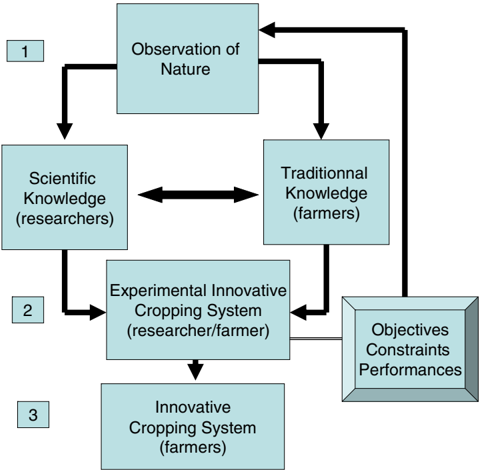
Despite huge gains in productivity, environmental impacts of industrial agriculture based on a few high-yielding crop cultivars and the massive use of chemical fertilisers and pesticides have led to a search for new pathways leading to more sustainable agriculture in both temperate and tropical regions. New strategies incorporating ecological knowledge gained from the observation of natural ecosystems is an alternative to design “ecologically intensive” agroecosystems. Such systems are indeed both ecological and productive. Designing ecologically intensive agroecosystems calls for in-depth knowledge of biological regulations in ecosystems, and for the integration of traditional agricultural knowledge held by local farmers. This article reviews the main initiatives underlying ecologically intensive agroecosystems, analyses basic concepts, and proposes a framework for action. The rainforest model, the dry forest model, and the American Prairie are exemplified as three main natural systems at the basis of the mimicry concept. The link between biodiversity and the mimicry hypotheses, and the use of the concepts of productivity, efficiency, stability, and resilience for agroecosystems are discussed. Six main principles for cropping system design based on natural ecosystem mimicry are identified. A three-step framework for action is proposed, including nature observation, experimental design, and participatory design. Although far from being a panacea, the mimicry approach can provide new ways for agroecosystem design both in temperate and tropical countries.
Overview
The claims and statistics of this paper haven’t been checked yet.
Free: it reads the open-access text and checks the first 5 claims that cite a source we can check. Create a free account to check every claim.
Integrity signals
Registry
Cites
Statistics
Figures

Verification
Claims the paper makes
The claims and statistics of this paper haven’t been checked yet.
Free: it reads the open-access text and checks the first 5 claims that cite a source we can check. Create a free account to check every claim.
Claims other papers make about this one
Each is checked against this paper’s own text: does it say what the citing paper says it does?
The cited source says what the claim attributes to it.
In the citing paper
“Based on the ecology of agricultural systems, their approach takes inspiration from natural or anthropized ecosystems to develop new objects at various scales (plot, farm, landscape) (Malézieux 2012).”
From Designing agroecological systems across scales: a new analytical framework (2022) · cites this paper as Malézieux 2012
The cited source says what the claim attributes to it.
In the citing paper
“Examples of such approaches include using the functional traits of a species, containing pests via complex trophic chains or using plant properties or other biological methods to control them (Malézieux 2012).”
From Designing agroecological systems across scales: a new analytical framework (2022) · cites this paper as Malézieux 2012
Self-check
Percentages, sums and reported differences re-computed from the paper’s own numbers.
The self-check needs the paper’s full text.
Citations
Cites
Resilience and Stability of Ecological Systems
Holling, C. S. (1973) · Annual Review of Ecology and Systematics · doi:10.1146/annurev.es.04.110173.000245 · Cited by 18,995 · cited 2×
“The concepts of production, efficiency, stability and resilience, as defined by Holling (1973), lie at the heart of natural ecosystem characterization by ecologists.”
BackgroundEFFECTS OF BIODIVERSITY ON ECOSYSTEM FUNCTIONING: A CONSENSUS OF CURRENT KNOWLEDGE
Hooper, D. U., Chapin, F. S., Ewel, J. J., Hector, A., Inchausti, P., Lavorel, S., Lawton, J. H., Lodge, D. M., Loreau, M., Naeem, S., et al. (2005) · Ecological Monographs · doi:10.1890/04-0922 · Cited by 8,046
Agricultural sustainability and intensive production practices
Tilman, D., Cassman, K. G., Matson, P. A., Naylor, R., & Polasky, S. (2002) · Nature · doi:10.1038/nature01014 · Cited by 7,957 · cited 1×
“Increased agricultural pressure on humans and on ecosystems means that it is now necessary to rethink the often unsustainable natural resource management methods used in agriculture (Brown et al. 2000; Tilman et al. 2002).”
BackgroundResilience, Adaptability and Transformability in Social–ecological Systems
Walker, B., Holling, C. S., Carpenter, S. R., & Kinzig, A. P. (2004) · Ecology and Society · doi:10.5751/es-00650-090205 · Cited by 7,821 · cited 3×
“More recently, Walker et al. (2004) proposed other attributes for ecosystem resilience: latitude (deformation limit beyond which a return to the initial state is impossible), resistance (varying degree of a system’s ability to change), precarity (closeness of the current state of the system to a…”
BackgroundInfluentialBiodiversity and ecosystem functioning: Current knowledge and future challenges
Loreau, M., Naeem, S., Inchausti, P., Bengtsson, J., Grime, J. P., Hector, A., Hooper, D. U., Huston, M. A., Raffaelli, D., Schmid, B., et al. (2001) · Science · doi:10.1126/science.1064088 · Cited by 4,649 · cited 1×
“A great deal of recent work has shown some positive correlations between biodiversity and primary productivity, nutrient retention and post-stress resilience in natural ecosystems (Hector et al. 1999; Loreau et al. 2001), but also in cultivated ecosystems (Altieri 1999).”
BackgroundAgricultural Intensification and Ecosystem Properties
Matson, P. A., Parton, W. J., Power, A. G., & Swift, M. J. (1997) · Science · doi:10.1126/science.277.5325.504 · Cited by 3,160 · cited 2×
“Modern agriculture, characterised by crop specialisation and a massive use of chemicals and energy, has generated and still generates major environmental problems on a local and global scale (Matson et al. 1997; Altieri 1999; Piper 1999; Figs.”
BackgroundLand mosaics: the ecology of landscapes and regions
(1996) · Choice Reviews Online · doi:10.5860/choice.33-6317 · Cited by 3,086
Productivity and sustainability influenced by biodiversity in grassland ecosystems.
Tilman, D., Wedin, D., & Knops, J. (1996) · Nature · doi:10.1038/379718a0 · Cited by 2,803 · cited 2×
“Tilman et al. (1996) assessed the sustainability of numerous prairie ecosystems characterised by different levels of biological diversity (number of plant species present).”
BackgroundThe ecological role of biodiversity in agroecosystems
Altieri, M. A. (1999) · Agriculture, Ecosystems & Environment · doi:10.1016/s0167-8809(99)00028-6 · Cited by 2,561
Land Mosaics: The Ecology of Landscapes and Regions
Forman, R. T. T., & Wilson, E. O. (1995) · doi:10.1017/9781107050327 · Cited by 2,386
Research works printed but not linked: 7
- 17. Dupraz C, Capillon A (2005) L'agroforesterie: une voie de diversification écologique de l'agriculture européenne? Cahier d'études DEMETER. Economie et Stratégie agricole, Paris, pp 101-113
- 30. Götz S, da Fonseca GAB, Harvey CA, Gascon C, Vasconcelos HL, Izac A-MN (eds) Agroforestry and biodiversity conservation in tropical landscapes. Island Press, Washington, pp 227-260
- 33. Gunderson LH, Holling CS (2002) Panarchy. Understanding transformation in human and natural systems. Island Press, Washington
- 53. Mitsch WJ (1996) Ecological engineering: a new paradigm for engineers and ecologists. In: Scultze PC (ed) Engineering with ecological constraints. National Academy Press, Washington DC, pp 114-132
- 57. O'Neill R (2001) Is it time to bury the ecosystem concept? Ecology 82 (12):3275-3284
- 70. Schroth G, Da Fonseca GAB, Harvey CA, Gascon C, Vasconcelos HL, Izac A-M (2004) Agroforestry and biodiversity conservation in tropical landscapes. Island Press, Washington
- 81. Vandermeer J (ed) (2003) Tropical agroecosystems. CRC Press, Florida, USA
Cited by
Items 101–200 of 395
Agroforesterie et services écosystémiques en zone tropicale
Seghieri, J., & Harmand, J. (2019) · Éditions Quæ eBooks · doi:10.35690/978-2-7592-3059-4 · Cited by 28
Gaudio, N., Violle, C., Gendre, X., Fort, F., Mahmoud, R., Pelzer, E., Médiène, S., Hauggaard‐Nielsen, H., Bedoussac, L., Bonnet, C., et al. (2021) · Journal of Applied Ecology · doi:10.1111/1365-2664.13979 · Cited by 30
Common ground: restoring land health for sustainable agriculture
Larbodière, L., Davies, J., Schmidt, R., Magero, C., Vidal, A., Schnell, A. A., Bücher, P., Maginnis, S., Cox, N., Hasinger, O., et al. (2020) · doi:10.2305/iucn.ch.2020.10.en · Cited by 28
Lescourret, F., Dutoit, T., Rey, F., Côté, F., Hamelin, M., & Lichtfouse, É. (2015) · Agronomy for Sustainable Development · doi:10.1007/s13593-015-0335-9 · Cited by 28
A review of intercropping systems in Western Canada
Mbanyele, V., Enesi, R. O., Shaw, L., & Gorim, L. Y. (2024) · Agronomy Journal · doi:10.1002/agj2.21622 · Cited by 27
La transition agro-écologique des agricultures du Sud
Côte, F.-X. (. )., Poirier-Magona, E. (. )., Perret, S. (. )., Roudier, P., Rapidel, B., & Thirion, M.-C. (. ). (2019) · Éditions Quæ eBooks · doi:10.35690/978-2-7592-2824-9 · Cited by 27
Crop planting layout optimization in sustainable agriculture: A constraint programming approach
Adamo, T., Colizzi, L., Dimauro, G., Guerriero, E., & Pareo, D. (2024) · Computers and Electronics in Agriculture · doi:10.1016/j.compag.2024.109162 · Cited by 26
Degrune, F., Boeraeve, F., Dufrêne, M., Cornelis, J., Frey, B., & Hartmann, M. (2019) · Frontiers in Ecology and Evolution · doi:10.3389/fevo.2019.00261 · Cited by 28
Queyrel, W., van Inghelandt, B., Colas, F., Cavan, N., Granger, S., Guyot, B., Réau, R., Derrouch, D., Chauvel, B. B., Maillot, T., et al. (2022) · SSRN Electronic Journal · doi:10.2139/ssrn.4252148 · Cited by 26
Possible Role of High Temperature and Soil Biological Fertility on Kiwifruit Early Decline Syndrome
Bardi, L., Nari, L., Morone, C., Faga, M. G., & Malusà, E. (2020) · Frontiers in Agronomy · doi:10.3389/fagro.2020.580659 · Cited by 23
“Alternatively, a more agro-ecological approach to orchard management (Malézieux, 2012) could also represent a technically and economically feasible solution to halt the spread of KEDS in kiwifruit orchards, by recreating the natural environmental conditions where Actinidia sp.”
BackgroundOrganic agriculture: impact on the environment and food quality
Gomiero, T. (2021) · Elsevier eBooks · doi:10.1016/b978-0-12-821363-6.00002-3 · Cited by 25
The impact of agricultural practices on food composition – A systematic review
Anim, A. O., Lutterodt, H. E., Ofori, C. W., Boateng, I. O., Bonsu, J. A., Ankar-Brewoo, G. M., Aduku, L. N. E., Apprey, C., & Annan, R. A. (2025) · Journal of Food Composition and Analysis · doi:10.1016/j.jfca.2025.108388 · Cited by 23
Livestock Farming Systems and Agroecology in the Tropics
Alexandre, G., Fanchone, A., Ozier‐Lafontaine, H., & Diman, J. (2014) · Sustainable agriculture reviews · doi:10.1007/978-3-319-06016-3_4 · Cited by 22
The role of spatial self-organization in the design of agroforestry systems
Tzuk, O., Uecker, H., & Meroni, E. (2020) · PLoS ONE · doi:10.1371/journal.pone.0236325 · Cited by 22
Salembier, C. (2019) · theses.fr (ABES) · doi:10.70675/078c7ae8z8716z445bzbbc1z87c6547e7b64 · Cited by 22
“…Rapidel et al., 2009), (ii) approaches used for designing specific technical options (e.g. intercropping - Barot et al., 2017; Gaba et al., 2015; Malézieux, 2012) and (iii) participatory design process involving multiple stakeholders (e.g. Brevault et al., 2014; Cardoso et al., 2001; Groot…”
BackgroundMethodEfecto de los árboles de sombra sobre el rendimiento de los cafetos, basado en perfiles de daño
Acuna, V., Cerda, R., & Avelino, J. (2016) · Agritrop (Cirad) · doi:10.13140/rg.2.2.27058.61124 · Cited by 21
Alignier, A., Carof, M., & Aviron, S. (2024) · Agricultural Systems · doi:10.1016/j.agsy.2024.104100 · Cited by 22
Fate of Fertilizer P in Soils—The Organic Pathway
Frossard, E., Bünemann, E. K., Gunst, L., Oberson, A., Schärer, M., & Tamburini, F. (2016) · Springer eBooks · doi:10.1007/978-94-017-7612-7_4 · Cited by 21
Agroecological Crop Protection in Organic Farming: Relevance and Limits
Deguine, J., & Penvern, S. (2014) · Springer eBooks · doi:10.1007/978-94-007-7927-3_6 · Cited by 21
Pastor‐Pastor, A., González‐Paleo, L., Vilela, A. E., & Ravetta, D. A. (2014) · Industrial Crops and Products · doi:10.1016/j.indcrop.2014.11.044 · Cited by 21
Deheuvels, O. (2011) · theses.fr (ABES) · doi:10.70675/df126ae8z6ceez4e95z8923z7c68b1b9e348 · Cited by 21
Schaller, N. (2011) · theses.fr (ABES) · doi:10.70675/89f7acbdz3a26z4d4dzad48z2915103cc9ba · Cited by 21
Marchi, M. D., Diantini, A., & Pappalardo, S. E. (2022) · CRC Press eBooks · doi:10.1201/9780429052842 · Cited by 20
Rousseau, G. X., Deheuvels, O., Celentano, D., Arias, I. R., Hernández-García, L. M., & Somarriba, E. (2021) · Pedobiologia · doi:10.1016/j.pedobi.2021.150770 · Cited by 20
Is the system of rice intensification (SRI) consonant with agroecology?
Deb, D. (2020) · Agroecology and Sustainable Food Systems · doi:10.1080/21683565.2020.1779165 · Cited by 19
Blanc, E., Barbillon, P., Fournier, C., Lecarpentier, C., Pradal, C., & Enjalbert, J. (2021) · Frontiers in Plant Science · doi:10.3389/fpls.2021.734056 · Cited by 19
Conversion of Mountain Beech Coppices into High Forest: An Example for Ecological Intensification
Mattioli, W., Ferrari, B., Giuliarelli, D., Mancini, L. D., Portoghesi, L., & Corona, P. (2015) · Environmental Management · doi:10.1007/s00267-015-0549-2 · Cited by 19
“Several authors (Ewel 1999; Altieri 2002; Jackson 2002; Vandermeer 2002; Malézieux 2012) have suggested that natural ecosystems may provide appropriate models for systems design to achieve both environmental and societal goals while ensuring long-term sustainability.”
BackgroundBorgo, A. G. D., Chiaffarelli, G., Capocefalo, V., Schievano, A., Bocchi, S., & Vagge, I. (2023) · Sustainability · doi:10.3390/su151411020 · Cited by 18
Agroforestry Practices as a Keystone for Biodiversity Conservation: A Review
VijayKumar, R., Lallawmkimi, M. C., Gautam, S. K., Tiwari, P., Aneesh, K. S., Sekhar, M., & Upadhyay, L. (2024) · Journal of Experimental Agriculture International · doi:10.9734/jeai/2024/v46i92805 · Cited by 18
Integrating Organic Fertilizers in Coconut Farming: Best Practices and Application Techniques
Atapattu, A. J., Nuwarapaksha, T. D., Udumann, S. S., & Dissanayaka, N. S. (2025) · Crops · doi:10.3390/crops5020017 · Cited by 19
“These fertilizers are made on the farm through composting, crop residues and other organic waste, hence greatly reducing the cost of purchasing costly chemical fertilizers [71].”
Notaro, M., Deheuvels, O., & Gary, C. (2021) · European Journal of Agronomy · doi:10.1016/j.eja.2021.126395 · Cited by 18
Future agricultures: The promise and pitfalls of a (re)turn to nature
Sumberg, J. (2022) · Outlook on Agriculture · doi:10.1177/00307270221078027 · Cited by 18
Ecological Intensification for Crop Protection
Ratnadass, A., & Barzman, M. S. (2014) · Sustainable agriculture reviews · doi:10.1007/978-3-319-06016-3_3 · Cited by 18
“Ecological Intensifi cation To some extent, crop protection issues are also central in the “ecological intensifi cation” approach, where natural ecosystems serve as a source of inspiration (Doré et al. 2011 ; Malézieux 2012 ).”
BackgroundAccompagner le changement en agriculture : du non labour à l’agriculture de conservation
de Tourdonnet, S., Brives, H., Denis, M., Omon, B., & Thomas, F. (2013) · HAL · Cited by 18
Khanal, N. (2022) · Canadian Journal of Plant Science · doi:10.1139/cjps-2022-0125 · Cited by 17
“The fragile soils undergoing simplified rotations with high dependence on external inputs may compromise the resilience of production systems (Malézieux 2012; Bowles et al. 2020; Petersen-Rockney et al. 2021).”
BackgroundLangensiepen, M., Opiyo, E., Kaudia, A. A., Rugege, D., Richard, K., Akotsi, E., Ashitiva, D., Ningu, J. K., Munyazikwiye, F., Ngaboyamahina, T., et al. (2023) · Wetlands · doi:10.1007/s13157-023-01679-2 · Cited by 18
Trends in agroforestry research over 4 decades
Hastings, Z., Ocloo, X. S., Chapman, M., Hunt, L. G., & Stenger, K. (2023) · Elementa Science of the Anthropocene · doi:10.1525/elementa.2022.00151 · Cited by 17
Sustainable agriculture and Nature-based Solutions
Demozzi, T., Oberč, B. P., López, A. P., Larbodière, L., & Borges, M. A. (2024) · doi:10.2305/ezvw9195 · Cited by 17
Carrillo, F. Á., Molina, J. R., & Suárez, J. C. (2013) · Ciencia y Tecnología Agropecuaria · doi:10.21930/rcta.vol13_num2_art:249 · Cited by 17
Fuentes, M. T., Lenardis, A. E., & de la Fuente, E. B. (2017) · Agriculture Ecosystems & Environment · doi:10.1016/j.agee.2017.12.007 · Cited by 17
Linking integrative plant physiology with agronomy to sustain future plant production
Langensiepen, M., Jansen, M. A. K., Wingler, A., Demmig‐Adams, B., Adams, W. W., Dodd, I. C., Fotopoulos, V., Snowdon, R. J., Fenollosa, E., Tullio, M. C. D., et al. (2020) · Environmental and Experimental Botany · doi:10.1016/j.envexpbot.2020.104125 · Cited by 17
Shi, Y., Pinsard, C., & Accatino, F. (2021) · Regional Environmental Change · doi:10.1007/s10113-021-01818-7 · Cited by 17
“2011) and less dependence on fossil fuels (Malézieux 2012).”
BackgroundDubs, F., Enjalbert, J., Barot, S., Porcher, E., Allard, V., de Vallavieille-Pope, C., Gauffreteau, A., Niboyet, A., Pommier, T., Saint‐Jean, S., et al. (2023) · Agronomy for Sustainable Development · doi:10.1007/s13593-023-00924-6 · Cited by 18
“There is thus a need for an environmental transition in agriculture (Altieri 1999; Foley et al. 2011), which can be achieved by reinforcing ecological functions through better management of cultivated and wild biodiversity (Foley et al. 2011; Eggermont et al. 2015; Malézieux 2011).”
Gardening in an urban farm: A way to reconnect citizens with the soil
Scheromm, P., & Javelle, A. (2022) · Urban forestry & urban greening · doi:10.1016/j.ufug.2022.127590 · Cited by 17
Designing agroecological systems across scales: a new analytical framework
Belmin, R., Malézieux, E., Basset-Mens, C., Martin, T., Mottes, C., Della Rossa, P., Vayssières, J.-F., & Le Bellec, F. (2022) · Agronomy for Sustainable Development · doi:10.1007/s13593-021-00741-9 · Cited by 35
“Examples of such approaches include using the functional traits of a species, containing pests via complex trophic chains or using plant properties or other biological methods to control them (Malézieux 2012).”
BackgroundMethodAffichard, M., Jacquelin, M., Khalil, T., Andrivon, D., & May, C. L. (2024) · Agronomy · doi:10.3390/agronomy14061210 · Cited by 17
da Silva, J. D. L., de Oliveira, E. G., Soares, L. A. D. C., Gomes, R. L. F., da Costa, A. F., de Barros, R. F. M., Almeida, R. D. C., da Silva, V. B., Costa, M. F., & Lopes, Â. C. D. A. (2023) · Genetic Resources and Crop Evolution · doi:10.1007/s10722-023-01553-4 · Cited by 15
Boudsocq, S., Cros, C., Hinsinger, P., & Lambers, H. (2022) · Plant and Soil · doi:10.1007/s11104-022-05558-3 · Cited by 15
Parseval, H. D., Abbadie, L., Barot, S., Gignoux, J., Lata, J., & Raynaud, X. (2015) · Oikos · doi:10.1111/oik.02726 · Cited by 15
“Finally, reduced soil exploration could be an interesting trait for producing more nutrient-efficient crops, that are needed to develop more sustainable agricultural systems (Weiner et al. 2010, Malézieux 2011, Subbarao et al. 2013).”
BackgroundTessier, L., Bijttebier, J., Marchand, F., & Baret, P. V. (2020) · Agroecology and Sustainable Food Systems · doi:10.1080/21683565.2020.1755764 · Cited by 15
Burdock, R. P., & Ampt, P. (2017) · Journal of Agricultural Science · doi:10.5539/jas.v9n5p1 · Cited by 14
Blanco, J., Michon, G., & Carrière, S. M. (2017) · Journal of Environmental Management · doi:10.1016/j.jenvman.2017.08.030 · Cited by 14
d’Orbcastel, E. R., Lutier, M., Floc’h, E. L., Ruelle, F., Triplet, S., Gall, P. L., Hubert, C., Fortune, M., Laugier, T., Geoffroy, T., et al. (2022) · Aquaculture International · doi:10.1007/s10499-022-00953-0 · Cited by 13
Javelle, A. (2021) · Tracés · doi:10.4000/traces.12135 · Cited by 13
Bank, G., Vaisman, I., Entz, M. H., & Wonneck, M. D. (2013) · Cited by 13
Notes on autonomy as an agroecological principle
de Molina, M. G. (2025) · Agroecology and Sustainable Food Systems · doi:10.1080/21683565.2025.2502092 · Cited by 12
“The structure and functioning of systems such as tropical dry forests, American prairies, the dehesa system in the Iberian Peninsula, etc. has been a source of inspiration for the design of sustainable agroecosystems (Malézieux 2012).”
Potential of Wild Species in the Scenario of Climate Change
Jordanovska, S., Јоvоvić, Z., & Andjelković, V. (2020) · Springer eBooks · doi:10.1007/978-981-15-0156-2_10 · Cited by 12
Parada, S. P., & Salas, C. B. (2023) · Land · doi:10.3390/land13010039 · Cited by 12
Challand, M., Vismara, P., & de Tourdonnet, S. (2024) · Agricultural Systems · doi:10.1016/j.agsy.2024.104154 · Cited by 12
From Artificialization to the Ecologization of Cropping Systems
Maraux, F., Malézieux, É., & Gary, C. (2013) · Springer eBooks · doi:10.1007/978-94-007-7984-6_3 · Cited by 12
Lovell, S. T., Stanek, E. C., & Revord, R. S. (2021) · Springer eBooks · doi:10.1007/978-3-030-80060-4_17 · Cited by 12
Ecosystem Services of Multispecific and Multistratified Cropping Systems
Valet, S., & Ozier‐Lafontaine, H. (2014) · Sustainable agriculture reviews · doi:10.1007/978-3-319-06016-3_7 · Cited by 12
Pastor‐Pastor, A., Vilela, A. E., & González‐Paleo, L. (2018) · Annals of Applied Biology · doi:10.1111/aab.12441 · Cited by 13
“These mechanisms involve a reduction in N storage and conservation that would lead to a higher reliance on external inputs and affect following year’s regrowth, thus, reducing yield stability and life span (Jackson & Koch, 1997; Malézieux, 2012; Pimentel et al., 2012; Crews et al., 2016).”
BackgroundLe conseil agricole coopératif à l'épreuve de l'environnement : une enquête en Champagne-Ardenne
Villemaine, R. (2016) · theses.fr (ABES) · doi:10.70675/659c7358zab50z4c85zb162z84d6600b59ed · Cited by 12
van Frank, G. (2018) · theses.fr (ABES) · doi:10.70675/98e9f34az5dfez444ez9a78z6190fac19413 · Cited by 12
Continuous cropping obstacles in fungal production: A review of mechanisms and remedial strategies
Li, W., Li, X., Zhang, K., Liu, J., Wei, M., Yang, Z., Peng, Y., & Zhang, B. (2025) · Soil Use and Management · doi:10.1111/sum.70014 · Cited by 11
“In addition, simulating wild cultivation makes it difficult to accurately control yield and may lead to unstable production (Jaggard et al., 2010; Malézieux, 2012).”
New Paradigms in Soil Health Management for Sustainable Production of Plantation Crops
THOMAS, G. V., Krishnakumar, V., & Prabhu, S. R. (2024) · Springer eBooks · doi:10.1007/978-981-97-0092-9_11 · Cited by 12
Yao, X., Liao, L., Huang, Y., Fan, G., Yang, M., & Ye, S. (2021) · BMC Plant Biology · doi:10.1186/s12870-021-02969-9 · Cited by 11
“Thus, ecological mechanisms that occur in natural ecosystems to sustain productivity should be utilized [10], and the slight drop in productivity could be worth the reduced fertilizer costs if the difficulties of implementing mixed plantations are overcome by forest managers [1, 9].”
BackgroundRahajaharilaza, K., Muller, B., Violle, C., Brocke, K. V., Ramavovololona, R., Morel, J., Ballini, E., & Fort, F. (2023) · Frontiers in Plant Science · doi:10.3389/fpls.2023.1266704 · Cited by 10
Sensors and sensing practices: shaping farming system strategies toward agricultural sustainability
Gorissen, L., Konrad, K., & Turnhout, E. (2025) · Agriculture and Human Values · doi:10.1007/s10460-024-10686-w · Cited by 10
“…is based on a radical reduction and eventual elimination of exogenous inputs through high biological diversification and intensified ecological interac - tions to enhance fertility, productivity, and resilience (Kre-men et al. 2012; Bellon and Hemptinne 2012 ; Malézieux 2012; Duru et al. 2015a).”
Abán, C. L., Larama, G., Ducci, A., Huidobro, J., Abanto, M., Gil, S. V., & Brandán, C. P. (2022) · Sustainability · doi:10.3390/su15010488 · Cited by 10
The conservation of arable weeds at crop edges of barley fields in northeast Spain
José‐María, L., Armengot, L., Chamorro, L., & Sans, F. X. (2013) · Annals of Applied Biology · doi:10.1111/aab.12032 · Cited by 10
Increased farmer income evidenced by a new multifunctional actor network in China
Zheng, L., & Liu, H. (2013) · Agronomy for Sustainable Development · doi:10.1007/s13593-013-0169-2 · Cited by 10
“In this system, a strong economic function may weaken other functions in rural areas (Malézieux 2012).”
BackgroundVollheyde, A., Cebrián‐Piqueras, M. A., & von Haaren, C. (2024) · Legume Science · doi:10.1002/leg3.246 · Cited by 9
Agroforestry System: A Game Changer for Sustainable Land Use Practices
Atapattu, A. J., Nuwarapaksha, T. D., Udumann, S. S., & Dissanayaka, N. S. (2025) · Springer eBooks · doi:10.1007/978-3-031-97151-8_9 · Cited by 11
Ebbisa, A. F. (2023) · IntechOpen eBooks · doi:10.5772/intechopen.110742 · Cited by 9
Cropping Systems and Application of Models
Ahmed, M., Ahmad, S., Abbas, G., Hussain, S., & Hoogenboom, G. (2024) · Springer eBooks · doi:10.1007/978-981-97-0331-9_1 · Cited by 9
Boiffin, J., Doré, T., Kockmann, F., Papy, F., & Prévost, P. (2022) · Éditions Quæ eBooks · doi:10.35690/978-2-7592-3542-1 · Cited by 9
Co-design and establishment of innovative fruit-based agroforestry cropping systems in Belgium
Jamar, L., Rondia, A., Lateur, M., Minet, L., Froncoux, A., & Stilmant, D. (2016) · Acta Horticulturae · doi:10.17660/actahortic.2016.1137.48 · Cited by 9
“A literature review, as well as visits to current agroforestry system experiments, gave us insight into the prospects and limits of system designs and the basic ecological processes to be optimized (Malézieux, 2012).”
BackgroundLi, W., Teng, X., Zhang, H., Liu, T., Wang, Q., GuoHui, Y., & Guo, X. (2017) · PLoS ONE · doi:10.1371/journal.pone.0171948 · Cited by 9
Patel, S. K., Singh, A., & Singh, G. S. (2019) · International Journal of Current Microbiology and Applied Sciences · doi:10.20546/ijcmas.2019.801.020 · Cited by 9
Harrison, R. J., Edwards, T. J., Steel, E. J., Yates, R. J., Nutt, B. J., & Howieson, J. G. (2021) · Agronomy for Sustainable Development · doi:10.1007/s13593-021-00704-0 · Cited by 9
“These interactions must be understood if perennial plants are to be developed for the advancement of sustainable agriculture and agroecology (Crews et al. 2016; Edwards et al. 2019; Wezel et al. 2009; Malézieux 2012).”
BackgroundRestoring social and ecological relationships in the agroecosystems of Canada's prairie region
Martens, J. R. T. (2022) · Outlook on Agriculture · doi:10.1177/00307270221077356 · Cited by 9
“Production systems that closely mimic the natural ecosystem, such as diversified perennial grains and forages, may offer the greatest ecological benefits (Bonin and Tracy, 2012; Malézieux, 2012; Ryan et al., 2018) but do not meet current human demand for annual crop products.”
BackgroundAlsabbagh, P., Gay, L., Colombo, M., Montazeaud, G., Ardisson, M., Rocher, A., Allard, V., & David, J. (2022) · PLoS ONE · doi:10.1371/journal.pone.0276223 · Cited by 9
Sustainability in Agriculture and Local Food Systems: A Solution to a Global Crisis
Gibbons, C., Morgan, B., Kavouras, J. H., & Othmen, M. A. B. (2020) · Encyclopedia of the UN sustainable development goals · doi:10.1007/978-3-319-69626-3_116-1 · Cited by 9
Lecarpentier, C. (2017) · theses.fr (ABES) · doi:10.70675/b949cc31z0696z42bcz97d5zbc70be0029ee · Cited by 9
Mottes, C. (2013) · theses.fr (ABES) · doi:10.70675/b8f50737z5ab0z4cf4za9daz1fd5d075a402 · Cited by 9
Regenerative Supply Chains: A Knowledge Polycentrism View
Dentoni, D., & Pascucci, S. (2026) · Journal of Supply Chain Management · doi:10.1111/jscm.70017 · Cited by 8
Penerapan Pertanian Regeneratif pada Perkebunan Kopi
Evizal, R., & Prasmatiwi, F. E. (2024) · JURNAL AGROTROPIKA · doi:10.23960/ja.v23i1.8571 · Cited by 8
“Untuk memperoleh produktivitas dan efisiensi yang tinggi, sistem ini mensimplifikasi agroekosistem yaitu mengembangkan beberapa varietas unggul dari hanya satu spesies tanaman (Malézieux, 2012).”
BackgroundResource Management in Agroecosystems
Ondrašek, G., & Zhang, L. (2022) · IntechOpen eBooks · doi:10.5772/intechopen.104280 · Cited by 8
Practicing Agroecology: Management Principles Drawn From Small Farming in Misiones (Argentina)
Girard, N., Magda, D. D., Noseda, C. N., & Sarandón, S. J. (2015) · Agroecology and Sustainable Food Systems · doi:10.1080/21683565.2015.1020081 · Cited by 8
“Several authors have pointed out the necessity to bridge the design of sustainable systems from agroecological rules and the analysis of “traditional systems” showing a very low degree of artificialization (Toledo et al. 2003; Altieri 2009; Malézieux 2012).”
BackgroundImpact of crop genetic diversity on a litter consumer
Chassé, P., Pelosi, C., Lata, J., & Barot, S. (2019) · Basic and Applied Ecology · doi:10.1016/j.baae.2019.02.002 · Cited by 8
“The results of agroecological or 87 ecological engineering experiments suggest that increasing biodiversity in agrosystems to 88 mimic natural ecosystems could be a way to benefit from the services provided by 89 biodiversity and consequently lower the use of chemical inputs (Malézieux, 2011).”
BackgroundChanges, Adaptations, and Resilience: The Case of French Oyster Farming
Mariojouls, C., & Prou, J. (2015) · Springer eBooks · doi:10.1007/978-3-319-13878-7_33 · Cited by 8
Sida, T. S. (2018) · doi:10.18174/425918 · Cited by 8
Ecological and Economic Potentials of Cocoa Agroforestry Systems in the Center Region of Cameroon
Nadège, M. T., Simo, C., Roger, K. B. L. P., Chimi, C. D., Godswill, N. N., Flore, N. Y. A., Carole, T. M., Mireil, T. V., & Zapfack, L. (2020) · American Journal of Agriculture and Forestry · doi:10.11648/j.ajaf.20200805.15 · Cited by 7
Prevention and management of plant protection product transfers within the environment: A review
Tournebize, J., Bedos, C., Corio‐Costet, M., Douzals, J., Gouy, V., Bellec, F. L., Achard, A.-L., & Mamy, L. (2024) · Environmental Science and Pollution Research · doi:10.1007/s11356-024-35496-9 · Cited by 7
“The agronomic approaches favouring the reduction of PPP use, e.g. agroecology (Doré et al. 2011; Malézieux 2012) or integrated pest management (IPM) (Barzman et al. 2015), have not been covered in this review which rather focuses on levers for reducing PPP transfer when they are used.”
Designer cropping systems in phytoremediation programs
Pandey, V. C., Gajić, G., Lebrun, M., & Mahajan, P. (2023) · Elsevier eBooks · doi:10.1016/b978-0-323-95618-5.00006-3 · Cited by 7
Permaculture as farming practice and international grassroots network: a multidisciplinary study
Ferguson, J. R. (2015) · Illinois Digital Environment for Access to Learning and Scholarship (University of Illinois at Urbana-Champaign) · Cited by 7
Metadata
- Authors
- Malézieux, E.
- Venue
- Agronomy for Sustainable Development
- Published
- 2011-06-01
- Volume
- 32
- Issue
- 1
- Pages
- 15-29
- ISSN
- 1773-0155 (ISSN-L)
- 1774-0746
- OpenAlex
- W2044459925
- Cited by
- 295
- References
- 100
- Citations by year
- 2026: 14 · 2025: 17 · 2024: 19 · 2023: 23 · 2022: 26 · 2021: 26 · 2020: 25 · 2019: 23 · 2018: 21 · 2017: 23 · 2016: 18 · 2015: 18 · 2014: 15 · 2013: 21 · 2012: 4
- FWCI
- 25.89
- Type
- journal article
- Language
- en
- Open access
- hybrid
- doi.org
- Licence
- cc-by-nc
- Locations
- Agronomy for Sustainable Development (publishedVersion, cc-by-nc)
- HAL (submittedVersion, other-oa)
- Agritrop (Cirad) (submittedVersion)
- Topics
- Life Sciences › Agricultural and Biological Sciences › Agronomy and Crop Science › Agronomic Practices and Intercropping Systems
- Life Sciences › Agricultural and Biological Sciences › General Agricultural and Biological Sciences › Plant and soil sciences
- Life Sciences › Agricultural and Biological Sciences › Forestry › Agroforestry and silvopastoral systems
- Keywords
- agroecosystem design, cropping systems, biodiversity, agroecosystem resilience, agroecosystem stability, efficiency, traditional agricultural knowledge, participatory design, sustainable agriculture
About these checks
Registry, retraction, Cites and statistics results are computed, not judged, with one exception: a printed reference that no index lists is read once by a model before it counts as a citation error. Claims are extracted by a model and kept only when their quote appears verbatim in the text; each cited source is then checked, with a model’s help, for whether it says what the claim relies on. Those verdicts can be wrong — read the claim’s quote and the cited source before relying on one.
Statistics and arithmetic are recomputed, not judged.
Confidence bands are shown only for fields calibrated on our annotated test set. None is calibrated yet, so no band is shown.
What counts as a claim ›How we measure confidence ›How we check this ›
Are you an author, or do you see a problem with this page? Request a review
Data sources
Bibliographic data: Semantic Scholar, OpenAlex, Crossref.
Contains information from the Semantic Scholar Academic Graph Datasets, made available under the ODC Attribution License (ODC-BY 1.0).
Semantic Scholar’s data is described in: Kinney, R., et al. (2023). The Semantic Scholar Open Data Platform. arXiv:2301.10140.
