

Designing cropping systems from nature
Open accessThe DOI matches its Crossref record; 100 of the 100 references it cites were found in a registry or an index.
Abstract
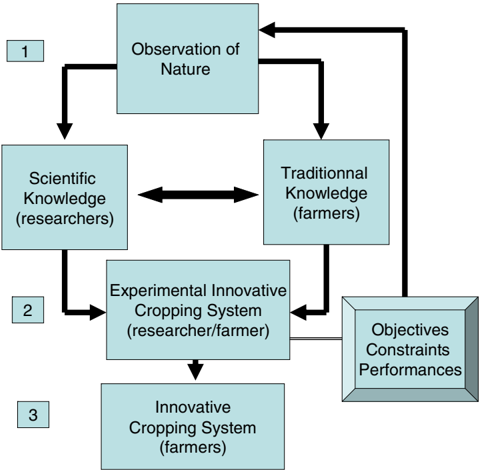
Despite huge gains in productivity, environmental impacts of industrial agriculture based on a few high-yielding crop cultivars and the massive use of chemical fertilisers and pesticides have led to a search for new pathways leading to more sustainable agriculture in both temperate and tropical regions. New strategies incorporating ecological knowledge gained from the observation of natural ecosystems is an alternative to design “ecologically intensive” agroecosystems. Such systems are indeed both ecological and productive. Designing ecologically intensive agroecosystems calls for in-depth knowledge of biological regulations in ecosystems, and for the integration of traditional agricultural knowledge held by local farmers. This article reviews the main initiatives underlying ecologically intensive agroecosystems, analyses basic concepts, and proposes a framework for action. The rainforest model, the dry forest model, and the American Prairie are exemplified as three main natural systems at the basis of the mimicry concept. The link between biodiversity and the mimicry hypotheses, and the use of the concepts of productivity, efficiency, stability, and resilience for agroecosystems are discussed. Six main principles for cropping system design based on natural ecosystem mimicry are identified. A three-step framework for action is proposed, including nature observation, experimental design, and participatory design. Although far from being a panacea, the mimicry approach can provide new ways for agroecosystem design both in temperate and tropical countries.
Overview
The claims and statistics of this paper haven’t been checked yet.
Free: it reads the open-access text and checks the first 5 claims that cite a source we can check. Create a free account to check every claim.
Integrity signals
Registry
Cites
Statistics
Figures

Verification
Claims the paper makes
The claims and statistics of this paper haven’t been checked yet.
Free: it reads the open-access text and checks the first 5 claims that cite a source we can check. Create a free account to check every claim.
Claims other papers make about this one
Each is checked against this paper’s own text: does it say what the citing paper says it does?
The cited source says what the claim attributes to it.
In the citing paper
“Based on the ecology of agricultural systems, their approach takes inspiration from natural or anthropized ecosystems to develop new objects at various scales (plot, farm, landscape) (Malézieux 2012).”
From Designing agroecological systems across scales: a new analytical framework (2022) · cites this paper as Malézieux 2012
The cited source says what the claim attributes to it.
In the citing paper
“Examples of such approaches include using the functional traits of a species, containing pests via complex trophic chains or using plant properties or other biological methods to control them (Malézieux 2012).”
From Designing agroecological systems across scales: a new analytical framework (2022) · cites this paper as Malézieux 2012
Self-check
Percentages, sums and reported differences re-computed from the paper’s own numbers.
The self-check needs the paper’s full text.
Citations
Cites
Resilience and Stability of Ecological Systems
Holling, C. S. (1973) · Annual Review of Ecology and Systematics · doi:10.1146/annurev.es.04.110173.000245 · Cited by 18,995 · cited 2×
“The concepts of production, efficiency, stability and resilience, as defined by Holling (1973), lie at the heart of natural ecosystem characterization by ecologists.”
BackgroundEFFECTS OF BIODIVERSITY ON ECOSYSTEM FUNCTIONING: A CONSENSUS OF CURRENT KNOWLEDGE
Hooper, D. U., Chapin, F. S., Ewel, J. J., Hector, A., Inchausti, P., Lavorel, S., Lawton, J. H., Lodge, D. M., Loreau, M., Naeem, S., et al. (2005) · Ecological Monographs · doi:10.1890/04-0922 · Cited by 8,046
Agricultural sustainability and intensive production practices
Tilman, D., Cassman, K. G., Matson, P. A., Naylor, R., & Polasky, S. (2002) · Nature · doi:10.1038/nature01014 · Cited by 7,957 · cited 1×
“Increased agricultural pressure on humans and on ecosystems means that it is now necessary to rethink the often unsustainable natural resource management methods used in agriculture (Brown et al. 2000; Tilman et al. 2002).”
BackgroundResilience, Adaptability and Transformability in Social–ecological Systems
Walker, B., Holling, C. S., Carpenter, S. R., & Kinzig, A. P. (2004) · Ecology and Society · doi:10.5751/es-00650-090205 · Cited by 7,821 · cited 3×
“More recently, Walker et al. (2004) proposed other attributes for ecosystem resilience: latitude (deformation limit beyond which a return to the initial state is impossible), resistance (varying degree of a system’s ability to change), precarity (closeness of the current state of the system to a…”
BackgroundInfluentialBiodiversity and ecosystem functioning: Current knowledge and future challenges
Loreau, M., Naeem, S., Inchausti, P., Bengtsson, J., Grime, J. P., Hector, A., Hooper, D. U., Huston, M. A., Raffaelli, D., Schmid, B., et al. (2001) · Science · doi:10.1126/science.1064088 · Cited by 4,649 · cited 1×
“A great deal of recent work has shown some positive correlations between biodiversity and primary productivity, nutrient retention and post-stress resilience in natural ecosystems (Hector et al. 1999; Loreau et al. 2001), but also in cultivated ecosystems (Altieri 1999).”
BackgroundAgricultural Intensification and Ecosystem Properties
Matson, P. A., Parton, W. J., Power, A. G., & Swift, M. J. (1997) · Science · doi:10.1126/science.277.5325.504 · Cited by 3,160 · cited 2×
“Modern agriculture, characterised by crop specialisation and a massive use of chemicals and energy, has generated and still generates major environmental problems on a local and global scale (Matson et al. 1997; Altieri 1999; Piper 1999; Figs.”
BackgroundLand mosaics: the ecology of landscapes and regions
(1996) · Choice Reviews Online · doi:10.5860/choice.33-6317 · Cited by 3,086
Productivity and sustainability influenced by biodiversity in grassland ecosystems.
Tilman, D., Wedin, D., & Knops, J. (1996) · Nature · doi:10.1038/379718a0 · Cited by 2,803 · cited 2×
“Tilman et al. (1996) assessed the sustainability of numerous prairie ecosystems characterised by different levels of biological diversity (number of plant species present).”
BackgroundThe ecological role of biodiversity in agroecosystems
Altieri, M. A. (1999) · Agriculture, Ecosystems & Environment · doi:10.1016/s0167-8809(99)00028-6 · Cited by 2,561
Land Mosaics: The Ecology of Landscapes and Regions
Forman, R. T. T., & Wilson, E. O. (1995) · doi:10.1017/9781107050327 · Cited by 2,386
Plant diversity and productivity experiments in european grasslands
Hector, A., Schmid, B., Beierkuhnlein, C., Caldeira, M. C., Diemer, M., Dimitrakopoulos, P. G., Finn, J. A., Freitas, H., Giller, P. S., Good, J., et al. (1999) · Science · doi:10.1126/science.286.5442.1123 · Cited by 2,125 · cited 1×
“By incorporating certain characteristics of natural ecosystems into cultivated agrosystems, it can be hoped to confer upon them certain worthwhile properties, such as productivity (Fukai 1993), stability (Aerts 1999 ;S chulte et al. 2002), resilience, notably with regard to pest attacks (Trenbath 1993), energy efficie…”
BackgroundAgroecology as a science, a movement and a practice. A review
Wezel, A., Bellon, S., Doré, T., Francis, C., Vallod, D., & David, C. (2009) · Agronomy for Sustainable Development · doi:10.1051/agro/2009004 · Cited by 1,504 · cited 3×
“Westman (1978) specifies that the resilience of an ecosystem can be characterised by its elasticity (time needed for restoration), its amplitude (degree of modification reached before restoration), its hysteresis (varying degree of asymmetry in alteration and restoration paths) and its malleability (capacity of the ec…”
BackgroundInfluentialConservation agriculture and smallholder farming in Africa : the heretics ’ view
Giller, K. E., Witter, E., Corbeels, M., & Tittonell, P. (2009) · Field Crops Research · doi:10.1016/j.fcr.2009.06.017 · Cited by 1,499 · cited 1×
“Despite their apparent advantages, these direct-seeding techniques are not very widely used for the moment in Europe (Holland 2004) and in small-scale tropical agriculture, for biophysical, technological, organisational and institutional reasons (Erenstein 2003; Giller et al. 2009).”
BackgroundBiodiversity and Ecosystem Function
(1993) · Springer eBooks · doi:10.1007/978-3-642-58001-7 · Cited by 1,311
From Balance of Nature to Hierarchical Patch Dynamics: A Paradigm Shift in Ecology
Wu, J., & Loucks, O. L. (1995) · The Quarterly Review of Biology · doi:10.1086/419172 · Cited by 1,246
Agroecology: the science of natural resource management for poor farmers in marginal environments
Altieri, M. A. (2002) · Agriculture, Ecosystems & Environment · doi:10.1016/s0167-8809(02)00085-3 · Cited by 1,136 · cited 3×
“That is the hypothesis put forward today by some agronomists (Ewel 1999; Altieri 2002; Jackson 2002; Vandermeer 2003).”
BackgroundThe environmental consequences of adopting conservation tillage in Europe: reviewing the evidence
Holland, J. M. (2004) · Agriculture, Ecosystems & Environment · doi:10.1016/j.agee.2003.12.018 · Cited by 1,062 · cited 4×
“However, an awareness arose in Europe and USA in the 1970s, then rapidly in Africa too, and in most developing countries, of the limitations (mostly environmental but also social) of this intensification model and of the race for productivity through chemical intensification and simplification of the systems (Pimentel…”
BackgroundInfluentialAgroecology: The Ecology of Sustainable Food Systems
Gliessman, S. R. (2007) · Andalas University Repository (Andalas University) · Cited by 1,061
Shade Coffee: A Disappearing Refuge for Biodiversity
Perfecto, I., Rice, R. A., Greenberg, R., & van der Voort, M. E. (1996) · BioScience · doi:10.2307/1312989 · Cited by 1,040 · cited 2×
“The same applies to animal biodiversity (Perfecto et al. 1996; Leakey 1999; Perfecto and Armbrecht 2003).”
BackgroundAgroecology: The Ecology of Food Systems
Francis, C., Lieblein, G., Gliessman, S., Breland, T. A., Creamer, N., Harwood, R., Salomonsson, L., Helenius, J., Rickerl, D., Salvador, R., et al. (2003) · Journal of Sustainable Agriculture · doi:10.1300/j064v22n03_10 · Cited by 975 · cited 2×
“…agroecology may consider different meanings and scales (Wesel et al. 2009), the sciences of agroecology (Altieri 1995, 2002; Dalgaard et al. 2003; Francis et al. 2003; Gliessman 2007), and landscape ecology (Forman 1995) propose today to embrace ecological and farmers’ knowledge in agroecosystem…”
BackgroundAgroecology: The Science Of Sustainable Agriculture, Second Edition
Altieri, M. A. (1995) · Medical Entomology and Zoology · Cited by 904
Mixing plant species in cropping systems: concepts, tools and models. A review
Malézieux, E., Crozat, Y., Dupraz, C., Laurans, M., Makowski, D., Ozier-Lafontaine, H., Rapidel, B., Tourdonnet, S., & Valantin-Morison, M. (2009) · Agronomy for Sustainable Development · doi:10.1051/agro:2007057 · Cited by 835 · cited 3×
“Positive correlations between biodiversity and productivity, nutrient retention, and post-stress resilience have also been found in cultivated ecosystems (Altieri 1999; Malézieux et al. 2009).”
BackgroundFood Production and the Energy Crisis
Pimentel, D., Hurd, L. E., Bellotti, A. C., Forster, M. J., Oka, I. N., Sholes, O. D., & Whitman, R. J. (1973) · Science · doi:10.1126/science.182.4111.443 · Cited by 825 · cited 2×
“However, an awareness arose in Europe and USA in the 1970s, then rapidly in Africa too, and in most developing countries, of the limitations (mostly environmental but also social) of this intensification model and of the race for productivity through chemical intensification and simplification of the systems (Pimentel…”
BackgroundAgroforestry and Biodiversity Conservation in Tropical Landscapes
(2005) · Princeton University Press eBooks · doi:10.2307/jj.41003705 · Cited by 812
Biodiversity and ecosystem services in agricultural landscapes—are we asking the right questions?
Swift, M. J., Izac, A.-M. N., & van Noordwijk, M. (2004) · Agriculture, Ecosystems & Environment · doi:10.1016/j.agee.2004.01.013 · Cited by 778 · cited 1×
“More generally, interest in incorporating biodiversity into agricultural systems and in ways of exploiting ecosystem services has grown (Gross and Smith 2002; Swift et al. 2004; Clergue et al. 2005; Jackson et al. 2005) and can create the basis for constructing new cropping systems (Vandermeer 1995; Malézieux et al.”
BackgroundRatnadass, A., Fernandes, P., Avelino, J., & Habib, R. (2012) · Agronomy for Sustainable Development · doi:10.1007/s13593-011-0022-4 · Cited by 775 · cited 1×
“The approach consists in promoting habitats that are suitable for the native useful fauna and unsuitable for harmful fauna ( Ratnadass et al. 2011 ).”
BackgroundAltieri, M. A. (1995) · doi:10.3362/9781788532310 · Cited by 612
Biodiversity and Ecosystem Function.
Hodgson, J., Schulze, E.-D., & Mooney, H. A. (1994) · The Journal of Ecology · doi:10.2307/2261463 · Cited by 570
Aerts, R. (1999) · Journal of Experimental Botany · doi:10.1093/jexbot/50.330.29 · Cited by 522 · cited 2×
“…into cultivated agrosystems, it can be hoped to confer upon them certain worthwhile properties, such as productivity (Fukai 1993), stability (Aerts 1999; Schulte et al. 2002), resilience, notably with regard to pest attacks (Trenbath 1993), energy efficiency in a context of depleted fossil…”
BackgroundDoré, T., Makowski, D., Malézieux, E., Munier-Jolain, N., Tchamitchian, M., & Tittonell, P. (2011) · European Journal of Agronomy · doi:10.1016/j.eja.2011.02.006 · Cited by 474 · cited 1×
“These new paradigms may deeply orientate the future of agronomy as a discipline (Doré et al. 2011).”
BackgroundSanchez, P. A. (1995) · Forestry Sciences · doi:10.1007/978-94-017-0681-0_1 · Cited by 460
Sanchez, P. A. (1995) · Agroforestry Systems · doi:10.1007/bf00708912 · Cited by 437 · cited 2×
“However, an awareness arose in Europe and USA in the 1970s, then rapidly in Africa too, and in most developing countries, of the limitations (mostly environmental but also social) of this intensification model and of the race for productivity through chemical intensification and simplification of the systems (Pimentel…”
BackgroundSilvoarable Systems in Europe – Past, Present and Future Prospects
Eichhorn, M. P., Paris, P., Herzog, F., Incoll, L. D., Liagre, F., Mantzanas, K., Mayus, M., Moreno, G., Papanastasis, V. P., Pilbeam, D. J., et al. (2006) · Agroforestry Systems · doi:10.1007/s10457-005-1111-7 · Cited by 405 · cited 3×
“Despite their apparent advantages, these direct-seeding techniques are not very widely used for the moment in Europe (Holland 2004) and in small-scale tropical agriculture, for biophysical, technological, organisational and institutional reasons (Erenstein 2003; Giller et al. 2009).”
BackgroundAgroecology, scaling and interdisciplinarity
Dalgaard, T., Hutchings, N. J., & Porter, J. R. (2003) · Agriculture, Ecosystems & Environment · doi:10.1016/s0167-8809(03)00152-x · Cited by 400 · cited 2×
“Although the field of agroecology may consider different meanings and scales (Wesel et al. 2009), the sciences of agroecology (Altieri 1995, 2002; Dalgaard et al. 2003; Francis et al. 2003; Gliessman 2007), and landscape ecology (Forman 1995) propose today to embrace ecological and farmers’…”
BackgroundEcological engineering : an introduction to ecotechnology
Mitsch, W. J., & Jørgensen, S. E. (1989) · Wiley eBooks · Cited by 392
Sprugel, D. G. (1991) · Biological Conservation · doi:10.1016/0006-3207(91)90041-7 · Cited by 390 · cited 2×
“The very definition of the “natural” vegetation of an ecosystem is the subject of debates, or even controversies in ecology ( Sprugel 1991 ).”
BackgroundEcological engineering: A field whose time has come
Mitsch, W. J., & Jørgensen, S. E. (2003) · Ecological Engineering · doi:10.1016/j.ecoleng.2003.05.001 · Cited by 360 · cited 3×
“self-organisation is the property of ecosystems to reorganize themselves given an environment that is inherently unstable and non-homogeneous (Mitsch and Jorgensen 2003).”
BackgroundInfluentialNectar and Pollen Feeding by Insect Herbivores and Implications for Multitrophic Interactions
Wäckers, F. L., Romeis, J., & van Rijn, P. (2007) · Annual Review of Entomology · doi:10.1146/annurev.ento.52.110405.091352 · Cited by 355
The dehesa system of southern Spain and Portugal as a natural ecosystem mimic
Joffre, R., Rambal, S., & Ratte, J. P. (1999) · Agroforestry Systems · doi:10.1023/a:1006259402496 · Cited by 334
Intercropping for the management of pests and diseases
Trenbath, B. R. (1993) · Field Crops Research · doi:10.1016/0378-4290(93)90123-5 · Cited by 326 · cited 2×
“…confer upon them certain worthwhile properties, such as productivity (Fukai 1993), stability (Aerts 1999; Schulte et al. 2002), resilience, notably with regard to pest attacks (Trenbath 1993), energy efficiency in a context of depleted fossil fuels (Hatfield 1997) and, ultimately, sustainability.”
BackgroundAgroecology as a Science, a Movement and a Practice
Wezel, A., Bellon, S., Doré, T., Francis, C., Vallod, D., & David, C. (2011) · Sustainable Agriculture Volume 2 · doi:10.1007/978-94-007-0394-0_3 · Cited by 324
Measuring the Inertia and Resilience of Ecosystems
Westman, W. E. (1978) · BioScience · doi:10.2307/1307321 · Cited by 316 · cited 1×
“Westman (1978) specifies that the resilience of an ecosystem can be characterised by its elasticity (time needed for restoration), its amplitude (degree of modification reached before restoration), its hysteresis (varying degree of asymmetry in alteration and restoration paths) and its malleability…”
BackgroundBiodiversity in Agroecosystems
(1998) · Advances in Agroecology · doi:10.1201/9781420049244 · Cited by 315
Design principles for ecological engineering
Bergen, S. D., Bolton, S. M., & L. Fridley, J. (2001) · Ecological Engineering · doi:10.1016/s0925-8574(01)00078-7 · Cited by 300 · cited 1×
“In their attempt to define ecological engineering, Bergen et al. (2001) identified five main principles.”
BackgroundErenstein, O. (2003) · Agriculture, Ecosystems & Environment · doi:10.1016/s0167-8809(03)00150-6 · Cited by 276 · cited 2×
“Despite their apparent advantages, these direct-seeding techniques are not very widely used for the moment in Europe (Holland 2004) and in small-scale tropical agriculture, for biophysical, technological, organisational and institutional reasons (Erenstein 2003; Giller et al. 2009).”
BackgroundDESIGNING AGRICULTURAL ECOSYSTEMS FOR THE HUMID TROPICS
Ewel, J. J. (1986) · Annual Review of Ecology and Systematics · doi:10.1146/annurev.es.17.110186.001333 · Cited by 274 · cited 3×
“It is the mix of life forms not the mix of species that exerts major controls over ecosystems (Ewel 1986).”
BackgroundInfluentialThe Doubly Green Revolution: Food for All in the Twenty-First Century
Conway, G. (1999) · Cornell University Press eBooks · doi:10.7591/9781501722660 · Cited by 261 · cited 1×
“However, an awareness arose in Europe and USA in the 1970s, then rapidly in Africa too, and in most developing countries, of the limitations (mostly environmental but also social) of this intensification model and of the race for productivity through chemical intensification and simplification of the systems (Pimentel…”
BackgroundNatural systems as models for the design of sustainable systems of land use
Ewel, J. J. (1999) · Agroforestry Systems · doi:10.1023/a:1006219721151 · Cited by 256 · cited 8×
“Paradoxically, might these traditional systems based on integrated management of local natural resources and, in many cases, on rational biodiversity management, which were long ignored or disparaged, constitute models for the cropping systems of tomorrow? That is the hypothesis put forward today by some agronomists (…”
BackgroundInfluentialIS IT TIME TO BURY THE ECOSYSTEM CONCEPT? (WITH FULL MILITARY HONORS, OF COURSE!)1
O'Neill, R. V. (2001) · Ecology · doi:10.1890/0012-9658(2001)082[3275:iittbt]2.0.co;2 · Cited by 238
SU, N.-Y., & Scheffrahn, R. H. (1998) · Integrated Pest Management Reviews · doi:10.1023/a:1009684821954 · Cited by 237 · cited 2×
“Other sub-species of M. anisopliae have been found to be effective in termite control ( Su and Scheffrahn 1998 )a nd other fungi, such as Beauveria bassiana ,h ave proved efficient in controlling diamond back moth and banana weevil (Grimm 2001), and Neozygites tanajoa is effective against cassava green mite (Delaliber…”
BackgroundEcoagriculture: Strategies to Feed the World and Save Wild Biodiversity
McNeely, J. A., & Scherr, S. J. (2002) · VTechWorks (Virginia Tech) · Cited by 235
Biological Diversity and Terrestrial Ecosystem Biogeochemistry
Vitousek, P. M., & Hooper, D. U. (1994) · Biodiversity and Ecosystem Function · doi:10.1007/978-3-642-58001-7_1 · Cited by 226 · cited 2×
“Vitousek and Hooper (1993) showed that the relation between the number of species in an ecosystem and the functions ensured by that ecosystem, e.g.”
BackgroundTraditional Ecological Knowledge (TEK): Ideas, inspiration, and designs for ecological engineering
Martin, J. F., Roy, E. D., Diemont, S. A. W., & Ferguson, B. G. (2010) · Ecological Engineering · doi:10.1016/j.ecoleng.2010.04.001 · Cited by 210 · cited 1×
“Traditional agricultural systems, which are a product of numerous generations of subsistence farmers in the Tropics, are often the result of a long observation of nature and may be an important source of ideas for designing cropping systems (Martin et al. 2010).”
BackgroundDarwinian Agriculture: When Can Humans Find Solutions Beyond The Reach of Natural Selection?
Denison, R. F., Kiers, E. T., & West, S. A. (2003) · The Quarterly Review of Biology · doi:10.1086/374951 · Cited by 206 · cited 2×
“Hence, designing agricultural systems “in Nature’s image” has become a realistic objective for sustainable agriculture (Dawson and Fry 1998).”
BackgroundTHE ECOLOGICAL BASIS OF ALTERNATIVE AGRICULTURE
Vandermeer, J. (1995) · Annual Review of Ecology and Systematics · doi:10.1146/annurev.es.26.110195.001221 · Cited by 194 · cited 2×
“2005) and can create the basis for constructing new cropping systems (Vandermeer 1995; Malézieux et al. 2009).”
BackgroundPlant-soil interactions in multistrata agroforestry in the humid tropicsa
Schroth, G., Lehmann, J. C., Rodrigues, M. R. L., Barros, E. N. D. S., & de Macêdo, J. L. V. (2001) · Agroforestry Systems · doi:10.1023/a:1013360000633 · Cited by 192 · cited 1×
“Widespread in Asia, Oceania, Africa, and Latin America, they ensure both subsistence for local populations and major environmental and socio-economic services (Sanchez 1995; Nair 2001; Schroth et al. 2001, 2004; Figs.”
BackgroundTime and spatial scales in ecological sustainability
Fresco, L. O., & Kroonenberg, S. B. (1992) · Land Use Policy · doi:10.1016/0264-8377(92)90040-4 · Cited by 184 · cited 2×
“They were proposed by Fresco and Kroonenberg (1992) to assess agrosystems, but in reality their use remains very limited.”
BackgroundHistoire des agricultures du mondePreprint
Mazoyer, M., & Roudart, L. (1997) · RePEc: Research Papers in Economics · Cited by 184
The Doubly Green Revolution: Food for All in the Twenty-First Century
Ruttan, V. W., & Conway, G. (1998) · Population and Development Review · doi:10.2307/2807982 · Cited by 182
Natural systems agriculture: a truly radical alternative
Jackson, W. (2002) · Agriculture Ecosystems & Environment · doi:10.1016/s0167-8809(01)00247-x · Cited by 173 · cited 2×
“That is the hypothesis put forward today by some agronomists (Ewel 1999; Altieri 2002; Jackson 2002; Vandermeer 2003).”
BackgroundDe la protection de la nature au pilotage de la biodiversit�
Blandin, P. (2009) · doi:10.3917/quae.bland.2009.01 · Cited by 169 · cited 1×
“The overall objective, for a local society, becomes to guide the trajectories of ecological systems as a function of the project it has constructed (Blandin 2009).”
BackgroundFlavin, C., French, H., Gardner, G., Dunn, S., Engelman, R., Halweil, B., Mastny, L., McGinn, A. P., Nierenberg, D., & Renner, M. (2015) · Princeton University Press eBooks · doi:10.2307/jj.41003883 · Cited by 166
Biodiversity: Function and Assessment in Agricultural Areas: A Review
Clergué, B., Amiaud, B., Pervanchon, F., Lasserre‐Joulin, F., & Plantureux, S. (2009) · Springer eBooks · doi:10.1007/978-90-481-2666-8_21 · Cited by 153 · cited 1×
“…in incorporating biodiversity into agricultural systems and in ways of exploiting ecosystem services has grown (Gross and Smith 2002; Swift et al. 2004; Clergue et al. 2005; Jackson et al. 2005) and can create the basis for constructing new cropping systems (Vandermeer 1995; Malézieux et al. 2009).”
BackgroundBiodiversity: function and assessment in agricultural areas. A review
Clergué, B., Amiaud, B., Pervanchon, F., Lasserre‐Joulin, F., & Plantureux, S. (2005) · Agronomie · doi:10.1051/agro:2004049 · Cited by 136
Agrobiodiversity: Characterization, Utilization and Management
Wood, D. M., & Lenné, J. M. (1999) · Cited by 124
Ecoagriculture: strategies to feed the world and save wild biodiversity
Geisler, C. (2004) · Journal of Rural Studies · doi:10.1016/j.jrurstud.2003.12.002 · Cited by 112
The Doubly Green Revolution: Food for All in the Twenty-First Century
Gill, W. J., & Conway, G. (1999) · Geographical Journal · doi:10.2307/3060423 · Cited by 112
Biodiversity in Agroecosystems
Thompson, J., Hodgkin, T., Atta-Krah, K., Jarvis, D., Hoogendoorn, C., & Padulosi, S. (1998) · CRC Press eBooks · doi:10.1201/9781003040668 · Cited by 111
Do tropical homegardens elude science, or is it the other way around?
Nair, P. K. R. (2001) · Agroforestry Systems · doi:10.1023/a:1013388806993 · Cited by 103 · cited 1×
“Widespread in Asia, Oceania, Africa, and Latin America, they ensure both subsistence for local populations and major environmental and socio-economic services (Sanchez 1995; Nair 2001; Schroth et al. 2001, 2004; Figs.”
BackgroundEffects of Changes in Biodiversity on Ecosystem Function in Tropical Forests
Silver, W. L., Brown, S., & Lugo, A. E. (1996) · Conservation Biology · doi:10.1046/j.1523-1739.1996.10010017.x · Cited by 101 · cited 1×
“While the actual number or species is no guarantee of stability, most authors agree in acknowledging the importance of functional diversity (Silver et al. 1996; Hooper et al. 2005) in the stability and resilience of ecosystems.”
BackgroundCan the ecosystem mimic hypotheses be applied to farms in African savannahs?
van Noordwijk, M., & Ong, C. K. (1999) · Agroforestry Systems · doi:10.1023/a:1006245605705 · Cited by 100 · cited 2×
“Ewel (1999) and Van Noordwijk and Ong (1999) proposed two mimicry hypotheses for designing agrosystems from natural ecosystems: –”
BackgroundThe state of the art of agroforestry diagnosis and design
Raintree, J. B. (1987) · Agroforestry Systems · doi:10.1007/bf00119124 · Cited by 93 · cited 2×
“Raintree (1987) proposed methods for agroforestry diagnosis and design in developing countries, mainly summarising ICRAF’s efforts.”
MethodIntercropping — bases of productivity
Fukai, S. (1993) · Field Crops Research · doi:10.1016/0378-4290(93)90116-5 · Cited by 91 · cited 2×
“…of natural ecosystems into cultivated agrosystems, it can be hoped to confer upon them certain worthwhile properties, such as productivity (Fukai 1993), stability (Aerts 1999; Schulte et al. 2002), resilience, notably with regard to pest attacks (Trenbath 1993), energy efficiency in a…”
BackgroundAgrobiodiversity: Characterization, Utilization and Management
Kristjanson, P. (2000) · Agricultural Systems · doi:10.1016/s0308-521x(00)00017-2 · Cited by 90
Complex Agroforests: Their Structure, Diversity, and Potential Role in Landscape Conservation
Schroth, G., Harvey, C. A., & Vincent, G. (2013) · Princeton University Press eBooks · doi:10.2307/jj.41003705.17 · Cited by 82
Ecology – the science of agriculture in the 21st century
WEINER, J. (2003) · The Journal of Agricultural Science · doi:10.1017/s0021859603003605 · Cited by 82 · cited 1×
“This scheme was until now judged efficient by the predominant paradigms of economic and industrial optimization that aimed at maximising short-term yields and profits (Weiner 2003).”
MethodThe Coffee Agroecosystem in the Neotropics: Combining Ecological and Economic Goals
(2002) · Tropical Agroecosystems · doi:10.1201/9781420039887-9 · Cited by 77 · cited 1×
“The same applies to animal biodiversity (Perfecto et al. 1996; Leakey 1999; Perfecto and Armbrecht 2003).”
BackgroundDiversity and Function of Soil Mesofauna
Neher, D. A., & Barbercheck, M. E. (1998) · Advances in agroecology · doi:10.1201/9781420049244.ch3 · Cited by 77 · cited 1×
“However, tillage does not create the same development conditions for soil-borne species as techniques that do not disturb the soil through mechanical action (Neher and Barbercheck 1999).”
BackgroundAgroforestry for Biodiversity in Farming Systems
Leakey, R. R. B. (1998) · Advances in agroecology · doi:10.1201/9781420049244.ch8 · Cited by 76 · cited 1×
“The same applies to animal biodiversity (Perfecto et al. 1996; Leakey 1999; Perfecto and Armbrecht 2003).”
BackgroundHatfield, C. B. (1997) · Nature · doi:10.1038/387121a0 · Cited by 70
Agriculture as a mimic of natural ecosystems
Lefroy, E. C., Hobbs, R. J., O'Connor, M., & Pate, J. (1998) · eCite Digital Repository (University of Tasmania) · Cited by 64
Neozygites tanajoae sp. nov., a Pathogen of the Cassava Green Mite
Delalibera, Í., Hajek, A. E., & Humber, R. A. (2004) · Mycologia · doi:10.2307/3762084 · Cited by 57
L'agroforesterie : des arbres et des champs
Torquebiau, E. F. (2007) · Agritrop (Cirad) · Cited by 48
Protection des cultures : de l'agrochimie à l'agroécologie
Deguine, J., Ferron, P., & Russell, D. (2008) · HAL · Cited by 46
(2002) · CRC Press eBooks · doi:10.1201/9781420039887 · Cited by 42
Moving from descriptive to predictive ecology
Hobbs, R. J., & Morton, S. R. (1999) · Agroforestry Systems · doi:10.1023/a:1006263503404 · Cited by 39 · cited 1×
“Hobbs and Morton (1999) identified a set of steps required for the development of agricultural systems based on mimicking natural ecosystems.”
BackgroundNourrir la planète, Michel Griffon
Giri, J. (2006) · Afrique contemporaine · doi:10.3917/afco.219.0203 · Cited by 37
Pannell, D. J. (1995) · Agricultural Systems · doi:10.1016/0308-521x(94)00049-w · Cited by 35
Analysis of the production stability of mixed grasslands
Schulte, R. P. O., Lantinga, E. A., & Struik, P. C. (2002) · Ecological Modelling · doi:10.1016/s0304-3800(02)00261-2 · Cited by 35
Economic feasibility of a small-scale production plant for entomopathogenic fungi in Nicaragua
Grimm, C. (2001) · Crop Protection · doi:10.1016/s0261-2194(01)00021-7 · Cited by 34
Capdepuy, V. (2013) · Sciences Humaines · doi:10.3917/sh.244.0024 · Cited by 30
Technological Change and Biodiversity in the Rubber Agroecosystem of Sumatra
Beukema, H., Wibawa, G., van Noordwijk, M., Joshi, L., & Williams, S. (2002) · Advances in agroecology · doi:10.1201/9781420039887.ch5 · Cited by 28 · cited 1×
“In other situations in the Tropics, undestroyed forest is usually gradually domesticated, leading to productive agroforests based on a high level of biodiversity (Joshi et al. 2003).”
BackgroundDawson, T. E., & Fry, R. (1998) · Trends in Ecology & Evolution · doi:10.1016/s0169-5347(97)01251-2 · Cited by 25 · cited 4×
“Hence, designing agricultural systems “in Nature’s image” has become a realistic objective for sustainable agriculture (Dawson and Fry 1998).”
BackgroundInfluentialPiper, J. K. (1998) · Advances in agroecology · doi:10.1201/9781420049244.ch10 · Cited by 21
West, A. (1988) · Cited by 13
Optimizing crop diversification.
Connor, D. J. (2001) · CABI Publishing eBooks · doi:10.1079/9780851995304.0191 · Cited by 10 · cited 1×
“Crop diversification on farms is an old issue, but it is still on the agenda and has once again become essential in dealing with the ecological, economic, and social sustainability of agrosystems (Connor 2001).”
BackgroundWest, A. (1988) · Cited by 10
Analysis of the production stability of mixed grasslands
Schulte, R. P. O. (2002) · Ecological Modelling · doi:10.1016/s0304-3800(02)00262-4 · Cited by 10
Tropical Agricultural Landscapes
Vandermeer, J. H. (2002) · CRC Press eBooks · doi:10.1201/9781420039887-10 · Cited by 3
Incorporating ecology into agriculture
Gross, K. L., & Smith, R. G. (2002) · Trends in Ecology & Evolution · doi:10.1016/s0169-5347(02)02547-8 · Cited by 3 · cited 2×
“More generally, interest in incorporating biodiversity into agricultural systems and in ways of exploiting ecosystem services has grown (Gross and Smith 2002; Swift et al. 2004; Clergue et al. 2005; Jackson et al. 2005) and can create the basis for constructing new cropping systems (Vandermeer…”
Background
Research works printed but not linked: 7
- 17. Dupraz C, Capillon A (2005) L'agroforesterie: une voie de diversification écologique de l'agriculture européenne? Cahier d'études DEMETER. Economie et Stratégie agricole, Paris, pp 101-113
- 30. Götz S, da Fonseca GAB, Harvey CA, Gascon C, Vasconcelos HL, Izac A-MN (eds) Agroforestry and biodiversity conservation in tropical landscapes. Island Press, Washington, pp 227-260
- 33. Gunderson LH, Holling CS (2002) Panarchy. Understanding transformation in human and natural systems. Island Press, Washington
- 53. Mitsch WJ (1996) Ecological engineering: a new paradigm for engineers and ecologists. In: Scultze PC (ed) Engineering with ecological constraints. National Academy Press, Washington DC, pp 114-132
- 57. O'Neill R (2001) Is it time to bury the ecosystem concept? Ecology 82 (12):3275-3284
- 70. Schroth G, Da Fonseca GAB, Harvey CA, Gascon C, Vasconcelos HL, Izac A-M (2004) Agroforestry and biodiversity conservation in tropical landscapes. Island Press, Washington
- 81. Vandermeer J (ed) (2003) Tropical agroecosystems. CRC Press, Florida, USA
Cited by
Tittonell, P., & Giller, K. E. (2013) · Field Crops Research · doi:10.1016/j.fcr.2012.10.007 · Cited by 1,098
Ecological intensification of agriculture — sustainable by nature
Tittonell, P. (2014) · Current Opinion in Environmental Sustainability · doi:10.1016/j.cosust.2014.08.006 · Cited by 770
“[36]), and some forms of conservation agriculture (e.”
BackgroundHow to implement biodiversity-based agriculture to enhance ecosystem services: A review
Duru, M., Therond, O., Martin, G., Martin-Clouaire, R., Magne, M.-A., Justes, E., Journet, E.-P., Aubertot, J.-N., Savary, S., Bergez, J.-E., et al. (2015) · Agronomy for Sustainable Development · doi:10.1007/s13593-015-0306-1 · Cited by 659
“tems (Malézieux 2011), (ii) assessment of risks associated with new practices (Le Gall et al.”
BackgroundInfluentialDoré, T., Makowski, D., Malézieux, E., Munier-Jolain, N., Tchamitchian, M., & Tittonell, P. (2011) · European Journal of Agronomy · doi:10.1016/j.eja.2011.02.006 · Cited by 474
“natural ecosystems, guiding alternative agronomic practices (Malézieux, 2011).”
BackgroundInfluentialTechnological Approaches to Sustainable Agriculture at a Crossroads: An Agroecological Perspective
Altieri, M., Nicholls, C., & Montalba, R. (2017) · Sustainability · doi:10.3390/su9030349 · Cited by 364
“richness of planned and associated biodiversity improves nutrient cycling and soil fertility, limit nutrient leaching losses, reduces the negative impacts of pests, diseases and weeds and enhances overall resilience of the cropping system (Figure 2) [28].”
Background
Metadata
- Authors
- Malézieux, E.
- Venue
- Agronomy for Sustainable Development
- Published
- 2011-06-01
- Volume
- 32
- Issue
- 1
- Pages
- 15-29
- ISSN
- 1773-0155 (ISSN-L)
- 1774-0746
- OpenAlex
- W2044459925
- Cited by
- 295
- References
- 100
- Citations by year
- 2026: 14 · 2025: 17 · 2024: 19 · 2023: 23 · 2022: 26 · 2021: 26 · 2020: 25 · 2019: 23 · 2018: 21 · 2017: 23 · 2016: 18 · 2015: 18 · 2014: 15 · 2013: 21 · 2012: 4
- FWCI
- 25.89
- Type
- journal article
- Language
- en
- Open access
- hybrid
- doi.org
- Licence
- cc-by-nc
- Locations
- Agronomy for Sustainable Development (publishedVersion, cc-by-nc)
- HAL (submittedVersion, other-oa)
- Agritrop (Cirad) (submittedVersion)
- Topics
- Life Sciences › Agricultural and Biological Sciences › Agronomy and Crop Science › Agronomic Practices and Intercropping Systems
- Life Sciences › Agricultural and Biological Sciences › General Agricultural and Biological Sciences › Plant and soil sciences
- Life Sciences › Agricultural and Biological Sciences › Forestry › Agroforestry and silvopastoral systems
- Keywords
- agroecosystem design, cropping systems, biodiversity, agroecosystem resilience, agroecosystem stability, efficiency, traditional agricultural knowledge, participatory design, sustainable agriculture
About these checks
Registry, retraction, Cites and statistics results are computed, not judged, with one exception: a printed reference that no index lists is read once by a model before it counts as a citation error. Claims are extracted by a model and kept only when their quote appears verbatim in the text; each cited source is then checked, with a model’s help, for whether it says what the claim relies on. Those verdicts can be wrong — read the claim’s quote and the cited source before relying on one.
Statistics and arithmetic are recomputed, not judged.
Confidence bands are shown only for fields calibrated on our annotated test set. None is calibrated yet, so no band is shown.
What counts as a claim ›How we measure confidence ›How we check this ›
Are you an author, or do you see a problem with this page? Request a review
Data sources
Bibliographic data: Semantic Scholar, OpenAlex, Crossref.
Contains information from the Semantic Scholar Academic Graph Datasets, made available under the ODC Attribution License (ODC-BY 1.0).
Semantic Scholar’s data is described in: Kinney, R., et al. (2023). The Semantic Scholar Open Data Platform. arXiv:2301.10140.
