

A Phase I, Open-label, Single-Dose Study to Evaluate the Pharmacokinetics, Safety, and Tolerability of AMG 986 in Healthy Japanese Subjects
Open accessThe DOI matches its Crossref record; 11 of the 11 references it cites were found in a registry or an index.
Abstract
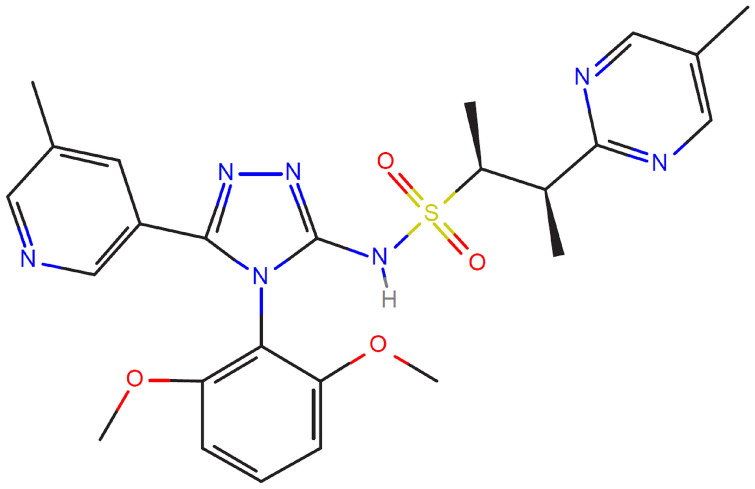
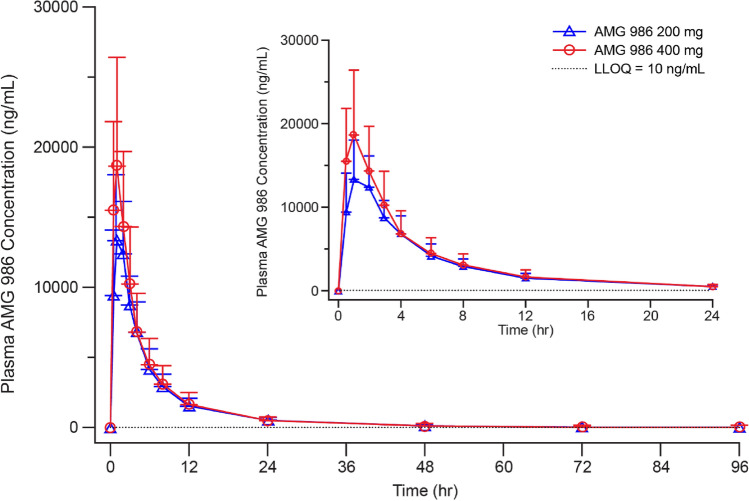
AMG 986 is a first-in-class, novel apelin receptor small molecule agonist initially developed as a treatment for patients with heart failure (HF). Previously, a first-in-human study of AMG 986 was conducted in healthy and HF subjects; however, AMG 986 was not evaluated in Japanese subjects. This was a phase I, open-label, single-dose, single-center study conducted to evaluate the safety and pharmacokinetics (PK) of AMG 986 200 mg and 400 mg in 12 healthy Japanese subjects. Six subjects received AMG 986 200 mg and six subjects received AMG 986 400 mg. Following oral administration, median time to maximum observed plasma concentration ( t max ) was 1.0 h for both the AMG 986 200 mg and 400 mg groups, and mean terminal half-life ( t ½ ) was 15.1 h and 17.6 h, respectively. When comparing the AMG 986 200 mg and 400 mg groups, 1.33-fold and 1.18-fold higher maximum observed plasma concentration ( C max ) and AUC ∞ , respectively, were observed for the 2-fold increase in dose. AMG 986 exhibited an acceptable safety and tolerability profile; all adverse events were mild in severity. AMG 986 exposure increased with increasing dose, and the increase was less than dose proportional in healthy Japanese subjects. The results of this study could facilitate the subsequent clinical development of AMG 986 for the treatment of Japanese patients with HF.
Overview
The claims and statistics of this paper haven’t been checked yet.
Free: it reads the open-access text and checks the first 5 claims that cite a source we can check. Create a free account to check every claim.
Integrity signals
Registry
Cites
Statistics
Figures
Verification
Claims the paper makes
The claims and statistics of this paper haven’t been checked yet.
Free: it reads the open-access text and checks the first 5 claims that cite a source we can check. Create a free account to check every claim.
Claims other papers make about this one
Each is checked against this paper’s own text: does it say what the citing paper says it does?
The check wasn’t confident either way, so it gives no verdict — never disputed.
In the citing paper
“the bioactive peptide Apelin (produced and secreted by the AT) provides an alternate potential therapeutic means of maintaining SM mass in the context of NEB.”
From Optimised Skeletal Muscle Mass as a Key Strategy for Obesity Management (2025) · cites this paper as [117]
Experimental — accuracy not yet measured
Self-check
Percentages, sums and reported differences re-computed from the paper’s own numbers.
The self-check needs the paper’s full text.
Citations
Cites
Isolation and Characterization of a Novel Endogenous Peptide Ligand for the Human APJ Receptor
Tatemoto, K., Hosoya, M., Habata, Y., Fujii, R., Kakegawa, T., Zou, M.-X., Kawamata, Y., Fukusumi, S., Hinuma, S., Kitada, C., et al. (1998) · Biochemical and Biophysical Research Communications · doi:10.1006/bbrc.1998.9489 · Cited by 1,685
Harmonised, I., & Guideline, T. (2006) · doi:10.1002/9781118445112.stat07000 · Cited by 1,415
O'Dowd, B. F., Heiber, M., Chan, A., Heng, H. H. Q., Tsui, L.-C., Kennedy, J. L., Shi, X., Petronis, A., George, S. R., & Nguyen, T. (1993) · Gene · doi:10.1016/0378-1119(93)90495-o · Cited by 851
Jones, N. R., Roalfe, A. K., Adoki, I., Hobbs, F. D. R., & Taylor, C. J. (2019) · European Journal of Heart Failure · doi:10.1002/ejhf.1594 · Cited by 618 · cited 1×
“The prognosis for patients with HF remains poor, demonstrating an unmet need for novel therapies [2].”
BackgroundMolecular Basis of Ethnic Differences in Drug Disposition and Response
Xie, H.-G., Kim, R. B., Wood, A. J., & Stein, C. M. (2001) · Annual Review of Pharmacology and Toxicology · doi:10.1146/annurev.pharmtox.41.1.815 · Cited by 600 · cited 2×
“This raises the possibility that interethnic variability may exist in the PK properties of AMG 986, potentially leading to differences in efficacy and/or toxicity in Japanese subjects [8, 9].”
BackgroundELABELA: A Hormone Essential for Heart Development Signals via the Apelin Receptor
Chng, S. C., Ho, L., Tian, J., & Reversade, B. (2013) · Developmental Cell · doi:10.1016/j.devcel.2013.11.002 · Cited by 506
Ethnic Factors in the Acceptability of Foreign Clinical Data
Naito, C. (1998) · doi:10.1177/00928615980320s121 · Cited by 234 · cited 1×
“The renal and biliary elimination of drugs is not generally influenced by ethnic differences [8–10]; however, interethnic variability is common when P-gp and CYP enzymes are involved in drug transport and metabolism, and in drugs with nonlinear PK properties [10].”
BackgroundPathophysiology of chronic heart failure
Francis, G. S. (2001) · The American Journal of Medicine · doi:10.1016/s0002-9343(98)00385-4 · Cited by 226
Chen, M. (2006) · Clinical Pharmacokinetics · doi:10.2165/00003088-200645100-00001 · Cited by 162
Cardiovascular response to small molecule APJ activation.
Ason, B., Chen, Y.-H., Guo, Q., Hoagland, K. M., Chui, R., Fielden, M., Sutherland, W., Chen, R., Zhang, Y., Mihardja, S. S., et al. (2020) · JCI Insight · doi:10.1172/jci.insight.132898 · Cited by 46 · cited 2×
“AMG 986 is a first-in-class, novel apelin receptor small molecule agonist that binds and activates the apelin receptor to improve cardiac function by increasing cardiac contractility without affecting heart rate, initially developed as a treatment for patients with HF [6, 7].”
Background
Cited by
Targeting the apelin system for the treatment of cardiovascular diseases
Chapman, F. A., Maguire, J. J., Newby, D. E., Davenport, A. P., & Dhaun, N. (2023) · Cardiovascular Research · doi:10.1093/cvr/cvad171 · Cited by 104
“179,182 So far, neither agent has progressed to further studies.”
BackgroundWang, W.-T., Wang, Q., Li, W.-M., Xu, H., Liang, X.-L., Wang, W., Li, N., Yang, H., Xu, Y.-Z., Bai, J., et al. (2024) · Journal of Advanced Research · doi:10.1016/j.jare.2024.12.033 · Cited by 21
Optimised Skeletal Muscle Mass as a Key Strategy for Obesity Management
Barber, T. M., Kabisch, S., Pfeiffer, A. F. H., & Weickert, M. O. (2025) · Metabolites · doi:10.3390/metabo15020085 · Cited by 19
“Such a scenario should prompt a redoubling of management strategies to reduce the AMR, thereby improving cardiometabolic risk, and these types of cases should be prioritised.”
Advances in the therapeutic potentials of ligands of the apelin receptor APJ
Wagenaar, G. T. M., & Moll, G. N. (2025) · European Journal of Pharmacology · doi:10.1016/j.ejphar.2025.177302 · Cited by 12
Narayanan, S., Dai, D., Devambatla, R. K. V., Albert, V., Bruneau-Latour, N., Vasukuttan, V., Ciblat, S., Rehder, K., Runyon, S., & Maitra, R. (2022) · Bioorganic & Medicinal Chemistry · doi:10.2139/ssrn.4064345 · Cited by 8
Davenport, A. P., Williams, T. L., Nyimanu, D., Macrae, R. G. C., Kuc, R. E., Chapman, F. A., Yang, P. B., Dhaun, N., & Maguire, J. J. (2026) · Pharmacological Reviews · doi:10.1016/j.pharmr.2026.100130 · Cited by 5
Dynamic monomer-dimer transition in ligand-induced apelin receptor activation
Ji, S.-Y., Wang, W.-W., Yang, Y.-X., Xu, P., Zhang, J.-R., Zhao, X., Xi, K., Zang, S., Shen, D.-D., Mao, C., et al. (2025) · bioRxiv · doi:10.1038/s41467-026-71325-y · Cited by 5
“Nonetheless, apelin-induced β -arrestin-dependent signaling contributes to detrimental cardiac hypertrophy, driving interests in the development of G-protein-biased APLNR agonists as potential heart failure therapies 19 – 22 .”
Alfonso, D., Sy, J. C. Y., & Palabrica, M. (2026) · Cardiovascular Drugs and Therapy · doi:10.1007/s10557-026-07913-3 · Cited by 2
Liu, H.-Z., Yan, S., Liu, J., Zhai, S., & Li, K. (2026) · Biochemical Pharmacology · doi:10.1016/j.bcp.2026.118374
Apelin inhibits cyst growth and improves kidney function in mice with polycystic kidney diseasePreprint
Nyimanu, D., Chakraborty, A., Parnell, S. C., Wallace, D. P., & Yu, A. S. L. (2026) · bioRxiv · doi:10.64898/2026.03.26.714294
Metadata
- Authors
- Trivedi, A., Mather, O., Vega, S., Hutton, S., Hellawell, J., & Lee, E.
- Affiliations
- Amgen (United States) (US)
- Corresponding author
- Trivedi, Ashit
- Venue
- Drugs in R&D
- Published
- 2022-03-13
- Volume
- 22
- Issue
- 2
- Pages
- 141-146
- ISSN
- 1174-5886 (ISSN-L)
- 1179-6901
- PMC
- PMC9167390
- OpenAlex
- W4221004766
- Semantic Scholar
- 1f7b60bba2440bb5f63d2a1434070461e1c280b8
- Cited by
- 10
- References
- 11
- Citations by year
- 2026: 5 · 2025: 2 · 2024: 1 · 2023: 1 · 2022: 1
- FWCI
- 0.75
- Type
- journal article
- Language
- en
- Open access
- gold
- doi.org
- Licence
- cc-by-nc
- creativecommons.org/licenses/by-nc/4.0 (tdm)
- creativecommons.org/licenses/by-nc/4.0 (vor)
- Locations
- Drugs in R&D (publishedVersion, cc-by-nc)
- PubMed Central (publishedVersion, cc-by-nc)
- PubMed (publishedVersion)
- Funders
- Amgen
- Topics
- Health Sciences › Medicine › Pharmacology (medical) › Apelin-related biomedical research
- Health Sciences › Medicine › Cardiology and Cardiovascular Medicine › Heart Failure Treatment and Management
- Health Sciences › Medicine › Pediatrics, Perinatology and Child Health › Pharmaceutical studies and practices
- Keywords
- pharmacokinetics, safety and tolerability, heart failure, Japanese subjects, dose proportionality, oral administration, healthy volunteers
- MeSH terms
- Administration, Oral, Dose-Response Relationship, Drug, Humans, Japan, Area Under Curve, Healthy Volunteers
About these checks
Registry, retraction, Cites and statistics results are computed, not judged, with one exception: a printed reference that no index lists is read once by a model before it counts as a citation error. Claims are extracted by a model and kept only when their quote appears verbatim in the text; each cited source is then checked, with a model’s help, for whether it says what the claim relies on. Those verdicts can be wrong — read the claim’s quote and the cited source before relying on one.
Statistics and arithmetic are recomputed, not judged.
Confidence bands are shown only for fields calibrated on our annotated test set. None is calibrated yet, so no band is shown.
What counts as a claim ›How we measure confidence ›How we check this ›
Are you an author, or do you see a problem with this page? Request a review
Data sources
Bibliographic data: Semantic Scholar, OpenAlex, Crossref.
Contains information from the Semantic Scholar Academic Graph Datasets, made available under the ODC Attribution License (ODC-BY 1.0).
Semantic Scholar’s data is described in: Kinney, R., et al. (2023). The Semantic Scholar Open Data Platform. arXiv:2301.10140.
