

Targeting the apelin system for the treatment of cardiovascular diseases
Open accessThe DOI matches its Crossref record; 181 of the 182 references it cites were found in a registry or an index.
Abstract
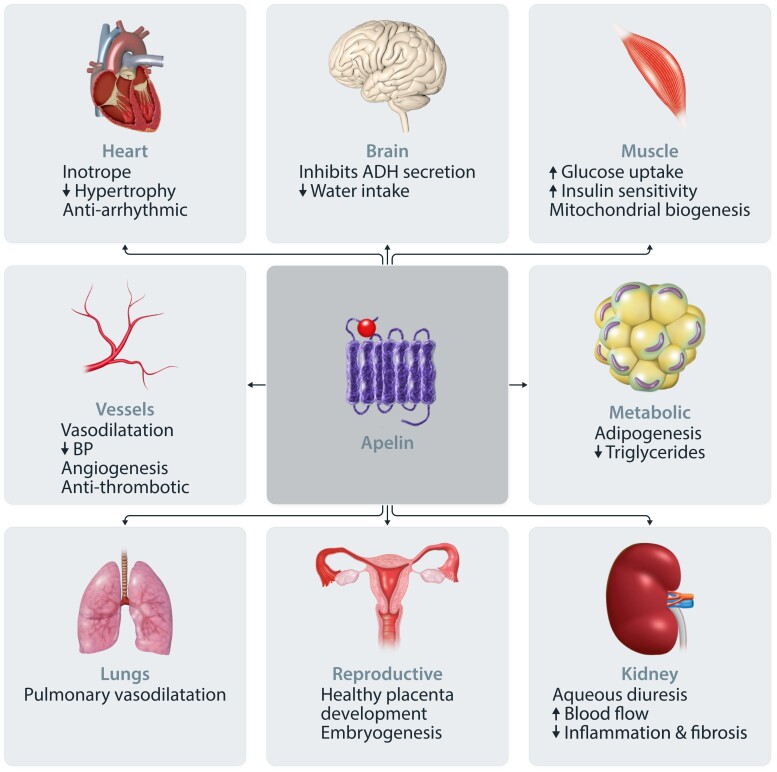
Cardiovascular disease is the leading cause of death worldwide. Its prevalence is rising due to ageing populations and the increasing incidence of diseases such as chronic kidney disease, obesity, and diabetes that are associated with elevated cardiovascular risk. Despite currently available treatments, there remains a huge burden of cardiovascular disease-associated morbidity for patients and healthcare systems, and newer treatments are needed. The apelin system, comprising the apelin receptor and its two endogenous ligands apelin and elabela, is a broad regulator of physiology that opposes the actions of the renin-angiotensin and vasopressin systems. Activation of the apelin receptor promotes endothelium-dependent vasodilatation and inotropy, lowers blood pressure, and promotes angiogenesis. The apelin system appears to protect against arrhythmias, inhibits thrombosis, and has broad anti-inflammatory and anti-fibrotic actions. It also promotes aqueous diuresis through direct and indirect (central) effects in the kidney. Thus, the apelin system offers therapeutic promise for a range of cardiovascular, kidney, and metabolic diseases. This review will discuss current cardiovascular disease targets of the apelin system and future clinical utility of apelin receptor agonism.
Overview
The claims and statistics of this paper haven’t been checked yet.
Free: it reads the open-access text and checks the first 5 claims that cite a source we can check. Create a free account to check every claim.
Integrity signals
Registry
Cites
Statistics
Figures
Verification
Claims the paper makes
The claims and statistics of this paper haven’t been checked yet.
Free: it reads the open-access text and checks the first 5 claims that cite a source we can check. Create a free account to check every claim.
Claims other papers make about this one
Each is checked against this paper’s own text: does it say what the citing paper says it does?
The source backs part of the claim, not all of it — or backs it for a different population, condition or comparison.
In the citing paper
“the bioactive peptide Apelin (produced and secreted by the AT) provides an alternate potential therapeutic means of maintaining SM mass in the context of NEB.”
From Optimised Skeletal Muscle Mass as a Key Strategy for Obesity Management (2025) · cites this paper as [118]
Experimental — accuracy not yet measured
Self-check
Percentages, sums and reported differences re-computed from the paper’s own numbers.
The self-check needs the paper’s full text.
Citations
Cites
Global Burden of Cardiovascular Diseases and Risk Factors, 1990–2019
Roth, G. A., Mensah, G. A., Johnson, C. O., Addolorato, G., Ammirati, E., Baddour, L. M., Barengo, N. C., Beaton, A. Z., Benjamin, E. J., Benziger, C. P., et al. (2020) · Journal of the American College of Cardiology · doi:10.1016/j.jacc.2020.11.010 · Cited by 11,449
Global burden of hypertension: analysis of worldwide data
Kearney, P. M., Whelton, M., Reynolds, K., Muntner, P., Whelton, P. K., & He, J. (2005) · The Lancet · doi:10.1016/s0140-6736(05)17741-1 · Cited by 8,594
Whelton, P. K., Carey, R. M., Aronow, W. S., Casey, D. E., Collins, K. J., Dennison Himmelfarb, C., DePalma, S. M., Gidding, S., Jamerson, K. A., Jones, D. W., et al. (2018) · Hypertension · doi:10.1161/hyp.0000000000000065 · Cited by 7,391
Angiotensin-neprilysin inhibition versus enalapril in heart failure
McMurray, J. J. V., Packer, M., Desai, A. S., Gong, J., Lefkowitz, M. P., Rizkala, A. R., Rouleau, J. L., Shi, V. C., Solomon, S. D., Swedberg, K., et al. (2014) · New England Journal of Medicine · doi:10.1056/nejmoa1409077 · Cited by 6,957 · cited 1×
“108 As neprilysin fully inactivates apelin peptides, the success of these agents might be partly due to an increase in apelin peptide levels and this warrants further investigation in clinical studies.”
BackgroundGo, A. S., Hylek, E. M., Phillips, K. A., Chang, Y., Henault, L. E., Selby, J. V., & Singer, D. E. (2001) · JAMA · doi:10.1001/jama.285.18.2370 · Cited by 6,205 · cited 1×
“111 Apelin is involved in regulation of cardiomyocyte electrophysiology, acting on several ion channels to shorten the action potential and increase conduction velocity.”
BackgroundWhelton, P. K., Carey, R. M., Aronow, W. S., Casey, D. E., Collins, K. J., Dennison Himmelfarb, C., DePalma, S. M., Gidding, S., Jamerson, K. A., Jones, D. W., et al. (2018) · Hypertension · doi:10.1161/hyp.0000000000000066 · Cited by 4,347
Webster, A. C., Nagler, E. V., Morton, R. L., & Masson, P. (2017) · The Lancet · doi:10.1016/s0140-6736(16)32064-5 · Cited by 3,842
Isolation and Characterization of a Novel Endogenous Peptide Ligand for the Human APJ Receptor
Tatemoto, K., Hosoya, M., Habata, Y., Fujii, R., Kakegawa, T., Zou, M.-X., Kawamata, Y., Fukusumi, S., Hinuma, S., Kitada, C., et al. (1998) · Biochemical and Biophysical Research Communications · doi:10.1006/bbrc.1998.9489 · Cited by 1,685
Global and regional estimates of preeclampsia and eclampsia: a systematic review
Abalos, E., Cuesta, C., Grosso, A. L., Chou, D., & Say, L. (2013) · European Journal of Obstetrics & Gynecology and Reproductive Biology · doi:10.1016/j.ejogrb.2013.05.005 · Cited by 1,574 · cited 1×
“132 It is characterized by the development of gestational hypertension with additional evidence of end-organ dysfunction, such as proteinuria.”
BackgroundPleiotropic Effects of Statins on the Cardiovascular System
Oesterle, A., Laufs, U., & Liao, J. K. (2017) · Circulation Research · doi:10.1161/circresaha.116.308537 · Cited by 1,247 · cited 1×
“78 Statins induce kruppel-like factor 2, an important regulator of endothelial cell homeostasis, and subsequently production of endothelial nitric oxide synthase and thrombomodulin.”
Background
Cited by
Ru, Q., Li, Y., Zhang, F., Chen, L., Wu, Y., Min, J., & Wang, F. (2025) · Bone Research · doi:10.1038/s41413-024-00398-6 · Cited by 69
Li, Y., Li, H., Chen, X., & Liang, X. (2024) · Frontiers in Endocrinology · doi:10.3389/fendo.2024.1483468 · Cited by 49
“Despite signi fi cant progress in the prevention, diagnosis, and treatment of CVD in recent years, its global incidence continues to rise globally (5).”
Alotaiq, N., & Dermawan, D. (2025) · International Journal of Molecular Sciences · doi:10.3390/ijms26020462 · Cited by 36
Microparticle Mediated Delivery of Apelin Improves Heart Function in Post Myocardial Infarction Mice
Tang, L. F. P., Qiu, H., Xu, B., Su, Y., Nyarige, V., Li, P., Chen, H., Killham, B., Liao, J., Adám, H., et al. (2024) · Circulation Research · doi:10.1161/circresaha.124.324608 · Cited by 38
“14 Treatment with apelin analogs with a longer half-life showed greater recovery of heart function following induced ischemic injury.”
Qi, R.-Q., Chen, Y., Cheng, J., Song, J.-W., Chen, Y.-H., Wang, S., Liu, Y., Yan, K., Liu, X.-Y., Li, J., et al. (2024) · Molecular Medicine · doi:10.1186/s10020-024-00997-3 · Cited by 37
Metadata
- Authors
- Chapman, F. A., Maguire, J. J., Newby, D. E., Davenport, A. P., & Dhaun, N.
- Affiliations
- Edinburgh Royal Infirmary (GB)
- University of Cambridge (GB)
- The Queen's Medical Research Institute (GB)
- Corresponding author
- Dhaun, Neeraj
- Venue
- Cardiovascular Research
- Publisher
- Oxford University Press (OUP)
- Published
- 2023-11-13
- Volume
- 119
- Issue
- 17
- Pages
- 2683-2696
- ISSN
- 0008-6363 (ISSN-L)
- 1755-3245
- PMC
- PMC10757586
- OpenAlex
- W4388625241
- Cited by
- 104
- References
- 182
- Citations by year
- 2026: 38 · 2025: 42 · 2024: 24
- FWCI
- 3.78
- Type
- journal article
- Language
- en
- Open access
- hybrid
- doi.org
- Licence
- Locations
- Cardiovascular Research (publishedVersion, cc-by)
- PubMed Central (publishedVersion, cc-by)
- PubMed (publishedVersion)
- Edinburgh Research Explorer (University of Edinburgh) (submittedVersion, cc-by)
- Apollo (University of Cambridge) (submittedVersion, cc-by)
- Apollo (cc-by)
- Funders
- Kidney Research UK (TF_006_20171124)
- British Heart Foundation (TG/18/4/33770, FS/06/064, FS/09/019, CH09/002, RG/16/10/32375, RE/18/5/34216)
- National Institute for Health and Care Research Cambridge Biomedical Research Centre Biomedical Resources
- Wellcome Trust (WT103782AIA)
- Chief Scientist Office (SCAF/19/02)
- National Institute for Health and Care Research
- Department of Health and Social Care
- Topics
- Health Sciences › Medicine › Pharmacology (medical) › Apelin-related biomedical research
- Life Sciences › Neuroscience › Cellular and Molecular Neuroscience › Neuropeptides and Animal Physiology
- Health Sciences › Medicine › Surgery › Cardiovascular, Neuropeptides, and Oxidative Stress Research
- Keywords
- apelin receptor, apelin, Elabela, cardiovascular disease, renin-angiotensin system, vasodilation, angiogenesis, cardiac arrhythmias, thrombosis, anti-inflammatory activity, antifibrotic effect, diuresis, chronic kidney disease, obesity, diabetes mellitus
- MeSH terms
- Apelin, Apelin Receptors, Cardiovascular Diseases, Cardiovascular System, Heart, Humans
About these checks
Registry, retraction, Cites and statistics results are computed, not judged, with one exception: a printed reference that no index lists is read once by a model before it counts as a citation error. Claims are extracted by a model and kept only when their quote appears verbatim in the text; each cited source is then checked, with a model’s help, for whether it says what the claim relies on. Those verdicts can be wrong — read the claim’s quote and the cited source before relying on one.
Statistics and arithmetic are recomputed, not judged.
Confidence bands are shown only for fields calibrated on our annotated test set. None is calibrated yet, so no band is shown.
What counts as a claim ›How we measure confidence ›How we check this ›
Are you an author, or do you see a problem with this page? Request a review
How to cite
Cite CoChat for the checks on this page, and the paper for its own findings.
- This page
- CoChat. (2026). Citation check: Targeting the apelin system for the treatment of cardiovascular diseases. https://app.cochat.ai/papers/10.1093/cvr/cvad171
- The paper
- Chapman, F. A., Maguire, J. J., Newby, D. E., Davenport, A. P., & Dhaun, N. (2023). Targeting the apelin system for the treatment of cardiovascular diseases. Cardiovascular Research. https://doi.org/10.1093/cvr/cvad171
Data sources
Bibliographic data: Semantic Scholar, OpenAlex, Crossref.
Contains information from the Semantic Scholar Academic Graph Datasets, made available under the ODC Attribution License (ODC-BY 1.0).
Semantic Scholar’s data is described in: Kinney, R., et al. (2023). The Semantic Scholar Open Data Platform. arXiv:2301.10140.
