

The perspectives of patients with chronic diseases and their caregivers on self-management interventions: A scoping review of reviews.
Open accessThe DOI matches its Crossref record; 193 of the 194 references it cites were found in a registry or an index.
Abstract
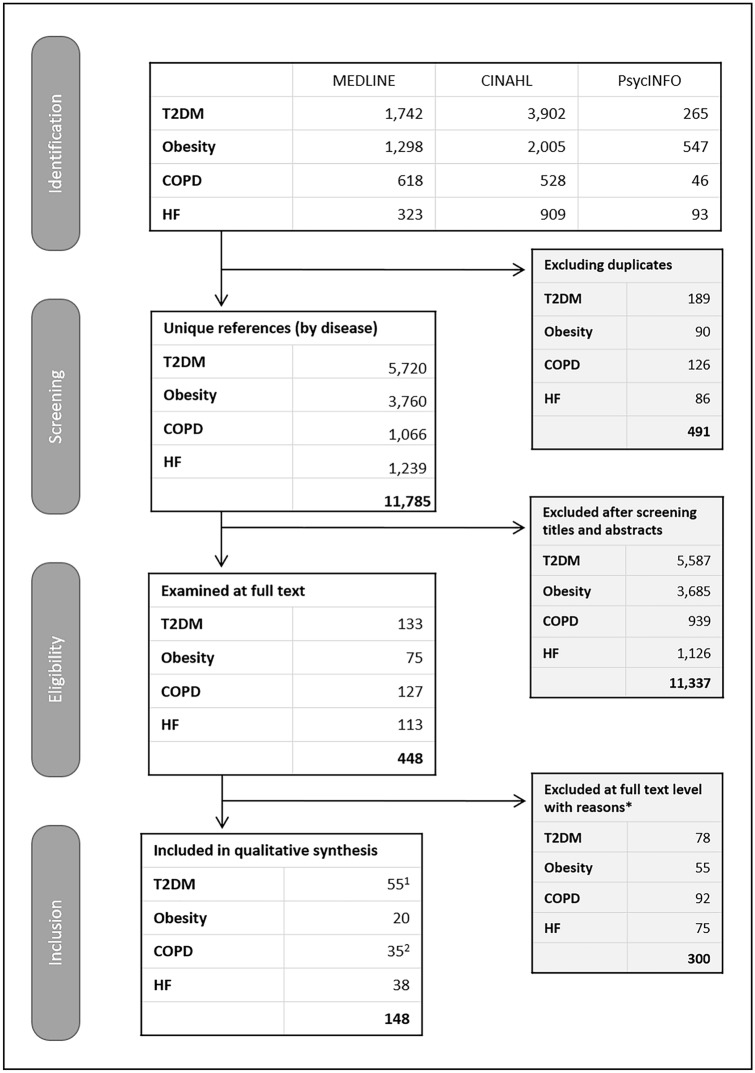
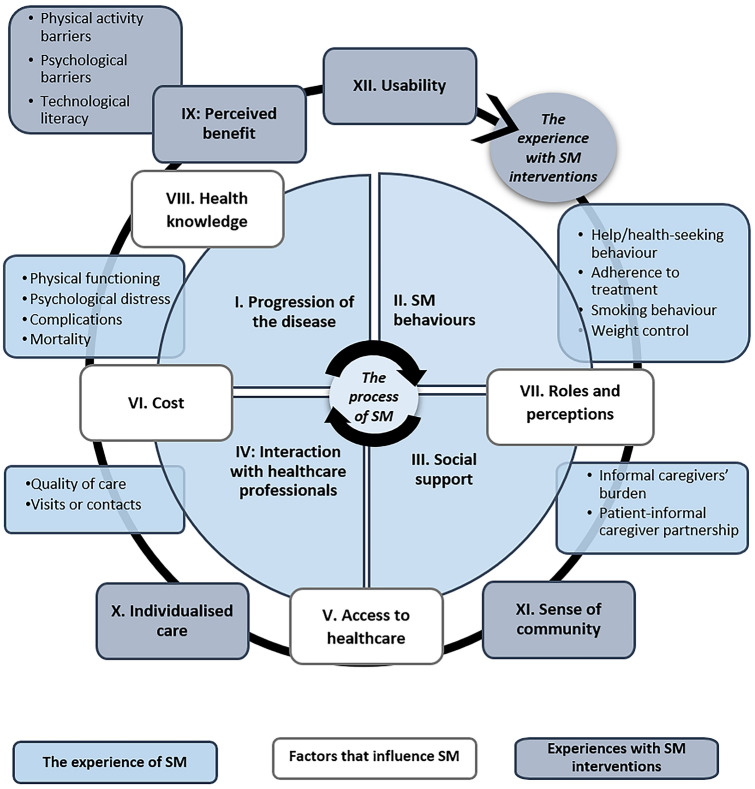
BACKGROUND: Self-management (SM) interventions are supportive interventions systematically provided by healthcare professionals, peers, or laypersons to increase the skills and confidence of patients in their ability to manage chronic diseases. We had two objectives: (1) to summarise the preferences and experiences of patients and their caregivers (informal caregivers and healthcare professionals) with SM in four chronic diseases and (2) to identify and describe the relevant outcomes for SM interventions from these perspectives. METHODS: We conducted a mixed-methods scoping review of reviews. We searched three databases until December 2020 for quantitative, qualitative, or mixed-methods reviews exploring patients' and caregivers' preferences or experiences with SM in type 2 diabetes mellitus (T2DM), obesity, chronic obstructive pulmonary disease (COPD), and heart failure (HF). Quantitative data were narratively synthesised, and qualitative data followed a three-step descriptive thematic synthesis. Identified themes were categorised into outcomes or modifiable factors of SM interventions. RESULTS: We included 148 reviews covering T2DM (n = 53 [35.8%]), obesity (n = 20 [13.5%]), COPD (n = 32 [21.6%]), HF (n = 38 [25.7%]), and those with more than one disease (n = 5 [3.4%]). We identified 12 main themes. Eight described the process of SM (disease progression, SM behaviours, social support, interaction with healthcare professionals, access to healthcare, costs for patients, culturally defined roles and perceptions, and health knowledge), and four described their experiences with SM interventions (the perceived benefit of the intervention, individualised care, sense of community with peers, and usability of equipment). Most themes and subthemes were categorised as outcomes of SM interventions. CONCLUSION: The process of SM shaped the perspectives of patients and their caregivers on SM interventions. Their perspectives were influenced by the perceived benefit of the intervention, the sense of community with peers, the intervention's usability, and the level of individualised care. Our findings can inform the selection of patient-important outcomes, decision-making processes, including the formulation of recommendations, and the design and implementation of SM interventions.
Overview
The claims and statistics of this paper haven’t been checked yet.
Free: it reads the open-access text and checks the first 5 claims that cite a source we can check. Create a free account to check every claim.
Integrity signals
Registry
Cites
Statistics
Figures

Verification
Claims the paper makes
The claims and statistics of this paper haven’t been checked yet.
Free: it reads the open-access text and checks the first 5 claims that cite a source we can check. Create a free account to check every claim.
Claims other papers make about this one
Each is checked against this paper’s own text: does it say what the citing paper says it does?
The source backs part of the claim, not all of it — or backs it for a different population, condition or comparison.
In the citing paper
“Most patients were unable to adhere to recommended HF self-care behaviors [36].”
From Effectiveness of a videoconferencing group-based dyad acceptance and commitment therapy on the quality of life of chronic heart failure patients and their family caregivers: A study protocol for a randomized controlled trial (2024) · cites this paper as [36]
Experimental — accuracy not yet measured
Self-check
Percentages, sums and reported differences re-computed from the paper’s own numbers.
The self-check needs the paper’s full text.
Citations
Cites
Ryan, R. M., & Deci, E. L. (2000) · American Psychologist · doi:10.1037//0003-066x.55.1.68 · Cited by 54,599 · cited 2×
“This theory outlines the process of self-regulation, describing how people internalise social values and extrinsic contingencies, thereby moving from controlled to autonomously motivated behaviours that align with personal values and goals [185].”
BackgroundPRISMA Extension for Scoping Reviews (PRISMA-ScR): Checklist and Explanation
Tricco, A. C., Lillie, E., Zarin, W., O'Brien, K. K., Colquhoun, H., Levac, D., Moher, D., Peters, M. D. J., Horsley, T., Weeks, L., et al. (2018) · Annals of Internal Medicine · doi:10.7326/m18-0850 · Cited by 43,565 · cited 1×
“We conducted a mixed-methods scoping review of reviews based on Arksey and O’Malley’s methodology [17–19] and reported findings using the Preferred Reporting Items for Systematic Reviews and Meta-Analyses Extension for Scoping Reviews (PRISMA-ScR) checklist [20].”
MethodScoping studies: towards a methodological framework
Arksey, H., & O'Malley, L. (2005) · International Journal of Social Research Methodology · doi:10.1080/1364557032000119616 · Cited by 36,742
Munn, Z., Peters, M. D. J., Stern, C., Tufanaru, C., McArthur, A., & Aromataris, E. (2018) · BMC Medical Research Methodology · doi:10.1186/s12874-018-0611-x · Cited by 11,385
Methods for the thematic synthesis of qualitative research in systematic reviews
Thomas, J., & Harden, A. (2008) · BMC Medical Research Methodology · doi:10.1186/1471-2288-8-45 · Cited by 9,312
Moral Identity and Developmental Theory
Lapsley, D. (2015) · Human Development · doi:10.1159/000435926 · Cited by 3,819
Patient Self-management of Chronic Disease in Primary Care
Bodenheimer, T. (2002) · JAMA · doi:10.1001/jama.288.19.2469 · Cited by 3,598
Self-management approaches for people with chronic conditions: a review
Barlow, J., Wright, C., Sheasby, J., Turner, A., & Hainsworth, J. (2002) · Patient Education and Counseling · doi:10.1016/s0738-3991(02)00032-0 · Cited by 2,800 · cited 1×
“SM was conceived as a dynamic, interactive, and daily process in of evidence about their effectiveness, cost effectiveness, and implementation considerations are yet available [5, 6].”
BackgroundDeveloping core outcome sets for clinical trials: issues to consider
Williamson, P. R., Altman, D. G., Blazeby, J. M., Clarke, M., Devane, D., Gargon, E., & Tugwell, P. (2012) · Trials · doi:10.1186/1745-6215-13-132 · Cited by 1,661 · cited 1×
“In COMPAR-EU, the perspectives of patients and caregivers (informal caregivers and healthcare professionals) on SM were contemplated as a key component in, for example, the development of the Core Outcome Sets (COS) of SM interventions and the development of recommendations [8, 9].”
BackgroundAndrews, J., Guyatt, G., Oxman, A. D., Alderson, P., Dahm, P., Falck-Ytter, Y., Nasser, M., Meerpohl, J., Post, P. N., Kunz, R., et al. (2013) · Journal of Clinical Epidemiology · doi:10.1016/j.jclinepi.2012.03.013 · Cited by 1,416
Research works printed but not linked: 3
- FDA Guidance Patient Preference Information—voluntary submission, review in premarket approval applications, humanitarian device exemption applications, and de novo requests, and inclusion in decision summaries and device labeling. FDA. 2016.
- Ellis K, Mulnier H, Forbes A. Perceptions of insulin use in type 2 diabetes in primary care: a thematic synthesis. BMC Fam Pract. 2018;19(1):N.PAG-N.PAG. 10.1186/s12875-018-0753-2. PMC5964885 29788908 · DOI · Paper page
- Miller MJ Jones J Anderson CB Christiansen CL Factors influencing participation in physical activity after dysvascular amputation: a qualitative meta-synthesis Disabil Rehabil 2019 41 26 3141 3150 10.1080/09638288.2018.1492031 30261758 PMC6437000 · DOI
Cited by
Wu, Y., Wen, J. L., Wang, X., Wang, Q., Wang, W., Wang, X., Xie, J., & Li, C. (2022) · BMC Public Health · doi:10.1186/s12889-022-14695-4 · Cited by 107
Wang, R. S., Zhou, C., Wu, Y., Sun, M., Yang, L., Ye, X., & Zhang, M. (2021) · Journal of Advanced Nursing · doi:10.1111/jan.15077 · Cited by 99
Operationalizing the Chronic Care Model with Goal-Oriented Care
Grudniewicz, A., Gray, C. S., Boeckxstaens, P., Maeseneer, J. D., & Mold, J. W. (2023) · Patient · doi:10.1007/s40271-023-00645-8 · Cited by 94
“In response to self-management interventions, patients often report experiencing traditional didactic approaches over truly collaborative relationships with providers [44].”
BackgroundSeng, J. J. B., Gwee, M. F. R., Yong, M. H. A., Kwan, Y. H., Thumboo, J., & Low, L. L. (2023) · Journal of Medical Internet Research · doi:10.2196/46988 · Cited by 27
de Guzmán, E. N., Bracchiglione, J., Ballester, M., Groene, O., Heijmans, M., García, L. M., Noordman, J., Orrego, C., Rocha, C. A., Suñol, R., et al. (2023) · Archives of Public Health · doi:10.1186/s13690-023-01153-9 · Cited by 28
Self-citation
Metadata
- Authors
- Niño de Guzmán Quispe, E., Martínez García, L., Orrego Villagrán, C., Heijmans, M., Sunol, R., Fraile-Navarro, D., Pérez-Bracchiglione, J., Ninov, L., Salas-Gama, K., Viteri García, A., & Alonso-Coello, P.
- Affiliations
- Netherlands Institute for Health Services Research (NL)
- European Patients Forum (LU)
- Vall d'Hebron Institut de Recerca (ES)
- Venue
- The Patient - Patient-Centered Outcomes Research
- Published
- 2021-04-19
- Volume
- 14
- Issue
- 6
- Pages
- 719-740
- ISSN
- 1178-1653 (ISSN-L)
- 1178-1661
- PMC
- PMC8563562
- OpenAlex
- W3153762200
- Cited by
- 54
- References
- 194
- Citations by year
- 2026: 8 · 2025: 16 · 2024: 6 · 2023: 18 · 2022: 4 · 2021: 2
- FWCI
- 1.15
- Type
- journal article
- Language
- en
- Open access
- hybrid
- doi.org
- Licence
- cc-by-nc
- creativecommons.org/licenses/by-nc/4.0 (tdm)
- creativecommons.org/licenses/by-nc/4.0 (vor)
- Locations
- Patient (publishedVersion, cc-by-nc)
- Europe PMC (PubMed Central) (publishedVersion, other-oa)
- PubMed Central (publishedVersion, cc-by-nc)
- PubMed (publishedVersion)
- Dipòsit Digital de Documents de la UAB (Universitat Autònoma de Barcelona) (submittedVersion, cc-by-nc)
- Data Archiving and Networked Services (DANS) (submittedVersion, other-oa)
- RePEc: Research Papers in Economics (submittedVersion)
- Funders
- Horizon 2020 Framework Programme (754936)
- Topics
- Health Sciences › Medicine › Endocrinology, Diabetes and Metabolism › Diabetes Management and Education
- Health Sciences › Medicine › Epidemiology › Chronic Disease Management Strategies
- Health Sciences › Nursing › Research and Theory › Nursing care and research
- Keywords
- self-management interventions, chronic disease, patient perspectives, caregiver perspectives, informal caregivers, type 2 diabetes, obesity, chronic obstructive pulmonary disease, heart failure, patient-relevant outcomes, social support, peer support, individualized care, intervention usability
- MeSH terms
- Self-Management, Diabetes Mellitus, Type 2, Health Personnel, Humans, Review Literature as Topic, Review Literature As Topic, Caregivers, Pulmonary Disease, Chronic Obstructive
About these checks
Registry, retraction, Cites and statistics results are computed, not judged, with one exception: a printed reference that no index lists is read once by a model before it counts as a citation error. Claims are extracted by a model and kept only when their quote appears verbatim in the text; each cited source is then checked, with a model’s help, for whether it says what the claim relies on. Those verdicts can be wrong — read the claim’s quote and the cited source before relying on one.
Statistics and arithmetic are recomputed, not judged.
Confidence bands are shown only for fields calibrated on our annotated test set. None is calibrated yet, so no band is shown.
What counts as a claim ›How we measure confidence ›How we check this ›
Are you an author, or do you see a problem with this page? Request a review
How to cite
Cite CoChat for the checks on this page, and the paper for its own findings.
- This page
- CoChat. (2026). Citation check: The perspectives of patients with chronic diseases and their caregivers on self-management interventions: A scoping review of reviews. https://app.cochat.ai/papers/10.1007/s40271-021-00514-2
- The paper
- Niño de Guzmán Quispe, E., Martínez García, L., Orrego Villagrán, C., Heijmans, M., Sunol, R., Fraile-Navarro, D., Pérez-Bracchiglione, J., Ninov, L., Salas-Gama, K., Viteri García, A., & Alonso-Coello, P. (2021). The perspectives of patients with chronic diseases and their caregivers on self-management interventions: A scoping review of reviews. The Patient - Patient-Centered Outcomes Research. https://doi.org/10.1007/s40271-021-00514-2
Data sources
Bibliographic data: Semantic Scholar, OpenAlex, Crossref.
Contains information from the Semantic Scholar Academic Graph Datasets, made available under the ODC Attribution License (ODC-BY 1.0).
Semantic Scholar’s data is described in: Kinney, R., et al. (2023). The Semantic Scholar Open Data Platform. arXiv:2301.10140.
