

Creatine Loading Does Not Preserve Muscle Mass or Strength During Leg Immobilization in Healthy, Young Males: A Randomized Controlled Trial
Open accessThe DOI matches its Crossref record; 39 of the 39 references it cites were found in a registry or an index.
Abstract
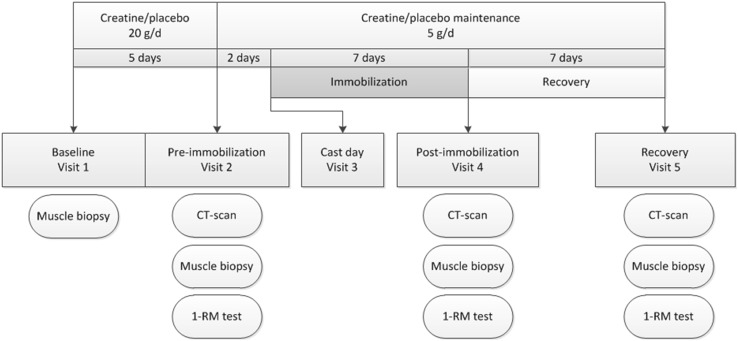
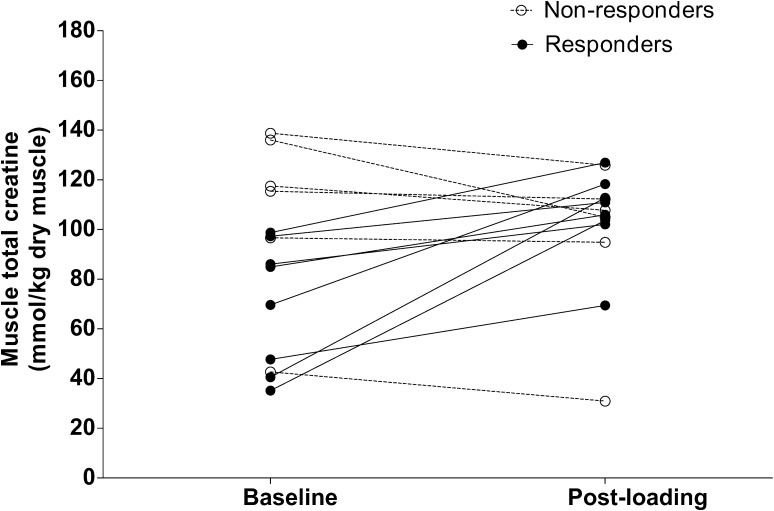
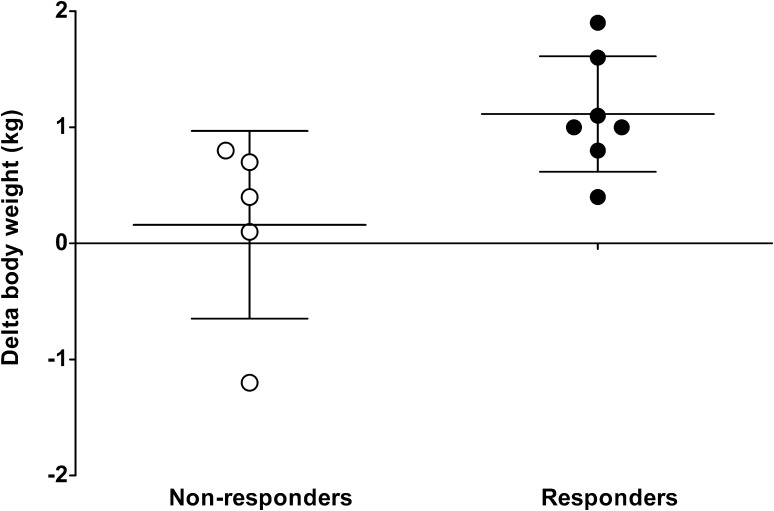
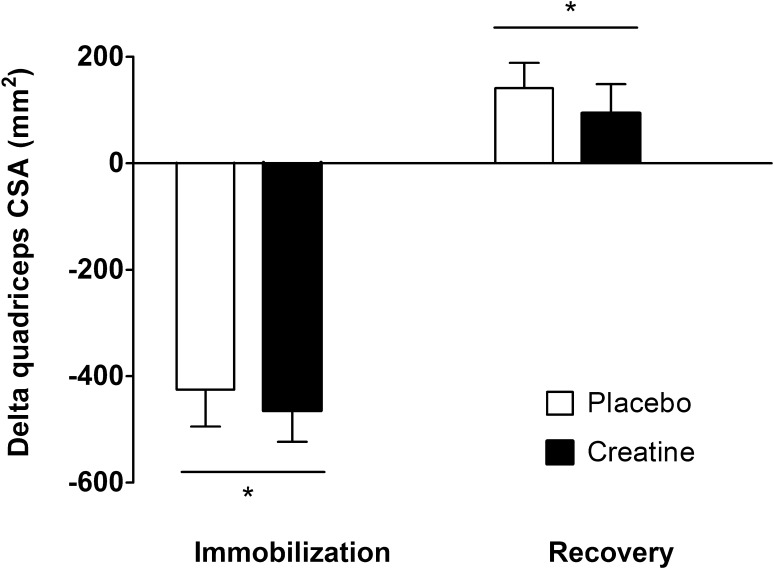
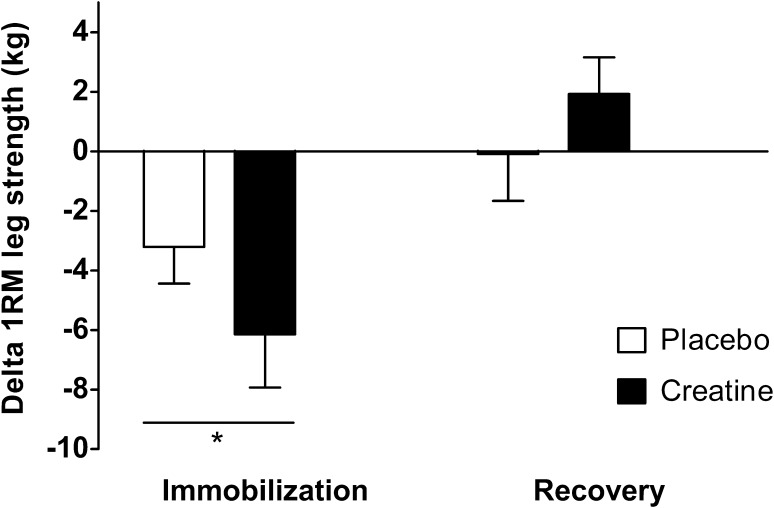
A short period of leg immobilization leads to rapid loss of muscle mass and strength. Creatine supplementation has been shown to increase lean body mass in active individuals and can be used to augment gains in muscle mass and strength during prolonged resistance-type exercise training. Our objective was to investigate whether creatine loading can attenuate the loss of muscle mass and strength during short-term leg immobilization. Healthy young men (n = 30; aged 23 ± 1 years; body mass index [BMI] 23.3 ± 0.5 kg/m−2) were randomly assigned to either a creatine or a placebo group. Subjects received placebo or creatine supplements (20 g/d) for 5 days before one leg was immobilized by means of a full-leg cast for 7 days. Muscle biopsies were taken before creatine loading, prior to and immediately after leg immobilization, and after 7 days of subsequent recovery. Quadriceps cross-sectional area (CSA) (computed tomography [CT] scan) and leg muscle strength (one-repetition maximum [1-RM] knee extension) were assessed before and immediately after immobilization and after 1 week of recovery. Data were analyzed using repeated measures analysis of variance (ANOVA). Data are presented consistently as mean ± standard error of the mean (SEM). There was a significant overall increase in muscle total creatine content following the 5-day loading phase (p = 0.049), which appeared driven by an increase in the creatine group (from 90 ± 9 to 107 ± 4 mmol/kg−1 dry muscle) with no apparent change in the placebo group (from 88 ± 4 to 90 ± 3 mmol/kg−1; p = 0.066 for time × treatment interaction). Quadriceps muscle CSA had declined by 465 ± 59 and 425 ± 69 mm2 (p < 0.01) in the creatine and placebo group, respectively, with no differences between groups (p = 0.76). Leg muscle strength decreased from 56 ± 4 to 53 ± 4 kg in the creatine and from 59 ± 3 to 53 ± 3 kg in the placebo group, with no differences between groups (p = 0.20). Muscle fiber size did not change significantly over time in either group (p > 0.05). When non-responders to creatine loading were excluded (n = 6), responders (n = 8; total creatine content increasing from 70 to 106 mmol/kg−1) showed similar findings, with no signs of preservation of muscle mass or strength during immobilization. During the subsequent recovery phase, no differences in muscle mass or strength were found between the two groups (p > 0.05). Creatine supplementation prior to and during leg immobilization does not prevent or attenuate the loss of muscle mass or strength during short-term muscle disuse. NIH Clinical Trial Registration Number: NCT01894737 ( http://www.clinicaltrials.gov/ ).
Overview
The claims and statistics of this paper haven’t been checked yet.
Free: it reads the open-access text and checks the first 5 claims that cite a source we can check. Create a free account to check every claim.
Integrity signals
Registry
Cites
Statistics
Figures
Verification
Claims the paper makes
The claims and statistics of this paper haven’t been checked yet.
Free: it reads the open-access text and checks the first 5 claims that cite a source we can check. Create a free account to check every claim.
Claims other papers make about this one
Each is checked against this paper’s own text: does it say what the citing paper says it does?
In the citing paper
“these same benefits have not been observed following periods of lower limb immobilization [144], knee arthroplasty [145], or anterior cruciate ligament reconstruction [146].”
From Creatine for exercise and sports performance, with recovery considerations for healthy populations (2021) · cites this paper as [144]
Self-check
Percentages, sums and reported differences re-computed from the paper’s own numbers.
The self-check needs the paper’s full text.
Citations
Cites
A SIMPLE METHOD FOR THE ISOLATION AND PURIFICATION OF TOTAL LIPIDES FROM ANIMAL TISSUES
Folch, J., Lees, M., & Stanley, G. H. S. (1957) · Journal of Biological Chemistry · doi:10.1016/s0021-9258(18)64849-5 · Cited by 65,189
Down-Regulation of Na+/K+ATPase Activity by Human Parvovirus B19 Capsid Protein VP1
Almilaji, A., Szteyn, K., Fein, E., Pakladok, T., Munoz, C., Elvira, B., Towhid, S. T., Alesutan, I., Shumilina, E., Bock, C.-T., et al. (2013) · Cellular Physiology and Biochemistry · doi:10.1159/000350083 · Cited by 8,675
Functional significance of cell volume regulatory mechanisms
LANG, F., BUSCH, G. L., RITTER, M., VÖLKL, H., WALDEGGER, S., GULBINS, E., & HÄUSSINGER, D. (1998) · Physiological Reviews · doi:10.1152/physrev.1998.78.1.247 · Cited by 1,891 · cited 1×
“The greater osmotic pressure following the increase in creatine content has been suggested to result in muscle cell swelling, which is considered a key stimulus for cell growth [11, 18].”
BackgroundPercutaneous Needle Biopsy of Skeletal Muscle in Physiological and Clinical Research
Bergström, J. (1975) · Scandinavian Journal of Clinical & Laboratory Investigation · doi:10.1080/00365517509095787 · Cited by 1,170
Goodpaster, B. H., Kelley, D. E., Thaete, F. L., He, J., & Ross, R. (2000) · Journal of Applied Physiology · doi:10.1152/jappl.2000.89.1.104 · Cited by 947
Harris, R. C., Hultman, E., & Nordesjö, L. O. (1974) · Scandinavian Journal of Clinical and Laboratory Investigation · doi:10.3109/00365517409082477 · Cited by 849
Muscle creatine loading in men
Hultman, E., Soderlund, K., Timmons, J. A., Cederblad, G., & Greenhaff, P. L. (1996) · Journal of Applied Physiology · doi:10.1152/jappl.1996.81.1.232 · Cited by 822
Nilwik, R., Snijders, T., Leenders, M., Groen, B. B. L., van Kranenburg, J., Verdijk, L. B., & van Loon, L. J. C. (2013) · Experimental Gerontology · doi:10.1016/j.exger.2013.02.012 · Cited by 776
Self-citationEffect of oral creatine supplementation on skeletal muscle phosphocreatine resynthesis
Greenhaff, P. L., Bodin, K., Soderlund, K., & Hultman, E. (1994) · American Journal of Physiology-Endocrinology and Metabolism · doi:10.1152/ajpendo.1994.266.5.e725 · Cited by 531
Prolonged bed rest decreases skeletal muscle and whole body protein synthesis
Ferrando, A. A., Lane, H. W., Stuart, C. A., Davis-Street, J., & Wolfe, R. R. (1996) · American Journal of Physiology-Endocrinology and Metabolism · doi:10.1152/ajpendo.1996.270.4.e627 · Cited by 499
Cited by
Dietary Supplements for Health, Adaptation, and Recovery in Athletes
Rawson, E. S., Miles, M. P., & Larson-Meyer, D. E. (2018) · International Journal of Sport Nutrition and Exercise Metabolism · doi:10.1123/ijsnem.2017-0340 · Cited by 201
“Although positive effects were not found in every outcome of each study (Backx et al., 2017; Eijnde et al., 2005), it appears that creatine supplements may play a role in recovery from disuse.”
BackgroundCreatine for exercise and sports performance, with recovery considerations for healthy populations
Wax, B., Kerksick, C. M., Jagim, A. R., Mayo, J. J., Lyons, B. C., & Kreider, R. B. (2021) · Nutrients · doi:10.3390/nu13061915 · Cited by 182
“Although short term oral creatine supplementation was found to attenuate the loss in muscle mass and strength following a period of upper arm immobilization in healthy young men, [143] these same benefits have not been observed following periods of lower limb immobilization [144], knee arthroplasty [145], or anterior…”
BackgroundTemporal Muscle-specific Disuse Atrophy during One Week of Leg Immobilization
KILROE, S. P., FULFORD, J., JACKMAN, S. R., VAN LOON, L. J. C., & WALL, B. T. (2020) · Medicine & Science in Sports & Exercise · doi:10.1249/mss.0000000000002200 · Cited by 111
Wu, S.-H., Chen, K., Hsu, C., Chen, H.-C., Chen, J., Yu, S.-Y., & Shiu, Y.-J. (2022) · Nutrients · doi:10.3390/nu14061255 · Cited by 89
Houben, L. H. P., Overkamp, M., KRAAIJ, P. V., Trommelen, J., van Roermund, J. G. H., de Vries, P. W., de Laet, K., van der Meer, S., Mikkelsen, U. R., Verdijk, L. B., et al. (2022) · Medicine & Science in Sports & Exercise · doi:10.1249/mss.0000000000003095 · Cited by 79
Self-citationCreatine Supplementation: An Update
Hall, M., Manetta, E., & Tupper, K. (2021) · Current Sports Medicine Reports · doi:10.1249/jsr.0000000000000863 · Cited by 80
Marshall, R. N., Smeuninx, B., Morgan, P. T., & Breen, L. (2020) · Nutrients · doi:10.3390/nu12051533 · Cited by 63
Mirzoev, T. M. (2020) · International Journal of Molecular Sciences · doi:10.3390/ijms21217940 · Cited by 65
“(2017) [192] have recently demonstrated that creatine administration failed to preserve skeletal muscle mass or strength during leg immobilization in healthy, young males.”
BackgroundThe Application of Creatine Supplementation in Medical Rehabilitation
Harmon, K. K., Stout, J. R., Fukuda, D. H., Pabian, P. S., Rawson, E. S., & Stock, M. S. (2021) · Nutrients · doi:10.3390/nu13061825 · Cited by 46
Leermakers, P. A., Kneppers, A. E. M., Schols, A. M. W. J., KELDERS, M. C. J. M., de Theije, C. C., Verdijk, L. B., van Loon, L. J. C., LANGEN, R. C. J., & Gosker, H. R. (2019) · Muscle & Nerve · doi:10.1002/mus.26702 · Cited by 61
Self-citationRollo, I., Carter, J. M., Close, G. L., Yanguas, J., Gómez-Díaz, A. J., Leal, D. M., Duda, J. L., Holohan, D., Erith, S. J., & Podlog, L. W. (2020) · European Journal of Sport Science · doi:10.1080/17461391.2020.1792558 · Cited by 63
Holwerda, A. M., Overkamp, M., Paulussen, K. J. M., Smeets, J. S. J., van Kranenburg, J., Backx, E. M. P., Gijsen, A. P., Goessens, J. P. B., Verdijk, L. B., & van Loon, L. J. C. (2018) · The Journal of Nutrition · doi:10.1093/jn/nxy169 · Cited by 59
Self-citationBackx, E. M. P., Horstman, A. M. H., Marzuca-Nassr, G. N., Van Kranenburg, J., Smeets, J. S., Fuchs, C. J., Janssen, A. A. W., De Groot, L. C. P. G. M., Snijders, T., Verdijk, L. B., et al. (2018) · Nutrients · doi:10.3390/nu10050635 · Cited by 46
Self-citationGiraldo-Vallejo, J. E., Cardona-Guzmán, M. Á., Rodríguez-Alcivar, E. J., Kočí, J., Petro, J. L., Kreider, R. B., Cannataro, R., & Bonilla, D. A. (2023) · Nutrients · doi:10.3390/nu15040819 · Cited by 55
Baron, J. E., Parker, E. A., Duchman, K. R., & Westermann, R. W. (2020) · Orthopaedic Journal of Sports Medicine · doi:10.1177/2325967120930296 · Cited by 54
Kilroe, S. P., Fulford, J., Jackman, S. R., Holwerda, A. M., Gijsen, A. P., van Loon, L. J. C., & Wall, B. T. (2020) · American Journal of Clinical Nutrition · doi:10.1093/ajcn/nqaa136 · Cited by 47
Blood Flow Restriction Only Increases Myofibrillar Protein Synthesis with Exercise
Nyakayiru, J., Fuchs, C. J., Trommelen, J., Smeets, J. S. J., Senden, J. M., Gijsen, A. P., Zorenc, A. H. G., van Loon, L. J. C., & Verdijk, L. B. (2019) · Medicine & Science in Sports & Exercise · doi:10.1249/mss.0000000000001899 · Cited by 42
Self-citationPashayee-Khamene, F., Heidari, Z., Asbaghi, O., Ashtary‐Larky, D., Goudarzi, K., Forbes, S. C., Candow, D. G., Bagheri, R., Ghanavati, M., & Dutheil, F. (2024) · Journal of the International Society of Sports Nutrition · doi:10.1080/15502783.2024.2380058 · Cited by 42
Preobrazenski, N., Seigel, J., Halliday, S., Janssen, I., & McGlory, C. (2023) · Journal of Cachexia Sarcopenia and Muscle · doi:10.1002/jcsm.13201 · Cited by 37
Jiaming, Y., & Rahimi, M. H. (2021) · Journal of Food Biochemistry · doi:10.1111/jfbc.13916 · Cited by 39
Antonio, J., Brown, A. F., Candow, D. G., Chilibeck, P. D., Ellery, S. J., Forbes, S. C., Gualano, B., Jagim, A. R., Kerksick, C., Kreider, R. B., et al. (2025) · Journal of the International Society of Sports Nutrition · doi:10.1080/15502783.2024.2441760 · Cited by 33
“Contrary to these findings, Backx et al. [114] failed to demonstrate beneficial effects of CrM in healthy young men ( n = 30) randomly assigned to receive either CrM (20 grams/day) or placebo for 5 days before one leg was immobilized using a cast for 7 days.”
Michel, J. M., Godwin, J. S., Plotkin, D. L., McIntosh, M. C., Mattingly, M. L., Agostinelli, P. J., Mueller, B. J., Anglin, D. A., Kontos, N. J., Berry, A. C., et al. (2025) · Journal of Applied Physiology · doi:10.1152/japplphysiol.00837.2024 · Cited by 20
Coordinated regulation of skeletal muscle mass and metabolic plasticity during recovery from disuse
Kneppers, A. E. M., Leermakers, P. A., Pansters, N. A. M., Backx, E. M. P., Gosker, H. R., van Loon, L. J. C., Schols, A. M. W. J., LANGEN, R. C. J., & Verdijk, L. B. (2018) · The FASEB Journal · doi:10.1096/fj.201701403rrr · Cited by 20
Self-citationHorstman, A. M. H., Backx, E. M. P., Smeets, J. S. J., Marzuca-Nassr, G. N., van Kranenburg, J. M. X., de Boer, D., Dolmans, J., Snijders, T., Verdijk, L. B., de Groot, C. P. G. M., et al. (2019) · PLoS ONE · doi:10.1371/journal.pone.0210823 · Cited by 20
Self-citationShort-Term Creatine Supplementation Changes Protein Metabolism Signaling in Hindlimb Suspension
Marzuca-Nassr, G. N., Fortes, M. A. S., Guimarães-Ferreira, L., Murata, G. M., Vitzel, K. F., Vasconcelos, D. A. A., Bassit, R. A., & Curi, R. (2019) · Brazilian Journal of Medical and Biological Research · doi:10.1590/1414-431x20198391 · Cited by 19
Nutritional Considerations in Preventing Muscle Atrophy
Creţoiu, S. M., & Zugravu, C. (2018) · Advances in experimental medicine and biology · doi:10.1007/978-981-13-1435-3_23 · Cited by 19
Weijzen, M. E. G., Holwerda, A. M., Jetten, G. H. J., Houben, L. H. P., Kerr, A., Davis, H., Keogh, B., Khaldi, N., Verdijk, L. B., & van Loon, L. J. C. (2023) · Journal of Nutrition · doi:10.1016/j.tjnut.2023.01.014 · Cited by 19
Self-citationMitigating skeletal muscle wasting in unloading and augmenting subsequent recovery
Michel, J. M., Hettinger, Z. R., Ambrosio, F., Egan, B., Roberts, M. D., Ferrando, A. A., Graham, Z., & Bamman, M. M. (2024) · The Journal of Physiology · doi:10.1113/jp284301 · Cited by 17
Zhao, K., Dong, S., & Wang, W. (2022) · Frontiers in Surgery · doi:10.3389/fsurg.2022.911471 · Cited by 14
Overkamp, M., Houben, L. H. P., Aussieker, T., van Kranenburg, J. M. X., Pinckaers, P. J., Mikkelsen, U. R., Beelen, M., Beijer, S., van Loon, L. J. C., & Snijders, T. (2023) · The Journal of Clinical Endocrinology & Metabolism · doi:10.1210/clinem/dgad245 · Cited by 14
Self-citationSmith, M., Hoffman, N. J., Jose, A. T. S., Burke, L. M., & Opar, D. A. (2025) · Sports Medicine · doi:10.1007/s40279-025-02174-w · Cited by 14
Overkamp, M., Houben, L. H. P., van der Meer, S., van Roermund, J. G. H., Bos, R., Kokshoorn, A. P. J., Larsen, M. S., van Loon, L. J. C., Beelen, M., & Beijer, S. (2023) · Scandinavian Journal of Urology · doi:10.1080/21681805.2023.2168050 · Cited by 13
Ye, H., Yang, J., Luo, Y., Long, Y., Zhang, J.-H., Zhong, Y., Gao, F., & Wang, M. (2023) · Frontiers in Nutrition · doi:10.3389/fnut.2023.1093988 · Cited by 13
Holwerda, A. M., Weijzen, M. E. G., Zorenc, A. H. G., Senden, J. M., Jetten, G. H. J., Houben, L. H. P., Verdijk, L. B., & van Loon, L. J. C. (2023) · Medicine & Science in Sports & Exercise · doi:10.1249/mss.0000000000003342 · Cited by 12
Self-citationGala, K. S., Desai, V. K., Liu, N., Omer, E. M., & McClave, S. A. (2020) · Current Nutrition Reports · doi:10.1007/s13668-020-00334-0 · Cited by 12
Supplement Use in Patients Undergoing Anterior Cruciate Ligament Reconstruction: A Systematic Review
Greif, D. N., Emerson, C. P., Allegra, P. R., Arizpe, A., Mansour, K. L., Cade, W. H., & Baraga, M. G. (2020) · Arthroscopy The Journal of Arthroscopic and Related Surgery · doi:10.1016/j.arthro.2020.04.047 · Cited by 13
Luo, D., Edwards, S., Smeuninx, B., McKendry, J., Nishimura, Y., Perkins, M., Philp, A., Joanisse, S., & Breen, L. (2020) · American Journal of Physiology-Cell Physiology · doi:10.1152/ajpcell.00072.2020 · Cited by 11
Creatine Monohydrate Supplementation: Considerations for Cognitive Performance in Athletes
Machek, S. B., & Bagley, J. R. (2018) · Strength and conditioning journal · doi:10.1519/ssc.0000000000000369 · Cited by 11
Preobrazenski, N., Janssen, I., & McGlory, C. (2023) · Journal of Applied Physiology · doi:10.1152/japplphysiol.00147.2023 · Cited by 10
Joosten, I. B. T., Fuchs, C. J., Beelen, M., Plasqui, G., van Loon, L. J. C., & Faber, C. G. (2023) · Journal of Neuromuscular Diseases · doi:10.3233/jnd-230036 · Cited by 8
Houben, L. H. P., Overkamp, M., Senden, J. M., van Roermund, J. G. H., de Vries, P. W., de Laet, K., van der Meer, S., van Loon, L. J. C., Beelen, M., & Beijer, S. (2024) · European Journal of Sport Science · doi:10.1002/ejsc.12050 · Cited by 6
Casuso, R. A., Huertas, J. R., & Aragón‐Vela, J. (2024) · European Journal of Sport Science · doi:10.1002/ejsc.12093 · Cited by 5
Lima, C. L. S., Holanda, M. O., da Silva, J. Y. G., Lira, S. M., Moura, V. B., Oliveira, J. D. S. M., & Serra, B. F. (2020) · Brazilian Journal of Health Review · doi:10.34119/bjhrv3n4-045 · Cited by 4
Suplementos alimentares e sua eficácia na hipertrofia muscular
Costa, F. D. S., & Landim, L. A. D. S. R. (2022) · Research Society and Development · doi:10.33448/rsd-v11i15.36841 · Cited by 3
Rocha‐Rodrigues, S., Leão, C., Marinho, M., & Afonso, J. R. (2024) · The Journal of Sports Medicine and Physical Fitness · doi:10.23736/s0022-4707.24.16222-6 · Cited by 3
Integrated muscle protein synthesis during disuse and rehabilitation in late-midlife adults
Kilroe, S. P., Ruff, Z. D. V., Kalenta, H., Bugay, V., Arentson‐Lantz, E. J., Murton, A. J., Rontoyanni, V. G., Abdelrahman, D. R., Volpi, E., Paddon‐Jones, D., et al. (2025) · American Journal of Physiology-Regulatory, Integrative and Comparative Physiology · doi:10.1152/ajpregu.00072.2025 · Cited by 3
Giguère, R., Marois, A., Fortin‐Guichard, D., Charest, J., Rocheleau, J., Thompson, K., Stolberg, M., St‐Martin, P., Bergouignan, A., Niaussat, V., et al. (2026) · Frontiers in Physiology · doi:10.3389/fphys.2025.1729596 · Cited by 3
Strategies to mitigate muscle mass loss in individuals with spinal cord injury
Horstman, A. M. H., Stolwijk-Swüste, J. M., van Loon, L. J. C., & de Groot, S. (2025) · Journal of Spinal Cord Medicine · doi:10.1080/10790268.2025.2503048 · Cited by 3
Parada-Flores, B., Contreras, L. M. V., Aldana-Lara, S., Salgado-Abasolo, V., Martínez‐Salazar, C., Valderrama, J. F., Flores-Rivera, C., Luna-Villouta, P. F., & Vitoria, R. V. (2024) · Retos · doi:10.47197/retos.v62.110771 · Cited by 2
Bodrick, M. M., & Zakariya, A. (2025) · Journal of Sports and Physical Education Studies · doi:10.32996/jspes.2025.5.2.1 · Cited by 1
Lee, E.-J., & Kim, J. (2026) · Healthcare · doi:10.3390/healthcare14142136 · Cited by 1
Pratt, J., Candow, D. G., Rawson, E. S., Forbes, S. C., & Prokopidis, K. (2026) · Experimental Physiology · doi:10.1113/ep093965 · Cited by 1
Filho, E. M. D. A., de Souza, Y. B. A., & de Carvalho, L. M. F. (2021) · Research Society and Development · doi:10.33448/rsd-v10i15.22405 · Cited by 1
Nutritional interventions to preserve skeletal muscle mass
Backx, E. M. P. (2016) · doi:10.18174/389376
Self-citationHangelbroek, R. (2017) · doi:10.18174/425481
Self-citationErgogenic effects of dietary nitrate
Nyakayiru (2019) · Research Publications (Maastricht University) · doi:10.26481/dis.20190213jn
Skeletal muscle mitochondrial clearance: translation to COPD
Leermakers (2019) · Research Publications (Maastricht University) · doi:10.26481/dis.20190405pl
Protein intake to support muscle health in a clinical setting
Weijzen, M. E. G. (2022) · Research Publications (Maastricht University) · doi:10.26481/dis.20221019mw
Myotonic dystrophy type 1: clinical genetics and multisystem involvement
Joosten, I. B. T. (2023) · Research Publications (Maastricht University) · doi:10.26481/dis.20231023ij
Kilroe, S. P. (2023) · Research Publications (Maastricht University) · doi:10.26481/dis.20230925sk
Exercise training in prostate cancer patients on androgen deprivation therapy
Houben, L. H. P. (2024) · Research Publications (Maastricht University) · doi:10.26481/dis.20240111lh
O uso da suplementação de creatina: melhora da performance e ganho de massa muscular
Bandeira, J. A., & Muttoni, S. M. P. (2024) · Contribuciones a las Ciencias Sociales · doi:10.55905/revconv.17n.7-254
Exercise and nutritional strategies for human muscle metabolic regulation with ageing and inactivity
Marshall, R. N. (2023) · University of Birmingham Institutional Research Archive (University of Birmingham)
O papel da nutrição nas lesões desportivas
Pereira, P. F. A. (2018) · Portuguese National Funding Agency for Science, Research and Technology (RCAAP Project by FCT)
Characterising human muscle protein synthetic responses across the physical activity spectrum
Shad, B. J. (2019) · University of Birmingham Institutional Research Archive (University of Birmingham)
Reyes Reyes, P. D. C. (2023) · Dialnet (Universidad de la Rioja)
Blocquiaux, S. (2020) · Lirias
Prednosti in slabosti uživanja prehranskega dopolnila kreatina
Ostanek, A. (2023) · Repository of the University of Primorsk (University of Primorska)
EFFECTIVENESS OF CREATINE SUPPLEMENTATION IN STRENGTH SPORTS – A REVIEW
Michalska, I., Myśliwiec, M., Karwat, M., Sendecki, D., Tyralik, T., Kular, J., Malec, O., Niebylecka, J., Glanc, N., & Zalewski, G. (2025) · International Journal of Innovative Technologies in Social Science · doi:10.31435/ijitss.4(48).2025.4091
Paśko, P., Dąbek, A., & Bieg, F. (2026) · Farmacja Polska · doi:10.32383/farmpol/220500
Modern Techniques to Maximize Muscle Healing in Athletes
Shannon, D., Oakes, D., Hadley, R., & Mautner, K. (2026) · Operative Techniques in Sports Medicine · doi:10.1016/j.otsm.2026.151247
The role of biotics and bioactive compounds in sports injuries: a narrative review
Şahin, K., Dal, N., Gönen, B., Akman, O., Raposa, B. L., & Ağagündüz, D. (2026) · Frontiers in Nutrition · doi:10.3389/fnut.2026.1813030
Ostojić, S. M., Candow, D. G., Rátgéber, L., Betlehem, J., & Ács, P. (2026) · Nutrition and Health · doi:10.1177/02601060261454583
Creatine monohydrate supplementation for recovery from muscle disuse: Timing matters
Stout, J. R., & Pabian, P. S. (2026) · Sports Medicine and Health Science · doi:10.1016/j.smhs.2026.05.006
The Role of Creatine Supplementation on Neuromuscular Function
Petry, M. (2026) · Syracuse University Libraries (Syracuse University)
Ye, H., Yang, J.-M., Luo, Y., Long, Y., Zhang, J.-H., Zhong, Y.-B., Gao, F., & Wang, M.-Y. (2023) · doi:10.3389/fnut.2023.1093988.s006
Metadata
- Authors
- Backx, E. M. P., Hangelbroek, R., Snijders, T., Verscheijden, M.-L., Verdijk, L. B., de Groot, L. C. P. G. M., & van Loon, L. J. C.
- Affiliations
- Maastricht University Medical Centre (NL)
- TiFN (NL)
- Venue
- Sports Medicine
- Published
- 2017-01-05
- Volume
- 47
- Issue
- 8
- Pages
- 1661-1671
- ISSN
- 0112-1642 (ISSN-L)
- 1179-2035
- PMC
- PMC5507980
- OpenAlex
- W2568037712
- Cited by
- 61
- References
- 38
- Citations by year
- 2026: 7 · 2025: 5 · 2024: 7 · 2023: 10 · 2022: 4 · 2021: 5 · 2020: 9 · 2019: 7 · 2018: 6 · 2017: 1
- FWCI
- 3.36
- Type
- journal article
- Language
- en
- Open access
- hybrid
- doi.org
- Locations
- Sports Medicine (publishedVersion, cc-by)
- PubMed Central (publishedVersion, cc-by)
- PubMed (publishedVersion)
- Socio-Environmental Systems Modeling (acceptedVersion, cc-by)
- Research Bank (Australian Catholic University) (submittedVersion)
- Research Publications (Maastricht University) (submittedVersion, cc-by)
- Research Publications (Maastricht University) (submittedVersion, other-oa)
- Data Archiving and Networked Services (DANS) (submittedVersion, cc-by)
- Funders
- TI Food and Nutrition (The project is funded by TI Food and Nutrition, a public-private partnership on precompetitive research in food and nutrition. The researchers are responsible for the study design, data collection and analysis, decision to publish, and preparation of the manuscript. The industrial partners have contributed to the project through regular discussion. Disclosure summary: The authors have nothing to declare)
- Topics
- Health Sciences › Nursing › Nutrition and Dietetics › Muscle metabolism and nutrition
- Life Sciences › Biochemistry, Genetics and Molecular Biology › Molecular Biology › Muscle Physiology and Disorders
- Health Sciences › Medicine › Physiology (medical) › Nutrition and Health in Aging
- Keywords
- creatine supplementation, creatine loading, leg immobilization, muscle atrophy, muscle strength, muscle mass, quadriceps cross-sectional area, muscle fiber size, disuse
- MeSH terms
- Administration, Oral, Biopsy, Body Composition, Casts, Surgical, Creatine, Double-Blind Method, Humans, Immobilization, Male, Tomography, X-Ray Computed, Body Mass Index, Muscle, Skeletal, Dietary Supplements, Muscle Strength, Resistance Training, Young Adult, Healthy Volunteers
About these checks
Registry, retraction, Cites and statistics results are computed, not judged, with one exception: a printed reference that no index lists is read once by a model before it counts as a citation error. Claims are extracted by a model and kept only when their quote appears verbatim in the text; each cited source is then checked, with a model’s help, for whether it says what the claim relies on. Those verdicts can be wrong — read the claim’s quote and the cited source before relying on one.
Statistics and arithmetic are recomputed, not judged.
Confidence bands are shown only for fields calibrated on our annotated test set. None is calibrated yet, so no band is shown.
What counts as a claim ›How we measure confidence ›How we check this ›
Are you an author, or do you see a problem with this page? Request a review
Data sources
Bibliographic data: Semantic Scholar, OpenAlex, Crossref.
Contains information from the Semantic Scholar Academic Graph Datasets, made available under the ODC Attribution License (ODC-BY 1.0).
Semantic Scholar’s data is described in: Kinney, R., et al. (2023). The Semantic Scholar Open Data Platform. arXiv:2301.10140.
