

No Time to Lift? Designing Time-Efficient Training Programs for Strength and Hypertrophy: A Narrative Review
Open accessThe DOI matches its Crossref record; 109 of the 109 references it cites were found in a registry or an index.
Abstract
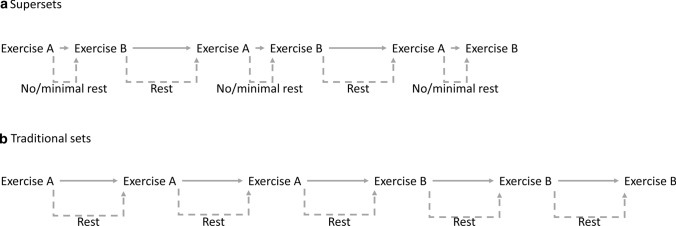
Lack of time is among the more commonly reported barriers for abstention from exercise programs. The aim of this review was to determine how strength training can be most effectively carried out in a time-efficient manner by critically evaluating research on acute training variables, advanced training techniques, and the need for warm-up and stretching. When programming strength training for optimum time-efficiency we recommend prioritizing bilateral, multi-joint exercises that include full dynamic movements (i.e. both eccentric and concentric muscle actions), and to perform a minimum of one leg pressing exercise (e.g. squats), one upper-body pulling exercise (e.g. pull-up) and one upper-body pushing exercise (e.g. bench press). Exercises can be performed with machines and/or free weights based on training goals, availability, and personal preferences. Weekly training volume is more important than training frequency and we recommend performing a minimum of 4 weekly sets per muscle group using a 6–15 RM loading range (15–40 repetitions can be used if training is performed to volitional failure). Advanced training techniques, such as supersets, drop sets and rest-pause training roughly halves training time compared to traditional training, while maintaining training volume. However, these methods are probably better at inducing hypertrophy than muscular strength, and more research is needed on longitudinal training effects. Finally, we advise restricting the warm-up to exercise-specific warm-ups, and only prioritize stretching if the goal of training is to increase flexibility. This review shows how acute training variables can be manipulated, and how specific training techniques can be used to optimize the training response: time ratio in regard to improvements in strength and hypertrophy. Graphic Abstract:
Overview
The claims and statistics of this paper haven’t been checked yet.
Free: it reads the open-access text and checks the first 5 claims that cite a source we can check. Create a free account to check every claim.
Integrity signals
Registry
Cites
Statistics
Figures
Verification
Claims the paper makes
The claims and statistics of this paper haven’t been checked yet.
Free: it reads the open-access text and checks the first 5 claims that cite a source we can check. Create a free account to check every claim.
Claims other papers make about this one
Each is checked against this paper’s own text: does it say what the citing paper says it does?
The source backs part of the claim, not all of it — or backs it for a different population, condition or comparison.
In the citing paper
“One multi-joint exercise compared to various single-joint exercises (with the same set and repetition range compared to the multi-joint exercise) can increase muscle strength and power to an even greater extent [38, 115–117].”
From Minimalist Training: Is Lower Dosage or Intensity Resistance Training Effective to Improve Physical Fitness? A Narrative Review (2024) · cites this paper as [38]
Experimental — accuracy not yet measuredThe cited source says what the claim attributes to it.
In the citing paper
“Other advanced RT routines such as drop sets and rest-pause sets can also decrease training time, but may be more effective for inducing greater hypertrophy than strength [38], while the increased intensity and discomfort would probably discourage the reluctant RT individual.”
From Minimalist Training: Is Lower Dosage or Intensity Resistance Training Effective to Improve Physical Fitness? A Narrative Review (2024) · cites this paper as [38]
The cited source says what the claim attributes to it.
In the citing paper
“Consequently, it is suggested that multi-joint exercises can be considered as more time efficient by reducing the overall number of exercises (i.e., less training time with similar results) [38, 120].”
From Minimalist Training: Is Lower Dosage or Intensity Resistance Training Effective to Improve Physical Fitness? A Narrative Review (2024) · cites this paper as [38]
Self-check
Percentages, sums and reported differences re-computed from the paper’s own numbers.
The self-check needs the paper’s full text.
Citations
Cites
Garber, C. E., Blissmer, B., Deschenes, M. R., Franklin, B. A., Lamonte, M. J., Lee, I.-M., Nieman, D. C., & Swain, D. P. (2011) · Medicine & Science in Sports & Exercise · doi:10.1249/mss.0b013e318213fefb · Cited by 9,319 · cited 3×
“A typical strength and hypertrophy program for untrained or intermediately trained healthy adults involves training all major muscle groups with 2–4 sets of 8–10 exercises for 3–12 repetitions with 2–5 min rest between sets, carried out 2–4 times per week [1, 8].”
BackgroundGuthold, R., Stevens, G. A., Riley, L. M., & Bull, F. C. (2018) · The Lancet Global Health · doi:10.1016/s2214-109x(18)30357-7 · Cited by 4,819 · cited 1×
“However, a majority of people refrain from performing strength training and other forms of exercise, and as much as a quarter of the world’s population are at risk for developing health-related problems and diseases linked to inactivity [4].”
BackgroundProgression Models in Resistance Training for Healthy Adults
(2009) · Medicine & Science in Sports & Exercise · doi:10.1249/mss.0b013e3181915670 · Cited by 4,332
Progression Models in Resistance Training for Healthy Adults
(2002) · Medicine and Science in Sports and Exercise · doi:10.1097/00005768-200202000-00027 · Cited by 2,979
Williams, M. A., Haskell, W. L., Ades, P. A., Amsterdam, E. A., Bittner, V., Franklin, B. A., Gulanick, M., Laing, S. T., & Stewart, K. J. (2007) · Circulation · doi:10.1161/circulationaha.107.185214 · Cited by 1,211
The importance of muscular strength: Training considerations
Suchomel, T. J., Nimphius, S., Bellon, C. R., & Stone, M. H. (2018) · Sports Medicine · doi:10.1007/s40279-018-0862-z · Cited by 940 · cited 4×
“This advice is reflected in recent reviews, where it was concluded that rest intervals should vary from 2–5 min depending on whether the goal is hypertrophy or strength and power [41].”
BackgroundInfluentialSchoenfeld, B. J., Grgic, J., Ogborn, D., & Krieger, J. W. (2017) · Journal of Strength and Conditioning Research · doi:10.1519/jsc.0000000000002200 · Cited by 851 · cited 2×
“Furthermore, although the use of heavyloads was superior for inducing strength gains, considerable strength increases were shown for low-load training as well (increases in 1RM of 35% and 28%, respectively) [25].”
BackgroundSelf-citationSchoenfeld, B. J., Ogborn, D., & Krieger, J. W. (2017) · Journal of Sports Sciences · doi:10.1080/02640414.2016.1210197 · Cited by 671 · cited 1×
“stratified hypertrophic gains across the pooled literature for < 5 weekly sets, 5–9 weekly sets, and 10 + weekly sets, reporting increases of ~ 5%, ~ 7%, and ~ 10%, respectively [23].”
BackgroundSelf-citationEssentials of strength training and conditioning
Haff, G. G., & Triplett, N. T. (2016) · Edith Cowan University Research Online (Edith Cowan University) · Cited by 566
Bird, S. P., Tarpenning, K. M., & Marino, F. E. (2005) · Sports Medicine · doi:10.2165/00007256-200535100-00002 · Cited by 533 · cited 4×
“A traditional belief has been that adaptations following strength training are load dependent, with heavy loads, moderate loads and low loads used for increasing maximum strength, hypertrophy and muscular endurance, respectively [9].”
BackgroundInfluential
Research works printed but not linked: 2
- WHO guidelines approved by the guidelines review committee. Global recommendations on physical activity for health. Geneva: World Health Organization. Copyright (c) World Health Organization 2010.; 2010.
- Carpinelli R A critical analysis of the strength and conditioning association`s opinion that free weights are superior to machines for increasing muscular strength and power Med Sport Pract 2017 18 21 39
Cited by
Items 101–159 of 159
Iversen, V. M., Norum, M., Schoenfeld, B. J., & Fimland, M. S. (2021) · Sports Medicine · doi:10.1007/s40279-021-01592-w · Cited by 1
Self-citationPujowigoro, Y., Sukarmin, Y., Nasrulloh, A., Nugroho, S., Guntur, G., & Manihuruk, F. (2023) · INTERNATIONAL JOURNAL OF MULTIDISCIPLINARY RESEARCH AND ANALYSIS · doi:10.47191/ijmra/v6-i6-71 · Cited by 1
“…using one's own body is an alternative to strength training that can be practiced almost anywhere and anytime, while training using external weights can improve physical fitness such as muscle strength, muscle hypertrophy, coordination, and muscle power (Iversen et al., 2021; Vieira et al., 2021).”
BackgroundTime-Saving Versus Time-Efficient Training Terminology, Methods, and Prescription
Bonder, I. J., Waller, M. A., Shim, A., & Tangeman, M. (2023) · Strength and conditioning journal · doi:10.1519/ssc.0000000000000805 · Cited by 1
The Impact of Resistance Training on Mental Health: Neuropsychological and Behavioral Functioning
Hattabi, S., Fadhlaoui, H., Hammami, N., Forte, P. M., Sortwell, A., & Branquinho, L. (2024) · IntechOpen eBooks · doi:10.5772/intechopen.1008261 · Cited by 1
Haraldson, C., Sjöberg, P., & Berglund, L. (2025) · Physical Therapy Reviews · doi:10.1080/10833196.2025.2459537 · Cited by 1
Miftachurochmah, Y., Tomoliyus, T., Sukamti, E. R., Pamungkas, G., & Pavlović, R. (2025) · Health sport rehabilitation · doi:10.58962/hsr.2025.11.2.115-126 · Cited by 1
Zhang, J., Liu, J., & Liu, R. (2025) · Research Square · doi:10.21203/rs.3.rs-7868842/v1 · Cited by 1
Themistocleous, I.-C., Petros, A., & Stefanakis, M. (2022) · International Journal of Sports and Exercise Medicine · doi:10.23937/2469-5718/1510240 · Cited by 1
The efficacy of the load-velocity profile to predict one repetition maximum
Thompson, S. W. (2022) · Sheffield Hallam University · doi:10.7190/shu-thesis-00591
Exercício Físico com Resistência Elástica para o Fortalecimento Muscular de Idosos: um guia prático
Regis, J. D. F., & Gil, A. W. D. O. (2024) · Editora Científica Digital eBooks · doi:10.37885/978-65-5360-644-9
Suharta, A., Mahmuddin, M. , Amansyah, Nurkadri, N., Bangun, S. Y., Laksana, A. A. N. P., Siregar, Y. I., Sihombing, R. S., Suganda, M. A., Yanti, N., et al. (2025) · doi:10.56984/8zg00e1onap
Hänninen, H., Kalaja, S., Kalaja, T., Vuoriainen, A., Rinnevuori, M., & Haapasalo, L. (2025) · Science of Gymnastics Journal · doi:10.52165/sgj.17.2.259-271 · Cited by 1
de Souza, T. R. (2025) · QUT ePrints (Queensland University of Technology) · doi:10.5204/thesis.eprints.258466 · Cited by 1
Samsudin, N., Ahmad, N. S., Ooi, F. K., Kadir, A. A., & Kassim, N. K. (2025) · Annals of Applied Sport Science · doi:10.61186/aassjournal.1453
Martins, T. B., Mochizuki, L., do Nascimento, I. B., Okubo, R., & Santos, G. M. (2025) · Human Movement Science · doi:10.1016/j.humov.2025.103386
The Effect of Bosu Ball Strengthening Exercise on Dynamic Balance Among UniKL RCMP Athletes
Ismail, N. F. (2025) · Malaysian Journal of Science and Advanced Technology · doi:10.56532/mjsat.v5i3.466
Comparative evaluation of hand grip strength in weight trainers and manual laborers.
Leghari, M. H., Sheikh, A. M., Kaleemullah, H., & Mirza, F. (2025) · INTERNATIONAL JOURNAL OF ENDORSING HEALTH SCIENCE RESEARCH (IJEHSR) · doi:10.29052/ijehsr.v13.i2.2025.81-88
Spor Dalına Özgü Kuvvet Gelişimi: Takım Sporları ve Bireysel Sporlar İçin Yaklaşımlar
Gündüz, B. (2025) · Akademisyen Kitabevi eBooks · doi:10.37609/akya.3849.c1238
Impact of 6-Week Combined Gym and Climbing Training on Handgrip Strength and Arm Size—GRIP-6 Study
Chomiuk, T., Męczyński, A., Kasiak, P. S., Mamcarz, A., & Śliż, D. (2025) · Journal of Functional Morphology and Kinesiology · doi:10.3390/jfmk10040427
“While this volume may be significant for amateurs, it could not be effective for more advanced athletes [31].”
Berndt, P. (2024) · Publication Server of Kaiserslautern University of Technology (Kaiserslautern University of Technology) · doi:10.26204/kluedo/7845
Bell, L., Strafford, B. W., Coleman, M., Androulakis‐Korakakis, P., & Nolan, D. A. (2024) · Figshare · doi:10.6084/m9.figshare.26618686
Isenmann, E., Kaluza, D., Havers, T., Elbeshausen, A., Geisler, S., Hofmann, K., Flenker, U., Diel, P. R., & Gavanda, S. (2023) · Figshare · doi:10.6084/m9.figshare.24264713
Avaliação das escolhas nutricionais por nadadores de competição, pré-treino de alta intensidade
Pinto, M. (2023) · Portuguese National Funding Agency for Science, Research and Technology (RCAAP Project by FCT)
Nikkinen, A. (2025) · Jyväskylä University Digital Archive (University of Jyväskylä)
Ensihoitajan voimaharjoittelumalli
Nyman, A. (2023) · Theseus (Ammattikorkeakoulujen)
Imam Abudarda Permana (2024) · Repository at Universitas Pendidikan Indonesia (Universitas Pendidikan Indonesia)
Resistance Training in Older Adults: The Importance of Volume and Movement Velocity
Marques, D. L. S. T. (2023) · Portuguese National Funding Agency for Science, Research and Technology (RCAAP Project by FCT)
Alaber Herrero, A., Matute Llorente, Á., & Marques-Lopes, I. (2023) · Zaguan (Universidad de Zaragoza)
Steinert, N. (2024) · Hochschulschriftenserver Ostfalia Hochschule
Tissari, E. (2024) · Theseus (Ammattikorkeakoulujen)
Lihasvoimaharjoittelu -opas vaihdevuosi-ikäisille naisille
Nissilä, T., Paavola, A., & Taskinen, L. (2025) · Theseus (Ammattikorkeakoulujen)
Effects of Specific Time-Efficient Warm-Up on One-Repetition Maximum Squat Performance
Madarsa, N. I., Shalan, N. A. A. M., Nadzalan, A. M., & Mohamad, N. I. (2025) · Lecture notes in bioengineering · doi:10.1007/978-981-96-8757-2_16
Primerjava akutnih učinkov statičnega in PNF raztezanja na togost zadnjih stegenskih mišic
Železnik, P. (2024) · Repository of the University of Primorsk (University of Primorska)
Minimum-Effective Resistance Training Doses
Mang, Z. (2025) · ACSMʼs Health & Fitness Journal · doi:10.1249/fit.0000000000001117
Keshavarz, M., & Arazi, H. (2026) · Comparative Exercise Physiology · doi:10.1163/17552559-bja10078
Goli, A., Attarieh, P., Nunes, J. P., Nehegadar, S., Khani, S., Fashi, M., & Ahmadizad, S. (2026) · International journal of exercise science · doi:10.70252/ijes2026403
Maciel, O. (2022) · Portuguese National Funding Agency for Science, Research and Technology (RCAAP Project by FCT)
Stulginskas, K. (2024) · Lithuanian University of Health Sciences
Dandekar, S. C., Kurth, J. D., Shang, Y., Stine, J. G., Ladwig, M. A., Conroy, D. E., Schmitz, K. H., Rovniak, L. S., Silvis, M. L., Danilovich, M., et al. (2026) · PLoS ONE · doi:10.1371/journal.pone.0336748
“[17] Our team has observed that 84% of older adults with difficulty walking preferred doing RT 5 minutes per day versus the traditional 45 minutes three-times weekly in part due to physical limitations and pain.”
Design of an intervention protocol for time-efficient strength training using alternating sets
García-Orea, G. P., Sánchez, Á. B., & Belando‐Pedreño, N. (2026) · E-balonmano com Journal Sports Science · doi:10.17398/1885-7019.89
“…how training sessions can be designed to optimize available time (i.e., minimizing time expenditure) without significantly compromising results could encourage more individuals to participate in this form of exercise (Iversen et al., 2021) and help prevent dropout from exercise programs.”
Halmenschlager, G. H., de Oliveira, L. F., & da Matta, T. T. (2026) · Muscles Ligaments and Tendons Journal · doi:10.32098/mltj_2026_6516
“Additionally, time constraints are a significant barrier to regular exercise participation [12] , and incorporating static stretching into resistance training sessions can further extend their duration.”
Sensitivity of Load–velocity Relationship Variables to a Resistance Training Mesocycle
Chen, Z., García‐Ramos, A., Huang, Z., Li, Z., Zhang, X., & Miras‐Moreno, S. (2026) · International Journal of Sports Medicine · doi:10.1055/a-2879-3417
Leinonen, E., & Våg, J. (2026) · Theseus (Ammattikorkeakoulujen)
Reilly, R. R. (2026) · Strength and conditioning journal · doi:10.1519/ssc.0000000000000964
Andersen, V. S., Stien, N., Sæterbakken, A. H., & Solstad, T. E. J. (2026) · Universitetsforlaget eBooks · doi:10.18261/9788294167371-26-03
Koban, Z. A., & Heil, B. V. (2026) · Springer eBooks · doi:10.1007/978-3-032-03840-1_47
Jumel, V. R., & Bettembos, A. M. (2023) · TITULA
Muñoz-López, M., Sancho-Haro, E. S., Zabaleta-Korta, A., Rodríguez, A. M., López‐Gil, J. F., Tornero-Aguilera, J. F., & Sepulveda, R. A. Y. (2026) · Sports · doi:10.3390/sports14070304
“Evidence on time-efficient resistance training suggests that session duration and weekly volume can be reduced by manipulating variables such as number of sets, exercise selection, rest periods, load, frequency, and proximity to muscular failure [40–46].”
InfluentialKhachfe, H. H., Diab, A., Sater, B. H. A., & Sater, A. H. A. (2026) · Sports Health A Multidisciplinary Approach · doi:10.1177/19417381261460192
“13 These results suggest that, in addition to evaluating exercise program effectiveness, researchers should also evaluate the burden imposed by exercise programs.”
Methods and Systems of Resistance Training: A Narrative Review Based on Contemporary Recommendations
Rios, M. J., Ferreira, F. A., Chapman, D. W., Fernandes, R. J., & Reis, V. M. (2026) · Sports · doi:10.3390/sports14080348
“The relevance of proximity to muscular failure may depend on relative load, training volume, training status, and the outcome assessed [16,17].”
Tuna, G. (2026) · Turkish Journal of Sport and Exercise · doi:10.15314/tsed.1808800
Morales, C. A. N., & Chica, M. G. P. (2026) · Ciencia y Educación · doi:10.5281/zenodo.22218135
Saka, P., & Fitria, V. A. (2026) · TIN Terapan Informatika Nusantara · doi:10.47065/tin.v7i1.10214
“Selain itu, keterbatasan waktu juga perlu dipertimbangkan, sebab kurangnya waktu sering menjadi salah satu alasan seseorang sulit mengikuti program latihan secara terstruktur (Iversen et al., 2021).”
Chien, K., Chan, T.-H., Lin, T.-R., & Lin, T.-C. (2026) · Journal of Functional Morphology and Kinesiology · doi:10.3390/jfmk11030370
“Previous reviews have suggested that superset-or paired-set-based training can reduce session duration and improve training efficiency while generally maintaining volume load and repetition performance [11,22].”
Yan, R., Fang, H., Wang, S., & Ma, D. (2026) · Quest · doi:10.1080/00336297.2026.2730236
Smith, S., Behan, F. P., Nolan, D. A., & Egan, B. (2026) · The Journal of Strength and Conditioning Research · doi:10.1519/jsc.0000000000005640
Corey, M. R., Jessie, B. M., Michele, L. P., Renee, S., Christopher, C. G., Michael, B., Prodromou, P., Katie, E. A., & Marily, O. (2026) · Contemporary Clinical Trials · doi:10.1016/j.cct.2026.108490
Efectos de un programa de entrenamiento de fuerza de 5 días vs 3 días en jóvenes universitarios
Estupiñan, A. P., Ángulo, D. J. B., Álava-Magallanes, G. D., Plaza-Criollo, L. I., Montoya-Arellano, W. I., Rodríguez-Batioja, D. R., & Menoscal-Burgos, J. F. (2026) · Sportis Scientific Journal of School Sport Physical Education and Psychomotricity · doi:10.55040/947zfn44
Metadata
- Authors
- Iversen, V. M., Norum, M., Schoenfeld, B. J., & Fimland, M. S.
- Affiliations
- Norwegian University of Science and Technology (NO)
- Lehman College (US)
- Corresponding author
- Iversen, Vegard M.
- Venue
- Sports Medicine
- Published
- 2021-06-14
- Volume
- 51
- Issue
- 10
- Pages
- 2079-2095
- ISSN
- 0112-1642 (ISSN-L)
- 1179-2035
- PMC
- PMC8449772
- OpenAlex
- W3168884713
- Cited by
- 122
- References
- 108
- Citations by year
- 2026: 18 · 2025: 34 · 2024: 25 · 2023: 22 · 2022: 19 · 2021: 4
- FWCI
- 3.73
- Type
- journal article
- Language
- en
- Open access
- hybrid
- doi.org
- Licence
- cc-by
- creativecommons.org/licenses/by/4.0 (tdm)
- creativecommons.org/licenses/by/4.0 (vor)
- Locations
- Sports Medicine (publishedVersion, cc-by)
- Europe PMC (PubMed Central) (publishedVersion, other-oa)
- PubMed Central (publishedVersion, cc-by)
- PubMed (publishedVersion)
- Funders
- NTNU Norwegian University of Science and Technology
- Topics
- Health Sciences › Medicine › Orthopedics and Sports Medicine › Sports Performance and Training
- Health Sciences › Medicine › Physiology (medical) › Cardiovascular and exercise physiology
- Health Sciences › Nursing › Nutrition and Dietetics › Muscle metabolism and nutrition
- Keywords
- resistance training, hypertrophy, training duration, training volume, exercise frequency, leg press, pull-ups, bench press, free weights, supersets, warm-up, stretching, flexibility
- MeSH terms
- Humans, Hypertrophy, Exercise, Muscle, Skeletal, Muscle Strength, Resistance Training
About these checks
Registry, retraction, Cites and statistics results are computed, not judged, with one exception: a printed reference that no index lists is read once by a model before it counts as a citation error. Claims are extracted by a model and kept only when their quote appears verbatim in the text; each cited source is then checked, with a model’s help, for whether it says what the claim relies on. Those verdicts can be wrong — read the claim’s quote and the cited source before relying on one.
Statistics and arithmetic are recomputed, not judged.
Confidence bands are shown only for fields calibrated on our annotated test set. None is calibrated yet, so no band is shown.
What counts as a claim ›How we measure confidence ›How we check this ›
Are you an author, or do you see a problem with this page? Request a review
Data sources
Bibliographic data: Semantic Scholar, OpenAlex, Crossref.
Contains information from the Semantic Scholar Academic Graph Datasets, made available under the ODC Attribution License (ODC-BY 1.0).
Semantic Scholar’s data is described in: Kinney, R., et al. (2023). The Semantic Scholar Open Data Platform. arXiv:2301.10140.
