

The Effects of Concurrent Aerobic and Strength Training on Muscle Fiber Hypertrophy: A Systematic Review and Meta-Analysis
Open accessThe DOI matches its Crossref record; 47 of the 48 references it cites were found in a registry or an index.
Abstract
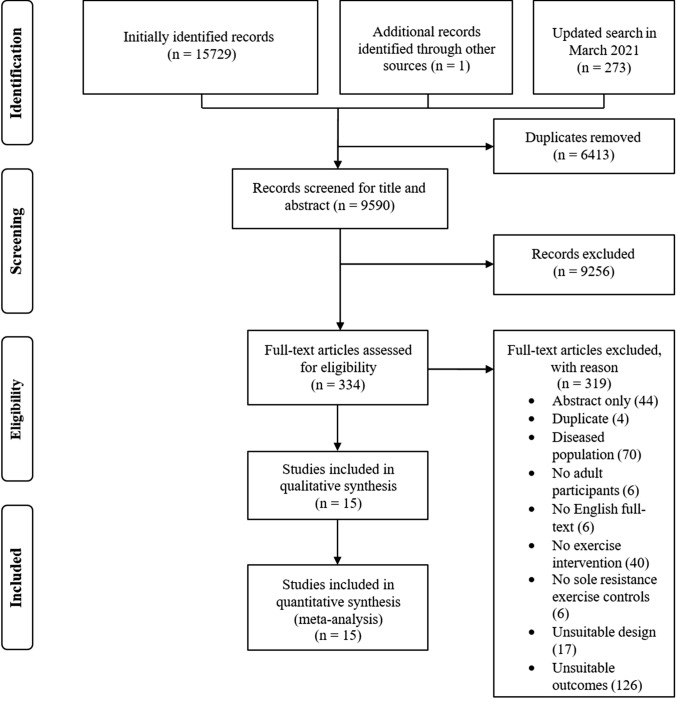
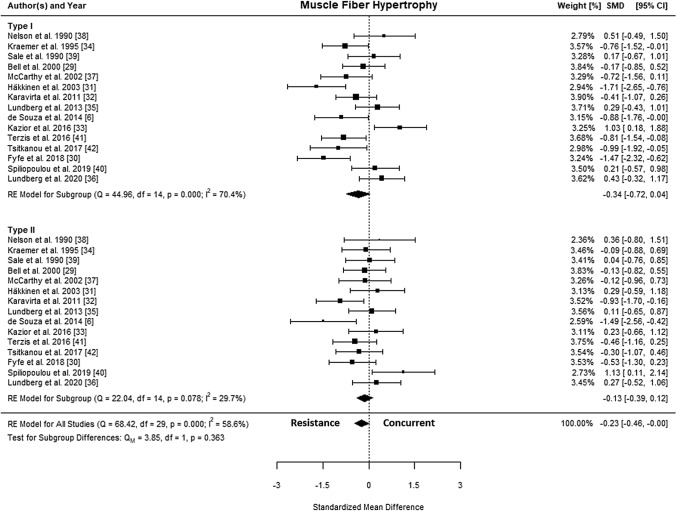
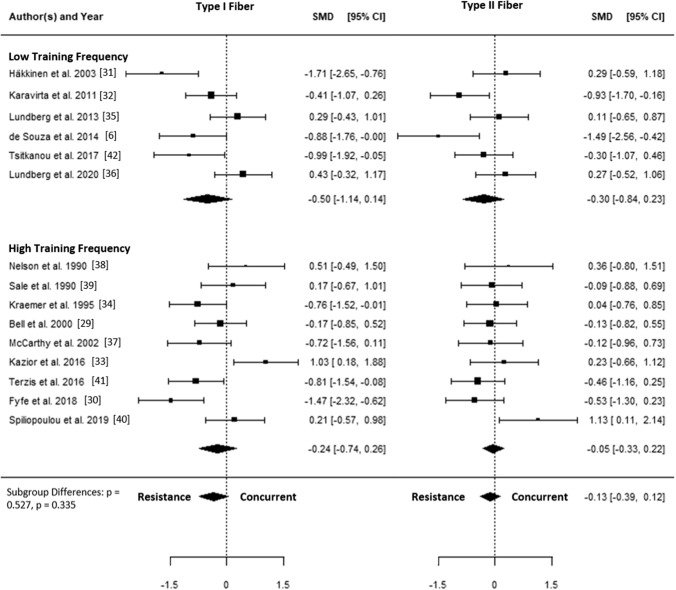
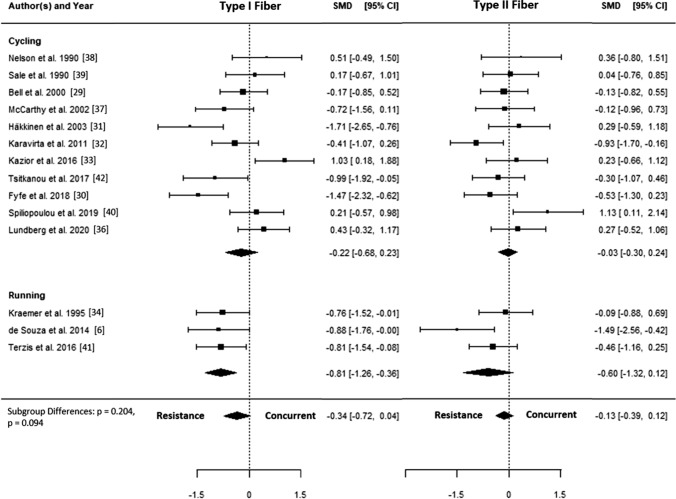
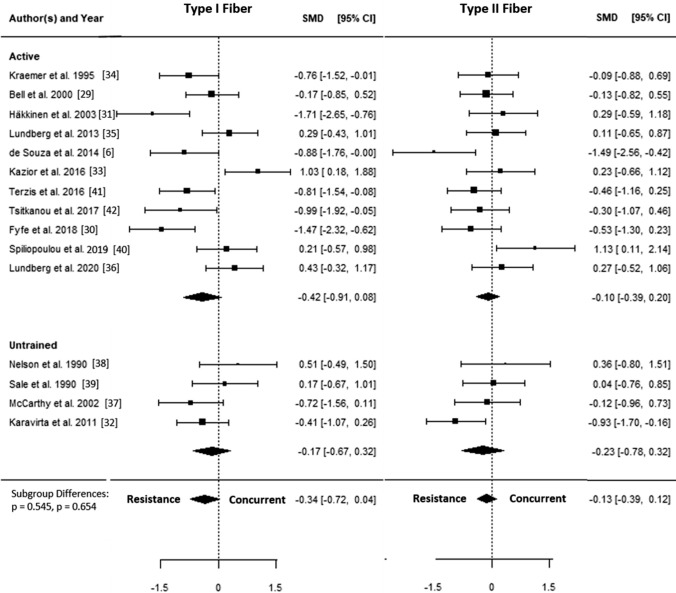
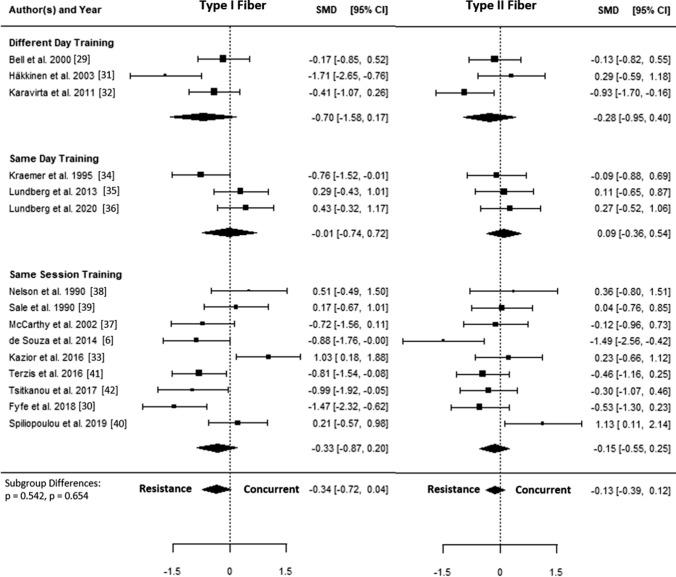
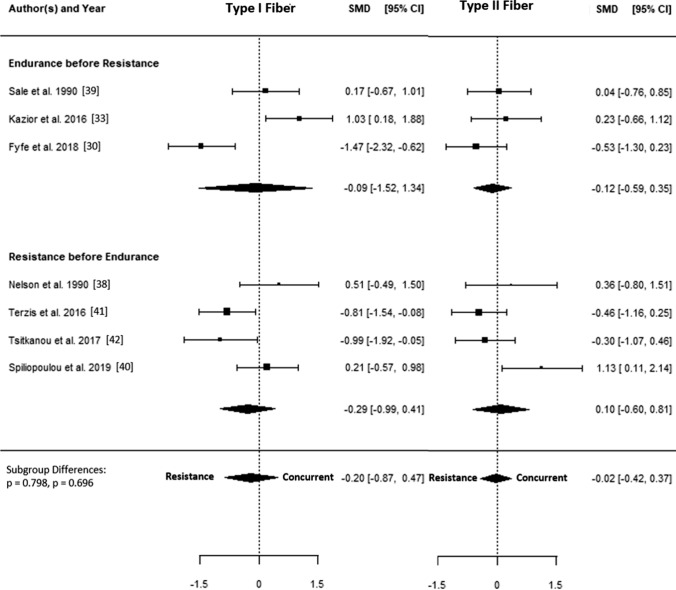
Background: Whole muscle hypertrophy does not appear to be negatively affected by concurrent aerobic and strength training compared to strength training alone. However, there are contradictions in the literature regarding the effects of concurrent training on hypertrophy at the myofiber level. Objective: The current study aimed to systematically examine the extent to which concurrent aerobic and strength training, compared with strength training alone, influences type I and type II muscle fiber size adaptations. We also conducted subgroup analyses to examine the effects of the type of aerobic training, training modality, exercise order, training frequency, age, and training status. Design: A systematic literature search was conducted according to the Preferred Reporting Items for Systematic Reviews and Meta-Analyses (PRISMA) [PROSPERO: CRD42020203777]. The registered protocol was modified to include only muscle fiber hypertrophy as an outcome. Data Sources: PubMed/MEDLINE, ISI Web of Science, Embase, CINAHL, SPORTDiscus, and Scopus were systematically searched on 12 August, 2020, and updated on 15 March, 2021. Eligibility Criteria: Population: healthy adults of any sex and age; intervention: supervised, concurrent aerobic and strength training of at least 4 weeks; comparison: identical strength training prescription, with no aerobic training; and outcome: muscle fiber hypertrophy. Results: A total of 15 studies were included. The estimated standardized mean difference based on the random-effects model was − 0.23 (95% confidence interval [CI] − 0.46 to − 0.00, p = 0.050) for overall muscle fiber hypertrophy. The standardized mean differences were − 0.34 (95% CI − 0.72 to 0.04, p = 0.078) and − 0.13 (95% CI − 0.39 to 0.12, p = 0.315) for type I and type II fiber hypertrophy, respectively. A negative effect of concurrent training was observed for type I fibers when aerobic training was performed by running but not cycling (standardized mean difference − 0.81, 95% CI − 1.26 to − 0.36). None of the other subgroup analyses (i.e., based on concurrent training frequency, training status, training modality, and training order of same-session training) revealed any differences between groups. Conclusions: In contrast to previous findings on whole muscle hypertrophy, the present results suggest that concurrent aerobic and strength training may have a small negative effect on fiber hypertrophy compared with strength training alone. Preliminary evidence suggests that this interference effect may be more pronounced when aerobic training is performed by running compared with cycling, at least for type I fibers.
Overview
The claims and statistics of this paper haven’t been checked yet.
Free: it reads the open-access text and checks the first 5 claims that cite a source we can check. Create a free account to check every claim.
Integrity signals
Registry
Cites
Statistics
Figures
Verification
Claims the paper makes
The claims and statistics of this paper haven’t been checked yet.
Free: it reads the open-access text and checks the first 5 claims that cite a source we can check. Create a free account to check every claim.
Claims other papers make about this one
Each is checked against this paper’s own text: does it say what the citing paper says it does?
The check wasn’t confident either way, so it gives no verdict — never disputed.
In the citing paper
“However, less attention has been given to body fat changes with CT [2,3].”
From Comparison of concurrent, resistance, or aerobic training on body fat loss: a systematic review and meta-analysis. (2025) · cites this paper as [2]
Experimental — accuracy not yet measured
Self-check
Percentages, sums and reported differences re-computed from the paper’s own numbers.
The self-check needs the paper’s full text.
Citations
Cites
Quantifying heterogeneity in a meta‐analysis
Higgins, J. P. T., & Thompson, S. G. (2002) · Statistics in Medicine · doi:10.1002/sim.1186 · Cited by 36,763
Liberati, A., Altman, D. G., Tetzlaff, J., Mulrow, C., Gøtzsche, P. C., Ioannidis, J. P. A., Clarke, M., Devereaux, P. J., Kleijnen, J., & Moher, D. (2009) · PLoS Medicine · doi:10.1371/journal.pmed.1000100 · Cited by 28,164
Conducting Meta-Analyses in R with the metafor Package
Viechtbauer, W. (2010) · Journal of Statistical Software · doi:10.18637/jss.v036.i03 · Cited by 20,464
Operating characteristics of a rank correlation test for publication bias
Begg, C. B., & Mazumdar, M. (1994) · Biometrics · doi:10.2307/2533446 · Cited by 16,955
World Health Organization 2020 guidelines on physical activity and sedentary behaviour
Bull, F. C., Al-Ansari, S. S., Biddle, S., Borodulin, K., Buman, M. P., Cardon, G., Carty, C., Chaput, J.-P., Chastin, S., Chou, R., et al. (2020) · British Journal of Sports Medicine · doi:10.1136/bjsports-2020-102955 · Cited by 11,657 · cited 1×
“Current physical activity guidelines recommend that all children, adolescents, and adults engage in concurrent training to promote significant health benefits [1].”
The combination of estimates from different experiments
Cochran, W. G. (1954) · Biometrics · doi:10.2307/3001666 · Cited by 5,380
Outlier and influence diagnostics for meta-analysis
Viechtbauer, W., & Cheung, M. W.-L. (2010) · Research Synthesis Methods · doi:10.1002/jrsm.11 · Cited by 2,949 · cited 1×
“Studentized residuals and Cook’s distances were examined to assess whether studies might be outliers and/or overly influential [25].”
Publication Bias in Meta‐Analysis: Prevention, Assessment and Adjustments
(2005) · doi:10.1002/0470870168 · Cited by 2,368
Estimating effect sizes from pretest-posttest-control group designs
Morris, S. B. (2008) · Organizational Research Methods · doi:10.1177/1094428106291059 · Cited by 2,133
Bias and Efficiency of Meta-Analytic Variance Estimators in the Random-Effects Model
Viechtbauer, W. (2005) · Journal of Educational and Behavioral Statistics · doi:10.3102/10769986030003261 · Cited by 1,699 · cited 1×
“, τ2), was estimated using the restricted maximum-likelihood estimator [21].”
Research works printed but not linked: 1
- Higgins JPT Green S Cochrane handbook for systematic reviews of interventions, version 5.1.0 2011 Chichester Wiley-Blackwell
Cited by
Exercise Metabolism and Adaptation in Skeletal Muscle
Smith, J. A. B., Murach, K. A., Dyar, K. A., & Zierath, J. R. (2023) · Nature Reviews Molecular Cell Biology · doi:10.1038/s41580-023-00606-x · Cited by 342
The molecular athlete: exercise physiology from mechanisms to medals
Furrer, R., Hawley, J. A., & Handschin, C. (2023) · Physiological Reviews · doi:10.1152/physrev.00017.2022 · Cited by 217
Huiberts, R. O., Wüst, R. C. I., & van der Zwaard, S. (2024) · Sports Medicine · doi:10.1007/s40279-023-01943-9 · Cited by 75
“Importantly, prior meta-analyses on concurrent training did not distinguish between both endurance-and strength-trained status [7, 9, 10, 25].”
Hooren, B. V., Aagaard, P., & Blazevich, A. J. (2024) · Sports Medicine · doi:10.1007/s40279-024-02110-4 · Cited by 58
The Connection Between Resistance Training, Climbing Performance, and Injury Prevention
Sæterbakken, A. H., Stien, N., Pedersen, H., Langer, K., Scott, S., Michailov, M. L., Grønhaug, G., Baláš, J., Solstad, T. E. J., & Andersen, V. S. (2024) · Sports Medicine - Open · doi:10.1186/s40798-024-00677-w · Cited by 44
Khalafi, M., Kheradmand, S., Maleki, A. H., Symonds, M. E., Rosenkranz, S. K., & Batrakoulis, A. (2025) · Healthcare · doi:10.3390/healthcare13070776 · Cited by 43
Zhao, Y.-C., & Gao, B. (2024) · European Journal of Applied Physiology · doi:10.1007/s00421-024-05549-5 · Cited by 36
Yan, R., Jia, S., Lu, D., Song, W., Zhang, W., Sun, J., & Li, D. (2025) · The journal of nutrition health & aging · doi:10.1016/j.jnha.2025.100718 · Cited by 33
Zhang, M., Fang, W., & Wang, J. (2025) · International Journal of Clinical and Health Psychology · doi:10.1016/j.ijchp.2025.100559 · Cited by 28
Flewwelling, L. D., Hannaian, S. J., Cao, V., Chaillou, T., Churchward‐Venne, T. A., & Cheng, A. J. (2024) · American Journal of Physiology-Cell Physiology · doi:10.1152/ajpcell.00266.2024 · Cited by 27
Mikkonen, R. S., Ihalainen, J. K., Hackney, A. C., & Häkkinen, K. (2023) · Sports Medicine · doi:10.1007/s40279-023-01955-5 · Cited by 23
Zhou, L., Li, H., Zhang, Z., & Wang, L. (2024) · Journal of Global Health · doi:10.7189/jogh.14.04239 · Cited by 20
Training modalities for elder sarcopenic obesity: a systematic review and network meta-analysis
Qiu, H., Zheng, W., Zhou, X., Liu, Q., & Zhao, X. (2025) · Frontiers in Nutrition · doi:10.3389/fnut.2025.1537291 · Cited by 17
Li, Z., Qi, Y., Chen, X., Li, J., Zhang, J., Li, P., & Zhou, Z. (2024) · Scandinavian Journal of Medicine and Science in Sports · doi:10.1111/sms.14764 · Cited by 14
Tüfekçi, O., Ünal, E., Aktaş, B. E., Tan, A., Çevik, İ. H., Karabulut, E., Pinar, A., Korkusuz, F., Onur, M. R., Kiraz, S., et al. (2024) · Rheumatology · doi:10.1093/rheumatology/keae365 · Cited by 14
Ding, L., Lou, L., Zhang, M., & Zhang, X. (2025) · Experimental Gerontology · doi:10.1016/j.exger.2024.112652 · Cited by 13
Chen, Y., Feng, X., Huang, L., Wang, K., & Mi, J. (2023) · Journal of Exercise Science & Fitness · doi:10.1016/j.jesf.2023.12.005 · Cited by 13
Sterczala, A. J., Rodriguez‐Ortiz, N., Feigel, E. D., Krajewski, K. T., Martin, B. J., Sekel, N. M., Lovalekar, M. T., Kargl, C. K., Koltun, K. J., van Eck, C. F., et al. (2024) · Physiological Reports · doi:10.14814/phy2.15953 · Cited by 13
Reljic, D., Zieseniss, N., Herrmann, H. J., Neurath, M. F., & Zopf, Y. (2024) · Nutrients · doi:10.3390/nu16162713 · Cited by 12
Lafontant, K., Rukstela, A., Hanson, A., Chan, J., Alsayed, Y., Ayers-Creech, W. A., Bale, C., Ohigashi, Y., Solis, J., Shelton, G., et al. (2025) · Journal of the International Society of Sports Nutrition · doi:10.1080/15502783.2025.2507949 · Cited by 11
Cheng, Y., Ma, J., & Bo, S. (2024) · PeerJ · doi:10.7717/peerj.17958 · Cited by 11
Lyngbæk, M. P. P., Legaard, G. E., Nielsen, N. S., Durrer, C. G., Almdal, T., Lund, M. A. V., Liebetrau, B., Ewertsen, C., Lauridsen, C. A., Solomon, T. P. J., et al. (2024) · Journal of sport and health science/Journal of Sport and Health Science · doi:10.1016/j.jshs.2024.100999 · Cited by 11
Lundby, C., Mazza, O., Nielsen, J., Haubro, M., Kvorning, T., Ørtenblad, N., & Gejl, K. D. (2023) · Journal of Applied Physiology · doi:10.1152/japplphysiol.00587.2023 · Cited by 11
The effects of strength training on distance running performance and running injury prevention
Karp, J. R., & Mba (2024) · Journal of Physical Education and Sport · doi:10.7752/jpes.2024.10259 · Cited by 11
Wang, W., Zhang, T., Du, L., Li, K., Zhang, L., Li, H., Gao, X., Xu, L., Li, J., & Gao, H. (2023) · Meat Science · doi:10.1016/j.meatsci.2023.109350 · Cited by 10
Zambrano-Villacres, R., Campuzano-Donoso, M., Reytor-González, C., Rossetti, G., Cobellis, L., Cobellis, F., Pilone, V., Simancas‐Racines, D., & Schiavo, L. (2026) · Nutrients · doi:10.3390/nu18111751 · Cited by 9
Power and Endurance: Polar Opposites or Willing Partners?
Ferguson, C., Furrer, R., Murach, K. A., Hepple, R. T., & Rossiter, H. B. (2025) · Medicine & Science in Sports & Exercise · doi:10.1249/mss.0000000000003793 · Cited by 8
Gomes, M., Fitas, A., Santos, P., Pezarat‐Correia, P., & Mendonça, G. V. (2025) · Journal of Sports Sciences · doi:10.1080/02640414.2025.2518827 · Cited by 8
de Haan, M., van der Zwaard, S., Sanders, J., Beek, P. J., & Jaspers, R. T. (2025) · Journal of Sports Science and Medicine · doi:10.52082/jssm.2025.764 · Cited by 8
Nabutovsky, I., Sabah, R., Moreno, M., Epstein, Y., Klempfner, R., & Scheinowitz, M. (2024) · Journal of Clinical Medicine · doi:10.3390/jcm13051445 · Cited by 8
Anatomical Study of the Palmaris Longus Muscle and Its Clinical Importance
Risi, A.-M. A., Busaidi, S. A., Aufi, H. A., Hashmi, L. A., Sirasanagandla, S. R., & Das, S. (2025) · Diagnostics · doi:10.3390/diagnostics15030304 · Cited by 8
The Effect of Time-Equated Concurrent Training Programs in Resistance-Trained Men
Dolan, C., Quiles, J. M., Goldsmith, J. A., Mendez, K. M., Klemp, A., Robinson, Z. P., Pelland, J. C., Coccia, C. C., & Zourdos, M. C. (2024) · Journal of Human Kinetics · doi:10.5114/jhk/185637 · Cited by 7
Effects of blood flow restriction training in athletes: a systematic review and meta-analysis
Zhang, Y., Xu, K., Yin, M., Duan, B., Kong, H., Xie, Y., & Girard, O. (2025) · International Journal of Sports Medicine · doi:10.1055/a-2537-5879 · Cited by 6
The impact of concurrent training in team sports and soccer
Malamud, O., & Smukas, I. I. R. (2024) · The Journal of Sports Medicine and Physical Fitness · doi:10.23736/s0022-4707.24.16357-8 · Cited by 6
López, P., Rech, A., Petropoulou, M., Silveira, C. B., Molinari, T., Muller, C. T., Casara, P., Bettariga, F., Singh, F., & Radaelli, R. (2026) · Sports Medicine · doi:10.1007/s40279-026-02402-x · Cited by 5
Gomes, M., Gonçalves, A. D., Pezarat‐Correia, P., & Mendonça, G. V. (2025) · European Journal of Applied Physiology · doi:10.1007/s00421-025-05775-5 · Cited by 5
Velocity Loss During Resistance Training: Implications for Concurrent Training Adaptations
Tundidor-Duque, R. M., Loturco, I., Páez-Maldonado, J. A., Asín‐Izquierdo, I., Lovillo‐Fuentes, F., Sánchez‐Valdepeñas, J., Cornejo‐Daza, P. J., Pereira, L. A., de Villarreal, E. S., & Pareja‐Blanco, F. (2026) · Scandinavian Journal of Medicine and Science in Sports · doi:10.1111/sms.70265 · Cited by 5
Boujelbane, M. A., Trabelsi, K., Jahrami, H., Ammar, A., Salem, A., Kerkeni, M., Charfi, A., Boukhris, O. F., Clark, C. C. T., Roufayel, R., et al. (2025) · Health Science Reports · doi:10.1002/hsr2.70692 · Cited by 5
Chen, W. (2025) · Journal of Health Population and Nutrition · doi:10.1186/s41043-025-01031-w · Cited by 5
Jia, Y., Geng, M., Chen, Y., Wang, Y., Ge, X., Zhao, J., & Kong, Y. (2025) · Journal of Sports Science and Medicine · doi:10.52082/jssm.2025.388 · Cited by 4
Sampaio, J., Pizarro, A. I. N., Pinto, J., Oliveira, B. M. P. M., Moreira, A. M., Padrão, P., de Pinho, P. G., Moreira, P. A. M., Barros, R., & Carvalho, J. (2024) · Nutrients · doi:10.3390/nu16203527 · Cited by 4
Inspiratory Muscle Training: Back to Basics Must be the First Step?
Ballesteros-Reviriego, G., Etxarri, A. A., & Martí, J.-D. (2024) · Archivos de Bronconeumología · doi:10.1016/j.arbres.2024.03.025 · Cited by 4
Zambolin, F., Vikmoen, O., Cumming, K. T., Skattebo, Ø., Ødemark, H. N., Øfsteng, S. J., Hammarström, D., Hansen, J., Rønnestad, B. R., & Raastad, T. (2026) · Journal of Applied Physiology · doi:10.1152/japplphysiol.01038.2025 · Cited by 3
Maximizing Adaptations in Concurrent Training: An Umbrella Review of Meta-analyses
Held, S., Wolf, L., Rappelt, L., Bloch, W., Donath, L., Micke, F., Geisler, S., & Isenmann, E. (2026) · Sports Medicine · doi:10.1007/s40279-026-02401-y · Cited by 3
Feng, Z., Ying, W., & Jun, W. (2026) · Frontiers in Sports and Active Living · doi:10.3389/fspor.2025.1692399 · Cited by 3
Kuśmierska, M., & Kuśmierski, J. (2024) · Quality in Sport · doi:10.12775/qs.2024.15.51852 · Cited by 3
Influence of strength training on physical development and physical fitness of young men
Prontenko, K. V., Bezuhlyi, Y. B., Красілов, А. Д., Зеленюк, О. В., Nesterov, O. S., Viala, O. M., & Denysovets, A. (2025) · Wiadomości Lekarskie · doi:10.36740/wlek/209510 · Cited by 3
Lyngbæk, M. P. P., Legaard, G. E., Nielsen, N. S., Durrer, C. G., Almdal, T., Lund, M. A. V., Liebetrau, B., Ewertsen, C., Lauridsen, C. A., Solomon, T. P. J., et al. (2023) · medRxiv · doi:10.1101/2023.06.04.23290749 · Cited by 2
Rerung, C. T. (2026) · International Journal of Experimental Sports Science Research · doi:10.66968/byxz4r77 · Cited by 2
jabbari, A., & Ghazalian, F. (2023) · مجله علوم پزشکی رازی · doi:10.47176/rjms.30.206 · Cited by 2
Missina, S. S., Сергеевич, К. А., Dikunets, M. A., & Борисович, М. Е. (2022) · Human Physiology · doi:10.1134/s0362119722700074 · Cited by 2
From Anecdote to Evidence: Dispelling Myths in Bodybuilding and Physique Sports
Roberts, B. M., Buckner, S. L., Colenso‐Semple, L. M., Conlin, L., Church, D. D., Campbell, B. I., Souza, E. O. D., Gonzalez, A. M., Helms, E. R., Newmire, D. E., et al. (2026) · Strength and conditioning journal · doi:10.1519/ssc.0000000000000937 · Cited by 1
Conceição, M. S., VECHIN, F. C., Telles, G. D., Lixandrão, M. E., Ribeiro, N., Costa, L. A. R., Hevia-Larraín, V., Scarpelli, M. C., Damas, F., Libardi, C. A., et al. (2025) · Journal of Applied Physiology · doi:10.1152/japplphysiol.00642.2025 · Cited by 1
Hucteau, E., Hureau, T. J., Decor, A., Weltzer, L., Kouzkouz, N., Bischoff, H., Somme, L., Schött, R., Pivot, X. B., Pagano, A. F., et al. (2026) · European Journal of Sport Science · doi:10.1002/ejsc.70153 · Cited by 1
Effect of Trapezius Muscle Thickness on the One-Repetition Maximum (1RM) Strength
Yılmaz, C., Ceylan, T., ALTUNBAŞ, A., Soylu, H. H., Kavuran, K., & Söyler, M. (2025) · Journal of Basic and Clinical Health Sciences · doi:10.30621/jbachs.1720886 · Cited by 1
Shi, A., Hillege, M. M., Noort, W., Offringa, C., Wu, G., Forouzanfar, T., Hoogaars, W. M. H., Wüst, R. C. I., & Jaspers, R. T. (2023) · bioRxiv (Cold Spring Harbor Laboratory) · doi:10.1101/2023.08.30.555466 · Cited by 1
Shi, A., Hillege, M. M. G., Noort, W., Offringa, C., Wu, G., Tim, F., Hoogaars, W. M. H., Wüst, R. C. I., & Jaspers, R. T. (2026) · Communications Biology · doi:10.21203/rs.3.rs-5136404/v1 · Cited by 1
(2023) · Advancement in Yoga and Physical Therapy · doi:10.33140/aypt.01.01.02 · Cited by 1
Effects of concurrent training on speed and agility performance in soccer referees
Baydemir, B., Kaçay, Z., Talaghir, L.-G., & Ivan, P. (2026) · Frontiers in Physiology · doi:10.3389/fphys.2026.1768715 · Cited by 1
Heavy DIY Activities as a Potential Preventative for Stress Urinary Incontinence
Liu, K., Lian, X., Wang, T., & Tao, Z. (2025) · American Journal of Men s Health · doi:10.1177/15579883251336056 · Cited by 1
dos Santos, R. P., PAULA, M. D. S., de Freitas, F. H., dos Santos, L. L., das Neves, C. E., Meira, R. L., Ramos, N. S., Corrêa, A. F., Nilo, M. C. D. S. S., Bezerra, J. C. P., et al. (2026) · Aposta · doi:10.23900/ra.v24i123.032 · Cited by 1
Subjektiivisen stressin yhteys voimaharjoittelussa kehittymiseen
Liikanen, K. (2024) · Jyväskylä University Digital Archive (University of Jyväskylä) · Cited by 1
Ayudas ergogénicas nutricionales en el CrossFit: una revisión narrativa
Esteban Ruiz, M. (2023) · UVaDOC UVaDOC University of Valladolid Documentary Repository (University of Valladolid) · Cited by 1
Vuong, J.-L., Raeder, C., & Wiewelhove, T. (2025) · Springer eBooks · doi:10.1007/978-3-662-69524-1_4
Effects of prolonged physical training on skeletal muscle mass accrual throughout the life span
Ledergerber, R., Kotikangas, J., Cadore, E. L., Feuerbacher, J. F., & Schumann, M. (2026) · Best Practice & Research Clinical Endocrinology & Metabolism · doi:10.1016/j.beem.2026.102132
Self-citationPapadakis, Z., Κουτλιάνος, Ν., Panoutsakopoulos, V., & Kouidi, E. J. (2026) · Frontiers in Network Physiology · doi:10.3389/fnetp.2026.1741770
Zhang, M., Yan, R., Lou, L., Wu, K., Bian, J., Li, D., & Sun, J. (2026) · Sports Health A Multidisciplinary Approach · doi:10.1177/19417381261451825
Möck, S., Haff, G. G., Behringer, M., & WIRTH, K. J. (2026) · European Journal of Applied Physiology · doi:10.1007/s00421-026-06477-2
Gomes, M., Costa, M., Pezarat‐Correia, P., & Mendonça, G. V. (2026) · The Journal of Strength and Conditioning Research · doi:10.1519/jsc.0000000000005698
Doing a short cardio session after weight training probably won’t boost your gains – here’s why
Pearson-Noseworthy, L. (2026) · The Conversation · doi:10.64628/ab.v4ydf9xxm
ZhangFeng, Yuhui, S., & WANGJun (2025) · Authorea · doi:10.22541/au.175324690.02278745/v1
Feuerbacher, J. F. (2025) · Qucosa - Monarch (Chemnitz University of Technology) · doi:10.60687/2026-0098
Self-citationNaddafha, S., Schoenfeld, B. J., António, J., & Stout, J. R. (2026) · Journal of the International Society of Sports Nutrition · doi:10.1080/15502783.2026.2743880
Stulginskas, K. (2024) · Lithuanian University of Health Sciences
Yustisia, I., Hardiany, N. S., Purnomo, E., & Dewi, S. (2025) · Retos · doi:10.47197/retos.v68.112914
Silva, M. Á. G. (2025) · Repositorio Institucional POLIJIC
Ottosson Käll, A. (2025) · Uppsala University Publications (Uppsala University)
Eriksson, J. (2023) · Digitala vetenskapliga arkivet (Diva) (Karlstad University)
Trevisan, E. G. W., Bahr, A. C., de Gregório, E., Lincoski, R. I., Kurtz, F. A., Santore, D. A., dos Santos, D., Costa, L. B. D., Martinello, M., Olekszyszen, B. W., et al. (2026) · Revista Ibero-Americana de Humanidades, Ciências e Educação · doi:10.51891/rease.v12i8.28890
Ribeiro, N. L. X. (2023) · LA Referencia (Red Federada de Repositorios Institucionales de Publicaciones Científicas)
Aumento de la masa muscular en el levantamiento de pesas mediante el fallo muscular
Urgilez, W. P. C., & Jarrín-Navas, S. A. (2026) · Pacha Revista de Estudios Contemporáneos del Sur Global · doi:10.46652/pacha.v7i21.548
Prevalência das lesões em praticantes de musculação e crossfit: uma revisão integrativa
da Costa, C. S., Ribeiro, D. B., & de Queiroz, J. F. (2026) · Brazilian Journal of Health Review · doi:10.34119/bjhrv9n3-140
Metadata
- Authors
- Lundberg, T. R., Feuerbacher, J. F., Sünkeler, M., & Schumann, M.
- Affiliations
- Karolinska University Hospital (SE)
- German Sport University Cologne (DE)
- Corresponding author
- Schumann, Moritz
- Venue
- Sports Medicine
- Published
- 2022-04-27
- Volume
- 52
- Issue
- 10
- Pages
- 2391-2403
- ISSN
- 0112-1642 (ISSN-L)
- 1179-2035
- PMC
- PMC9474354
- OpenAlex
- W4224998771
- Cited by
- 62
- References
- 48
- Citations by year
- 2026: 13 · 2025: 19 · 2024: 18 · 2023: 11 · 2022: 1
- FWCI
- 2.69
- Type
- journal article
- Language
- en
- Open access
- hybrid
- doi.org
- Licence
- cc-by
- creativecommons.org/licenses/by/4.0 (tdm)
- creativecommons.org/licenses/by/4.0 (vor)
- Locations
- Sports Medicine (publishedVersion, cc-by)
- PubMed Central (publishedVersion, cc-by)
- PubMed (publishedVersion)
- Funders
- Deutsche Sporthochschule Köln (DSHS)
- Topics
- Health Sciences › Medicine › Orthopedics and Sports Medicine › Sports Performance and Training
- Health Sciences › Medicine › Physiology (medical) › Cardiovascular and exercise physiology
- Health Sciences › Nursing › Nutrition and Dietetics › Muscle metabolism and nutrition
- Keywords
- concurrent training, aerobic exercise, resistance training, muscle fiber hypertrophy, type I muscle fibers, fast-twitch muscle, running, cycling, exercise order, exercise frequency, training status, healthy adults, endurance training, training methods, training order
- MeSH terms
- Adult, Humans, Hypertrophy, Infant, Infant, Newborn, Muscle, Skeletal, Muscle Fibers, Skeletal, Muscle Strength, Resistance Training
About these checks
Registry, retraction, Cites and statistics results are computed, not judged, with one exception: a printed reference that no index lists is read once by a model before it counts as a citation error. Claims are extracted by a model and kept only when their quote appears verbatim in the text; each cited source is then checked, with a model’s help, for whether it says what the claim relies on. Those verdicts can be wrong — read the claim’s quote and the cited source before relying on one.
Statistics and arithmetic are recomputed, not judged.
Confidence bands are shown only for fields calibrated on our annotated test set. None is calibrated yet, so no band is shown.
What counts as a claim ›How we measure confidence ›How we check this ›
Are you an author, or do you see a problem with this page? Request a review
Data sources
Bibliographic data: Semantic Scholar, OpenAlex, Crossref.
Contains information from the Semantic Scholar Academic Graph Datasets, made available under the ODC Attribution License (ODC-BY 1.0).
Semantic Scholar’s data is described in: Kinney, R., et al. (2023). The Semantic Scholar Open Data Platform. arXiv:2301.10140.
