

Maximal number of repetitions at percentages of the one repetition maximum: a meta-regression and moderator analysis of sex, age, training status, and exercise.
Open accessPublished version of a preprint
The DOI matches its Crossref record; 303 of the 303 references it cites were found in a registry or an index.
Abstract
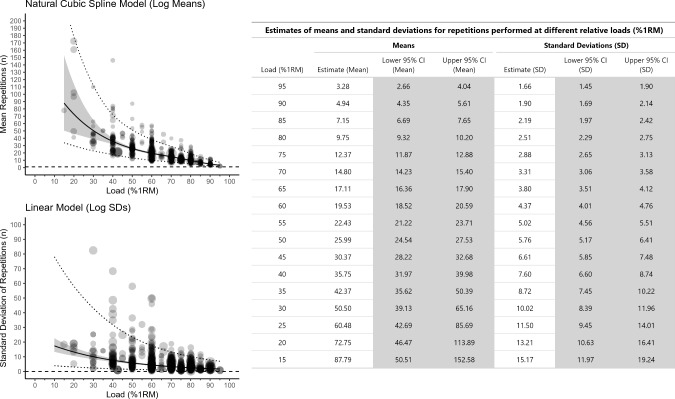
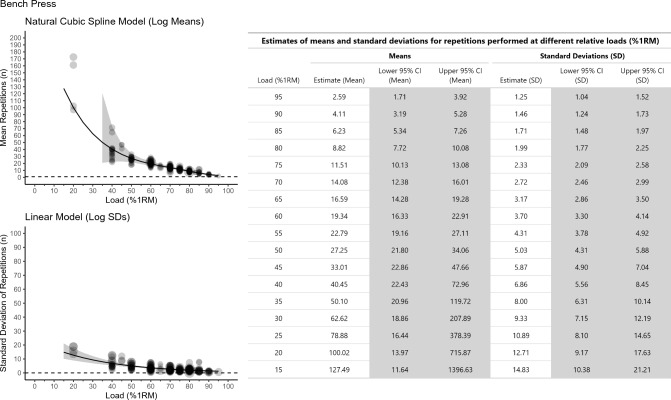
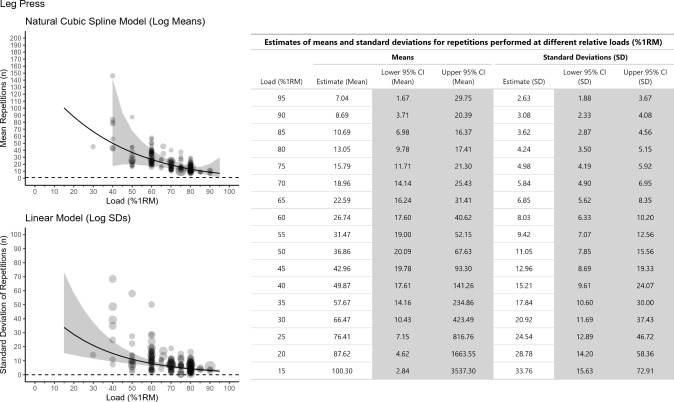
The maximal number of repetitions that can be completed at various percentages of the one repetition maximum (1RM) [REPS ~ %1RM relationship] is foundational knowledge in resistance exercise programming. The current REPS ~ %1RM relationship is based on few studies and has not incorporated uncertainty into estimations or accounted for between-individuals variation. Therefore, we conducted a meta-regression to estimate the mean and between-individuals standard deviation of the number of repetitions that can be completed at various percentages of 1RM. We also explored if the REPS ~ %1RM relationship is moderated by sex, age, training status, and/or exercise. A total of 952 repetitions-to-failure tests, completed by 7289 individuals in 452 groups from 269 studies, were identified. Study groups were predominantly male (66%), healthy (97%), < 59 years of age (92%), and resistance trained (60%). The bench press (42%) and leg press (14%) were the most commonly studied exercises. The REPS ~ %1RM relationship for mean repetitions and standard deviation of repetitions were best described using natural cubic splines and a linear model, respectively, with mean and standard deviation for repetitions decreasing with increasing %1RM. More repetitions were evident in the leg press than bench press across the loading spectrum, thus separate REPS ~ %1RM tables were developed for these two exercises. Analysis of moderators suggested little influences of sex, age, or training status on the REPS ~ %1RM relationship, thus the general main model REPS ~ %1RM table can be applied to all individuals and to all exercises other than the bench press and leg press. More data are needed to develop REPS ~ %1RM tables for other exercises.
Overview
The claims and statistics of this paper haven’t been checked yet.
Free: it reads the open-access text and checks the first 5 claims that cite a source we can check. Create a free account to check every claim.
Integrity signals
Registry
Cites
Statistics
Figures
Verification
Claims the paper makes
The claims and statistics of this paper haven’t been checked yet.
Free: it reads the open-access text and checks the first 5 claims that cite a source we can check. Create a free account to check every claim.
Self-check
Percentages, sums and reported differences re-computed from the paper’s own numbers.
The self-check needs the paper’s full text.
Citations
Cites
Items 201–303 of 303
Merrigan, J. J., Jones, M. T., & White, J. B. (2019) · Journal of Science in Sport and Exercise · doi:10.1007/s42978-019-00030-8 · Cited by 28
Prediction of muscle fiber composition using multiple repetition testing
Hall, E. C. R., Lysenko, E. A., Semenova, E. A., Borisov, O., Andryushchenko, O. N., Andryushchenko, L. B., Vepkhvadze, T. F., Lednev, E. M., Żmijewski, P., Popov, D. V., et al. (2020) · Biology of Sport · doi:10.5114/biolsport.2021.99705 · Cited by 28
Effects of Ischemic Preconditioning as a Warm-Up on Leg Press and Bench Press Performance
Telles, L. G. D. S., Carelli, L. C. N., Bráz, I. D., Junqueira, C. G. S., Monteiro, E. R., Reis, V. M., Vianna, J. M., & Novaes, J. D. S. (2020) · Journal of Human Kinetics · doi:10.2478/hukin-2020-0055 · Cited by 28
Haynes, J. T., Townsend, J. R., Aziz, M. A., Jones, M. D., Littlefield, L. A., Ruiz, M. D., Johnson, K. D., & Gonzalez, A. M. (2021) · Sports · doi:10.3390/sports9060077 · Cited by 28
Camic, C. L., Housh, T. J., Zuniga, J. M., Traylor, D. A., Bergstrom, H. C., Schmidt, R. J., Johnson, G. O., & Housh, D. J. (2014) · Journal of Strength and Conditioning Research · doi:10.1519/jsc.0b013e3182a361a5 · Cited by 27
The training effect of repeated isometric muscle contractions
Hansen, J. W. (1961) · European Journal of Applied Physiology · doi:10.1007/bf00699461 · Cited by 27 · cited 1×
“Investigations related to this topic were first conducted in the 1950s and 1960s [1–4] and were eventually followed by two influential studies by Hoeger et al. in 1987 [5] and 1990 [6].”
MethodTerada, K., Kikuchi, N., Burt, D., Voisin, S. A. C., & Nakazato, K. (2020) · The Journal of Strength and Conditioning Research · doi:10.1519/jsc.0000000000003690 · Cited by 27
Rossi, F. E., Gerosa-Neto, J., Zanchi, N. E., Cholewa, J. M., & Lira, F. S. (2016) · Journal of Strength and Conditioning Research · doi:10.1519/jsc.0000000000001189 · Cited by 27
The Hypoalgesic Effect of Low-Load Exercise to Failure Is Not Augmented by Blood Flow Restriction
Song, J. S., Kataoka, R., Yamada, Y., Wong, V. H. Y., Spitz, R. W., Bell, Z. W., & Loenneke, J. P. (2022) · Research Quarterly for Exercise and Sport · doi:10.1080/02701367.2022.2115443 · Cited by 27
Effects of β-Alanine on Body Composition and Performance Measures in Collegiate Women
Outlaw, J. J., Smith-Ryan, A. E., Buckley, A. L., Urbina, S. L., Hayward, S., Wingfield, H. L., Campbell, B., Foster, C., Taylor, L. W., & Wilborn, C. D. (2016) · Journal of Strength and Conditioning Research · doi:10.1519/jsc.0000000000000665 · Cited by 26
High Dose of Caffeine Mouth Rinse Increases Resistance Training Performance in Men
Karayiğit, R., Koz, M., Sánchez-Gómez, Á., Naderi, A., Yıldırım, U. C., Domínguez, R., & Gür, F. (2021) · Nutrients · doi:10.3390/nu13113800 · Cited by 26
Martin, J. S., Mumford, P. W., Haun, C. T., Luera, M. J., Muddle, T. W. D., Colquhoun, R. J., Feeney, M. P., Mackey, C. S., Roberson, P. A., Young, K. C., et al. (2017) · Journal of the International Society of Sports Nutrition · doi:10.1186/s12970-017-0195-6 · Cited by 25
Presence of Spotters Improves Bench Press Performance: A Deception Study
Sheridan, A. R., Marchant, D., Williams, E. L., Jones, H. S., Hewitt, P. A., & Sparks, S. A. (2017) · The Journal of Strength and Conditioning Research · doi:10.1519/jsc.0000000000002285 · Cited by 25
Emanuel, A., Smukas, I. I. R., & Halperin, I. (2020) · International Journal of Sports Physiology and Performance · doi:10.1123/ijspp.2019-0733 · Cited by 25
Kolind, M. I., Gam, S., Phillip, J. G., Pareja‐Blanco, F., Olsen, H. B., Gao, Y., Søgaard, K., & Nielsen, J. L. (2022) · European Journal of Sport Science · doi:10.1080/17461391.2022.2039781 · Cited by 25
Graduated Compression Sleeves: Effects on Metabolic Removal and Neuromuscular Performance
Martorelli, S., Martorelli, A., Pereira, M. C., Rocha-Júnior, V. A., Tan, J. G., Alvarenga, J. G., Brown, L. E., & Bottaro, M. (2014) · The Journal of Strength and Conditioning Research · doi:10.1519/jsc.0000000000000401 · Cited by 24
Effects of online yoga and tai chi on physical health outcome measures of adult informal caregivers
Candow, D. G., & Martin, A.-C. (2018) · International Journal of Yoga · doi:10.4103/ijoy.ijoy_5_18 · Cited by 24
Zant, R. S. V., Conway, J. M., & Seale, J. L. (2002) · PubMed · Cited by 23
The Effect of a Carbohydrate Mouth Rinse on Upper-Body Muscular Strength and Endurance
Dunkin, J. E., & Phillips, S. M. (2017) · Journal of Strength and Conditioning Research · doi:10.1519/jsc.0000000000001668 · Cited by 23
Jessee, M., Buckner, S. L., Mattocks, K. T., Dankel, S. J., Mouser, J. G., Bell, Z. W., Abe, T., & Loenneke, J. P. (2019) · Physiology International · doi:10.1556/2060.106.2019.15 · Cited by 23
Relationships Between the Flexed-Arm Hang and Select Measures of Muscular Fitness
Clemons, J. M., Duncan, C. A., Blanchard, O. E., Gatch, W. H., Hollander, D. B., & Doucet, J. L. (2004) · The Journal of Strength and Conditioning Research · doi:10.1519/r-12342.1 · Cited by 22
Børve, J., Jevne, S. N., Rud, B., & Losnegard, T. (2017) · Frontiers in Physiology · doi:10.3389/fphys.2017.00690 · Cited by 22
Visconti, L. M., Cotter, J. A., Schick, E. E., Daniels, N., Viray, F. E., Purcell, C. A., Brotman, C. B. R., Ruhman, K. E., & Escobar, K. A. (2021) · Metabolism Open · doi:10.1016/j.metop.2021.100133 · Cited by 22
Mangine, G. T., Serafini, P. R., Stratton, M. T., Olmos, A. A., VanDusseldorp, T. A., & Feito, Y. (2022) · Journal of Strength & Conditioning Research · doi:10.1519/jsc.0000000000004158 · Cited by 22
Fliss, M. D., Stevenson, J., Mardan-Dezfouli, S., Li, D. C. W., & Mitchell, C. J. (2022) · Applied Physiology, Nutrition, and Metabolism · doi:10.1139/apnm-2022-0263 · Cited by 22
Static Stretching and Performance in Multiple Sets in the Bench Press Exercise
Ribeiro, A. S., Romanzini, M., Dias, D. F., Ohara, D., da Silva, D. R. P., Achour, A., Avelar, A., & Cyrino, E. S. (2013) · The Journal of Strength and Conditioning Research · doi:10.1519/jsc.0000000000000257 · Cited by 21
Freitas, M. C., Cholewa, J. M., Gerosa-Neto, J., Gonçalves, D. C., Caperuto, E. C., Lira, F. S., & Rossi, F. E. (2019) · Journal of Strength and Conditioning Research · doi:10.1519/jsc.0000000000002198 · Cited by 20
Nuzzo, J. L., Pinto, M. D., & Nosaka, K. (2023) · European Journal of Applied Physiology · doi:10.1007/s00421-023-05157-9 · Cited by 20
Self-citationNuzzo, J. L., Pinto, M. D., & Nosaka, K. (2023) · Sports Medicine · doi:10.1007/s40279-023-01842-z · Cited by 20
Self-citationComparison of Concentric and Eccentric Bench Press Repetitions to Failure
Kelly, S., Brown, L. E., Hooker, S. P., Swan, P. D., Buman, M. P., Alvar, B. A., & Black, L. (2014) · The Journal of Strength and Conditioning Research · doi:10.1519/jsc.0000000000000713 · Cited by 19 · cited 1×
“Results from a small number of studies suggest that at equal relative loads, more eccentric-only than concentric-only repetitions can be completed at certain relative loads for some exercises [17, 169, 302].”
BackgroundReichert, T. L., Delevatti, R. S., Prado, A. K. G., Bagatini, N. C., Simmer, N. M., Meinerz, A. P., Barroso, B. M., Costa, R. R., Kanitz, A. C., & Kruel, L. F. M. (2018) · Journal of Physical Activity and Health · doi:10.1123/jpah.2017-0286 · Cited by 19
Anders, J. P. V., Keller, J. L., Smith, C. M., Hill, E. C., Housh, T. J., Schmidt, R. J., & Johnson, G. O. (2020) · Journal of Functional Morphology and Kinesiology · doi:10.3390/jfmk5010004 · Cited by 19
Carbohydrate mouth rinse improves resistance exercise capacity in the glycogen-lowered state
Durkin, M., Akeroyd, H., & Holliday, A. (2020) · Applied Physiology, Nutrition, and Metabolism · doi:10.1139/apnm-2020-0298 · Cited by 19
Azuma, R. H. E., Merlo, J. K., Jacinto, J. L., Borim, J. M., da Silva, R. A., Pacagnelli, F. L., Nunes, J. P., Ribeiro, A. S., & Aguiar, A. F. (2021) · Frontiers in Physiology · doi:10.3389/fphys.2021.664582 · Cited by 19
Winchester, L. J., Morris, C. E., Badinger, J., Wiczynski, T., & VanWye, W. R. (2020) · The Journal of Strength and Conditioning Research · doi:10.1519/jsc.0000000000003742 · Cited by 18
Cherouveim, E. D., Margaritelis, N. V., Koulouvaris, P., Tsolakis, C., Malliou, V. J., Chatzinikolaou, P. N., Franchi, M. V., Porcelli, S., Kyparos, A., Vrabas, I. S., et al. (2021) · Journal of Sports Sciences · doi:10.1080/02640414.2021.1983248 · Cited by 18 · cited 1×
“Results from a small number of studies suggest that at equal relative loads, more eccentric-only than concentric-only repetitions can be completed at certain relative loads for some exercises [17, 169, 302].”
BackgroundThe Effect of Rest Interval Length on Upper and Lower Body Exercises in Resistance-Trained Females
Millender, D. J., Mang, Z. A., Beam, J. R., Realzola, R. A., & Kravitz, L. (2021) · International journal of exercise science · doi:10.70252/eado7587 · Cited by 18
Schoenell, M. C. W., Alberton, C. L., Tiggemann, C. L., Noll, M. A., da Costa, R. F., Santos, N., & Kruel, L. F. M. (2016) · International Journal of Sports Medicine · doi:10.1055/s-0042-106299 · Cited by 17
Shibata, K., Takizawa, K., Tomabechi, N., Nosaka, K., & Mizuno, M. (2019) · The Journal of Strength and Conditioning Research · doi:10.1519/jsc.0000000000003279 · Cited by 17
Self-citationMachek, S. B., Cardaci, T. D., Wilburn, D. T., Cholewinski, M. C., Latt, S. L., Harris, D. R., & Willoughby, D. S. (2020) · The Journal of Strength and Conditioning Research · doi:10.1519/jsc.0000000000003869 · Cited by 17
Nuzzo, J. L. (2021) · The Journal of Strength and Conditioning Research · doi:10.1519/jsc.0000000000003959 · Cited by 17 · cited 1×
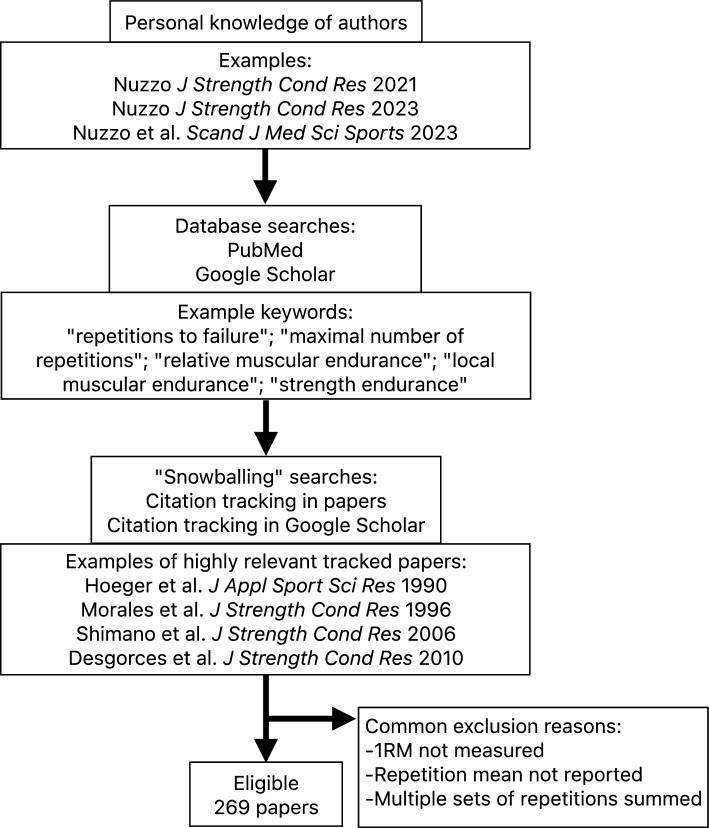
“The approach relied on the investigators’ personal knowledge [21, 22], checking of personal digital files, relevant keyword searches in PubMed and Google Scholar, and “snowballing” strategies (i.e., reference and citation tracking).”
MethodSelf-citationZuo, C., Bo, S., Wang, T., & Zhang, W. (2022) · Frontiers in Physiology · doi:10.3389/fphys.2022.868195 · Cited by 17
Blood Lipid and Hormonal Changes From Jogging and Weight Training of Middle-Aged Men
Blessing, D., Stone, M., Byrd, R., Wilson, D., Rozenek, R., Pushparani, D., & Lipner, H. (1987) · Journal of Strength and Conditioning Research · doi:10.1519/00124278-198705000-00002 · Cited by 16
Smith, C. M., Housh, T. J., Hill, E. C., Schmidt, R. J., & Johnson, G. O. (2017) · International journal of exercise science · doi:10.70252/wivg1238 · Cited by 16
Wilk, M., Krzysztofik, M., Petr, M., Zając, A., & Šťastný, P. (2021) · Neuro-endocrinology letters · Cited by 16
Krzysztofik, M., Matykiewicz, P., Filip-Stachnik, A., Humińska‐Lisowska, K., Rzeszutko-Bełzowska, A., & Wilk, M. (2021) · Scientific Reports · doi:10.1038/s41598-021-94338-7 · Cited by 16
Jones, L., Johnstone, I., Day, C., Marquer, S. L., & Hulton, A. T. (2021) · Nutrients · doi:10.3390/nu13103342 · Cited by 16
Nuzzo, J. L., Pinto, M. D., & Nosaka, K. (2023) · Scandinavian Journal of Medicine and Science in Sports · doi:10.1111/sms.14330 · Cited by 16 · cited 4×
“Muscle endurance or “strength endurance,” the attribute evaluated by a repetitions-to-failure test at a submaximal loads, may be impacted by sex [8–11], age [12–14], or muscle group [15].”
BackgroundInfluentialSelf-citationNoble, L., & McCraw, L. W. (1973) · Research Quarterly American Association for Health Physical Education and Recreation · doi:10.1080/10671188.1973.10615181 · Cited by 15
Schwarz, N. A., & McKinley-Barnard, S. K. (2018) · Journal of Dietary Supplements · doi:10.1080/19390211.2018.1498963 · Cited by 15
Gepfert, M., Jarosz, J., Wojdała, G., Krzysztofik, M., Campos, Y., Filip-Stachnik, A., Kostrzewa, M., Gaweł, D., Szkudlarek, A., Godlewski, P., et al. (2021) · Biology of Sport · doi:10.5114/biolsport.2021.103726 · Cited by 15
Karayigit, R., Forbes, S., Naderi, A., Candow, D., Yildirim, U., Akca, F., Aras, D., Yasli, B., Sisman, A., Mor, A., et al. (2021) · International Journal of Environmental Research and Public Health · doi:10.3390/ijerph18073463 · Cited by 15
Arazi, H., Asadi, A., Gentil, P., Ramírez-Campillo, R., Jahangiri, P., Ghorbani, A., Hackney, A. C., & Zouhal, H. (2021) · PeerJ · doi:10.7717/peerj.10537 · Cited by 15
Effect of Whey Protein in Conjunction With a Caloric-Restricted Diet and Resistance Training
Dudgeon, W. D., Kelley, E. P., & Scheett, T. P. (2017) · Journal of Strength and Conditioning Research · doi:10.1519/jsc.0000000000001196 · Cited by 14
Effects of various repetitive rates in weight training on improvements in strength and endurance.
Berger, R. A., & Mw, H. (1966) · PubMed · Cited by 14
Valério, D. F., Berton, R. P. D. B., Barbieri, J. F., Calzavara, J., de Moraes, A. C., & Barroso, R. (2019) · Sports Biomechanics · doi:10.1080/14763141.2019.1610490 · Cited by 14
Nickerson, B. S., Williams, T. D., Snarr, R. L., Garza, J. M., & Salinas, G. (2020) · The Journal of Strength and Conditioning Research · doi:10.1519/jsc.0000000000003731 · Cited by 14
Falch, H. N., Haugen, M. E., Larsen, S., & van den Tillaar, R. (2023) · Journal of Functional Morphology and Kinesiology · doi:10.3390/jfmk8010019 · Cited by 14
Shibata, K., Yamaguchi, T., Takizawa, K., & Nosaka, K. (2023) · The Journal of Strength and Conditioning Research · doi:10.1519/jsc.0000000000004470 · Cited by 14 · cited 2×
“Results from a small number of studies suggest that at equal relative loads, more eccentric-only than concentric-only repetitions can be completed at certain relative loads for some exercises [17, 169, 302].”
BackgroundSelf-citationPérez‐Castilla, A., Jukić, I., Haff, G. G., & García‐Ramos, A. (2021) · International Journal of Environmental Research and Public Health · doi:10.3390/ijerph18031057 · Cited by 13
Loaded Inter-set Stretching for Muscular Adaptations in Trained Males: Is the Hype Real?
Wadhi, T., Barakat, C., Evangelista, A. L., Pearson, J. R., Anand, A. S., Morrison, T. E. A., O'Sullivan, J., Walters, J., & Souza, E. O. D. (2021) · International Journal of Sports Medicine · doi:10.1055/a-1529-6281 · Cited by 13
Reproducibility of strength performance and strength-endurance profiles: A test-retest study
Mitter, B., Csapo, R., Bauer, P., & Tschan, H. (2022) · PLoS ONE · doi:10.1371/journal.pone.0268074 · Cited by 13
Lower-Body Work Capacity and One-Repetition Maximum Squat Prediction in College Football Players
Brechue, W. F., & Mayhew, J. L. (2012) · The Journal of Strength and Conditioning Research · doi:10.1519/jsc.0b013e318225eee3 · Cited by 12
Baker, D. G. (2009) · The Journal of Strength and Conditioning Research · doi:10.1519/jsc.0b013e3181b0708d · Cited by 12
Applying the Critical Power Model to a Full-Body Resistance-Training Movement
Dinyer, T. K., Byrd, M. T., Vesotsky, A. N., Succi, P. J., & Bergstrom, H. C. (2019) · International Journal of Sports Physiology and Performance · doi:10.1123/ijspp.2018-0981 · Cited by 12
Karayiğit, R., Mustafa, E. S. E. R., Gür, F., Sarı, C., Čepička, L., & Gabrys, T. T. (2022) · Nutrients · doi:10.3390/nu14040875 · Cited by 12
Varović, D., Grgić, J., Schoenfeld, B. J., & Vuk, S. (2023) · The Journal of Strength and Conditioning Research · doi:10.1519/jsc.0000000000004443 · Cited by 12
Objective Determination of Resistance Load for Ten Repetitions Maximum for Quadriceps Development
Clarke, D. H., & Herman, E. L. (1955) · Research Quarterly American Association for Health Physical Education and Recreation · doi:10.1080/10671188.1955.10612831 · Cited by 11
Islam, H., Yorgason, N. J., & Hazell, T. J. (2015) · European Journal of Sport Science · doi:10.1080/17461391.2015.1071877 · Cited by 11
Dinyer, T. K., Succi, P. J., Byrd, M. T., Voskuil, C. C., Soucie, E. P., & Bergstrom, H. C. (2020) · Motor Control · doi:10.1123/mc.2020-0050 · Cited by 11
Mitter, B., Zhang, L., Bauer, P., Baca, A., & Tschan, H. (2022) · European Journal of Sport Science · doi:10.1080/17461391.2022.2089915 · Cited by 11
Davies, T. B., Halaki, M., Orr, R., Mitchell, L., Helms, E. R., Clarke, J., & Hackett, D. A. (2021) · The Journal of Strength and Conditioning Research · doi:10.1519/jsc.0000000000003971 · Cited by 11
Heavy vs Light Load Single-Joint Exercise Performance with Different Rest Intervals
Senna, G. W., Rodrigues, B. M., Sandy, D. D., Scudese, E., Bianco, A., & Dantas, E. H. M. (2017) · Journal of Human Kinetics · doi:10.1515/hukin-2017-0077 · Cited by 10
Feuerbacher, J. F., von Schöning, V., Melcher, J., Notbohm, H. L., Freitag, N., & Schumann, M. (2021) · Nutrients · doi:10.3390/nu13030826 · Cited by 10
Exner, R. J., Patel, M. H., Whitener, D. V., Buckner, S. L., Jessee, M. B., & Dankel, S. J. (2022) · European Journal of Sport Science · doi:10.1080/17461391.2021.2023657 · Cited by 10
Intramuscular phosphagen status and the relationship to muscle performance across the age spectrum
Kerksick, C. M., Roberts, M. D., Dalbo, V. J., & Sunderland, K. (2015) · European Journal of Applied Physiology · doi:10.1007/s00421-015-3246-1 · Cited by 9
Grzyb, K., Candow, D. G., Schoenfeld, B. J., Bernat, P., Butchart, S., & Neary, J. P. (2020) · The Journal of Strength and Conditioning Research · doi:10.1519/jsc.0000000000003422 · Cited by 9
Reproducibility and Applicability of Traditional Strength Training Prescription Recommendations
Elvar, J. R. H., Hernández-Lougedo, J., Maicas-Pérez, L., Notario-Alonso, R., Garnacho‐Castaño, M. V., García-Fernández, P., & Maté‐Muñoz, J. L. (2022) · Biology · doi:10.3390/biology11060851 · Cited by 9
Santos, E. R. T., de Salles, B. F., Dias, I., Junior, R. F. S., & Willardson, J. M. (2022) · International journal of exercise science · doi:10.70252/paqb8351 · Cited by 9
Yarrow, J. F., Parr, J. J., White, L. J., Borsa, P. A., & Stevens, B. R. (2007) · Journal of the International Society of Sports Nutrition · doi:10.1186/1550-2783-4-2 · Cited by 8
Hatfield, D. L., Stranieri, A. M., Vincent, L. M., & Earp, J. E. (2021) · The Journal of Strength and Conditioning Research · doi:10.1519/jsc.0000000000004072 · Cited by 8
Girard, O., Mariotti-Nesurini, L., & Malatesta, D. (2021) · European Journal of Sport Science · doi:10.1080/17461391.2021.2002951 · Cited by 8
Andrade, L. S., David, G. B., Wilhelm, E. N., Pinto, S. S., & Alberton, C. L. (2022) · Research Quarterly for Exercise and Sport · doi:10.1080/02701367.2021.1948954 · Cited by 8
de Moura, H. P. D. S. N., Cholewa, J. M., Jäger, R., Campos, E. Z., Rosa, B. V., Nunes, F. A. D. S., Barros, A. A., Rossi, P. A. Q., Gerosa-Neto, J., Zanchi, N. E., et al. (2022) · International journal of exercise science · doi:10.70252/ynem9216 · Cited by 8
The Development of a Repetition-Load Scheme for the Eccentric- Only Bench Press Exercise
Moir, G. L., Erny, K. F., Davis, S. E., Guers, J. J., & Witmer, C. A. (2013) · Journal of Human Kinetics · doi:10.2478/hukin-2013-0042 · Cited by 7
Dose Response of Acute ATP Supplementation on Strength Training Performance
de Moura, H. P. D. S. N., Jäger, R., Purpura, M., Rathmacher, J. A., Fuller, J. C., & Rossi, F. E. (2021) · Frontiers in Sports and Active Living · doi:10.3389/fspor.2021.780459 · Cited by 7
Zuo, C., Bo, S., Li, Q., & Zhang, L. (2022) · Frontiers in Physiology · doi:10.3389/fphys.2022.888048 · Cited by 7
Kerksick, C. M., Mayhew, J. L., Grimstvedt, M. E., Greenwood, M., Rasmussen, C. J., & Kreider, R. B. (2014) · The Journal of Strength and Conditioning Research · doi:10.1519/jsc.0000000000000389 · Cited by 6
Timón, R., Collado‐Mateo, D., Olcina, G. J., & Gusi, N. (2016) · PubMed · Cited by 6
Jenkins, J. R., Salmon, O. F., Hill, E. C., Boyle, J. B., & Smith, C. M. (2021) · Current Research in Physiology · doi:10.1016/j.crphys.2021.09.002 · Cited by 6
Hackett, D. A., & Sabag, A. (2022) · Sports · doi:10.3390/sports10020027 · Cited by 6
Objective Determination of Resistance Load for Ten Repetitions Maximum for Knee Flexion Exercise
Clarke, D. H., & Irving, R. N. (1960) · Research Quarterly American Association for Health Physical Education and Recreation · doi:10.1080/10671188.1960.10613087 · Cited by 5
Steele, J., Fisher, J. P., Gießing, J., Androulakis‐Korakakis, P., Wolf, M., Kroeske, B., & Reuters, R. (2021) · doi:10.31236/osf.io/eq485 · Cited by 5
Self-citationSpecificity of training related to muscular endurance.
Mh, W., & Cw, J. (1977) · PubMed · Cited by 4
Meta-Analysis of Variation in Sport and Exercise SciencePreprint
Steele, J., Fisher, J. P., Smith, D., et al. (2022) · doi:10.51224/srxiv.214 · Cited by 4
Self-citationDavies, T. B., Li, J., & Hackett, D. A. (2022) · The Journal of Strength and Conditioning Research · doi:10.1519/jsc.0000000000004395 · Cited by 4
Bloomer, R. J., Alleman, R. J., Cantrell, G. S., Farney, T. M., & Schilling, B. K. (2011) · The Journal of Strength and Conditioning Research · doi:10.1519/jsc.0b013e318236d081 · Cited by 3
Aguiar, A. F., Buzzachera, C. F., Sanches, V. C., Pereira, R. M., Júnior, R. A. D. S., Januário, R. S. B., Rabelo, L. M., & Silva, A. L. D. S. (2016) · PubMed · Cited by 3
The Short Grit Scale (GRIT-S) does not Relate to Acute Muscular Endurance Performance
Haischer, M. H., Cooke, D. M., Carzoli, J. P., Johnson, T., Shipherd, A. M., & Zourdos, M. C. (2021) · Journal of Human Kinetics · doi:10.2478/hukin-2021-0057 · Cited by 3
Miranda, D. P., Alves, W. E. F. M., Lopes, H., de Santana, V. J., Bocchi, E. A., & Salemi, V. M. C. (2021) · Translational Sports Medicine · doi:10.1002/tsm2.244 · Cited by 2 · cited 2×
“A second limitation of the current study is that the amount of data available did not permit formal analyses that might be of interest to some exercise practitioners, for example, whether the REPS ~ %1RM relationship differs between different types of athletes [92, 202, 237].”
BackgroundJanicijevic, D. N., Mao, H., Gu, Y., Pérez‐Castilla, A., González-Hernández, J. M., & García‐Ramos, A. (2021) · PLoS ONE · doi:10.1371/journal.pone.0249974 · Cited by 2
The impact of postexercise blood flow restriction on local muscle endurance of a remote limb
Sandbach, P. J., Carvajal, M. S., Uygur, M., & Dankel, S. J. (2022) · Clinical Physiology and Functional Imaging · doi:10.1111/cpf.12776 · Cited by 2
Isotonic Strength and Relative Isotonic Endurance
Carlson, B. R. (1970) · Perceptual and Motor Skills · doi:10.2466/pms.1970.30.1.247 · Cited by 1
Research works printed but not linked: 7
- Hoeger WWK Hopkins DR Barette SL Hale DF Relationship between repetitions and selected percentages of one repetition maximum: a comparison between untrained and trained males and females J Appl Sport Sci Res 1990 4 2 47 54
- Gillespie J Gabbard C A test of three theories of muscular endurance development J Hum Mov Stud 1984 10 213 223
- Moraes E Alves HB Teixeira AL Dias MR Miranda H Simao R Relationship between repetitions and selected percentage of one repetition maximum in trained and untrained adolescent subjects J Exerc Physiol Online 2014 17 2 27 35
- Morales J Sobonya S Use of submaximal repetition tests for predicting 1-RM strength in class athletes J Strength Cond Res 1996 10 3 186 189
- Panza P Vianna JM Damasceno VO Aranda LC Bentes CM da Silva NJ Energy cost, number of maximum repetitions, and rating of perceived exertion in resistance exercise with stable and unstable platforms J Exerc Physiol Online 2014 17 3 77 87
- Pedrosa G Boaventura S Abreu E Gonçalves R Prestes J Gordon M Resistance exercise type but no training status affects the relationships between the maximum number of repetitions and the selected percentages of one repetition maximum Gazz Med Ital 2015 175 9 371 377
- Pick J Becque D The relationship between training status and intensity on muscle activation and relative submaximal lifting capacity during the back squat J Strength Cond Res 2000 14 2 175 181
Cited by
CURRIER, B. S., D’SOUZA, A. C., SINGH, M. A. F., LOWISZ, C. V., RAWSON, E. S., SCHOENFELD, B. J., SMITH-RYAN, A. E., STEEN, J. P., THOMAS, G. A., TRIPLETT, N. T., et al. (2026) · Medicine & Science in Sports & Exercise · doi:10.1249/mss.0000000000003897 · Cited by 105
“Several methods have been used to convert loads between %1RM and repetition maximum (17,184,185), including a recent analysis that considered exercise-specific conversions and between-subject variability (186).”
Xu, K., Blazevich, A. J., Boullosa, D. A., Ramírez‐Campillo, R., Yin, M., Zhong, Y., Tian, Y., Finlay, M. J., Byrne, P. J., Cuenca‐Fernández, F., et al. (2025) · Sports Medicine · doi:10.1007/s40279-024-02170-6 · Cited by 101
Robinson, Z. P., Pelland, J. C., Remmert, J. F., Refalo, M. C., Jukic, I., Steele, J., & Zourdos, M. C. (2024) · Sports Medicine · doi:10.1007/s40279-024-02069-2 · Cited by 63
“Previous research suggests that the number of repetitions performed at a given load is highly individual [124–127].”
Self-citationNuzzo, J. L., Pinto, M. D., Kirk, B. J. C., & Nosaka, K. (2024) · Sports Medicine · doi:10.1007/s40279-024-02009-0 · Cited by 56
“We have used similar nonsystematic approaches (e.g., “snowballing” searches) in several comprehensive literature reviews [27, 50–54].”
MethodSelf-citationNuzzo, J. L., & Pinto, M. D. (2025) · European Journal of Sport Science · doi:10.1002/ejsc.12282 · Cited by 54
“…and checking of personal digital files from previous research (Nuzzo 2023; Nuzzo 2025; Nuzzo et al. 2023; Nuzzo, Pinto, Nosaka, et al., 2023; Nuzzo et al. 2024); (b) relevant keyword searches performed in PubMed and Google Scholar; and (c) “snow-balling” strategies (i.e., reference and…”
Self-citation
Metadata
- Authors
- Nuzzo, J. L., Pinto, M. D., Nosaka, K., & Steele, J.
- Affiliations
- Edith Cowan University (AU)
- Southampton Solent University (GB)
- Corresponding author
- Nuzzo, James L.
- Venue
- Sports Medicine
- Published
- 2023-10-04
- Volume
- 54
- Issue
- 2
- Pages
- 303-321
- ISSN
- 0112-1642 (ISSN-L)
- 1179-2035
- PMC
- PMC10933212
- OpenAlex
- W4387326757
- Cited by
- 85
- References
- 301
- Citations by year
- 2026: 37 · 2025: 30 · 2024: 16 · 2023: 2
- FWCI
- 4.70
- Type
- journal article
- Language
- en
- Open access
- hybrid
- doi.org
- Licence
- cc-by
- creativecommons.org/licenses/by/4.0 (tdm)
- creativecommons.org/licenses/by/4.0 (vor)
- Locations
- Sports Medicine (publishedVersion, cc-by)
- PubMed Central (publishedVersion, cc-by)
- PubMed (publishedVersion)
- Australasian Journal of Paramedicine (submittedVersion, cc-by)
- Solent University Research Portal (Solent University) (submittedVersion, cc-by)
- Funders
- Edith Cowan University
- Topics
- Health Sciences › Medicine › Orthopedics and Sports Medicine › Sports Performance and Training
- Health Sciences › Medicine › Physiology (medical) › Cardiovascular and exercise physiology
- Health Sciences › Medicine › Public Health, Environmental and Occupational Health › Physical Activity and Health
- Keywords
- repetitions to failure, one-repetition maximum, resistance training, sex differences, age effects, training status, bench press, leg press, exercise selection, interindividual variability
- MeSH terms
- Exercise Therapy, Female, Humans, Male, Weight Lifting, Exercise, Linear Models, Muscle, Skeletal, Muscle Strength, Resistance Training
About these checks
Registry, retraction, Cites and statistics results are computed, not judged, with one exception: a printed reference that no index lists is read once by a model before it counts as a citation error. Claims are extracted by a model and kept only when their quote appears verbatim in the text; each cited source is then checked, with a model’s help, for whether it says what the claim relies on. Those verdicts can be wrong — read the claim’s quote and the cited source before relying on one.
Statistics and arithmetic are recomputed, not judged.
Confidence bands are shown only for fields calibrated on our annotated test set. None is calibrated yet, so no band is shown.
What counts as a claim ›How we measure confidence ›How we check this ›
Are you an author, or do you see a problem with this page? Request a review
Data sources
Bibliographic data: Semantic Scholar, OpenAlex, Crossref.
Contains information from the Semantic Scholar Academic Graph Datasets, made available under the ODC Attribution License (ODC-BY 1.0).
Semantic Scholar’s data is described in: Kinney, R., et al. (2023). The Semantic Scholar Open Data Platform. arXiv:2301.10140.
