

The Potential of Digital Phenotyping and Mobile Sensing for Psycho-Diagnostics of Internet Use Disorders
Open accessThe DOI matches its Crossref record; 64 of the 64 references it cites were found in a registry or an index.
Abstract
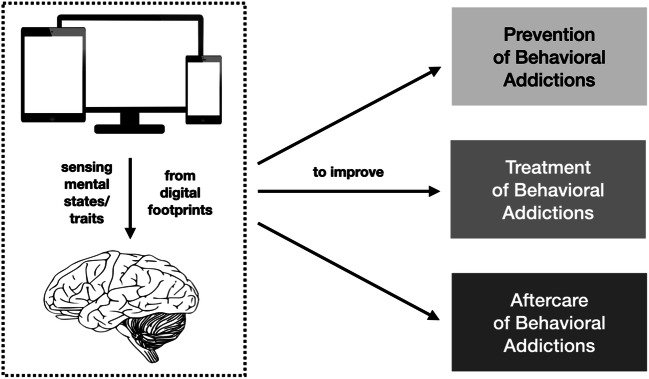
Purpose of Review: The present paper provides an accessible overview on the potential of digital phenotyping and mobile sensing not only shedding light on the nature of Internet Use Disorders (IUD), but also to provide new ideas on how to improve psycho-diagnostics of mental processes linked to IUD. Recent Findings: In detail, the psycho-diagnostic areas of prevention, treatment, and aftercare in the realm of IUDs are focused upon in this work. Before each of these areas is presented in more specificity, the terms digital phenotyping and mobile sensing are introduced against the background of an interdisciplinary research endeavor called Psychoinformatics. Obstacles to overcome problems in this emerging research endeavor—sensing psychological traits/states from digital footprints—are discussed together with risks and chances, which arise from the administration of online-tracking technologies in the field of IUDs. Summary: Given the limited validity and reliability of traditional assessment via questionnaires or diagnostic interviews with respect to recall bias and tendencies to answer towards social desirability, digital phenotyping and mobile sensing offer a novel approach overcoming recall bias and other limitations of usual assessment approaches. This will not only set new standards in precisely mapping behavior, but it will also offer scientists and practitioners opportunities to detect risky Internet use patterns in a timely manner and to establish tailored feedback as a means of intervention.
Overview
The claims and statistics of this paper haven’t been checked yet.
Free: it reads the open-access text and checks the first 5 claims that cite a source we can check. Create a free account to check every claim.
Integrity signals
Registry
Cites
Statistics
Figures
Verification
Claims the paper makes
The claims and statistics of this paper haven’t been checked yet.
Free: it reads the open-access text and checks the first 5 claims that cite a source we can check. Create a free account to check every claim.
Self-check
Percentages, sums and reported differences re-computed from the paper’s own numbers.
The self-check needs the paper’s full text.
Citations
Cites
Kardefelt-Winther, D. (2014) · Computers in Human Behavior · doi:10.1016/j.chb.2013.10.059 · Cited by 2,519
Brand, M., Young, K. S., Laier, C., Wölfling, K., & Potenza, M. N. (2016) · Neuroscience & Biobehavioral Reviews · doi:10.1016/j.neubiorev.2016.08.033 · Cited by 2,416 · cited 1×
“For an up-to-date theoretical framework to understand IUDs, please see the I-PACE model [22, 23].”
BackgroundBrand, M., Wegmann, E., Stark, R., Müller, A., Wölfling, K., Robbins, T. W., & Potenza, M. N. (2019) · Neuroscience & Biobehavioral Reviews · doi:10.1016/j.neubiorev.2019.06.032 · Cited by 2,126
Psychology of Computer Use: XL. Addictive Use of the Internet: A Case That Breaks the Stereotype
Young, K. S. (1996) · Psychological Reports · doi:10.2466/pr0.1996.79.3.899 · Cited by 1,108
Is smartphone addiction really an addiction?
Panova, T., & Carbonell, X. (2018) · Journal of behavioral addictions · doi:10.1556/2006.7.2018.49 · Cited by 976
Are we overpathologizing everyday life? A tenable blueprint for behavioral addiction research
Billieux, J., Schimmenti, A., Khazaal, Y., Maurage, P., & Heeren, A. (2015) · Journal of Behavioral Addictions · doi:10.1556/2006.4.2015.009 · Cited by 920
Global prevalence of gaming disorder: A systematic review and meta-analysis
Stevens, M. W., Dorstyn, D., Delfabbro, P. H., & King, D. L. (2021) · Australian & New Zealand Journal of Psychiatry · doi:10.1177/0004867420962851 · Cited by 863 · cited 1×
“In this context, also a study by Stevens et al. [6] is noteworthy showing that a focus on functional impairment when establishing prevalence rates for Gaming Disorder (a distinct IUD) also led to lower prevalence rates.”
BackgroundDigital Phenotyping: Technology for a New Science of Behavior
Insel, T. R. (2017) · JAMA · doi:10.1001/jama.2017.11295 · Cited by 833
Preventing problematic internet use during the COVID-19 pandemic: Consensus guidance
Király, O., Potenza, M. N., Stein, D. J., King, D. L., Hodgins, D. C., Saunders, J. B., Griffiths, M. D., Gjoneska, B., Billieux, J., Brand, M., et al. (2020) · Comprehensive Psychiatry · doi:10.1016/j.comppsych.2020.152180 · Cited by 820
Self-citationFacebook language predicts depression in medical records
Eichstaedt, J. C., Smith, R. J., Merchant, R. M., Ungar, L. H., Crutchley, P., Preoţiuc-Pietro, D., Asch, D. A., & Schwartz, H. A. (2018) · Proceedings of the National Academy of Sciences · doi:10.1073/pnas.1802331115 · Cited by 643 · cited 1×
“…use relatively robustly provide insights into negative affect accompanying addictive behavior: Withdrawal from society can be tracked via global position signal data [60] or less social interaction with others via phones and negative emotionality can be inferred from text mining messages [61].”
Background
Research works printed but not linked: 4
- Pathological Gambling - an overview | ScienceDirect Topics [Internet]. [cited 2020 Nov 13]. Available from: https://www.sciencedirect.com/topics/nursing-and-health-professions/pathological-gambling
- Elhai JD, Yang H, Levine JC. Applying fairness in labeling various types of internet use disorders: commentary on how to overcome taxonomical problems in the study of internet use disorders and what to do with “smartphone addiction”? Journal of Behavioral Addictions [Internet]. 2020;1 Akadémiai Kiadó; [cited 2020 Nov 10] Available from: https://akjournals.com/view/journals/2006/aop/article-10.1556-2006.2020.00071/article-10.1556-2006.2020.00071.xml.
- Shin M Lee K Measuring smartphone usage time is not sufficient to predict smartphone addiction J Theor Appl Inf Technol 2017 95 5296 5303
- Luo C, Sanger N, Singhal N, Pattrick K, Shams I, Shahid H, et al. A comparison of electronically-delivered and face to face cognitive behavioural therapies in depressive disorders: A systematic review and meta-analysis. EClinicalMedicine [Internet]. 2020;24 Elsevier · DOI · Paper page
Cited by
Building and breaking social media habits
Bayer, J. B., Anderson, I. A., & Tokunaga, R. S. (2022) · Current Opinion in Psychology · doi:10.1016/j.copsyc.2022.101303 · Cited by 98
Yao, N., Chen, J., Huang, S., Montag, C., & Elhai, J. D. (2023) · Computers in Human Behavior · doi:10.1016/j.chb.2023.107751 · Cited by 104
Self-citationRaneri, P. C., Montag, C., Rozgonjuk, D., Satel, J., & Pontes, H. M. (2022) · Addictive Behaviors Reports · doi:10.1016/j.abrep.2022.100415 · Cited by 115
“Future measuring of actual recorded behaviours and applying digital phenotyping principles may yield promising findings, but this clearly needs support from the industry (Montag & Rumpf, 2021).”
Self-citationMontag, C., & Elhai, J. D. (2023) · Current Addiction Reports · doi:10.1007/s40429-023-00494-3 · Cited by 52
Self-citationOn artificial intelligence and global mental health
Montag, C., Ali, R., Al‐Thani, D., & Hall, B. J. (2023) · Asian Journal of Psychiatry · doi:10.1016/j.ajp.2023.103855 · Cited by 45
Self-citation
Metadata
- Authors
- Montag, C., & Rumpf, H.-J.
- Affiliations
- Universität Ulm (DE)
- University of Lübeck (DE)
- Corresponding author
- Montag, Christian
- Venue
- Current Addiction Reports
- Published
- 2021-07-08
- Volume
- 8
- Issue
- 3
- Pages
- 422-430
- ISSN
- 2196-2952 (ISSN-L)
- PMC
- PMC8266294
- OpenAlex
- W3182365736
- Cited by
- 44
- References
- 64
- Citations by year
- 2026: 8 · 2025: 6 · 2024: 9 · 2023: 11 · 2022: 10
- FWCI
- 1.44
- Type
- journal article
- Language
- en
- Open access
- hybrid
- doi.org
- Licence
- cc-by
- creativecommons.org/licenses/by/4.0 (tdm)
- creativecommons.org/licenses/by/4.0 (vor)
- Locations
- Current Addiction Reports (publishedVersion, cc-by)
- PubMed Central (publishedVersion, cc-by)
- PubMed (publishedVersion)
- Informationszentrum Lebenswissenschaften (ZB MED) (submittedVersion, cc-by)
- OPen Access Repositorium der Universität Ulm (OPARU) (Ulm University) (submittedVersion, cc-by)
- Universität Ulm, Kommunikations- und Informationszentrum (kiz) (cc-by)
- Funders
- German Innovation Fund
- Topics
- Social Sciences › Sociology and Political Science › Impact of Technology on Adolescents
- Social Sciences › Psychology › Applied Psychology › Digital Mental Health Interventions
- Social Sciences › Psychology › Experimental and Cognitive Psychology › Mental Health Research Topics
- Keywords
- digital phenotyping, mobile sensing, internet use disorders, digital footprint, online tracking, recall bias, social desirability bias, prevention, treatment, follow-up care, personalized feedback
About these checks
Registry, retraction, Cites and statistics results are computed, not judged, with one exception: a printed reference that no index lists is read once by a model before it counts as a citation error. Claims are extracted by a model and kept only when their quote appears verbatim in the text; each cited source is then checked, with a model’s help, for whether it says what the claim relies on. Those verdicts can be wrong — read the claim’s quote and the cited source before relying on one.
Statistics and arithmetic are recomputed, not judged.
Confidence bands are shown only for fields calibrated on our annotated test set. None is calibrated yet, so no band is shown.
What counts as a claim ›How we measure confidence ›How we check this ›
Are you an author, or do you see a problem with this page? Request a review
Data sources
Bibliographic data: Semantic Scholar, OpenAlex, Crossref.
Contains information from the Semantic Scholar Academic Graph Datasets, made available under the ODC Attribution License (ODC-BY 1.0).
Semantic Scholar’s data is described in: Kinney, R., et al. (2023). The Semantic Scholar Open Data Platform. arXiv:2301.10140.
