

Suicide risk in caregivers of people with dementia: a systematic review and meta-analysis
Open accessThe DOI matches its Crossref record; 31 of the 31 references it cites were found in a registry or an index.
Abstract
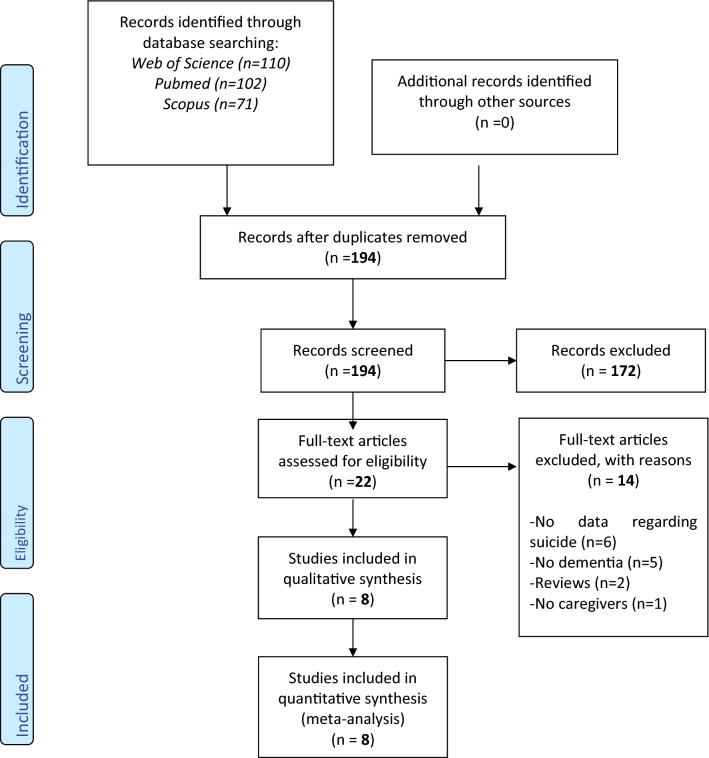
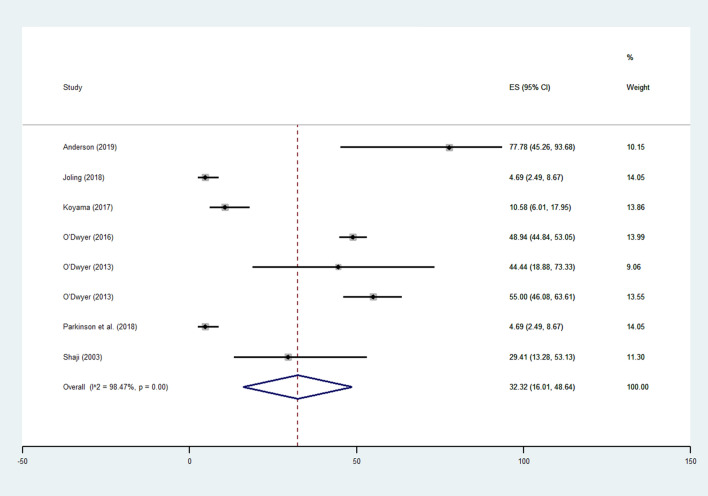
Background: Interest in physical and mental health outcomes in caregivers of patients with dementia is increasing. However, there is limited data available on the prevalence of suicidal ideation, suicidal attempts, and suicide rates among caregivers of those with dementia. Therefore, we aimed to systematically review these outcomes to address this gap in the literature and thus provide information to inform future policy and intervention for the benefit of caregivers of dementia patients. Methods: We searched several databases from inception to the 10 th November 2021, for studies investigating suicidal ideation, suicidal attempts, and suicide rates of caregivers of patients with dementia. We report data regarding suicidal ideation as prevalence, with the 95% confidence intervals (CIs), applying a random-effect model; since less than three studies were available for suicide attempt and suicide, these data are reported descriptively. Results: Among 194 articles, eight comprising 1,209 informal caregivers of people with dementia (mean age: 63.9 years, 74% females) were included. The prevalence of suicide ideation was 32.32% (95% CI: 16.01–48.64%;I2 = 98.5%,p < 0.0001). The prevalence of suicide ideation varied between studies from 4.69% to 77.78%. Two studies reported the rate of suicidal attempt in caregivers of patients with dementia, with the prevalence ranging from 5.9% to 16.1%. One study reported one in 17 caregivers of patients with dementia died by suicide. Conclusions: The prevalence of suicide ideation is high, affecting several caregivers of patients with dementia. These findings suggest intervention and/or policy are urgently needed to address suicidal behavior in this at-risk population.
Overview
The claims and statistics of this paper haven’t been checked yet.
Free: it reads the open-access text and checks the first 5 claims that cite a source we can check. Create a free account to check every claim.
Integrity signals
Registry
Cites
Statistics
Figures
Verification
Claims the paper makes
The claims and statistics of this paper haven’t been checked yet.
Free: it reads the open-access text and checks the first 5 claims that cite a source we can check. Create a free account to check every claim.
Claims other papers make about this one
Each is checked against this paper’s own text: does it say what the citing paper says it does?
The source backs part of the claim, not all of it — or backs it for a different population, condition or comparison.
In the citing paper
“A systematic review found the prevalence of suicide ideation (thinking about or making plans for suicide) in dementia caregivers with a mean age of 64 was 32% compared with 2.7% in U.S. adults age 56 and older.488,489”
From 2023 Alzheimer's disease facts and figures (2023) · cites this paper as [488]
Experimental — accuracy not yet measuredThe cited source says what the claim attributes to it.
In the citing paper
“A systematic review found the prevalence of suicidal ideation (thinking about or making plans for suicide) in dementia caregivers with a mean age of 64 was 32% compared with 2.7% in U.S. adults age 56 and older (please note that an exact age comparator is not available). 533 , 534”
From 2024 Alzheimer's disease facts and figures (2024) · cites this paper as [533]
Self-check
Percentages, sums and reported differences re-computed from the paper’s own numbers.
The self-check needs the paper’s full text.
Citations
Cites
Bias in meta-analysis detected by a simple, graphical test
Egger, M., Smith, G. D., Schneider, M., & Minder, C. (1997) · BMJ · doi:10.1136/bmj.315.7109.629 · Cited by 56,722 · cited 1×
“Publication bias was assessed by visually inspecting funnel plots and using the Egger bias test [12] and in case of publication bias a fill and trim analysis was performed [13].”
MethodMeta-analysis in clinical trials
DerSimonian, R., & Laird, N. (1986) · Controlled Clinical Trials · doi:10.1016/0197-2456(86)90046-2 · Cited by 39,552
Dermyshi, E., Wang, Y., Yan, C., Hong, W., Qiu, G., Gong, X., & Zhang, T. (2017) · Neonatology · doi:10.1159/000454668 · Cited by 24,451
Cochrane Handbook for Systematic Reviews of Interventions
(2019) · doi:10.1002/9781119536604 · Cited by 14,828
Duval, S., & Tweedie, R. (2000) · Biometrics · doi:10.1111/j.0006-341x.2000.00455.x · Cited by 14,099 · cited 1×
“Publication bias was assessed by visually inspecting funnel plots and using the Egger bias test [12] and in case of publication bias a fill and trim analysis was performed [13].”
MethodLiberati, A., Altman, D. G., Tetzlaff, J., Mulrow, C., Gøtzsche, P. C., Ioannidis, J. P. A., Clarke, M., Devereaux, P. J., Kleijnen, J., & Moher, D. (2009) · Journal of Clinical Epidemiology · doi:10.1016/j.jclinepi.2009.06.006 · Cited by 10,578
Hearing loss and cognitive decline in older adults
Lin, F. R., Yaffe, K., Xia, J., Xue, Q.-L., Harris, T. B., Purchase-Helzner, E., Satterfield, S., Ayonayon, H. N., Ferrucci, L., Simonsick, E. M., et al. (2013) · JAMA Internal Medicine · doi:10.1001/jamainternmed.2013.1868 · Cited by 4,017
Is caregiving hazardous to one’s physical health? A meta-analysis
Vitaliano, P. P., Zhang, J., & Scanlan, J. M. (2003) · Psychological Bulletin · doi:10.1037/0033-2909.129.6.946 · Cited by 1,734 · cited 1×
“1 3 potential risk factors for suicidal behavior [4].”
BackgroundMonetary Costs of Dementia in the United States
Hurd, M. D., Martorell, P., Delavande, A., Mullen, K. J., & Langa, K. M. (2013) · New England Journal of Medicine · doi:10.1056/nejmsa1204629 · Cited by 1,484 · cited 1×
“In the US, costs attributable to their care range between 157 and 215 billion dollars and are expected to more than double by 2040 [2].”
BackgroundPhysical and mental health effects of family caregiving
Schulz, R., & Sherwood, P. R. (2008) · AJN, American Journal of Nursing · doi:10.1097/01.naj.0000336406.45248.4c · Cited by 1,375 · cited 1×
“It has been widely reported that the caregivers of patients with dementia have high levels of stress and high rates of depression and anxiety [3].”
Background
Cited by
2023 Alzheimer's disease facts and figures
(2023) · Alzheimer's & Dementia · doi:10.1002/alz.13016 · Cited by 3,212
2024 Alzheimer's disease facts and figures
(2024) · Alzheimer's & Dementia · doi:10.1002/alz.13809 · Cited by 2,536
2025 Alzheimer's disease facts and figures
(2025) · Alzheimer's & Dementia · doi:10.1002/alz.70235 · Cited by 474
2026 Alzheimer's disease facts and figures
Alzheimer's, T. S. O. A. D. A. A. W. S. C. I. T. B. I., neurons, T. B. N. A. E. A. A. H. A. B. H. B. O., long, E. W., connections, B. E. T. E. E. I. N. T. F. C. W. O. N. A. S., synapses, C., memories, I. F. I. T. B. O. C. T. A. R. B. O. N. A. T. U. B. A. N. T. B. C. T. O. S. T. A. S. T. T. R. T. T. B. T. S. F. T. C. B. O., thoughts, sensations, emotions, & skills., M. A. (2026) · Alzheimer s & Dementia · doi:10.1002/alz.71345 · Cited by 126
Ye, F., Lee, J. J., Xue, D., & Yu, D. S.-F. (2023) · JAMA Network Open · doi:10.1001/jamanetworkopen.2023.46216 · Cited by 23
Resilience as a protective factor against depression in informal caregivers
Vázquez, F. L., Blanco, V., Andrade, E., Otero, P., Bueno, A. M., Simón, M. A., & Torres, Á. (2024) · Frontiers in Psychology · doi:10.3389/fpsyg.2024.1370863 · Cited by 26
Suicide and self-harm in older adults
Connors, M. H., Draper, B., Wand, A. P. F., Leo, D. D., & Reppermund, S. (2025) · Nature Reviews Psychology · doi:10.1038/s44159-025-00454-w · Cited by 20
“%) in a meta-analysis of eight studies 118 .”
Villena, A., Morales‐Asencio, J. M., Quemada, C., & Hurtado, M. M. (2024) · Archives of Psychiatric Nursing · doi:10.1016/j.apnu.2024.05.015 · Cited by 17
Zwar, L., König, H., & Hajek, A. (2023) · International Psychogeriatrics · doi:10.1017/s1041610223000601 · Cited by 10
“Weekly to lifetime prevalence of suicide ideation among dementia caregivers has been reported with a broad range (4.69 – 77.78%; Solimando et al ., 2022).”
InfluentialMa, Y., Gong, J., Zeng, L., Wang, Q., Yao, X., Li, H., Chen, Y., Liu, F., Zhang, M., Ren, H., et al. (2023) · Journal of Alzheimer s Disease Reports · doi:10.3233/adr-230067 · Cited by 10
Mohamad, M. A., Abdullah, M. F. I. L. B., & Shari, N. I. (2024) · BMC Geriatrics · doi:10.1186/s12877-024-04753-4 · Cited by 10
“…of people with dementia, the risk factors contributing to increased suicidal behavior include depression, previous suicidal attempts, a sense of hopelessness, a history of comorbid psychiatric illness, lack of social support, demoralization, pain, and a feeling of being a burden on others [10].”
BackgroundInfluentialGu, Y., Duan, M., Huang, Y., Hu, M., Bao, M., & Yang, F. (2025) · Scientific Reports · doi:10.1038/s41598-025-07280-3 · Cited by 11
Teasdale-Dubé, A., Viau‐Quesnel, C., & Lapierre, S. (2024) · Canadian Journal on Aging / La Revue canadienne du vieillissement · doi:10.1017/s0714980824000011 · Cited by 8
“To our knowledge, this is the first study on suicidal ideation targeting older French-Canadian dementia caregivers (O ’ Dwyer et al., 2021; Solimando et al., 2022).”
Dementia Caregiver Experiences: Insights From a Telephone-Based Support Program
Thai, G. H., Rivette, S., Sharman, J., Epps, F. R., & Masoud, S. S. (2024) · Journal of Applied Gerontology · doi:10.1177/07334648241234745 · Cited by 7
“Given the high prevalence of suicidal ideation among dementia caregivers (O ’ Dwyer et al., 2016; Solimando et al., 2022), measures of emotional and mental health are highly recommended for incorporation into future caregiver needs assessments.”
Hu, X., Zhang, Q., Wang, H., Tan, J., Geng, Q., Ma, H., & Jin, Y. (2025) · Psycho-Oncology · doi:10.1002/pon.70287 · Cited by 7
“A meta‐ analysis examining dementia caregivers [47] found that approximately one‐third (32.32”
InfluentialPrimary care preparedness to care for patients with ADRD: A national survey study
Januszewicz, J., Fowler, N. R., Mackwood, M., Fisher, E. S., Andrews, A. O., Schmidt, R. O., Akré, E.-R. L., & Schifferdecker, K. E. (2025) · Alzheimer s & Dementia · doi:10.1002/alz.70064 · Cited by 5
Huo, Z., Yip, B. H. K., Lee, A. T. C., Cheng, S., Chan, W. C., Fung, A. W. T., Ma, S. L., Cheng, C. P.-W., Lai, F. H., Wong, S. Y. S., et al. (2025) · BMC Geriatrics · doi:10.1186/s12877-025-06147-6 · Cited by 6
“These discrepancies may be attributed to the methodological heterogeneity across studies in sampling strategies, measurement tools, and recall periods [7, 11, 40].”
InfluentialHow Do Researchers Identify and Recruit Dementia Caregivers? A Scoping Review
Kashyap, B., Crouse, B., Fields, B., Aguirre, A., Ali, T., Hays, R., Li, X., Shapiro, L. N., Tao, M., Vaughn, I. A., et al. (2024) · The Gerontologist · doi:10.1093/geront/gnae189 · Cited by 4
Fenstermacher, E., Owsiany, M. T., Ju, C. H., Lohmar, S., & Edelstein, B. A. (2026) · Aging & Mental Health · doi:10.1080/13607863.2026.2612916 · Cited by 4
“In line with the ICIM and existing research, depression, suicidality, self-efficacy, distress tolerance, and personality traits were examined as ‘psychological variables’ and predictors of burnout (Gérain & Zech, 2019, 2022; Shaffer et al., 2016; Solimando et al., 2022; Tan et al., 2021).”
Perceptions of Dementia among Nursing Students in South Korea: A Phenomenological Study
Lim, S. (2024) · Healthcare · doi:10.3390/healthcare12161565 · Cited by 3
Zhang, X., Wang, M., Chen, K., Shi, N., Xia, C., Yang, Z., Chen, F., & Lin, X. (2024) · Journal of Alzheimer s Disease · doi:10.3233/jad-240629 · Cited by 4
Lin, C.-C., Lee, Y., Chiu, N., Lin, P., Huang, Y., Hung, C., & Wang, L. (2025) · International Journal of Bipolar Disorders · doi:10.1186/s40345-025-00383-w · Cited by 3
“The responsibilities that caregivers must assume can lead to an increased risk of suicidal thoughts and behaviors, especially when caring for individuals with chronic illnesses (Solimando et al. 2022).”
Prizer, L. P., & Hudson, P. (2023) · Handbook of clinical neurology · doi:10.1016/b978-0-12-824535-4.00014-8 · Cited by 4
We should care about informal carers: Reforms are needed to improve their health and wellbeing
Winter, N., & Haddock, R. (2025) · Health Policy · doi:10.1016/j.healthpol.2025.105437 · Cited by 3
Dayimu, N., Leng, L., & Jilili, M. (2026) · BMC Psychology · doi:10.1186/s40359-026-04318-7 · Cited by 2
“Prior literature documented the association between caregiving burden with adverse mental health outcomes, including depression, anxiety [8–10], and elevated risk of suicidal ideation [11].”
Interpersonal Predictors of Grief Among Caregivers of Persons With Dementia
Owens, L., Prigerson, H. G., Falzarano, F. B., & Maciejewski, P. K. (2026) · American Journal of Geriatric Psychiatry · doi:10.1016/j.jagp.2026.05.003 · Cited by 2
Cooper, M., Couzner, L., Smith‐Merry, J., Draper, B., Low, L., & Cations, M. (2024) · International Psychogeriatrics · doi:10.1016/j.inpsyc.2024.100002 · Cited by 2
Zabolypour, S., Arsalani, N., Gilvari, T., Vardanjani, L. R., Khajehmirzaei, F., & Fallahi-Khoshknab, M. (2024) · Salmand · doi:10.32598/sija.2023.3598.1 · Cited by 3
de Andrade, I. C. S., Gomes, N. P., Correia, C. M., & Romano, C. M. C. (2024) · Cogitare Enfermagem · doi:10.1590/ce.v29i0.96418 · Cited by 1
de Andrade, I. C. S., Gomes, N. P., Correia, C. M., & Romano, C. M. C. (2024) · Cogitare Enfermagem · doi:10.1590/ce.v29i0.92361 · Cited by 1
Narrativas de violência e saúde mental: experiências e territórios
García, C., & Ceccon, R. F. (2024) · doi:10.18310/9786554621144
Suicide risks among caregivers of patients with depressive disorders
Lin, C.-C., Huang, Y., Lee, Y., Lin, P.-Y., Chiu, N., Hung, C., & Wang, L. (2024) · Journal of International Medical Research · doi:10.1177/03000605241266226
Reducing Violence Risk: Home Healthcare Nurses and Early Identification of Informal Caregiver Burden
Lambert, P. (2024) · Home Healthcare Now · doi:10.1097/nhh.0000000000001302
“It is essential to note that social inequalities can also contribute to caregiver burden by creating obstacles for those from disad-vantaged backgrounds.”
EVALUACIÓN DE DESARROLLO EN FAMILIAS DE PERSONAS CON CONDUCTA SUICIDA: APLICACIÓN DEL MODELO CALGARY
de Andrade, I. C. S., Gomes, N. P., Correia, C. M., & Romano, C. M. C. (2024) · Cogitare Enfermagem · doi:10.1590/ce.v29i0.96419
“…discapacidades como enfermedades mentales y discapacidades más graves, como esquizofrenia, trastorno bipolar e incluso conductas suicidas 21-23 , que si bien no se considera una patología, también pueden formar parte de los resultados relacionados con la salud mental de estos cuidadores…”
Social suffering and caregiver burden in The Brothers Karamazov : the story of Captain Snegiryov
Garcia, A. C. M. (2025) · Medical Humanities · doi:10.1136/medhum-2025-013334
Huvent‐Grelle, D., Leroy, V., Horvath, M., Laurier-Grymonprez, L., Faucomprez, D., & Puisieux, F. L. (2025) · OBM Geriatrics · doi:10.21926/obm.geriatr.2504328
Suicide risk among spouses of patients with dementia: a population-based cohort study
Yang, H.-J., Huang, Y., & Cheng, W. (2025) · Innovation in Aging · doi:10.1093/geroni/igaf111
Mohamad, M. A., Abdullah, M. F. I. L. B., & Shari, N. I. (2024) · Figshare · doi:10.6084/m9.figshare.26693551
Mohamad, M. A., Abdullah, M. F. I. L. B., & Shari, N. I. (2024) · Figshare · doi:10.6084/m9.figshare.25414880
Mohamad, M. A., Abdullah, M. F. I. L. B., & Shari, N. I. (2024) · Figshare · doi:10.6084/m9.figshare.25415015
Kim, D., & Kang, H. (2026) · Journal of Social Science · doi:10.16881/jss.2026.01.37.1.275
Dayimu, N., Leng, L., Kuerbanniyazi, G., & Lin, X. (2026) · Frontiers in Psychology · doi:10.3389/fpsyg.2026.1771064
Rathnayake, S., Barbosa, A., Tu, J., & Randell, R. (2026) · JMIR Research Protocols · doi:10.2196/91741
Adult day services, leisure time satisfaction, and psychosocial well-being among dementia caregivers
Scher, C. J., Moxley, J. H., Riffin, C. A., & Czaja, S. J. (2026) · The Gerontologist · doi:10.1093/geront/gnag163
“These stressors can lead to increased rates of anxiety (Kaddour & Kishita, 2020), depression (Collins & Kishita, 2020), and suicidality (Solimando et al., 2022).”
Chang, W., Chang, S., Yen, W., & Ma, W. (2026) · International Journal of Geriatric Psychiatry · doi:10.1002/gps.70249
Toward Caregiver Flourishing: A Framework for Sustainable Capacity in Dementia Care
Beckett, C. (2026) · Journal of Health and Social Behavior · doi:10.1177/00221465261492703
Norbiato, M., Cadorin, L., Narduzzi, B., Ghirotto, L., & Bressan, V. (2026) · Journal of Clinical Nursing · doi:10.1111/jocn.70617
Metadata
- Authors
- Solimando, L., Fasulo, M., Cavallero, S., Veronese, N., Smith, L., Vernuccio, L., Bolzetta, F., Dominguez, L. J., & Barbagallo, M.
- Affiliations
- University of Palermo (IT)
- Anglia Ruskin University (GB)
- Università degli Studi di Enna Kore (IT)
- Corresponding author
- Veronese, Nicola
- ORCID
- Venue
- Aging Clinical and Experimental Research
- Published
- 2022-06-13
- Volume
- 34
- Issue
- 10
- Pages
- 2255-2260
- ISSN
- 1594-0667 (ISSN-L)
- 1720-8319
- PMC
- PMC9637612
- OpenAlex
- W4282822960
- Semantic Scholar
- 5be3ed094c04093f851362be3494018093242a4c
- Cited by
- 44
- References
- 31
- Citations by year
- 2026: 9 · 2025: 11 · 2024: 19 · 2023: 5
- FWCI
- 1.46
- Type
- journal article
- Language
- en
- Open access
- hybrid
- doi.org
- Licence
- cc-by
- creativecommons.org/licenses/by/4.0 (tdm)
- creativecommons.org/licenses/by/4.0 (vor)
- Locations
- Aging Clinical and Experimental Research (publishedVersion, cc-by)
- PubMed Central (publishedVersion, cc-by)
- PubMed (publishedVersion)
- Nova Science Publishers (Nova Science Publishers, Inc.) (submittedVersion, cc-by)
- Anglia Ruskin Research Online (Anglia Ruskin University) (submittedVersion)
- Figshare (submittedVersion, cc-by-nc-nd)
- Funders
- Università degli Studi di Palermo
- Topics
- Social Sciences › Psychology › Clinical Psychology › Suicide and Self-Harm Studies
- Health Sciences › Medicine › Psychiatry and Mental health › Dementia and Cognitive Impairment Research
- Health Sciences › Nursing › Research and Theory › Nursing care and research
- Keywords
- suicide risk, dementia caregivers, suicidal ideation, suicide attempts, prevalence, caregiver burden, dementia caregiving
- MeSH terms
- Dementia, Female, Humans, Male, Risk Factors, Suicide, Attempted, Prevalence, Caregivers, Suicidal Ideation
About these checks
Registry, retraction, Cites and statistics results are computed, not judged, with one exception: a printed reference that no index lists is read once by a model before it counts as a citation error. Claims are extracted by a model and kept only when their quote appears verbatim in the text; each cited source is then checked, with a model’s help, for whether it says what the claim relies on. Those verdicts can be wrong — read the claim’s quote and the cited source before relying on one.
Statistics and arithmetic are recomputed, not judged.
Confidence bands are shown only for fields calibrated on our annotated test set. None is calibrated yet, so no band is shown.
What counts as a claim ›How we measure confidence ›How we check this ›
Are you an author, or do you see a problem with this page? Request a review
Data sources
Bibliographic data: Semantic Scholar, OpenAlex, Crossref.
Contains information from the Semantic Scholar Academic Graph Datasets, made available under the ODC Attribution License (ODC-BY 1.0).
Semantic Scholar’s data is described in: Kinney, R., et al. (2023). The Semantic Scholar Open Data Platform. arXiv:2301.10140.
