

Role of Amino Acid Metabolism in the Virulence of Human Pathogenic Fungi
Open accessThe DOI matches its Crossref record; 111 of the 111 references it cites were found in a registry or an index.
Abstract
The success of Candida albicans , Aspergillus fumigatus , and Cryptococcus neoformans as fungal pathogens depends on their rapid adaptation to host microenvironments, through metabolic remodeling, stress resistance, and expression of virulence determinants. Amino acids represent an abundant nitrogen and carbon source within the host; however, their acquisition by fungi is a very complex process that interconnects several sensory and uptake systems and downstream pathways. In this review, we will summarize the current knowledge concerning this topic, identify gaps or discrepancies, and discuss future research directions. Aside from supporting basic cellular functions, the utilization of many amino acids has a direct effect on fungal pathogenicity by triggering key virulence traits, including hyphal morphogenesis and biofilm growth in C. albicans , capsule formation in C. neoformans , and melanization in A. fumigatus . Although many components of amino acid sensing and metabolism are fungal specific, their importance in infection and potential as candidates for antifungal drug development require further investigation.
Overview
The claims and statistics of this paper haven’t been checked yet.
Free: it reads the open-access text and checks the first 5 claims that cite a source we can check. Create a free account to check every claim.
Integrity signals
Registry
Cites
Statistics
Figures

Verification
Claims the paper makes
The claims and statistics of this paper haven’t been checked yet.
Free: it reads the open-access text and checks the first 5 claims that cite a source we can check. Create a free account to check every claim.
Claims other papers make about this one
Each is checked against this paper’s own text: does it say what the citing paper says it does?
The source backs part of the claim, not all of it — or backs it for a different population, condition or comparison.
In the citing paper
“amino acids, which are abundant inside macrophages are an important alternative carbon source for the immune evasion of C. albicans [24–28].”
From The F 1 F o -ATP synthase α subunit of Candida albicans induces inflammatory responses by controlling amino acid catabolism (2023) · cites this paper as [28]
Experimental — accuracy not yet measured
Self-check
Percentages, sums and reported differences re-computed from the paper’s own numbers.
The self-check needs the paper’s full text.
Citations
Cites
Hidden Killers: Human Fungal Infections
Brown, G. D., Denning, D. W., Gow, N. A. R., Levitz, S. M., Netea, M. G., & White, T. C. (2012) · Science Translational Medicine · doi:10.1126/scitranslmed.3004404 · Cited by 4,284
Genomic sequence of the pathogenic and allergenic filamentous fungus Aspergillus fumigatus
Nierman, W. C., Pain, A., Anderson, M. J., Wortman, J. R., Kim, H. S., Arroyo, J., Berriman, M., Abe, K., Archer, D. B., Bermejo, C., et al. (2005) · Nature · doi:10.1038/nature04332 · Cited by 1,391
TRANSLATIONAL REGULATION OF GCN4 AND THE GENERAL AMINO ACID CONTROL OF YEAST
Hinnebusch, A. G. (2005) · Annual Review of Microbiology · doi:10.1146/annurev.micro.59.031805.133833 · Cited by 1,251
Candida albicans Secreted Aspartyl Proteinases in Virulence and Pathogenesis
Naglik, J. R., Challacombe, S. J., & Hube, B. (2003) · Microbiology and Molecular Biology Reviews · doi:10.1128/mmbr.67.3.400-428.2003 · Cited by 1,179
Growth of Candida albicans hyphae
Sudbery, P. E. (2011) · Nature Reviews Microbiology · doi:10.1038/nrmicro2636 · Cited by 1,110
Target of Rapamycin (TOR) in Nutrient Signaling and Growth Control
Loewith, R., & Hall, M. N. (2011) · Genetics · doi:10.1534/genetics.111.133363 · Cited by 910
Owen, D. H., & Katz, D. F. (1999) · Contraception · doi:10.1016/s0010-7824(99)00010-4 · Cited by 718
Transcriptional Response of Candida albicans upon Internalization by Macrophages
Lorenz, M. C., Bender, J. A., & Fink, G. R. (2004) · Eukaryotic Cell · doi:10.1128/ec.3.5.1076-1087.2004 · Cited by 712
Nitrogen regulation in Saccharomyces cerevisiae
Magasanik, B., & Kaiser, C. A. (2002) · Gene · doi:10.1016/s0378-1119(02)00558-9 · Cited by 669
Development and regulation of single- and multi-species Candida albicans biofilms
Lohse, M. B., Gulati, M., Johnson, A. D., & Nobile, C. J. (2018) · Nature Reviews Microbiology · doi:10.1038/nrmicro.2017.107 · Cited by 643
Cited by
Multimodal Role of Amino Acids in Microbial Control and Drug Development
Idrees, M. M., Mohammad, A. R., Karodia, N., & Rahman, A. (2020) · Antibiotics · doi:10.3390/antibiotics9060330 · Cited by 136
“Despite being able to biosynthesise amino acids, fungi have also evolved certain mechanisms such as nitrogen catabolic repression (NCR), transceptor-mediated amino acid sensing, Ssy1-Ptr3-Ssy5 (SPS) and target of rapamycin (TOR) pathway to monitor and use the amino acids present in the environment [44].”
BackgroundO’Brien, C. E., Oliveira-Pacheco, J., Ó Cinnéide, E., Haase, M. A. B., Hittinger, C. T., Rogers, T. R., Zaragoza, O., Bond, U., & Butler, G. (2021) · PLOS Pathogens · doi:10.1371/journal.ppat.1009138 · Cited by 67
“Amino acid metabolism and acquisition can directly affect pathogenicity, and disruption of branched-chain amino acid metabolism is associated with loss of virulence (reviewed in [48]).”
BackgroundAllert, S., Schulz, D., Kämmer, P., Großmann, P., Wolf, T., Schäuble, S., Panagiotou, G., Brunke, S., & Hube, B. (2022) · Virulence · doi:10.1080/21505594.2022.2026037 · Cited by 66
“As amino acids are present in blood, they might be acquired via transporters to serve as carbon and nitrogen sources [105].”
BackgroundMuthamil, S., Prasath, K. G., Priya, A., Precilla, P., & Pandian, S. K. (2020) · Scientific Reports · doi:10.1038/s41598-020-61918-y · Cited by 70
Role of Cellular Metabolism during Candida-Host Interactions
Pellón, A., Begum, N., Nasab, S. D. S., Harzandi, A., Shoaie, S., & Moyes, D. L. (2022) · Pathogens · doi:10.3390/pathogens11020184 · Cited by 50
“General control of amino acid metabolism (GCN response) has also been linked to pathogenicity and virulence attributes of Candida species [61,64].”
BackgroundMetabolic profiling of Candida clinical isolates of different species and infection sources
Oliver, J. C., Laghi, L., Parolin, C., Foschi, C., Marangoni, A., Liberatore, A., Dias, A. L. T., Cricca, M., & Vitali, B. (2020) · Scientific Reports · doi:10.1038/s41598-020-73889-1 · Cited by 44
Amino Acid Sensing and Assimilation by the Fungal Pathogen Candida albicans in the Human Host
Silao, F. G. S., & Ljungdahl, P. O. (2021) · Pathogens · doi:10.3390/pathogens11010005 · Cited by 40
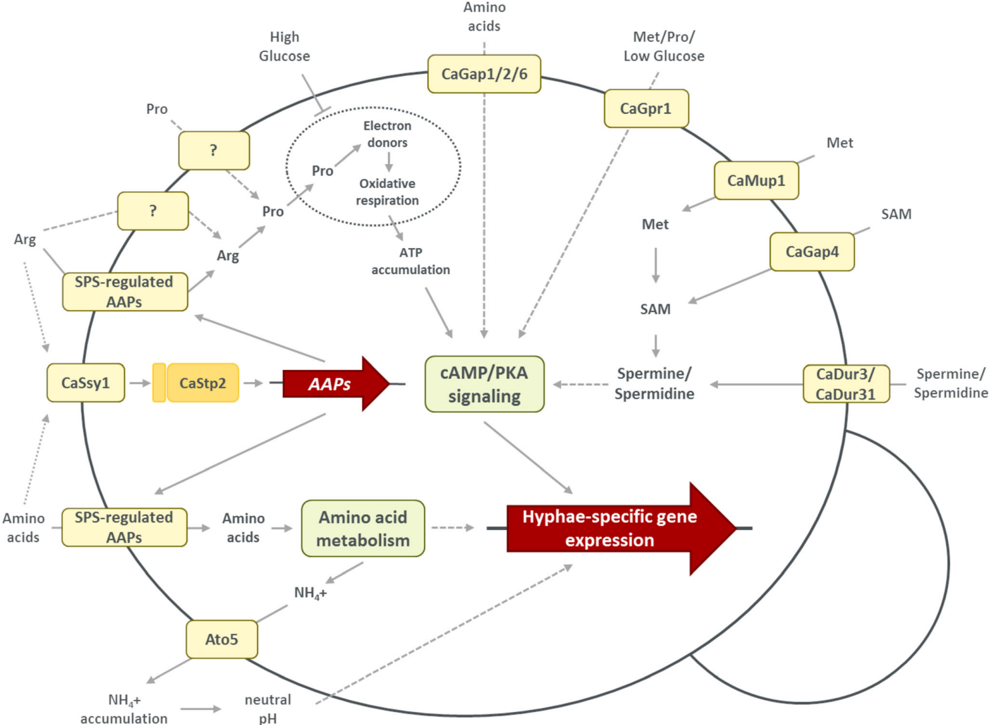
“albicans ([36–38,59,62]; reviewed in [35]) (Figure 4).”
BackgroundMetabolic Plasticity of Candida albicans in Response to Different Environmental Conditions
Gallo, M. L., Giovati, L., Magliani, W., Pertinhez, T. A., Conti, S., Ferrari, E., Spisni, A., & Ciociola, T. (2022) · Journal of Fungi · doi:10.3390/jof8070723 · Cited by 32
“Finally, ATP accumulation (Figure 4) is acknowledged to stimulate hyphal morphogenesis via the protein kinase A pathway [60].”
BackgroundResultSpray-Induced Gene Silencing (SIGS) as a Tool for the Management of Pine Pitch Canker Forest Disease
Bocos‐Asenjo, I. T., Amin, H., Mosquera, S., Diez‐Hermano, S., Ginésy, M., Díez, J. J., & Sánchez, J. N. (2024) · Plant Disease · doi:10.1094/pdis-02-24-0286-re · Cited by 27
Host and Environmental Sensing by Entomopathogenic Fungi to Infect Hosts
Shang, J., Tang, G., Lu, M., & Wang, C. (2022) · Current Clinical Microbiology Reports · doi:10.1007/s40588-022-00185-z · Cited by 24
Ianiri, G., Barone, G., Palmieri, D., Quiquero, M., Gaeta, I., Curtis, F. D., & Castoria, R. (2024) · Communications Biology · doi:10.1038/s42003-024-06031-w · Cited by 26
“10), and are also absent in C. neoformans 44 , implying a different evolutionary mechanism of amino acids sensing in the basidiomycete yeasts belonging to the Tremellomycetes.”
Koatale, P. C., Welling, M. M., Ndlovu, H., Kgatle, M., Mdanda, S., Mdlophane, A. H., Okem, A., Takyi‐Williams, J., Sathekge, M. M., & Ebenhan, T. (2024) · ACS Infectious Diseases · doi:10.1021/acsinfecdis.3c00443 · Cited by 22
Integrative functional analysis uncovers metabolic differences between Candida species
Begum, N., Lee, S., Portlock, T., Pellón, A., Nasab, S. D. S., Nielsen, J., Uhlén, M., Moyes, D. L., & Shoaie, S. (2022) · Communications Biology · doi:10.1038/s42003-022-03955-z · Cited by 21
Ding, Y., Ma, N., Haseeb, H. A., Dai, Z., Zhang, J., & Guo, W. (2023) · International Journal of Food Microbiology · doi:10.1016/j.ijfoodmicro.2023.110494 · Cited by 18
GNP2 Encodes a High-Specificity Proline Permease in Candida albicans
Garbe, E., Miramón, P., Gerwien, F., Ueberschaar, N., Hansske-Braun, L., Brandt, P., Böttcher, B., Lorenz, M. C., & Vylkova, S. (2022) · mBio · doi:10.1128/mbio.03142-21 · Cited by 18
“A key role in this context is the utilization of amino acids, which affects fungal virulence in various ways (21).”
BackgroundSelf-citationAl-Askar, A. A., Ghoneem, K. M., Hafez, E. E., & Saber, W. I. A. (2022) · Plants · doi:10.3390/plants11060829 · Cited by 17
Delaney, C., Short, B., Rajendran, R., Kean, R., Burgess, K., Williams, C., Munro, C. A., & Ramage, G. (2023) · Biofilm · doi:10.1016/j.bioflm.2023.100112 · Cited by 18
“Amino acids are thought to trigger signalling pathways in C. albicans , either directly or in directly, such as arginine in the activation of the SPS plasma sensor and/or indirectly through their biosynthesis leading to alkalinisation [59].”
BackgroundBöttcher, B., Hoffmann, B., Garbe, E., Weise, T., Cseresnyés, Z., Brandt, P., Dietrich, S., Driesch, D., Figge, M. T., & Vylkova, S. (2020) · Frontiers in Microbiology · doi:10.3389/fmicb.2020.00794 · Cited by 18
Self-citationGarbe, E., Gerwien, F., Driesch, D., Müller, T., Böttcher, B., Gräler, M. H., & Vylkova, S. (2022) · mSystems · doi:10.1128/msystems.00539-22 · Cited by 17
Self-citationGrowth modulation and metabolic responses of Ganoderma boninense to salicylic acid stress
Ong, C. E., Ahmad, R., Goh, Y. K., Azizan, K. A., Baharum, S. N., & Goh, K. J. (2021) · PLoS ONE · doi:10.1371/journal.pone.0262029 · Cited by 14
“boninense in responding to the surrounding stimuli, which is important in fungal physiology and pathogenicity, for nutrient assimilation and adaptation to host-imposed stress [87].”
BackgroundLi, L., Lin, B., Yu, T., Li, M., Hu, J., Song, J., Yan, Y., Chen, J., Xiao, H., & Tao, N. (2024) · Pesticide Biochemistry and Physiology · doi:10.1016/j.pestbp.2024.105933 · Cited by 13
Including glutamine in a resource allocation model of energy metabolism in cancer and yeast cells
Ewald, J., He, Z., Dimitriew, W., & Schuster, S. (2024) · npj Systems Biology and Applications · doi:10.1038/s41540-024-00393-x · Cited by 14
“Next to glucose, the uptake of glutamine is frequently observed in cells with high energy or biomass demand 29 – 32 .”
BackgroundDeciphering the role of mitochondria in human fungal drug resistance
Ma, Y., Zhou, Y., Jia, T., Zhuang, Z., Xue, P., & Yang, L. (2025) · Mycology: An International Journal on Fungal Biology · doi:10.1080/21501203.2025.2473507 · Cited by 14
“For instance, mitochondria contribute to the synthesis of glutamate, a key amino acid that plays a significant role in energy metabolism (Ene et al. 2014; Garbe and Vylkova 2019; Paudel et al. 2021).”
Deng, Y., Wang, R., Zhang, Y., Li, J., & Gooneratne, R. (2023) · Foods · doi:10.3390/foods12091829 · Cited by 12
Joseph, R. A., Lasa, M., Zhou, Y., & Keyhani, N. O. (2021) · Pathogens · doi:10.3390/pathogens10050528 · Cited by 11
“Extracellular amino acid sensing and utilization impacts both basic cellular growth and fungal pathogenicity, with regulatory circuits such as the nitrogen catabolite repression (NCR), target of rapamycin (TOR) and SPS and transceptormediated amino acid sensing dedicated to perceiving and responding to extracellular a…”
BackgroundPiatek, M. E., O’Beirne, C., Beato, Z., Tacke, M., & Kavanagh, K. A. (2022) · Metallomics · doi:10.1093/mtomcs/mfac046 · Cited by 10
Zeng, S., Li, X., Leng, J., Wisniewski, M., Chen, M., Wang, Y., & Liu, J. (2024) · Food Frontiers · doi:10.1002/fft2.459 · Cited by 9
The protein kinases family in fungi: adaptability, virulence and conservation between species
Santrer, E. L., Assunção, C. B., de Camargo, T. M. N., Rodrigues, I., Campolina, S. S., de Aguiar, E. L., Rodrigues, T. D. S., & Caligiorne, R. B. (2025) · Frontiers in Microbiology · doi:10.3389/fmicb.2025.1630196 · Cited by 8
PET Imaging of Active Invasive Fungal Infections with d -[5-11C]-Glutamine
Co, C. M., Mulgaonkar, A., Zhou, N., Harris, S. F., Öz, O. K., Tang, L., & Sun, X. (2022) · ACS Infectious Diseases · doi:10.1021/acsinfecdis.2c00249 · Cited by 8
Molaeitabari, A., & Dahms, T. E. S. (2025) · Microbiology Spectrum · doi:10.1128/spectrum.02754-24 · Cited by 10
“Since amino acids are used to synthesize proteins, converted to key metabolic intermediates, and used as both nitrogen and carbon sources, amino acid sensing and uptake play critical roles in C. albicans growth and pathogenicity (35, 36).”
Disruption to de novo uridine biosynthesis alters β-1,3-glucan masking in Candida albicans
Mangrum, M. M., Vogel, A. K., Wagner, A. S., King, A. E., Miao, J., Zhou, Y., Phillips, E. K., Peters, B. M., & Reynolds, T. B. (2024) · mSphere · doi:10.1128/msphere.00287-24 · Cited by 9
“C. albicans possesses amino acid permeases and proteinases for the uptake of amino acids and contains biosynthetic pathways for essential amino acids (14–16).”
El-Sayed, H., Osman, M., Abdelsalam, A., Boroujerdi, A. F. B., Sonbol, H. S., & Elsaba, Y. M. (2022) · Journal of Fungi · doi:10.3390/jof8111149 · Cited by 6
“The essential role of amino acids in pathogenicity of fungi has been reported [36].”
BackgroundAntifungal activity against Candida albicans of methyl 3,5-dinitrobenzoate loaded nanoemulsion
Duarte, A. B. S., Pérez‐Castillo, Y., Alves, D. D. N., de Castro, R. D., de Souza, R. L., de Sousa, D. P., & Oliveira, E. E. (2023) · Brazilian Journal of Microbiology · doi:10.1007/s42770-023-01214-9 · Cited by 7
“The uptake of amino acids is essential for fungi, and this process has been proposed as a potential target for the development of novel antifungal agents [81, 82].”
Druseikis, M. E., Mottola, A., & Berman, J. G. (2023) · Current Clinical Microbiology Reports · doi:10.1007/s40588-023-00189-3 · Cited by 6
“Carbon sources affect resistance/susceptibility, and amino acids promote virulence, yet little is known about how specific amino acids contribute to antifungal drug resistance or tolerance [33, 41–45] (for a current review on amino acid metabolism in virulence, see [46]).”
BackgroundThree transporters, including the novel Gai1 permease, drive amino acid uptake in Histoplasma yeasts
Ray, S. C., Shen, Q., & Rappleye, C. A. (2024) · Virulence · doi:10.1080/21505594.2024.2438750 · Cited by 4
Haslene‐Hox, H., Nærdal, G. K., Mørch, Y. A., Hageskal, G., Tøndervik, A., Turøy, A. V., Johnsen, H., Klinkenberg, G., & Sletta, H. (2022) · Journal of Applied Microbiology · doi:10.1111/jam.15770 · Cited by 4
“C. albicans is known to prefer ammonia, glutamine and glutamate as nitrogen sources, but has an extensive amino acid metabolism to enable uptake also of other amino acids (Garbe & Vylkova, 2019).”
BackgroundLi, S., Liu, Y., Weng, L., Zhao, Y., Zhang, Y., Zhang, Z., Yang, Y., Chen, Q., Liu, X., & Zhang, H. (2023) · Virulence · doi:10.1080/21505594.2023.2190645 · Cited by 3
Kausar, M. A., Narayan, J., Agarwal, P., Singh, P., Ahmed, R. M. E., Hag, A. B. M. E., Khalifa, A. M., Mohammed, N. A. R. K., Singh, R. K., & Mahfooz, S. (2024) · Antonie van Leeuwenhoek · doi:10.1007/s10482-023-01915-z · Cited by 3
“Fungal pathogens utilize arginine metabolism to produce molecules like NO (Gogoi et al. 2016), virulence factors (Garbe and Vylkova 2019), and ammonium ions (Voelz and May 2010), which influence host immune responses and promote their survival and growth within the host.”
Parihar, R., Singh, U., Das, A., Baishya, B., Singh, V., Ahirwar, S. C., Islahi, S., Sen, M., & Mittal, V. (2024) · Mycoses · doi:10.1111/myc.13699 · Cited by 3
“42 Besides supporting basic cellular functions, amino acids can influence bacterial pathogenicity.”
BackgroundFolorunso, O. S., & Sebolai, O. M. (2024) · International Journal of Microbiology · doi:10.1155/2024/5566438 · Cited by 3
“…committed steps in the metabolism of essential amino acids in pathogenic fungi could impel the fungi into commensal interaction with the infected host that may result in specialized expression of amino acid uptake mechanism, assuring a continual supply of nutrients within the infected host [66].”
Scott, J., & Amich, J. (2021) · Elsevier eBooks · doi:10.1016/b978-0-12-818731-9.00059-8 · Cited by 5
Liu, Z., Kang, L., Peng, Y., Wang, J., Ye, L., Zhou, H., & Liu, M. (2025) · Journal of Fungi · doi:10.3390/jof11120849 · Cited by 2
Azizan, N., Al‐Maleki, A. R., Rofiee, M. S., Karajacob, A. S., Loke, M. F., Goh, J. P. E., Kallarakkal, T. G., Himratul-Aznita, W. H., Vaithilingam, R. D., Teh, L. K., et al. (2026) · Scientific Reports · doi:10.1038/s41598-025-29629-4 · Cited by 2
“…attenuates yeast virulence 47,48 L-valine Essential for protein synthesis and structure 46 Disruption in biosynthesis may affect yeast virulence 48 Polyamine Spermine Essential nucleic acids (DNA and RNA) and protein synthesis; cellular metabolism & signaling 49 ; immunomodulation 50 ,…”
Surendrababu, S. P., Savva, L., Korolev, A. V., Hill, L., Saalbach, G., & Saunders, D. (2026) · The Plant Cell · doi:10.1093/plcell/koag135 · Cited by 2
“For instance, BCAAs (Ile, Leu, and Val) represent energy sources for bacterial and fungal pathogens (Kaiser and Heinrichs 2018; Garbe and Vylkova 2019), yet BCAA accumulation in plants also increases SA levels, which play a central role in directing immune signaling against biotrophic pathogens…”
Endophytic Entomopathogenic Fungi: Biology and Applications
Aouali, S. (2024) · Springer eBooks · doi:10.1007/978-981-97-5991-0_7 · Cited by 1
Garbe, E., Schäuble, S., Böttcher, B., Jesse, R., Driesch, D., van Wijlick, L., Elshafee, O., Schille, T. B., Hube, B., Panagiotou, G., et al. (2025) · mSystems · doi:10.1128/msystems.00226-25 · Cited by 1
“In this study, we combined metabolomics, transcriptomics, and in silico predictions to detail out fungal adaptation to amino acid availability, critical for fungal virulence, and its interaction with the human host (11, 13).”
Self-citationAntifungal and Antivirulence Activity of Alizarin against Candida dubliniensis
Arumugam, G., Muniasamy, S., de Lima, P. M. N., Barcick, U., Zelanis, A., Barros, B. C. S. C., Pedroso, L. L. C., Borges, B. M., Preite, N. W., Loures, F. V., et al. (2026) · ACS Infectious Diseases · doi:10.1021/acsinfecdis.6c00149 · Cited by 1
Analysis ofAspergillus versicolorexudate composition
Wang, H., Yang, X., & Wei, S. (2022) · Journal of Basic Microbiology · doi:10.1002/jobm.202200117 · Cited by 1
“Amino acid metabolism is reported to regulate hyphal morphogenesis and biofilm growth in Candida albicans, capsule formation in Cryptococcus neoformans, and melanization in Aspergillus fumigatus [54].”
BackgroundGerm Tube Induction Test Comparing Total of Six Liquid and Three Solid Media in Candida albicans
Ruby, R., Arifin, E. S., Kurniawan, S. V., & Surja, S. S. (2023) · Indonesian Journal of Tropical and Infectious Disease · doi:10.20473/ijtid.v11i1.34097 · Cited by 1
Folorunso, O. S., & Sebolai, O. M. (2023) · Preprints.org · doi:10.20944/preprints202306.1372.v1 · Cited by 1
Patro, S. K., Panda, N. K., & Sharma, M. (2023) · Springer eBooks · doi:10.1007/978-981-19-5399-6_12
Zhang, C., Xu, C., Wang, Y., Huang, J., & Zhao, X. (2025) · Microorganisms · doi:10.3390/microorganisms13122852
“In C. albicans , proline degradation activates the cAMP/PKA signaling pathway, inducing the transition from yeast to invasive hyphae—a key mechanism for tissue penetration [8].”
Evaluation of the mode of action of novel metal-based antimicrobial compounds
Piatek, M. E. (2023) · Maynooth University ePrints and eTheses Archive (Maynooth University) · Cited by 1
Rana, A., Gangber, S. K., Tanwar, A., & Thakur, A. (2026) · bioRxiv (Cold Spring Harbor Laboratory) · doi:10.64898/2026.03.05.709770
Reviews in Molecular Evolution of Infectious Agents and Diseases
(2026) · Frontiers research topics · doi:10.3389/978-2-8325-7705-9
Zhgun, A. A., Хомутов, М. А., Avdanina, D. A., Troyan, E., Dumina, M. V., Ermolyuk, A. A., Simonenko, N. P., Shumikhin, K. V., Khurs, E. N., Zhuikova, Y., et al. (2026) · Frontiers in Microbiology · doi:10.3389/fmicb.2026.1677277
“Methionine occupies a central role in metabolism and growth control in fungi (Garbe and Vylkova, 2019; Shrivastava et al., 2021; Rząd et al., 2024).”
Xiyang, W., Tian, Y., Min, G., Deyong, Z., & Yue, C. H. E. N. (2026) · Rice Science · doi:10.1016/j.rsci.2026.03.006
Jibril, S. M., Yang, X., Wang, C., Cheng, R., Cui, Y., Sun, J. Y., Liu, Q., Chao, Y., Hera, M. H. R., Liu, R., et al. (2026) · BMC Plant Biology · doi:10.1186/s12870-026-09573-9
“The pronounced downregu‑ lation of translational machinery aligns with established roles of ribosomes in fungal pathogenicity [32–35], while concurrent suppression of amino acid metabolism mir‑ rors findings that these pathways are critical for hyphal development and infection [36, 37].”
Curtis, A., Fitzpatrick, D. A., Harrison, F., & Kavanagh, K. A. (2026) · Microbiology · doi:10.1099/mic.0.001745
“The catabolism of host amino acids leads to the accumulation of propionyl-CoA, which is incorporated as pyruvate into the primary metabolism via the methylcitrate cycle-a pathway closely linked to the TCA cycle [107].”
Liu, S., Wen, Y., Shi, R., Guo, X., Ren, H., Zhao, H., Lv, G., Feng, X., & Zhao, X. (2026) · Food Research International · doi:10.1016/j.foodres.2026.120204
Cáceres-Valdiviezo, M. J., Sang, L. S.-C., Tapia, J. C., Acosta-Mosquera, Y., Cáceres-Valdiviezo, A., Morey-León, G., Fernández‐Cadena, J. C., Ugalde, J. A., & Andrade-Molina, D. (2026) · Journal of Fungi · doi:10.3390/jof12100753
“Indeed, previous research on opportunistic fungi such as Candida albicans , Aspergillus fumigatus , and Cryptococcus neoformans highlights their metabolic flexibility as an integral part of their pathogenicity [82–84].”
Lee, Y., Lee, M., Kang, S., Cha, H., Won, D., Lee, K.-A., Lee, W., Lee, K.-T., & Bahn, Y. (2026) · mBio · doi:10.1128/mbio.02574-26
Li, C., Du, Q., Li, S., Ge, L., Dun, X., Du, X., Wang, H., & Wang, X. (2026) · Industrial Crops and Products · doi:10.1016/j.indcrop.2026.124730
Metadata
- Authors
- Garbe, E., & Vylkova, S.
- Affiliations
- Leibniz-Institut für Naturstoff-Forschung und Infektionsbiologie e. V. - Hans-Knöll-Institut (HKI) (DE)
- Corresponding author
- Vylkova, Slavena
- Venue
- Current Clinical Microbiology Reports
- Published
- 2019-07-17
- Volume
- 6
- Issue
- 3
- Pages
- 108-119
- ISSN
- 2196-5471 (ISSN-L)
- OpenAlex
- W2962605392
- Cited by
- 59
- References
- 111
- Citations by year
- 2026: 10 · 2025: 6 · 2024: 12 · 2023: 9 · 2022: 13 · 2021: 5 · 2020: 4
- FWCI
- 1.82
- Type
- journal article
- Language
- en
- Update notices
- correction (2019-08-09)
- Open access
- hybrid
- doi.org
- Licence
- cc-by
- creativecommons.org/licenses/by/4.0 (tdm)
- creativecommons.org/licenses/by/4.0 (vor)
- Locations
- Current Clinical Microbiology Reports (publishedVersion, cc-by)
- Funders
- Bundesministerium für Bildung und Forschung (03Z22JN11)
- Topics
- Life Sciences › Biochemistry, Genetics and Molecular Biology › Molecular Biology › Fungal and yeast genetics research
- Health Sciences › Medicine › Infectious Diseases › Antifungal resistance and susceptibility
- Health Sciences › Medicine › Infectious Diseases › Fungal Infections and Studies
- Keywords
- amino acid metabolism, fungal virulence, Candida albicans, Aspergillus fumigatus, Cryptococcus neoformans, amino acid sensing, amino acid uptake, hyphal morphogenesis, biofilm formation, capsule formation, melanization, stress tolerance, metabolic remodeling, antifungal drug targets
About these checks
Registry, retraction, Cites and statistics results are computed, not judged, with one exception: a printed reference that no index lists is read once by a model before it counts as a citation error. Claims are extracted by a model and kept only when their quote appears verbatim in the text; each cited source is then checked, with a model’s help, for whether it says what the claim relies on. Those verdicts can be wrong — read the claim’s quote and the cited source before relying on one.
Statistics and arithmetic are recomputed, not judged.
Confidence bands are shown only for fields calibrated on our annotated test set. None is calibrated yet, so no band is shown.
What counts as a claim ›How we measure confidence ›How we check this ›
Are you an author, or do you see a problem with this page? Request a review
Data sources
Bibliographic data: Semantic Scholar, OpenAlex, Crossref.
Contains information from the Semantic Scholar Academic Graph Datasets, made available under the ODC Attribution License (ODC-BY 1.0).
Semantic Scholar’s data is described in: Kinney, R., et al. (2023). The Semantic Scholar Open Data Platform. arXiv:2301.10140.
