

Nephroprotective effects of GLP-1 receptor agonists: where do we stand?
Open accessThe DOI matches its Crossref record; 67 of the 67 references it cites were found in a registry or an index.
Abstract
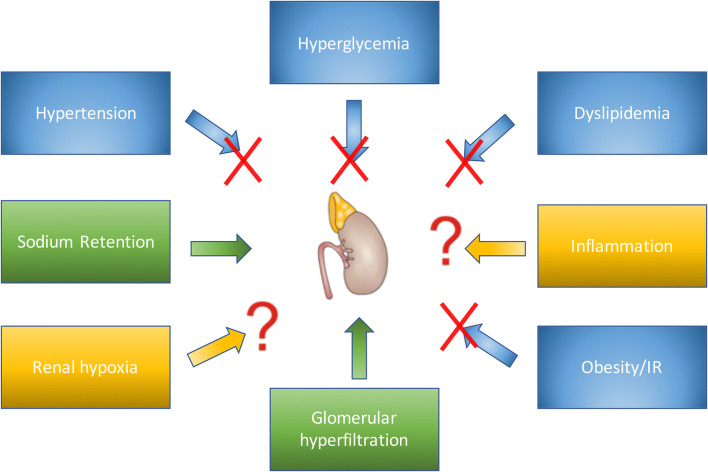
Glucagon-like peptide (GLP)-1 receptor agonists are the cornerstone in the treatment of hyperglycemia in many people suffering from type 2 diabetes (T2D). These drugs have potent glucose-lowering actions and, additionally, lower body weight through satiety induction while reducing blood pressure and dyslipidemia. Partly through these actions, GLP-1 receptor agonism was shown to reduce cardiovascular disease (CVD) in people with T2D with previous CVD or at high-risk thereof. In these cardiovascular safety trials, in secondary or exploratory analyses, GLP-1 receptor agonists were also shown to reduce macro-albuminuria, an accepted surrogate marker for diabetic kidney disease (DKD), a condition that still represents a major unmet medical need. In this review we will discuss the evidence which suggests renoprotection induced by GLP-1 receptor agonists and the potential mechanisms that may be involved. These include mitigation of hyperglycemia, overweight and insulin resistance, systemic and glomerular hypertension, dyslipidemia, sodium retention, inflammation and renal hypoxia. The recently initiated large-sized FLOW trial investigating the effects of semaglutide on hard renal outcomes in patients with DKD will provide clarity whether GLP-1 receptor agonists may reduce the burden of DKD in addition to their other beneficial metabolic and cardiovascular effects.
Overview
The claims and statistics of this paper haven’t been checked yet.
Free: it reads the open-access text and checks the first 5 claims that cite a source we can check. Create a free account to check every claim.
Integrity signals
Registry
Cites
Statistics
Figures
Verification
Claims the paper makes
The claims and statistics of this paper haven’t been checked yet.
Free: it reads the open-access text and checks the first 5 claims that cite a source we can check. Create a free account to check every claim.
Claims other papers make about this one
Each is checked against this paper’s own text: does it say what the citing paper says it does?
The cited source says what the claim attributes to it.
In the citing paper
“GLP-1RAs reduce progression to macro-albuminuria and lead to (subtle) reductions in the decline in renal function”
From Safety of Semaglutide (2021) · cites this paper as [118]
In the citing paper
“Furthermore, GLP-1RA inhibits mesangial expansion, reduces the endothelial expression of profibrotic molecules and increases the availability of intraglomerular nitric oxide, thus slowing the progression of DKD [37, 38].”
From GLP-1 receptor agonists and renal outcomes in patients with diabetes mellitus type 2 and diabetic kidney disease: state of the art (2022) · cites this paper as [37]
Self-check
Percentages, sums and reported differences re-computed from the paper’s own numbers.
The self-check needs the paper’s full text.
Citations
Cites
Ahmed, A., Jorna, T., & Bhandari, S. (2016) · Nephron · doi:10.1159/000447068 · Cited by 11,717
Brenner, B. M., Cooper, M. E., de Zeeuw, D., Keane, W. F., Mitch, W. E., Parving, H.-H., Remuzzi, G., Snapinn, S. M., Zhang, Z., & Shahinfar, S. (2001) · New England Journal of Medicine · doi:10.1056/nejmoa011161 · Cited by 7,493
IDF Diabetes Atlas: Global estimates of diabetes prevalence for 2017 and projections for 2045
Cho, N. H., Shaw, J. E., Karuranga, S., Huang, Y., da Rocha Fernandes, J. D., Ohlrogge, A. W., & Malanda, B. (2018) · Diabetes Research and Clinical Practice · doi:10.1016/j.diabres.2018.02.023 · Cited by 7,283
Semaglutide and Cardiovascular Outcomes in Patients with Type 2 Diabetes
Marso, S. P., Bain, S. C., Consoli, A., Eliaschewitz, F. G., Jódar, E., Leiter, L. A., Lingvay, I., Rosenstock, J., Seufert, J., Warren, M. L., et al. (2016) · New England Journal of Medicine · doi:10.1056/nejmoa1607141 · Cited by 6,900
Canagliflozin and Renal Outcomes in Type 2 Diabetes and Nephropathy
Perkovic, V., Jardine, M. J., Neal, B., Bompoint, S., Heerspink, H. J. L., Charytan, D. M., Edwards, R., Agarwal, R., Bakris, G., Bull, S., et al. (2019) · New England Journal of Medicine · doi:10.1056/nejmoa1811744 · Cited by 6,189
Lewis, E. J., Hunsicker, L. G., Clarke, W. R., Berl, T., Pohl, M. A., Lewis, J. B., Ritz, E., Atkins, R. C., Rohde, R., & Raz, I. (2001) · New England Journal of Medicine · doi:10.1056/nejmoa011303 · Cited by 5,987
Drucker, D. J., & Nauck, M. A. (2006) · The Lancet · doi:10.1016/s0140-6736(06)69705-5 · Cited by 3,896
Lixisenatide in Patients with Type 2 Diabetes and Acute Coronary Syndrome
Pfeffer, M. A., Claggett, B., Diaz, R., Dickstein, K., Gerstein, H. C., Køber, L. V., Lawson, F. C., Ping, L., Wei, X., Lewis, E. F., et al. (2015) · New England Journal of Medicine · doi:10.1056/nejmoa1509225 · Cited by 2,409
Chronic kidney disease and cardiovascular risk: epidemiology, mechanisms, and prevention
Gansevoort, R. T., Correa-Rotter, R., Hemmelgarn, B. R., Jafar, T. H., Heerspink, H. J. L., Mann, J. F., Matsushita, K., & Wen, C. P. (2013) · The Lancet · doi:10.1016/s0140-6736(13)60595-4 · Cited by 2,213
Oral Semaglutide and Cardiovascular Outcomes in Patients with Type 2 Diabetes
Husain, M., Birkenfeld, A. L., Donsmark, M., Dungan, K., Eliaschewitz, F. G., Franco, D. R., Jeppesen, O. K., Lingvay, I., Mosenzon, O., Pedersen, S. D., et al. (2019) · New England Journal of Medicine · doi:10.1056/nejmoa1901118 · Cited by 1,997
Cited by
Smits, M. M., & Van Raalte, D. H. (2021) · Frontiers in Endocrinology · doi:10.3389/fendo.2021.645563 · Cited by 332
Min, J. S., Jo, S. J., Lee, S., Kim, D. Y., Kim, D. H., Lee, C. B., & Bae, S. K. (2025) · Drug Design Development and Therapy · doi:10.2147/dddt.s506957 · Cited by 133
GLP-1 receptor agonists in diabetic kidney disease: current evidence and future directions
Yu, J. H., Park, S. Y., Lee, D. Y., Kim, N. H., & Seo, J. A. (2022) · Kidney Research and Clinical Practice · doi:10.23876/j.krcp.22.001 · Cited by 104
Tong, M., Luo, L.-Z., Xue, P., Han, Y.-H., Wang, L., Zhuge, D., Yao, Q., Chen, B., Zhao, Y., & Xu, H. (2021) · Acta Biomaterialia · doi:10.1016/j.actbio.2021.01.007 · Cited by 72
Slieker, R. C., van der Heijden, A. A. W. A., Siddiqui, M. K., Langendoen‐Gort, M., Nijpels, G., Herings, R. M. C., Feenstra, T., Moons, K. G. M., Bell, S., Elders, P. J. M., et al. (2021) · BMJ · doi:10.1136/bmj.n2134 · Cited by 70
Granata, A., Maccarrone, R., Anzaldi, M., Leonardi, G., Pesce, F., Amico, F., Gesualdo, L., & Corrao, S. (2022) · Clinical Kidney Journal · doi:10.1093/ckj/sfac069 · Cited by 54
“dothelial expression of profibrotic molecules and increases the availability of intraglomerular nitric oxide, thus slowing the progression of DKD [37, 38].”
InfluentialPotential Roles of Glucagon-Like Peptide 1 Receptor Agonists (GLP-1 RAs) in Nondiabetic Populations
Xu, D., Nair, A., Sigston, C., Ho, C., Li, J., Yang, D., Liao, X., Chen, W., Kuang, M., Li, Y., et al. (2022) · Cardiovascular Therapeutics · doi:10.1155/2022/6820377 · Cited by 50
“GLP-1 RA is thought to inhibit sodium-hydrogen exchange in the proximal-convoluted tubules, thus increasing urinary sodium excretion [34].”
BackgroundPatel, R., Sharma, A., Prasad, A., & Bansal, S. (2023) · Kidney Medicine · doi:10.1016/j.xkme.2023.100705 · Cited by 66
Lee, O. Y. A., Wong, A. N. N., Ho, C. Y., Tse, K. W., Chan, A. Z., Leung, G., Kwan, Y. W., & Yeung, M. H. Y. (2024) · Antioxidants · doi:10.3390/antiox13060751 · Cited by 69
“Particularly, the drug plays a significant role in preventing epithelial-mesenchymal transition (EMT), thereby blocking downstream cascades that cause ECM protein secretion [148,149].”
BackgroundLee, B. S., Holstein‐Rathlou, N., Sosnovtseva, O. V., & Sørensen, C. M. (2023) · American Journal of Physiology-Cell Physiology · doi:10.1152/ajpcell.00147.2023 · Cited by 42
Stefanou, M.-I., Palaiodimou, L., Theodorou, A., Safouris, A., Fischer, U., Kelly, P. J., Dawson, J., Katan, M., Katsanos, A. H., Lambadiari, V., et al. (2024) · Therapeutic Advances in Neurological Disorders · doi:10.1177/17562864241281903 · Cited by 36
Yuan, D., Sharma, H., Krishnan, A., Vangaveti, V., & Malabu, U. H. (2022) · Diabetes Obesity and Metabolism · doi:10.1111/dom.14776 · Cited by 41
“It may be true that insulin mediates renal protection through primarily lowering glucose levels while GLP-1RAs mediate renal protection through the described mechanisms as well as targeting obesity, reducing inflammation and renal hypoxia.(8,43,45) Given this variety of mechanisms in which GLP-1RAs may mediate renal p…”
BackgroundTreating the Chronic Disease of Obesity
Gossmann, M., Butsch, W. S., & Jastreboff, A. M. (2021) · Medical Clinics of North America · doi:10.1016/j.mcna.2021.06.005 · Cited by 33
Renal protection with glucagon-like peptide-1 receptor agonists
Vitale, M., Haxhi, J., Cirrito, T., & Pugliese, G. (2020) · Current Opinion in Pharmacology · doi:10.1016/j.coph.2020.08.018 · Cited by 31
der Beek, A. B. V. D. A., Apperloo, E. M., Jongs, N., Rouw, D. B., Sjöström, C. D., Friedli, I., Johansson, L., van Raalte, D. H., Hoogenberg, K., & Heerspink, H. J. L. (2023) · Diabetes Obesity and Metabolism · doi:10.1111/dom.15033 · Cited by 32
Unlocking the multifaceted roles of GLP-1: Physiological functions and therapeutic potential
AL-Noshokaty, T. M., Abdelhamid, R., Abdelmaksoud, N. M., Khaled, A., Hossam, M., Ahmed, R., Saber, T., Khaled, S., Elshaer, S. S., & Abulsoud, A. I. (2025) · Toxicology Reports · doi:10.1016/j.toxrep.2025.101895 · Cited by 30
“Various studies have shown that GLP-1RAs have a kidney protective effect in patients with T2D, when considering the safety and effectiveness of GLP-1RAs in comparison to other anti-diabetic medications [100 – 105].”
Metformin, chronic nephropathy and lactic acidosis: a multi-faceted issue for the nephrologist
Mariano, F., & Biancone, L. (2020) · Journal of Nephrology · doi:10.1007/s40620-020-00941-8 · Cited by 38
D’Marco, L., Morillo, V., Górriz, J. L., Suarez, M., Nava, M., Ortega, Á., Parra, H., Villasmil, N., Rojas, J., & Bermúdez, V. (2021) · Journal of Diabetes Research · doi:10.1155/2021/9032378 · Cited by 34
“These findings have allowed proposing direct protective mechanisms, in addition to the reduction of renal hypoxia, oxidative stress, and local and systemic inflammation [105, 106].”
BackgroundRroji, M., & Spasovski, G. B. (2024) · Biomedicines · doi:10.3390/biomedicines12030657 · Cited by 34
“against kidney and cardiovascular diseases [5,15,86,87,101,102].”
BackgroundCardiometabolic comorbidities and complications of obesity and chronic kidney disease (CKD)
Ali, M. M., Parveen, S., Williams, V. R., Dons, R. F., & Uwaifo, G. I. (2024) · Journal of Clinical & Translational Endocrinology · doi:10.1016/j.jcte.2024.100341 · Cited by 42
Fatty kidney: A possible future for chronic kidney disease research
Kanbay, M., Çöpür, S., Demiray, A., Sag, A. A., Covic, A. C., Ortíz, A., & Tuttle, K. R. (2022) · European Journal of Clinical Investigation · doi:10.1111/eci.13748 · Cited by 26
Mahzari, M. M., Alluhayyan, O. B., Almutairi, M. H., Bayounis, M. A., Alrayani, Y. H., Omair, A. A., & Alshahrani, A. S. (2024) · Journal of Clinical & Translational Endocrinology · doi:10.1016/j.jcte.2024.100343 · Cited by 31
Glucagon‐like peptide‐1: Are its roles as endogenous hormone and therapeutic wizard congruent?
Holst, J. J. (2022) · Journal of Internal Medicine · doi:10.1111/joim.13433 · Cited by 26
Chuang, C., Wang, K., Chang, C., Lee, C., Huang, J., Wu, H., Yang, P., & Yang, S. (2024) · International Journal of Medical Sciences · doi:10.7150/ijms.90273 · Cited by 23
“The GLP-1RA has been demonstrated to exert renal protective effects through the amelioration of albumin excretion and the prevention of creatinine elevation [22-24].”
BackgroundFadini, G. P., Prato, S. D., Avogaro, A., & Solini, A. (2021) · Diabetes Obesity and Metabolism · doi:10.1111/dom.14599 · Cited by 21
“ing FLOW trial on the renal effects of semaglutide in patients with DKD will clarify whether GLP-1RAs may slow DKD progression, thereby complementing the beneficial metabolic and cardiovascular effects.(56) Finally, in Italy, a relatively high proportion of patients with stage III CKD are still treated with sulphonylu…”
BackgroundSumida, Y., Yoneda, M., Toyoda, H., Yasuda, S., Tada, T., Hayashi, H., Nishigaki, Y., Suzuki, Y., Naiki, T., Morishita, A., et al. (2020) · International Journal of Molecular Sciences · doi:10.3390/ijms21144939 · Cited by 17
From diabetes to diverse domains: the multifaceted roles of GLP-1 receptor agonists
Dave, B. P., Chorawala, M. R., Shah, I., Shah, N. N., Bhagat, S. U., Prajapati, B. G., & Thakkar, P. C. (2024) · Molecular Biology Reports · doi:10.1007/s11033-024-09793-y · Cited by 17
Wilke, T., Picker, N., Müller, S., Stürmlinger, A., Deiters, B., Dittmar, A., Aberle, J., & Gabler, M. (2022) · ClinicoEconomics and Outcomes Research · doi:10.2147/ceor.s357540 · Cited by 13
Use of glucagon-like peptide type 1 receptor agonists in kidney transplant recipients
Vigara, L. A., Villanego, F., Orellana, C., Eady, M., Sánchez, M. G., Alonso, M., García, M. B., Amaro, J. M., García, T. G., & Mazuecos, A. (2024) · Nefrología (English Edition) · doi:10.1016/j.nefroe.2024.11.007 · Cited by 13
The expanding role of semaglutide: beyond glycemic control
Zarei, M., Sabetkasaei, M., Mozafari, M., & Zaeri, S. (2025) · Journal of Diabetes & Metabolic Disorders · doi:10.1007/s40200-025-01663-z · Cited by 11
“Despite isolated AKI cases, semaglutide demonstrates renal benefits, including reduced macroalbuminuria progression and slower renal function decline, as shown in Cardiovascular Outcomes Trials and a post-hoc SUSTAIN 6 analysis [154, 155 ].”
Effect of once-weekly dulaglutide on renal function in patients with chronic kidney disease
Kim, S., An, J. N., Song, Y. R., Kim, S. G., Lee, H., Cho, A., & Kim, J.-K. (2022) · PLoS ONE · doi:10.1371/journal.pone.0273004 · Cited by 10
“In moderate-to-severe CKD, GLP-1RAs can be a good therapeutic option [12, 15, 16].”
BackgroundKowalska, M. K., El‐Mallul, A., Hudecka, W., Lubojańska, J. E., Lubojański, P. J., Orłowska, S. M., & Bednarczyk, Ł. (2026) · International Journal of Molecular Sciences · doi:10.3390/ijms27041886 · Cited by 10
Wang, P., Hill, T. A., Mitchell, J. M., Fitzsimmons, R. L., Xu, W., Loh, Z., Suen, J. Y., Lim, J., Iyer, A., & Fairlie, D. P. (2022) · Journal of Medicinal Chemistry · doi:10.1021/acs.jmedchem.2c00653 · Cited by 8
Lin, L., Dekkers, I. A., Tao, Q., Paiman, E. H. M., Bizino, M. B., Jazet, I. M., & Lamb, H. J. (2023) · Journal of Magnetic Resonance Imaging · doi:10.1002/jmri.29174 · Cited by 9
Ninčević, V., Zjalić, M., Kolarić, T. O., Smolić, M., Kizivat, T., Kuna, L., Včev, A., Tabll, A. A., & Bilić-Čurčić, I. (2022) · Current Issues in Molecular Biology · doi:10.3390/cimb44030072 · Cited by 7
“Recently published cardiovascular outcome trials (CVOT) revealed that long acting GLP-1 RAs have significant renoprotective effects which could not be attributed only to the glucose-lowering effects of drugs primarily affecting the glomerular damage pathways [3].”
BackgroundAsif, S., Rampersad, C., Orchanian‐Cheff, A., & Kim, S. J. (2025) · Transplantation Reviews · doi:10.1016/j.trre.2025.100965 · Cited by 7
Obesity-related glomerulopathy, A growing kidney burden in the obesity pandemic
Mashayekhi, M., Zuckerman, J. E., Koubar, S. H., Wu, J., Qing, J., Abdipour, A., Lerma, E. V., Peters, W. R., & Norouzi, S. (2025) · Clinical and Experimental Nephrology · doi:10.1007/s10157-025-02804-7 · Cited by 8
“Furthermore, GLP1RAs reduce the progression or onset of macroalbuminuria in individuals with type 2 diabetes [56].”
Lin, C., Chen, J., Meyerowitz‐Katz, G., Huang, Y., & Su, P. (2025) · Diabetes Obesity and Metabolism · doi:10.1111/dom.16191 · Cited by 6
“40 In individuals with obesity, where RAAS is often already overactivated, 41 the combination of these effects could result in unfavourable haemodynamic changes and increased cardiovascular risk.”
Lee, B. S., Postnov, D. D., Sørensen, C. M., & Sosnovtseva, O. V. (2023) · Scientific Reports · doi:10.1038/s41598-023-49327-3 · Cited by 5
“The decline in renal function threatens diabetic patients, with symptoms manifesting in the form of hypertension, sodium retention, albuminuria, glomerular hyperfiltration, and micro-vascular damage, to name a few 21 .”
BackgroundAlbor, C., Anyiam, O., Boyle, L., Makaronidis, J., Tan, R. J. L., Iftikhar, S., Burzić, A., Lajeunesse‐Trempe, F., Stanley, M., Bhatti, A. I., et al. (2026) · Current Obesity Reports · doi:10.1007/s13679-026-00707-6 · Cited by 5
Emerging therapeutic landscape: Incretin agonists in chronic kidney disease management
Lian, K., Zhang, K., Kan, C., Hou, N., Han, F., Sun, X., Qiu, H., & Guo, Z. (2024) · Life Sciences · doi:10.1016/j.lfs.2024.122801 · Cited by 7
Russo, G. T., Giandalia, A., Ceriello, A., Bartolo, P. D., Cianni, G. D., Fioretto, P., Giorda, C. B., Manicardi, V., Pontremoli, R., Viazzi, F. C., et al. (2022) · Diabetes Research and Clinical Practice · doi:10.1016/j.diabres.2022.110092 · Cited by 5
Tommerdahl, K. L., Kula, A. J., & Bjornstad, P. (2023) · Expert Opinion on Pharmacotherapy · doi:10.1080/14656566.2023.2203319 · Cited by 6
“mation, and potentially renal hypoxia [56].”
Self-citationLuna, E., Álvarez, Á., Sabillón, J. A. R., Villa, J., Giraldo, T., Martín, M. V. M., Vázquez, E., Fernández, N., Ruíz, B., García‐Pino, G., et al. (2025) · Pharmaceutics · doi:10.3390/pharmaceutics17070943 · Cited by 5
“In the same manner, semaglutide not only increases sodium excretion while decreasing albuminuria and hyperfiltration but, in addition, it reduces body fat and the production of cytokines involved in the progression of CKD [24].”
Winkler, G. (2021) · Diabetologia Hungarica · doi:10.24121/dh.2021.17 · Cited by 4
Ahmad, N. B., Kassim, A., Manivasagam, S. S., & Raman, J. D. (2026) · International Urology and Nephrology · doi:10.1007/s11255-026-05177-2 · Cited by 2
“Meta-analyses of GLP-1 RA trials consistently report reductions in composite renal outcomes, including need for dialysis, GFR decline, or kidney-related death [7, 14].”
Chakravarti, H. N., Kesavadev, J., KOVIL, R. R., Sanyal, D., Das, S., Roy, N., Kumar, D., Deb, B., Chaudhuri, S. R., & Aneja, P. (2024) · International Journal of Diabetes and Technology · doi:10.4103/ijdt.ijdt_11_24 · Cited by 2
Vigara, L. A., Villanego, F., Orellana, C., Eady, M., Sánchez, M. G., Alonso, M., García, M. B., Amaro, J. M., García, T. G., & Mazuecos, A. (2023) · Nefrología · doi:10.1016/j.nefro.2023.06.010 · Cited by 2
Lessons learned from early-stage clinical trials for diabetic nephropathy
Rendell, M. (2024) · Expert Opinion on Investigational Drugs · doi:10.1080/13543784.2024.2326025 · Cited by 1
“The meta-analysis suggested that this composite variable was reduced by 21% (HR 0.79 [95% CI 0.73–0.87]; p < 0.0001) by GLP-1 RA [58].”
BackgroundInfluentialManagement of acute kidney disease in type 2 diabetes: the potential role of GLP-1 RAs and SGLT2-Is
Giugliano, D., Esposito, K., & Nicola, L. D. (2024) · Journal of Nephrology · doi:10.1007/s40620-024-02107-2 · Cited by 3
der Beek, A. B. V. D. A. (2023) · University of Groningen research database (University of Groningen / Centre for Information Technology) · doi:10.33612/diss.637600695
Semaglutide: Scoping Review with ☸️SAIMSARA
SAIMSARA (2026) · SAIMSARA Journal · doi:10.62487/saimsara45190890
Anupama, Y. J. (2026) · APIK Journal of Internal Medicine · doi:10.4103/ajim.ajim_3_26
Moreno, K., Gualán, J., Toapanta, J., & Barahona, A. S. C. (2026) · Innova Science Journal · doi:10.63618/omd/isj/v4/n2/252 · Cited by 5
Gobaru, M., Hasuzawa, N., Kurinami, N., Wada, N., Wang, L., Nagayama, A., Ashida, K., Moriyama, Y., Jinnouchi, H., & Nomura, M. (2026) · Frontiers in Endocrinology · doi:10.3389/fendo.2026.1924744
Bigda, P., Rafałowska, Z., Rutz, S., Wojtala, A., Kret, J., Wyrostkiewicz, A., Sadkowski, A., Gdula, J., Zielińska, L., Szpunar, M., et al. (2026) · International Journal of Innovative Technologies in Social Science · doi:10.31435/ijitss.3(51).2026.6153
Metadata
- Authors
- Mosterd, C. M., Bjornstad, P., & van Raalte, D. H.
- Affiliations
- Amsterdam University Medical Centers (NL)
- University of Colorado Anschutz (US)
- Venue
- Journal of Nephrology
- Publisher
- Oxford University Press (OUP)
- Published
- 2020-04-30
- Volume
- 33
- Issue
- 5
- Pages
- 965-975
- ISSN
- 1121-8428 (ISSN-L)
- 1724-6059
- PMC
- PMC7560915
- OpenAlex
- W3023544430
- Cited by
- 56
- References
- 67
- Citations by year
- 2026: 8 · 2025: 7 · 2024: 12 · 2023: 8 · 2022: 11 · 2021: 7 · 2020: 3
- FWCI
- 1.21
- Type
- journal article
- Language
- en
- Open access
- hybrid
- doi.org
- Licence
- cc-by
- creativecommons.org/licenses/by/4.0 (tdm)
- creativecommons.org/licenses/by/4.0 (vor)
- Locations
- Journal of Nephrology (publishedVersion, cc-by)
- PubMed Central (publishedVersion, cc-by)
- PubMed (publishedVersion)
- Amsterdam UMC (VU Amsterdam) - Institutional Repository (publishedVersion, other-oa)
- Pure Amsterdam UMC (submittedVersion, cc-by)
- Data Archiving and Networked Services (DANS) (submittedVersion, other-oa)
- Topics
- Health Sciences › Medicine › Nephrology › Chronic Kidney Disease and Diabetes
- Health Sciences › Medicine › Endocrinology, Diabetes and Metabolism › Diabetes Treatment and Management
- Health Sciences › Medicine › Nephrology › Acute Kidney Injury Research
- Keywords
- GLP-1 receptor agonists, diabetic nephropathy, renal protection, semaglutide, type 2 diabetes, albuminuria, hyperglycemia, insulin resistance, glomerular hypertension, dyslipidemia, sodium retention, renal inflammation, renal hypoxia, FLOW trial
- MeSH terms
- Glucagon-Like Peptide-1 Receptor, Cardiovascular Diseases, Diabetes Mellitus, Type 2, Diabetic Nephropathies, Pharmaceutical Preparations, Humans, Hypoglycemic Agents
About these checks
Registry, retraction, Cites and statistics results are computed, not judged, with one exception: a printed reference that no index lists is read once by a model before it counts as a citation error. Claims are extracted by a model and kept only when their quote appears verbatim in the text; each cited source is then checked, with a model’s help, for whether it says what the claim relies on. Those verdicts can be wrong — read the claim’s quote and the cited source before relying on one.
Statistics and arithmetic are recomputed, not judged.
Confidence bands are shown only for fields calibrated on our annotated test set. None is calibrated yet, so no band is shown.
What counts as a claim ›How we measure confidence ›How we check this ›
Are you an author, or do you see a problem with this page? Request a review
Data sources
Bibliographic data: Semantic Scholar, OpenAlex, Crossref.
Contains information from the Semantic Scholar Academic Graph Datasets, made available under the ODC Attribution License (ODC-BY 1.0).
Semantic Scholar’s data is described in: Kinney, R., et al. (2023). The Semantic Scholar Open Data Platform. arXiv:2301.10140.
