

Understanding the patterns and magnitude of life science publication retractions in the last four decades
Open accessThe DOI matches its Crossref record; 62 of the 63 references it cites were found in a registry or an index; 16 of the 49 sources its claims cite were checked for support.
Abstract
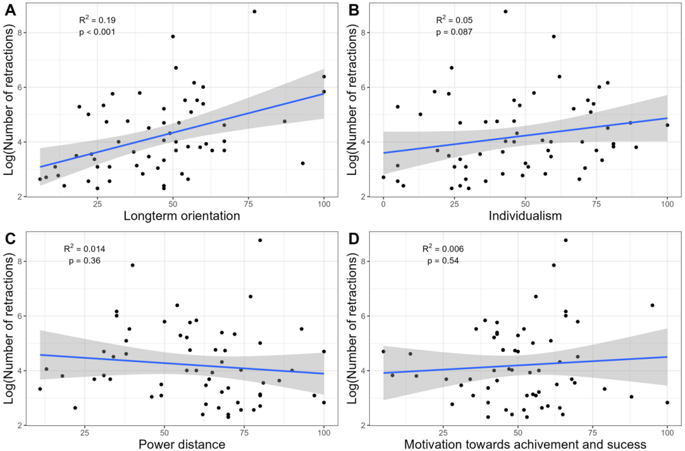
“Retractions”, a correction mechanism to remove unreliable publications, have increased significantly since the late 1970s. Thus, Exploring their patterns and drivers is crucial to develop effective strategies. For this research, we analyzed multi-decadal entries of life sciences in the Retraction Watch database since 1976 to understand the trends and drivers of retraction across time, countries and reasons. We also explored retraction dynamics with collaborative networks of retracted authors and the cultural dimension of retracted author affiliate countries. Our results revealed a 12–20% increase in retractions over decades in conference proceedings as well as journals with most of the authors of these studies from China (39.42%), the United States (15.81%) and India (5.03%). Interdisciplinary life science articles (20.26%), Cell Biology (19.08%), and cancer biology (13.61%) had high retraction rates among life sciences. Non-compliance with ethical and regulatory guidelines was the primary reason (23%) for retractions followed by publication and data integrity. The study revealed a close-knit collaborative network among retracted authors and the positive influence of the country’s long-term orientation (e.g., attitude towards future reward) on retraction magnitude. This study also highlighted the need to establish a dedicated Research Ethics and Integrity Office at institute and national level for an effective capacity-building programme to reduce incidents of scientific misconduct and article retraction. Not applicable.
Overview
CoChat Summary
TL;DR
This study analyzes Retraction Watch life-science retractions from 1976 to January 2023 to describe trends by time, country, subject, journal, author team, collaboration network, and national culture. It reports rising retractions, concentration in a few countries and subfields, ethical/regulatory non-compliance as the leading reason, and a positive association with journal impact factor and Hofstede’s long-term orientation.
Key findings
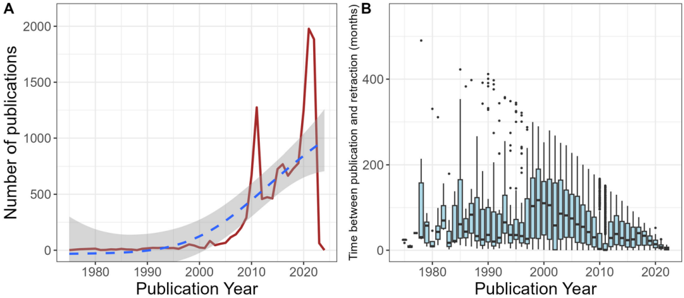
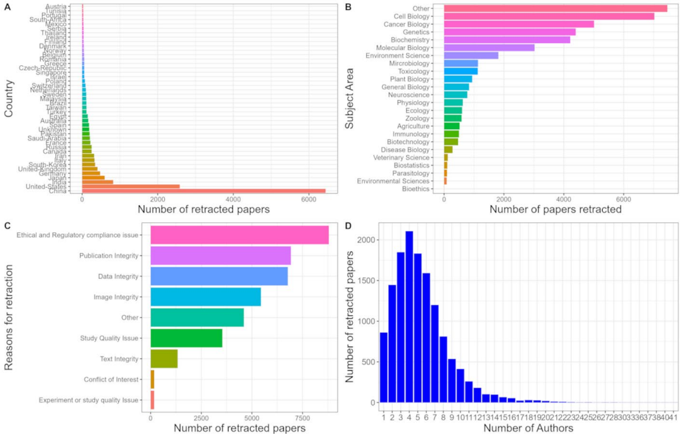
- Life-science retractions increased by 12–20% over decades; the final life-science dataset contained 13,567 entries. China accounted for the largest share (39.2% in Results; 39.42% in Abstract), followed by the United States (15.81%) and India (5.03%).
- Retractions varied significantly by subfield, highest in inter/multi-disciplinary life sciences (20.26%), cell biology (19.08%), and cancer biology (13.61%). The leading reason category was ethical and regulatory compliance issues (23.29%), followed by publication integrity violations (18.33%) and data integrity issues (17.92%).
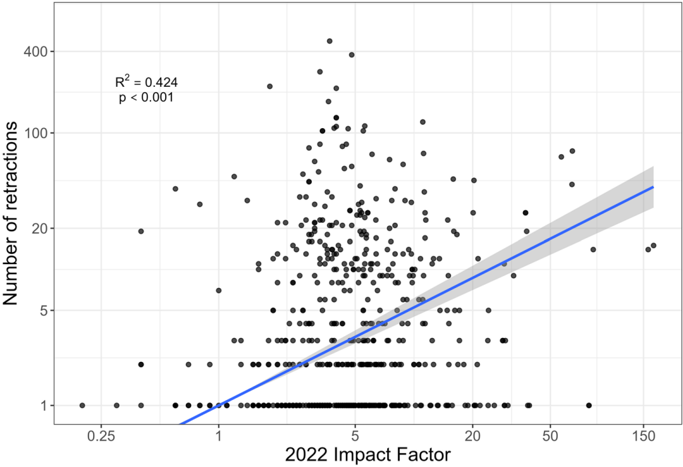
- Articles with three to five authors were retracted more frequently (13.51–15.53%) than single-author or >8-author articles. Journal impact factor was positively related to retraction count (R² = 0.424; F₁,₅₇₆ = 424.8, p < 0.001).
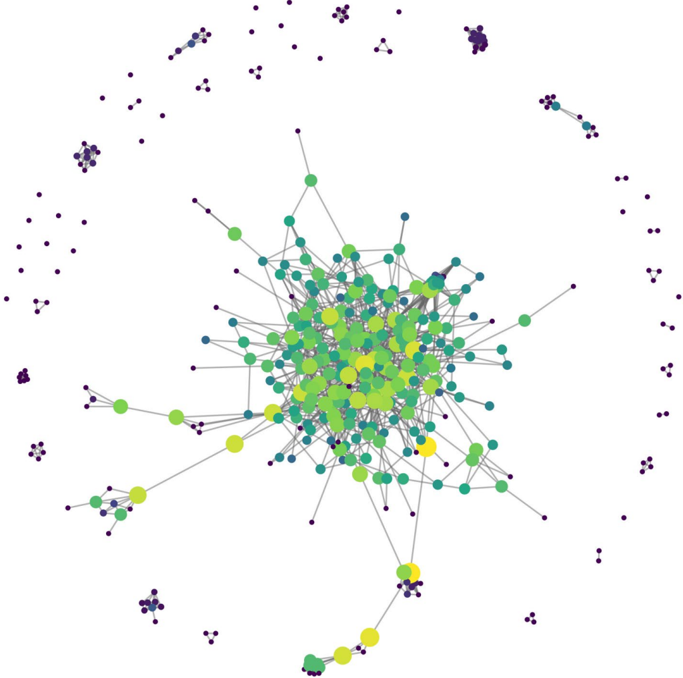
- Retracted authors showed a close-knit collaboration network: modularity was 0.696 for authors with >3 retractions and 0.607 for authors with >5 retractions. Country-level retraction magnitude was positively associated with Hofstede’s long-term orientation; individualism, power distance, and achievement motivation showed no specific pattern.
Methods
- Used Retraction Watch data accessed January 2023 (original n = 38,405), filtered to life-science/biological-science retractions and excluded studies focused primarily on medicine and public health, yielding 13,567 entries.
- Recategorized retraction reasons into eight classes and subjects into 22 categories; collected 2022 journal impact factors from Web of Science Master Journal List and country cultural-dimension data from Hofstede’s six-dimension website.
- Analyzed with R using chi-square tests, a general additive model trendline, regression for impact factor and cultural dimensions, and network graph analysis with the statnet package for co-authorship among retracted authors.
Limitations
- The paper states that retraction causes may extend beyond Retraction Watch categories, including poor-quality peer review, peer review fraud, weak editorship, paper mills, and publication pressure; that Retraction Watch lacks comprehensive year-wise total publication records, preventing comparison with total life-science output; and that the database may not record all retractions, so actual magnitude may be higher.
- The paper also states that spatiotemporal variation may reflect differences in countries’ quality assurance and investigation mechanisms.
- Evident from the text: the cultural and impact-factor analyses are observational country- or journal-level associations, and the study relies on retraction notices and database categorization, which the authors note can be ambiguous or inconsistent.
Model-written summary. Check it against the paper before relying on it.
Integrity signals
Registry
Cites
Statistics
Figures
Verification
Claims the paper makes
13 Valid · 0 Not valid · 28 Not checked · 52 Own results and interpretations
Every source the paper cites for this claim was checked and supports it.
In the paper
“A detailed analysis of retracted articles between 1983 and 2017 in the journal 'Science' revealed a higher proportion of retracted articles authored by two to four authors (Wray and Anderson, 2018).”
What the sources say
- Supportedcites Wray and Anderson, 2018 matched to “Retractions in Science” (2018) source
The Findings report 92 articles retracted from Science between 1983 and 2017. Of those, 47 (51%) were authored by teams of two to four scientists—a higher proportion than any other authorship-size category shown. (LLM, conf=0.95)
plainstates an association- Asserted: passes — The authors put it forward as true.
- Checkable: passes — It can be checked against evidence.
- Load-bearing: unclear — It is unclear whether the paper’s conclusions depend on it.
- Based: passes — The paper gives a reason why it holds.
- Supported
The cited sources support only part of this claim — read each source’s verdict below.
In the paper
“Multiple lines of evidence (Fanelli 2013; Fanelli et al. 2022) have suggested that the heightened scrutiny from both the journal and scientific community, and the strict implementation of retraction policies by the journal increased the retractions as a measure to correct the peer-reviewed scientific literature knowledge base.”
What the sources say
- Partly supportedcites Fanelli 2013 matched to “Why Growing Retractions Are (Mostly) a Good Sign” (2013) sourceExperimental — accuracy not yet measured
The Discussion and Conclusions say the rise in retractions is most plausibly due to researchers and editors becoming more aware of flawed papers and more proactive about removing them. But Box 2 of the Discussion says many journals lack clear retraction policies and existing policies are applied inconsistently; it does not support the claim that strict implementation of those policies increased retractions. (LLM, conf=0.88)
- Partly supportedcites Fanelli et al. 2022 matched to “What difference might retractions make? An estimate of the potential epistemic cost of retractions on meta-analyses” (2022) sourceExperimental — accuracy not yet measured
The opening passage (p. 2, labeled ABSTRACT in our copy) says multiple lines of evidence suggest that growing retractions result mainly or entirely from expanded and strengthened policies and practices to correct the literature. It does not specifically identify heightened scrutiny by journals and the scientific community or strict implementation of journal retraction policies as the mechanisms. (LLM, conf=0.84)
hedgedstates a cause- Asserted: passes — The authors put it forward as true.
- Checkable: passes — It can be checked against evidence.
- Load-bearing: unclear — It is unclear whether the paper’s conclusions depend on it.
- Based: passes — The paper gives a reason why it holds.
- Partly supported
A result the paper reports from its own data — it cites no other source for it, so there is none to check. The quote shows it is in the paper.
In the paper
“The current study also found that information mentioned in retraction notices as reported by The Retractions Watch database indicated reasons such as 'Bias Issues or Lack of Balance' , 'Objections by Third Party' , and 'Legal Reasons/Legal Threats' without clearly describing the issue.”
hedged- Asserted: passes — The authors put it forward as true.
- Checkable: passes — It can be checked against evidence.
- Load-bearing: passes — The paper’s conclusions depend on it.
- Based: passes — The paper gives a reason why it holds.
- Rests on an assumption not shown here.
A result the paper reports from its own data — it cites no other source for it, so there is none to check. The quote shows it is in the paper.
In the paper
“We found substantial variability in the prevalence of retraction across various subdisciplines of life sciences.”
plainstates an association- Asserted: passes — The authors put it forward as true.
- Checkable: passes — It can be checked against evidence.
- Load-bearing: passes — The paper’s conclusions depend on it.
- Based: passes — The paper gives a reason why it holds.
A result the paper reports from its own data — it cites no other source for it, so there is none to check. The quote shows it is in the paper.
In the paper
“our study revealed that low-impact journals experience a lower rate of retractions”
plainstates an association- Asserted: passes — The authors put it forward as true.
- Checkable: passes — It can be checked against evidence.
- Load-bearing: passes — The paper’s conclusions depend on it.
- Based: passes — The paper gives a reason why it holds.
25 more claims
Create a free account to see all 93 claims and to verify the 7 references still open.
- Probably not a substantial claim. 45
- It may state two separate claims as one. 35
- The quote only partly states this claim. 2
Self-check
Percentages, sums and reported differences re-computed from the paper’s own numbers.
Each contradiction between two passages listed here was confirmed by an independent check.
Rated minor: it would not touch a result — a value no result rests on, a p-value that stays on the same side of the significance level, or a conflict that is clerical, resolved elsewhere in the paper, or outside its own findings.
In the paper
§ Results · p. 8
“Fig. 4 Network of the retracted authors who had more than 5 retracted articles.”
§ Results · p. 7
“The purple dots represented authors who have one retracted article but remain highly isolated, with minimal or no collaboration with others who also have retracted articles.”
Cited works that were retracted
Works this paper cites that were later retracted, from the retraction notices publishers deposit. Major when the notice came out before this paper was published.
A note, not an issue: for example, a cited work that was retracted only after this paper was published, which its authors could not have known.
In the paper
“Campos-Varela I, Villaverde-Castañeda R, Ruano-Raviña A (2021) Retraction of publications: a study of biomedical journals Retracting publications based on impact factor and journal category. Gac Sanit 34:430–434. https://doi.org/10.1016/j.gaceta.2019.05.008”
Cited work 10.1016/j.gaceta.2019.05.008 · retraction date not known · this paper published 2025-06-21
A note, not an issue: for example, a cited work that was retracted only after this paper was published, which its authors could not have known.
In the paper
“Furthermore, publication retraction and the associated impact factor of corresponding journals were reported to be correlated (Fang and Casadevall 2011).”
Cited work 10.1128/iai.05661-11 · retraction date not known · this paper published 2025-06-21
Citations
Cites
2 retracted
Retracted Science and the Retraction Index
Fang, F. C., & Casadevall, A. (2011) · Infection and Immunity · doi:10.1128/iai.05661-11 · Cited by 405 · cited 1×
“Furthermore, publication retraction and the associated impact factor of corresponding journals were reported to be correlated (Fang and Casadevall 2011).”
RetractedCampos-Varela, I., Villaverde-Castañeda, R., & Ruano-Raviña, A. (2020) · Gaceta Sanitaria · doi:10.1016/j.gaceta.2019.05.008 · Cited by 41
RetractedCultures and Organizations: Software of the Mind.
Triandis, H. C., & Hofstede, G. (1993) · Administrative Science Quarterly · doi:10.2307/2393257 · Cited by 17,696
Rethinking individualism and collectivism: Evaluation of theoretical assumptions and meta-analyses.
Oyserman, D., Coon, H. M., & Kemmelmeier, M. (2002) · Psychological Bulletin · doi:10.1037/0033-2909.128.1.3 · Cited by 5,758 · cited 1×
“Furthermore, individuals from cultures with a long-term orientation might also be inclined to change their behaviour to maintain synergy with their peers and collaborators (Cialdini et al. 1999; Oyserman et al. 2002).”
Cultures and organizations: software of the mind
(1992) · Choice Reviews Online · doi:10.5860/choice.29-4203 · Cited by 3,673
Why the impact factor of journals should not be used for evaluating research
Seglen, P. O. (1997) · BMJ · doi:10.1136/bmj.314.7079.497 · Cited by 2,447 · cited 1×
“(Hans-son 1995; Seglen 1997; Bloch and Walter 2001; Szklo 2008).”
A Contingency Framework for Understanding Ethical Decision Making in Marketing
Ferrell, O. C., & Gresham, L. G. (1985) · Journal of Marketing · doi:10.1177/002224298504900308 · Cited by 1,858
Dates and Times Made Easy with lubridate
Grolemund, G., & Wickham, H. (2011) · Journal of Statistical Software · doi:10.18637/jss.v040.i03 · Cited by 1,664 · cited 1×
“The final dataset was filtered using programme R 4.2 using library package “tidyverse” (Wickham and Wickham 2017), “lubridate” (Grolemund and Wickham 2011) and visualized using “ggplot2” (Wilkinson 2011).”
Influentialtidyverse: Easily Install and Load the 'Tidyverse'
Wickham, H. (2016) · CRAN: Contributed Packages · doi:10.32614/cran.package.tidyverse · Cited by 1,381
Misconduct accounts for the majority of retracted scientific publications
Fang, F. C., Steen, R. G., & Casadevall, A. (2012) · Proceedings of the National Academy of Sciences · doi:10.1073/pnas.1212247109 · Cited by 1,232
Wealth, Culture, and Corruption
Husted, B. W. (1999) · Journal of International Business Studies · doi:10.1057/palgrave.jibs.8490073 · Cited by 853 · cited 1×
“Similarly, Husted (1999) indicated that high uncertainty avoidance, masculinity, power distance and the less individualistic a society might be correlated with increased corruption magnitude.”
Long- versus short-term orientation: new perspectives
Hofstede, G., & Minkov, M. (2010) · Asia Pacific Business Review · doi:10.1080/13602381003637609 · Cited by 798 · cited 1×
“Among all of Hofstede’s Cultural Dimensions, our study indicated an increased burden of retractions among countries with the third cultural dimension i.e., the long-term orientation which represents individuals who tend to focus on future well-being (Hofstede et al. 2010; Hofstede and Minkov 2010).”
ggplot2: Elegant Graphics for Data Analysis by WICKHAM, H.
Wilkinson, L. (2011) · Biometrics · doi:10.1111/j.1541-0420.2011.01616.x · Cited by 620 · cited 1×
“The final dataset was filtered using programme R 4.2 using library package “tidyverse” (Wickham and Wickham 2017), “lubridate” (Grolemund and Wickham 2011) and visualized using “ggplot2” (Wilkinson 2011).”
InfluentialTeam size matters: Collaboration and scientific impact since 1900
Larivière, V., Gingras, Y., Sugimoto, C. R., & Tsou, A. (2015) · Journal of the Association for Information Science and Technology · doi:10.1002/asi.23266 · Cited by 484
Cialdini, R. B., Wosinska, W., Barrett, D. W., Butner, J., & Gornik-Durose, M. (1999) · Personality and Social Psychology Bulletin · doi:10.1177/0146167299258006 · Cited by 458 · cited 1×
“Furthermore, individuals from cultures with a long-term orientation might also be inclined to change their behaviour to maintain synergy with their peers and collaborators (Cialdini et al. 1999; Oyserman et al. 2002).”
Why has the number of scientific retractions increased?
Steen, R. G., Casadevall, A., & Fang, F. C. (2013) · PLoS ONE · doi:10.1371/journal.pone.0068397 · Cited by 415 · cited 3×
“This finding is aligned with other studies in the recent past (Steen et al. 2013; Van Noorden, 2023).”
InfluentialThe effect of scholar collaboration on impact and quality of academic papers
Franceschet, M., & Costantini, A. (2010) · Journal of Informetrics · doi:10.1016/j.joi.2010.06.003 · Cited by 288
Why Growing Retractions Are (Mostly) a Good Sign
Fanelli, D. (2013) · PLoS Medicine · doi:10.1371/journal.pmed.1001563 · Cited by 272 · cited 1×
“Multiple lines of evidence (Fanelli 2013; Fanelli et al. 2022) have suggested that the heightened scrutiny from both the journal and scientific community, and the strict implementation of retraction policies by the journal increased the retractions as a measure to correct the peer-reviewed…”
Fanelli, D., Costas, R., & Larivière, V. (2015) · PLOS ONE · doi:10.1371/journal.pone.0127556 · Cited by 268 · cited 2×
“Fanelli et al. (2015) reported various drivers (e.g., lack of clear research ethics policies and enforcement, presence of cash rewards for individual publication performance, and absence of whistleblowing policies) for increased research misconduct and retracted articles.”
Why and how do journals retract articles? An analysis of Medline retractions 1988–2008
Wager, E., & Williams, P. (2011) · Journal of Medical Ethics · doi:10.1136/jme.2010.040964 · Cited by 263 · cited 1×
“Retraction practices in various journals are not uniform and often provide ambiguous information to readers not allowing them to clearly distinguish between errors and mis-conduct (Wager and Williams, 2011).”
Parker, M., & Kingori, P. (2016) · PLOS ONE · doi:10.1371/journal.pone.0163579 · Cited by 233 · cited 1×
“However, many studies also highlighted the limitations of collaborations as it always not guarantee ethical behaviour from each collaborator (Sun 2013; Parker and Kingori 2016).”
Unethical practices in authorship of scientific papers
Bennett, D. M., & Taylor, D. M. (2003) · Emergency Medicine · doi:10.1046/j.1442-2026.2003.00432.x · Cited by 216 · cited 1×
“…of authors in a collaborative study was reported to enhance the chance for consecutive text matching, carefree attitude towards responsibility, authorship disputes and data integrity issues which may lead to misconduct and retraction of collaborative articles (Bennett and Taylor 2003; Sun 2013).”
The Retraction Penalty: Evidence from the Web of Science
Lu, S. F., Jin, G. Z., Uzzi, B., & Jones, B. (2013) · Scientific Reports · doi:10.1038/srep03146 · Cited by 191 · cited 3×
“This finding is also in concordance with an earlier study by Lu et al. (2013) which highlighted an increased number (~ 40”
InfluentialNetwork Effects on Scientific Collaborations
Uddin, S., Hossain, L., & Rasmussen, K. (2013) · PLoS ONE · doi:10.1371/journal.pone.0057546 · Cited by 160 · cited 1×
“Studies which used social network analysis about co-authorship in publication highlighted a higher degree of centrality by lead scientists with strong links among collaborators for knowledge and resource sharing (Uddin et al. 2013; Bordons et al. 2015).”
Research Misconduct in Low- and Middle-Income Countries
Ana, J., Koehlmoos, T., Smith, R., & Yan, L. L. (2013) · PLoS Medicine · doi:10.1371/journal.pmed.1001315 · Cited by 159
Brainard, J. (2018) · Science · doi:10.1126/science.362.6413.390 · Cited by 149 · cited 3×
“Countries with smaller scientific communities have been reported to experience a higher retraction load (Brainard, 2018), whereas countries with structured academic and research integrity policies, along with institutes enforcing guidelines against misconduct, have fewer retractions (Fanelli, 2015).”
Bordons, M., Aparicio, J., González-Albo, B., & Díaz-Faes, A. A. (2015) · Journal of Informetrics · doi:10.1016/j.joi.2014.12.001 · Cited by 131 · cited 1×
“Studies which used social network analysis about co-authorship in publication highlighted a higher degree of centrality by lead scientists with strong links among collaborators for knowledge and resource sharing (Uddin et al. 2013; Bordons et al. 2015).”
Impact factor as a misleading tool in evaluation of medical journals
Hansson, S. (1995) · The Lancet · doi:10.1016/s0140-6736(95)92749-2 · Cited by 120
Zhao, L., Mao, H., Compton, B. J., Peng, J., Fu, G., Fang, F., Heyman, G. D., & Lee, K. (2022) · Educational Research Review · doi:10.1016/j.edurev.2022.100455 · Cited by 120
The Impact Factor: Time for Change
Bloch, S., & Walter, G. (2001) · Australian & New Zealand Journal of Psychiatry · doi:10.1080/0004867010060502 · Cited by 119
The career effects of scandal: Evidence from scientific retractions
Azoulay, P., Bonatti, A., & Krieger, J. L. (2017) · Research Policy · doi:10.1016/j.respol.2017.07.003 · Cited by 118 · cited 1×
“Scientists with retracted articles experience 8–9% fewer citations after the retraction, which highlights that retraction can cause a trust deficit in the professional field in the long run (Azoulay et al. 2017).”
Costly collaborations: The impact of scientific fraud on co‐authors' careers
Mongeon, P., & Larivière, V. (2016) · Journal of the Association for Information Science and Technology · doi:10.1002/asi.23421 · Cited by 83 · cited 1×
“Inci-dents of publication retraction are also closely linked with the decreased ranking of co-authors and collaborators and create a long-term impact on their careers (Mongeon and Larivière 2016).”
Salter, S. B., Guffey, D. M., & McMillan, J. J. (2001) · Journal of Business Ethics · doi:10.1023/a:1010785106667 · Cited by 81 · cited 1×
“…that individuals from countries with high uncertainty avoidance which can be defined in Hofstede’s cultural dimensions as “the extent to which the members of a culture feel threatened by uncertain or unknown situations” (Hofstede 1991, p. 113), are more likely to cheat (Salter et al. 2001).”
What studies of retractions tell us
Marcus, A., & Oransky, I. (2014) · Journal of Microbiology & Biology Education · doi:10.1128/jmbe.v15i2.855 · Cited by 81 · cited 1×
“Similar observations of one-line notices from leading life science journals (e.g. Journal of Biological Chemistry) which do not provide adequate information to help readers understand reasons for retraction have also been reported by Marcus and Oransky (2014).”
Asubiaro, T. (2019) · Scientometrics · doi:10.1007/s11192-019-03157-1 · Cited by 76 · cited 1×
“…in scientific research is considered highly desirable as it allows the optimum use of individual researchers or collaborative team skills which results in increased productivity (Morris and Goldstein 2007), and higher quality and citation rates (Fran-ceschet and Costantini 2010; Asubiaro 2019).”
Retractions are increasing, but not enough
Oransky, I. (2022) · Nature · doi:10.1038/d41586-022-02071-6 · Cited by 63 · cited 1×
“The rate of retractions has increased in recent years; however, it remains relatively low (0.1%), considering the number of flawed articles that needed to be retracted (Oransky 2022).”
InfluentialThe Legacy of the Hwang Case: Research Misconduct in Biosciences
Kakuk, P. (2009) · Science and Engineering Ethics · doi:10.1007/s11948-009-9121-x · Cited by 62 · cited 1×
“Many studies have found that the primary reason for retractions, scientific misconduct (e.g., plagiarism, data fabrication, and falsification) is often underre-ported (Kakuk 2009; Fang et al. 2012).”
Research groups: How big should they be?
Cook, I., Grange, S., & Eyre-Walker, A. (2015) · PeerJ · doi:10.7717/peerj.989 · Cited by 58 · cited 1×
“The group size of authors and number of publications were found to have a positive relationship in the field of biosciences (Cook et al. 2015).”
Pathogenic organization in science: Division of labor and retractions
Walsh, J. P., Lee, Y.-N., & Tang, L. (2019) · Research Policy · doi:10.1016/j.respol.2018.09.004 · Cited by 56 · cited 1×
“However, another study by Walsh et al., (2019) indicated that a greater division of labour (net size of the author team) also increases the likelihood of research misconduct which leads to a higher retraction rate.”
Media and social media attention to retracted articles according to Altmetric
Serghiou, S., Marton, R. M., & Ioannidis, J. P. A. (2021) · PLOS ONE · doi:10.1371/journal.pone.0248625 · Cited by 55 · cited 1×
“Similar patterns were also reported by Serghiou et al. (2021) whereas Bhat (2021) reported the United States, China, Japan, India and Germany were ranked the top five countries experiencing a high load of retraction in life science and biosciences.”
Set up a ‘self-retraction’ system for honest errors
Fanelli, D. (2016) · Nature · doi:10.1038/531415a · Cited by 53 · cited 1×
“…for a clear ethical guideline for language, publishing standard, reason related to retractions for all journals to reduce inconsistency in retraction notices. furthermore, self-retraction may be encouraged where retraction is resulted to due to honest error and agreed by all authors (Fanelli 2016).”
Wray, K. B., & Andersen, L. E. (2018) · Scientometrics · doi:10.1007/s11192-018-2922-4 · Cited by 53
A multi-perspective analysis of retractions in life sciences
Bhatt, B. (2021) · Scientometrics · doi:10.1007/s11192-021-03907-0 · Cited by 53
Foo, J. Y. A. (2011) · Science and Engineering Ethics · doi:10.1007/s11948-010-9212-8 · Cited by 51
Fortification of retraction notices to improve their transparency and usefulness
da Silva, J. A. T., & Vuong, Q. (2021) · Learned Publishing · doi:10.1002/leap.1409 · Cited by 51
Guilt by association: How scientific misconduct harms prior collaborators
Hussinger, K., & Pellens, M. (2019) · Research Policy · doi:10.1016/j.respol.2018.01.012 · Cited by 49 · cited 1×
“Collaborators of retracted authors also have fewer citation when the primary reason for retraction is scientific misconduct, whereas retractions due to honest errors are reported to have a limited impact (Mon-geon and Larivière 2016; Hussinger and Pellens 2019).”
Fanelli, D., Wong, J., & Moher, D. (2022) · Accountability in Research · doi:10.1080/08989621.2021.1947810 · Cited by 49
A Multidimensional Investigation of the Effects of Publication Retraction on Scholarly Impact
Shuai, X., Rollins, J., Moulinier, I., Custis, T., Edmunds, M., & Schilder, F. (2017) · Journal of the Association for Information Science and Technology · doi:10.1002/asi.23826 · Cited by 48 · cited 1×
“Though retraction has been introduced as a measure to weed out unreliable and erroneous publications, several studies have reported continued citation of retracted articles as a preliminary source of scientific data even long after their retraction (Shuai, 2017; Mott et al. 2019).”
Impact Factor: Good Reasons for Concern
Szklo, M. (2008) · Epidemiology · doi:10.1097/ede.0b013e31816b6a7a · Cited by 47
Sun, Y.-C. (2013) · Journal of English for Academic Purposes · doi:10.1016/j.jeap.2013.07.002 · Cited by 45 · cited 2×
“…of authors in a collaborative study was reported to enhance the chance for consecutive text matching, carefree attitude towards responsibility, authorship disputes and data integrity issues which may lead to misconduct and retraction of collaborative articles (Bennett and Taylor 2003; Sun 2013).”
Team size and retracted citations reveal the patterns of retractions from 1981 to 2020
Sharma, K. (2021) · Scientometrics · doi:10.1007/s11192-021-04125-4 · Cited by 45 · cited 3×
“Sharma (2021) reported that a significant proportion (55.2”
InfluentialMorris, S. A., & Goldstein, M. L. (2007) · Journal of the American Society for Information Science and Technology · doi:10.1002/asi.20661 · Cited by 42 · cited 1×
“…in scientific research is considered highly desirable as it allows the optimum use of individual researchers or collaborative team skills which results in increased productivity (Morris and Goldstein 2007), and higher quality and citation rates (Fran-ceschet and Costantini 2010; Asubiaro 2019).”
Mott, A., Fairhurst, C., & Torgerson, D. (2019) · Journal of Health Services Research & Policy · doi:10.1177/1355819618797965 · Cited by 36 · cited 2×
“Though retraction has been introduced as a measure to weed out unreliable and erroneous publications, several studies have reported continued citation of retracted articles as a preliminary source of scientific data even long after their retraction (Shuai, 2017; Mott et al. 2019).”
Academic and Business Ethical Misconduct and Cultural Values: A Cross National Comparison
Mirshekary, S., & Lawrence, A. D. K. (2009) · Journal of Academic Ethics · doi:10.1007/s10805-009-9093-0 · Cited by 35 · cited 1×
“A cross-cultural study conducted by Mirshekary and Lawrence (2009) indicated attitudes towards academic misconduct can be significantly influenced by culture and gender.”
An Integrated Approach to Evaluate Faculty Members’ Research Performance
Iyengar, R., Wang, Y., Chow, J., & Charney, D. S. (2009) · Academic Medicine · doi:10.1097/acm.0b013e3181bb2364 · Cited by 29 · cited 1×
“Both research misconduct and the number of retractions highlight the uncontrolled hyper-competitive nature of modern scientific research with a high emphasis on frequent publication in high-impact journals and obtaining a significant amount of funding at regular intervals (Iyengar et al. 2009).”
Volunteer watchdogs pushed a small country up the rankings
Oransky, I. (2018) · Science · doi:10.1126/science.362.6413.395 · Cited by 20 · cited 1×
“Many countries from the global south (e.g., Iran, and India) and the global north (e.g., USA) have reported comparatively high numbers of publication retractions in last two decades (Oransky 2018; Bhat, 2021).”
Why has the number of scientific retractions increased?
Steen, R. G., Casadevall, A., & Fang, F. C. (2015) · American Psychological Association eBooks · doi:10.1037/14805-034 · Cited by 20
Culture and Unmerited Authorship Credit: Who Wants It and Why?
Ren, X., Su, H., Lu, K., Dong, X., Ouyang, Z., & Talhelm, T. (2016) · Frontiers in Psychology · doi:10.3389/fpsyg.2016.02017 · Cited by 16 · cited 1×
“Earlier studies also highlighted that systematic cultural differences can influence unmerited authorship practice in scientific research (Ren et al. 2016).”
Mistakes and misconduct in the research literature: retractions just the tip of the iceberg
Poulton, A. (2007) · Medical Journal of Australia · doi:10.5694/j.1326-5377.2007.tb00917.x · Cited by 14 · cited 1×
“Poulton (2007) suggested that retraction may represent just the ‘tip of the iceberg’ of a larger issue, as stigmas surrounding retraction and the under-detection of misconduct contribute to the problem.”
A Multi-perspective Analysis of Retractions in Life SciencesPreprint
Bhatt, B. (2020) · bioRxiv (Cold Spring Harbor Laboratory) · doi:10.1101/2020.04.29.063016 · Cited by 8
REASONS FOR ACCOUNTING STUDENTS TO COMMIT ACADEMIC FRAUD: QUALITATIVE INTERVIEW STUDIES
Tonasa, M., & Setyorini, C. T. (2019) · Jurnal Akuntansi Manajemen dan Ekonomi · doi:10.32424/1.jame.2019.21.1.1431 · Cited by 7 · cited 1×
“The culture of a country is often defined as values and norms shared by a community in a certain area or geographic location with its members (Tonasa and Setyorini 2019).”
Fanelli, D., Wong, J., & Moher, D. (2022) · London School of Economics and Political Science Theses Online (London School of Economics and Political Science) · doi:10.6084/m9.figshare.20424148
Research groups: how big should they be?
Cook, I., Grange, S., & Eyre-Walker, A. (2015) · doi:10.7287/peerj.preprints.812v1
Cited by
Bhattacharyya, S. (2025) · Discover Education · doi:10.1007/s44217-025-00884-x · Cited by 4
“In recent years, a significant number of publications have been retracted because of the lack of data reproducibility and availability for scrutiny [5, 8, 10].”
Self-citationIndia’s research retraction surge sparks call for reform
Priyadarshini, S. (2025) · Nature India · doi:10.1038/d44151-025-00141-y · Cited by 1
Bhattacharyya, S., Chatterjee, N., & Ramanathan, A. (2025) · International Journal for Educational Integrity · doi:10.1007/s40979-025-00196-5
Self-citationDiagnosing event dependence in computer-generated-content retraction metadata, 2010–2025Preprint
Sokolov, A. (2026) · Research Square · doi:10.21203/rs.3.rs-10458624/v1
Metadata
- Authors
- Bhattacharyya, S., Chatterjee, N., & Ramanathan, A.
- Affiliations
- Institute for Stem Cell Biology and Regenerative Medicine (IN)
- University of Minnesota (US)
- Corresponding author
- Bhattacharyya, Sabuj
- ORCID
- Bhattacharyya, Sabuj
- Venue
- International Journal for Educational Integrity
- Published
- 2025-06-21
- Volume
- 21
- Issue
- 1
- ISSN
- 1833-2595 (ISSN-L)
- OpenAlex
- W4411477236
- Cited by
- 4
- References
- 52
- Citations by year
- 2026: 1 · 2025: 3
- FWCI
- 4.18
- Type
- journal article
- Language
- en
- Update notices
- correction (2025-07-21)
- Open access
- gold
- doi.org
- Licence
- cc-by-nc-nd
- creativecommons.org/licenses/by-nc-nd/4.0 (tdm)
- creativecommons.org/licenses/by-nc-nd/4.0 (vor)
- Locations
- International Journal for Educational Integrity (publishedVersion, cc-by-nc-nd)
- DOAJ (DOAJ: Directory of Open Access Journals) (submittedVersion, cc-by-sa)
- Topics
- Social Sciences › Education › Academic integrity and plagiarism
- Social Sciences › Library and Information Sciences › scientometrics and bibliometrics research
- Social Sciences › Library and Information Sciences › Academic Publishing and Open Access
- Keywords
- retraction, Retraction Watch, research integrity, research misconduct, publication ethics, long-term orientation, cultural dimensions, co-authorship networks, retraction reasons, data integrity, interdisciplinary research, tumor biology
About these checks
Registry, retraction, Cites and statistics results are computed, not judged, with one exception: a printed reference that no index lists is read once by a model before it counts as a citation error. Claims are extracted by a model and kept only when their quote appears verbatim in the text; each cited source is then checked, with a model’s help, for whether it says what the claim relies on. Those verdicts can be wrong — read the claim’s quote and the cited source before relying on one.
The claim verdicts this report counts are experimental: their accuracy is not yet measured.
A language model drew the claims from the paper on 2026-10-10, under version 3 of the claim definition (model deepseek-v4.1-flash, prompt extract-v3).
A second model labelled each claim on 2026-10-10 (model jev-1.13-20260917, definition revision gold-guideline-v0.2).
Cited sources are checked with a language model’s help (gpt-6-sol).
Statistics and arithmetic are recomputed, not judged.
Confidence bands are shown only for fields calibrated on our annotated test set. None is calibrated yet, so no band is shown.
What counts as a claim ›How we measure confidence ›How we check this ›
Are you an author, or do you see a problem with this page? Request a review
Data sources
Bibliographic data: Semantic Scholar, OpenAlex, Crossref.
Contains information from the Semantic Scholar Academic Graph Datasets, made available under the ODC Attribution License (ODC-BY 1.0).
Semantic Scholar’s data is described in: Kinney, R., et al. (2023). The Semantic Scholar Open Data Platform. arXiv:2301.10140.
