

Testing general relativity in cosmology
Open accessThe DOI matches its Crossref record; 1,143 of the 1,256 references it cites were found in a registry or an index, and 3 are not checked yet; 96 of the 510 sources its claims cite were checked for support.
Abstract
We review recent developments and results in testing general relativity (GR) at cosmological scales. The subject has witnessed rapid growth during the last two decades with the aim of addressing the question of cosmic acceleration and the dark energy associated with it. However, with the advent of precision cosmology, it has also become a well-motivated endeavor by itself to test gravitational physics at cosmic scales. We overview cosmological probes of gravity, formalisms and parameterizations for testing deviations from GR at cosmological scales, selected modified gravity (MG) theories, gravitational screening mechanisms, and computer codes developed for these tests. We then provide summaries of recent cosmological constraints on MG parameters and selected MG models. We supplement these cosmological constraints with a summary of implications from the recent binary neutron star merger event. Next, we summarize some results on MG parameter forecasts with and without astrophysical systematics that will dominate the uncertainties. The review aims at providing an overall picture of the subject and an entry point to students and researchers interested in joining the field. It can also serve as a quick reference to recent results and constraints on testing gravity at cosmological scales.
Verified 2026-11-22 · 3 references not checked yet
Overview
CoChat Summary
TL;DR
This review surveys how general relativity is tested at cosmological scales, emphasizing the split between background expansion/geometry probes and growth-of-structure probes, and how their combination constrains modified gravity. It also summarizes the status of major model classes, current data constraints, the impact of GW170817/GRB170817A, and the role of systematic effects and forecasting for future surveys.
Key findings
- The review argues that cosmology offers two complementary probe classes: expansion/geometry and structure growth; for testing deviations from GR, the growth sector is described as “rather the most useful” because many MG models can mimic the same expansion history as CDM while differing in growth.
- Current data generally remain consistent with GR, but often only at the level of relatively large uncertainties; the paper notes that constraints are tightening and that for upcoming surveys the dominant uncertainty will be systematic rather than statistical.
- Specific examples summarized in the text include:
- TeVeS was ruled out by Planck-based analyses, with one study reporting a best-fit Hubble constant that was “hard to reconcile” with other measurements and a goodness-of-fit worse than CDM.
- The self-accelerating DGP branch is described as disfavored/inconsistent with observations, while the normal branch remains useful as a benchmark.
- Galileon models are strongly constrained: cubic Galileons are ruled out by ISW data, and quartic/quintic Galileons are ruled out by GW170817/GRB170817A.
- f(R) models are driven very close to CDM by cosmological and astrophysical constraints, and the paper states that combining stringent cosmological constraints, astrophysical bounds, and no-go theorems “practically rules out” f(R) as an explanation for cosmic acceleration.
- The GW170817/GRB170817A event is presented as a major discriminator: it forces the GW speed to be practically equal to light speed and removes large parts of Horndeski/beyond-Horndeski and related model space, while leaving some viable subclasses (for example, generalized Brans–Dicke-like or certain no-slip scenarios) and several non-scalar-tensor classes.
Methods
- Narrative review of the literature on testing GR in cosmology, organized around: GR basics, standard cosmology, probes of gravity, formalisms for modified gravity, model classes, screening mechanisms, current constraints, GW170817 implications, software tools, systematics, and forecasts.
- Summarizes results from many published analyses and data sets, including Planck CMB, BAO, SN Ia, RSD, weak lensing, ISW, galaxy clustering, CMB lensing, and the GW170817/GRB170817A multimessenger event.
- Reviews analysis frameworks such as phenomenological modified-growth parameters, EFT, PPF, growth-index approaches, and model-specific Boltzmann/Einstein codes like CAMB, CLASS, ISiTGR, MGCAMB, hi_class, and EFTCAMB.
Limitations
- The paper explicitly states that it is not a comprehensive review of modified gravity models; it gives an overview of the current status of testing GR at cosmological scales and only outlines selected models as illustrative examples.
- It also notes that many current MG constraints are still limited by the constraining power of available data, and that scale-dependent MG parameters are often not meaningfully constrained by current data.
- Evident from the text: many quoted results are drawn from different papers using different parameterizations, data combinations, and modeling assumptions, so the review is synthesizing heterogeneous literature rather than presenting a single uniform analysis.
Model-written summary. Check it against the paper before relying on it.
Integrity signals
Registry
Cites
Statistics
Figures
Verification
Claims the paper makes
83 Valid · 9 Not valid · 289 Not checked · 144 Own results and interpretations
At least one cited source doesn’t support this claim or points to a different paper, and none confirmed it — see the verdicts below.
In the paper
“Incidentally, the bound in (327) is consistent with the bound derived in Moore and Nelson (2001) and Kimura and Yamamoto (2012) from gravitational Cherenkov radiation which constrains GW speed to not exceed the speed of light, assuming a galactic origin for the high energy cosmic rays.”
§ Testing general relativity in cosmology > Constraints on deviations from GR and MG models from neutron star merger event GW170817/GRB170817A
What the sources say
- Disputedcites Moore and Nelson (2001) matched to “Lower bound on the propagation speed of gravity from gravitational Cherenkov radiation” (2001) sourceExperimental — accuracy not yet measured
The Introduction says gravitational Cherenkov radiation places a strong lower bound on gravitational-wave speed, not a bound requiring it to stay below light speed. The discussion following equation (4.2) explicitly says Cherenkov radiation is impossible when gravity travels faster than light. The paper therefore does not derive the upper bound attributed to it; it does not address the later GW170817/GRB170817A result. (LLM, conf=0.91)
Checked by a reasoning model — may be wrong.
- Disputedcites Kimura and Yamamoto (2012) matched to “Constraints on general second-order scalar-tensor models from gravitational Cherenkov radiation” (2012) sourceExperimental — accuracy not yet measured
Kimura & Yamamoto (2012) state the opposite sense of the bound: in the Introduction (p. 1) eq. (1.1) is explicitly called 'the lower bound on the propagation speed of gravity from gravitational Cherenkov radiation', c − c_T < 2×10⁻¹⁵ c (assuming a galactic origin for the ultra-high-energy cosmic rays), i.e. it forbids the GW speed from falling BELOW c. Sec. 2 (eq. 2.6) and Sec. 6 repeat that Cherenkov radiation constrains models 'when the propagation speed of gravitational waves is less than the speed of light', and Sec. 4 applies it as c_T > 1 − ε with ε = 2×10⁻¹⁵. So while the galactic-origin assumption and the existence of a ~10⁻¹⁵ bound are in our copy, the attribution that gravitational Cherenkov radiation 'constrains GW speed to not exceed the speed of light' (an upper bound) is contrary to what this paper says; it places no constraint on superluminal propagation. (LLM, conf=0.85)
Checked by a reasoning model — may be wrong.
plainstates an association- Asserted: passes — The authors put it forward as true.
- Checkable: passes — It can be checked against evidence.
- Load-bearing: unclear — It is unclear whether the paper’s conclusions depend on it.
- Based: passes — The paper gives a reason why it holds.
- Rests on an assumption not shown here.
- Disputed
At least one cited source doesn’t support this claim or points to a different paper, and none confirmed it — see the verdicts below.
In the paper
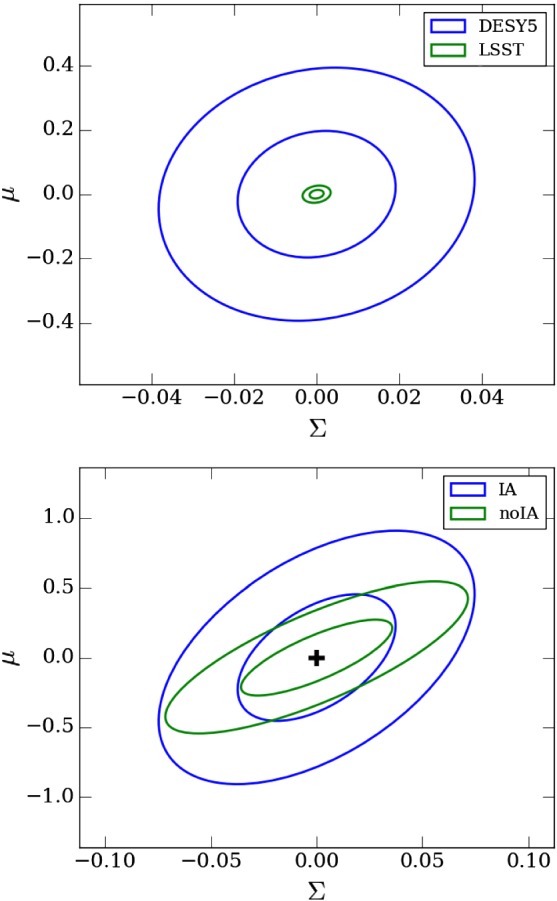
“They found that ignoring the effect of calibration bias or photometric redshift bias does affect significantly the constraints on MG parameters.”
§ Testing general relativity in cosmology > Systematic effects in cosmological probes and degeneracies with modifications to GR
What the sources say
- Disputedcites Ferté et al. (2017) matched to “Testing gravity on cosmological scales with cosmic shear, cosmic microwave background anisotropies, and redshift-space distortions” (2017) sourceExperimental — accuracy not yet measured
The ‘Impact of systematics’ section (p. 4) says the opposite: ignoring shear calibration bias or photometric redshift bias does not significantly affect constraints on the modified-gravity parameters Σ₀ and µ₀. It identifies intrinsic alignment, rather than either bias, as shifting the constraints. (LLM, conf=0.95)
Checked by a reasoning model — may be wrong.
plainstates a cause- Asserted: passes — The authors put it forward as true.
- Checkable: passes — It can be checked against evidence.
- Load-bearing: passes — The paper’s conclusions depend on it.
- Based: passes — The paper gives a reason why it holds.
- Disputed
The cited sources that could be checked couldn’t confirm or dispute this claim.
In the paper
“These seed fluctuations would have originated from microscopic quantum fluctuations that have been blown up to macroscopic scales by cosmic inflation (Guth 1981; Bardeen et al. 1983; Albrecht and Steinhardt 1982).”
§ Testing general relativity in cosmology > The standard model of cosmology > The inhomogeneous lumpy universe and the growth of large-scale structure
What the sources say
- Could not verifycites Guth 1981 matched to “Inflationary universe: A possible solution to the horizon and flatness problems” (1981) sourceExperimental — accuracy not yet measured
The passages on exponential expansion and inhomogeneities (indexed as Abstract; page unavailable) discuss inflation and random bubble formation, but do not identify microscopic quantum fluctuations as the origin of seed fluctuations. Searches for quantum fluctuations, density perturbations, and seed fluctuations found no passage making that connection. (LLM, conf=0.75)
- Not checked — no full text of the sourcecites Bardeen et al. 1983 matched to “Spontaneous creation of almost scale-free density perturbations in an inflationary universe” (1983) source
- Not checked — no full text of the sourcecites Albrecht and Steinhardt 1982 matched to “Cosmology for Grand Unified Theories with Radiatively Induced Symmetry Breaking” (1982) source
hedgedstates a cause- Asserted: passes — The authors put it forward as true.
- Checkable: passes — It can be checked against evidence.
- Load-bearing: unclear — It is unclear whether the paper’s conclusions depend on it.
- Based: passes — The paper gives a reason why it holds.
- Could not verify
Every source the paper cites for this claim was checked and supports it.
In the paper
“it has established very stringent constraints at the level of the solar system that any gravity theory must pass.”
§ Testing general relativity in cosmology > Introduction
What the sources say
- Supportedcites Will 2014 matched to “The Confrontation between General Relativity and Experiment” (2014) source
In “Tests of the strong equivalence principle” (page unavailable), the review describes solar-system experiments that test effects expected in many metric theories of gravity. It also calls the solar-system Cassini bound on a scalar-tensor parameter “very tight” and notes that alternative theories seek to preserve GR’s solar-system phenomenology. Together, these support the claim that gravity theories face stringent solar-system constraints. (LLM, conf=0.90)
boostedstates a cause- Asserted: passes — The authors put it forward as true.
- Checkable: passes — It can be checked against evidence.
- Load-bearing: passes — The paper’s conclusions depend on it.
- Based: passes — The paper gives a reason why it holds.
- Supported
The cited sources that could be checked couldn’t confirm or dispute this claim.
In the paper
“The standard picture of structure formation in the universe is that structures have grown by gravitational infall and clustering from primordial small fluctuations in the matter density field.”
§ Testing general relativity in cosmology > The standard model of cosmology > The inhomogeneous lumpy universe and the growth of large-scale structure
What the sources say
- Could not verifycites Guth 1981 matched to “Inflationary universe: A possible solution to the horizon and flatness problems” (1981) sourceExperimental — accuracy not yet measured
The Introduction and Conclusion passages discuss the early universe’s homogeneity, horizon and flatness problems, and possible inhomogeneity from inflationary bubble formation. Searches for gravitational clustering, primordial density fluctuations, and galaxy formation found no passage in our copy describing the claimed mechanism of structure formation. (LLM, conf=0.73)
- Not checked — no full text of the sourcecites Bardeen et al. 1983 matched to “Spontaneous creation of almost scale-free density perturbations in an inflationary universe” (1983) source
- Not checked — no full text of the sourcecites Albrecht and Steinhardt 1982 matched to “Cosmology for Grand Unified Theories with Radiatively Induced Symmetry Breaking” (1982) source
plainstates a cause- Asserted: passes — The authors put it forward as true.
- Checkable: passes — It can be checked against evidence.
- Load-bearing: unclear — It is unclear whether the paper’s conclusions depend on it.
- Based: passes — The paper gives a reason why it holds.
- Could not verify
219 more claims · 33 with their cited sources checked
Create a free account to see all 525 claims and to verify the 294 references still open.
- It may state two separate claims as one. 223
- Probably not a substantial claim. 125
- The quote only partly states this claim. 15
Citations
Cites
A new look at the statistical model identification
Akaike, H. (1974) · IEEE Transactions on Automatic Control · doi:10.1109/tac.1974.1100705 · Cited by 51,879 · cited 1×
“They use the Akaike information criterion (AIC) (Akaike 1974) to compare the two models αB 0 = 0 versus αB 0 = 0.”
MethodEquation of State Calculations by Fast Computing Machines
Metropolis, N., Rosenbluth, A. W., Rosenbluth, M. N., Teller, A. H., & Teller, E. (1953) · The Journal of Chemical Physics · doi:10.1063/1.1699114 · Cited by 37,192
Observational Evidence from Supernovae for an Accelerating Universe and a Cosmological Constant
Riess, A. G., Filippenko, A. V., Challis, P., Clocchiatti, A., Diercks, A., Garnavich, P. M., Gilliland, R. L., Hogan, C. J., Jha, S., Kirshner, R. P., et al. (1998) · The Astronomical Journal · doi:10.1086/300499 · Cited by 19,704
Measurements of Ω and Λ from 42 High‐Redshift Supernovae
Perlmutter, S., Aldering, G., Goldhaber, G., Knop, R. A., Nugent, P., Castro, P. G., Deustua, S., Fabbro, S., Goobar, A., Groom, D. E., et al. (1999) · The Astrophysical Journal · doi:10.1086/307221 · Cited by 18,062
Observation of Gravitational Waves from a Binary Black Hole Merger
Abbott, B. P., Abbott, R., Abbott, T. D., Abernathy, M. R., Acernese, F., Ackley, K., Adams, C., Adams, T., Addesso, P., Adhikari, R. X., et al. (2016) · Physical Review Letters · doi:10.1103/physrevlett.116.061102 · Cited by 14,151
Spergel, D. N., Verde, L., Peiris, H. V., Komatsu, E., Nolta, M. R., Bennett, C. L., Halpern, M., Hinshaw, G., Jarosik, N., Kogut, A., et al. (2003) · The Astrophysical Journal Supplement Series · doi:10.1086/377226 · Cited by 10,976
Planck 2015 results. XIII. Cosmological parameters
Planck Collaboration, Ade, P. A. R., Aghanim, N., Arnaud, M., Ashdown, M., Aumont, J., Baccigalupi, C., Banday, A. J., Barreiro, R. B., Bartlett, J. G., et al. (2015) · arXiv · doi:10.48550/arxiv.1502.01589 · Cited by 10,720
Planck 2015 results: XIII. Cosmological parameters
Planck Collaboration, Ade, P. A. R., Aghanim, N., Arnaud, M., Ashdown, M., Aumont, J., Baccigalupi, C., Banday, A. J., Barreiro, R. B., Bartlett, J. G., et al. (2016) · Astronomy & Astrophysics · doi:10.1051/0004-6361/201525830 · Cited by 10,583
Inflationary universe: A possible solution to the horizon and flatness problems
Guth, A. H. (1981) · Physical Review D · doi:10.1103/physrevd.23.347 · Cited by 9,983
GW170817: Observation of Gravitational Waves from a Binary Neutron Star Inspiral
Abbott, B. P., Abbott, R., Abbott, T. D., Acernese, F., Ackley, K., Adams, C., Adams, T., Addesso, P., Adhikari, R. X., Adya, V. B., et al. (2017) · Physical Review Letters · doi:10.1103/physrevlett.119.161101 · Cited by 9,473
Research works printed but not linked: 11
- Cartan E (1922a) Sur les équations de la gravitation d’Einstein. J Math Pures Appl 1922(1):141–202
- Debever R Le rayonnement gravitationnel. le tenseur de Riemann en relativité générale Cah Phys 1964 168 303
- Eddington A The mathematical theory of general relativity 1924 Cambridge CUP
- Ellis GFR Schatzman E Relativistic cosmology Cargèse lectures in physics 1973 New York Gordon and Breach 1
- Klein O Quantentheorie und Fünfdimensionale Relativitätstheorie Z Phys A 1926 37 895?906
- Könnig F, Akrami Y, Amendola L, Motta M, Solomon A (2014) Stable and unstable cosmological models in bimetric massive gravity. Phys Rev D 90:124014. 10.1103/PhysRevD.90.124014. arXiv:1407.4331 · DOI · Paper page
- Lifshitz EM On the theory of second-order phase transitions I Zh Eksp Teor Fiz 1941 11 255
- Misner CW Thorne KS Wheeler JA Gravitation 1973 Princeton Princeton University Press
- Peacock JA Cosmological physics 1999 Cambridge Cambridge University Press
- Schwarzschild K Über das Gravitationsfeld eines Massenpunktes nach der Einsteinschen Theorie Sitzungsber Koenigl Preuss Akad Wiss 1916 7 189 196
- Segre C Sulla teoria e sulla classificazione delle omografie in uno spazio lineare ad uno numero qualunque di dimensioni Mem R Accad Lincei, Ser 3 1884 XIX 127 148
Cited by
Modified gravity and cosmology
Clifton, T., Ferreira, P. G., Padilla, A., & Skordis, C. (2012) · Physics Reports · doi:10.1016/j.physrep.2012.01.001 · Cited by 4,146
Theory and Experiment in Gravitational Physics
Will, C. M. (2018) · doi:10.1017/9781316338612 · Cited by 3,637
DESI 2024 VI: cosmological constraints from the measurements of baryon acoustic oscillations
Adame, A. G., Aguilar, J., Ahlen, S., Alam, S., Alexander, D. M., Alvarez, M., Alves, O., Anand, A., Andrade, U., Armengaud, E., et al. (2025) · Journal of Cosmology and Astroparticle Physics · doi:10.1088/1475-7516/2025/02/021 · Cited by 1,136
Self-citationChallenges for Λ CDM: An update
Perivolaropoulos, L., & Skara, F. (2022) · New Astronomy Reviews · doi:10.1016/j.newar.2022.101659 · Cited by 902
DESI DR2 results. II. Measurements of baryon acoustic oscillations and cosmological constraints
Abdul Karim, M., Aguilar, J., Ahlen, S., Alam, S., Allen, L., Prieto, C. A., Alves, O., Anand, A., Andrade, U., Armengaud, E., et al. (2025) · Physical Review D · doi:10.1103/tr6y-kpc6 · Cited by 856
Self-citationAbbott, T. M. C., Abdalla, F. B., Avila, S., Banerji, M., Baxter, E., Bechtol, K., Becker, M. R., Bertin, E., Blazek, J., Bridle, S. L., et al. (2019) · Physical Review D · doi:10.1103/physrevd.99.123505 · Cited by 386
Cosmology with the Laser Interferometer Space Antenna
Auclair, P., Bacon, D., Baker, T., Barreiro, T., Bartolo, N., Belgacem, E., Bellomo, N., Ben-Dayan, I., Bertacca, D., Besancon, M., et al. (2023) · Living Reviews in Relativity · doi:10.1007/s41114-023-00045-2 · Cited by 333
Cosmological solutions and growth index of matter perturbations in f(Q) gravity
Khyllep, W., Paliathanasis, A., & Dutta, J. (2021) · Physical Review D · doi:10.1103/physrevd.103.103521 · Cited by 307
Derivation of regularized field equations for the Einstein-Gauss-Bonnet theory in four dimensions
Fernandes, P. G. S., Carrilho, P., Clifton, T., & Mulryne, D. J. (2020) · Physical Review D · doi:10.1103/physrevd.102.024025 · Cited by 209
DESI 2024 VII: cosmological constraints from the full-shape modeling of clustering measurements
Adame, A. G., Aguilar, J., Ahlen, S., Alam, S., Alexander, D. M., Allende Prieto, C., Alvarez, M., Alves, O., Anand, A., Andrade, U., et al. (2025) · Journal of Cosmology and Astroparticle Physics · doi:10.1088/1475-7516/2025/07/028 · Cited by 210
Self-citationA note on the novel 4D Einstein–Gauss–Bonnet gravity
Ai, W.-Y. (2020) · Communications in Theoretical Physics · doi:10.1088/1572-9494/aba242 · Cited by 159
“[5] M.”
BackgroundDesmond, H., Jain, B., & Sakstein, J. (2019) · Physical Review D · doi:10.1103/physrevd.100.043537 · Cited by 133
Towards an optimal estimation of cosmological parameters with the wavelet scattering transform
Valogiannis, G., & Dvorkin, C. (2022) · Physical review. D/Physical review. D. · doi:10.1103/physrevd.105.103534 · Cited by 146
Causality constraints on corrections to Einstein gravity
Caron-Huot, S., Li, Y.-Z., Parra-Martinez, J., & Simmons–Duffin, D. (2023) · Journal of High Energy Physics · doi:10.1007/jhep05(2023)122 · Cited by 174
Born–Infeld black holes in 4D Einstein–Gauss–Bonnet gravity
Yang, K., Gu, B.-M., Wei, S.-W., & Liu, Y.-X. (2020) · The European Physical Journal C · doi:10.1140/epjc/s10052-020-8246-6 · Cited by 118
Waveform of gravitational waves in the general parity-violating gravities
Zhao, W. K., Zhu, T., Qiao, J., & Wang, A. (2020) · Physical review. D/Physical review. D. · doi:10.1103/physrevd.101.024002 · Cited by 114
Cosmological parameter analyses using transversal BAO data
Nunes, R. C., Yadav, S. K., de Jesus, J. F., & Bernui, A. (2020) · Monthly Notices of the Royal Astronomical Society · doi:10.1093/mnras/staa2036 · Cited by 105
Probing observational bounds on scalar-tensor theories from standard sirens
D’Agostino, R., & Nunes, R. C. (2019) · Physical review. D/Physical review. D. · doi:10.1103/physrevd.100.044041 · Cited by 102
Cosmological viable models in f ( T , B ) theory as solutions to the H 0 tension
Escamilla‐Rivera, C., & Said, J. L. (2020) · Classical and Quantum Gravity · doi:10.1088/1361-6382/ab939c · Cited by 113
Cosmological inflation in f ( Q , T ) gravity
Shiravand, M., Fakhry, S., & Farhoudi, M. (2022) · Physics of the Dark Universe · doi:10.1016/j.dark.2022.101106 · Cited by 100
Unraveling the effective fluid approach for f ( R ) models in the subhorizon approximation
Arjona, R., Cardona, W., & Nesseris, S. (2019) · Physical review. D/Physical review. D. · doi:10.1103/physrevd.99.043516 · Cited by 99
Phenomenology of modified gravity at recombination
Lin, M.-X., Raveri, M., & Hu, W. (2019) · Physical Review D · doi:10.1103/physrevd.99.043514 · Cited by 80
Weak and strong deflection gravitational lensings by a charged Horndeski black hole
Wang, C.-Y., Shen, Y.-F., & Xie, Y. (2019) · Journal of Cosmology and Astroparticle Physics · doi:10.1088/1475-7516/2019/04/022 · Cited by 91
On the homogeneity of SnIa absolute magnitude in the Pantheon+ sample
Perivolaropoulos, L., & Skara, F. (2023) · Monthly Notices of the Royal Astronomical Society · doi:10.1093/mnras/stad451 · Cited by 96
Alam, S., Arnold, C., Avilés, A., Bean, R., Cai, Y.-C., Cautun, M., Cervantes–Cota, J. L., Cuesta-Lazaro, C., Devi, N. C., Eggemeier, A., et al. (2021) · Journal of Cosmology and Astroparticle Physics · doi:10.1088/1475-7516/2021/11/050 · Cited by 116
Self-citationGalileon inflation evades the no-go for PBH formation in the single-field framework
Choudhury, S., Panda, S., & Sami, M. (2023) · Journal of Cosmology and Astroparticle Physics · doi:10.1088/1475-7516/2023/08/078 · Cited by 100
Skara, F., & Perivolaropoulos, L. (2020) · Physical Review D · doi:10.1103/physrevd.101.063521 · Cited by 72
Cosmic voids in modified gravity models with massive neutrinos
Contarini, S., Marulli, F., Moscardini, L., Veropalumbo, A., Giocoli, C., & Baldi, M. (2021) · Monthly Notices of the Royal Astronomical Society · doi:10.1093/mnras/stab1112 · Cited by 88
MGCAMB with massive neutrinos and dynamical dark energy
Zucca, A., Pogosian, L., Silvestri, A., & Zhao, G. (2019) · Journal of Cosmology and Astroparticle Physics · doi:10.1088/1475-7516/2019/05/001 · Cited by 96
Observational constraints on the deceleration parameter in a tilted universe
Asvesta, K., Kazantzidis, L., Perivolaropoulos, L., & Tsagas, C. G. (2022) · Monthly Notices of the Royal Astronomical Society · doi:10.1093/mnras/stac922 · Cited by 95
Carson, Z., & Yagi, K. (2020) · Physical review. D/Physical review. D. · doi:10.1103/physrevd.101.044047 · Cited by 74
hi_class background evolution, initial conditions and approximation schemes
Bellini, E., Sawicki, I., & Zumalacárregui, M. (2020) · Journal of Cosmology and Astroparticle Physics · doi:10.1088/1475-7516/2020/02/008 · Cited by 98
Forecasting constraints on deviations from general relativity in f(Q) gravity with standard sirens
D’Agostino, R., & Nunes, R. C. (2022) · Physical review. D/Physical review. D. · doi:10.1103/physrevd.106.124053 · Cited by 61
Sabogal, M. A., Silva, E., Nunes, R. C., Kumar, S., Valentino, E. D., & Giarè, W. (2024) · Physical review. D/Physical review. D. · doi:10.1103/physrevd.110.123508 · Cited by 88
Kluge, M., Comparat, J., Liu, A., Balzer, F., Bülbül, E., Chitham, J. I., Ghirardini, V., Garrel, C., Bahar, Y. E., Artis, E., et al. (2024) · Astronomy and Astrophysics · doi:10.1051/0004-6361/202349031 · Cited by 114
Correspondence between modified gravity and general relativity with scalar fields
Afonso, V. I., Olmo, G. J., Orazi, E., & Rubiera-García, D. (2019) · Physical review. D/Physical review. D. · doi:10.1103/physrevd.99.044040 · Cited by 65
Viability of bouncing cosmology in energy-momentum-squared gravity
Barbar, A., Awad, A., & AlFiky, M. T. (2020) · Physical review. D/Physical review. D. · doi:10.1103/physrevd.101.044058 · Cited by 57
Going beyond the galaxy power spectrum: An analysis of BOSS data with wavelet scattering transforms
Valogiannis, G., & Dvorkin, C. (2022) · Physical review. D/Physical review. D. · doi:10.1103/physrevd.106.103509 · Cited by 74
Waveform of gravitational waves in the ghost-free parity-violating gravities
Qiao, J., Zhu, T., Zhao, W. K., & Wang, A. (2019) · Physical review. D/Physical review. D. · doi:10.1103/physrevd.100.124058 · Cited by 58
Bonilla, A., Kumar, S., & Nunes, R. C. (n.d.) · Biblioteca Digital da Memória Científica do INPE (National Institute for Space Research) · Cited by 53
A simple $$F(\mathcal{R},\phi )$$ deformation of Starobinsky inflationary model
Canko, D. D., Gialamas, I. D., & Kodaxis, G. P. (2020) · The European Physical Journal C · doi:10.1140/epjc/s10052-020-8025-4 · Cited by 71
Generalized framework for testing gravity with gravitational-wave propagation. III. Future prospect
Nishizawa, A., & Arai, S. (2019) · Physical review. D/Physical review. D. · doi:10.1103/physrevd.99.104038 · Cited by 58
Designing Horndeski and the effective fluid approach
Arjona, R., Cardona, W., & Nesseris, S. (2019) · Physical review. D/Physical review. D. · doi:10.1103/physrevd.100.063526 · Cited by 58
Big bang nucleosynthesis constraints on higher-order modified gravities
Asimakis, P., Basilakos, S., Mavromatos, N. E., & Saridakis, E. N. (2022) · Physical review. D/Physical review. D. · doi:10.1103/physrevd.105.084010 · Cited by 64
Matter power spectrum emulator for f(R) modified gravity cosmologies
Ramachandra, N., Valogiannis, G., Ishak, M., & Heitmann, K. (2021) · Physical review. D/Physical review. D. · doi:10.1103/physrevd.103.123525 · Cited by 63
Self-citationZAKHAROV, A. F. (2022) · Universe · doi:10.3390/universe8030141 · Cited by 62
Tello‐Ortiz, F., Maurya, S. K., & Bargueño, P. (2021) · The European Physical Journal C · doi:10.1140/epjc/s10052-021-09179-5 · Cited by 53
Modified gravity constraints from the full shape modeling of clustering measurements from DESI 2024
Ishak, M., Pan, J., Calderón, R., Lodha, K., Valogiannis, G., Avilés, A., Niz, G., Yi, L., Zheng, C., García-Quintero, C., et al. (2025) · Journal of Cosmology and Astroparticle Physics · doi:10.1088/1475-7516/2025/09/053 · Cited by 128
Self-citationGauss–Bonnet term corrections in scalar field cosmology
Фомин, И. В. (2020) · The European Physical Journal C · doi:10.1140/epjc/s10052-020-08718-w · Cited by 67
cosmic birth : efficient Bayesian inference of the evolving cosmic web from galaxy surveys
Kitaura, F.-S., Ata, M., Rodríguez-Torres, S. A., Hernández-Sánchez, M., Balaguera-Antolínez, A., & Yepes, G. (2020) · Monthly Notices of the Royal Astronomical Society · doi:10.1093/mnras/staa3774 · Cited by 55
Perivolaropoulos, L., & Skara, F. (2022) · Universe · doi:10.3390/universe8100502 · Cited by 54
Forecast constraints on f(T) gravity with gravitational waves from compact binary coalescences
Nunes, R. C., Alves, M. E. S., & de Araújo, J. C. N. (2019) · Physical review. D/Physical review. D. · doi:10.1103/physrevd.100.064012 · Cited by 53
hi_class: Background Evolution, Initial Conditions and Approximation Schemes
Bellini, E., Sawicki, I., & Zumalacárregui, M. (2019) · eScholarship (California Digital Library) · doi:10.48550/arxiv.1909.01828 · Cited by 46
Cosmic voids: a novel probe to shed light on our UniversePreprint
Pisani, A., Massara, E., Spergel, D. N., Alonso, D., Baker, T., Cai, Y.-C., Cautun, M., Davies, C. T., Demchenko, V., Doré, O., et al. (2019) · arXiv (Cornell University) · doi:10.48550/arxiv.1903.05161 · Cited by 107
Gravity in the infrared and effective nonlocal models
Belgacem, E., Dirian, Y., Finke, A., Foffa, S., & Maggiore, M. (2020) · Journal of Cosmology and Astroparticle Physics · doi:10.1088/1475-7516/2020/04/010 · Cited by 57
An emulator for the Lyman-α forest in beyond-ΛCDM cosmologies
Pedersen, C., Font-Ribera, A., Rogers, K. K., et al. (2021) · Journal of Cosmology and Astroparticle Physics · doi:10.1088/1475-7516/2021/05/033 · Cited by 46
Post-Newtonian approximations in the Hořava-Lifshitz gravity with extra U(1) symmetry
Lin, K., Mukohyama, S., Wang, A., & Zhu, T. (2014) · Physical review. D. Particles, fields, gravitation, and cosmology/Physical review. D. Particles and fields · doi:10.1103/physrevd.89.084022 · Cited by 50
Constraining Scalar-tensor Theories Using Neutron Star–Black Hole Gravitational Wave Events
Niu, R., Zhang, X., Wang, B., & Zhao, W. K. (2021) · The Astrophysical Journal · doi:10.3847/1538-4357/ac1d4f · Cited by 55
Shadow of rotating and twisting charged black holes with cloud of strings and quintessence
Zahid, M., Rayimbaev, J., Sarikulov, F., Khan, S. U., & Ren, J. (2023) · The European Physical Journal C · doi:10.1140/epjc/s10052-023-12025-5 · Cited by 47
Obtaining Precision Constraints on Modified Gravity with Helioseismology
Saltas, I. D., & Lopes, I. P. (2019) · Physical Review Letters · doi:10.1103/physrevlett.123.091103 · Cited by 49
Exact Spherically Symmetric Solutions in Modified Teleparallel Gravity
Bahamonde, S., & Camcı, U. (2019) · Symmetry · doi:10.3390/sym11121462 · Cited by 45
Zhai, Z., Park, C., Wang, Y., & Ratra, B. (2020) · Journal of Cosmology and Astroparticle Physics · doi:10.1088/1475-7516/2020/07/009 · Cited by 60
Quintessential Inflation: A Tale of Emergent and Broken Symmetries
Bettoni, D., & Rubio, J. (2022) · Galaxies · doi:10.3390/galaxies10010022 · Cited by 58
Primordial non-Gaussianity from ultra slow-roll Galileon inflation
Choudhury, S., Karde, A., Panda, S., & Sami, M. (2024) · Journal of Cosmology and Astroparticle Physics · doi:10.1088/1475-7516/2024/01/012 · Cited by 66
Cosmological perturbations in the Tsallis holographic dark energy scenarios
da Silva, W. J. C., & Silva, R. (2021) · The European Physical Journal Plus · doi:10.1140/epjp/s13360-021-01522-9 · Cited by 41
Early and late time cosmology: the f(R) gravity perspective
Bajardi, F., D’Agostino, R., Benetti, M., Falco, V. D., & Capozzıello, S. (2022) · The European Physical Journal Plus · doi:10.1140/epjp/s13360-022-03418-8 · Cited by 41
Linear growth index of matter perturbations in Rastall gravity
Khyllep, W., & Dutta, J. (2019) · Physics Letters B · doi:10.1016/j.physletb.2019.134796 · Cited by 45
Screened fifth forces mediated by dark matter-baryon interactions: Theory and astrophysical probes
Sakstein, J., Desmond, H., & Jain, B. (2019) · Physical review. D/Physical review. D. · doi:10.1103/physrevd.100.104035 · Cited by 44
N-body simulations for parametrized modified gravity
Hassani, F., & Lombriser, L. (2020) · Monthly Notices of the Royal Astronomical Society · doi:10.1093/mnras/staa2083 · Cited by 47
Fernandes, P. G. S., Carrilho, P., Clifton, T., & Mulryne, D. J. (2021) · Physical review. D/Physical review. D. · doi:10.1103/physrevd.104.044029 · Cited by 47
Principal reconstructed modes of dark energy and gravity
Raveri, M., Pogosian, L., Martinelli, M., Koyama, K., Silvestri, A., & Zhao, G. (2023) · Journal of Cosmology and Astroparticle Physics · doi:10.1088/1475-7516/2023/02/061 · Cited by 75
Abdalla, E., Abellán, G. F., Aboubrahim, A., Agnello, A., Akarsu, Ö., Akrami, Y., Alestas, G., Aloni, D., Amendola, L., Anchordoqui, L. A., et al. (2022) · Journal of High Energy Astrophysics · doi:10.1016/j.jheap.2022.04.002 · Cited by 37
Self-citationPerturbative description of biased tracers using consistency relations of LSS
Fujita, T., & Vlah, Z. (2020) · Journal of Cosmology and Astroparticle Physics · doi:10.1088/1475-7516/2020/10/059 · Cited by 47
A Bayesian interpretation of inconsistency measures in cosmology
Lin, W., & Ishak, M. (2021) · Journal of Cosmology and Astroparticle Physics · doi:10.1088/1475-7516/2021/05/009 · Cited by 51
Self-citationBatista, R. A., Amin, M. A., Barenboim, G., Bartolo, N., Baumann, D., Bauswein, A., Bellini, E., Benisty, D., Bertone, G., Blasi, P., et al. (2021) · Repository KITopen (Karlsruhe Institute of Technology) · doi:10.3204/pubdb-2022-00819 · Cited by 93
Gravitational wave observations, distance measurement uncertainties, and cosmology
Chassande-Mottin, E., Leyde, K., Mastrogiovanni, S., et al. (2019) · Physical review. D/Physical review. D. · doi:10.1103/physrevd.100.083514 · Cited by 36
Valogiannis, G., Yuan, S., & Dvorkin, C. (2024) · Physical review. D/Physical review. D. · doi:10.1103/physrevd.109.103503 · Cited by 47
An accurate perturbative approach to redshift space clustering of biased tracers in modified gravity
Valogiannis, G., Bean, R., & Avilés, A. (2020) · Journal of Cosmology and Astroparticle Physics · doi:10.1088/1475-7516/2020/01/055 · Cited by 40
Exact Spherically Symmetric Solutions in Modified Teleparallel Gravity
Bahamonde, S., & Camci, U. (2019) · UCL Discovery (University College London) · Cited by 35
Alestas, G., Kazantzidis, L., & Nesseris, S. (2022) · Physical review. D/Physical review. D. · doi:10.1103/physrevd.106.103519 · Cited by 44
Measuring H0 from low-z datasets
Zhang, X., & Huang, Q.-G. (2020) · Science China Physics Mechanics and Astronomy · doi:10.1007/s11433-019-1504-8 · Cited by 36
Galaxy formation in the brane world I: overview and first results
Hernández‐Aguayo, C., Arnold, C., Li, B., & Baugh, C. M. (2021) · Monthly Notices of the Royal Astronomical Society · doi:10.1093/mnras/stab694 · Cited by 41
Gravitational wave propagation in f(R) models: New parametrizations and observational constraints
Matos, I. S., Calvão, M. O., & Waga, I. (2021) · Physical review. D/Physical review. D. · doi:10.1103/physrevd.103.104059 · Cited by 37
Kazantzidis, L., & Perivolaropoulos, L. (2021) · Springer eBooks · doi:10.1007/978-3-030-83715-0_33 · Cited by 64
New MGCAMB tests of gravity with CosmoMC and Cobaya
Wang, Z., Mirpoorian, S. H., Pogosian, L., Silvestri, A., & Zhao, G. (2023) · Journal of Cosmology and Astroparticle Physics · doi:10.1088/1475-7516/2023/08/038 · Cited by 45
Said, J. L., Mifsud, J., Parkinson, D., Saridakis, E. N., Sultana, J., & Adami, K. Z. (2020) · Journal of Cosmology and Astroparticle Physics · doi:10.1088/1475-7516/2020/11/047 · Cited by 35
Pardo, K., & Spergel, D. N. (2020) · Physical Review Letters · doi:10.1103/physrevlett.125.211101 · Cited by 49
Gonzalez-Espinoza, M., Otalora, G., & Saavedra, J. (2021) · Journal of Cosmology and Astroparticle Physics · doi:10.1088/1475-7516/2021/10/007 · Cited by 44
Limitations on Standard Sirens tests of gravity from screening
Dalang, C., & Lombriser, L. (2019) · Journal of Cosmology and Astroparticle Physics · doi:10.1088/1475-7516/2019/10/013 · Cited by 39
Cosmological constraints on dark energy models using DESI BAO 2024
Zheng, J., Qiang, D.-C., & You, Z.-Q. (2025) · Journal of Cosmology and Astroparticle Physics · doi:10.1088/1475-7516/2025/08/056 · Cited by 52
Ali, A., & Saifullah, K. (2021) · Annals of Physics · doi:10.1016/j.aop.2021.168726 · Cited by 30
Model comparison tests of modified gravity from the Eöt-Wash experiment
Krishak, A., & Desai, S. (2020) · Journal of Cosmology and Astroparticle Physics · doi:10.1088/1475-7516/2020/07/006 · Cited by 44
Classification of teleparallel Horndeski cosmology via Noether symmetries
Dialektopoulos, K. F., Said, J. L., & Oikonomopoulou, Z. (2022) · The European Physical Journal C · doi:10.1140/epjc/s10052-022-10201-7 · Cited by 35
Observational Constraints on Dynamical Dark Energy Models
Avsajanishvili, O., Chitov, G. Y., Kahniashvili, T., Mandal, S., & Samushia, L. (2024) · Universe · doi:10.3390/universe10030122 · Cited by 38
Underdetermination in classic and modern tests of general relativity
Wolf, W. J., Sanchioni, M., & Read, J. A. M. (2024) · European Journal for Philosophy of Science · doi:10.1007/s13194-024-00617-1 · Cited by 53
Minimal theory of massive gravity in the light of CMB data and the S8 tension
de Araújo, J. C. N., Felice, A. D., Kumar, S., & Nunes, R. C. (2021) · Physical review. D/Physical review. D. · doi:10.1103/physrevd.104.104057 · Cited by 33
Lensing with Generalized Symmetrons
Käding, C. (2023) · Astronomy · doi:10.3390/astronomy2020009 · Cited by 37
Large fluctuations and primordial black holes
Choudhury, S., & Sami, M. (2024) · Physics Reports · doi:10.1016/j.physrep.2024.10.007 · Cited by 56
Reconstructing the dark energy density in light of DESI BAO observations
Berti, M., Bellini, E., Bonvin, C., Kunz, M., Viel, M., & Zumalacárregui, M. (2025) · Physical review. D/Physical review. D. · doi:10.1103/dj3k-84v4 · Cited by 65
A systematic procedure to build the beyond generalized Proca field theory
Cadavid, A. G., & Rodríguez, Y. (2019) · Physics Letters B · doi:10.1016/j.physletb.2019.134958 · Cited by 36
Metadata
- Authors
- Ishak, M.
- Affiliations
- The University of Texas at Dallas (US)
- Corresponding author
- Ishak, Mustapha
- ORCID
- Ishak, Mustapha
- Venue
- Living Reviews in Relativity
- Published
- 2018-12-18
- Volume
- 22
- Issue
- 1
- Pages
- 1-1
- ISSN
- 1433-8351 (ISSN-L)
- 2367-3613
- PMC
- PMC6299071
- OpenAlex
- W2809838409
- Cited by
- 449
- References
- 1,256
- Citations by year
- 2026: 28 · 2025: 69 · 2024: 60 · 2023: 46 · 2022: 52 · 2021: 49 · 2020: 70 · 2019: 57 · 2018: 15
- FWCI
- 4.35
- Type
- journal article
- Language
- en
- Open access
- diamond
- doi.org
- Licence
- cc-by
- creativecommons.org/licenses/by/4.0 (tdm)
- creativecommons.org/licenses/by/4.0 (vor)
- Locations
- Living Reviews in Relativity (publishedVersion, cc-by)
- arXiv (Cornell University) (publishedVersion)
- Europe PMC (PubMed Central) (publishedVersion, other-oa)
- PubMed Central (publishedVersion, cc-by)
- PubMed (publishedVersion)
- DOAJ (DOAJ: Directory of Open Access Journals) (submittedVersion, cc-by-sa)
- OSTI OAI (U.S. Department of Energy Office of Scientific and Technical Information) (submittedVersion)
- arXiv (Cornell University)
- Funders
- National Science Foundation (AST-1517768)
- Office of Science (DE-SC0019206)
- Topics
- Physical Sciences › Physics and Astronomy › Astronomy and Astrophysics › Cosmology and Gravitation Theories
- Physical Sciences › Physics and Astronomy › Nuclear and High Energy Physics › Noncommutative and Quantum Gravity Theories
- Physical Sciences › Physics and Astronomy › Astronomy and Astrophysics › Pulsars and Gravitational Waves Research
- Keywords
- tests of general relativity, modified gravity, cosmic acceleration, dark energy, gravitational screening, binary neutron star mergers, precision cosmology
About these checks
Registry, retraction, Cites and statistics results are computed, not judged, with one exception: a printed reference that no index lists is read once by a model before it counts as a citation error. Claims are extracted by a model and kept only when their quote appears verbatim in the text; each cited source is then checked, with a model’s help, for whether it says what the claim relies on. Those verdicts can be wrong — read the claim’s quote and the cited source before relying on one.
The claim verdicts this report counts are experimental: their accuracy is not yet measured.
A language model drew the claims from the paper on 2026-10-10, under version 3 of the claim definition (model deepseek-v4.1-flash, prompt extract-v3).
A second model labelled each claim on 2026-10-10 (model jev-1.13-20260917, definition revision gold-guideline-v0.2).
Cited sources are checked with a language model’s help (gpt-6-sol and qwen3.8-omni-flash).
Statistics and arithmetic are recomputed, not judged.
Confidence bands are shown only for fields calibrated on our annotated test set. None is calibrated yet, so no band is shown.
What counts as a claim ›How we measure confidence ›How we check this ›
Are you an author, or do you see a problem with this page? Request a review
Data sources
Bibliographic data: Semantic Scholar, OpenAlex, Crossref.
Contains information from the Semantic Scholar Academic Graph Datasets, made available under the ODC Attribution License (ODC-BY 1.0).
Semantic Scholar’s data is described in: Kinney, R., et al. (2023). The Semantic Scholar Open Data Platform. arXiv:2301.10140.
