

Testing general relativity in cosmology
Open accessThe DOI matches its Crossref record; 1,143 of the 1,256 references it cites were found in a registry or an index, and 3 are not checked yet; 96 of the 510 sources its claims cite were checked for support.
Abstract
We review recent developments and results in testing general relativity (GR) at cosmological scales. The subject has witnessed rapid growth during the last two decades with the aim of addressing the question of cosmic acceleration and the dark energy associated with it. However, with the advent of precision cosmology, it has also become a well-motivated endeavor by itself to test gravitational physics at cosmic scales. We overview cosmological probes of gravity, formalisms and parameterizations for testing deviations from GR at cosmological scales, selected modified gravity (MG) theories, gravitational screening mechanisms, and computer codes developed for these tests. We then provide summaries of recent cosmological constraints on MG parameters and selected MG models. We supplement these cosmological constraints with a summary of implications from the recent binary neutron star merger event. Next, we summarize some results on MG parameter forecasts with and without astrophysical systematics that will dominate the uncertainties. The review aims at providing an overall picture of the subject and an entry point to students and researchers interested in joining the field. It can also serve as a quick reference to recent results and constraints on testing gravity at cosmological scales.
Verified 2026-11-22 · 3 references not checked yet
Overview
CoChat Summary
TL;DR
This review surveys how general relativity is tested at cosmological scales, emphasizing the split between background expansion/geometry probes and growth-of-structure probes, and how their combination constrains modified gravity. It also summarizes the status of major model classes, current data constraints, the impact of GW170817/GRB170817A, and the role of systematic effects and forecasting for future surveys.
Key findings
- The review argues that cosmology offers two complementary probe classes: expansion/geometry and structure growth; for testing deviations from GR, the growth sector is described as “rather the most useful” because many MG models can mimic the same expansion history as CDM while differing in growth.
- Current data generally remain consistent with GR, but often only at the level of relatively large uncertainties; the paper notes that constraints are tightening and that for upcoming surveys the dominant uncertainty will be systematic rather than statistical.
- Specific examples summarized in the text include:
- TeVeS was ruled out by Planck-based analyses, with one study reporting a best-fit Hubble constant that was “hard to reconcile” with other measurements and a goodness-of-fit worse than CDM.
- The self-accelerating DGP branch is described as disfavored/inconsistent with observations, while the normal branch remains useful as a benchmark.
- Galileon models are strongly constrained: cubic Galileons are ruled out by ISW data, and quartic/quintic Galileons are ruled out by GW170817/GRB170817A.
- f(R) models are driven very close to CDM by cosmological and astrophysical constraints, and the paper states that combining stringent cosmological constraints, astrophysical bounds, and no-go theorems “practically rules out” f(R) as an explanation for cosmic acceleration.
- The GW170817/GRB170817A event is presented as a major discriminator: it forces the GW speed to be practically equal to light speed and removes large parts of Horndeski/beyond-Horndeski and related model space, while leaving some viable subclasses (for example, generalized Brans–Dicke-like or certain no-slip scenarios) and several non-scalar-tensor classes.
Methods
- Narrative review of the literature on testing GR in cosmology, organized around: GR basics, standard cosmology, probes of gravity, formalisms for modified gravity, model classes, screening mechanisms, current constraints, GW170817 implications, software tools, systematics, and forecasts.
- Summarizes results from many published analyses and data sets, including Planck CMB, BAO, SN Ia, RSD, weak lensing, ISW, galaxy clustering, CMB lensing, and the GW170817/GRB170817A multimessenger event.
- Reviews analysis frameworks such as phenomenological modified-growth parameters, EFT, PPF, growth-index approaches, and model-specific Boltzmann/Einstein codes like CAMB, CLASS, ISiTGR, MGCAMB, hi_class, and EFTCAMB.
Limitations
- The paper explicitly states that it is not a comprehensive review of modified gravity models; it gives an overview of the current status of testing GR at cosmological scales and only outlines selected models as illustrative examples.
- It also notes that many current MG constraints are still limited by the constraining power of available data, and that scale-dependent MG parameters are often not meaningfully constrained by current data.
- Evident from the text: many quoted results are drawn from different papers using different parameterizations, data combinations, and modeling assumptions, so the review is synthesizing heterogeneous literature rather than presenting a single uniform analysis.
Model-written summary. Check it against the paper before relying on it.
Integrity signals
Registry
Cites
Statistics
Figures
Verification
Claims the paper makes
83 Valid · 9 Not valid · 289 Not checked · 144 Own results and interpretations
At least one cited source doesn’t support this claim or points to a different paper, and none confirmed it — see the verdicts below.
In the paper
“Incidentally, the bound in (327) is consistent with the bound derived in Moore and Nelson (2001) and Kimura and Yamamoto (2012) from gravitational Cherenkov radiation which constrains GW speed to not exceed the speed of light, assuming a galactic origin for the high energy cosmic rays.”
§ Testing general relativity in cosmology > Constraints on deviations from GR and MG models from neutron star merger event GW170817/GRB170817A
What the sources say
- Disputedcites Moore and Nelson (2001) matched to “Lower bound on the propagation speed of gravity from gravitational Cherenkov radiation” (2001) sourceExperimental — accuracy not yet measured
The Introduction says gravitational Cherenkov radiation places a strong lower bound on gravitational-wave speed, not a bound requiring it to stay below light speed. The discussion following equation (4.2) explicitly says Cherenkov radiation is impossible when gravity travels faster than light. The paper therefore does not derive the upper bound attributed to it; it does not address the later GW170817/GRB170817A result. (LLM, conf=0.91)
Checked by a reasoning model — may be wrong.
- Disputedcites Kimura and Yamamoto (2012) matched to “Constraints on general second-order scalar-tensor models from gravitational Cherenkov radiation” (2012) sourceExperimental — accuracy not yet measured
Kimura & Yamamoto (2012) state the opposite sense of the bound: in the Introduction (p. 1) eq. (1.1) is explicitly called 'the lower bound on the propagation speed of gravity from gravitational Cherenkov radiation', c − c_T < 2×10⁻¹⁵ c (assuming a galactic origin for the ultra-high-energy cosmic rays), i.e. it forbids the GW speed from falling BELOW c. Sec. 2 (eq. 2.6) and Sec. 6 repeat that Cherenkov radiation constrains models 'when the propagation speed of gravitational waves is less than the speed of light', and Sec. 4 applies it as c_T > 1 − ε with ε = 2×10⁻¹⁵. So while the galactic-origin assumption and the existence of a ~10⁻¹⁵ bound are in our copy, the attribution that gravitational Cherenkov radiation 'constrains GW speed to not exceed the speed of light' (an upper bound) is contrary to what this paper says; it places no constraint on superluminal propagation. (LLM, conf=0.85)
Checked by a reasoning model — may be wrong.
plainstates an association- Asserted: passes — The authors put it forward as true.
- Checkable: passes — It can be checked against evidence.
- Load-bearing: unclear — It is unclear whether the paper’s conclusions depend on it.
- Based: passes — The paper gives a reason why it holds.
- Rests on an assumption not shown here.
- Disputed
At least one cited source doesn’t support this claim or points to a different paper, and none confirmed it — see the verdicts below.
In the paper
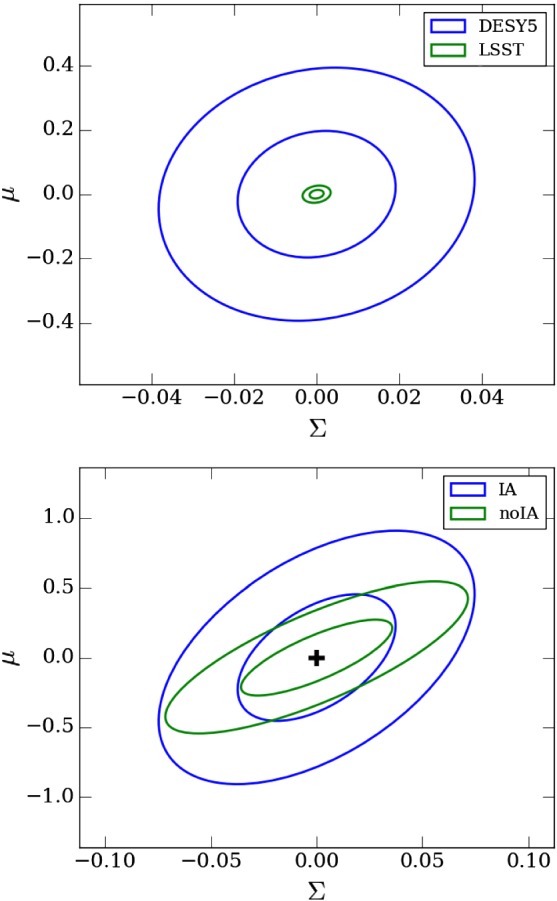
“They found that ignoring the effect of calibration bias or photometric redshift bias does affect significantly the constraints on MG parameters.”
§ Testing general relativity in cosmology > Systematic effects in cosmological probes and degeneracies with modifications to GR
What the sources say
- Disputedcites Ferté et al. (2017) matched to “Testing gravity on cosmological scales with cosmic shear, cosmic microwave background anisotropies, and redshift-space distortions” (2017) sourceExperimental — accuracy not yet measured
The ‘Impact of systematics’ section (p. 4) says the opposite: ignoring shear calibration bias or photometric redshift bias does not significantly affect constraints on the modified-gravity parameters Σ₀ and µ₀. It identifies intrinsic alignment, rather than either bias, as shifting the constraints. (LLM, conf=0.95)
Checked by a reasoning model — may be wrong.
plainstates a cause- Asserted: passes — The authors put it forward as true.
- Checkable: passes — It can be checked against evidence.
- Load-bearing: passes — The paper’s conclusions depend on it.
- Based: passes — The paper gives a reason why it holds.
- Disputed
The cited sources that could be checked couldn’t confirm or dispute this claim.
In the paper
“These seed fluctuations would have originated from microscopic quantum fluctuations that have been blown up to macroscopic scales by cosmic inflation (Guth 1981; Bardeen et al. 1983; Albrecht and Steinhardt 1982).”
§ Testing general relativity in cosmology > The standard model of cosmology > The inhomogeneous lumpy universe and the growth of large-scale structure
What the sources say
- Could not verifycites Guth 1981 matched to “Inflationary universe: A possible solution to the horizon and flatness problems” (1981) sourceExperimental — accuracy not yet measured
The passages on exponential expansion and inhomogeneities (indexed as Abstract; page unavailable) discuss inflation and random bubble formation, but do not identify microscopic quantum fluctuations as the origin of seed fluctuations. Searches for quantum fluctuations, density perturbations, and seed fluctuations found no passage making that connection. (LLM, conf=0.75)
- Not checked — no full text of the sourcecites Bardeen et al. 1983 matched to “Spontaneous creation of almost scale-free density perturbations in an inflationary universe” (1983) source
- Not checked — no full text of the sourcecites Albrecht and Steinhardt 1982 matched to “Cosmology for Grand Unified Theories with Radiatively Induced Symmetry Breaking” (1982) source
hedgedstates a cause- Asserted: passes — The authors put it forward as true.
- Checkable: passes — It can be checked against evidence.
- Load-bearing: unclear — It is unclear whether the paper’s conclusions depend on it.
- Based: passes — The paper gives a reason why it holds.
- Could not verify
Every source the paper cites for this claim was checked and supports it.
In the paper
“it has established very stringent constraints at the level of the solar system that any gravity theory must pass.”
§ Testing general relativity in cosmology > Introduction
What the sources say
- Supportedcites Will 2014 matched to “The Confrontation between General Relativity and Experiment” (2014) source
In “Tests of the strong equivalence principle” (page unavailable), the review describes solar-system experiments that test effects expected in many metric theories of gravity. It also calls the solar-system Cassini bound on a scalar-tensor parameter “very tight” and notes that alternative theories seek to preserve GR’s solar-system phenomenology. Together, these support the claim that gravity theories face stringent solar-system constraints. (LLM, conf=0.90)
boostedstates a cause- Asserted: passes — The authors put it forward as true.
- Checkable: passes — It can be checked against evidence.
- Load-bearing: passes — The paper’s conclusions depend on it.
- Based: passes — The paper gives a reason why it holds.
- Supported
The cited sources that could be checked couldn’t confirm or dispute this claim.
In the paper
“The standard picture of structure formation in the universe is that structures have grown by gravitational infall and clustering from primordial small fluctuations in the matter density field.”
§ Testing general relativity in cosmology > The standard model of cosmology > The inhomogeneous lumpy universe and the growth of large-scale structure
What the sources say
- Could not verifycites Guth 1981 matched to “Inflationary universe: A possible solution to the horizon and flatness problems” (1981) sourceExperimental — accuracy not yet measured
The Introduction and Conclusion passages discuss the early universe’s homogeneity, horizon and flatness problems, and possible inhomogeneity from inflationary bubble formation. Searches for gravitational clustering, primordial density fluctuations, and galaxy formation found no passage in our copy describing the claimed mechanism of structure formation. (LLM, conf=0.73)
- Not checked — no full text of the sourcecites Bardeen et al. 1983 matched to “Spontaneous creation of almost scale-free density perturbations in an inflationary universe” (1983) source
- Not checked — no full text of the sourcecites Albrecht and Steinhardt 1982 matched to “Cosmology for Grand Unified Theories with Radiatively Induced Symmetry Breaking” (1982) source
plainstates a cause- Asserted: passes — The authors put it forward as true.
- Checkable: passes — It can be checked against evidence.
- Load-bearing: unclear — It is unclear whether the paper’s conclusions depend on it.
- Based: passes — The paper gives a reason why it holds.
- Could not verify
219 more claims · 33 with their cited sources checked
Create a free account to see all 525 claims and to verify the 294 references still open.
- It may state two separate claims as one. 223
- Probably not a substantial claim. 125
- The quote only partly states this claim. 15
Citations
Cites
A new look at the statistical model identification
Akaike, H. (1974) · IEEE Transactions on Automatic Control · doi:10.1109/tac.1974.1100705 · Cited by 51,879 · cited 1×
“They use the Akaike information criterion (AIC) (Akaike 1974) to compare the two models αB 0 = 0 versus αB 0 = 0.”
MethodEquation of State Calculations by Fast Computing Machines
Metropolis, N., Rosenbluth, A. W., Rosenbluth, M. N., Teller, A. H., & Teller, E. (1953) · The Journal of Chemical Physics · doi:10.1063/1.1699114 · Cited by 37,192
Observational Evidence from Supernovae for an Accelerating Universe and a Cosmological Constant
Riess, A. G., Filippenko, A. V., Challis, P., Clocchiatti, A., Diercks, A., Garnavich, P. M., Gilliland, R. L., Hogan, C. J., Jha, S., Kirshner, R. P., et al. (1998) · The Astronomical Journal · doi:10.1086/300499 · Cited by 19,704
Measurements of Ω and Λ from 42 High‐Redshift Supernovae
Perlmutter, S., Aldering, G., Goldhaber, G., Knop, R. A., Nugent, P., Castro, P. G., Deustua, S., Fabbro, S., Goobar, A., Groom, D. E., et al. (1999) · The Astrophysical Journal · doi:10.1086/307221 · Cited by 18,062
Observation of Gravitational Waves from a Binary Black Hole Merger
Abbott, B. P., Abbott, R., Abbott, T. D., Abernathy, M. R., Acernese, F., Ackley, K., Adams, C., Adams, T., Addesso, P., Adhikari, R. X., et al. (2016) · Physical Review Letters · doi:10.1103/physrevlett.116.061102 · Cited by 14,151
Spergel, D. N., Verde, L., Peiris, H. V., Komatsu, E., Nolta, M. R., Bennett, C. L., Halpern, M., Hinshaw, G., Jarosik, N., Kogut, A., et al. (2003) · The Astrophysical Journal Supplement Series · doi:10.1086/377226 · Cited by 10,976
Planck 2015 results. XIII. Cosmological parameters
Planck Collaboration, Ade, P. A. R., Aghanim, N., Arnaud, M., Ashdown, M., Aumont, J., Baccigalupi, C., Banday, A. J., Barreiro, R. B., Bartlett, J. G., et al. (2015) · arXiv · doi:10.48550/arxiv.1502.01589 · Cited by 10,720
Planck 2015 results: XIII. Cosmological parameters
Planck Collaboration, Ade, P. A. R., Aghanim, N., Arnaud, M., Ashdown, M., Aumont, J., Baccigalupi, C., Banday, A. J., Barreiro, R. B., Bartlett, J. G., et al. (2016) · Astronomy & Astrophysics · doi:10.1051/0004-6361/201525830 · Cited by 10,583
Inflationary universe: A possible solution to the horizon and flatness problems
Guth, A. H. (1981) · Physical Review D · doi:10.1103/physrevd.23.347 · Cited by 9,983
GW170817: Observation of Gravitational Waves from a Binary Neutron Star Inspiral
Abbott, B. P., Abbott, R., Abbott, T. D., Acernese, F., Ackley, K., Adams, C., Adams, T., Addesso, P., Adhikari, R. X., Adya, V. B., et al. (2017) · Physical Review Letters · doi:10.1103/physrevlett.119.161101 · Cited by 9,473
Large Mass Hierarchy from a Small Extra Dimension
Randall, L., & Sundrum, R. (1999) · Physical Review Letters · doi:10.1103/physrevlett.83.3370 · Cited by 9,227
SEVEN-YEAR WILKINSON MICROWAVE ANISOTROPY PROBE(WMAP) OBSERVATIONS: COSMOLOGICAL INTERPRETATION
Komatsu, E., Smith, K. M., Dunkley, J., Bennett, C. L., Gold, B., Hinshaw, G., Jarosik, N., Larson, D., Nolta, M. R., Page, L., et al. (2011) · The Astrophysical Journal Supplement Series · doi:10.1088/0067-0049/192/2/18 · Cited by 8,802 · cited 2×
“(2012), as well as CMB temperature (TT) and polarization (TE) with data from WMAP7 (Komatsu et al. 2011).”
BackgroundMethodQuantum Fields in Curved Space
Birrell, N. D., & Davies, P. C. W. (1982) · doi:10.1017/cbo9780511622632 · Cited by 8,354
THE WIDE-FIELD INFRARED SURVEY EXPLORER (WISE): MISSION DESCRIPTION AND INITIAL ON-ORBIT PERFORMANCE
Wright, E. L., Eisenhardt, P. R. M., Mainzer, A. K., Ressler, M. E., Cutri, R. M., Jarrett, T., Kirkpatrick, J. D., Padgett, D., McMillan, R. S., Skrutskie, M., et al. (2010) · The Astronomical Journal · doi:10.1088/0004-6256/140/6/1868 · Cited by 7,987 · cited 1×
“For ISW, they used CMB temperature maps cross-correlated with foreground galaxies from the Wide-field Infrared Survey Explorer (WISE) survey (Wright et al. 2010).”
MethodThe cosmological constant problem
Weinberg, S. (1989) · Reviews of Modern Physics · doi:10.1103/revmodphys.61.1 · Cited by 7,341 · cited 2×
“Interestingly, this connects the problem of cosmic acceleration to the problems of the cosmological constant/vacuum energy problems (Weinberg, 1989; Carroll et al, 1992; Sahni and Starobinsky, 2000; Carroll, 2001; Peebles and Ratra, 2003; Padmanabhan, 2003; Copeland et al, 2006; Ishak, 2007).”
BackgroundAn Alternative to Compactification
Randall, L., & Sundrum, R. (1999) · Physical Review Letters · doi:10.1103/physrevlett.83.4690 · Cited by 7,217
An Alternative to Compactification
Randall, L., & Sundrum, R. (1999) · arXiv · doi:10.48550/arxiv.hep-th/9906064 · Cited by 7,212
Three‐Year Wilkinson Microwave Anisotropy Probe ( WMAP ) Observations: Implications for Cosmology
Spergel, D. N., Bean, R., Dore, O., Nolta, M. R., Bennett, C. L., Dunkley, J., Hinshaw, G., Jarosik, N., Komatsu, E., Page, L., et al. (2007) · The Astrophysical Journal Supplement Series · doi:10.1086/513700 · Cited by 6,778
The hierarchy problem and new dimensions at a millimeter
Arkani–Hamed, N., Dimopoulos, S., & Dvali, G. (1998) · Physics Letters B · doi:10.1016/s0370-2693(98)00466-3 · Cited by 6,563
Planck 2013 results. XVI. Cosmological parameters
Planck Collaboration, Ade, P. A. R., Aghanim, N., Armitage-Caplan, C., Arnaud, M., Ashdown, M., Atrio-Barandela, F., Aumont, J., Baccigalupi, C., Banday, A. J., et al. (2014) · Astronomy & Astrophysics · doi:10.1051/0004-6361/201321591 · Cited by 6,521
COPELAND, E. J., SAMI, M., & TSUJIKAWA, S. (2006) · International Journal of Modern Physics D · doi:10.1142/s021827180600942x · Cited by 6,239
Mach's Principle and a Relativistic Theory of Gravitation
Brans, C., & Dicke, R. H. (1961) · Physical Review · doi:10.1103/physrev.124.925 · Cited by 5,621 · cited 2×
“Indeed, just a few years after GR was introduced, Weyl gravity was proposed (Weyl, 1918), and so were the theories of Eddington (Eddington, 1924), Cartan (Cartan, 1922), BransDicke (Brans and Dicke, 1961), and many others.”
BackgroundMethodAde, P. A. R., Aghanim, N., Arnaud, M., Ashdown, M., Aumont, J., Baccigalupi, C., Banday, A. J., Barreiro, R. B., Bartlett, J. G., Bartolo, N., et al. (2016) · Research at the University of Copenhagen (University of Copenhagen) · doi:10.17863/cam.32861 · Cited by 5,315
The cosmological constant and dark energy
Peebles, P. J. E., & Ratra, B. (2003) · Reviews of Modern Physics · doi:10.1103/revmodphys.75.559 · Cited by 5,213
NINE-YEAR WILKINSON MICROWAVE ANISOTROPY PROBE ( WMAP ) OBSERVATIONS: COSMOLOGICAL PARAMETER RESULTS
Hinshaw, G., Larson, D., Komatsu, E., Spergel, D. N., Bennett, C. L., Dunkley, J., Nolta, M. R., Halpern, M., Hill, R. S., Odegard, N., et al. (2013) · The Astrophysical Journal Supplement Series · doi:10.1088/0067-0049/208/2/19 · Cited by 5,121
Cosmology for Grand Unified Theories with Radiatively Induced Symmetry Breaking
Albrecht, A., & Steinhardt, P. J. (1982) · Physical Review Letters · doi:10.1103/physrevlett.48.1220 · Cited by 4,981
Particle dark matter: evidence, candidates and constraints
Bertone, G., Hooper, D., & Silk, J. (2005) · Physics Reports · doi:10.1016/j.physrep.2004.08.031 · Cited by 4,979 · cited 1×
“…lensing observations, and the requirement of deep initial potential wells that would have allowed the formation of the largest structures that we observe today; see for example Trimble (1987); Bertone et al (2005); D’Amico et al (2009); Einasto (2014); Freese (2017) and references therein.”
BackgroundLewis, A., Challinor, A., & Lasenby, A. (2000) · The Astrophysical Journal · doi:10.1086/309179 · Cited by 4,920
Eisenstein, D. J., Zehavi, I., Hogg, D. W., Scoccimarro, R., Blanton, M. R., Nichol, R. C., Scranton, R., Seo, H., Tegmark, M., Zheng, Z., et al. (2005) · The Astrophysical Journal · doi:10.1086/466512 · Cited by 4,629
Sotiriou, T. P., & Faraoni, V. (2010) · Reviews of Modern Physics · doi:10.1103/revmodphys.82.451 · Cited by 4,519
Riess, A. G., Strolger, L., Tonry, J., Casertano, S., Ferguson, H. C., Mobasher, B., Challis, P., Filippenko, A. V., Jha, S., Li, W., et al. (2004) · The Astrophysical Journal · doi:10.1086/383612 · Cited by 4,315
Cosmological consequences of a rolling homogeneous scalar field
Ratra, B., & Peebles, P. J. E. (1988) · Physical Review D · doi:10.1103/physrevd.37.3406 · Cited by 4,310 · cited 2×
“These are for example quintessence models based on a scalar field with kinetic energy and potential terms that can be cast as well into an effective dark energy model with a negative equation of state also close to minus one (Peebles and Ratra, 1988; Ratra and Peebles, 1988; Caldwell et al, 1998).”
BackgroundModified gravity and cosmology
Clifton, T., Ferreira, P. G., Padilla, A., & Skordis, C. (2012) · Physics Reports · doi:10.1016/j.physrep.2012.01.001 · Cited by 4,146
The Confrontation between General Relativity and Experiment
Will, C. M. (2014) · Living Reviews in Relativity · doi:10.12942/lrr-2014-4 · Cited by 3,996
New dimensions at a millimeter to a fermi and superstrings at a TeV
Antoniadis, I., Arkani-Hamed, N., Dimopoulos, S., & Dvali, G. (1998) · Physics Letters B · doi:10.1016/s0370-2693(98)00860-0 · Cited by 3,915
De Felice, A., & Tsujikawa, S. (2010) · Living Reviews in Relativity · doi:10.12942/lrr-2010-3 · Cited by 3,871
Cosmological Imprint of an Energy Component with General Equation of State
Caldwell, R. R., Dave, R., & Steinhardt, P. J. (1998) · Physical Review Letters · doi:10.1103/physrevlett.80.1582 · Cited by 3,694
Theory and Experiment in Gravitational Physics
Will, C. M. (2018) · doi:10.1017/9781316338612 · Cited by 3,637
Gravitational Field of a Spinning Mass as an Example of Algebraically Special Metrics
Kerr, R. P. (1963) · Physical Review Letters · doi:10.1103/physrevlett.11.237 · Cited by 3,551
4D gravity on a brane in 5D Minkowski space
Dvali, G., Gabadadze, G., & Porrati, M. (2000) · Physics Letters B · doi:10.1016/s0370-2693(00)00669-9 · Cited by 3,513 · cited 2×
“After outlining some seminal or major developments on the topic, we present the Dvali–Gabadadze–Porrati (DGP) theory (Dvali et al. 2000) as an illustrative case.”
BackgroundGravitational Waves and Gamma-Rays from a Binary Neutron Star Merger: GW170817 and GRB 170817A
Abbott, B. P., Abbott, R., Abbott, T. D., Acernese, F., Ackley, K., Adams, C., Adams, T., Addesso, P., Adhikari, R. X., Adya, V. B., et al. (2017) · The Astrophysical Journal Letters · doi:10.3847/2041-8213/aa920c · Cited by 3,505
Cosmological parameters from CMB and other data: A Monte Carlo approach
Lewis, A., & Bridle, S. (2002) · Physical Review D · doi:10.1103/physrevd.66.103511 · Cited by 3,495 · cited 3×
“11.1 Integrated Software in Testing General Relativity (ISiTGR) . . . . . . . . . . . . . . 119 11.2 Modification of Growth with CAMB (MGCAMB) and MGCosmoMC . . . . . . . . . . . . . . 122 11.3 Horndeski in CLASS (hi class) . . . . . . . . . . . . . . . . . . . . . . . . . . . . . 122 11.4 Effective Field Theory with…”
BackgroundMethodInfluentialA modification of the Newtonian dynamics as a possible alternative to the hidden mass hypothesis
Milgrom, M. (1983) · The Astrophysical Journal · doi:10.1086/161130 · Cited by 3,316 · cited 2×
“The dark matter problem motivated the introduction of modified gravity (MG) theories that would explain such observations by a small modification to Kepler laws such as Modified Newtonian Dynamics (MOND) (Milgrom, 1983b), its relativistic generalization known as TeVeS (tensor-vector-scalar) theory (Bekenstein, 2004),…”
Final Results from the Hubble Space Telescope Key Project to Measure the Hubble Constant
Freedman, W. L., Madore, B. F., Gibson, B. K., Ferrarese, L., Kelson, D. D., Sakai, S., Mould, J. R., Kennicutt, Jr., Ford, H. C., Graham, J. A., et al. (2001) · The Astrophysical Journal · doi:10.1086/320638 · Cited by 3,298
The statistics of peaks of Gaussian random fields
Bardeen, J. M., Bond, J. R., Kaiser, N., & Szalay, A. S. (1986) · The Astrophysical Journal · doi:10.1086/164143 · Cited by 3,270
The Large-Scale Structure of the Universe
(2007) · Astronomy and Astrophysics Library · doi:10.1007/978-3-540-73478-9_2 · Cited by 3,219
Static Solutions of Einstein's Field Equations for Spheres of Fluid
Tolman, R. C. (1939) · Physical Review · doi:10.1103/physrev.55.364 · Cited by 3,206
Cosmological constant—the weight of the vacuum
Padmanabhan, T. (2003) · Physics Reports · doi:10.1016/s0370-1573(03)00120-0 · Cited by 3,195
Gravitation and Cosmology: Principles and Applications of the General Theory of Relativity
Weinberg, S., & Dicke, R. H. (1973) · American Journal of Physics · doi:10.1119/1.1987308 · Cited by 3,103
Alam, S., Ata, M., Bailey, S., Beutler, F., Bizyaev, D., Blazek, J. A., Bolton, A. S., Brownstein, J. R., Burden, A., Chuang, C.-H., et al. (2017) · Monthly Notices of the Royal Astronomical Society · doi:10.1093/mnras/stx721 · Cited by 3,056
Gravitation and Cosmology: Principles and Applications of the General Theory of Relativity
Weinberg, S., & Wagoner, R. V. (1973) · Physics Today · doi:10.1063/1.3128097 · Cited by 3,031
The Einstein Tensor and Its Generalizations
Lovelock, D. (1971) · Journal of Mathematical Physics · doi:10.1063/1.1665613 · Cited by 2,945 · cited 1×
“A variation of such an action with respect to the metric gives the Einstein equations in a higher dimension plus a Lovelock tensor term (Lovelock, 1971; Lanczos, 1938).”
BackgroundQuantentheorie und f�nfdimensionale Relativit�tstheorie
Klein, O. (1926) · Zeitschrift f�r Physik · doi:10.1007/bf01397481 · Cited by 2,775
THE CASE FOR A POSITIVE COSMOLOGICAL Λ-TERM
SAHNI, V., & STAROBINSKY, A. (2000) · International Journal of Modern Physics D · doi:10.1142/s0218271800000542 · Cited by 2,767
Clustering in real space and in redshift space
Kaiser, N. (1987) · Monthly Notices of the Royal Astronomical Society · doi:10.1093/mnras/227.1.1 · Cited by 2,750
Second-order scalar-tensor field equations in a four-dimensional space
Horndeski, G. W. (1974) · International Journal of Theoretical Physics · doi:10.1007/bf01807638 · Cited by 2,734
Cosmology and the fate of dilatation symmetry
Wetterich, C. (1988) · Nuclear Physics B · doi:10.1016/0550-3213(88)90193-9 · Cited by 2,689
Quantum gravity at a Lifshitz point
Hořava, P. (2009) · Physical Review D · doi:10.1103/physrevd.79.084008 · Cited by 2,666
Carroll, S. M. (2001) · Living Reviews in Relativity · doi:10.12942/lrr-2001-1 · Cited by 2,650 · cited 1×
“Interestingly, this connects the problem of cosmic acceleration to the problems of the cosmological constant/vacuum energy problems (Weinberg 1989; Carroll et al. 1992; Sahni and Starobinsky 2000; Carroll 2001; Peebles and Ratra 2003; Padmanabhan 2003; Copeland et al. 2006; Ishak 2007).”
BackgroundNine-Year Wilkinson Microwave Anisotropy Probe (WMAP) Observations: Cosmological Parameter Results
WRIGHT, E. L. (2016) · NASA STI Repository (National Aeronautics and Space Administration) · doi:10.15781/t2st7f05x · Cited by 2,601
Beutler, F., Blake, C., Colless, M., Jones, D. H., Staveley-Smith, L., Campbell, L., Parker, Q., Saunders, W., & Watson, F. (2011) · Monthly Notices of the Royal Astronomical Society · doi:10.1111/j.1365-2966.2011.19250.x · Cited by 2,590
Eisenstein, D. J., Zehavi, I., Hogg, D. W., Scoccimarro, R., Blanton, M. R., Nichol, R. C., Scranton, R., Seo, H., Tegmark, M., Zheng, Z., et al. (2005) · Cited by 2,568
Renormalization of higher-derivative quantum gravity
Stelle, K. S. (1977) · Physical Review D · doi:10.1103/physrevd.16.953 · Cited by 2,563
Exploring the Expansion History of the Universe
Linder, E. V. (2003) · Physical Review Letters · doi:10.1103/physrevlett.90.091301 · Cited by 2,526
ACCELERATING UNIVERSES WITH SCALING DARK MATTER
CHEVALLIER, M., & POLARSKI, D. (2001) · International Journal of Modern Physics D · doi:10.1142/s0218271801000822 · Cited by 2,490
Astier, P., Guy, J., Regnault, N., Pain, R., Aubourg, E., Balam, D., Basa, S., Carlberg, R. G., Fabbro, S., Fouchez, D., et al. (2006) · Astronomy & Astrophysics · doi:10.1051/0004-6361:20054185 · Cited by 2,434
New dimensions at a millimeter to a Fermi and superstrings at A TeV
Ignatios Antoniadis, A., Nima Arkani-hamed, A., Dimopoulos, S., Dvali, G., & The Abdus Salam International Centre for Theoretical Physics, T. (. (1998) · OpenGrey (Institut de l'Information Scientifique et Technique) · Cited by 2,422
Bartelmann, M., & Schneider, P. (2001) · Physics Reports · doi:10.1016/s0370-1573(00)00082-x · Cited by 2,420
Arkani-Hamed, N., Dimopoulos, S., & Dvali, G. (1999) · Physical Review D · doi:10.1103/physrevd.59.086004 · Cited by 2,394
Gauge-invariant cosmological perturbations
Bardeen, J. M. (1980) · Physical Review D · doi:10.1103/physrevd.22.1882 · Cited by 2,393
The Cosmic Linear Anisotropy Solving System (CLASS). Part II: Approximation schemes
Blas, D., Lesgourgues, J., & Tram, T. (2011) · Journal of Cosmology and Astroparticle Physics · doi:10.1088/1475-7516/2011/07/034 · Cited by 2,305
Is cosmic speed-up due to new gravitational physics?
Carroll, S. M., Duvvuri, V., Trodden, M., & Turner, M. S. (2004) · Physical Review D · doi:10.1103/physrevd.70.043528 · Cited by 2,269
A 2.4% DETERMINATION OF THE LOCAL VALUE OF THE HUBBLE CONSTANT*
Riess, A. G., Macri, L. M., Hoffmann, S. L., Scolnic, D., Casertano, S., Filippenko, A. V., Tucker, B. E., Reid, M. J., Jones, D. O., Silverman, J. M., et al. (2016) · The Astrophysical Journal · doi:10.3847/0004-637x/826/1/56 · Cited by 2,242
Baryonic Features in the Matter Transfer Function
Eisenstein, D. J., & Hu, W. (1998) · The Astrophysical Journal · doi:10.1086/305424 · Cited by 2,239
Exact Solutions of Einstein's Field Equations
Stephani, H., Kramer, D., MacCallum, M., Hoenselaers, C., & Herlt, E. (2003) · doi:10.1017/cbo9780511535185 · Cited by 2,184
Nojiri, S., & Odintsov, S. D. (2003) · Physical Review D · doi:10.1103/physrevd.68.123512 · Cited by 2,183
Cosmological Constant - the Weight of the Vacuum
Padmanabhan, Τ. (2002) · CERN Document Server (European Organization for Nuclear Research) · Cited by 2,145
On relativistic wave equations for particles of arbitrary spin in an electromagnetic field
Fierz, M., & Pauli, W. E. (1939) · Proceedings of the Royal Society of London. Series A. Mathematical and Physical Sciences · doi:10.1098/rspa.1939.0140 · Cited by 2,114 · cited 2×
“They derived and added a (PF)-term at linear order to the Einstein–Hilbert action that generates the massive graviton as follows (Fierz and Pauli 1939)”
BackgroundThe absolute magnitudes of Type IA supernovae
Phillips, M. M. (1993) · The Astrophysical Journal · doi:10.1086/186970 · Cited by 2,111
Cole, S., Percival, W. J., Peacock, J. A., Norberg, P., Baugh, C. M., Frenk, C. S., Baldry, I., Bland-Hawthorn, J., Bridges, T., Cannon, R., et al. (2005) · Monthly Notices of the Royal Astronomical Society · doi:10.1111/j.1365-2966.2005.09318.x · Cited by 2,094
Spontaneous creation of almost scale-free density perturbations in an inflationary universe
Bardeen, J. M., Steinhardt, P. J., & Turner, M. S. (1983) · Physical Review D · doi:10.1103/physrevd.28.679 · Cited by 2,073
Stable clustering, the halo model and non-linear cosmological power spectra
Smith, R. E., Peacock, J. A., Jenkins, A., White, S. D. M., Frenk, C. S., Pearce, F. R., Thomas, P. A., Efstathiou, G., & Couchman, H. M. P. (2003) · Monthly Notices of the Royal Astronomical Society · doi:10.1046/j.1365-8711.2003.06503.x · Cited by 2,054 · cited 1×
“As mentioned above, a second common practice used for f (R) models is to parameterize them using the dimensionless Compton wavelength (of the scalaron) in Hubble units given by Song et al. (2007a) and Hu and Sawicki (2007a)”
MethodTHE BARYON OSCILLATION SPECTROSCOPIC SURVEY OF SDSS-III
Dawson, K. S., Schlegel, D. J., Ahn, C. P., Anderson, S. F., Aubourg, É., Bailey, S., Barkhouser, R. H., Bautista, J. E., Beifiori, A., Berlind, A. A., et al. (2013) · The Astronomical Journal · doi:10.1088/0004-6256/145/1/10 · Cited by 2,051
4D Gravity on a Brane in 5D Minkowski Space
Dvali, G., Gabadadze, G., & Porrati, M. (2000) · CERN Document Server (European Organization for Nuclear Research) · Cited by 2,047
Cosmological Perturbation Theory in the Synchronous and Conformal Newtonian Gauges
Ma, C.-P., & Bertschinger, E. (1995) · The Astrophysical Journal · doi:10.1086/176550 · Cited by 2,040 · cited 2×
“…of the energy-momentum in the perturbed matter fluid, these quantities for uncoupled fluid species or the mass-averaged quantities for all the fluids evolve as, e.g. Ma and Bertschinger (1995): δ′ = −kq + 3(1 + w)Φ′ + 3H(w − δP δρ )δ (34) q′ k = −H(1− 3w) q k + δP δρ δ + (1 + w) (Ψ− σ) .”
A test of general relativity using radio links with the Cassini spacecraft
Bertotti, B., Iess, L., & Tortora, P. (2003) · Nature · doi:10.1038/nature01997 · Cited by 2,017 · cited 4×
“The most stringent constraint on Brans–Dicke (BD) theory comes from solar system tests where the Cassini mission put the bound ωBD > 40, 000 (Bertotti et al. 2003; Will 2014).”
BackgroundInfluentialDynamical Solution to the Problem of a Small Cosmological Constant and Late-Time Cosmic Acceleration
Armendariz-Picon, C., Mukhanov, V., & Steinhardt, P. J. (2000) · Physical Review Letters · doi:10.1103/physrevlett.85.4438 · Cited by 1,974
Bias and variance of angular correlation functions
Landy, S. D., & Szalay, A. S. (1993) · The Astrophysical Journal · doi:10.1086/172900 · Cited by 1,953
Improved cosmological constraints from a joint analysis of the SDSS-II and SNLS supernova samples
Betoule, M., Kessler, R., Guy, J., Mosher, J., Hardin, D., Biswas, R., Astier, P., El-Hage, P., Konig, M., Kuhlmann, S., et al. (2014) · Astronomy & Astrophysics · doi:10.1051/0004-6361/201423413 · Cited by 1,905
Galileon as a local modification of gravity
Nicolis, A., Rattazzi, R., & Trincherini, E. (2009) · Physical Review D · doi:10.1103/physrevd.79.064036 · Cited by 1,863 · cited 3×
“Galileonmodels can also result from conformal invariance (Nicolis et al. 2009; Creminelli et al. 2013) or from”
BackgroundArmendáriz-Picón, C., Damour, T., & Mukhanov, V. (1999) · Physics Letters B · doi:10.1016/s0370-2693(99)00603-6 · Cited by 1,846
Anderson, L., Aubourg, É., Bailey, S., Beutler, F., Bhardwaj, V., Blanton, M., Bolton, A. S., Brinkmann, J., Brownstein, J. R., Burden, A., et al. (2014) · Monthly Notices of the Royal Astronomical Society · doi:10.1093/mnras/stu523 · Cited by 1,842
Armendariz-Picon, C., Mukhanov, V., & Steinhardt, P. J. (2001) · Physical Review D · doi:10.1103/physrevd.63.103510 · Cited by 1,840
Dirichlet Branes and Ramond-Ramond Charges
Polchinski, J. (1995) · Physical Review Letters · doi:10.1103/physrevlett.75.4724 · Cited by 1,827
Perturbations of a Cosmological Model and Angular Variations of the Microwave Background
Sachs, R. K., & Wolfe, A. M. (1967) · The Astrophysical Journal · doi:10.1086/148982 · Cited by 1,815
Resummation of Massive Gravity
de Rham, C., Gabadadze, G., & Tolley, A. J. (2011) · Physical Review Letters · doi:10.1103/physrevlett.106.231101 · Cited by 1,802 · cited 3×
“Using various distance measurements, Alcaniz (2002); Jain et al (2002); Deffayet et al (2002b); Fairbairn and Goobar (2006) found that the characteristic scale does verify rc ∼ H−1 0 .”
BackgroundMethodTests of General Relativity with GW150914
Abbott, B. P., Abbott, R., Abbott, T. D., Abernathy, M. R., Acernese, F., Ackley, K., Adams, C., Adams, T., Addesso, P., Adhikari, R. X., et al. (2016) · Physical Review Letters · doi:10.1103/physrevlett.116.221101 · Cited by 1,773
The clustering of the SDSS DR7 main Galaxy sample – I. A 4 per cent distance measure at z=0.15
Ross, A. J., Samushia, L., Howlett, C., Percival, W. J., Burden, A., & Manera, M. (2015) · Monthly Notices of the Royal Astronomical Society · doi:10.1093/mnras/stv154 · Cited by 1,745 · cited 1×
“15 (Eisenstein et al. 2005; Ross et al. 2015), the 2-degree-Field Galaxy Survey (2dFGRS) at zeff = 0.”
BackgroundPlanck 2013 results. I. Overview of products and scientific results
Planck Collaboration, Ade, P. A. R., Aghanim, N., Alves, M. I. R., Armitage-Caplan, C., Arnaud, M., Ashdown, M., Atrio-Barandela, F., Aumont, J., Aussel, H., et al. (2014) · Astronomy & Astrophysics · doi:10.1051/0004-6361/201321529 · Cited by 1,738
Models off(R)cosmic acceleration that evade solar system tests
Hu, W., & Sawicki, I. (2007) · Physical Review D · doi:10.1103/physrevd.76.064004 · Cited by 1,736
Cosmology with a time-variable cosmological 'constant'
Peebles, P. J. E., & Ratra, B. (1988) · The Astrophysical Journal · doi:10.1086/185100 · Cited by 1,720
To the problem of nonvanishing gravitation mass
Vainshtein, A. I. (1972) · Physics Letters B · doi:10.1016/0370-2693(72)90147-5 · Cited by 1,707
Suzuki, N., Rubin, D., Lidman, C., Aldering, G., Amanullah, R., Barbary, K., Barrientos, L. F., Botyanszki, J., Brodwin, M., Connolly, N., et al. (2012) · The Astrophysical Journal · doi:10.1088/0004-637x/746/1/85 · Cited by 1,699
A 2.4% Determination of the Local Value of the Hubble Constant
Riess, A. G., Macri, L. M., Hoffmann, S., et al. (2016) · OakTrust (Texas A&M University Libraries) · doi:10.48550/arxiv.1604.01424 · Cited by 1,691
Cosmological Perturbation Theory
Kodama, H., & Sasaki, M. (1984) · Progress of Theoretical Physics Supplement · doi:10.1143/ptps.78.1 · Cited by 1,671
Lorentz Invariance and the Gravitational Field
Kibble, T. W. B. (1961) · Journal of Mathematical Physics · doi:10.1063/1.1703702 · Cited by 1,655
Chameleon Fields: Awaiting Surprises for Tests of Gravity in Space
Khoury, J., & Weltman, A. (2004) · Physical Review Letters · doi:10.1103/physrevlett.93.171104 · Cited by 1,648
Dynamical Theory of Groups and Fields
DeWitt, B. S., & Mullin, A. A. (1966) · American Journal of Physics · doi:10.1119/1.1953053 · Cited by 1,634
Khoury, J., & Weltman, A. (2004) · Physical Review D · doi:10.1103/physrevd.69.044026 · Cited by 1,634
Goldstein, A., Veres, P., Burns, E., Briggs, M. S., Hamburg, R., Kocevski, D., Wilson-Hodge, C. A., Preece, R. D., Poolakkil, S., Roberts, O. J., et al. (2017) · The Astrophysical Journal Letters · doi:10.3847/2041-8213/aa8f41 · Cited by 1,632
Eleven-dimensional supergravity on a manifold with boundary
Hořava, P., & Witten, E. (1996) · Nuclear Physics B · doi:10.1016/0550-3213(96)00308-2 · Cited by 1,626
Carroll, S. M., Press, W. H., & Turner, E. L. (1992) · Annual Review of Astronomy and Astrophysics · doi:10.1146/annurev.aa.30.090192.002435 · Cited by 1,542
Improved Cosmological Constraints from New, Old, and Combined Supernova Data Sets
Kowalski, M., Rubin, D., Aldering, G., Agostinho, R. J., Amadon, A., Amanullah, R., Balland, C., Barbary, K., Blanc, G., Challis, P. J., et al. (2008) · The Astrophysical Journal · doi:10.1086/589937 · Cited by 1,540
Relativistic gravitation theory for the modified Newtonian dynamics paradigm
Bekenstein, J. D. (2004) · Physical Review D · doi:10.1103/physrevd.70.083509 · Cited by 1,487 · cited 1×
“…modified gravity (MG) theories that would explain such observations by a small modification to Kepler laws such as Modified Newtonian Dynamics (MOND) (Milgrom, 1983b), its relativistic generalization known as TeVeS (tensor-vector-scalar) theory (Bekenstein, 2004), or other vector-tensor theories.”
The Sixth Data Release of the Sloan Digital Sky Survey
Adelman‐McCarthy, J. K., Agüeros, M. A., Allam, S. S., Allende Prieto, C., Anderson, K. S. J., Anderson, S. F., Annis, J., Bahcall, N. A., Bailer‐Jones, C. A. L., Baldry, I. K., et al. (2008) · The Astrophysical Journal Supplement Series · doi:10.1086/524984 · Cited by 1,486
Testing general relativity with present and future astrophysical observations
Berti, E., Barausse, E., Cardoso, V., Gualtieri, L., Pani, P., Sperhake, U., Stein, L. C., Wex, N., Yagi, K., Baker, T., et al. (2015) · Classical and Quantum Gravity · doi:10.1088/0264-9381/32/24/243001 · Cited by 1,477
Riess, A. G., Macri, L., Casertano, S., Lampeitl, H., Ferguson, H. C., Filippenko, A. V., Jha, S. W., Li, W., & Chornock, R. (2011) · The Astrophysical Journal · doi:10.1088/0004-637x/730/2/119 · Cited by 1,473
Friedman, A. (1922) · Zeitschrift f�r Physik · doi:10.1007/bf01332580 · Cited by 1,465
Modulus Stabilization with Bulk Fields
Goldberger, W. D., & Wise, M. B. (1999) · Physical Review Letters · doi:10.1103/physrevlett.83.4922 · Cited by 1,436
Cosmological constraints from the SDSS luminous red galaxies
Tegmark, M., Eisenstein, D. J., Strauss, M. A., Weinberg, D. H., Blanton, M. R., Frieman, J. A., Fukugita, M., Gunn, J. E., Hamilton, A. J. S., Knapp, G. R., et al. (2006) · Physical Review D · doi:10.1103/physrevd.74.123507 · Cited by 1,400
Neutron star observations: Prognosis for equation of state constraints
LATTIMER, J., & PRAKASH, M. (2007) · Physics Reports · doi:10.1016/j.physrep.2007.02.003 · Cited by 1,399
Observational probes of cosmic acceleration
Weinberg, D. H., Mortonson, M. J., Eisenstein, D. J., Hirata, C., Riess, A. G., & Rozo, E. (2013) · Physics Reports · doi:10.1016/j.physrep.2013.05.001 · Cited by 1,397
Classical gravity with higher derivatives
Stelle, K. S. (1978) · General Relativity and Gravitation · doi:10.1007/bf00760427 · Cited by 1,379
Do we live inside a domain wall?
Rubakov, V. A., & Shaposhnikov, M. E. (1983) · Physics Letters B · doi:10.1016/0370-2693(83)91253-4 · Cited by 1,377
Raychaudhuri, A. (1955) · Physical Review · doi:10.1103/physrev.98.1123 · Cited by 1,335
Disappearing cosmological constant in f(R) gravity
Starobinsky, A. A. (2007) · JETP Letters · doi:10.1134/s0021364007150027 · Cited by 1,329
Massive and mass-less Yang-Mills and gravitational fields
van Dam, H., & Veltman, M. (1970) · Nuclear Physics B · doi:10.1016/0550-3213(70)90416-5 · Cited by 1,288
The Logic of Inductive Inference
Fisher, R. A. (1935) · Journal of the Royal Statistical Society · doi:10.2307/2342435 · Cited by 1,265
Generalized G-Inflation: --Inflation with the Most General Second-Order Field Equations--
Kobayashi, T., Yamaguchi, M., & Yokoyama, J. (2011) · Progress of Theoretical Physics · doi:10.1143/ptp.126.511 · Cited by 1,248
The string dilation and a least coupling principle
Damour, T., & Polyakov, A. M. (1994) · Nuclear Physics B · doi:10.1016/0550-3213(94)90143-0 · Cited by 1,233
Beyond the cosmological standard model
Joyce, A., Jain, B., Khoury, J., & Trodden, M. (2015) · Physics Reports · doi:10.1016/j.physrep.2014.12.002 · Cited by 1,231
Primeval Adiabatic Perturbation in an Expanding Universe
Peebles, P. J. E., & Yu, J. T. (1970) · The Astrophysical Journal · doi:10.1086/150713 · Cited by 1,230
Can Gravitation Have a Finite Range?
Boulware, D. G., & Deser, S. (1972) · Physical Review D · doi:10.1103/physrevd.6.3368 · Cited by 1,225
Dark Energy Survey year 1 results: Cosmological constraints from galaxy clustering and weak lensing
Abbott, T. M. C., Abdalla, F. B., Alarcon, A., Aleksić, J., Allam, S., Allen, S., Amara, A., Annis, J., Asorey, J., Avila, S., et al. (2018) · Physical Review D · doi:10.1103/physrevd.98.043526 · Cited by 1,213
(2003) · Cited by 1,199
The Baryon Oscillation Spectroscopic Survey of SDSS-III
Verde, L., Miralda Escudé, J., Cuesta, A. J., & Pérez-Ràfols, I. (2012) · Dipòsit Digital de la Universitat de Barcelona (Universitat de Barcelona) · Cited by 1,197
Moresco, M., Pozzetti, L., Cimatti, A., Jimenez, R., Maraston, C., Verde, L., Thomas, D., Citro, A., Tojeiro, R., & Wilkinson, D. (2016) · Journal of Cosmology and Astroparticle Physics · doi:10.1088/1475-7516/2016/05/014 · Cited by 1,182
The effective field theory of inflation
Cheung, C., Fitzpatrick, A. L., Kaplan, J., Senatore, L., & Creminelli, P. (2008) · Journal of High Energy Physics · doi:10.1088/1126-6708/2008/03/014 · Cited by 1,175
Mémoires sur les équations différentielles, relatives au problème des isopérimètres
Ostrogradsky, M. (1850) · Cited by 1,174
The DESI Experiment Part I: Science,Targeting, and Survey Design
DESI Collaboration, Aghamousa, A., Aguilar, J., Ahlen, S. P., Alam, S., Allen, L. E., Prieto, C. A., Annis, J. T., Bailey, S., Balland, C., et al. (2016) · arXiv (Cornell University) · doi:10.48550/arxiv.1611.00036 · Cited by 1,148
Generalization of the Fierz-Pauli action
de Rham, C., & Gabadadze, G. (2010) · Physical Review D · doi:10.1103/physrevd.82.044020 · Cited by 1,134
de Rham, C. (2014) · Living Reviews in Relativity · doi:10.12942/lrr-2014-7 · Cited by 1,120
From k -essence to generalized Galileons
Deffayet, C., Gao, X., Steer, D. A., & Zahariade, G. (2011) · Physical Review D · doi:10.1103/physrevd.84.064039 · Cited by 1,105
An evolution free test for non-zero cosmological constant
Alcock, C., & Paczyński, B. (1979) · Nature · doi:10.1038/281358a0 · Cited by 1,100
Weak gravitational lensing of the CMB
LEWIS, A., & CHALLINOR, A. (2006) · Physics Reports · doi:10.1016/j.physrep.2006.03.002 · Cited by 1,087
Effect of Inhomogeneity on Cosmological Models
Tolman, R. C. (1934) · Proceedings of the National Academy of Sciences · doi:10.1073/pnas.20.3.169 · Cited by 1,078
Accelerating Universes with Scaling Dark Matter
Chevallier, M., & Polarski, D. (2001) · HAL (Le Centre pour la Communication Scientifique Directe) · Cited by 1,075
A modification of the Newtonian dynamics - Implications for galaxies
Milgrom, M. (1983) · The Astrophysical Journal · doi:10.1086/161131 · Cited by 1,069
Deffayet, C., Esposito-Farèse, G., & Vikman, A. (2009) · Physical Review D · doi:10.1103/physrevd.79.084003 · Cited by 1,066
Non-conventional cosmology from a brane universe
Binétruy, P., Deffayet, C., & Langlois, D. (2000) · Nuclear Physics B · doi:10.1016/s0550-3213(99)00696-3 · Cited by 1,036
KiDS-450: cosmological parameter constraints from tomographic weak gravitational lensing
Hildebrandt, H., Viola, M., Heymans, C., Joudaki, S., Kuijken, K., Blake, C., Erben, T., Joachimi, B., Klaes, D., Miller, L., et al. (2017) · Monthly Notices of the Royal Astronomical Society · doi:10.1093/mnras/stw2805 · Cited by 1,021
Planck 2015 results: I. Overview of products and scientific results
Planck Collaboration, Adam, R., Ade, P. A. R., Aghanim, N., Akrami, Y., Alves, M. I. R., Argüeso, F., Arnaud, M., Arroja, F., Ashdown, M., et al. (2016) · Astronomy & Astrophysics · doi:10.1051/0004-6361/201527101 · Cited by 1,014
Cosmology and fundamental physics with the Euclid satellite
The Euclid Theory Working Group, Amendola, L., Appleby, S., Avgoustidis, A., Bacon, D., Baker, T., Baldi, M., Bartolo, N., Blanchard, A., Bonvin, C., et al. (2018) · Living Reviews in Relativity · doi:10.1007/s41114-017-0010-3 · Cited by 1,009
Blake, C., Kazin, E. A., Beutler, F., Davis, T. M., Parkinson, D., Brough, S., Colless, M., Contreras, C., Couch, W., Croom, S., et al. (2011) · Monthly Notices of the Royal Astronomical Society · doi:10.1111/j.1365-2966.2011.19592.x · Cited by 1,003
Accelerated universe from gravity leaking to extra dimensions
Deffayet, C., Dvali, G., & Gabadadze, G. (2002) · Physical Review D · doi:10.1103/physrevd.65.044023 · Cited by 1,002
Ghost Condensation and a Consistent IR Modification of Gravity
Hamed, N. A., Cheng, H. S., Luty, M. A., & Mukohyama, S. (2004) · Journal of High Energy Physics · doi:10.1088/1126-6708/2004/05/074 · Cited by 996 · cited 3×
“The theory has interesting features such as attractive or repulsive gravity and has been used for problems in inflation, dark matter and cosmic acceleration (Hamed et al. 2004).”
BackgroundMethodInfluentialThe quartic effective action for the heterotic string
Gross, D. J., & Sloan, J. H. (1987) · Nuclear Physics B · doi:10.1016/0550-3213(87)90465-2 · Cited by 991
Karhunen‐Loeve Eigenvalue Problems in Cosmology: How Should We Tackle Large Data Sets?
Tegmark, M., Taylor, A. N., & Heavens, A. F. (1997) · The Astrophysical Journal · doi:10.1086/303939 · Cited by 979
Wide-Field InfrarRed Survey Telescope-Astrophysics Focused Telescope Assets WFIRST-AFTA 2015 Report
Spergel, D. N., Gehrels, N. A., Baltay, C., Bennett, D. P., Breckinridge, J. B., Donahue, M. E., Dressler, A. M., Gaudi, B. S., Greene, T. P., Guyon, O., et al. (2015) · arXiv (Cornell University) · doi:10.48550/arxiv.1503.03757 · Cited by 957
Dark Energy After GW170817: Dead Ends and the Road Ahead
Ezquiaga, J. M., & Zumalacárregui, M. (2017) · Physical Review Letters · doi:10.1103/physrevlett.119.251304 · Cited by 947
Gravity with a dynamical preferred frame
Jacobson, T., & Mattingly, D. (2001) · Physical Review D · doi:10.1103/physrevd.64.024028 · Cited by 944
Nojiri, S., & Odintsov, S. D. (2006) · Physical Review D · doi:10.1103/physrevd.74.086005 · Cited by 940
The Scalar-Tensor Theory of Gravitation
Fujii, Y., & Maeda, K.-I. (2003) · Cambridge University Press eBooks · doi:10.1017/cbo9780511535093 · Cited by 939
Wang, L., & Steinhardt, P. J. (1998) · The Astrophysical Journal · doi:10.1086/306436 · Cited by 933
Blake, C., Brough, S., Colless, M., Contreras, C., Couch, W., Croom, S., Croton, D., Davis, T. M., Drinkwater, M. J., Forster, K., et al. (2012) · Monthly Notices of the Royal Astronomical Society · doi:10.1111/j.1365-2966.2012.21473.x · Cited by 927
The large-scale structure of the Universe
Stephenson, F. R. (1981) · Endeavour · doi:10.1016/0160-9327(81)90118-6 · Cited by 921
Savchenko, V., Ferrigno, C., Kuulkers, E., Bazzano, A., Bozzo, E., Brandt, S., Chenevez, J., Courvoisier, T. J.-L., Diehl, R., Domingo, A., et al. (2017) · The Astrophysical Journal Letters · doi:10.3847/2041-8213/aa8f94 · Cited by 917
Cosmology and Fundamental Physics with the Euclid Satellite
The Euclid Theory Working Group, Amendola, L., Appleby, S., Bacon, D., Baker, T., Baldi, M., Bartolo, N., Blanchard, A., Bonvin, C., Borgani, S., et al. (2013) · Living Reviews in Relativity · doi:10.12942/lrr-2013-6 · Cited by 899 · cited 2×
“Finally, Gómez-Valent and Amendola (2018) followed on the H(z) approach using cosmic chronometers, Type Ia supernovae, Gaussian processes and a novel Weighted Polynomial Regression method to find H0 = 67.”
BackgroundMethodConley, A., Guy, J., Sullivan, M., Regnault, N., Astier, P., Balland, C., Basa, S., Carlberg, R. G., Fouchez, D., Hardin, D., et al. (2011) · The Astrophysical Journal Supplement Series · doi:10.1088/0067-0049/192/1/1 · Cited by 898
Anderson, L., Aubourg, E., Bailey, S., Bizyaev, D., Blanton, M., Bolton, A. S., Brinkmann, J., Brownstein, J. R., Burden, A., Cuesta, A. J., et al. (2012) · Monthly Notices of the Royal Astronomical Society · doi:10.1111/j.1365-2966.2012.22066.x · Cited by 893
Sur les variétés à connexion affine et la théorie de la relativité généralisée (première partie)
Cartan, E. (1923) · Annales scientifiques de l'École normale supérieure · doi:10.24033/asens.751 · Cited by 892
124: The Logic of Inductive Inference.
Fisher, R. A. (1935) · Adelaide Research & Scholarship (AR&S) (University of Adelaide) · Cited by 881
Spherically Symmetrical Models in General Relativity
Bondi, H. (1947) · Monthly Notices of the Royal Astronomical Society · doi:10.1093/mnras/107.5-6.410 · Cited by 872
Class of viable modifiedf(R)gravities describing inflation and the onset of accelerated expansion
Cognola, G., Elizalde, E., Nojiri, S., Odintsov, S. D., Sebastiani, L., & Zerbini, S. (2008) · Physical Review D · doi:10.1103/physrevd.77.046009 · Cited by 871
Cosmology on a brane in Minkowski bulk
Deffayet, C. (2001) · Physics Letters B · doi:10.1016/s0370-2693(01)00160-5 · Cited by 865 · cited 1×
“With an FLRWmetric for the brane, a Minkowski metric for bulk and zero tension, σ , one gets first a modified Friedmann equation from the 4D Einstein’s equations (Deffayet 2001; Lue 2003; Dick 2001) as”
MethodA class of homogeneous cosmological models
Ellis, G. F. R., & MacCallum, M. A. H. (1969) · Communications in Mathematical Physics · doi:10.1007/bf01645908 · Cited by 859
Bimetric gravity from ghost-free massive gravity
Hassan, S. F., & Rosen, R. A. (2012) · Journal of High Energy Physics · doi:10.1007/jhep02(2012)126 · Cited by 838
Weak gravitational lensing of distant galaxies
Kaiser, N. (1992) · The Astrophysical Journal · doi:10.1086/171151 · Cited by 833
Planck 2013 results. VII. HFI time response and beams
Planck Collaboration, Ade, P. A. R., Aghanim, N., Armitage-Caplan, C., Arnaud, M., Ashdown, M., Atrio-Barandela, F., Aumont, J., Baccigalupi, C., Banday, A. J., et al. (2014) · Astronomy & Astrophysics · doi:10.1051/0004-6361/201321535 · Cited by 829
Dark Energy after GW170817 and GRB170817A
Creminelli, P., & Vernizzi, F. (2017) · Physical Review Letters · doi:10.1103/physrevlett.119.251302 · Cited by 817 · cited 1×
“So it is not expected to see any significant changes in the speed of GW and the constraint (327) does not affect this theory (Creminelli and Vernizzi 2017).”
BackgroundStrong Constraints on Cosmological Gravity from GW170817 and GRB 170817A
Baker, T., Bellini, E., Ferreira, P. G., Lagos, M., Noller, J., & Sawicki, I. (2017) · Physical Review Letters · doi:10.1103/physrevlett.119.251301 · Cited by 813
Non-linear evolution of cosmological power spectra
Peacock, J. A., & Dodds, S. J. (1996) · Monthly Notices of the Royal Astronomical Society · doi:10.1093/mnras/280.3.l19 · Cited by 783
Spectral Dimension of the Universe in Quantum Gravity at a Lifshitz Point
Hořava, P. (2009) · Physical Review Letters · doi:10.1103/physrevlett.102.161301 · Cited by 782
Existence and Nature of Dark Matter in the Universe
Trimble, V. (1987) · Annual Review of Astronomy and Astrophysics · doi:10.1146/annurev.aa.25.090187.002233 · Cited by 776
The Analysis of Counts of the Extragalactic Nebulae in Terms of a Fluctuating Density Field.
Limber, D. N. (1953) · The Astrophysical Journal · doi:10.1086/145672 · Cited by 770
Cosmic growth history and expansion history
Linder, E. V. (2005) · Physical Review D · doi:10.1103/physrevd.72.043529 · Cited by 769
Effective field theory for massive gravitons and gravity in theory space
Arkani-Hamed, N., Georgi, H., & Schwartz, M. D. (2003) · Annals of Physics · doi:10.1016/s0003-4916(03)00068-x · Cited by 755
Can modified gravity explain accelerated cosmic expansion?
Dolgov, A. D., & Kawasaki, M. (2003) · Physics Letters B · doi:10.1016/j.physletb.2003.08.039 · Cited by 752
Nojiri, S., Odintsov, S. D., & Sasaki, M. (2005) · Physical Review D · doi:10.1103/physrevd.71.123509 · Cited by 742
Friedman, A. (1999) · General Relativity and Gravitation · doi:10.1023/a:1026751225741 · Cited by 740
New Class of Consistent Scalar-Tensor Theories
Gleyzes, J., Langlois, D., Piazza, F., & Vernizzi, F. (2015) · Physical Review Letters · doi:10.1103/physrevlett.114.211101 · Cited by 740
Cosmological implications of baryon acoustic oscillation measurements
Aubourg, É., Bailey, S., Bautista, J. E., Beutler, F., Bhardwaj, V., Bizyaev, D., Blanton, M., Blomqvist, M., Bolton, A. S., Bovy, J., et al. (2015) · Physical Review D · doi:10.1103/physrevd.92.123516 · Cited by 734
Bernal, J. L., Verde, L., & Riess, A. G. (2016) · Journal of Cosmology and Astroparticle Physics · doi:10.1088/1475-7516/2016/10/019 · Cited by 733
Membranes at quantum criticality
Hořava, P. (2009) · Journal of High Energy Physics · doi:10.1088/1126-6708/2009/03/020 · Cited by 731
Implications of the Neutron Star Merger GW170817 for Cosmological Scalar-Tensor Theories
Sakstein, J., & Jain, B. (2017) · Physical Review Letters · doi:10.1103/physrevlett.119.251303 · Cited by 727
Deffayet, C., Deser, S., & Esposito-Farèse, G. (2009) · Physical Review D · doi:10.1103/physrevd.80.064015 · Cited by 719
Planck 2015 results: XI. CMB power spectra, likelihoods, and robustness of parameters
Planck Collaboration, Aghanim, N., Arnaud, M., Ashdown, M., Aumont, J., Baccigalupi, C., Banday, A. J., Barreiro, R. B., Bartlett, J. G., Bartolo, N., et al. (2016) · Astronomy & Astrophysics · doi:10.1051/0004-6361/201526926 · Cited by 716
Chern–Simons modified general relativity
Alexander, S., & Yunes, N. (2009) · Physics Reports · doi:10.1016/j.physrep.2009.07.002 · Cited by 715 · cited 4×
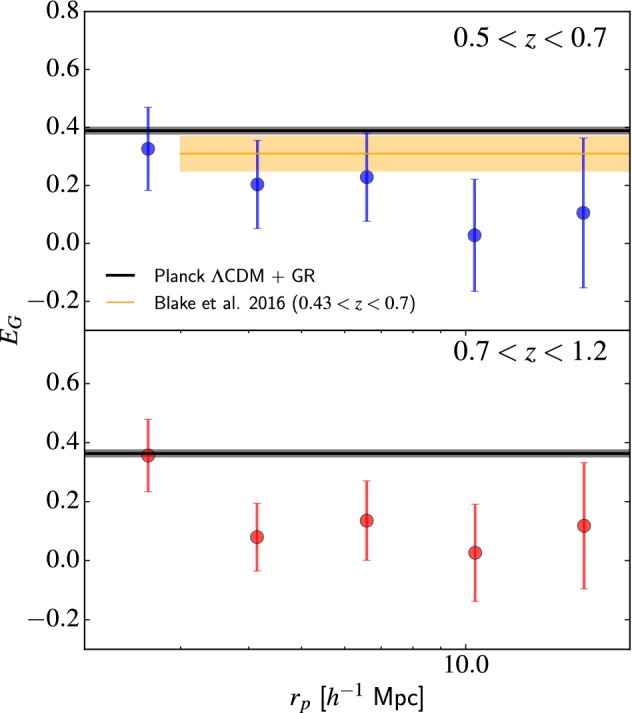
“3 Constraints on EG Reyes et al (2010) provided one of the first measurements of EG at redshift z = 0.3 finding EG = 0.39 ± 0.06 in agreement with GR-ΛCDM value of 0.408 ± 0.029 although the uncertainties did not exclude some other possible alternative gravity theories such as f(R) that predict a range of EG between 0…”
MethodInfluentialCosmological tests of modified gravity
Koyama, K. (2016) · Reports on Progress in Physics · doi:10.1088/0034-4885/79/4/046902 · Cited by 713
A Hypothesis, Unifying the Structure and the Entropy of the Universe
Zeldovich, Y. B. (1972) · Monthly Notices of the Royal Astronomical Society · doi:10.1093/mnras/160.1.1p · Cited by 708
Research works printed but not linked: 11
- Cartan E (1922a) Sur les équations de la gravitation d’Einstein. J Math Pures Appl 1922(1):141–202
- Debever R Le rayonnement gravitationnel. le tenseur de Riemann en relativité générale Cah Phys 1964 168 303
- Eddington A The mathematical theory of general relativity 1924 Cambridge CUP
- Ellis GFR Schatzman E Relativistic cosmology Cargèse lectures in physics 1973 New York Gordon and Breach 1
- Klein O Quantentheorie und Fünfdimensionale Relativitätstheorie Z Phys A 1926 37 895?906
- Könnig F, Akrami Y, Amendola L, Motta M, Solomon A (2014) Stable and unstable cosmological models in bimetric massive gravity. Phys Rev D 90:124014. 10.1103/PhysRevD.90.124014. arXiv:1407.4331 · DOI · Paper page
- Lifshitz EM On the theory of second-order phase transitions I Zh Eksp Teor Fiz 1941 11 255
- Misner CW Thorne KS Wheeler JA Gravitation 1973 Princeton Princeton University Press
- Peacock JA Cosmological physics 1999 Cambridge Cambridge University Press
- Schwarzschild K Über das Gravitationsfeld eines Massenpunktes nach der Einsteinschen Theorie Sitzungsber Koenigl Preuss Akad Wiss 1916 7 189 196
- Segre C Sulla teoria e sulla classificazione delle omografie in uno spazio lineare ad uno numero qualunque di dimensioni Mem R Accad Lincei, Ser 3 1884 XIX 127 148
Cited by
Modified gravity and cosmology
Clifton, T., Ferreira, P. G., Padilla, A., & Skordis, C. (2012) · Physics Reports · doi:10.1016/j.physrep.2012.01.001 · Cited by 4,146
Theory and Experiment in Gravitational Physics
Will, C. M. (2018) · doi:10.1017/9781316338612 · Cited by 3,637
DESI 2024 VI: cosmological constraints from the measurements of baryon acoustic oscillations
Adame, A. G., Aguilar, J., Ahlen, S., Alam, S., Alexander, D. M., Alvarez, M., Alves, O., Anand, A., Andrade, U., Armengaud, E., et al. (2025) · Journal of Cosmology and Astroparticle Physics · doi:10.1088/1475-7516/2025/02/021 · Cited by 1,136
Self-citationChallenges for Λ CDM: An update
Perivolaropoulos, L., & Skara, F. (2022) · New Astronomy Reviews · doi:10.1016/j.newar.2022.101659 · Cited by 902
DESI DR2 results. II. Measurements of baryon acoustic oscillations and cosmological constraints
Abdul Karim, M., Aguilar, J., Ahlen, S., Alam, S., Allen, L., Prieto, C. A., Alves, O., Anand, A., Andrade, U., Armengaud, E., et al. (2025) · Physical Review D · doi:10.1103/tr6y-kpc6 · Cited by 856
Self-citation
Metadata
- Authors
- Ishak, M.
- Affiliations
- The University of Texas at Dallas (US)
- Corresponding author
- Ishak, Mustapha
- ORCID
- Ishak, Mustapha
- Venue
- Living Reviews in Relativity
- Published
- 2018-12-18
- Volume
- 22
- Issue
- 1
- Pages
- 1-1
- ISSN
- 1433-8351 (ISSN-L)
- 2367-3613
- PMC
- PMC6299071
- OpenAlex
- W2809838409
- Cited by
- 449
- References
- 1,256
- Citations by year
- 2026: 28 · 2025: 69 · 2024: 60 · 2023: 46 · 2022: 52 · 2021: 49 · 2020: 70 · 2019: 57 · 2018: 15
- FWCI
- 4.35
- Type
- journal article
- Language
- en
- Open access
- diamond
- doi.org
- Licence
- cc-by
- creativecommons.org/licenses/by/4.0 (tdm)
- creativecommons.org/licenses/by/4.0 (vor)
- Locations
- Living Reviews in Relativity (publishedVersion, cc-by)
- arXiv (Cornell University) (publishedVersion)
- Europe PMC (PubMed Central) (publishedVersion, other-oa)
- PubMed Central (publishedVersion, cc-by)
- PubMed (publishedVersion)
- DOAJ (DOAJ: Directory of Open Access Journals) (submittedVersion, cc-by-sa)
- OSTI OAI (U.S. Department of Energy Office of Scientific and Technical Information) (submittedVersion)
- arXiv (Cornell University)
- Funders
- National Science Foundation (AST-1517768)
- Office of Science (DE-SC0019206)
- Topics
- Physical Sciences › Physics and Astronomy › Astronomy and Astrophysics › Cosmology and Gravitation Theories
- Physical Sciences › Physics and Astronomy › Nuclear and High Energy Physics › Noncommutative and Quantum Gravity Theories
- Physical Sciences › Physics and Astronomy › Astronomy and Astrophysics › Pulsars and Gravitational Waves Research
- Keywords
- tests of general relativity, modified gravity, cosmic acceleration, dark energy, gravitational screening, binary neutron star mergers, precision cosmology
About these checks
Registry, retraction, Cites and statistics results are computed, not judged, with one exception: a printed reference that no index lists is read once by a model before it counts as a citation error. Claims are extracted by a model and kept only when their quote appears verbatim in the text; each cited source is then checked, with a model’s help, for whether it says what the claim relies on. Those verdicts can be wrong — read the claim’s quote and the cited source before relying on one.
The claim verdicts this report counts are experimental: their accuracy is not yet measured.
A language model drew the claims from the paper on 2026-10-10, under version 3 of the claim definition (model deepseek-v4.1-flash, prompt extract-v3).
A second model labelled each claim on 2026-10-10 (model jev-1.13-20260917, definition revision gold-guideline-v0.2).
Cited sources are checked with a language model’s help (gpt-6-sol and qwen3.8-omni-flash).
Statistics and arithmetic are recomputed, not judged.
Confidence bands are shown only for fields calibrated on our annotated test set. None is calibrated yet, so no band is shown.
What counts as a claim ›How we measure confidence ›How we check this ›
Are you an author, or do you see a problem with this page? Request a review
Data sources
Bibliographic data: Semantic Scholar, OpenAlex, Crossref.
Contains information from the Semantic Scholar Academic Graph Datasets, made available under the ODC Attribution License (ODC-BY 1.0).
Semantic Scholar’s data is described in: Kinney, R., et al. (2023). The Semantic Scholar Open Data Platform. arXiv:2301.10140.
