

Quantum kinetic theory of plasmas
Open accessThe DOI matches its Crossref record; 107 of the 112 references it cites were found in a registry or an index; 30 of the 87 sources its claims cite were checked for support.
Abstract
As is well known, for plasmas of high density and modest temperature, the classical kinetic theory needs to be extended. Such extensions can be based on the Schrödinger Hamiltonian, applying a Wigner transform of the density matrix, in which case the Vlasov equation is replaced by the celebrated Wigner–Moyal equation. Extending the treatment to more complicated models, we investigate aspects such as spin dynamics (based on the Pauli Hamiltonian), exchange effects (using the Hartree–Fock approximation), Landau quantization, and quantum relativistic theory. In the relativistic theory, we first study cases where the field strength is well-beyond Schwinger critical field. Both weakly relativistic theory (gamma factors close to unity) and strongly relativistic theory are investigated, using assumptions that allow for a separation of electron and positron states. Finally, we study the so-called Dirac–Heisenberg–Wigner (DHW) formalism, which is a fully quantum relativistic theory, allowing for field strengths of the order of the Schwinger critical field or even larger. As a result, the quantum kinetic theory is extended to cover phenomena such as Zitterbewegung and electron–positron pair creation. While the focus of this review is on the quantum kinetic models, we illustrate the theories with various applications throughout the manuscript.
Overview
CoChat Summary
TL;DR
This review synthesizes quantum kinetic theory for high-density, modest-temperature plasmas, progressing from Wigner-Moyal/Schrödinger models to exchange, spin-Pauli, relativistic Landau-quantized, and full Dirac-Heisenberg-Wigner (DHW) formulations. It illustrates the frameworks with analytical applications including exchange-corrected Langmuir and ion-acoustic dispersion, spin-dependent conductivity, and ponderomotive forces.
Key findings
- The review builds a hierarchy of quantum kinetic models: the Wigner-Moyal equation replaces the Vlasov equation; exchange effects are treated via Hartree-Fock; spin dynamics via the Pauli Hamiltonian; relativistic Landau quantization and the DHW formalism cover Zitterbewegung and electron-positron pair creation.
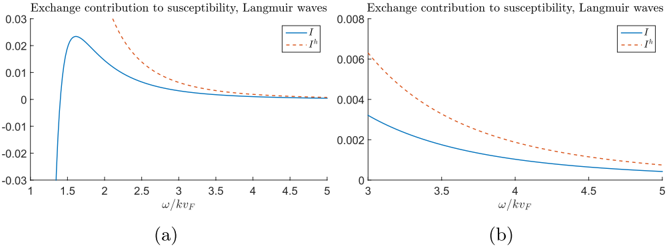
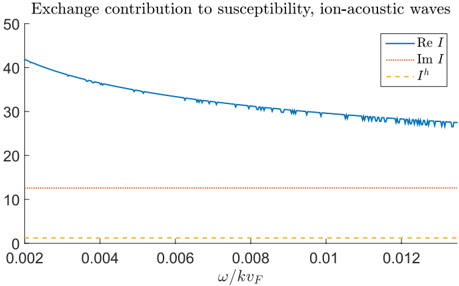
- Exchange corrections are not universally negligible: for Langmuir waves the exchange term contains the small factor \(1/90\), but for ion-acoustic waves the exchange corrections are order unity times the quantum parameter \(H^2\), with nondegenerate dispersion coefficients \(0.8\) and \(3\), and a degenerate term \((14.9+7.11i)\); the paper concludes omission of exchange terms cannot be justified for ion-acoustic waves.
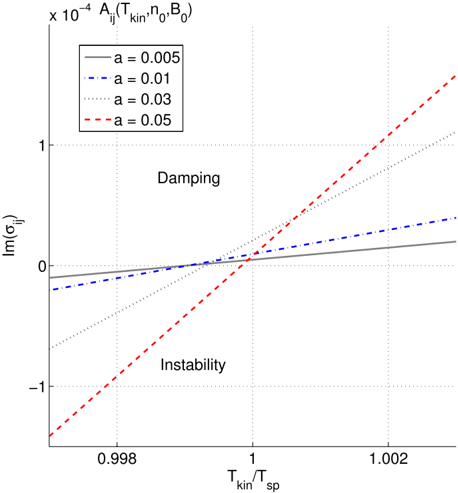
- Spin effects enter the linear conductivity tensor for a magnetized plasma, generalized to anisotropic backgrounds; spin terms can be magnified near \(\Delta \omega_c=(g/2-1)\omega_c\approx 0.00116\omega_c\), and a spin-temperature difference can drive a Weibel-type instability.
- In the relativistic/DHW regime, Landau-quantized energies are \(E_{n\pm}=m\sqrt{1+(2n+1\pm1)\hbar\omega_{ce}/m+p_z^2/m^2}\); the DHW linearized Langmuir dispersion includes a pair-production resonance when \(\hbar\omega\ge 2mc^2\) and a vacuum-polarization contribution, with magnetar fields cited as \(\sim 10^{10}\) T.
Methods
- Theoretical review: derives quantum kinetic equations from the density matrix and von Neumann equation, using Wigner/Stratonovich transforms, BBGKY mean-field and Hartree-Fock approximations, the Pauli Hamiltonian, Foldy-Wouthuysen transformation, and the DHW formalism.
- Applications use linearized Wigner/Vlasov equations, plane-wave ansätze, perturbative exchange corrections, eigenfunction expansion for the conductivity tensor, and weakly nonlinear perturbation theory for ponderomotive forces; some exchange integrals are evaluated numerically.
- No experimental sample or dataset is analyzed; figures are reproduced from prior works (Zamanian et al. 2015; Lundin and Brodin 2010; Al-Naseri et al. 2021).
Limitations
- Stated: the review focuses on nondissipative quantum kinetic models, neglecting collisions and higher-order correlations; exchange treatment is perturbative and complicated; the hydrodynamic DFT-based model is time-independent and may underestimate exchange; DHW limiting-case equivalence is not fully demonstrated; numerical study of the quantum relativistic Langmuir dispersion is left for future work.
- Evident: as a review, it omits many topics it names, including wave-particle interaction, spin-polarization dynamics, numerical computation schemes, and single-particle dynamics, and it provides no new experimental validation.
Model-written summary. Check it against the paper before relying on it.
Integrity signals
Registry
Cites
Statistics
Figures
Verification
Claims the paper makes
21 Valid · 1 Not valid · 34 Not checked · 136 Own results and interpretations
Every source the paper cites for this claim was checked and supports it.
In the paper
“As is well known, for plasmas of high density and modest temperature, the classical kinetic theory needs to be extended.”
§ Quantum kinetic theory of plasmas > Abstract
What the sources say
- Supportedcites Manfredi et al. 2019 matched to “Phase-space modeling of solid-state plasmas: A journey from classical to quantum” (2019) source
Section 2 ('Basic concepts, parameters, mechanisms') states that because of the large density of solid-state systems the electron gas displays prominent quantum properties ('quantum plasmas'), and that quantum effects become important when the temperature is comparable to or smaller than the Fermi temperature, with the Fermi-Dirac distribution deviating drastically from the classical Maxwell-Boltzmann one — exactly the high-density/modest-temperature condition in the claim. Section 1 (Introduction) carries the extension itself: classical phase-space/Vlasov kinetic models are the semiclassical limit and 'were later extended to the quantum regime using the Wigner phase-space description', and Sec. 7.3 confirms that for metallic densities a Maxwell-Boltzmann (classical) equilibrium requires an unphysically high T = 64 000 K. This is a broad background statement and our copy treats the topic that way throughout. (LLM, conf=0.85)
- Supportedcites Shukla and Eliasson 2011 matched to “Colloquium : Nonlinear collective interactions in quantum plasmas with degenerate electron fluids” (2011) source
Section II (p. 4) of our copy states that classical plasmas are nondegenerate with low densities and relatively high temperatures, whereas quantum plasmas have degenerate electrons/positrons with extremely high number densities and relatively low temperatures, and that when the particle temperature approaches the Fermi temperature the equilibrium distribution changes from Maxwell-Boltzmann to Fermi-Dirac — i.e. the classical description no longer suffices. The Introduction (pp. 3-4) correspondingly describes how the classical kinetic/hydrodynamic framework is replaced by quantum kinetic (Wigner) and quantum hydrodynamic equations with quantum statistical pressure and Bohm potential for such dense, low-temperature plasmas. The citing sentence is a general background paraphrase of exactly this point, with the same qualifiers (high density, modest/low temperature). (LLM, conf=0.85)
boostedstates a cause- Asserted: passes — The authors put it forward as true.
- Checkable: passes — It can be checked against evidence.
- Load-bearing: passes — The paper’s conclusions depend on it.
- Based: passes — The paper gives a reason why it holds.
- Supported
Every source the paper cites for this claim was checked and supports it.
In the paper
“However, in recent times, much work (see, e.g., Refs.Manfredi et al. 2019;Shukla and Eliasson 2011;Melrose 2020;Shukla and Eliasson 2010;Vladimirov and Tyshetskiy 2011, and references therein) has been devoted to the regime of high density and a low or modest temperature, allowing for quantum mechanical phenomena to influence the dynamics.”
§ Quantum kinetic theory of plasmas > 1 Introduction
What the sources say
- Supportedcites Manfredi et al. 2019 matched to “Phase-space modeling of solid-state plasmas: A journey from classical to quantum” (2019) source
Section 2 (Basic concepts, parameters, mechanisms) states that because of the large density of solid-state objects the electron gas displays prominent quantum properties, and that in a fermion gas quantum effects become important when the temperature is comparable to or smaller than the Fermi temperature (T_F ≈ 10^4 K for metals, so conduction electrons are in the quantum regime even at room temperature). The same section frames the degeneracy via T_e/T_F and g_q as density- and temperature-dependent parameters defining the regions of the (n, T) plane, matching the claim's 'high density and low or modest temperature' regime. The paper's applications (Sec. 7) then show quantum effects modifying plasma-wave dynamics in that regime. (LLM, conf=0.90)
- Supportedcites Shukla and Eliasson 2011 matched to “Colloquium : Nonlinear collective interactions in quantum plasmas with degenerate electron fluids” (2011) source
The Colloquium's Section II (Basic Properties of Quantum Plasmas, p. 4) states that quantum plasmas have degenerate electrons/positrons with extremely high number densities and relatively low temperatures, and that 'Quantum mechanical effects start playing a significant role' when the Wigner-Seitz radius becomes comparable to or smaller than the thermal de Broglie wavelength (equivalently T ≲ T_F). The Introduction (p. 1, p. 3) and the abstract page (p. 1) likewise treat this high-density/low-temperature regime as the domain in which quantum effects modify collective/plasma-wave dynamics (quantum statistical pressure, Bohm potential, spin/exchange contributions to dispersion). This is a background/identification citation and our copy supports the paraphrase directly. (LLM, conf=0.90)
plainstates a possible cause- Asserted: passes — The authors put it forward as true.
- Checkable: passes — It can be checked against evidence.
- Load-bearing: passes — The paper’s conclusions depend on it.
- Based: passes — The paper gives a reason why it holds.
- Supported
Every source the paper cites for this claim was checked and supports it.
In the paper
“Extending the models to cover the weakly relativistic regime (Asenjo et al. 2012;Hurst et al. 2017;Ekman et al. 2021), spin-orbit interaction, Thomas precession, and a spin-dependent polarization current are new features of the theory.”
§ Quantum kinetic theory of plasmas > 1 Introduction
What the sources say
- Supportedcites Asenjo et al. 2012 matched to “Semi-relativistic effects in spin-1/2 quantum plasmas” (2012) source
The Conclusions state that the weakly relativistic evolution equation adds spin-orbit interaction, including the Thomas factor, and that spin-associated polarization must be included in the current. Section 5.2 identifies the spin-orbit effect as a Thomas precession correction. (LLM, conf=0.94)
- Supportedcites Hurst et al. 2017 matched to “Phase-space methods for the spin dynamics in condensed matter systems” (2017) source
The Introduction (p. 3) says the model extends earlier Zeeman-only work by including spin-orbit coupling as a relativistic correction. Section IV (p. 11) identifies a spin-orbit correction as the nonrelativistic limit of Thomas precession, and Section III (p. 9) describes spin polarization and a new contribution to current density among the relativistic corrections. (LLM, conf=0.86)
- Supportedcites Ekman et al. 2021 matched to “Short-scale quantum kinetic theory including spin–orbit interactions” (2021) source
The Introduction says the paper extends a Pauli-equation model into the weakly relativistic regime and includes spin-orbit interaction, Thomas precession, and polarization currents associated with spin. This directly supports the attributed paraphrase. (LLM, conf=0.94)
plainstates a cause- Asserted: passes — The authors put it forward as true.
- Checkable: passes — It can be checked against evidence.
- Load-bearing: unclear — It is unclear whether the paper’s conclusions depend on it.
- Based: passes — The paper gives a reason why it holds.
- Supported
Every source the paper cites for this claim was checked and supports it.
In the paper
“Treating the ions as immobile, considering a Maxwell-Boltzmann background distribution for the electrons, and performing the steps outlined above, Ref. (Zamanian et al. 2015) was able to derive the following result:”
§ Quantum kinetic theory of plasmas > 3.2 High-frequency Langmuir waves
What the sources say
- Supportedcites Zamanian et al. 2015 matched to “On the contribution of exchange interactions to the Vlasov equation” (2015) source
Section III (pp. 4-5) shows exactly this derivation: the evolution equation (1) is linearized together with the Poisson equation for electrons only, with 'the positively charged ions constitute a neutralizing background' (i.e. immobile), and, 'assuming that the thermodynamic temperature is much higher than the Fermi temperature', the Maxwell-Boltzmann distribution is used as f0; f1 is then solved 'to first order in the exchange term' and inserted into the linearized Poisson equation, giving the exchange-corrected dispersion relation Eq. (9). The Introduction (p. 2) and Abstract (p. 1) likewise state that the exchange term is treated perturbatively to obtain 'the correction to the linear Langmuir dispersion relation'. Our copy phrases the outcome as a correction to the dispersion relation rather than using the word 'susceptibility' (the undecoded formulas prevent checking an intermediate chi(k,omega) expression), but the content attributed — the first-order exchange correction for linear Langmuir waves on a Maxwell-Boltzmann electron background with static ions — is what the paper derives. (LLM, conf=0.80)
plain- Asserted: passes — The authors put it forward as true.
- Checkable: passes — It can be checked against evidence.
- Load-bearing: passes — The paper’s conclusions depend on it.
- Based: passes — The paper gives a reason why it holds.
- Rests on 6 assumptions not shown here.
- Supported
The sources with a verdict support this claim; the rest weren’t checked yet, have no full text we could read, or their verdicts aren’t rated yet.
In the paper
“The relative importance of exchange effects in plasmas is proportional to the parameter H 2 = (ℏ p ∕E k ) 2”
§ Quantum kinetic theory of plasmas > 3 Exchange effects
What the sources say
- Not checked yetcites Crouseilles et al. 2008 matched to “Quantum hydrodynamic model for the nonlinear electron dynamics in thin metal films” (2008) source
- Not checked yetcites Haas 2021
- Supportedcites Zamanian et al. 2013 matched to “Exchange effects in plasmas: The case of low-frequency dynamics” (2013) source
The Discussion (page not supplied) says the relative magnitude of the exchange effects is of order H² and defines H using ℏωpe and the electron kinetic-energy scale. It also explicitly says the relative importance of the exchange term scales as (ℏωp/Ek)². The claim is a proportionality, so the differing constant in the definitions does not change it. (LLM, conf=0.92)
plainstates an association- Asserted: passes — The authors put it forward as true.
- Checkable: passes — It can be checked against evidence.
- Load-bearing: passes — The paper’s conclusions depend on it.
- Based: passes — The paper gives a reason why it holds.
108 more claims · 12 with their cited sources checked
Create a free account to see all 192 claims and to verify the 57 references still open.
- It may state two separate claims as one. 35
- Probably not a substantial claim. 49
- The quote only partly states this claim. 1
Self-check
Percentages, sums and reported differences re-computed from the paper’s own numbers.
Each contradiction between two passages listed here was confirmed by an independent check.
Rated minor: it would not touch a result — a value no result rests on, a p-value that stays on the same side of the significance level, or a conflict that is clerical, resolved elsewhere in the paper, or outside its own findings.
In the paper
§ Quantum kinetic theory of plasmas > 2.2 The Wigner transformation
“Therefore, the phase-space function corresponding to Ô = xp x is O(x, p x ) = xp x + iℏ .”
§ Quantum kinetic theory of plasmas > 2.2 The Wigner transformation
“(27) Ô = 1 2 xp x + xp x = 1 2 xp x + px x + i� ↔ xp x + i� 2 .”
Rated minor: it would not touch a result — a value no result rests on, a p-value that stays on the same side of the significance level, or a conflict that is clerical, resolved elsewhere in the paper, or outside its own findings.
In the paper
§ Quantum kinetic theory of plasmas > A BBGKY-hierarchy and the mean-field approximation
“(163 ) i�𝜕 t ρ = ρ, Ĥ ,”
§ Quantum kinetic theory of plasmas > 4.1 Derivation of evolution equations
“(56) i� 𝜕 ρ𝛼𝛽 𝜕t = Ĥ, ρ𝛼𝛽 .”
Rated minor: it would not touch a result — a value no result rests on, a p-value that stays on the same side of the significance level, or a conflict that is clerical, resolved elsewhere in the paper, or outside its own findings.
In the paper
§ Quantum kinetic theory of plasmas > Abstract
“In the relativistic theory, we first study cases where the field strength is well-beyond Schwinger critical field.”
§ Quantum kinetic theory of plasmas > 5.1 Conservation laws
“Quantitatively, the electric field should be much smaller than the critical field, E ≪ E c = m 2 ∕e� and similarly for the magnetic field (we use units with c = 1 in this section).”
Citations
Cites
Self-Consistent Equations Including Exchange and Correlation Effects
Kohn, W., & Sham, L. J. (1965) · Physical Review · doi:10.1103/physrev.140.a1133 · Cited by 64,135
Spintronics: A Spin-Based Electronics Vision for the Future
Wolf, S. A., Awschalom, D. D., Buhrman, R. A., Daughton, J. M., von Molnár, S., Roukes, M. L., Chtchelkanova, A. Y., & Treger, D. M. (2001) · Science · doi:10.1126/science.1065389 · Cited by 11,442
On the Quantum Correction For Thermodynamic Equilibrium
Wigner, E. (1932) · Physical Review · doi:10.1103/physrev.40.749 · Cited by 9,283
Tajima, T., & Dawson, J. M. (1979) · Physical Review Letters · doi:10.1103/physrevlett.43.267 · Cited by 4,705
Sakurai, J. J., & Napolitano, J. (2020) · Cambridge University Press eBooks · doi:10.1017/9781108587280 · Cited by 3,666
Quantum mechanics as a statistical theory
Moyal, J. E. (1949) · Mathematical Proceedings of the Cambridge Philosophical Society · doi:10.1017/s0305004100000487 · Cited by 3,116
On the Dirac Theory of Spin 1/2 Particles and Its Non-Relativistic Limit
Foldy, L. L., & Wouthuysen, S. A. (1950) · Physical Review · doi:10.1103/physrev.78.29 · Cited by 2,183
Sakurai, J. J., & Napolitano, J. (2017) · Cambridge University Press eBooks · doi:10.1017/9781108499996 · Cited by 1,650
Strongly coupled plasmas: high-density classical plasmas and degenerate electron liquids
Ichimaru, S. (1982) · Reviews of Modern Physics · doi:10.1103/revmodphys.54.1017 · Cited by 1,425
Physics of strongly magnetized neutron stars
Harding, A. K., & Lai, D. (2006) · Reports on Progress in Physics · doi:10.1088/0034-4885/69/9/r03 · Cited by 823
Atwater, H. A. (2007) · Scientific American · doi:10.1038/scientificamerican0407-56 · Cited by 773
X-ray Thomson scattering in high energy density plasmas
Glenzer, S. H., & Redmer, R. (2009) · Reviews of Modern Physics · doi:10.1103/revmodphys.81.1625 · Cited by 740
Boyd, T. J. M., & Sanderson, J. J. (2003) · doi:10.1017/cbo9780511755750 · Cited by 512
Nonlinear aspects of quantum plasma physics
Shukla, P. K., & Eliasson, B. (2010) · Physics-Uspekhi · doi:10.3367/ufne.0180.201001b.0055 · Cited by 509
Relativistic nonlinear effects in plasmas
Shukla, P. (1986) · Physics Reports · doi:10.1016/0370-1573(86)90157-2 · Cited by 490
Colloquium : Nonlinear collective interactions in quantum plasmas with degenerate electron fluids
Shukla, P. K., & Eliasson, B. (2011) · Reviews of Modern Physics · doi:10.1103/revmodphys.83.885 · Cited by 477
Bonitz, M. (2016) · doi:10.1007/978-3-319-24121-0 · Cited by 447 · cited 4×
“[38]), and the dynamics is given by the von Neumann equation with the Hamiltonian”
BackgroundMethodInfluentialQuantum Mechanics in Phase Space: An Overview with Selected Papers
Zachos, C. K., Fairlie, D. B., & Curtright, T. L. (2005) · World Scientific Series in 20th Century Physics · doi:10.1142/5287 · Cited by 406
Density functional theory in the solid state
Hasnip, P. J., Refson, K., Probert, M. I. J., Yates, J. R., Clark, S. J., & Pickard, C. J. (2014) · Philosophical Transactions of the Royal Society A: Mathematical, Physical and Engineering Sciences · doi:10.1098/rsta.2013.0270 · Cited by 400
Quantum hydrodynamic model for the nonlinear electron dynamics in thin metal films
Crouseilles, N., Hervieux, P.-A., & Manfredi, G. (2008) · Physical Review B · doi:10.1103/physrevb.78.155412 · Cited by 346
Pair production from vacuum at the focus of an X-ray free electron laser
Ringwald, A. (2001) · Physics Letters B · doi:10.1016/s0370-2693(01)00496-8 · Cited by 262
Quantum Plasmas: An Hydrodynamic Approach
Haas, F. (2011) · Springer Series on Atomic, Optical, and Plasma Physics · doi:10.1007/978-1-4419-8201-8 · Cited by 259
New strong-field QED effects at extreme light infrastructure: Nonperturbative vacuum pair production
Dunne, G. V. (2009) · The European Physical Journal D · doi:10.1140/epjd/e2009-00022-0 · Cited by 236
"Try Simplest Cases" Discovery of "Hidden Momentum" Forces on "Magnetic Currents"
Shockley, W., & James, R. P. (1967) · Physical Review Letters · doi:10.1103/physrevlett.18.876 · Cited by 224
Phase-space structure of the Dirac vacuum
Bialynicki-Birula, I., Górnicki, P., & Rafelski, J. (1991) · Physical Review D · doi:10.1103/physrevd.44.1825 · Cited by 223
Liu, D., Chen, X., Hu, Y., Sun, T., Song, Z., Zheng, Y., Cao, Y., Cai, Z., Cao, M., Peng, L., et al. (2018) · Nature Communications · doi:10.1038/s41467-017-02627-5 · Cited by 195
Hebenstreit, F., Alkofer, R., & Gies, H. (2010) · Physical Review D · doi:10.1103/physrevd.82.105026 · Cited by 186
Explicit treatment of N-body correlations within a density-matrix formalism
Shun-jin, W., & Cassing, W. (1985) · Annals of Physics · doi:10.1016/0003-4916(85)90116-2 · Cited by 168
Two-dimensional self-modulation of a whistler wave propagating along the magnetic field in a plasma
Karpman, V. I., & Washimi, H. (1977) · Journal of Plasma Physics · doi:10.1017/s0022377800020973 · Cited by 166
Theoretical foundations of quantum hydrodynamics for plasmas
Moldabekov, Z. A., Bonitz, M., & Ramazanov, T. S. (2018) · Physics of Plasmas · doi:10.1063/1.5003910 · Cited by 159
Dornheim, T., Groth, S., Vorberger, J., & Bonitz, M. (2018) · Physical Review Letters · doi:10.1103/physrevlett.121.255001 · Cited by 155
Origin of "Hidden Momentum Forces" on Magnets
Coleman, S., & Van Vleck, J. H. (1968) · Physical Review · doi:10.1103/physrev.171.1370 · Cited by 149
Relativistic plasma physics in supercritical fields
Zhang, P., Bulanov, S. S., Seipt, D., Arefiev, A. V., & Thomas, A. G. R. (2020) · Physics of Plasmas · doi:10.1063/1.5144449 · Cited by 149
Autoresonant control of the many-electron dynamics in nonparabolic quantum wells
Manfredi, G., & Hervieux, P.-A. (2007) · Applied Physics Letters · doi:10.1063/1.2761246 · Cited by 142
Li, Y.-F., Shaisultanov, R., Hatsagortsyan, K. Z., Wan, F., Keitel, C. H., & Li, J.-X. (2019) · Physical Review Letters · doi:10.1103/physrevlett.122.154801 · Cited by 139
Particle Self-Bunching in the Schwinger Effect in Spacetime-Dependent Electric Fields
Hebenstreit, F., Alkofer, R., & Gies, H. (2011) · Physical Review Letters · doi:10.1103/physrevlett.107.180403 · Cited by 136
Effects of thegFactor in Semiclassical Kinetic Plasma Theory
Brodin, G., Marklund, M., Zamanian, J., Ericsson, Å., & Mana, P. L. (2008) · Physical Review Letters · doi:10.1103/physrevlett.101.245002 · Cited by 129
Self-citationPlasma physics of extreme astrophysical environments
Uzdensky, D. A., & Rightley, S. (2014) · Reports on Progress in Physics · doi:10.1088/0034-4885/77/3/036902 · Cited by 118
Silenko, A. J. (2008) · Physical Review A · doi:10.1103/physreva.77.012116 · Cited by 118
Spin polarization of electrons by ultraintense lasers
Del Sorbo, D., Seipt, D., Blackburn, T. G., Thomas, A. G. R., Murphy, C. D., Kirk, J. G., & Ridgers, C. P. (2017) · Physical Review A · doi:10.1103/physreva.96.043407 · Cited by 117
Quantum hydrodynamics for plasmas—Quo vadis?
Bonitz, M., Moldabekov, Z. A., & Ramazanov, T. S. (2019) · Physics of Plasmas · doi:10.1063/1.5097885 · Cited by 110
Scalar quantum kinetic theory for spin-1/2 particles: mean field theory
Zamanian, J., Marklund, M., & Brodin, G. (2010) · New Journal of Physics · doi:10.1088/1367-2630/12/4/043019 · Cited by 108
Self-citationQuantum Radiation Reaction: From Interference to Incoherence
Dinu, V., Harvey, C., Ilderton, A., Marklund, M., & Torgrimsson, G. (2016) · Physical Review Letters · doi:10.1103/physrevlett.116.044801 · Cited by 107
On description of a collisionless quantum plasma
Vladimirov, S. V., & Tyshetskiy, Y. O. (2011) · Physics-Uspekhi · doi:10.3367/ufne.0181.201112g.1313 · Cited by 98
Self-focusing of an optical beam in a plasma
Kurki-Suonio, T., Morrison, P. J., & Tajima, T. (1989) · Physical Review A · doi:10.1103/physreva.40.3230 · Cited by 98
Spin Contribution to the Ponderomotive Force in a Plasma
Brodin, G., Misra, A. P., & Marklund, M. (2010) · Physical Review Letters · doi:10.1103/physrevlett.105.105004 · Cited by 88
Self-citationSemi-relativistic effects in spin-1/2 quantum plasmas
Asenjo, F. A., Zamanian, J., Marklund, M., Brodin, G., & Johansson, P. (2012) · New Journal of Physics · doi:10.1088/1367-2630/14/7/073042 · Cited by 85
Self-citationGauge-independent Wigner functions: General formulation
Serimaa, O. T., Javanainen, J., & Varró, S. (1986) · Physical Review A · doi:10.1103/physreva.33.2913 · Cited by 82
Quantum Electrodynamics in Strong Magnetic Fields. I. Electron States
Melrose, D., & Parle, A. (1983) · Australian Journal of Physics · doi:10.1071/ph830755 · Cited by 76
Hidden momentum, field momentum, and electromagnetic impulse
Babson, D., Reynolds, S. P., Bjorkquist, R., & Griffiths, D. J. (2009) · American Journal of Physics · doi:10.1119/1.3152712 · Cited by 69
Strong-magnetic-field states of the pure electron plasma
MacDonald, A. H., & Bryant, G. W. (1987) · Physical Review Letters · doi:10.1103/physrevlett.58.515 · Cited by 64
Dispersion properties of electrostatic oscillations in quantum plasmas
ELIASSON, B., & SHUKLA, P. K. (2010) · Journal of Plasma Physics · doi:10.1017/s0022377809990316 · Cited by 61
Del Sorbo, D., Seipt, D., Thomas, A. G. R., & Ridgers, C. P. (2018) · Plasma Physics and Controlled Fusion · doi:10.1088/1361-6587/aab979 · Cited by 59
Pair production in temporally and spatially oscillating fields
Aleksandrov, I. A., & Kohlfürst, C. (2020) · Physical review. D/Physical review. D. · doi:10.1103/physrevd.101.096009 · Cited by 57
Exchange effects in Coulomb quantum plasmas: Dispersion of waves in 2D and 3D quantum plasmas
Andreev, P. A. (2014) · Annals of Physics · doi:10.1016/j.aop.2014.07.019 · Cited by 55
Spin quasi-distribution functions
Scully, M. O., & Wódkiewicz, K. (1994) · Foundations of Physics · doi:10.1007/bf02053909 · Cited by 54
Ab initio results for the plasmon dispersion and damping of the warm dense electron gas
Hamann, P., Vorberger, J., Dornheim, T., Moldabekov, Z. A., & Bonitz, M. (2020) · Contributions to Plasma Physics · doi:10.1002/ctpp.202000147 · Cited by 52
Wigner function and pair production in parallel electric and magnetic fields
Sheng, X.-L., Fang, R.-H., Wang, Q., & Rischke, D. H. (2019) · Physical review. D/Physical review. D. · doi:10.1103/physrevd.99.056004 · Cited by 52
Shockley, W. (1968) · Physical Review Letters · doi:10.1103/physrevlett.20.343 · Cited by 49
Degenerate quantum gases in the binary collision approximation
Boercker, D. B., & Dufty, J. W. (1979) · Annals of Physics · doi:10.1016/0003-4916(79)90247-1 · Cited by 46
Localized whistlers in magnetized spin quantum plasmas
Misra, A. P., Brodin, G., Marklund, M., & Shukla, P. K. (2010) · Physical Review E · doi:10.1103/physreve.82.056406 · Cited by 46
Self-citationLinearized kinetic theory of spin-1/2 particles in magnetized plasmas
Lundin, J., & Brodin, G. (2010) · Physical Review E · doi:10.1103/physreve.82.056407 · Cited by 45
Self-citationExchange corrections in a low-temperature plasma
Ekman, R., Zamanian, J., & Brodin, G. (2015) · Physical Review E · doi:10.1103/physreve.92.013104 · Cited by 44
Self-citationExchange effects in plasmas: The case of low-frequency dynamics
Zamanian, J., Marklund, M., & Brodin, G. (2013) · Physical Review E · doi:10.1103/physreve.88.063105 · Cited by 41
Self-citationFrom extended phase space dynamics to fluid theory
Zamanian, J., Stefan, M., Marklund, M., & Brodin, G. (2010) · Physics of Plasmas · doi:10.1063/1.3496053 · Cited by 41
Self-citationHaas, F. (2008) · Physics of Plasmas · doi:10.1063/1.2829071 · Cited by 39
Weakly relativistic quantum kinetic theory for electrostatic wave modes in magnetized plasmas
Hussain, A., Stefan, M., & Brodin, G. (2014) · Physics of Plasmas · doi:10.1063/1.4867490 · Cited by 39
Self-citationPonderomotive force due to the intrinsic spin in extended fluid and kinetic models
Stefan, M., Zamanian, J., Brodin, G., Misra, A. P., & Marklund, M. (2011) · Physical Review E · doi:10.1103/physreve.83.036410 · Cited by 38
Self-citationPhase-space modeling of solid-state plasmas: A journey from classical to quantum
Manfredi, G., Hervieux, P.-A., & Hurst, J. (2019) · Reviews of Modern Plasma Physics · doi:10.1007/s41614-019-0034-0 · Cited by 38
Eliezer, S., Norreys, P. A., Mendonça, J. T., & Lancaster, K. (2005) · Physics of Plasmas · doi:10.1063/1.1914808 · Cited by 37
Generation of wakefields by whistlers in spin quantum magnetoplasmas
Misra, A. P., Brodin, G., Marklund, M., & Shukla, P. K. (2010) · Physics of Plasmas · doi:10.1063/1.3527995 · Cited by 36
Self-citationFluid moment hierarchy equations derived from quantum kinetic theory
Haas, F., Marklund, M., Brodin, G., & Zamanian, J. (2010) · Physics Letters A · doi:10.1016/j.physleta.2009.11.011 · Cited by 36
Self-citationEffect of Electron Exchange on the Dispersion Relation of Plasmons
von Roos, O., & Zmuidzinas, J. S. (1961) · Physical Review · doi:10.1103/physrev.121.941 · Cited by 34
Fluid moment hierarchy equations derived from gauge invariant quantum kinetic theory
Haas, F., Zamanian, J., Marklund, M., & Brodin, G. (2010) · New Journal of Physics · doi:10.1088/1367-2630/12/7/073027 · Cited by 33
Self-citationSemiclassical Vlasov and fluid models for an electron gas with spin effects
Hurst, J., Morandi, O., Manfredi, G., & Hervieux, P.-A. (2014) · The European Physical Journal D · doi:10.1140/epjd/e2014-50205-5 · Cited by 33
Spin-electron acoustic waves: The Landau damping and ion contribution in the spectrum
Andreev, P. A. (2016) · Physics of Plasmas · doi:10.1063/1.4953049 · Cited by 32
Quantum hydrodynamic model by moment closure of Wigner equation
Cai, Z., Fan, Y., Li, R., Lu, T., & Wang, Y. (2012) · Journal of Mathematical Physics · doi:10.1063/1.4748971 · Cited by 32
Relativistic kinetic equation for spin-1/2 particles in the long-scale-length approximation
Ekman, R., Asenjo, F. A., & Zamanian, J. (2017) · Physical Review E · doi:10.1103/physreve.96.023207 · Cited by 30
Self-citationFluid descriptions of quantum plasmas
Manfredi, G., Hervieux, P.-A., & Hurst, J. (2021) · Reviews of Modern Plasma Physics · doi:10.1007/s41614-021-00056-y · Cited by 29
Simulations of relativistic quantum plasmas using real-time lattice scalar QED
Shi, Y. C., Xiao, J., Qin, H., & Fisch, N. J. (2018) · Physical review. E · doi:10.1103/physreve.97.053206 · Cited by 26
Phase-space methods for the spin dynamics in condensed matter systems
Hurst, J., Hervieux, P.-A., & Manfredi, G. (2017) · Philosophical Transactions of the Royal Society A: Mathematical, Physical and Engineering Sciences · doi:10.1098/rsta.2016.0199 · Cited by 26
Manfredi, G., & Hurst, J. (2015) · Plasma Physics and Controlled Fusion · doi:10.1088/0741-3335/57/5/054004 · Cited by 25
Electron-positron annihilation freeze-out in the early universe
Thomas, L. C., Dezen, T., Grohs, E. B., & Kishimoto, C. T. (2020) · Physical Review D · doi:10.1103/physrevd.101.063507 · Cited by 24
Linear and nonlinear wave propagation in weakly relativistic quantum plasmas
Stefan, M., & Brodin, G. (2013) · Physics of Plasmas · doi:10.1063/1.4773897 · Cited by 20
Self-citationPlasma dynamics and vacuum pair creation using the Dirac-Heisenberg-Wigner formalism
Al-Naseri, H., Zamanian, J., & Brodin, G. (2021) · Physical Review E · doi:10.1103/physreve.104.015207 · Cited by 18
Self-citationMelrose, D. B. (2020) · Reviews of Modern Plasma Physics · doi:10.1007/s41614-020-00044-8 · Cited by 17
Elkamash, I. S., Haas, F., & Kourakis, I. (2017) · Physics of Plasmas · doi:10.1063/1.4989777 · Cited by 16
On the contribution of exchange interactions to the Vlasov equation
Zamanian, J., Marklund, M., & Brodin, G. (2015) · The European Physical Journal D · doi:10.1140/epjd/e2014-50158-7 · Cited by 16
Self-citationBrodin, G., Ekman, R., & Zamanian, J. (2019) · Physics of Plasmas · doi:10.1063/1.5104339 · Cited by 16
Self-citationEkman, R., Al-Naseri, H., Zamanian, J., & Brodin, G. (2019) · Physical Review E · doi:10.1103/physreve.100.023201 · Cited by 15
Self-citationPhase-space structures in quantum-plasma wave turbulence
Haas, F., Eliasson, B., Shukla, P. K., et al. (2008) · Physical Review E · doi:10.1103/physreve.78.056407 · Cited by 15
Kinetic theory for spin-1/2 particles in ultrastrong magnetic fields
Al-Naseri, H., Zamanian, J., Ekman, R., & Brodin, G. (2020) · Physical review. E · doi:10.1103/physreve.102.043203 · Cited by 15
Self-citationPeculiarities of surface plasmons in quantum plasmas
TYSHETSKIY, Y. O., VLADIMIROV, S. V., & KOMPANEETS, R. (2013) · Journal of Plasma Physics · doi:10.1017/s0022377813000135 · Cited by 13
Andreev, P. A. (2017) · Physics of Plasmas · doi:10.1063/1.4975015 · Cited by 11
Andreev, P. A., & Kuz'menkov, L. S. (2017) · Physics of Plasmas · doi:10.1063/1.4999103 · Cited by 9
Shaukat, M. I. (2017) · Physics of Plasmas · doi:10.1063/1.4985681 · Cited by 9
Temporal Klein Model for Particle-Pair Creation
Mendonça, J. T. (2021) · Symmetry · doi:10.3390/sym13081361 · Cited by 9
Geometric particle-in-cell methods for the Vlasov–Maxwell equations with spin effects
Crouseilles, N., Hervieux, P.-A., Li, Y., Manfredi, G., & Sun, Y. (2021) · Journal of Plasma Physics · doi:10.1017/s0022377821000532 · Cited by 9
Asymptotic preserving schemes for the Wigner–Poisson–BGK equations in the diffusion limit
Crouseilles, N., & Manfredi, G. (2013) · Computer Physics Communications · doi:10.1016/j.cpc.2013.06.002 · Cited by 8
Bönitz, M., Schlünzen, N., & Hermanns, S. (2014) · Contributions to Plasma Physics · doi:10.1002/ctpp.201400065 · Cited by 7
Nonlinear stationary solutions of the Wigner and Wigner–Poisson equations
Haas, F., & Shukla, P. K. (2008) · Physics of Plasmas · doi:10.1063/1.3008047 · Cited by 7
Kinetic theory of fully degenerate electrons in the long scale limit
Brodin, G., & Stefan, M. (2013) · Physical Review E · doi:10.1103/physreve.88.023107 · Cited by 6
Self-citationDensity functional theory for collisionless plasmas – equivalence of fluid and kinetic approaches
Manfredi, G. (2020) · Journal of Plasma Physics · doi:10.1017/s0022377820000240 · Cited by 6
A new type of surface waves in a fully degenerate quantum plasma
Tyshetskiy, Y., Vladimirov, S. V., & Kompaneets, R. (2014) · Physics of Plasmas · doi:10.1063/1.4904302 · Cited by 4
Kinetic description of the oblique propagating spin-electron acoustic waves in degenerate plasmas
Andreev, P. A. (2018) · Physics of Plasmas · doi:10.1063/1.5022076 · Cited by 4
Analytical properties of linear electrostatic waves in two-component quantum and classical plasmas
Rightley, S., & Uzdensky, D. (2018) · Journal of Plasma Physics · doi:10.1017/s0022377818000843 · Cited by 3
Short-scale quantum kinetic theory including spin–orbit interactions
Ekman, R., Al-Naseri, H., Zamanian, J., & Brodin, G. (2021) · The European Physical Journal D · doi:10.1140/epjd/s10053-020-00021-3 · Cited by 2
Self-citation
Research works printed but not linked: 10
- N.N. Bogolyubov, Z. Eksp, Teor. Fiz. 16, 691 (1946). ([JETP 10, 265 (1946)])
- 8. G. Chabrier, F. Douchin, A. Potekhin, J. Phys.: Condens. Matter 14, 9133 (2002)
- 25. P. Giannozzi, S. Baroni, N. Bonin et al., J. Phys.: Condens. Matter 21, 395502 (2009)
- 29. F. Haas, Contrib. Plasma Phys. 2021, e202100046 (2021)
- 50. G. Manfredi, Fields Inst. Commun. 46, 263 (2005)
- 62. A. Moradi, J. Phys.: Condens. Matter 21, 045303 (2008)
- 64. H. Nersisyan, C. Toepffer, G. Zwicknagel, Interactions Between Charged Particles in a Magnetic Field (Springer, Berlin, 2007)
- 82. R.L. Stratonovic, Z. Eksp, Teor. Fiz. 58, 1612 (1970). ([Sov. Phys. -JETP 31, 864 (1970)
- 83. G. Swanson, Plasma Waves (Taylor & Francis, Routledge, 2003)
- 99. S. Zhang, K.P. Driver, F. Soubiran, B. Militzer, HEDP 21, 16 (2016)
Cited by
Advances in QED with intense background fields
Fedotov, A., Ilderton, A., Karbstein, F., King, B., Seipt, D., Taya, H., & Torgrimsson, G. (2023) · Physics Reports · doi:10.1016/j.physrep.2023.01.003 · Cited by 400
Plasma dynamics at the Schwinger limit and beyond
Brodin, G., Al-Naseri, H., Zamanian, J., Torgrimsson, G., & Eliasson, B. (2023) · Physical review. E · doi:10.1103/physreve.107.035204 · Cited by 28
Self-citationDasgupta, S., Atteya, A., & Karmakar, P. K. (2023) · Chinese Journal of Physics · doi:10.1016/j.cjph.2023.04.004 · Cited by 10
Effect of plasmon excitations in relativistic quantum electron gas
Akbari-Moghanjoughi, M. (2023) · Physics of Plasmas · doi:10.1063/5.0167561 · Cited by 11
Vortex Structures and Momentum Sharing in Dynamic Sauter-Schwinger Process
Bechler, A., Vélez, F. C., Krajewska, K., & Kamiński, J. Z. (2023) · Acta Physica Polonica A · doi:10.12693/aphyspola.143.s18 · Cited by 15
Metadata
- Authors
- Brodin, G., & Zamanian, J.
- Affiliations
- Umeå University (SE)
- Corresponding author
- Brodin, Gert
- Venue
- Reviews of Modern Plasma Physics
- Published
- 2022-02-11
- Volume
- 6
- Issue
- 1
- ISSN
- 2367-3192 (ISSN-L)
- OpenAlex
- W3210180242
- Cited by
- 37
- References
- 112
- Citations by year
- 2026: 4 · 2025: 10 · 2024: 7 · 2023: 13 · 2022: 3
- FWCI
- 1.03
- Type
- journal article
- Language
- en
- Open access
- hybrid
- doi.org
- Licence
- cc-by
- creativecommons.org/licenses/by/4.0 (tdm)
- creativecommons.org/licenses/by/4.0 (vor)
- Locations
- Reviews of Modern Plasma Physics (publishedVersion, cc-by)
- arXiv (Cornell University) (submittedVersion)
- KTH Publication Database DiVA (KTH Royal Institute of Technology) (submittedVersion, other-oa)
- arXiv (Cornell University)
- Funders
- Umea University
- Topics
- Physical Sciences › Physics and Astronomy › Nuclear and High Energy Physics › Laser-Plasma Interactions and Diagnostics
- Physical Sciences › Physics and Astronomy › Atomic and Molecular Physics, and Optics › Dust and Plasma Wave Phenomena
- Physical Sciences › Physics and Astronomy › Atomic and Molecular Physics, and Optics › Quantum and Classical Electrodynamics
- Keywords
- quantum kinetic theory, plasma, Wigner transform, Vlasov equation, spin dynamics, Pauli Hamiltonian, Hartree-Fock approximation, exchange effects, Landau quantization, Schwinger critical field, Zitterbewegung, electron-positron pair production, high-density plasma
About these checks
Registry, retraction, Cites and statistics results are computed, not judged, with one exception: a printed reference that no index lists is read once by a model before it counts as a citation error. Claims are extracted by a model and kept only when their quote appears verbatim in the text; each cited source is then checked, with a model’s help, for whether it says what the claim relies on. Those verdicts can be wrong — read the claim’s quote and the cited source before relying on one.
The claim verdicts this report counts are experimental: their accuracy is not yet measured.
A language model drew the claims from the paper on 2026-09-29, under version 3 of the claim definition (model deepseek-v4.1-flash, prompt extract-v3).
A second model labelled each claim on 2026-09-29 (model jev-1.13-20260917, definition revision gold-guideline-v0.2).
Cited sources are checked with a language model’s help (qwen3.8-omni-flash and gpt-6-sol).
Statistics and arithmetic are recomputed, not judged.
Confidence bands are shown only for fields calibrated on our annotated test set. None is calibrated yet, so no band is shown.
What counts as a claim ›How we measure confidence ›How we check this ›
Are you an author, or do you see a problem with this page? Request a review
Data sources
Bibliographic data: Semantic Scholar, OpenAlex, Crossref.
Contains information from the Semantic Scholar Academic Graph Datasets, made available under the ODC Attribution License (ODC-BY 1.0).
Semantic Scholar’s data is described in: Kinney, R., et al. (2023). The Semantic Scholar Open Data Platform. arXiv:2301.10140.
