

An Ethics Framework for Big Data in Health and Research
Open accessThe DOI matches its Crossref record; 57 of the 58 references it cites were found in a registry or an index.
Abstract
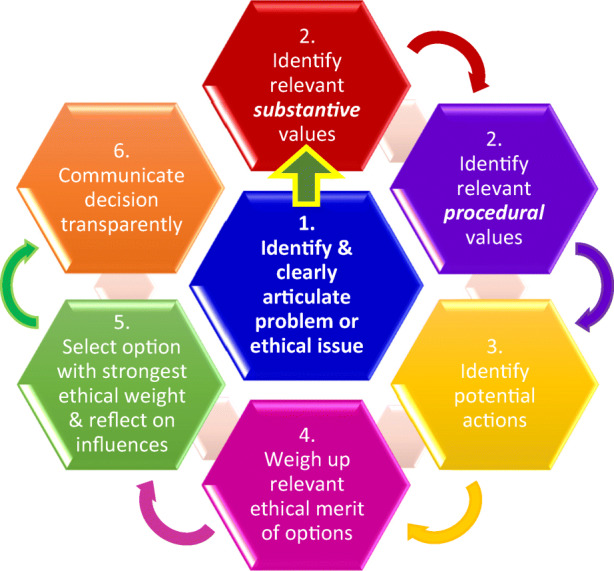
Ethical decision-making frameworks assist in identifying the issues at stake in a particular setting and thinking through, in a methodical manner, the ethical issues that require consideration as well as the values that need to be considered and promoted. Decisions made about the use, sharing, and re-use of big data are complex and laden with values. This paper sets out an Ethics Framework for Big Data in Health and Research developed by a working group convened by the Science, Health and Policy-relevant Ethics in Singapore (SHAPES) Initiative. It presents the aim and rationale for this framework supported by the underlying ethical concerns that relate to all health and research contexts. It also describes a set of substantive and procedural values that can be weighed up in addressing these concerns, and a step-by-step process for identifying, considering, and resolving the ethical issues arising from big data uses in health and research. This Framework is subsequently applied in the papers published in this Special Issue. These papers each address one of six domains where big data is currently employed: openness in big data and data repositories, precision medicine and big data, real-world data to generate evidence about healthcare interventions, AI-assisted decision-making in healthcare, public-private partnerships in healthcare and research, and cross-sectoral big data.
Overview
The claims and statistics of this paper haven’t been checked yet.
Free: it reads the open-access text and checks the first 5 claims that cite a source we can check. Create a free account to check every claim.
Integrity signals
Registry
Cites
Statistics
Figures
Verification
Claims the paper makes
The claims and statistics of this paper haven’t been checked yet.
Free: it reads the open-access text and checks the first 5 claims that cite a source we can check. Create a free account to check every claim.
Claims other papers make about this one
Each is checked against this paper’s own text: does it say what the citing paper says it does?
The source backs part of the claim, not all of it — or backs it for a different population, condition or comparison.
In the citing paper
“In particular, data breaches can lead to discrimination or criminal behavior in stigmatized or vulnerable populations”
From SHIFTing artificial intelligence to be responsible in healthcare: a systematic review (2022) · cites this paper as Xafis et al., 2019
Experimental — accuracy not yet measured
Self-check
Percentages, sums and reported differences re-computed from the paper’s own numbers.
The self-check needs the paper’s full text.
Citations
Cites
Principles of Biomedical Ethics
(2012) · Thieves of Virtue · doi:10.7551/mitpress/9079.003.0009 · Cited by 13,453
Cook, R. J., Dickens, B. M., & Fathalla, M. F. (2003) · Reproductive Health and Human Rights · doi:10.1093/acprof:oso/9780199241323.003.0025 · Cited by 10,769
Critical analysis of Big Data challenges and analytical methods
Sivarajah, U., Kamal, M. M., Irani, Z., & Weerakkody, V. (2017) · Journal of Business Research · doi:10.1016/j.jbusres.2016.08.001 · Cited by 2,066 · cited 4×
“…terms of the following: & ‘ 3 Vs ’ (volume, variety, velocity); & ‘ 4 Vs ’ (volume, variety, velocity, variability); & ‘ 6 Vs ’ (volume, variety, velocity, variability, veracity, value); and & ‘ 7 Vs ’ (volume, variety, velocity, variability, veracity, value, visualisation) (Sivarajah et al. 2017).”
BackgroundInfluentialWang, Y., Kung, L., & Byrd, T. A. (2018) · Technological Forecasting and Social Change · doi:10.1016/j.techfore.2015.12.019 · Cited by 1,571 · cited 2×
“An example of operational benefits that would impact on patients directly is the improvement of the quality and accuracy of clinical decisions (Wang et al. 2018).”
BackgroundThe ethics of big data: current and foreseeable issues in biomedical contexts
Mittelstadt, B. D., & Floridi, L. (2016) · Science and Engineering Ethics · doi:10.1007/s11948-015-9652-2 · Cited by 714 · cited 1×
“Mittelstadt and Floridi talk about ‘ data subjects [being] in a disempowered state, faced with seemingly insurmountable barriers to understanding who holds what data about them, being used for which purposes ’ (Mittelstadt and Floridi 2016).”
BackgroundCouncil for International Organizations of Medical Sciences (CIOMS)
(2025) · Cobert's Manual of Drug Safety and Pharmacovigilance · doi:10.1142/9789811297724_0006 · Cited by 543
Psychological Wisdom Research: Commonalities and Differences in a Growing Field
Staudinger, U. M., & Glück, J. (2011) · Annual Review of Psychology · doi:10.1146/annurev.psych.121208.131659 · Cited by 477 · cited 1×
“Personal and general wisdom incorporate features such as deep insight, sound judgement, acknowledgment, and tolerance of uncertainty, as well as a balanced outlook on solutions (Staudinger 2013; Staudinger and Glück 2011).”
BackgroundElucidating the concept of vulnerability: Layers not labels
Luna, F. (2009) · International Journal of Feminist Approaches to Bioethics · doi:10.2979/fab.2009.2.1.121 · Cited by 471 · cited 2×
“As Luna has argued, it may be less fruitful to think of a person as being vulnerable, than to think of them as being in a situation that renders them vulnerable; ‘ [i]f the situation changes, the person may no longer be considered vulnerable ’ (Luna 2009).”
BackgroundEffects of Mentha suaveolens Essential Oil on Chlamydia trachomatis
Sessa, R., Di Pietro, M., De Santis, F., Filardo, S., Ragno, R., & Angiolella, L. (2015) · BioMed Research International · doi:10.1155/2015/508071 · Cited by 470
The social licence for research: why care.data ran into trouble
Carter, P., Laurie, G. T., & Dixon-Woods, M. (2015) · Journal of Medical Ethics · doi:10.1136/medethics-2014-102374 · Cited by 336 · cited 2×
“…and Research (Ballantyne and Stewart 2019) discusses the destructive effects of deploying big data programmes without adequate clear information, consultation, or public engagement, even if the legal frameworks within which they are designed are sound (Carter et al. 2015; van Staa et al. 2016).”
BackgroundSelf-citationLysaght, T., Lim, H. Y., Xafis, V., & Ngiam, K. Y. (2019) · Asian Bioethics Review · doi:10.1007/s41649-019-00096-0 · Cited by 332 · cited 4×
“This point is touched on in the Domain paper AI-assisted Decision-Making in Healthcare (Lysaght et al. 2019).”
BackgroundInfluentialSelf-citationWhy bioethics needs a concept of vulnerability
Rogers, W., Mackenzie, C., & Dodds, S. (2012) · International Journal of Feminist Approaches to Bioethics · doi:10.2979/intjfemappbio.5.2.11 · Cited by 327 · cited 4×
“Yet this reflects neither how ‘vulnerability’ is used in everyday language, nor its moral importance: as Rogers has suggested, a wide definition of vulnerability ‘obscures rather than enables the identification of the contextspecific needs of particular groups’ (Rogers et al. 2012).”
BackgroundInfluentialCosta, F. F. (2014) · Drug Discovery Today · doi:10.1016/j.drudis.2013.10.012 · Cited by 302 · cited 1×
“…considerations may be applied to research involving children, or on research into rare or ‘ orphan ’ diseases, for which sweeps of large datasets may provide otherwise unavailable insights into prevalence, aetiology, and possible treatment (Costa 2014; Pogue et al. 2018; Austin and Gadhia 2017).”
BackgroundCaliff, R. M., & Muhlbaier, L. H. (2003) · Circulation · doi:10.1161/01.cir.0000085720.65685.90 · Cited by 238
Kass, N. E., Faden, R. R., Goodman, S. N., Pronovost, P., Tunis, S., & Beauchamp, T. L. (2013) · Hastings Center Report · doi:10.1002/hast.133 · Cited by 235 · cited 2×
“Even though we provide discrete definitions, we acknowledge the blurring of boundaries between research and treatment (Kass et al. 2013), which impacts on our definition of ‘ health ’ .”
BackgroundToward a Literature-Driven Definition of Big Data in Healthcare
Baro, E., Degoul, S., Beuscart, R., & Chazard, E. (2015) · BioMed Research International · doi:10.1155/2015/639021 · Cited by 210 · cited 2×
“We will not attempt to provide our own definition of ‘ big data ’ here; we will focus instead on key characteristics frequently associated with the term, all of which point to its complexity (Baro et al. 2015).”
BackgroundBraunack-Mayer, A., Elkin, S., Norris, P., & Wilson, H. J. (2005) · Journal of Bioethical Inquiry · doi:10.1007/bf02448598 · Cited by 201
Advances in experimental medicine and biology
(1984) · International Journal of Biochemistry · doi:10.1016/0020-711x(84)90204-0 · Cited by 191
The second wave: Toward responsible inclusion of pregnant women in research.
Lyerly, A. D., Little, M. O., & Faden, R. (2008) · PubMed · doi:10.1353/ijf.0.0047 · Cited by 189
Andrejevic, M. (2014) · International journal of communication · Cited by 160
Hill, E. M., Turner, E. L., Martin, R. M., & Donovan, J. L. (2013) · BMC Medical Research Methodology · doi:10.1186/1471-2288-13-72 · Cited by 151 · cited 1×
“The expectations of publics regarding the acceptability of big data activities are heavily influenced by the level of engagement with publics and appropriate information dissemination (Hill et al. 2013).”
BackgroundA Lab of Their Own: Genomic sovereignty as postcolonial science policy
Benjamin, R. (2009) · Policy and Society · doi:10.1016/j.polsoc.2009.09.007 · Cited by 149 · cited 1×
“Mexico, for example, has passed a law stipulating that genetic data is property of the government; the use and export of data, particularly when a patentable outcome is envisaged, therefore requires approval (Benjamin 2009; Séguin et al. 2008).”
BackgroundVulnerability in Research Ethics: a Way Forward
Lange, M. M., Rogers, W., & Dodds, S. (2013) · Bioethics · doi:10.1111/bioe.12032 · Cited by 145 · cited 1×
“This lack in turn increases the vulnerability of all pregnant women (Lange et al. 2013; Dodds 2008).”
BackgroundVulnerability: Challenging bioethics
ten Have, H. (2016) · Routledge eBooks · doi:10.4324/9781315624068 · Cited by 141 · cited 1×
“Meanwhile, Henk ten Have suggests that ‘ [w]hat makes vulnerability problematic is the possibility of abuse and exploitation ’ (ten Have 2016).”
BackgroundIntroduction : what is vulnerability and why does it matter for moral theory?
Mackenzie, C., Rogers, W., & Dodds, S. (2014) · eCite Digital Repository (University of Tasmania) · Cited by 127
Respect: Or, How Respect for Persons Became Respect for Autonomy
Lysaught, M. T. (2004) · The Journal of Medicine and Philosophy A Forum for Bioethics and Philosophy of Medicine · doi:10.1080/03605310490883028 · Cited by 122 · cited 1×
“Historically, respect for persons has always been associated with acknowledging and respecting individuals ’ autonomy (Lysaught 2004) but the concept of respect for persons is controversial, primarily because of debates about who counts as a ‘ person ’ .”
BackgroundThe Declaration of Helsinki, CIOMS and the ethics of research on vulnerable populations
Zion, D., Gillam, L. H., & Loff, B. (2000) · Nature Medicine · doi:10.1038/76174 · Cited by 116 · cited 2×
“Vulnerability is also linked to a person ’ s relationship with other people and institutions and can therefore be analysed in terms of agents ’ relative power — economic, political, or intellectual — over their own or others ’ lives (Zion et al. 2000).”
BackgroundRare genetic diseases: update on diagnosis, treatment and online resources
Pogue, R. E., Cavalcanti, D. P., Shanker, S., de Andrade, R. V., Aguiar, L. R., Carvalho, J. L., & Costa, F. F. (2017) · Drug Discovery Today · doi:10.1016/j.drudis.2017.11.002 · Cited by 116 · cited 2×
“As noted above, similar considerations may be applied to research involving children, or on research into rare or ‘orphan’ diseases, for which sweeps of large datasets may provide otherwise unavailable insights into prevalence, aetiology, and possible treatment (Costa 2014; Pogue et al. 2018; Austin and Gadhia 2017).”
BackgroundBig Data Privacy: Challenges to Privacy Principles and Models
Soria-Comas, J., & Domingo‐Ferrer, J. (2015) · Data Science and Engineering · doi:10.1007/s41019-015-0001-x · Cited by 114 · cited 1×
“Privacy models take into account the attributes of a dataset (as well as specific ‘ attacker ’ models) and specify the conditions that the data must satisfy in order for the disclosure risk to be minimised to an acceptable risk level (Soria-Comas and Domingo-Ferrer 2016).”
BackgroundMackenzie, C., Rogers, W., & Dodds, S. (2013) · Vulnerability · doi:10.1093/acprof:oso/9780199316649.003.0001 · Cited by 107
Ethics and Law for the Health Professions.
Kerridge, I., Lowe, M., & McPhee, J. (2005) · Flinders Academic Commons (Flinders University) · Cited by 100
Big health data: the need to earn public trust
van Staa, T.-P., Goldacre, B., Buchan, I., & Smeeth, L. (2016) · BMJ · doi:10.1136/bmj.i3636 · Cited by 95 · cited 1×
“…and Research (Ballantyne and Stewart 2019) discusses the destructive effects of deploying big data programmes without adequate clear information, consultation, or public engagement, even if the legal frameworks within which they are designed are sound (Carter et al. 2015; van Staa et al. 2016).”
BackgroundThe Scientific Study of Personal Wisdom
(2012) · Springer eBooks · doi:10.1007/978-90-481-9231-1 · Cited by 87
The Need to Distinguish Personal from General Wisdom: A Short History and Empirical Evidence
Staudinger, U. M. (2013) · Springer eBooks · doi:10.1007/978-94-007-7987-7_1 · Cited by 73 · cited 1×
“Personal and general wisdom incorporate features such as deep insight, sound judgement, acknowledgment, and tolerance of uncertainty, as well as a balanced outlook on solutions (Staudinger 2013; Staudinger and Glück 2011).”
BackgroundVulnerability: Challenging Bioethics
ten Have, H. (2016) · Cited by 67
Ballantyne, A., & Stewart, C. (2019) · Asian Bioethics Review · doi:10.1007/s41649-019-00100-7 · Cited by 65 · cited 6×
“The domain paper on Big Data and Public-Private Partnerships in Healthcare and Research (Ballantyne and Stewart 2019) discusses the destructive effects of deploying big data programmes without adequate clear information, consultation, or public engagement, even if the legal frameworks within which…”
BackgroundInfluentialSelf-citationXafis, V. (2015) · BMC Medical Ethics · doi:10.1186/s12910-015-0070-4 · Cited by 64 · cited 1×
“Social licence depends on the specific context for a data activity (Xafis 2015), the partners involved, and local cultural norms.”
BackgroundSelf-citationEthical Frameworks in Public Health Decision-Making: Defending a Value-Based and Pluralist Approach
Grill, K., & Dawson, A. (2015) · Health Care Analysis · doi:10.1007/s10728-015-0299-6 · Cited by 57 · cited 1×
“& If there are underlying assumptions that implicitly give priority to a value, a framework can reinforce certain positions rather than being genuinely exploratory of all relevant values (Dawson 2010; Grill and Dawson 2017).”
BackgroundSéguin, B., Hardy, B.-J., SINGER, P. A., & Daar, A. S. (2008) · Nature Reviews Genetics · doi:10.1038/nrg2442 · Cited by 57 · cited 1×
“Mexico, for example, has passed a law stipulating that genetic data is property of the government; the use and export of data, particularly when a patentable outcome is envisaged, therefore requires approval (Benjamin 2009; Séguin et al. 2008).”
BackgroundPersonalized Medicine: What’s in it for Rare Diseases?
Halfmann, S. S. G., Mählmann, L., Leyens, L., Reumann, M., & Brand, A. M. (2017) · Advances in experimental medicine and biology · doi:10.1007/978-3-319-67144-4_22 · Cited by 48 · cited 1×
“However, for some problems that need to be addressed with this notion, see (Halfmann et al. 2017).”
BackgroundSchaefer, G. O., Tai, E. S., & Sun, S. H.-L. (2019) · Asian Bioethics Review · doi:10.1007/s41649-019-00094-2 · Cited by 40 · cited 1×
“Precision medicine and big data (Schaefer et al. 2019) 3.”
Self-citationBalancing in Ethical Deliberation: Superior to Specification and Casuistry
DeMarco, J., & FORD, P. (2006) · The Journal of Medicine and Philosophy A Forum for Bioethics and Philosophy of Medicine · doi:10.1080/03605310600912675 · Cited by 38 · cited 2×
“The justifications and reasoning provided for considering one value to hold greater importance than another help promote and further moral debate and provide a clear basis on which decisions have been reached (Demarco and Ford 2006).”
BackgroundEthics and law for the health professions. 4th ed.
Komesaroff, P. A. (2014) · Australian Prescriber · doi:10.18773/austprescr.2014.009 · Cited by 35
Xafis, V., & Labude, M. K. (2019) · Asian Bioethics Review · doi:10.1007/s41649-019-00097-z · Cited by 35 · cited 1×
“Explicit articulation of the steps above is exemplified in the first of the domain papers (Xafis and Labude 2019) presented in this Special Issue.”
BackgroundSelf-citationReal-world Data to Generate Evidence About Healthcare Interventions
Lipworth, W. L. (2019) · Asian Bioethics Review · doi:10.1007/s41649-019-00095-1 · Cited by 33 · cited 2×
“Gathering real-world data on any sequelae may therefore be the only available method of learning about effectiveness and side effects, and therefore of ameliorating vulnerability (see for example (Lipworth 2019)).”
BackgroundMethodSelf-citationMedication Safety During Pregnancy: Improving Evidence‐Based Practice
Sinclair, S. M., Miller, R. K., Chambers, C., & Cooper, E. (2016) · Journal of Midwifery & Women s Health · doi:10.1111/jmwh.12358 · Cited by 31 · cited 2×
“…there are gaps in our knowledge about how drugs affect around half the people using them due to differences between the male and female physiology and yet the drugs may get administered to women all the same, not least in the time before a woman knows that she is pregnant (Sinclair et al. 2016).”
BackgroundTheory and practice in public health ethics: a complex relationship
Dawson, A. (2009) · Policy Press eBooks · doi:10.1332/policypress/9781847421029.003.0012 · Cited by 30 · cited 4×
“This Framework is a tool for deliberating about issues related to big data by bringing to the fore relevant values which guide or ‘ frame ’ decision-making (Dawson 2010).”
BackgroundMethodInfluentialPublic health ethics and practice
(2009) · Bristol University Press eBooks · doi:10.2307/j.ctt9qgr52 · Cited by 28
Statistical Disclosure Control for Microdata: Methods and Applications in R
Templ, M. (2017) · Springer eBooks · doi:10.1007/978-3-319-50272-4 · Cited by 22 · cited 1×
“” (Personal Data Protection Commission Singapore 2018) & inferential disclosure — when information about person X can be inferred with high confidence with released data (Templ 2017).”
BackgroundCross-Sectoral Big Data: The Application of an Ethics Framework for Big Data in Health and Research
Laurie, G. T. (2019) · Asian Bioethics Review · doi:10.1007/s41649-019-00093-3 · Cited by 22
Self-citationThe Need to Distinguish Personal from General Wisdom: A Short History and Empirical Evidence
Staudinger, U. M. (2012) · Springer eBooks · doi:10.1007/978-90-481-9231-1_1 · Cited by 20
New Therapeutic Uses for Existing Drugs
Austin, B. A., & Gadhia, A. D. (2017) · Advances in experimental medicine and biology · doi:10.1007/978-3-319-67144-4_14 · Cited by 19 · cited 1×
“…considerations may be applied to research involving children, or on research into rare or ‘ orphan ’ diseases, for which sweeps of large datasets may provide otherwise unavailable insights into prevalence, aetiology, and possible treatment (Costa 2014; Pogue et al. 2018; Austin and Gadhia 2017).”
BackgroundBeyond Consent: Respect for Community in Genetic Research
Jones, D. J., Bush, P. L., & Macaulay, A. C. (2014) · Wiley eBooks · doi:10.1002/9780470015902.a0005179.pub2 · Cited by 18 · cited 1×
“Co-governance Co-governance implies ‘[s]haring and allocating roles, funds, responsibilities [and] powers’, and sharing in the formulation of the protocols for research programmes (Jones et al. 2001).”
BackgroundAnonymization in the Time of Big Data
Domingo‐Ferrer, J., & Soria-Comas, J. (2016) · Lecture notes in computer science · doi:10.1007/978-3-319-45381-1_5 · Cited by 18 · cited 3×
“However, for the reasons given above, the anonymisation of data with the aid of privacy models is not perfect because these models were originally developed for static data sets rather than for use in the big data environment (Domingo-Ferrer and Soria-Comas 2016).”
BackgroundInfluentialInclusion and exclusion in women's access to health and medicine
Dodds, S. (2008) · International Journal of Feminist Approaches to Bioethics · doi:10.2979/fab.2008.1.2.58 · Cited by 12 · cited 1×
“This lack in turn increases the vulnerability of all pregnant women (Lange et al. 2013; Dodds 2008).”
BackgroundCommunity Consent for Genetic Research
Weijer, C. (2006) · Encyclopedia of Life Sciences · doi:10.1038/npg.els.0005179 · Cited by 5 · cited 1×
“Appealing to the idea that a community may have representatives to speak on its behalf (Weijer 2006) simply changes the form of the problem: what does it mean to be representative, or a representative, of a group?”
Background
Research works printed but not linked: 1
- Department of Health and Human Services. 2017. Code of Federal Regulations - title 45 public welfare CFR. Vol. 46. U.S. Dept of Health and Human Services.
Cited by
Health information technology and digital innovation for national learning health and care systems
Sheikh, A., Anderson, M., Albala, S., Casadei, B., Franklin, B. D., Richards, M., Taylor, D., Tibble, H., & Mossialos, E. (2021) · The Lancet Digital Health · doi:10.1016/s2589-7500(21)00005-4 · Cited by 389
SHIFTing artificial intelligence to be responsible in healthcare: a systematic review
Siala, H., & Wang, Y. (2022) · Social Science & Medicine · doi:10.1016/j.socscimed.2022.114782 · Cited by 358
Lysaght, T., Lim, H. Y., Xafis, V., & Ngiam, K. Y. (2019) · Asian Bioethics Review · doi:10.1007/s41649-019-00096-0 · Cited by 332
“The CDSS can predict outcomes based on these and other social determinants of health, which can lead to further discrimination of already-marginalised groups and communities, as discussed in Xafis et al. (2019).”
BackgroundMethodSelf-citationDigital tools against COVID-19: taxonomy, ethical challenges, and navigation aid
Gasser, U., Ienca, M., Scheibner, J., Sleigh, J., & Vayena, E. (2020) · The Lancet Digital Health · doi:10.1016/s2589-7500(20)30137-0 · Cited by 314
The value of standards for health datasets in artificial intelligence-based applications
Arora, A., Alderman, J. E., Palmer, J., Ganapathi, S., Laws, E., McCradden, M. D., Oakden-Rayner, L., Pfohl, S. R., Ghassemi, M., McKay, F., et al. (2023) · Nature Medicine · doi:10.1038/s41591-023-02608-w · Cited by 294
“Finally, two records discussed how data quality can be improved by involving clinical experts when developing the data-collection strategy 5,25 .”
Background
Metadata
- Authors
- Xafis, V., Schaefer, G. O., Labude, M. K., Brassington, I., Ballantyne, A., Lim, H. Y., Lipworth, W., Lysaght, T., Stewart, C., Sun, S., Laurie, G. T., & Tai, E. S.
- Affiliations
- National University of Singapore (SG)
- University of Manchester (GB)
- University of Otago (NZ)
- The University of Sydney (AU)
- Nanyang Technological University (SG)
- University of Edinburgh (GB)
- Corresponding author
- Xafis, Vicki
- ORCID
- Venue
- Asian Bioethics Review
- Published
- 2019-09
- Volume
- 11
- Issue
- 3
- Pages
- 227-254
- ISSN
- 1793-8759 (ISSN-L)
- 1793-9453
- PMC
- PMC7747261
- OpenAlex
- W2978159570
- Cited by
- 136
- References
- 58
- Citations by year
- 2026: 12 · 2025: 13 · 2024: 27 · 2023: 19 · 2022: 20 · 2021: 26 · 2020: 12 · 2019: 7
- FWCI
- 14.97
- Type
- journal article
- Language
- en
- Open access
- hybrid
- doi.org
- Licence
- cc-by
- creativecommons.org/licenses/by/4.0 (tdm)
- creativecommons.org/licenses/by/4.0 (vor, 30 d)
- Locations
- Asian Bioethics Review (publishedVersion, cc-by)
- PubMed Central (publishedVersion, cc-by)
- PubMed (publishedVersion)
- Research Explorer (The University of Manchester) (publishedVersion, cc-by)
- PhilPapers (PhilPapers Foundation) (submittedVersion, cc-by)
- The Sydney eScholarship Repository (The University of Sydney) (submittedVersion, cc-by)
- National University of Singapore (submittedVersion)
- DR-NTU (Nanyang Technological University) (submittedVersion, cc-by)
- PhilPapers (PhilPapers Foundation) (submittedVersion)
- Funders
- National Medical Research Council (NMRC Funding Initiative (SHAPES))
- Topics
- Health Sciences › Medicine › Public Health, Environmental and Occupational Health › Ethics in Clinical Research
- Health Sciences › Medicine › Health Informatics › Artificial Intelligence in Healthcare and Education
- Health Sciences › Medicine › Public Health, Environmental and Occupational Health › Ethics and bioethics in healthcare
- Keywords
- big data ethics, ethical decision-making framework, health data, research data, data sharing and reuse, data repositories, precision medicine, real-world data, AI-assisted decision-making, public-private partnerships
About these checks
Registry, retraction, Cites and statistics results are computed, not judged, with one exception: a printed reference that no index lists is read once by a model before it counts as a citation error. Claims are extracted by a model and kept only when their quote appears verbatim in the text; each cited source is then checked, with a model’s help, for whether it says what the claim relies on. Those verdicts can be wrong — read the claim’s quote and the cited source before relying on one.
Statistics and arithmetic are recomputed, not judged.
Confidence bands are shown only for fields calibrated on our annotated test set. None is calibrated yet, so no band is shown.
What counts as a claim ›How we measure confidence ›How we check this ›
Are you an author, or do you see a problem with this page? Request a review
Data sources
Bibliographic data: Semantic Scholar, OpenAlex, Crossref.
Contains information from the Semantic Scholar Academic Graph Datasets, made available under the ODC Attribution License (ODC-BY 1.0).
Semantic Scholar’s data is described in: Kinney, R., et al. (2023). The Semantic Scholar Open Data Platform. arXiv:2301.10140.
