

An Ethics Framework for Big Data in Health and Research
Open accessThe DOI matches its Crossref record; 57 of the 58 references it cites were found in a registry or an index.
Abstract
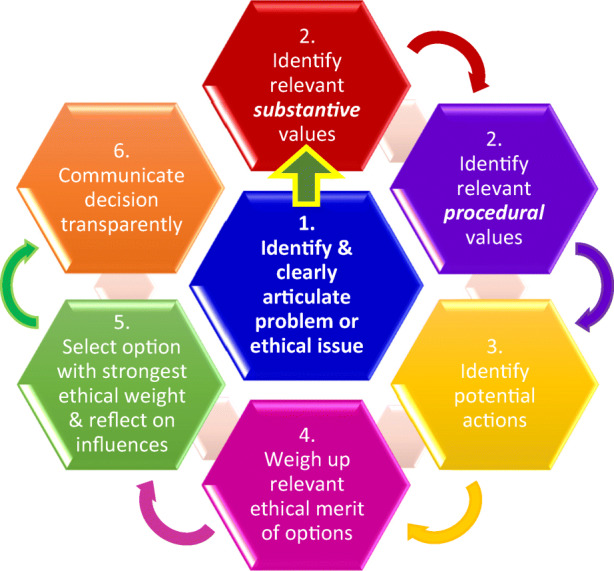
Ethical decision-making frameworks assist in identifying the issues at stake in a particular setting and thinking through, in a methodical manner, the ethical issues that require consideration as well as the values that need to be considered and promoted. Decisions made about the use, sharing, and re-use of big data are complex and laden with values. This paper sets out an Ethics Framework for Big Data in Health and Research developed by a working group convened by the Science, Health and Policy-relevant Ethics in Singapore (SHAPES) Initiative. It presents the aim and rationale for this framework supported by the underlying ethical concerns that relate to all health and research contexts. It also describes a set of substantive and procedural values that can be weighed up in addressing these concerns, and a step-by-step process for identifying, considering, and resolving the ethical issues arising from big data uses in health and research. This Framework is subsequently applied in the papers published in this Special Issue. These papers each address one of six domains where big data is currently employed: openness in big data and data repositories, precision medicine and big data, real-world data to generate evidence about healthcare interventions, AI-assisted decision-making in healthcare, public-private partnerships in healthcare and research, and cross-sectoral big data.
Overview
The claims and statistics of this paper haven’t been checked yet.
Free: it reads the open-access text and checks the first 5 claims that cite a source we can check. Create a free account to check every claim.
Integrity signals
Registry
Cites
Statistics
Figures
Verification
Claims the paper makes
The claims and statistics of this paper haven’t been checked yet.
Free: it reads the open-access text and checks the first 5 claims that cite a source we can check. Create a free account to check every claim.
Claims other papers make about this one
Each is checked against this paper’s own text: does it say what the citing paper says it does?
The source backs part of the claim, not all of it — or backs it for a different population, condition or comparison.
In the citing paper
“In particular, data breaches can lead to discrimination or criminal behavior in stigmatized or vulnerable populations”
From SHIFTing artificial intelligence to be responsible in healthcare: a systematic review (2022) · cites this paper as Xafis et al., 2019
Experimental — accuracy not yet measured
Self-check
Percentages, sums and reported differences re-computed from the paper’s own numbers.
The self-check needs the paper’s full text.
Citations
Cites
Principles of Biomedical Ethics
(2012) · Thieves of Virtue · doi:10.7551/mitpress/9079.003.0009 · Cited by 13,453
Cook, R. J., Dickens, B. M., & Fathalla, M. F. (2003) · Reproductive Health and Human Rights · doi:10.1093/acprof:oso/9780199241323.003.0025 · Cited by 10,769
Critical analysis of Big Data challenges and analytical methods
Sivarajah, U., Kamal, M. M., Irani, Z., & Weerakkody, V. (2017) · Journal of Business Research · doi:10.1016/j.jbusres.2016.08.001 · Cited by 2,066 · cited 4×
“…terms of the following: & ‘ 3 Vs ’ (volume, variety, velocity); & ‘ 4 Vs ’ (volume, variety, velocity, variability); & ‘ 6 Vs ’ (volume, variety, velocity, variability, veracity, value); and & ‘ 7 Vs ’ (volume, variety, velocity, variability, veracity, value, visualisation) (Sivarajah et al. 2017).”
BackgroundInfluentialWang, Y., Kung, L., & Byrd, T. A. (2018) · Technological Forecasting and Social Change · doi:10.1016/j.techfore.2015.12.019 · Cited by 1,571 · cited 2×
“An example of operational benefits that would impact on patients directly is the improvement of the quality and accuracy of clinical decisions (Wang et al. 2018).”
BackgroundThe ethics of big data: current and foreseeable issues in biomedical contexts
Mittelstadt, B. D., & Floridi, L. (2016) · Science and Engineering Ethics · doi:10.1007/s11948-015-9652-2 · Cited by 714 · cited 1×
“Mittelstadt and Floridi talk about ‘ data subjects [being] in a disempowered state, faced with seemingly insurmountable barriers to understanding who holds what data about them, being used for which purposes ’ (Mittelstadt and Floridi 2016).”
BackgroundCouncil for International Organizations of Medical Sciences (CIOMS)
(2025) · Cobert's Manual of Drug Safety and Pharmacovigilance · doi:10.1142/9789811297724_0006 · Cited by 543
Psychological Wisdom Research: Commonalities and Differences in a Growing Field
Staudinger, U. M., & Glück, J. (2011) · Annual Review of Psychology · doi:10.1146/annurev.psych.121208.131659 · Cited by 477 · cited 1×
“Personal and general wisdom incorporate features such as deep insight, sound judgement, acknowledgment, and tolerance of uncertainty, as well as a balanced outlook on solutions (Staudinger 2013; Staudinger and Glück 2011).”
BackgroundElucidating the concept of vulnerability: Layers not labels
Luna, F. (2009) · International Journal of Feminist Approaches to Bioethics · doi:10.2979/fab.2009.2.1.121 · Cited by 471 · cited 2×
“As Luna has argued, it may be less fruitful to think of a person as being vulnerable, than to think of them as being in a situation that renders them vulnerable; ‘ [i]f the situation changes, the person may no longer be considered vulnerable ’ (Luna 2009).”
BackgroundEffects of Mentha suaveolens Essential Oil on Chlamydia trachomatis
Sessa, R., Di Pietro, M., De Santis, F., Filardo, S., Ragno, R., & Angiolella, L. (2015) · BioMed Research International · doi:10.1155/2015/508071 · Cited by 470
Research works printed but not linked: 1
- Department of Health and Human Services. 2017. Code of Federal Regulations - title 45 public welfare CFR. Vol. 46. U.S. Dept of Health and Human Services.
Cited by
Health information technology and digital innovation for national learning health and care systems
Sheikh, A., Anderson, M., Albala, S., Casadei, B., Franklin, B. D., Richards, M., Taylor, D., Tibble, H., & Mossialos, E. (2021) · The Lancet Digital Health · doi:10.1016/s2589-7500(21)00005-4 · Cited by 389
SHIFTing artificial intelligence to be responsible in healthcare: a systematic review
Siala, H., & Wang, Y. (2022) · Social Science & Medicine · doi:10.1016/j.socscimed.2022.114782 · Cited by 358
Lysaght, T., Lim, H. Y., Xafis, V., & Ngiam, K. Y. (2019) · Asian Bioethics Review · doi:10.1007/s41649-019-00096-0 · Cited by 332
“The CDSS can predict outcomes based on these and other social determinants of health, which can lead to further discrimination of already-marginalised groups and communities, as discussed in Xafis et al. (2019).”
BackgroundMethodSelf-citationDigital tools against COVID-19: taxonomy, ethical challenges, and navigation aid
Gasser, U., Ienca, M., Scheibner, J., Sleigh, J., & Vayena, E. (2020) · The Lancet Digital Health · doi:10.1016/s2589-7500(20)30137-0 · Cited by 314
The value of standards for health datasets in artificial intelligence-based applications
Arora, A., Alderman, J. E., Palmer, J., Ganapathi, S., Laws, E., McCradden, M. D., Oakden-Rayner, L., Pfohl, S. R., Ghassemi, M., McKay, F., et al. (2023) · Nature Medicine · doi:10.1038/s41591-023-02608-w · Cited by 294
“Finally, two records discussed how data quality can be improved by involving clinical experts when developing the data-collection strategy 5,25 .”
BackgroundShaping the future of AI in healthcare through ethics and governance
Bouderhem, R. (2024) · Humanities and Social Sciences Communications · doi:10.1057/s41599-024-02894-w · Cited by 162
Operationalising ethics in artificial intelligence for healthcare: a framework for AI developers
Solanki, P., Grundy, J., & Hussain, W. (2023) · AI and Ethics · doi:10.1007/s43681-022-00195-z · Cited by 157
“Trade-offs between ethical principles should be care-fully reasoned in this context and clearly documented [123], making use of frameworks such as that offered in [185] to evaluate ethical tensions.”
BackgroundAmann, J., Vayena, E., Ormond, K. E., Frey, D., Madai, V. I., & Blasimme, A. (2023) · PLOS ONE · doi:10.1371/journal.pone.0279088 · Cited by 106
The social licence for data-intensive health research: towards co-creation, public value and trust
Muller, S. H. A., Kalkman, S., van Thiel, G. J. M. W., Mostert, M., & van Delden, J. J. M. (2021) · BMC Medical Ethics · doi:10.1186/s12910-021-00677-5 · Cited by 104
Milne, R., Morley, K. I., Almarri, M. A., Anwer, S., Atutornu, J., Baranova, E. E., Bevan, P., Cerezo, M., Cong, Y., Costa, A., et al. (2021) · Genome Medicine · doi:10.1186/s13073-021-00903-0 · Cited by 81
Incorporation of “Artificial Intelligence” for Objective Pain Assessment: A Comprehensive Review
El-Tallawy, S. N., Pergolizzi, J. V., Vasiliu-Feltes, I., Ahmed, R. S., LeQuang, J. A., El-Tallawy, H. N., Varrassi, G., & Nagiub, M. S. (2024) · Pain and Therapy · doi:10.1007/s40122-024-00584-8 · Cited by 104
Mapping the regulatory landscape of AI in healthcare in Africa
Townsend, B. A., Sihlahla, I., Naidoo, M., Naidoo, S., Donnelly, D.-L., & Thaldar, D. W. (2023) · Frontiers in Pharmacology · doi:10.3389/fphar.2023.1214422 · Cited by 76
“The use and processing of personal data, and in particular sensitive health data and electronic health records, are well described, as are securing and protecting large-scale data sets against unauthorised collection, access, processing, storage, and distribution (Goodman, 2016; Bari and O’ Neill, 2019; Xafis et al.,…”
Amugongo, L. M., Kriebitz, A., Boch, A., & Lütge, C. (2025) · AI and Ethics · doi:10.1007/s43681-023-00331-3 · Cited by 68
“Finally, trade-offs between ethical principles should be thoughtfully considered and well-documented [71], utilising frameworks such as the one proposed by [72] to assess ethical tensions.”
Ballantyne, A., & Stewart, C. (2019) · Asian Bioethics Review · doi:10.1007/s41649-019-00100-7 · Cited by 65
“The paradox is that those with most at stake may have least capacity to exert influence (see the discussion on vulnerability in Xafis et al. (2019)).”
BackgroundSelf-citationLocal public services and the ethical deployment of artificial intelligence
Kinder, T., Stenvall, J., Koskimies, E., Webb, H. C., & Janenova, S. (2023) · Government Information Quarterly · doi:10.1016/j.giq.2023.101865 · Cited by 99
Richter, G., Borzikowsky, C., Lesch, W., Semler, S. C., Bunnik, E. M., Buyx, A., & Krawczak, M. (2020) · European Journal of Human Genetics · doi:10.1038/s41431-020-00735-3 · Cited by 62
“agreement on the preconditions for responsible and, hence, ethically acceptable data sharing, including the protection of privacy, minimization of risks, data security, transparency as well as public information and trust [32], little is known about the attitude of the data subjects themselves [31, 33].”
Ethical Responsibilities for Companies That Process Personal Data
McCoy, M. S., Allen, A. L., Kopp, K., Mello, M. M., Patil, D. J., Ossorio, P. N., Joffe, S., & Emanuel, E. (2023) · The American Journal of Bioethics · doi:10.1080/15265161.2023.2209535 · Cited by 74
“Commentators have identified as many as 16 distinct substantive and procedural principles related to the collection and use of personal data (Xafis et al. 2019).”
BackgroundSamuel, G. N., Chubb, J., & Derrick, G. (2021) · Journal of Empirical Research on Human Research Ethics · doi:10.1177/15562646211002744 · Cited by 67
“…that population health research ethics needs to open-up; it needs to revolve around a public health ethics framework, focusing on justice, promoting population health, and reducing inequalities, rather than protecting individuals from potential research harm (Ballantyne, 2019; Xa fi s et al., 2019).”
BackgroundDigital Contact Tracing for Pandemic Response
Kahn, J. P. (2020) · Johns Hopkins University Press eBooks · doi:10.1353/book.75831 · Cited by 59
Ranisch, R., Nijsingh, N., Ballantyne, A., van Bergen, A., Buyx, A., Friedrich, O., Hendl, T., Marckmann, G., Munthe, C., & Wild, V. (2020) · Ethics and Information Technology · doi:10.1007/s10676-020-09566-8 · Cited by 68
“…possible loss of privacy and risks related to an effective CT app may appear justifiable in light of the enormous costs in terms of welfare, liberty and health outcomes of either letting the virus run its course or maintaining comprehensive restrictions or lockdowns (Schaefer and Ballantyne 2020).”
BackgroundMethodSelf-citationFirst do no harm: An exploration of researchers’ ethics of conduct in Big Data behavioral studies
Favaretto, M., Clercq, E. D., Gaab, J., & Elger, B. S. (2020) · PLoS ONE · doi:10.1371/journal.pone.0241865 · Cited by 81
Staunton, C., Tschigg, K., & Sherman, G. G. (2021) · PLoS ONE · doi:10.1371/journal.pone.0260341 · Cited by 63
Samuel, G. N., & Richie, C. (2022) · Journal of Medical Ethics · doi:10.1136/jme-2022-108489 · Cited by 57
Braunack-Mayer, A. J., Street, J. M., Tooher, R., Feng, X., & Scharling-Gamba, K. (2020) · Review of Educational Research · doi:10.3102/0034654320960213 · Cited by 41
“First, the papers we reviewed were relatively quiet on the “big data divide” (Xafis et al., 2019): the fact that the benefits arising from collecting and using big data are not evenly distributed.”
BackgroundMethodInfluentialArtificial intelligence in medicine: Ethical, social and legal perspectives
Sung, J. J. �. (2023) · Annals of the Academy of Medicine Singapore · doi:10.47102/annals-acadmedsg.2023103 · Cited by 40
Schaefer, G. O., Tai, E. S., & Sun, S. H.-L. (2019) · Asian Bioethics Review · doi:10.1007/s41649-019-00094-2 · Cited by 40
“However, this approach must be taken with caution, as it is not always clear who does or should speak for a ‘ community ’ (see Xafis et al. 2019 for further discussion of group harms and co-governance).”
BackgroundMethodInfluentialSelf-citationXafis, V., & Labude, M. K. (2019) · Asian Bioethics Review · doi:10.1007/s41649-019-00097-z · Cited by 35
Self-citationReal-world Data to Generate Evidence About Healthcare Interventions
Lipworth, W. L. (2019) · Asian Bioethics Review · doi:10.1007/s41649-019-00095-1 · Cited by 33
Self-citationDigital tools against COVID-19: Framing the ethical challenges and how to address themPreprint
Gasser, U., Ienca, M., Scheibner, J., Sleigh, J., & Vayena, E. (2020) · arXiv (Cornell University) · doi:10.48550/arxiv.2004.10236 · Cited by 31
A qualitative study of big data and the opioid epidemic: recommendations for data governance
Evans, E., Delorme, E., Cyr, K. D., & Goldstein, D. M. (2020) · BMC Medical Ethics · doi:10.1186/s12910-020-00544-9 · Cited by 33
Perceptions of ‘Precision’ and ‘Personalised’ Medicine in Singapore and Associated Ethical Issues
Ong, S. A. K., Ling, J., Ballantyne, A., Lysaght, T., & Xafis, V. (2021) · Asian Bioethics Review · doi:10.1007/s41649-021-00165-3 · Cited by 32
Self-citationMapping ethico‐legal principles for the use of artificial intelligence in gastroenterology
Stewart, C. L., Wong, S. K. Y., & Sung, J. J. �. (2021) · Journal of Gastroenterology and Hepatology · doi:10.1111/jgh.15521 · Cited by 28
Self-citationMulti-chaos, fractal and multi-fractional AI in different complex systems
Karaca, Y. (2022) · Elsevier eBooks · doi:10.1016/b978-0-323-90032-4.00016-x · Cited by 30
Cybersecurity, Ethics, and Collective Responsibility
Miller, S., & Bossomaier, T. (2024) · doi:10.1093/oso/9780190058135.001.0001 · Cited by 18
Reed‐Berendt, R., Dove, E. S., Pareek, M., & UK‐REACH Study Collaborative Group (2021) · Ethics & Human Research · doi:10.1002/eahr.500111 · Cited by 25
Cross-Sectoral Big Data: The Application of an Ethics Framework for Big Data in Health and Research
Laurie, G. T. (2019) · Asian Bioethics Review · doi:10.1007/s41649-019-00093-3 · Cited by 22
Self-citationFavaretto, M., Clercq, E. D., Briel, M., & Elger, B. S. (2020) · Journal of Empirical Research on Human Research Ethics · doi:10.1177/1556264620935223 · Cited by 20
Advancing a Data Justice Framework for Public Health Surveillance
Buchbinder, M. H., Juengst, E. T., Rennie, S., Blue, C. M., & Rosen, D. L. (2022) · AJOB Empirical Bioethics · doi:10.1080/23294515.2022.2063997 · Cited by 22
Kerr, J. I., Naegelin, M., Benk, M., von Wangenheim, F., Meins, E., Viganò, E., & Ferrario, A. (2023) · Journal of Medical Internet Research · doi:10.2196/44131 · Cited by 24
“It is of great importance in the context of digital health, as health technology providers are not operating under professional codes of ethics that usually guide professional mental health therapists and clinicians and do not have to answer to ethics committees like researchers have to [62,97].”
Data reuse in agricultural genomics research: challenges and recommendations
Hafner, A., DeLeo, V. L., Deng, C. H., Elsik, C. G., Fleming, D. S., Harrison, P. W., Kalbfleisch, T., Petry, B., Pucker, B., Quezada-Rodríguez, E. H., et al. (2025) · GigaScience · doi:10.1093/gigascience/giae106 · Cited by 19
Use of Population-Level Administrative Data in Developmental Science
Milne, B. J., D’Souza, S., Andersen, S. H., & Richmond‐Rakerd, L. S. (2022) · Annual Review of Developmental Psychology · doi:10.1146/annurev-devpsych-120920-023709 · Cited by 16
Kirana, P., Güdeloğlu, A., Sansone, A., & Sokolakis, I. (2023) · Sexual Medicine · doi:10.1093/sexmed/qfad032 · Cited by 16
Lock, C., Tan, N. S. M., Long, I. J., & Keong, N. C. H. (2024) · Frontiers in Artificial Intelligence · doi:10.3389/frai.2023.1286266 · Cited by 19
Artificial intelligence in health and bioethical implications: a systematic review
Elias, M. A., Faversani, L. A., Moreira, J. A. V., Masiero, A. V., & da Cunha, N. V. (2023) · Revista Bioética · doi:10.1590/1983-803420233542pt · Cited by 25
“Big data tools, that is, the storage and analysis of voluminous data, such as those used in healthcare, can also be used in association with AI 5 .”
MethodSharing Practices for Datasets Related to Accessibility and Aging
Kamikubo, R., Dwivedi, U., & Kacorri, H. (2021) · Proceedings of the 23rd International ACM SIGACCESS Conference on Computers and Accessibility · doi:10.1145/3441852.3471208 · Cited by 13
Daten teilen für die Forschung: Einstellungen und Perspektiven zur Datenspende in Deutschland
Lesch, W., Richter, G., & Semler, S. C. (2021) · Springer eBooks · doi:10.1007/978-3-662-62987-1_11 · Cited by 17
Toward Systems Models for Obesity Prevention: A Big Role for Big Data
Tufford, A., Diou, C., Lucassen, D. A., Ioakimidis, I., O’Malley, G., Alagialoglou, L., Charmandari, E., Doyle, G., Filis, K., Kassari, P., et al. (2022) · Current Developments in Nutrition · doi:10.1093/cdn/nzac123 · Cited by 14
Publicly Available Health Research Datasets: Opportunities and Responsibilities
BaHammam, A. S., & Chee, M. W. L. (2022) · Nature and Science of Sleep · doi:10.2147/nss.s390292 · Cited by 15
Müller, R., Kuhn, E. M., Ranisch, R., Hunger, J., & Primc, N. (2023) · Ethics and Information Technology · doi:10.1007/s10676-023-09677-y · Cited by 11
Sung, J. J. �., Savulescu, J., Ngiam, K. Y., An, B., Ang, T. L., Yeoh, K. G., Cham, T., Tsao, S. K. K., & Chua, T. (2023) · Journal of Gastroenterology and Hepatology · doi:10.1111/jgh.16241 · Cited by 14
Allen, J. W., Schaefer, G. O., Mann, S. P., Earp, B. D., & Wilkinson, D. J. C. (2024) · Research Ethics · doi:10.1177/17470161241298726 · Cited by 16
“For example, public concerns about the transparency and accountability of LLMs in handling personal data could lead to resistance or outright rejection of their use in CRC, similar to the backlash seen in other data-intensive health research initiatives (Xafis et al., 2019).”
Self-citationEthical Issues of Gamification in Healthcare: The Need to be Involved
Coelho, L., & Reis, S. (2021) · Advances in Medical Technologies and Clinical Practice · doi:10.4018/978-1-7998-7472-0.ch001 · Cited by 11
Richter, G., Loh, W., Buyx, A., von Kielmansegg, S. G., & GmbH, S.-V. (2021) · Springer eBooks · doi:10.1007/978-3-662-62987-1 · Cited by 14
Promoting Data Sharing: The Moral Obligations of Public Funding Agencies
Wendelborn, C., Anger, M., & Schickhardt, C. (2024) · Science and Engineering Ethics · doi:10.1007/s11948-024-00491-3 · Cited by 14
“Some authors warn that this increases risks of stigmatisation and discrimination of marginalised groups (Favaretto et al., 2019; Reed-Berendt et al., 2022; Xafis et al., 2019).”
BackgroundViaña, J. N. M., Pilbeam, C., Howard, M., Scholz, B., Ge, Z., Fisser, C., Mitchell, I., Raman, S., & Leach, J. (2023) · OMICS A Journal of Integrative Biology · doi:10.1089/omi.2023.0120 · Cited by 10
“The development of devices, sensors, and software platforms for patients, carers, and health care providers leads to data access and privacy concerns (Jokinen et al., 2021; Kalkman et al., 2019; Xafis et al., 2019).”
Stakeholder interactions and ethical imperatives in big data and AI development
Brodny, J., & Tutak, M. (2025) · Journal of Open Innovation Technology Market and Complexity · doi:10.1016/j.joitmc.2025.100491 · Cited by 22
Braunack‐Mayer, A., Carolan, L., Street, J., Ha, T., Fabrianesi, B., & Carter, S. M. (2023) · PLoS ONE · doi:10.1371/journal.pone.0282285 · Cited by 14
A Future-Focused Lens to Equipping Biomedical Engineering Graduates for an Evolving Field
Lam, G., Hueck, I. S., Rivera, C., & Widder, P. (2025) · Biomedical Engineering Education · doi:10.1007/s43683-025-00186-6 · Cited by 10
“A biomedical data science ethics framework [57], for example, was implemented to organize and provide coherence to an ethics curriculum.”
Shah, K. M., Leow, K., Janssen, A. L., Shaw, T. J., Stewart, C. L., & Kerridge, I. (2025) · BMJ Open Quality · doi:10.1136/bmjoq-2025-003309 · Cited by 8
“Each response reconfigures clinical practice around public expectations for accountability and transparency in healthcare but reserves the right to self-determine how performance metrics are used.”
Self-citationDoreswamy, N., & Horstmanshof, L. (2022) · JMIR Research Protocols · doi:10.2196/42353 · Cited by 10
“These forms of AI collate, filter, search, and find patterns in big data, enabling human decision makers to make evidence-based decisions at speed [12].”
Harvey, K., & Laurie, G. T. (2024) · Journal of Bioethical Inquiry · doi:10.1007/s11673-024-10335-1 · Cited by 8
“This means that robust PE and clear lines of accountability become more important (Xafis et al. 2019).”
InfluentialSelf-citationIgumbor, J. O., Bosire, E. N., Vicente-Crespo, M., Igumbor, E. U., Olalekan, U. A., Chirwa, T. F., Kinyanjui, S., Kyobutungi, C. K., & Fonn, S. (2021) · Wellcome Open Research · doi:10.12688/wellcomeopenres.17000.1 · Cited by 9
Althobaiti, K. (2021) · The New Bioethics · doi:10.1080/20502877.2021.1993055 · Cited by 10
Embodied Narratives: Protecting Identity Interests through Ethical Governance of Bioinformation
Postan, E. (2022) · Cambridge University Press eBooks · doi:10.1017/9781108652599 · Cited by 12
Ethical Decision Making in Iot Data Driven Research: A Case Study of a Large-Scale Pilot
Segkouli, S., Fico, G., Vera‐Muñoz, C., Ciáurriz, J. M. L., Voulgaridis, A., Triantafyllidis, A. K., Sala, P., Nunziata, S., Campanini, N., Montanari, E., et al. (2022) · Healthcare · doi:10.3390/healthcare10050957 · Cited by 6
Jantavongso, S., & Fusiripong, P. (2021) · The Electronic Journal of Information Systems in Developing Countries · doi:10.1002/isd2.12179 · Cited by 9
“An ethical framework is needed (Xafis et al., 2019).”
BackgroundEmerging Paradigms for Ethical Review of Research Using Artificial Intelligence
Shaw, J. (2022) · The American Journal of Bioethics · doi:10.1080/15265161.2022.2055206 · Cited by 8
Rucinski, K. B., Knight, J., Willis, K., Wang, L., Rao, A., Roach, M. A., Phaswana-Mafuya, R., Bao, L., Thiam, S., Arimi, P., et al. (2024) · Current HIV/AIDS Reports · doi:10.1007/s11904-024-00702-3 · Cited by 9
“Yet, repurposing these data for new analyses, including linkages to other datasets, may not be covered by appropriate oversight, informed consent, or principles of equitable data ownership [43].”
BackgroundEmerging Opportunities Provided by Technology to Advance Research in Child Health Globally
van Heerden, A. C., Leppänen, J. M., Rotheram‐Borus, M. J., Worthman, C. M., Kohrt, B. A., Skeen, S., Giese, S., Hughes, R. C., Böhmer, L., & Tomlinson, M. (2020) · Global Pediatric Health · doi:10.1177/2333794x20917570 · Cited by 6
“56 Significantly, this framework raises the challenges associated with informed consent as the foundational ethical pillar for these types of data and explores alternative ethically acceptable alternatives such as the principles of respect for persons and social license.”
BackgroundLysaght, T., Chan, H. Y., Scheibner, J., Toh, H. J., & Richards, B. J. (2023) · BMC Medical Ethics · doi:10.1186/s12910-023-00952-7 · Cited by 8
“1, which were defined directly from Xafis et al. [23] and asked to rate (on a Likert scale of four) their desirability and feasibility for the ethical code.”
BackgroundMethodResultInfluentialSelf-citationCybersecurity: Threats, Countermeasures, and the Institutional Landscape
Miller, S., & Bossomaier, T. R. J. (2024) · Oxford University Press eBooks · doi:10.1093/oso/9780190058135.003.0002 · Cited by 8
Boyer, P., Donia, J., Whyne, C. M., Burns, D., & Shaw, J. (2022) · Health Policy and Technology · doi:10.1016/j.hlpt.2022.100648 · Cited by 9
Evolving an ethical framework for Covid-19 management in India
Basu, S., & Sharma, N. (2021) · Indian Journal of Medical Ethics · doi:10.20529/ijme.2021.024 · Cited by 5
Data on the Margins – Data from LGBTIQ+ Populations in European Social Science Data Archives
Recker, A., & Perry, A. (2024) · Data Science Journal · doi:10.5334/dsj-2024-039 · Cited by 4
Buhr, L., & Schicktanz, S. (2022) · Big Data & Society · doi:10.1177/20539517221092653 · Cited by 5
“A third widely quoted overview of normative issues and relevant values was provided by Xa fi s et al. (2019); this was developed by a working group of experts with feedback cycles.”
BackgroundMethodEthical Implications of e-Health Applications in Early Preventive Healthcare
Stake, M., & Heinrichs, B. (2022) · Frontiers in Genetics · doi:10.3389/fgene.2022.902631 · Cited by 6
Schmit, C. D., Ferdinand, A. O., Giannouchos, T. V., & Kum, H. (2024) · JAMIA Open · doi:10.1093/jamiaopen/ooae010 · Cited by 4
“…these findings, we note that the ethical issues raised in most secondary data studies align better with public health ethics—which places greater weight on societal risks and benefits, such as promoting the common good—than the bioethical approach 36–38 —which relies heavily on informed consent.”
BackgroundInteligência artificial em saúde e implicações bioéticas: uma revisão sistemática
Elias, M. A., Faversani, L. A., Moreira, J. A. V., Masiero, A. V., & da Cunha, N. V. (2023) · Revista Bioética · doi:10.1590/1983-803420233542en · Cited by 58
“Várias questões éticas complexas surgem quando se considera o uso de big data e, portanto, um arca - bouço ético para abordá-las e orientar ações é importante 5 .”
BackgroundInfluentialEthical Issues Raised by Artificial Intelligence and Big Data in Population Health: A Scoping Review
Couture, V., Roy, M.-C., Dez, E., Tremblay, F., & Bélisle-Pipon, J.-C. (2025) · Frontiers in Sociology · doi:10.3389/fsoc.2025.1536389 · Cited by 3
“…2019; Vollmer Dahlke and Ory, 2020; Ahmed et al., 2020; Canaway et al., 2019; Zhang et al., 2017; Manrique de Lara and Pelaez-Ballestas, 2020; Ossorio, 2014; Samuel and Derrick, 2020; Xafis et al., 2019; Casanovas et al., 2017; Gossec et al., 2020; Pepin et al., 2020; Deshpande et al., 2019).”
Elsayed, N. (2026) · International Journal of Medical Informatics · doi:10.1016/j.ijmedinf.2026.106419 · Cited by 5
Muller, S. H. A., Mostert, M., van Delden, J. J. M., Schillemans, T., & van Thiel, G. J. M. W. (2022) · Big Data & Society · doi:10.1177/20539517221136078 · Cited by 4
Tan, N., Khan, M. I., & Saleh, A. (2024) · Journal of Open Innovation Technology Market and Complexity · doi:10.1016/j.joitmc.2024.100376 · Cited by 6
Data Management in Healthcare Research as a Guarantee of its Quality
Rekunenko, І., Бойко, А., Kramarenko, O. A., & Khan, B. (2022) · Health Economics and Management Review · doi:10.21272/hem.2022.2-04 · Cited by 3
A Framework for Crowd-Sourced Exercise Data Collection and Processing
Khasawneh, N., Christoph, S., & Fraiwan, M. (2020) · International Conference on Information and Communication Systems (ICICS) · doi:10.1109/icics49469.2020.239546 · Cited by 3
An Overview of the Internet of Medical Things and Its Modern Perspective
França, R. P., Monteiro, A. C. B., Arthur, R., & Iano, Y. (2021) · Internet of things · doi:10.1007/978-3-030-66633-0_1 · Cited by 3
Lysaght, T., Xafis, V., & Stewart, C. L. (2024) · Elsevier eBooks · doi:10.1016/b978-0-323-95068-8.00003-0 · Cited by 2
Self-citationBig data ethics: implications for organizational performance and business value
Nilashi, M., Abumalloh, R. A., Boon, O. K., Tan, G. W., Aw, E. C., & Cham, T. (2025) · Management Decision · doi:10.1108/md-04-2024-0801 · Cited by 3
Seringa, J., Cordeiro, J. V., Santana, R. M., & Magalhães, T. (2026) · Frontiers in Digital Health · doi:10.3389/fdgth.2026.1781497 · Cited by 2
“In addition to reviewing the topic through this lens, we also discuss transparency and accountability as relevant principles to AI adoption in healthcare (25).”
Privacy and Confidentiality: Bulk Data, Surveillance, and Encryption
Miller, S., & Bossomaier, T. R. J. (2024) · Oxford University Press eBooks · doi:10.1093/oso/9780190058135.003.0003 · Cited by 3
Gouveia, A. J., Teixeira, B., Pinto, G., Figueiredo, G., & Simões, B. (2025) · Procedia Computer Science · doi:10.1016/j.procs.2025.02.203 · Cited by 2
Ang, C., & Lee, K.-F. (2025) · Advances in computational intelligence and robotics book series · doi:10.4018/979-8-3693-5837-5.ch003 · Cited by 4
Data Privacy Issues and Challenges: Lessons from Literature
Bala, R. (2021) · doi:10.37962/ibras/2021/162-169 · Cited by 2
The role of an ethics advisory committee in data science research in sub-Saharan Africa
Kling, S., Singh, S., Burgess, T. L., & Nair, G. (2023) · South African Journal of Science · doi:10.17159/sajs.2023/14724 · Cited by 3
on behalf of the SHAPES Working Group, Laurie, G. T., & Tai, E. S. (2019) · Asian Bioethics Review · doi:10.1007/s41649-019-00098-y · Cited by 2
Self-citationAn ethics framework for the transition to an operational learning healthcare system
Hollestelle, M. J., van der Graaf, R., Sturkenboom, M., & van Delden, J. J. M. (2024) · Learning Health Systems · doi:10.1002/lrh2.10414 · Cited by 2
“20 Lastly, Ballantyne proposes a public health ethics framework to guide decisions about the secondary use of health data for research, which is also at the core of an LHS.”
BackgroundInfluentialSustainable Pharma Case Studies
Nguyen, N. T. T., & Nguyen, T. T. (2025) · Springer eBooks · doi:10.1007/978-981-97-9707-3_17 · Cited by 1
Trustworthy Governance of Genomic and Health-Related Data: Lessons from Singapore
Ballantyne, A., Schaefer, G. O., Newson, A. J., Xafis, V., Toh, H. J., Ong, S. A. K., Lysaght, T., & Tai, E. S. (2026) · Asian Bioethics Review · doi:10.1007/s41649-025-00397-7 · Cited by 1
“Data sharing for PM, especially between parties with divergent strategic and commercial interests, requires balancing competing values including public trust, accountability and public benefit, privacy, individual control and consent (Chataway et al. 2012; Ballantyne 2018; Xafis et al. 2019).”
Self-citationMachado, H., Silva, S., Santos, J. M., & Juth, N. (2026) · BMC Medical Ethics · doi:10.1186/s12910-026-01564-7 · Cited by 1
“In this context, it is plausible that ethical debate is partially shaped by what can be operationalised within data-driven research designs [80], potentially narrowing the space for anticipation, prudence, and reflexivity [81].”
Inteligencia artificial en salud y sus implicaciones bioéticas: una revisión sistemática
Elias, M. A., Faversani, L. A., Moreira, J. A. V., Masiero, A. V., & da Cunha, N. V. (2023) · Revista Bioética · doi:10.1590/1983-803420233542es · Cited by 9
“Se deben manipular varios conjuntos de datos para desarrollar herramientas de IA, lo que significa que esta tecnología solo puede avanzar mediante el uso de big data 5 .”
BackgroundInfluentialCyberconflict: Covert Political Action, Cognitive Warfare, and Cyberweapons
Miller, S., & Bossomaier, T. R. J. (2024) · Oxford University Press eBooks · doi:10.1093/oso/9780190058135.003.0007 · Cited by 1
Metadata
- Authors
- Xafis, V., Schaefer, G. O., Labude, M. K., Brassington, I., Ballantyne, A., Lim, H. Y., Lipworth, W., Lysaght, T., Stewart, C., Sun, S., Laurie, G. T., & Tai, E. S.
- Affiliations
- National University of Singapore (SG)
- University of Manchester (GB)
- University of Otago (NZ)
- The University of Sydney (AU)
- Nanyang Technological University (SG)
- University of Edinburgh (GB)
- Corresponding author
- Xafis, Vicki
- ORCID
- Venue
- Asian Bioethics Review
- Published
- 2019-09
- Volume
- 11
- Issue
- 3
- Pages
- 227-254
- ISSN
- 1793-8759 (ISSN-L)
- 1793-9453
- PMC
- PMC7747261
- OpenAlex
- W2978159570
- Cited by
- 136
- References
- 58
- Citations by year
- 2026: 12 · 2025: 13 · 2024: 27 · 2023: 19 · 2022: 20 · 2021: 26 · 2020: 12 · 2019: 7
- FWCI
- 14.97
- Type
- journal article
- Language
- en
- Open access
- hybrid
- doi.org
- Licence
- cc-by
- creativecommons.org/licenses/by/4.0 (tdm)
- creativecommons.org/licenses/by/4.0 (vor, 30 d)
- Locations
- Asian Bioethics Review (publishedVersion, cc-by)
- PubMed Central (publishedVersion, cc-by)
- PubMed (publishedVersion)
- Research Explorer (The University of Manchester) (publishedVersion, cc-by)
- PhilPapers (PhilPapers Foundation) (submittedVersion, cc-by)
- The Sydney eScholarship Repository (The University of Sydney) (submittedVersion, cc-by)
- National University of Singapore (submittedVersion)
- DR-NTU (Nanyang Technological University) (submittedVersion, cc-by)
- PhilPapers (PhilPapers Foundation) (submittedVersion)
- Funders
- National Medical Research Council (NMRC Funding Initiative (SHAPES))
- Topics
- Health Sciences › Medicine › Public Health, Environmental and Occupational Health › Ethics in Clinical Research
- Health Sciences › Medicine › Health Informatics › Artificial Intelligence in Healthcare and Education
- Health Sciences › Medicine › Public Health, Environmental and Occupational Health › Ethics and bioethics in healthcare
- Keywords
- big data ethics, ethical decision-making framework, health data, research data, data sharing and reuse, data repositories, precision medicine, real-world data, AI-assisted decision-making, public-private partnerships
About these checks
Registry, retraction, Cites and statistics results are computed, not judged, with one exception: a printed reference that no index lists is read once by a model before it counts as a citation error. Claims are extracted by a model and kept only when their quote appears verbatim in the text; each cited source is then checked, with a model’s help, for whether it says what the claim relies on. Those verdicts can be wrong — read the claim’s quote and the cited source before relying on one.
Statistics and arithmetic are recomputed, not judged.
Confidence bands are shown only for fields calibrated on our annotated test set. None is calibrated yet, so no band is shown.
What counts as a claim ›How we measure confidence ›How we check this ›
Are you an author, or do you see a problem with this page? Request a review
Data sources
Bibliographic data: Semantic Scholar, OpenAlex, Crossref.
Contains information from the Semantic Scholar Academic Graph Datasets, made available under the ODC Attribution License (ODC-BY 1.0).
Semantic Scholar’s data is described in: Kinney, R., et al. (2023). The Semantic Scholar Open Data Platform. arXiv:2301.10140.
