

The DOI matches its Crossref record; 30 of the 30 references it cites were found in a registry or an index; 17 of the 40 sources its claims cite were checked for support.
Transformer Network-Aided Relative Pose Estimation for Non-cooperative Spacecraft Using Vision Sensor
Open accessAbstract
The objective of the proposed work is to perform monocular vision-based relative 6-DOF pose estimation of the non-cooperative target spacecraft relative to the chaser satellite in rendezvous operations. In this work, the convolutional neural network (CNN) is replaced by the high-resolution transformer network to predict the feature points of the target satellite. The self-attention mechanism inside the transformer provides the advantage of overcoming the inadequacies of the translation equivariance, 2D neighborhood awareness, and long-range dependencies in CNN. First, the 3D model of the target satellite is reconstructed using the inverse direct linear transform (IDLT) method. Then, the pose estimation pipeline is developed with a learning-based image-processing subsystem and geometric optimization of the pose solver. The image-processing subsystem performs target localization using CNN-based architecture. Then, the key points detection network performs regression to predict 2D key points using the transformer-based network. Afterward, the predicted key points based on their confidence scores are projected onto the corresponding 3D points, and the pose value is computed using the efficient perspective-n-point method. The pose is refined using the non-linear iterative Gauss–Newton method. The proposed architecture is trained and tested on the spacecraft pose estimation dataset and it shows superior accuracy both in translation and rotation values. The architecture has shown robustness against the drastically changing clutter background and light conditions in the space images due to the self-attention mechanism. Moreover, this method consumes less computation resources by using fewer floating-point operations and trainable parameters with low input image resolution.
Overview
CoChat Summary
TL;DR
The paper proposes a monocular 6-DOF relative pose estimation pipeline for non-cooperative spacecraft that replaces CNN keypoint detection with a high-resolution transformer (HRFORMER), followed by EPnP and Gauss-Newton pose refinement. On SPEED/SPEED+ data, it reports mean translation error of 6.48 cm and mean rotation error of 1.52°, with lower FLOPs and parameters than a comparable CNN.
Key findings
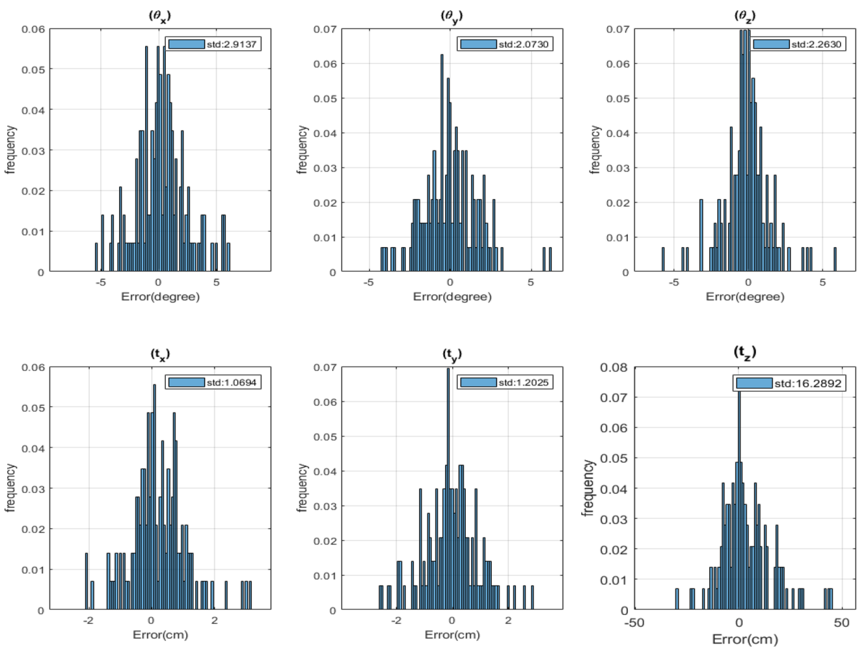
- The full pipeline achieved mean translation error \(E_t = 6.48\) cm, median \(E_t = 3.78\) cm, mean rotation error \(E_q = 1.52^\circ\), and mean pose error \(e_T = 0.0349\); EPnP alone gave \(E_t = 10\) cm, \(E_q = 2.22^\circ\), and \(e_T = 0.0525\).
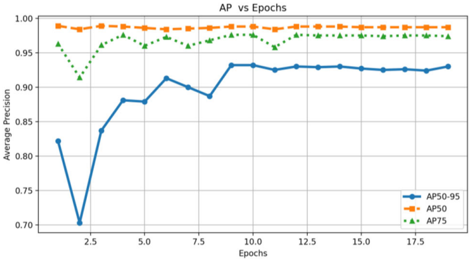
- Keypoint detection with HRFORMER reached AP50 = 98%, AP75 = 98%, AP50-95 = 94.2%, AR50-95 = 95.87%, and mean OKS = 98.5%; target localization reached AP50 = 98.8%, AP75 = 97.9%, AP50-95 = 93%, mean IOU = 95%, and median IOU = 96%.
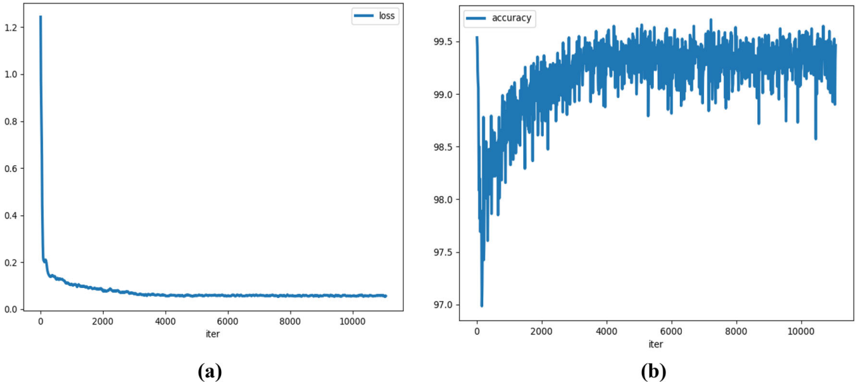
- The transformer keypoint network used 3.33G FLOPs and 7.73M parameters at 256 × 192 input, versus 7.68G FLOPs and 28.53M parameters for the CNN-based HRNET comparison.
- The authors report better translation and rotation errors than [13,16,31], but higher pose error than Wang et al. [17] (0.0123) and Chen et al. [15] (0.0094), which used higher-resolution images and/or more computationally complex solvers.
Methods
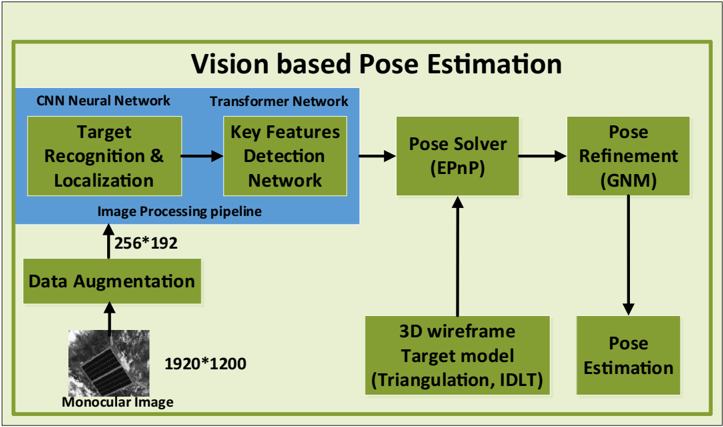
- Monocular vision pipeline: 3D wireframe reconstructed from 14 selected images with 13 manually annotated key features using inverse direct linear transform (IDLT); input images preprocessed/augmented from 1920 × 1200 to 256 × 192; target localization via Faster-RCNN with HRNET-w18 backbone; keypoint detection via HRFORMER transformer producing 13 heatmaps.
- Pose estimation: predicted 2D keypoints with confidence > 70% and at least 6 keypoints are matched by index to 3D model points; EPnP gives an initial pose, then Gauss-Newton method refines it until pose error reaches \(10^{-10}\) or a set iteration limit.
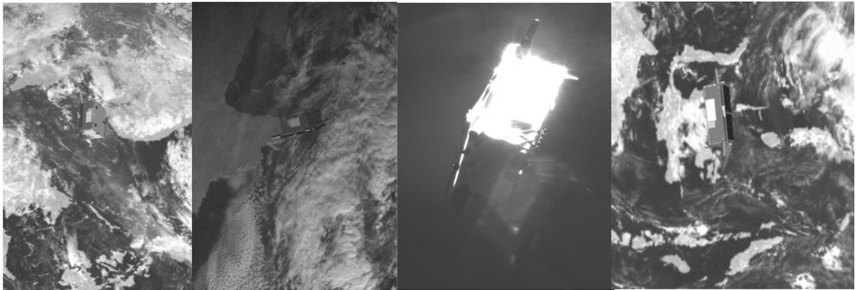
- Data and training: SPEED and SPEED+ datasets, TANGO spacecraft, grayscale images, target-camera range 3–45 m; test set made of 3000 random images selected from the SPEED training set; transformer trained with Adam, learning rate 0.000125, batch size 25 on an NVIDIA TITAN XP GPU, using MSE heatmap loss.
Limitations
- Stated: the work uses a single-domain dataset, and real space environment images are unavailable for training deep learning models; a domain gap remains between synthetic/source and real/target images, and the transformer approach did not significantly change results for this issue.
- Stated: keypoint detection is less accurate when the target is very near (4–5 m) due to minimal camera field of view, and in dark areas; some keypoints are invisible or undetected due to contrast, light conditions, or target orientation.
- Evident from the text: the reported test set is drawn from the SPEED training set rather than the official test or real-image sets, so the evaluation may not fully reflect generalization to unseen or real space imagery.
Model-written summary. Check it against the paper before relying on it.
Integrity signals
Registry
Cites
Statistics
Figures








Verification
Claims the paper makes
15 Valid · 12 Not valid · 16 Not checked · 70 Own results and interpretations
The sources with a verdict support this claim; the rest weren’t checked yet, have no full text we could read, or their verdicts aren’t rated yet.
In the paper
“Fourth, the domain gap exists between real and synthetically generated space-borne datasets that affect the performance and accuracy of learning-based architectures [21,23].”
§ Transformer Network-Aided Relative Pose Estimation for Non-cooperative Spacecraft Using Vision Sensor > 1 Introduction
What the sources say
- Not checked — no full text of the sourcecites [21] Jawaid M, Elms E, Latif Y, Chin TJ (2023) Towards bridging the space domain gap for satellite pose estimation using event sensing. In: 2023 IEEE international conference on robotics and automation (ICRA). IEEE, pp 11866–11873 source
- Supportedcites [23] Park TH, Martens M, Lecuyer G, Izzo D, D’Amico S (2022) SPEED+: next-generation dataset for spacecraft pose estimation across domain gap. In: 2022 IEEE aerospace conference (AERO). IEEE, pp 1–15 source
The Introduction states that CNNs trained on synthetic imagery can suffer performance degradation when tested on target spaceborne imagery because they overfit to synthetic features; it calls this a domain gap. The abstract likewise says synthetic images fail to resemble features of target spaceborne images. (LLM, conf=0.93)
plainstates a cause- Asserted: passes — The authors put it forward as true.
- Checkable: passes — It can be checked against evidence.
- Load-bearing: passes — The paper’s conclusions depend on it.
- Based: passes — The paper gives a reason why it holds.
Every source the paper cites for this claim was checked and supports it.
In the paper
“The memory and computation complexity of the architecture is reduced from quadratic to linear due to the use of localized parallel self-attention windows in each stage along with depth-wise convolution in FFN blocks.”
§ Transformer Network-Aided Relative Pose Estimation for Non-cooperative Spacecraft Using Vision Sensor > 4.2.2 Key Features Detection Network
What the sources say
- Supportedcites [27] Yuan Y, Fu R, Huang L, Lin W, Zhang C, Chen X, Wang J (2021) HRFormer: high-resolution transformer for dense prediction. In: Advances in neural information processing systems, NeurIPS 2021, arXiv:2110.09408v3. https://doi.org/10.48550/arXiv.2110.09408 source
The Introduction (p. 2) explicitly says local-window self-attention reduces memory and computation complexity from quadratic to linear with respect to spatial size. It also describes the depth-wise convolution in the FFN as part of the HRFormer block; the High-Resolution Transformer section (p. 5) says the combination significantly improves efficiency. (LLM, conf=0.91)
plainstates a cause- Asserted: passes — The authors put it forward as true.
- Checkable: passes — It can be checked against evidence.
- Load-bearing: unclear — It is unclear whether the paper’s conclusions depend on it.
- Based: passes — The paper gives a reason why it holds.
- Supported
Every source the paper cites for this claim was checked and supports it.
In the paper
“The architecture has a multiscale fusion module that is used to exchange information between different resolutions and as a result, HRFORMER has both local and global features.”
§ Transformer Network-Aided Relative Pose Estimation for Non-cooperative Spacecraft Using Vision Sensor > 4.2.2 Key Features Detection Network
What the sources say
- Supportedcites [27] Yuan Y, Fu R, Huang L, Lin W, Zhang C, Chen X, Wang J (2021) HRFormer: high-resolution transformer for dense prediction. In: Advances in neural information processing systems, NeurIPS 2021, arXiv:2110.09408v3. https://doi.org/10.48550/arXiv.2110.09408 source
The Introduction (p. 1) says HRFormer mixes short-range and long-range attention by exchanging multi-resolution feature information through a multi-scale fusion module. Section 3 (p. 3) confirms that the modules repeatedly exchange information across resolution streams, supporting the claim's description of local and global features. (LLM, conf=0.93)
plainstates a cause- Asserted: passes — The authors put it forward as true.
- Checkable: passes — It can be checked against evidence.
- Load-bearing: unclear — It is unclear whether the paper’s conclusions depend on it.
- Based: passes — The paper gives a reason why it holds.
- Supported
The cited sources support only part of this claim — read each source’s verdict below.
In the paper
“In addition, each branch starting from stage 2 has local self-attention windows to develop long-range dependencies.”
§ Transformer Network-Aided Relative Pose Estimation for Non-cooperative Spacecraft Using Vision Sensor > 4.2.2 Key Features Detection Network
What the sources say
- Partly supportedcites [27] Yuan Y, Fu R, Huang L, Lin W, Zhang C, Chen X, Wang J (2021) HRFormer: high-resolution transformer for dense prediction. In: Advances in neural information processing systems, NeurIPS 2021, arXiv:2110.09408v3. https://doi.org/10.48550/arXiv.2110.09408 sourceExperimental — accuracy not yet measured
The architecture description (Section 3, p. 4) says stages 2–4 use transformer blocks with local-window self-attention. But Section 3 (pp. 3–4) says attention operates independently within each window, without exchange across windows; the paper attributes broader interactions to the depth-wise convolution and multi-scale fusion, not to the local windows alone. (LLM, conf=0.87)
plainstates a cause- Asserted: passes — The authors put it forward as true.
- Checkable: passes — It can be checked against evidence.
- Load-bearing: unclear — It is unclear whether the paper’s conclusions depend on it.
- Based: passes — The paper gives a reason why it holds.
- Partly supported
The cited sources support only part of this claim — read each source’s verdict below.
In the paper
“The information exchange between layers is only possible through convolution exchange blocks that isolate the transformer from other layers and that is the reason it uses almost half Flops as compared to the CNN-based HRNET architecture used by [15] and [16].”
§ Transformer Network-Aided Relative Pose Estimation for Non-cooperative Spacecraft Using Vision Sensor > 7 Comparison
What the sources say
- Partly supportedcites [15] Chen B, Cao J, Parra A, Chin TJ (2019) Satellite pose estimation with deep landmark regression and nonlinear pose refinement. In: Proceedings of the IEEE/CVF international conference on computer vision workshops sourceExperimental — accuracy not yet measured
Section 3.3 (Landmark regression) confirms that the cited paper used HRNet for landmark prediction. The paper does not report transformer FLOPs, a near-half FLOPs comparison, or the proposed explanation involving convolution exchange blocks. (LLM, conf=0.85)
- Not checked yetcites [16] Piazza M, Maestrini M, Di Lizia P (2022) Monocular relative pose estimation pipeline for uncooperative resident space objects. J Aerosp Inf Syst 19:613–632. https://doi.org/10.2514/1.I011064/ASSET/IMAGES/LARGE/FIGURE25.JPEG doi:10.2514/1.i011064/asset/images/large/figure25.jpeg
plainstates a cause- Asserted: passes — The authors put it forward as true.
- Checkable: passes — It can be checked against evidence.
- Load-bearing: passes — The paper’s conclusions depend on it.
- Based: passes — The paper gives a reason why it holds.
- Partly supported
44 more claims
Create a free account to see all 113 claims and to verify the 8 references still open.
- Probably not a substantial claim. 32
- It may state two separate claims as one. 39
Self-check
Percentages, sums and reported differences re-computed from the paper’s own numbers.
Each contradiction between two passages listed here was confirmed by an independent check.
Rated minor: it would not touch a result — a value no result rests on, a p-value that stays on the same side of the significance level, or a conflict that is clerical, resolved elsewhere in the paper, or outside its own findings.
In the paper
§ Transformer Network-Aided Relative Pose Estimation for Non-cooperative Spacecraft Using Vision Sensor > 7 Comparison
“Also, the trainable parameters are reduced by four in our architecture i.e., 28.53-7.68M”
§ Transformer Network-Aided Relative Pose Estimation for Non-cooperative Spacecraft Using Vision Sensor > 8 Conclusion
“| Parameters | 7.73 M | 28.53 M |”
Rated minor: it would not touch a result — a value no result rests on, a p-value that stays on the same side of the significance level, or a conflict that is clerical, resolved elsewhere in the paper, or outside its own findings.
In the paper
§ Transformer Network-Aided Relative Pose Estimation for Non-cooperative Spacecraft Using Vision Sensor > 8 Conclusion
“| CNN (HRNET-w18 + faster-RCNN) | 93 | 98.8 | 97.9 | 95 | 96 |”
§ Transformer Network-Aided Relative Pose Estimation for Non-cooperative Spacecraft Using Vision Sensor > 8 Conclusion
“| | Median | % | 95 | 96.50 | 93.6 | 96.34 | | 89.08 |”
Rated minor: it would not touch a result — a value no result rests on, a p-value that stays on the same side of the significance level, or a conflict that is clerical, resolved elsewhere in the paper, or outside its own findings.
In the paper
§ Transformer Network-Aided Relative Pose Estimation for Non-cooperative Spacecraft Using Vision Sensor > 8 Conclusion
“| Images | Distance (m) | Distance error (m) | Attitude (degree) | Attitude error | | | | |”
§ Transformer Network-Aided Relative Pose Estimation for Non-cooperative Spacecraft Using Vision Sensor > 3 Spacecraft Pose Estimation Dataset
“The range of distance between the target satellite and the camera is between 3 and 45 m”
Citations
Cites
Vaswani, A., Shazeer, N., Parmar, N., Uszkoreit, J., Jones, L., Gomez, A. N., Kaiser, L., & Polosukhin, I. (2017) · arXiv · doi:10.48550/arxiv.1706.03762 · Cited by 120,404 · cited 3×
“There are a few other architectures related to transformers that are available in literature like a swin transformer [32], and vision transformer [33], etc. Swin transformer [32] is based on the hierarchical design that breaks the input image into small patches.”
Exploiting Generative AI to Scale up Intelligent Tutoring Systems
Jakubův, J., Chvalovský, K., Goertzel, Z., Kaliszyk, C., Olšák, M., Piotrowski, B., Schulz, S., Suda, M., & Urban, J. (2023) · DROPS (Schloss Dagstuhl – Leibniz Center for Informatics) · doi:10.4230/lipics.itp.2023.19 · Cited by 76,658
Faster R-CNN: Towards Real-Time Object Detection with Region Proposal Networks
Ren, S., He, K., Girshick, R., & Sun, J. (2017) · IEEE Transactions on Pattern Analysis and Machine Intelligence · doi:10.1109/tpami.2016.2577031 · Cited by 73,472
Deep High-Resolution Representation Learning for Human Pose Estimation
Sun, K., Xiao, B., Liu, D., & Wang, J. (2019) · 2019 IEEE/CVF Conference on Computer Vision and Pattern Recognition (CVPR) · doi:10.1109/cvpr.2019.00584 · Cited by 5,984 · cited 2×
“The CNN-based high-resolution network (HRNET-w32/48) [26] has shown great performance for terrestrial datasets in the applications of key points extraction and pose estimation.”
EPnP: An Accurate O(n) Solution to the PnP Problem
Lepetit, V., Moreno-Noguer, F., & Fua, P. (2009) · International Journal of Computer Vision · doi:10.1007/s11263-008-0152-6 · Cited by 3,298
Liu, Z., Ning, J., Cao, Y., Wei, Y., Zhang, Z., Lin, S., & Hu, H. (2021) · arXiv · doi:10.48550/arxiv.2106.13230 · Cited by 2,294
Deep learning for monocular depth estimation: A review
Ming, Y., Meng, X., Fan, C., & Yu, H. (2021) · Neurocomputing · doi:10.1016/j.neucom.2020.12.089 · Cited by 454
Opromolla, R., Fasano, G., Rufino, G., & Grassi, M. (2017) · Progress in Aerospace Sciences · doi:10.1016/j.paerosci.2017.07.001 · Cited by 330 · cited 1×
“For close to medium-range ren-dezvous operations, different vision sensors are used for pose estimation of the non-cooperative target; some are active sensors like LIDARS and some are passive sensors like stereo and monocular sensors [8].”
Satellite Pose Estimation Challenge: Dataset, Competition Design, and Results
Kisantal, M., Sharma, S., Park, T. H., Izzo, D., Martens, M., & D'Amico, S. (2020) · IEEE Transactions on Aerospace and Electronic Systems · doi:10.1109/taes.2020.2989063 · Cited by 304 · cited 4×
“Our IOU values are better than the work presented by SPN [22] and Stanford_lab [30].”
InfluentialSpacecraft pose estimation dataset (speed)
Sharma, S., Park, T. H., & D'Amico, S. (2026) · Stanford Digital Repository · doi:10.25740/dz692fn7184 · Cited by 304
Research works printed but not linked: 1
- Pauly L, Rharbaoui W, Shneider C, Rathinam A, Gaudillière V, Aouada D (2023) A survey on deep learning-based monocular spacecraft pose estimation: current state, limitations and prospects. Acta Astronaut 212:339–360. https://doi.org/10.1016/j.actaastro.2023.08.001 · DOI · Paper page
Cited by
EvSat3D: Satellite Pose Estimation and 3D Reconstruction With Event Camera
Malik, S. S., Moshrefizadeh, M., Tahri, O., Bai, X., Blasch, E., Sagan, V., & Aliakbarpour, H. (2025) · IEEE Access · doi:10.1109/access.2025.3589506 · Cited by 13
“Each of these methods is designed to address the distinct challenges of the space environment [13], [14], [15], [16], [17], [18].”
Wu, F., Li, H., Qu, G., Zhang, C., Liu, Y., Yang, J., Yang, D., & Cheng, Y.-T. (2025) · Advances in Space Research · doi:10.1016/j.asr.2025.04.012 · Cited by 5
Cylinder object 6-DOF pose estimation via single perspective circle on cylindrical surface
Yu, A., Wang, Y., Guo, B., et al. (2024) · Measurement Science and Technology · doi:10.1088/1361-6501/ad8775 · Cited by 1
“These applications include spacecraft capture [3–5], docking and recovery of autonomous underwater vehicles (AUVs) [6–8], alignment for charging of AUVs [9], refueling of unmanned aerial vehicles [10], and part assembly tasks [11].”
Badhe, N. B., Yele, V. P., Neve, R. P., et al. (2025) · Sensing and Imaging · doi:10.1007/s11220-025-00632-3 · Cited by 1
“Ahmed et al. [29] employed a transformer-assisted network for estimating relative pose in spacecraft imagery, where the attention mechanism captures spatial geometry across visual inputs, improving prediction under non-cooperative conditions.”
Relative pose measurement algorithm based on the vertical feature line for binocular vision
Li, J. (2025) · Applied Optics · doi:10.1364/ao.568527
Metadata
- Authors
- Ahmed, J., Arshad, A., Bang, H., & Choi, Y.
- Affiliations
- Korea Advanced Institute of Science and Technology (KR)
- Corresponding author
- Bang, Hyochoong
- ORCID
- Bang, Hyochoong
- Venue
- International Journal of Aeronautical and Space Sciences
- Published
- 2024-03-17
- Volume
- 25
- Issue
- 3
- Pages
- 1146-1165
- ISSN
- 1229-9626 (ISSN-L)
- 2093-274X
- 2093-2480
- OpenAlex
- W4392890925
- Cited by
- 11
- References
- 28
- Citations by year
- 2026: 6 · 2025: 4 · 2024: 1
- FWCI
- 1.89
- Type
- journal article
- Language
- en
- Open access
- hybrid
- doi.org
- Licence
- cc-by
- creativecommons.org/licenses/by/4.0 (tdm)
- creativecommons.org/licenses/by/4.0 (vor)
- Locations
- International Journal of Aeronautical and Space Sciences (publishedVersion, cc-by)
- Funders
- Korea Advanced Institute of Science and Technology
- Topics
- Physical Sciences › Engineering › Aerospace Engineering › Space Satellite Systems and Control
- Physical Sciences › Engineering › Aerospace Engineering › Spacecraft Dynamics and Control
- Physical Sciences › Computer Science › Computer Vision and Pattern Recognition › Advanced Neural Network Applications
- Keywords
- relative pose estimation, non-cooperative spacecraft, monocular vision, transformer models, self-attention, satellite rendezvous, keypoint detection, 3D reconstruction, perspective-n-point
About these checks
Registry, retraction, Cites and statistics results are computed, not judged, with one exception: a printed reference that no index lists is read once by a model before it counts as a citation error. Claims are extracted by a model and kept only when their quote appears verbatim in the text; each cited source is then checked, with a model’s help, for whether it says what the claim relies on. Those verdicts can be wrong — read the claim’s quote and the cited source before relying on one.
The claim verdicts this report counts are experimental: their accuracy is not yet measured.
A language model drew the claims from the paper on 2026-10-10, under version 3 of the claim definition (model deepseek-v4.1-flash, prompt extract-v3).
A second model labelled each claim on 2026-10-10 (model jev-1.13-20260917, definition revision gold-guideline-v0.2).
Cited sources are checked with a language model’s help (gpt-6-sol).
Statistics and arithmetic are recomputed, not judged.
Confidence bands are shown only for fields calibrated on our annotated test set. None is calibrated yet, so no band is shown.
What counts as a claim ›How we measure confidence ›How we check this ›
Are you an author, or do you see a problem with this page? Request a review
How to cite
Cite CoChat for the checks on this page, and the paper for its own findings.
- This page
- CoChat. (2026). Citation check: Transformer Network-Aided Relative Pose Estimation for Non-cooperative Spacecraft Using Vision Sensor. https://app.cochat.ai/papers/10.1007/s42405-023-00703-3
- The paper
- Ahmed, J., Arshad, A., Bang, H., & Choi, Y. (2024). Transformer Network-Aided Relative Pose Estimation for Non-cooperative Spacecraft Using Vision Sensor. International Journal of Aeronautical and Space Sciences. https://doi.org/10.1007/s42405-023-00703-3
Data sources
Bibliographic data: Semantic Scholar, OpenAlex, Crossref.
Contains information from the Semantic Scholar Academic Graph Datasets, made available under the ODC Attribution License (ODC-BY 1.0).
Semantic Scholar’s data is described in: Kinney, R., et al. (2023). The Semantic Scholar Open Data Platform. arXiv:2301.10140.
