

SPEED+: Next-Generation Dataset for Spacecraft Pose Estimation across Domain Gap
Open accessThe DOI matches its Crossref record; 54 of the 54 references it cites were found in a registry or an index; 16 of the 32 sources its claims cite were checked for support.
Abstract
This paper describes the Stanford/ESA Spacecraft PosE Estimation Dataset Plus (SPEED+) dataset for next-generation spacecraft pose estimation across the synthetic-to-real domain gap, comprising synthetic images of the Tango spacecraft.
Overview
CoChat Summary
TL;DR
SPEED+ is a next-generation spacecraft pose estimation dataset built to study the synthetic-to-real domain gap, combining large-scale labeled synthetic imagery with unlabeled hardware-in-the-loop images from the TRON robotic testbed. Baseline CNNs trained only on synthetic images degrade sharply on the HIL domains, though oracle and PRISMA comparisons suggest the HIL images retain learnable features and can serve as surrogates for flight imagery.
Key findings
- SPEED+ contains 59,960 synthetic images split 80:20 for train/validation, plus 9,531 HIL images from TRON: 6,740 lightbox and 2,791 sunlamp test images. The abstract describes “60,000 synthetic images for training” and “9,531 hardware-in-the-loop images.”
- Synthetic-only baselines show a large domain gap. For KRN, errors rise from 0.14 m / 3.69° on synthetic to 2.25 m / 44.53° on lightbox and 14.64 m / 80.95° on sunlamp. HigherHRNet degrades less: 0.97 m / 34.71° on lightbox and 0.85 m / 47.75° on sunlamp.
- Domain-bridging helps but does not close the gap. For KRN on lightbox, synthetic-only gives 2.25 m / 44.53° / pose 1.12; style augmentation gives 1.06 m / 36.14° / 0.81; DANN gives 0.95 m / 33.62° / 0.74; oracle is 0.24 ± 0.04 m / 6.15 ± 0.61° / 0.15 ± 0.01. On sunlamp, synthetic-only gives 14.64 m / 80.95° / 3.73; style augmentation gives 1.32 m / 62.85° / 1.32; DANN gives 2.04 m / 65.37° / 1.47; oracle is 0.19 ± 0.02 m / 5.33 ± 0.36° / 0.13 ± 0.01.
- The paper reports that SPEED+ HIL images retain learnable features, as shown by oracle performance, and that KRN SPEED-score distributions on PRISMA flight images “more or less overlap” with those on SPEED+ HIL images, supporting HIL images as surrogates for flight images in robustness analysis.
Methods
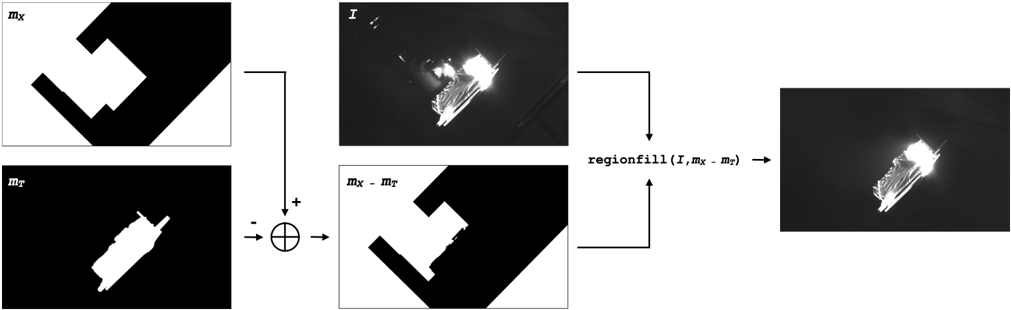
- Dataset construction: synthetic images were rendered with the OpenGL-based Optical Stimulator of SLAB’s multi-Satellite Software Simulator. HIL images were captured in the TRON facility using two KUKA robot arms, Vicon tracking, 10 Earth-albedo lightboxes, and a sun lamp, with a half-scale Tango spacecraft mockup. A total of 10,000 pose labels were generated, divided into 10 illumination configurations, post-processed, and manually filtered to leave 6,740 lightbox and 2,791 sunlamp images.
- Baseline experiments: three pose estimation CNNs—SPN, KRN, and HigherHRNet with EPnP—were trained on synthetic images and tested on HIL domains. DANN and style augmentation were applied to KRN as domain-bridging benchmarks. Oracle performance was approximated by 5-fold cross-validation on each HIL domain, and KRN was also evaluated on the 25-image prisma25 flight dataset.
- Metrics: position error, orientation error, and pose error/SPEED score. SPEC2021 uses a modified pose error with thresholds θ_q = 0.169° for orientation and θ_t = 2.173 mm/m for normalized translation.
Limitations
- The paper states that SPEED+ currently contains images of a single known target; future sequels will include more targets, and the KUKA robot arms will undergo a pending update to enable more accurate pose labeling with less human intervention for sample rejection.
- The paper states that in real missions the servicer typically does not have target images until rendezvous, but SPEC2021 makes unlabeled lightbox and sunlamp images public to encourage participation; these operational constraints are not enforced.
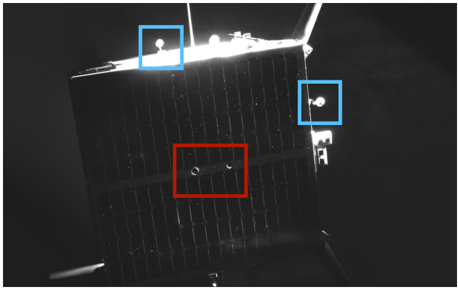
- The paper states that the baseline studies are intended to characterize the dataset rather than identify the best architecture or algorithm, with more comprehensive analysis planned after the competition. Evident from the text: HIL test images are unlabeled, manual sample rejection was required, retained artifacts include infrared markers, mounting holes, and unnatural surface glow, and calibration may allow up to centimeter-level position error beyond close range.
Model-written summary. Check it against the paper before relying on it.
Integrity signals
Registry
Cites
Statistics
Figures






Verification
Claims the paper makes
10 Valid · 7 Not valid · 5 Not checked · 37 Own results and interpretations
Every source the paper cites for this claim was checked and supports it.
In the paper
“TRON is a first-of-akind robotic testbed capable of capturing an arbitrary number of target images with accurate and maximally diverse pose labels and high-fidelity spaceborne illumination conditions.”
What the sources say
- Supportedcites [33] [33] T. H. Park, J. Bosse, and S. D'Amico, 'Robotic testbed for rendezvous and optical navigation: Multi-source calibration and machine learning use cases,' in 2021 AAS/AIAA Astrodynamics Specialist Conference, Big Sky, Vitrual , August 9-11 2021. - source
The Conclusion (p. 18) calls TRON a first-of-a-kind robotic testbed and says it can generate an arbitrary number of target images with maximally diverse pose distribution. It also reports millimeter-level position and millidegree-level orientation accuracy for the pose estimates and describes lighting that emulates diffuse and direct sources encountered in space. (LLM, conf=0.94)
plain- Asserted: passes — The authors put it forward as true.
- Checkable: passes — It can be checked against evidence.
- Load-bearing: passes — The paper’s conclusions depend on it.
- Based: passes — The paper gives a reason why it holds.
- Supported
Every source the paper cites for this claim was checked and supports it.
In the paper
“The measurements from both sources are used to jointly calibrate the facility, which allows the user to recover the true pose label of the target with respect to the camera from available measurements of an arbitrary sample with millimeter position and sub-degree orientation accuracies at close range.”
What the sources say
- Supportedcites [33] [33] T. H. Park, J. Bosse, and S. D'Amico, 'Robotic testbed for rendezvous and optical navigation: Multi-source calibration and machine learning use cases,' in 2021 AAS/AIAA Astrodynamics Specialist Conference, Big Sky, Vitrual , August 9-11 2021. - source
The Introduction (p. 4) says the calibration reconstructs the target’s pose from KUKA or Vicon measurements and that the resulting camera-relative poses achieve, on average, millimeter-level position and sub-degree orientation accuracy at close range. The Experiment (p. 12) describes validation on a trajectory of arbitrary relative poses. (LLM, conf=0.92)
plainstates a cause- Asserted: passes — The authors put it forward as true.
- Checkable: passes — It can be checked against evidence.
- Load-bearing: passes — The paper’s conclusions depend on it.
- Based: passes — The paper gives a reason why it holds.
- Supported
The cited sources support only part of this claim — read each source’s verdict below.
In the paper
“Existing datasets, such as Spacecraft PosE Estimation Dataset (SPEED), have so far mostly relied on synthetic images for both training and validation, which are easy to mass-produce but fail to resemble the visual features and illumination variability inherent to the target spaceborne images.”
What the sources say
- Partly supportedcites [16] [16] S. Sharma, T. H. Park, and S. D'Amico, 'Spacecraft pose estimation dataset (speed),' Stanford Digital Repository. Available at: https://doi.org/10.25740/dz692fn7184, 2019. - sourceExperimental — accuracy not yet measured
The Introduction (p. 1) and Table I (p. 4) show that SPEED relied predominantly on synthetic images for training and testing. The real-image comparison (p. 4) identifies differences in texture and illumination, but the synthetic-dataset section (p. 3) says SPEED closely emulated illumination in actual flight imagery. The categorical claim that its images fail to resemble spaceborne illumination therefore overstates the source; the paper also does not establish the claim for existing datasets generally. (LLM, conf=0.87)
plainstates a cause- Asserted: passes — The authors put it forward as true.
- Checkable: passes — It can be checked against evidence.
- Load-bearing: passes — The paper’s conclusions depend on it.
- Based: passes — The paper gives a reason why it holds.
- Partly supported
The cited sources that could be checked couldn’t confirm or dispute this claim.
In the paper
“Specifically, the light boxes [34] are designed and calibrated to provide a uniform maximum radiance of 14 W/m 2 sr, which corresponds to the mean radiance from the Earth for an albedo coefficient of 0.3 [35] and a solar irradiance of 1366 W/m 2 [36].”
What the sources say
- Not matchedcites [34] [34] 'Verification of light-box devices for earth albedo simulation,' Technical Note, Stanford Space Rendezvous Lab (SLAB), January (2016). -
Couldn’t be matched to a paper in Crossref, so it can’t be checked.
- Could not verifycites [35] [35] D. Bhanderi and T. Bak, 'Modeling earth albedo for satellites in earth orbit,' in Proceedings of AIAA Conference on Guidance, Navigation and Control . AIAA, 2005, null ; Conference date: 15-08-2005 Through 1808-2005. - sourceExperimental — accuracy not yet measured
The Texture Randomization section (p. 9) mentions laboratory testbeds and the difficulty of reproducing space lighting, but does not describe light boxes. Searches for light-box calibration, 14 W/m² sr, Earth albedo, and solar irradiance found no passage in our copy addressing the claim. (LLM, conf=0.72)
- Not matchedcites [36] [36] E. ASTM, '490, standard solar constant and zero air mass solar spectral irradiance tables,' in Space Simulation and Applications of Space Technology , 2000. -
Couldn’t be matched to a paper in Crossref, so it can’t be checked.
plain- Asserted: passes — The authors put it forward as true.
- Checkable: passes — It can be checked against evidence.
- Load-bearing: unclear — It is unclear whether the paper’s conclusions depend on it.
- Based: passes — The paper gives a reason why it holds.
- Not matched
The cited sources support only part of this claim — read each source’s verdict below.
In the paper
“To the best of the authors' knowledge, the only publicly available benchmark dataset on spacecraft pose estimation with fully labeled images from multiple sources is the Spacecraft PosE Estimation Dataset (SPEED) [16] which consists of 15,300 images of the Tango spacecraft from the PRISMA mission [17, 18].”
What the sources say
- Partly supportedcites [16] [16] S. Sharma, T. H. Park, and S. D'Amico, 'Spacecraft pose estimation dataset (speed),' Stanford Digital Repository. Available at: https://doi.org/10.25740/dz692fn7184, 2019. - sourceExperimental — accuracy not yet measured
Section III (p. 2) describes SPEED as the first publicly available spacecraft-pose-estimation dataset, with synthetic and real Tango images; it does not establish that SPEED is the only such benchmark. Table I and Section III.C (p. 4) list 15,303 images, approximately 15,300, but say only five real images are provided with training labels, so the claim that all images are fully labeled is not supported. (LLM, conf=0.88)
- Not checked — no full text of the sourcecites [17] [17] S. D'Amico, M. Benn, and J. L. Jørgensen, 'Pose estimation of an uncooperative spacecraft from actual space imagery,' International Journal of Space Science and Engineering , vol. 2, no. 2, p. 171, 2014. - source
- Not checked — no full text of the sourcecites [18] [18] S. D'Amico, P. Bodin, M. Delpech, and R. Noteborn, 'PRISMA,' in Distributed Space Missions for Earth System Monitoring Space Technology Library , M. D'Errico, Ed., 2013, vol. 31, ch. 21, pp. 599-637. - source
hedged- Asserted: passes — The authors put it forward as true.
- Checkable: passes — It can be checked against evidence.
- Load-bearing: passes — The paper’s conclusions depend on it.
- Based: passes — The paper gives a reason why it holds.
- Partly supported
14 more claims · 1 with their cited sources checked
Create a free account to see all 59 claims and every source verdict.
- Probably not a substantial claim. 30
- It may state two separate claims as one. 19
- The quote only partly states this claim. 1
Claims other papers make about this one
Each is checked against this paper’s own text: does it say what the citing paper says it does?
The source backs part of the claim, not all of it — or backs it for a different population, condition or comparison.
In the citing paper
“The origin of the domain gap comes from the two main limitations of the image rendering tool used to generate the training set.”
From Domain Generalization for In-Orbit 6D Pose Estimation (2025) · cites this paper as [55]
Experimental — accuracy not yet measuredThe source backs part of the claim, not all of it — or backs it for a different population, condition or comparison.
In the citing paper
“For example, in the SPEED + dataset [55], the Multi-Layer Insulation (MLI) represented in the CAD model is over-simplified compared to the actual one, as illustrated in Figure 4.”
From Domain Generalization for In-Orbit 6D Pose Estimation (2025) · cites this paper as [55]
Experimental — accuracy not yet measuredThe cited source says what the claim attributes to it.
In the citing paper
“Fourth, the domain gap exists between real and synthetically generated space-borne datasets that affect the performance and accuracy of learning-based architectures [21,23].”
From Transformer Network-Aided Relative Pose Estimation for Non-cooperative Spacecraft Using Vision Sensor (2024) · cites this paper as [23]
The cited source says what the claim attributes to it.
In the citing paper
“The lightbox domain consists of 6,740 images of the half-scale mockup model of the Tango spacecraft illuminated with albedo lightboxes to simulate diffuse light in the Earth's orbit, whereas the sunlamp domain contains 2,791 images of the same model illuminated with a metal halide arc lamp to simulate direct sunlight.”
From Robust multi-task learning and online refinement for spacecraft pose estimation across domain gap (2024) · cites this paper as Park et al., 2022
The cited source says what the claim attributes to it.
In the citing paper
“In addition to the standard data augmentation techniques, style augmentation (Jackson et al., 2019) is employed to randomize the style and inherent texture of the synthetic spacecraft via neural style transfer (Ghiasi et al., 2017), as done in the SPEED + baseline studies (Park et al., 2022).”
From Robust multi-task learning and online refinement for spacecraft pose estimation across domain gap (2024) · cites this paper as Park et al., 2022
1 more claim about this paper
Create a free account to see every claim other papers make about this one.
Citations
Cites
ImageNet classification with deep convolutional neural networks
Krizhevsky, A., Sutskever, I., & Hinton, G. E. (2017) · Communications of the ACM · doi:10.1145/3065386 · Cited by 112,155
MobileNetV2: Inverted Residuals and Linear Bottlenecks
Sandler, M., Howard, A., Zhu, M., Zhmoginov, A., & Chen, L.-C. (2018) · 2018 IEEE/CVF Conference on Computer Vision and Pattern Recognition · doi:10.1109/cvpr.2018.00474 · Cited by 28,755
Are we ready for autonomous driving? The KITTI vision benchmark suite
Geiger, A., Lenz, P., & Urtasun, R. (2012) · 2012 IEEE Conference on Computer Vision and Pattern Recognition · doi:10.1109/cvpr.2012.6248074 · Cited by 14,897 · cited 1×
“…to the spaceborne navigation is the semantic segmentation for autonomous driving, in which the large-scale synthetic images from gaming engines such as GTA V [29] or SYNTHIA [30] are used for training, whereas real street images available from KITTI [31] or Cityscapes [32] are used for testing.”
The Cityscapes Dataset for Semantic Urban Scene Understanding
Cordts, M., Omran, M., Ramos, S., Rehfeld, T., Enzweiler, M., Benenson, R., Franke, U., Roth, S., & Schiele, B. (2016) · 2016 IEEE Conference on Computer Vision and Pattern Recognition (CVPR) · doi:10.1109/cvpr.2016.350 · Cited by 12,433
Domain-Adversarial Training of Neural Networks
Ganin, Y., Ustinova, E., Ajakan, H., Germain, P., Larochelle, H., Laviolette, F., Marchand, M., & Lempitsky, V. (2017) · Advances in Computer Vision and Pattern Recognition · doi:10.1007/978-3-319-58347-1_10 · Cited by 8,318
EPnP: An Accurate O(n) Solution to the PnP Problem
Lepetit, V., Moreno-Noguer, F., & Fua, P. (2009) · International Journal of Computer Vision · doi:10.1007/s11263-008-0152-6 · Cited by 3,298
Domain randomization for transferring deep neural networks from simulation to the real world
Tobin, J., Fong, R., Ray, A., Schneider, J., Zaremba, W., & Abbeel, P. (2017) · 2017 IEEE/RSJ International Conference on Intelligent Robots and Systems (IROS) · doi:10.1109/iros.2017.8202133 · Cited by 3,124 · cited 2×
“While it is possible to train a more domain-invariant CNN model using methods such as domain randomization [13,14] and texture randomization [4, 15], its use in space missions requires a validation of performance in a highly representative space environment prior to mission deployment.”
Adapting visual category models to new domains
Saenko, K., Kulis, B., Fritz, M., & Darrell, T. (2010) · Lecture Notes in Computer Science · doi:10.1007/978-3-642-15561-1_16 · Cited by 2,847 · cited 1×
“A number of datasets with emphasis on domain gap are available for terrestrial computer vision applications, such as Office-31 [26], Syn2Real [12, 27], and DomainNet [28] for various tasks such as classification, object detection and semantic segmentation.”
Unsupervised Domain Adaptation by Backpropagation
Ganin, Y., & Lempitsky, V. (2014) · arXiv (Cornell University) · doi:10.48550/arxiv.1409.7495 · Cited by 2,521
Ros, G., Sellart, L., Materzynska, J., Vazquez, D., & Lopez, A. M. (2016) · 2016 IEEE Conference on Computer Vision and Pattern Recognition (CVPR) · doi:10.1109/cvpr.2016.352 · Cited by 2,338
Research works printed but not linked: 3
- 0, Vero Compact super wide camera by vicon
- 2016, Verification of light-box devices for earth albedo simulation, Technical Note Stanford Space Rendezvous Lab (SLAB)
- tsiotras, 2014, Astros: A 5dof experimental facility for research in space proximity operations, Advances in the Astronautical Sciences, 151, 717
Cited by
Robust multi-task learning and online refinement for spacecraft pose estimation across domain gap
Park, T. H., & D’Amico, S. (2024) · Advances in Space Research · doi:10.1016/j.asr.2023.03.036 · Cited by 125
“To address this issue, SPEED + (Park et al., 2021b, 2022) has been recently introduced with two distinct HIL image domains, lightbox and sunlamp , that are captured from the upgraded TRON facility at SLAB (Park et al., 2021a).”
BackgroundMethodResultInfluentialSelf-citationSatellite Pose Estimation Competition 2021: Results and Analyses
Park, T. H., Märtens, M., Jawaid, M., Wang, Z., Chen, B., Chin, T.-J., Izzo, D., & D’Amico, S. (2023) · Acta Astronautica · doi:10.1016/j.actaastro.2023.01.002 · Cited by 91
Self-citationWang, Z., Chen, M., Guo, Y., Li, Z., & Yu, Q. (2024) · IEEE Transactions on Aerospace and Electronic Systems · doi:10.1109/taes.2023.3250385 · Cited by 64
“Table I lists the experimental results of ours and 3 meth-ods reported by Park et al. [22].”
BackgroundMethodResultInfluentialPVSPE: A pyramid vision multitask transformer network for spacecraft pose estimation
Yang, H., Xiao, X., Yao, M., Xiong, Y., Cui, H., & Fu, Y. (2024) · Advances in Space Research · doi:10.1016/j.asr.2024.05.011 · Cited by 41
Zero-G Lab: A multi-purpose facility for emulating space operations
Olivares-Méndez, M. A., Makhdoomi, M. R., Yalçın, B. C., Bokal, Z. M., Muralidharan, V., del Castillo, M. O., Gaudillière, V., Pauly, L., Borgue, O., Alandihallaj, M. A., et al. (2023) · Journal of Space Safety Engineering · doi:10.1016/j.jsse.2023.09.003 · Cited by 35
Metadata
- Authors
- Park, T. H., Martens, M., Lecuyer, G., Izzo, D., & D'Amico, S.
- Affiliations
- Stanford University (US)
- Advanced Concepts Team European Space Agency,Noordwijk,AZ,The Netherlands,2201
- European Space Agency (FR)
- Stanford University,Department of Aeronautics & Astronautics,Stanford,CA,94305
- Venue
- 2022 IEEE Aerospace Conference (AERO)
- Publisher
- IEEE
- Published
- 2022-03-05
- Pages
- 1-15
- ISSN
- 1095-323X (ISSN-L)
- OpenAlex
- W3202897977
- Cited by
- 170
- References
- 46
- Citations by year
- 2026: 32 · 2025: 64 · 2024: 40 · 2023: 31 · 2022: 3
- FWCI
- 60.27
- Type
- conference paper
- Language
- en
- Open access
- green
- arxiv.org
- Locations
- IEEE Aerospace Conference (AERO) (publishedVersion)
- arXiv (Cornell University) (submittedVersion)
- arXiv (Cornell University)
- Topics
- Physical Sciences › Engineering › Aerospace Engineering › Space Satellite Systems and Control
- Physical Sciences › Engineering › Aerospace Engineering › Spacecraft Dynamics and Control
- Physical Sciences › Computer Science › Computer Vision and Pattern Recognition › Advanced Neural Network Applications
- Keywords
- spacecraft pose estimation, spacecraft navigation, domain gap, synthetic images, illumination variation, on-orbit servicing, space logistics, visual navigation
About these checks
Registry, retraction, Cites and statistics results are computed, not judged, with one exception: a printed reference that no index lists is read once by a model before it counts as a citation error. Claims are extracted by a model and kept only when their quote appears verbatim in the text; each cited source is then checked, with a model’s help, for whether it says what the claim relies on. Those verdicts can be wrong — read the claim’s quote and the cited source before relying on one.
The claim verdicts this report counts are experimental: their accuracy is not yet measured.
A language model drew the claims from the paper on 2026-09-28, under version 3 of the claim definition (prompt extract-v3).
A second model labelled each claim on 2026-09-28 (model jev-1.13-20260917, definition revision gold-guideline-v0.2).
Cited sources are checked with a language model’s help (gpt-6-sol).
Statistics and arithmetic are recomputed, not judged.
Confidence bands are shown only for fields calibrated on our annotated test set. None is calibrated yet, so no band is shown.
What counts as a claim ›How we measure confidence ›How we check this ›
Are you an author, or do you see a problem with this page? Request a review
How to cite
Cite CoChat for the checks on this page, and the paper for its own findings.
- This page
- CoChat. (2026). Citation check: SPEED+: Next-Generation Dataset for Spacecraft Pose Estimation across Domain Gap. https://app.cochat.ai/papers/10.1109/aero53065.2022.9843439
- The paper
- Park, T. H., Martens, M., Lecuyer, G., Izzo, D., & D'Amico, S. (2022). SPEED+: Next-Generation Dataset for Spacecraft Pose Estimation across Domain Gap. 2022 IEEE Aerospace Conference (AERO). https://doi.org/10.1109/aero53065.2022.9843439
Data sources
Bibliographic data: Semantic Scholar, OpenAlex, Crossref.
Contains information from the Semantic Scholar Academic Graph Datasets, made available under the ODC Attribution License (ODC-BY 1.0).
Semantic Scholar’s data is described in: Kinney, R., et al. (2023). The Semantic Scholar Open Data Platform. arXiv:2301.10140.
