

Update on the neurodevelopmental theory of depression: is there any 'unconscious code'?
Open accessThe DOI matches its Crossref record; 103 of the 103 references it cites were found in a registry or an index.
Abstract
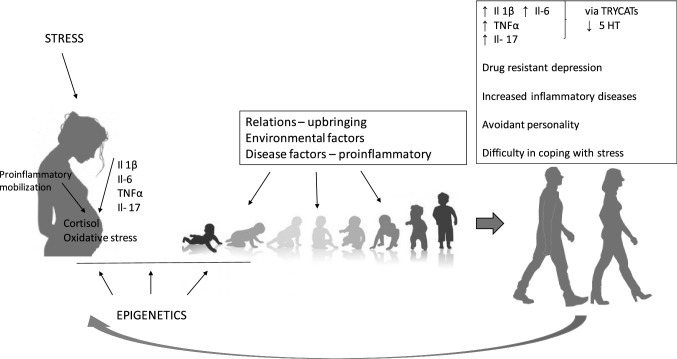
Depression is currently one of the most common psychiatric disorders and the number of patients receiving antidepressant treatment is increasing every year. Therefore, it is essential to understand the underlying mechanisms that are associated with higher prevalence of depression. The main component leading to the change in functioning, in the form of apathy, anhedonia, lack of motivation and sleep disturbances, is stress. This is the factor that in recent decades—due to the civilization speed, dynamic technological development as well as competitiveness and competition in relationships—significantly affects the psychophysical condition, which results in an increase in the prevalence of civilization diseases, including depression. To understand the mechanism of susceptibility to this disease, one should consider the significant role of the interaction between immune and nervous systems. Their joint development from the moment of conception is a matrix of later predispositions, both associated with the mobilization of the proinflammatory pathways (TNFα, IL-1β, IL-6) and associated with psychological coping with stress. Such an early development period is associated with epigenetic processes that are strongly marked in prenatal development up to 1 year of age and determinate the characteristic phenotype for various forms of pathology, including depression. Regarding the inflammatory hypothesis of depression, interleukin 17 (IL-17), among other proinflammatory cytokines, might play an important role in the development of depressive disorders. It is secreted by Th17 cells, crossed the placental barrier and acts on the brain structures of the fetus by increasing IL-17 receptor levels and affecting the intensity of its signaling in the brain.
Overview
The claims and statistics of this paper haven’t been checked yet.
Free: it reads the open-access text and checks the first 5 claims that cite a source we can check. Create a free account to check every claim.
Integrity signals
Registry
Cites
Statistics
Figures
Verification
Claims the paper makes
The claims and statistics of this paper haven’t been checked yet.
Free: it reads the open-access text and checks the first 5 claims that cite a source we can check. Create a free account to check every claim.
Claims other papers make about this one
Each is checked against this paper’s own text: does it say what the citing paper says it does?
The source backs part of the claim, not all of it — or backs it for a different population, condition or comparison.
In the citing paper
“the immune and inflammatory systems may be crucial contributors to the onset and progression of this life-threatening illness (10,11).”
From Analysis of complete blood count and derived inflammatory indicators for bipolar disorder patients with different states (2023) · doi:10.3389/fpsyt.2023.1219151 · cites this paper as [10]
Experimental — accuracy not yet measured
Self-check
Percentages, sums and reported differences re-computed from the paper’s own numbers.
The self-check needs the paper’s full text.
Citations
Cites
Ivanov, I. I., McKenzie, B. S., Zhou, L., Tadokoro, C. E., Lepelley, A., Lafaille, J. J., Cua, D. J., & Littman, D. R. (2006) · Cell · doi:10.1016/j.cell.2006.07.035 · Cited by 5,145
Korn, T., Bettelli, E., Oukka, M., & Kuchroo, V. K. (2009) · Annual Review of Immunology · doi:10.1146/annurev.immunol.021908.132710 · Cited by 4,873
From Neurons to Neighborhoods: The Science of Early Childhood Development
(2000) · doi:10.17226/9824 · Cited by 4,484 · cited 1×
“During these periods of special sensitivity (the so-called critical windows), the effects of certain adverse factors may be most pronounced [13].”
BackgroundPsychological stress and the human immune system: a meta-analytic study of 30 Years of inquiry
Segerstrom, S. C., & Miller, G. E. (2004) · Psychological Bulletin · doi:10.1037/0033-2909.130.4.601 · Cited by 3,334
From Neurons to Neighborhoods: The Science of Early Childhood Development
Carey, W. B. (2001) · Journal of Developmental & Behavioral Pediatrics · doi:10.1097/00004703-200104000-00011 · Cited by 2,657
TGF-β-induced Foxp3 inhibits TH17 cell differentiation by antagonizing RORγt function
Zhou, L., Lopes, J. E., Chong, M. M. W., Ivanov, I. I., Min, R., Victora, G. D., Shen, Y., Du, J., Rubtsov, Y. P., Rudensky, A. Y., et al. (2008) · Nature · doi:10.1038/nature06878 · Cited by 1,863
Oxytocin, vasopressin, and the neurogenetics of sociality
Donaldson, Z. R., & Young, L. J. (2008) · Science · doi:10.1126/science.1158668 · Cited by 1,645
Maternal Immune Activation Alters Fetal Brain Development through Interleukin-6
Smith, S. E. P., Li, J., Garbett, K., Mirnics, K., & Patterson, P. H. (2007) · The Journal of Neuroscience · doi:10.1523/jneurosci.2178-07.2007 · Cited by 1,605
So depression is an inflammatory disease, but where does the inflammation come from?
Berk, M., Williams, L. J., Jacka, F. N., O’Neil, A., Pasco, J. A., Moylan, S., Allen, N. B., Stuart, A. L., Hayley, A. C., Byrne, M. L., et al. (2013) · BMC Medicine · doi:10.1186/1741-7015-11-200 · Cited by 1,423
Self-citationMaternal immune activation: Implications for neuropsychiatric disorders
Estes, M. L., & McAllister, A. K. (2016) · Science · doi:10.1126/science.aag3194 · Cited by 1,206 · cited 1×
“Animal studies confirm that the later disturbances in utero occur due to maternal immune activation (MIA), the less important this is for the brain of the developing fetus [30].”
Background
Research works printed but not linked: 2
- Barnes GL Woolgar M Beckwith H John Bowlby and contemporary issues of clinical diagnosis Attachment (Lond) 2018 12 1 35 47 30542373 PMC6287705
- Al Aboud NM, Tupper C, Jialal I. Genetics, Epigenetic Mechanism. [Updated 2020 Oct 2]. In: StatPearls [Internet]. Treasure Island (FL): StatPearls Publishing; 2020 Jan-. Available from: https://www.ncbi.nlm.nih.gov/books/NBK532999/ 30422591
Cited by
Sobolewska-Nowak, J., Wachowska, K., Nowak, A., Orzechowska, A., Szulc, A., Płaza, O., & Gałecki, P. (2023) · Biomedicines · doi:10.3390/biomedicines11071903 · Cited by 84
Self-citationAdvancing electrochemical biosensors for interleukin-6 detection
McCrae, L. E., Ting, W., & Howlader, M. M. R. (2022) · Biosensors and Bioelectronics X · doi:10.1016/j.biosx.2022.100288 · Cited by 63
Th17 Cells, Glucocorticoid Resistance, and Depression
Khantakova, J. N., Mutovina, A., Ayriyants, K. A., & Bondar, N. P. (2023) · Cells · doi:10.3390/cells12232749 · Cited by 38
“In the blood lymphocytes of depressed patients, the level of mRNA IL-17 is increased [2], which is associated with the severity of anhedonia symptoms [99].”
BackgroundThe gut–organ axis: Clinical aspects and immune mechanisms
Fukasawa, N., Tsunoda, J., Sunaga, S., Kiyohara, H., Nakamoto, N., Teratani, T., Mikami, Y., & Kanai∥, T. (2025) · Allergology International · doi:10.1016/j.alit.2025.01.004 · Cited by 39
Fusar‐Poli, L., Amerio, A., Cimpoesu, P., Filioli, P. G., Natale, A., Zappa, G., Aguglia, E., Amore, M., Serafini, G., & Aguglia, A. (2021) · Brain Sciences · doi:10.3390/brainsci11030363 · Cited by 28
“The literature extensively demonstrated that the immune and inflammatory systems may play a crucial role in determining the onset and recurrence of major depressive disorder (MDD) [31,32].”
BackgroundInflammation and Cognition in Depression: A Narrative Review
Wachowska, K., & Gałecki, P. (2021) · Journal of Clinical Medicine · doi:10.3390/jcm10245859 · Cited by 29
Self-citationLarsen, N. Y., Vihrs, N., Møller, J., Sporring, J., Tan, X., Li, X., Ji, G., Rajkowska, G., Sun, F., & Nyengaard, J. R. (2022) · Translational Psychiatry · doi:10.1038/s41398-022-02128-0 · Cited by 29
Bliźniewska-Kowalska, K. M., Halaris, A. E., Wang, S.-C., Su, K., Maes, M. H. J., Berk, M., & Gałecki, P. (2021) · Medical Science Monitor · doi:10.12659/msm.932220 · Cited by 26
“Mindful of the inflammation theory of depression [33,34], elevated pro-inflammatory cytokines might be a nexus in the shared pathology of these diseases.”
BackgroundSelf-citationYılmaz, N. S., Şen, B., Karadag, R. F., Aslan, S., Ertek, İ. E., Bozkurt, A., Çiçek, S., Bolu, A., Ucar, H., Koçak, C., et al. (2022) · Journal of Neural Transmission · doi:10.1007/s00702-022-02553-x · Cited by 21
“It is also stated that neurodevelopmental processes that interact with the immune system and epigenetics play a role in the pathogenesis (Gałecka et al. 2021; Tanaka et al. 2022a).”
BackgroundDecreased cortical gyrification in major depressive disorder
Kang, Y., Kang, W., Kim, A., Tae, W., Ham, B., & Han, K. (2023) · Psychological Medicine · doi:10.1017/s0033291723001216 · Cited by 23
Lin, J., Su, Y., Shi, C., Liu, Q., Wang, G., Wei, J., Zhu, G., Chen, Q., Tian, H., Zhang, K., et al. (2021) · Journal of Affective Disorders · doi:10.1016/j.jad.2021.02.068 · Cited by 18
Inflammatory Markers and Episodic Memory Functioning in Depressive Disorders
Wachowska, K., Szemraj, J., Śmigielski, J., & Gałecki, P. (2022) · Journal of Clinical Medicine · doi:10.3390/jcm11030693 · Cited by 13
“It was also suggested that early stages of development, of both the nervous and immune systems, might be crucial in future mental problems [40].”
BackgroundSelf-citationRole of interleukin 17 (IL-17) in the inflammatory hypothesis of depression
Bliźniewska-Kowalska, K. M., Halaris, A. E., Gałecki, P., & Gałecka, M. (2023) · Journal of Affective Disorders Reports · doi:10.1016/j.jadr.2023.100610 · Cited by 15
Self-citationPersonality Traits and Inflammation in Depressive Disorders
Wachowska, K., Gałecki, P., Szemraj, J., Śmigielski, J., & Orzechowska, A. (2022) · Journal of Clinical Medicine · doi:10.3390/jcm11071974 · Cited by 12
“The authors of the aforementioned theory highlight significance of epigenetic processes in creating individual predisposition to depression [16,32].”
BackgroundInfluentialSelf-citationKhantakova, J. N., Bondar, N. P., Antontseva, E. V., & Reshetnikov, V. V. (2022) · Frontiers in Cellular Neuroscience · doi:10.3389/fncel.2022.1066794 · Cited by 10
Pathways between Risk/Protective Factors and Maternal Postnatal Depressive Symptoms: The ELFE Cohort
Balès, M., Pambrun, É., Maguet, C., van der Waerden, J. E. B., Glangeaud-Freudenthal, N. M.-C., Charles, M.-A. A., Bois, C., Melchior, M., Milgrom, J., Falissard, B., et al. (2023) · Journal of Clinical Medicine · doi:10.3390/jcm12093204 · Cited by 17
(2023) · doi:10.3389/fpsyt.2023.1219151 · Cited by 8
“Although the etiopathogenesis of BD remains poorly understood, numerous studies have widely reported that the immune and inflammatory systems may be crucial contributors to the onset and progression of this life-threatening illness (10, 11).”
BackgroundTorres-Galván, S., Flores-López, M., Romero‐Sanchiz, P., Requena-Ocaña, N., Porras-Perales, Ó., Nogueira‐Arjona, R., Mayoral, F., Araos, P. F., Serrano, A., Muga, R., et al. (2021) · Scientific Reports · doi:10.1038/s41598-021-93075-1 · Cited by 10
Post-weaning social isolation impairs purinergic signaling in rat brain
Andrejew, R., Paim, M., Moritz, C. E. J., Carreño, F. O., Rates, S. M. K., Elisabetsky, E., Souza, D. O., Almeida, R. F., & Battastini, A. M. O. (2021) · Neurochemistry International · doi:10.1016/j.neuint.2021.105111 · Cited by 7
Depressive Disorder and Dermatological Autoimmune Diseases
Peła, Z., Gałecka, M., Murgrabia, A., Kondratowicz, A., & Gałecki, P. (2024) · Journal of Clinical Medicine · doi:10.3390/jcm13113224 · Cited by 8
“Adults with maternal activation of the pro-inflammatory cytokine system during pregnancy have lower susceptibility to stress, higher levels of anxiety, a greater risk of developing an avoidant personality and, finally, a greater susceptibility to depressive disorders and autoimmune diseases [89].”
BackgroundSelf-citationXia, W., Xu, Y., Gong, Y., Cheng, X., Tian-gui, Y., & Yu, G. (2022) · Oxidative Medicine and Cellular Longevity · doi:10.1155/2022/2049371 · Cited by 5
“In addition, the activation of the HPA axis can stimulate the upregulation of the expression of inflammatory factors, further promoting the activity of the HPA axis and forming a vicious cycle leading to the onset and persistence of PSD [84].”
RetractedExpression of p11 in Patients with Depression
Gałecka, M., Bliźniewska-Kowalska, K. M., Gałecki, P., Szemraj, J., & Orzechowska, A. (2022) · Journal of Clinical Medicine · doi:10.3390/jcm11195743 · Cited by 5
“Traumatic life experiences, especially those characterized by chronic stress, are factors causing a cascade of biological changes, mainly pro-inflammatory in their nature [4,5].”
BackgroundSelf-citationДемченко, О., Козлова, Y., & Siroukh, S. (2023) · PROBLEMS OF ENDOCRINE PATHOLOGY · doi:10.21856/j-pep.2023.3.10 · Cited by 5
Zhang, L., Wang, Y., Li, S., Otani, S., & Chen, F. (2023) · Neuroscience · doi:10.1016/j.neuroscience.2023.12.004 · Cited by 2
Stępień, A., Domitrz, I., Kozubski, W. P., Rejdak, K., Rózniecki, J., Słowik, A., Woroń, J., Wachowska, K., & Gałecki, P. (2021) · Psychiatria Polska · doi:10.12740/pp/onlinefirst/136489
“The neurodevelopmental theory integrates all previous theories [39].”
Self-citationDiseases Deriving from Alterations of the Ecological Niche—Part I: Not Regarding the Holobiont
Libertini, G., Corbi, G., Shubernetskaya, O. S., Komici, K., & Ferrara, N. (2024) · Advances in studies of aging and health · doi:10.1007/978-3-031-84877-3_3
Fol, J., Bastidas, C. G., Pham, E., Meuleman, B., Savary, V., Pictet, A., Dieben, K., Perroud, N. A., Edan, A., & Piguet, C. (2026) · Child Psychiatry & Human Development · doi:10.1007/s10578-026-02043-1
Metadata
- Authors
- Gałecka, M., Bliźniewska-Kowalska, K., Maes, M., Su, K.-P., & Gałecki, P.
- Affiliations
- Medical University of Lodz (PL)
- Chulalongkorn University (TH)
- China Medical University (TW)
- Corresponding author
- Gałecka, Małgorzata
- Venue
- Pharmacological Reports
- Published
- 2020-12-31
- Volume
- 73
- Issue
- 2
- Pages
- 346-356
- ISSN
- 1734-1140 (ISSN-L)
- 2299-5684
- PMC
- PMC7994228
- OpenAlex
- W3116217226
- Cited by
- 27
- References
- 103
- Citations by year
- 2026: 1 · 2025: 1 · 2024: 2 · 2023: 8 · 2022: 8 · 2021: 7
- FWCI
- 0.37
- Type
- journal article
- Language
- en
- Open access
- hybrid
- doi.org
- Licence
- cc-by
- creativecommons.org/licenses/by/4.0 (tdm)
- creativecommons.org/licenses/by/4.0 (vor)
- Locations
- Pharmacological Reports (publishedVersion, cc-by)
- PubMed Central (publishedVersion, cc-by)
- PubMed (publishedVersion)
- Funders
- Uniwersytet Medyczny w Lodzi (503/5-062-02/503-51-004-17, 503/5062-02/503-51-010-18)
- Topics
- Life Sciences › Neuroscience › Biological Psychiatry › Tryptophan and brain disorders
- Life Sciences › Neuroscience › Behavioral Neuroscience › Stress Responses and Cortisol
- Health Sciences › Medicine › Pharmacology (medical) › Treatment of Major Depression
- Keywords
- depression, neurodevelopmental theory, stress, civilization diseases, inflammatory cytokines, IL-17, Th17 cells, epigenetics, prenatal development, IL-17 receptor signaling, antidepressant treatment, anhedonia
- MeSH terms
- Animals, Brain, Depression, Depressive Disorder, Female, Humans, Infant, Infant, Newborn, Pregnancy, Stress, Psychological, Signal Transduction, Cytokines, Th17 Cells
About these checks
Registry, retraction, Cites and statistics results are computed, not judged, with one exception: a printed reference that no index lists is read once by a model before it counts as a citation error. Claims are extracted by a model and kept only when their quote appears verbatim in the text; each cited source is then checked, with a model’s help, for whether it says what the claim relies on. Those verdicts can be wrong — read the claim’s quote and the cited source before relying on one.
Statistics and arithmetic are recomputed, not judged.
Confidence bands are shown only for fields calibrated on our annotated test set. None is calibrated yet, so no band is shown.
What counts as a claim ›How we measure confidence ›How we check this ›
Are you an author, or do you see a problem with this page? Request a review
Data sources
Bibliographic data: Semantic Scholar, OpenAlex, Crossref.
Contains information from the Semantic Scholar Academic Graph Datasets, made available under the ODC Attribution License (ODC-BY 1.0).
Semantic Scholar’s data is described in: Kinney, R., et al. (2023). The Semantic Scholar Open Data Platform. arXiv:2301.10140.
