

Driving into the future: a cross-cutting analysis of distributed artificial intelligence, CCAM and the platform economy
Open accessThe DOI matches its Crossref record; 36 of the 36 references it cites were found in a registry or an index.
Abstract
The future of driving is autonomous. It requires a comprehensive stack of embedded software components, enabled by open-source and proprietary platforms at different abstraction layers, and then operating within a larger ecosystem. Autonomous driving demands connectivity, cooperation and automation to form the cornerstone of autonomous mobility solutions. Platform economy principles have revolutionized the way we produce, deliver and consume products and services worldwide. More and more businesses in the field of mobility and transport appear to implement transaction, innovation, and integration platforms as core enablers for Mobility-as-a-Service and transport applications. Artificial intelligence approaches, especially those dealing with distributed systems, enable new mobility solutions, such as autonomous driving. This paper contributes to understanding the intertwining role between distributed artificial intelligence, autonomous mobility and the resulting platform ecosystem. A systematic literature review is applied, in order to identify the intersection between those aspects. Furthermore, the research project BeIntelli is considered as a hands-on application of our findings. Taking into account our analysis and the aforementioned research project, we pose a blueprint architecture for autonomous mobility. This architecture is the subject of further research. Our conclusions facilitate the development and implementation of future urban transportation systems and resulting mobility ecosystems in practice.
Overview
The claims and statistics of this paper haven’t been checked yet.
Free: it reads the open-access text and checks the first 5 claims that cite a source we can check. Create a free account to check every claim.
Integrity signals
Registry
Cites
Statistics
Figures
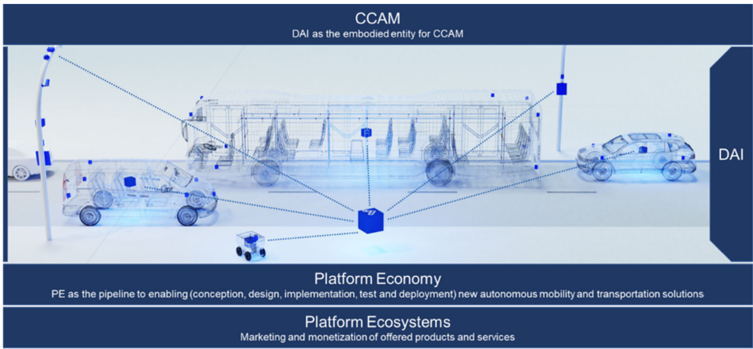
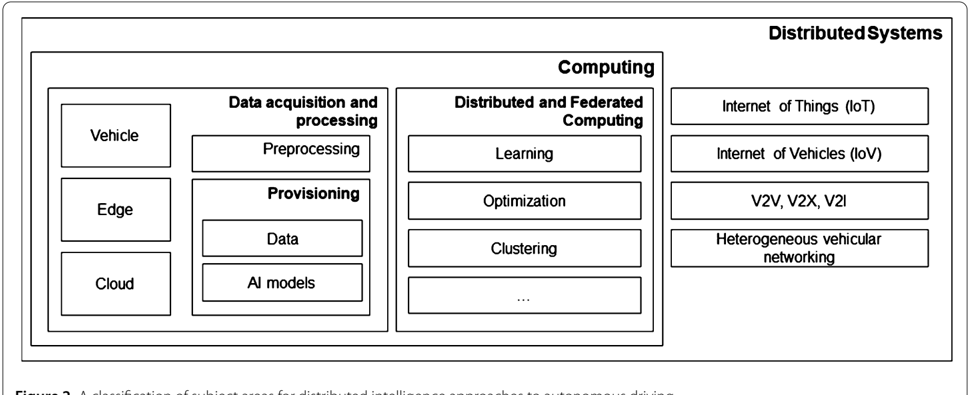
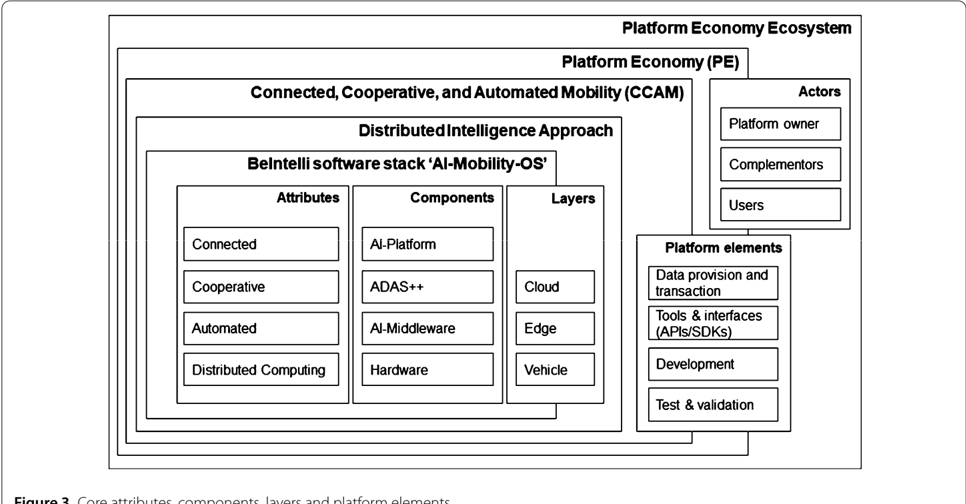
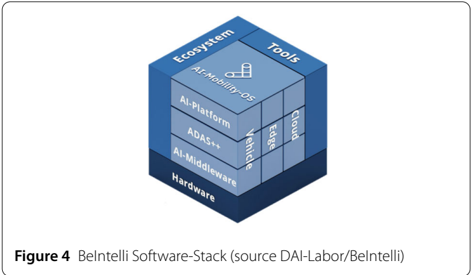
Verification
Claims the paper makes
The claims and statistics of this paper haven’t been checked yet.
Free: it reads the open-access text and checks the first 5 claims that cite a source we can check. Create a free account to check every claim.
Self-check
Percentages, sums and reported differences re-computed from the paper’s own numbers.
The self-check needs the paper’s full text.
Citations
Cites
The sustainable mobility paradigm
Banister, D. (2008) · Transport Policy · doi:10.1016/j.tranpol.2007.10.005 · Cited by 2,778 · cited 1×
“Vehicle and transport infrastructure digitalization has not only opened up a new landscape for mobility and transportation offerings but disrupts paradigms such as travel as a derived demand [40].”
Taleb, T., Samdanis, K., Mada, B., Flinck, H., Dutta, S., & Sabella, D. (2017) · IEEE Communications Surveys & Tutorials · doi:10.1109/comst.2017.2705720 · Cited by 1,775 · cited 2×
“Furthermore, MAEC may act as an extended component for autonomous vehicles in providing useful information for a car’s decision making [17].”
Tiwana, A., Konsynski, B., & Bush, A. A. (2010) · Information Systems Research · doi:10.1287/isre.1100.0323 · Cited by 1,514 · cited 1×
“Scholars in information systems define a platform as a set of stable components that provides core functionalities in a system by constraining the interfaces through which they operate [25, 26, 41].”
Rayle, L., Dai, D., Chan, N., Cervero, R., & Shaheen, S. (2016) · Transport Policy · doi:10.1016/j.tranpol.2015.10.004 · Cited by 1,118
Open Platform Strategies and Innovation: Granting Access vs. Devolving Control
Boudreau, K. (2010) · Management Science · doi:10.1287/mnsc.1100.1215 · Cited by 978 · cited 1×
“Scholars in information systems define a platform as a set of stable components that provides core functionalities in a system by constraining the interfaces through which they operate [25, 26, 41].”
The Architecture of Platforms: A Unified ViewPreprint
Baldwin, C. Y., & Woodard, C. J. (2008) · SSRN Electronic Journal · doi:10.2139/ssrn.1265155 · Cited by 915
Ghazawneh, A., & Henfridsson, O. (2013) · Information Systems Journal · doi:10.1111/j.1365-2575.2012.00406.x · Cited by 854 · cited 1×
“Application Programming Interfaces (APIs) enable components and users’ communication and interaction, as well as third parties to provide additional services [27] which create value for the platform.”
The Architecture of Platforms: A Unified View
Baldwin, C. Y., & Woodard, C. J. (2009) · Platforms, Markets and Innovation · doi:10.4337/9781849803311.00008 · Cited by 800
Edge Computing for Autonomous Driving: Opportunities and Challenges
Liu, S., Liu, L., Tang, J., Yu, B., Wang, Y., & Shi, W. (2019) · Proceedings of the IEEE · doi:10.1109/jproc.2019.2915983 · Cited by 778 · cited 1×
“Research has approached edge computing from various angles; for instance, [8] examines its opportunities, [9, 10] look into IoV and the role of the mobile edge and [11] provides insights to vehicular applications using the edge.”
(2019) · Cited by 627
Digital platforms’ boundaries: The interplay of firm scope, platform sides, and digital interfaces
Gawer, A. (2021) · Long Range Planning · doi:10.1016/j.lrp.2020.102045 · Cited by 626 · cited 2×
“The interplay between platform owners, service providers, solution providers and users creates cross-side network effects [28], which translate into previously untapped value.”
Mobile Edge Intelligence and Computing for the Internet of Vehicles
Zhang, J., & Letaief, K. B. (2020) · Proceedings of the IEEE · doi:10.1109/jproc.2019.2947490 · Cited by 537 · cited 2×
“Research has approached edge computing from various angles; for instance, [8] examines its opportunities, [9, 10] look into IoV and the role of the mobile edge and [11] provides insights to vehicular applications using the edge.”
OVERVIEW OF PLATOONING SYSTEMS
Bergenhem, C., Shladover, S. E., Coelingh, E., Englund, C., & Tsugawa, S. (2012) · Chalmers Publication Library (Chalmers University of Technology) · Cited by 303
Katsaros, K., Kernchen, R., Dianati, M., & Rieck, D. (2011) · 2011 7th International Wireless Communications and Mobile Computing Conference · doi:10.1109/iwcmc.2011.5982524 · Cited by 224 · cited 1×
“This includes use cases such as smart parking [4], Green-Light Optimized Speed Advisory (GLOSA) [5], platooning [6], and vehicle on-demand [7], to name just a few examples.”
Particle Swarm Optimization for the Vehicle Routing Problem with Stochastic Demands
Marinakis, Y., Iordanidou, G.-R., & Marinaki, M. (2013) · Applied Soft Computing · doi:10.1016/j.asoc.2013.01.007 · Cited by 188 · cited 1×
“DAI provides CCAM with services such as co-operative perception [33], swarm optimization [34], federated [35] and distributed learning [4] of ML models, just to name a few examples.”
Trends in distributed artificial intelligence
Chaib-draa, B., Moulin, B., Mandiau, R., & Millot, P. (1992) · Artificial Intelligence Review · doi:10.1007/bf00155579 · Cited by 171
Vehicle control system coordinated between cloud and mobile edge computing
Sasaki, K., Suzuki, N., Makido, S., & Nakao, A. (2016) · Annual Conference of the Society of Instrument and Control Engineers of Japan (SICE) · doi:10.1109/sice.2016.7749210 · Cited by 110 · cited 4×
“To address this issue, they proposed a so-called infrastructure-based vehicle control system which helps disseminating tasks and allocate computational resources dynamically [18].”
InfluentialDistributed Real-Time IoT for Autonomous Vehicles
Philip, B. V., Alpcan, T., Jin, J., & Palaniswami, M. (2019) · IEEE Transactions on Industrial Informatics · doi:10.1109/tii.2018.2877217 · Cited by 105 · cited 5×
“Real-time communication and data processing are key components for cooperation between autonomous vehicles [15].”
InfluentialA Decentralized Federated Learning Approach for Connected Autonomous Vehicles
Pokhrel, S. R., & Choi, J. (2020) · 2020 IEEE Wireless Communications and Networking Conference Workshops (WCNCW) · doi:10.1109/wcncw48565.2020.9124733 · Cited by 102 · cited 1×
“DAI provides CCAM with services such as co-operative perception [33], swarm optimization [34], federated [35] and distributed learning [4] of ML models, just to name a few examples.”
Internet of Vehicles (IoV) for traffic management
Dandala, T. T., Krishnamurthy, V., & Alwan, R. (2017) · 2017 International Conference on Computer, Communication and Signal Processing (ICCCSP) · doi:10.1109/icccsp.2017.7944096 · Cited by 96 · cited 1×
“Analogously, Internet of Vehicles (IoV) is used for those objects limited to the context of automotive [16].”
Kim, S.-W., Chong, Z. J., Qin, B., Shen, X., Cheng, Z., Liu, W., & Ang, M. H. (2013) · 2013 IEEE/RSJ International Conference on Intelligent Robots and Systems · doi:10.1109/iros.2013.6697088 · Cited by 80 · cited 1×
“DAI provides CCAM with services such as co-operative perception [33], swarm optimization [34], federated [35] and distributed learning [4] of ML models, just to name a few examples.”
Infrastructure Enabled Autonomy: A Distributed Intelligence Architecture for Autonomous Vehicles
Gopalswamy, S., & Rathinam, S. (2018) · IEEE Intelligent Vehicles Symposium · doi:10.1109/ivs.2018.8500436 · Cited by 66
Distributed Learning for Vehicle Routing Decision in Software Defined Internet of Vehicles
Lin, K., Li, C., Li, Y., Savaglio, C., & Fortino, G. (2020) · IEEE Transactions on Intelligent Transportation Systems · doi:10.1109/tits.2020.3023958 · Cited by 65 · cited 2×
“DAI provides CCAM with services such as co-operative perception [33], swarm optimization [34], federated [35] and distributed learning [4] of ML models, just to name a few examples.”
Economic implications of a connected and automated mobility in Europe
Raposo, M. A., Grosso, M., Mourtzouchou, A., Krause, J., Duboz, L., & Ciuffo, B. (2021) · Research in Transportation Economics · doi:10.1016/j.retrec.2021.101072 · Cited by 59 · cited 1×
“For more information about the social impact of CCAM, see [24].”
Intelligent Environment Enabling Autonomous Driving
Khan, M. A. (2021) · IEEE Access · doi:10.1109/access.2021.3059652 · Cited by 39
Exploiting Mobile Edge Computing for Enhancing Vehicular Applications in Smart Cities
El‐Sayed, H., & Chaqfeh, M. (2019) · Sensors · doi:10.3390/s19051073 · Cited by 33 · cited 2×
“Research has approached edge computing from various angles; for instance, [8] examines its opportunities, [9, 10] look into IoV and the role of the mobile edge and [11] provides insights to vehicular applications using the edge.”
Mobile Edge Intelligence and Computing for the Internet of VehiclesPreprint
Zhang, J., & Letaief, K. B. (2019) · arXiv (Cornell University) · doi:10.48550/arxiv.1906.00400 · Cited by 23 · cited 2×
“Research has approached edge computing from various angles; for instance, [8] examines its opportunities, [9, 10] look into IoV and the role of the mobile edge and [11] provides insights to vehicular applications using the edge.”
Enabling Autonomous and Connected Vehicles at the 5G Network Edge
Coronado, E., Cebrián-Márquez, G., & Riggio, R. (2020) · IEEE International Conference on Network Softwarization (NetSoft) · doi:10.1109/netsoft48620.2020.9165444 · Cited by 16 · cited 1×
“Furthermore, more approaches are considered to ship basic functionalities of autonomous vehicles, such as object detection, to the edge [19].”
Cooperative Connected and Automated Mobility (CCAM)
Ferreira, J. (2020) · MDPI eBooks · doi:10.3390/books978-3-03928-159-6 · Cited by 14 · cited 1×
“The technologies underlying CCAM are far-reaching, starting with communication such as 5G, cooperative perception, low-latency communication approaches, to distributed control algorithms, and more [23].”
Dynamic Distributed Computing for Infrastructure-Assisted Autonomous UAVs
Callegaro, D., Baidya, S., & Levorato, M. (2020) · International Conference on Communications · doi:10.1109/icc40277.2020.9148986 · Cited by 12 · cited 2×
“Furthermore, Callegaro et al. discussed the use of unmanned aerial vehicles (UAV) for extending infrastructure perception [12].”
Schulz, W. H., Wieker, H., & Arnegger, B. (2018) · Management for professionals · doi:10.1007/978-3-319-77724-5_19 · Cited by 10 · cited 2×
“The economic factors also play a major role in the realization of CCAM [3] towards enabling efficient and cost-effective transportation of people and goods.”
Mobile Edge Computing for the Internet of Vehicles
Zhang, Y. (2021) · Simula SpringerBriefs on computing · doi:10.1007/978-3-030-83944-4_5 · Cited by 7
Distributed Computing and Image Processing for Autonomous Driving Systems
Gavankar, T., Joshi, A. S., & Sharma, S. (2018) · IEEE International Conference on Distributed Computing, VLSI, Electrical Circuits and Robotics (DISCOVER) · doi:10.1109/discover.2018.8673972 · Cited by 4 · cited 1×
“Application areas for distributed computing are image processing [14] and real-time IoT [15] to support autonomous vehicles.”
Building a Multi-sided Data-Driven Mobility Platform: Key Design Elements and Configurations
Soto, A. C., Augusto, M. G., & Salomo, S. (2023) · Lecture notes in mobility · doi:10.1007/978-981-19-8361-0_6 · Cited by 4
Self-citationMobility as a Service Enabled by the Autonomous Driving
Rakow, C., & Khan, M. A. (2018) · Lecture notes in computer science · doi:10.1007/978-3-030-05081-8_15 · Cited by 3 · cited 1×
“We designed, planned and implemented a digital test track that has been integrated into real urban and complex traf-fic environments at the heart of Berlin [1, 21, 38].”
On the Integration of Shared Autonomous Mobility on Demand in Mobility Service Platforms
Schwinger, F., Philipsen, R., Himmel, S., Jarke, M., & Ziefle, M. (2021) · International Conference on Web Information Systems and Technologies · doi:10.5220/0010675000003058 · Cited by 1 · cited 1×
“As CCAM becomes widespread, the aforementioned use cases will evolve to fit the future user’s needs who would tend to switch from private transportation to more environmentally and space sustainable mobility modes [31].”
Research works printed but not linked: 4
- M. Guerreiro Augusto, N. Masuch, J. Keiser, A. Hessler, S. Albayrak, Towards intelligent infrastructures and AI-driven platform ecosystems for connected and automated mobility solutions, in ITS World Congr. Hamburg, vol. 27 (2021), pp. 2364-2373
- S.A. Bagloee, M. Tavana, M. Asadi, T. Oliver, Autonomous vehicles: challenges, opportunities, and future implications for transportation policies. J. Mod. Transp. 24(4), 284-303 (2016). https://doi.org/10.1007/S40534-016-0117-3/FIGURES/5 · doi:10.1007/s40534-016-0117-3/figures/5
- Self-Driving Cars Work Better With Smart Roads -IEEE Spectrum. https://spectrum.ieee.org/intelligent-transportation-systems (accessed Oct. 28, 2022)
- C. Silva, R. Pinto, J. Castro, P. Tedesco, Requirements for multi-agent systems 37. S.V. Nagaraj, Securing multi-agent systems: a survey. Adv. Intell. Syst. Comput. 176, 23-30 (2012). https://doi.org/10.1007/978-3-642-31513-8_3/COVER · doi:10.1007/978-3-642-31513-8_3/cover
Cited by
A Survey on Sensor Selection and Placement for Connected and Automated Mobility
KİRAZ, M. N. K., Sivrikaya, F., & Albayrak, Ş. (2024) · IEEE Open Journal of Intelligent Transportation Systems · doi:10.1109/ojits.2024.3481328 · Cited by 19
“Together, these pillars make it possible to gather, analyze, and make decisions using real-time data in order to optimize traffic flow, reduce congestion, and increase road safety [7].”
BackgroundSelf-citationJoh, M., Kumaran, S. K., Shin, Y., Cha, H., Oh, E., Lee, K. H., & Choi, H. (2025) · RSC Advances · doi:10.1039/d4ra07510b · Cited by 17
Efficient and accurate road crack detection technology based on YOLOv8-ES
Zeng, K., Fan, R., & Tang, X. (2025) · Autonomous Intelligent Systems · doi:10.1007/s43684-025-00091-3 · Cited by 22
Zhang, F., Yang, X., Dang, Y., Wu, C., & Chen, B. (2025) · Procedia Computer Science · doi:10.1016/j.procs.2025.04.022 · Cited by 9
Augusto, M. G., Maas, J., Kosch, M., Henke, M., Küster, T., Straube, F., & Albayrak, Ş. (2025) · Logistics · doi:10.3390/logistics9010010 · Cited by 9
Metadata
- Authors
- Guerreiro Augusto, M., Acar, B., Soto, A. C., Sivrikaya, F., & Albayrak, S.
- Affiliations
- Technische Universität Berlin (DE)
- Venue
- Autonomous Intelligent Systems
- Published
- 2024-01-03
- Volume
- 4
- Issue
- 1
- ISSN
- 2730-616X (ISSN-L)
- OpenAlex
- W4390572423
- Cited by
- 15
- References
- 34
- Citations by year
- 2026: 3 · 2025: 6 · 2024: 6
- FWCI
- 1.62
- Type
- journal article
- Language
- en
- Open access
- diamond
- doi.org
- Licence
- cc-by
- creativecommons.org/licenses/by/4.0 (tdm)
- creativecommons.org/licenses/by/4.0 (vor)
- Locations
- Autonomous Intelligent Systems (publishedVersion, cc-by)
- DOAJ (DOAJ: Directory of Open Access Journals) (submittedVersion, cc-by-sa)
- Funders
- Bundesministerium für Verkehr und Digitale Infrastruktur (01MM20004)
- Topics
- Physical Sciences › Engineering › Automotive Engineering › Autonomous Vehicle Technology and Safety
- Social Sciences › Transportation › Transportation and Mobility Innovations
- Social Sciences › Business, Management and Accounting › Strategy and Management › Digital Platforms and Economics
- Keywords
- distributed artificial intelligence, autonomous driving, platform economy, Mobility as a Service, autonomous mobility, platform ecosystems, embedded software, open-source platform, autonomous vehicles, urban transportation systems, architectural blueprints
About these checks
Registry, retraction, Cites and statistics results are computed, not judged, with one exception: a printed reference that no index lists is read once by a model before it counts as a citation error. Claims are extracted by a model and kept only when their quote appears verbatim in the text; each cited source is then checked, with a model’s help, for whether it says what the claim relies on. Those verdicts can be wrong — read the claim’s quote and the cited source before relying on one.
Statistics and arithmetic are recomputed, not judged.
Confidence bands are shown only for fields calibrated on our annotated test set. None is calibrated yet, so no band is shown.
What counts as a claim ›How we measure confidence ›How we check this ›
Are you an author, or do you see a problem with this page? Request a review
Data sources
Bibliographic data: Semantic Scholar, OpenAlex, Crossref.
Contains information from the Semantic Scholar Academic Graph Datasets, made available under the ODC Attribution License (ODC-BY 1.0).
Semantic Scholar’s data is described in: Kinney, R., et al. (2023). The Semantic Scholar Open Data Platform. arXiv:2301.10140.
