

Applications of biochar in medical and related environmental fields: current status and future perspectives
Open accessThe DOI matches its Crossref record; 88 of the 88 references it cites were found in a registry or an index.
Abstract
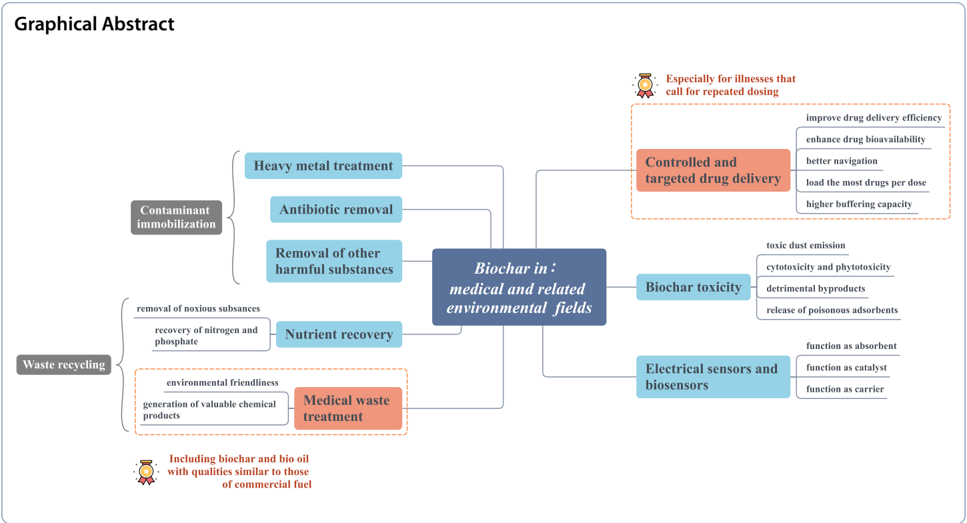
Biochar (BC) is a stable, carbon-rich material produced through biomass pyrolysis in an oxygen-restricted environment. In recent years, BC has gained recognition as an environmentally friendly material and has been extensively researched for its various applications related to human health. However, the medical applications of biochar remain relatively unexplored. This review aims to analyze recent publications from PubMed, focusing on the direct association between biochar and medical science over the past 3 years. The analysis identified five main subjects: contaminant immobilization, medical waste treatment and nutrient recovery, biochar toxicity, electrical sensors and biosensors, and drug delivery. Among these subjects, drug delivery and biosensors demonstrated the most direct relevance to the medical field. To enhance the validity of our findings, a bibliometric analysis was performed using the Web of Science Core Collection to visualize the trends in medical applications of biochar over time. The results further support our analysis. Finally, potential directions for future medical applications of biochar were discussed. This review underscores the necessity for further research on the medical applications of biochar. By exploring its potential in drug delivery, biosensors, and other domains, biochar has the potential to revolutionize medicine. Graphical Abstract
Overview
The claims and statistics of this paper haven’t been checked yet.
Free: it reads the open-access text and checks the first 5 claims that cite a source we can check. Create a free account to check every claim.
Integrity signals
Registry
Cites
Statistics
Figures
Verification
Claims the paper makes
The claims and statistics of this paper haven’t been checked yet.
Free: it reads the open-access text and checks the first 5 claims that cite a source we can check. Create a free account to check every claim.
Self-check
Percentages, sums and reported differences re-computed from the paper’s own numbers.
The self-check needs the paper’s full text.
Citations
Cites
Zhang, Q.-Q., Ying, G.-G., Pan, C.-G., Liu, Y.-S., & Zhao, J.-L. (2015) · Environmental Science & Technology · doi:10.1021/acs.est.5b00729 · Cited by 3,852 · cited 1×
“…“ Antibiotic Pollution Map of Rivers in China ”, the norfloxacin (NOR) concentration in the Pearl River (Guangdong province) was even higher than 1000 ng/L, while the average antibiotic concentration in China’s major rivers was approximately 303 ng/L (Zhang et al. 2015; Liang et al. 2022).”
BackgroundPatel, M., Kumar, R., Kishor, K., Mlsna, T., Pittman, C. U., & Mohan, D. (2019) · Chemical Reviews · doi:10.1021/acs.chemrev.8b00299 · Cited by 2,654 · cited 2×
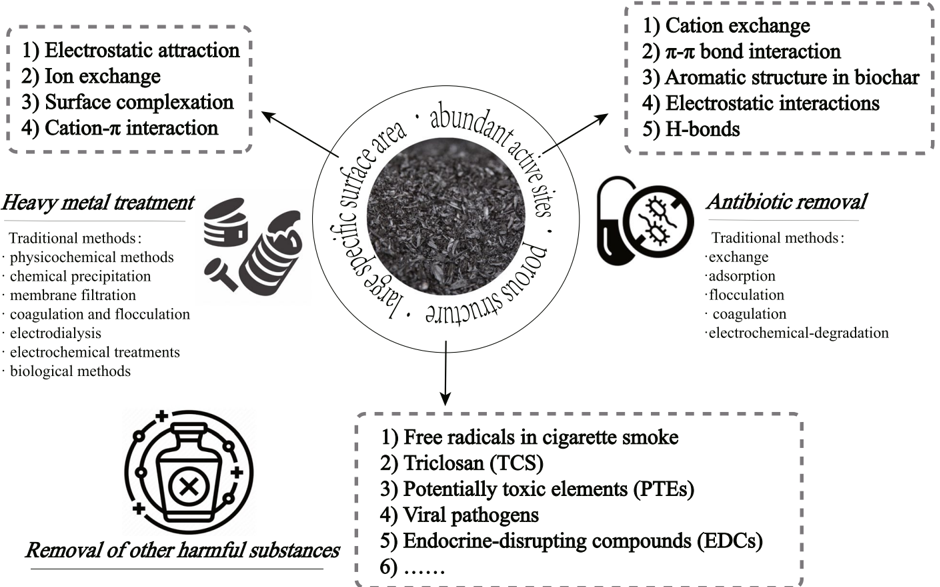
“Besides contaminating soil and water supply, genes that are resistant to antibiotics are also produced when antibiotics are left in the environment, which are widely distributed in food chain and damage the ecosystem (Qiao et al. 2018; Patel et al. 2019).”
BackgroundControlled Drug Delivery Systems: Current Status and Future Directions
Adepu, S., & Ramakrishna, S. (2021) · Molecules · doi:10.3390/molecules26195905 · Cited by 1,691 · cited 1×
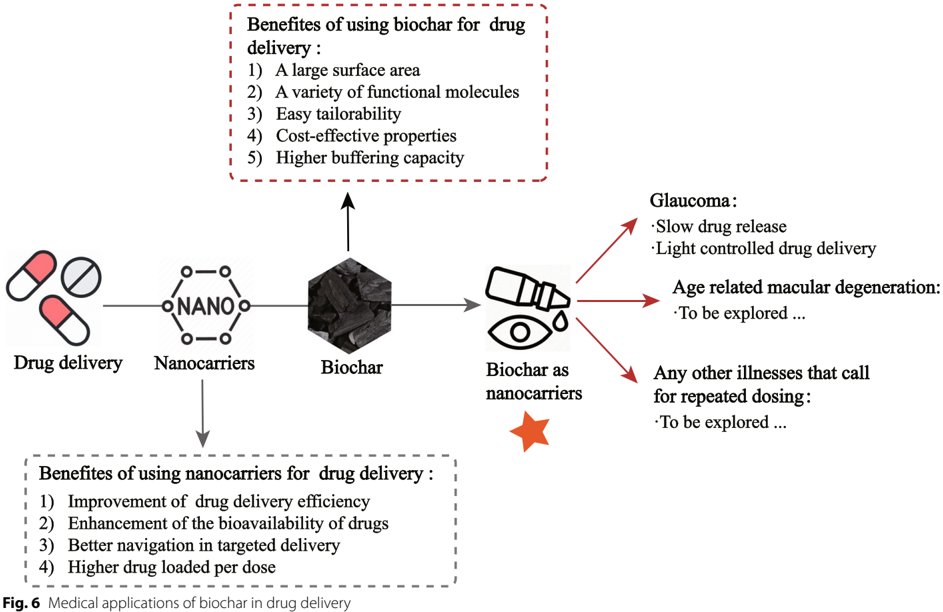
“Drawing upon the comprehensive review by Adepu and Ramakrishna (2021), a detailed list of the advantages of biochar over commonly employed nano-carriers was compiled, which is presented in Table 4 (Adepu and Ramakrishna 2021).”
MethodReview of antibiotic resistance in China and its environment
Qiao, M., Ying, G.-G., Singer, A. C., & Zhu, Y.-G. (2018) · Environment International · doi:10.1016/j.envint.2017.10.016 · Cited by 1,494
A review of biochar as a low-cost adsorbent for aqueous heavy metal removal
Inyang, M. I., Gao, B., Yao, Y., Xue, Y., Zimmerman, A., Mosa, A., Pullammanappallil, P., Ok, Y. S., & Cao, X. (2016) · Critical Reviews in Environmental Science and Technology · doi:10.1080/10643389.2015.1096880 · Cited by 1,397 · cited 2×
“The highly absorbent nature of biochar enables effective removal of heavy metals from wastewater (Inyang et al. 2016), as well as other toxic substances such as triclosan (TCS) (Ma et al. 2022), potentially toxic elements (PTEs) (Muhammad et al. 2020), and antibiotics in contaminated soil (Qiao et…”
BackgroundA review on thermal and catalytic pyrolysis of plastic solid waste (PSW)
Al-Salem, S. M., Antelava, A., Constantinou, A., Manos, G., & Dutta, A. (2017) · Journal of Environmental Management · doi:10.1016/j.jenvman.2017.03.084 · Cited by 1,200 · cited 2×
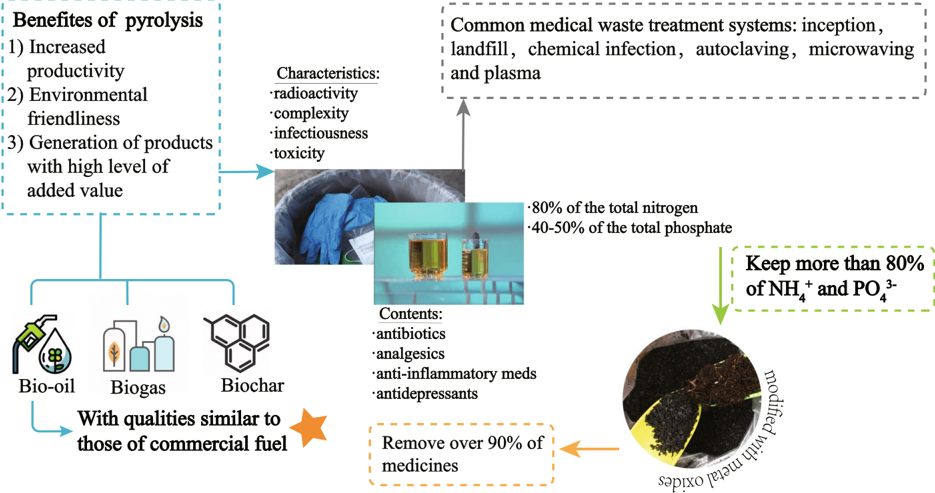
“Furthermore, catalytic pyrolysis proved to be even more advantageous by facilitating higher reaction rates at lower temperatures, thereby influencing product selectivity and enhancing overall efficiency (Al-Salem et al. 2017; Purnomo et al. 2021).”
BackgroundSurface chemistry variations among a series of laboratory-produced biochars
Mukherjee, A., Zimmerman, A. R., & Harris, W. (2011) · Geoderma · doi:10.1016/j.geoderma.2011.04.021 · Cited by 1,171 · cited 1×
“Also, it is reported that as a carrier, biochar shows a higher buffering capacity (Mukherjee et al. 2011), which is undoubtedly beneficial for the controlled release of substances.”
BackgroundKlemeš, J. J., Fan, Y. V., Tan, R. R., & Jiang, P. (2020) · Renewable and Sustainable Energy Reviews · doi:10.1016/j.rser.2020.109883 · Cited by 985 · cited 1×
“Medical waste also demonstrates traits of radioactivity, complexity, infectiousness, and toxicity (Su et al. 2021) making it even more difficult to manage this type of trash and placing an immense pressure on the current waste management system (Klemeš et al. 2020; Purnomo et al. 2021).”
BackgroundAntibiotic Pollution in the Environment: From Microbial Ecology to Public Policy
Kraemer, S. A., Ramachandran, A., & Perron, G. G. (2019) · Microorganisms · doi:10.3390/microorganisms7060180 · Cited by 932 · cited 2×
“In addition to biodegradable routes, non-biodegradable pathways, including Photolysis, Ozonation, advanced oxidation processes, and Fenton processes, have been explored for antibiotic degradation (Kraemer et al. 2019; Katiyar et al. 2022).”
BackgroundXiao, X., Chen, B., Chen, Z., Zhu, L., & Schnoor, J. L. (2018) · Environmental Science & Technology · doi:10.1021/acs.est.7b06487 · Cited by 914 · cited 1×
“…nutrient recovery (Xu et al. 2019), wastewater treatment (Liu et al. 2022a, b), contaminant immobilization (Li et al. 2021), soil amendment strategies (Sashidhar et al. 2020), and carbon sequestration in soil (Xiao et al. 2018), all of which have direct or indirect implications for human health.”
Background
Research works printed but not linked: 1
- Som U, Rahman F, Hossain S (2018) Recovery of pyrolytic oil from thermal pyrolysis of medical waste. J Eng Sci 5(2):H5-H8
Cited by
Life cycle assessment of biochar as a green sorbent for soil remediation
Osman, A. I., Farghali, M., & Rashwan, A. K. (2024) · Current Opinion in Green and Sustainable Chemistry · doi:10.1016/j.cogsc.2024.100882 · Cited by 76
Active Learning-Based Guided Synthesis of Engineered Biochar for CO 2 Capture
Yuan, X., Suvarna, M., Lim, J. Y., Pérez‐Ramírez, J., Wang, X., & Ok, Y. S. (2024) · Environmental Science & Technology · doi:10.1021/acs.est.3c10922 · Cited by 66
Razzak, S. A. (2024) · Journal of Analytical and Applied Pyrolysis · doi:10.1016/j.jaap.2024.106622 · Cited by 58
Deng, J., Zhang, W., Zhang, L., Qin, C., Wang, H., & Ling, W. (2024) · Environment International · doi:10.1016/j.envint.2024.108972 · Cited by 55
Solid waste-derived carbonaceous catalysts for environmental and energy applications
Jiang, T., Wang, B., Hassan, M., & Zou, Q. (2024) · Carbon Research · doi:10.1007/s44246-024-00166-5 · Cited by 39
“…pyrolysis conditions, such as pyrolysis temperature, heating rate, residence time, and types of protective gas, can influence the yield, SSA, porosity, pH, functional group content, as well as the types and amounts of persistent free radicals (PFRs) of CCs (Sun et al. 2024; Zhuo et al. 2023).”
Biochar Utilization in Antimicrobial, Anticancer, and Biosensing Applications: A Review
Min, K. H., Kim, K. H., Seo, J.-H., & Pack, S. P. (2025) · Biomolecules · doi:10.3390/biom15060760 · Cited by 26
“Recently, the biomedical applications of biochar have emerged as a promising area of study, demonstrating potential in fields such as drug delivery, tissue engineering, and antimicrobial treatments [23,44].”
InfluentialThe evolving role of biochar: recent advances and future directions - a review
Ogunwa, K. I., Nnadozie, E. C., Dube, N., Oladoye, P. O., & Obayomi, K. S. (2025) · Biomass and Bioenergy · doi:10.1016/j.biombioe.2025.108844 · Cited by 16
Bezzalla, A., Bennadji, M. E. A., Zidane, L., Neffar, S., & Chenchouni, H. (2026) · Biomass and Bioenergy · doi:10.1016/j.biombioe.2026.108960 · Cited by 15
Amir, N., Hussin, F., Aroua, M. K., & Gozan, M. (2025) · Renewable and Sustainable Energy Reviews · doi:10.1016/j.rser.2025.115458 · Cited by 16
Das, K. P., & Satapathy, B. K. (2024) · ACS Applied Polymer Materials · doi:10.1021/acsapm.4c00386 · Cited by 12
Macavei, M. G., Pătrașcu, M., Ionescu, G., Gheorghe, V.-C., Petcu, G., Volceanov, A., Magdziarz, A., & Mărculescu, C. (2025) · Clean Technologies and Environmental Policy · doi:10.1007/s10098-025-03275-w · Cited by 13
“It can also be used in pharmaceutical applications, as drugs or toxins adsorbent (Zhuo et al. 2023).”
Shao, M., Ma, X., Zhang, M., Li, Y., Liu, L., Wang, J., Wei, M., Sun, C., Zheng, H., Luo, X., et al. (2025) · Chemical Engineering Journal · doi:10.1016/j.cej.2025.160070 · Cited by 10
Rezvani, B. (2025) · The Canadian Journal of Chemical Engineering · doi:10.1002/cjce.25702 · Cited by 11
Mkilima, T., & Baimukasheva, S. (2025) · Journal of Ecological Engineering · doi:10.12911/22998993/203696 · Cited by 9
Baseline Characteristics of Pristine Agricultural Pods Biochar
Busari, B. I., Al‐Senani, G. M., Emmanuel, S. S., Al‐Qahtani, S. D., Emenike, E. C., Iwuozor, K. O., Egbemhenghe, A. U., Yusuf, R. O., & Adeniyi, A. G. (2025) · Asia-Pacific Journal of Chemical Engineering · doi:10.1002/apj.70128 · Cited by 6
Huang, Y. L., Guan, Y., Dong, W., Wang, Y., Wang, P., Wu, M., Peng, Y., Chen, Q., & Pan, B. (2025) · Chemical Engineering Science · doi:10.1016/j.ces.2025.122084 · Cited by 5
Hernández-Calderón, C., Escobar, B., Valdez-Ojeda, R. A., Arroyo-Herrera, A., Toledano-Thompson, T., & Baas-López, J. M. (2025) · Natural Product Research · doi:10.1080/14786419.2025.2484269 · Cited by 4
“Although various studies have explored biochar applications, few have investigated its use as a control tool against Salmonella in human health (Zhuo et al. 2023).”
Lemine, O. M., Bououdina, M., Altoub, T., Alshammari, M., Museery, K. Y., Alanzi, A. Z., & Latrous, L. (2025) · RSC Advances · doi:10.1039/d5ra04120a · Cited by 4
Mitigating Abiotic Stresses and Enhancing Tree Growth with Biochar and Hydrogels: A Review
Ammar, A., Bakari, Z., BUBBA, M. D., Aziz, F., Khemakhem, B., Ghadraoui, A. E., & Elleuch, A. (2025) · Journal of soil science and plant nutrition · doi:10.1007/s42729-025-02741-0 · Cited by 4
“Biochar is a stable porous carbonaceous material, rich in aromatic groups, enclosing both a graphene-forming crystalline fraction and amorphous fraction, whereby the organic carbon is bonded to various polar groups (Zhuo et al. 2023).”
Mulabagal, V., Baah, D. A., Egiebor, N. O., Sajjadi, B., Chen, W.-Y., Viticoski, R. L., & Hayworth, J. S. (2025) · Springer eBooks · doi:10.1007/978-3-031-84483-6_80 · Cited by 4
Cintra, D. S., Alcântara, L. M., Nardy, K. A., Valente, M. R., de Oliveira, P. C. O., Peixoto, B. S., Veloso, M. C. D. C., Romeiro, G. A., Zamith‐Miranda, D., Nosanchuk, J. D., et al. (2025) · Scientific Reports · doi:10.1038/s41598-025-17626-6 · Cited by 4
“…an important product of pyrolysis, can also be used in pigments and adhesives, contaminant immobilization, electric sensors and biosensors and drug delivery, with direct medical relevance 29,30 and waste treatment and reuse, as a sustainable and protective approach to environmental protection 31 .”
Gao, Y., Chen, H., Wang, F., Li, J., Fang, Z., Zhang, X., Yang, X., Wang, J., Liu, J., Li, C., et al. (2026) · Biochar · doi:10.1007/s42773-026-00579-y · Cited by 3
Lee, S., Park, J. E., Sun, J. X., Kim, H., & Kim, Y. (2025) · Korean Journal of Chemical Engineering · doi:10.1007/s11814-025-00478-1 · Cited by 2
“As a result, activated biochar demonstrates improved adsorption capacity and environmental resilience, making it effective in various applications [59, 60].”
Future Prospects and Emerging Trends of Biochar
Singh, S., Thakur, A., Kiran, V., Dulta, K., Kamau, S. K., Ghosh, S., Tomar, S., & Dubey, G. (2026) · Springer eBooks · doi:10.1007/978-3-032-16746-0_13 · Cited by 3
Mulabagal, V., Baah, D. A., Egiebor, N. O., Sajjadi, B., Chen, W.-Y., Viticoski, R. L., & Hayworth, J. S. (2024) · Springer eBooks · doi:10.1007/978-1-4614-6431-0_80-3 · Cited by 2
Hydrochar as sustainable redox catalyst for advanced oxidation processes-based wastewater treatment
Manickavasagam, G., Saaid, M., & Oh, W. (2025) · Pure and Applied Chemistry · doi:10.1515/pac-2024-0309 · Cited by 2
Biochar: A Sustainable Solution for Agriculture and Environment
Singh, N. K., Maurya, V. K., & Kumar, D. (2025) · Springer eBooks · doi:10.1007/978-981-95-0425-1_2 · Cited by 4
Agricultural Waste Biomass Management and Biochar Production
Shinde, A., Patwardhan, S. V., Kshirsagar, R., Jivani, F., Loni, S., Tanwar, M. D., Guldhe, A., & Suprasanna, P. (2025) · Springer eBooks · doi:10.1007/978-981-95-0425-1_6 · Cited by 1
Corn vs. apple biochars: Efficient detoxication of heavy metals in nerve terminal model
Krisanova, N., Terebilenko, A. V., Pozdnyakova, N., Mazur, D. O., Tarasenko, A., Dudarenko, M., Pastukhov, A. O., Borysov, A., Pariiska, O. O., Kurys, Y. I., et al. (2025) · Chemical Engineering Journal Advances · doi:10.1016/j.ceja.2025.100953 · Cited by 1
Unraveling the physical genome of biochar
Ji, Y., Kirk, D. W., Cai, Z., & Jia, C. Q. (2026) · Biochar X · doi:10.48130/bchax-0026-0003 · Cited by 2
Vivekanandan, K. E., Kandasamy, S., Sigamani, S., Kaliyannan, G., Selvaraj, M., Assiri, M. A., & Sarangi, P. K. (2026) · Biomass and Bioenergy · doi:10.1016/j.biombioe.2026.109342 · Cited by 1
Zhang, L., Shi, A., Song, L., Zhou, Y., Wang, S., LIU, X., Chu, J., & Yao, X. (2026) · Journal of environmental chemical engineering · doi:10.1016/j.jece.2026.123776 · Cited by 1
Mukherjee, T., & Pal, S. (2024) · Royal Society of Chemistry eBooks · doi:10.1039/bk9781837673131-00358
Environmental Compatibility of Biochar
Srivastava, N., Saxena, N., & Yadav, P. (2025) · Springer eBooks · doi:10.1007/978-3-031-92594-8_11
A Study of Biochar Application in Various Fields
Chung, J. (2025) · Journal of Environmental Science International · doi:10.5322/jesi.2025.34.7.443
Alqaraleh, M., Al-Rawashde, F. A., Al-Samydai, A. M., Al‐Najdawi, M. A., Al‐Kabariti, A. Y., Al-Tarawneh, A. A., Hasan, D., Khleifat, K. M., Ahmad, M. A.-S., & Al-Najjar, B. O. (2026) · Journal of Applied Toxicology · doi:10.1002/jat.70264
Guo, Y., Li, S., Zhang, X., Wang, L., Gao, Y., Xue, Y., Gao, Y., Ye, Y., Zhu, L., Wang, J., et al. (2026) · Applied Soil Ecology · doi:10.1016/j.apsoil.2026.107241
Yapıcıoğlu, P. S. (2026) · Elsevier eBooks · doi:10.1016/b978-0-443-34290-5.00010-x
Sharma, N., Lal, S., & Bansal, N. (2026) · Journal of Thermoplastic Composite Materials · doi:10.1177/08927057261478995
Biochar-based biosensors: from sustainable carbon materials to next-generation sensing platforms
Kumar, S., Anand, S., & Kumar, V. (2026) · Analytical Methods · doi:10.1039/d6ay01381c
Biochar for sustainable wastewater remediation
Senadheera, S. S., Lee, J. T. E., Klimchuk, K., Kenney, J. P. L., Khan, E., Hou, C., Alessi, D. S., & Ok, Y. S. (2026) · Water Science & Technology · doi:10.2166/wst.2026.359
Metadata
- Authors
- Zhuo, Q., Liang, Y., Hu, Y., Shi, M., Zhao, C., & Zhang, S.
- Affiliations
- Shanghai Medical College of Fudan University (CN)
- Corresponding author
- Zhao, Chen
- Zhang, Shujie
- Venue
- Carbon Research
- Published
- 2023-09-18
- Volume
- 2
- Issue
- 1
- ISSN
- 2731-6696 (ISSN-L)
- OpenAlex
- W4386829977
- Semantic Scholar
- 690a8ff21dbcdbd0c03c05f00481f3ff8eaea6d8
- Cited by
- 39
- References
- 88
- Citations by year
- 2026: 11 · 2025: 20 · 2024: 8
- FWCI
- 3.09
- Type
- journal article
- Language
- en
- Open access
- hybrid
- doi.org
- Licence
- cc-by
- creativecommons.org/licenses/by/4.0 (tdm)
- creativecommons.org/licenses/by/4.0 (vor)
- Locations
- Carbon Research (publishedVersion, cc-by)
- DOAJ (DOAJ: Directory of Open Access Journals) (submittedVersion)
- Funders
- National Natural Science Foundation of China (8201001029)
- Topics
- Physical Sciences › Energy › Fuel Technology › Thermochemical Biomass Conversion Processes
- Physical Sciences › Environmental Science › Water Science and Technology › Adsorption and biosorption for pollutant removal
- Physical Sciences › Engineering › Biomedical Engineering › Graphene and Nanomaterials Applications
- Keywords
- biochar, medical applications, drug delivery, biosensors, electrical sensors, contaminant immobilization, medical waste treatment, nutrient recovery, biomass pyrolysis, carbon-rich materials
About these checks
Registry, retraction, Cites and statistics results are computed, not judged, with one exception: a printed reference that no index lists is read once by a model before it counts as a citation error. Claims are extracted by a model and kept only when their quote appears verbatim in the text; each cited source is then checked, with a model’s help, for whether it says what the claim relies on. Those verdicts can be wrong — read the claim’s quote and the cited source before relying on one.
Statistics and arithmetic are recomputed, not judged.
Confidence bands are shown only for fields calibrated on our annotated test set. None is calibrated yet, so no band is shown.
What counts as a claim ›How we measure confidence ›How we check this ›
Are you an author, or do you see a problem with this page? Request a review
Data sources
Bibliographic data: Semantic Scholar, OpenAlex, Crossref.
Contains information from the Semantic Scholar Academic Graph Datasets, made available under the ODC Attribution License (ODC-BY 1.0).
Semantic Scholar’s data is described in: Kinney, R., et al. (2023). The Semantic Scholar Open Data Platform. arXiv:2301.10140.
