

A scientometric and literature review of global trends and valorisation strategies for construction and demolition waste
Open accessThe DOI matches its Crossref record; 66 of the 66 references it cites were found in a registry or an index; none of the 74 sources its claims cite is checked for support yet.
Abstract
The increasing volume of construction and demolition waste (CDW) poses significant environmental and resource challenges, necessitating effective utilisation strategies. This study presents a scientometric review of global research on CDW utilisation, identifying key trends, influential authors, and thematic developments over the past two decades. The analysis of 7326 publications identifies recycled aggregates, circular economy, life-cycle assessment, and sustainable construction as the major research clusters, highlighting a shift toward resource recovery and high-value CDW valorisation. The paper explores valorisation pathways, including direct reuse, recycling into construction materials, and advanced transformation technologies. Environmental and economic considerations, such as life cycle assessment and cost–benefit analysis, are critically reviewed. Despite progress, significant gaps persist in policy integration, high-value valorisation, and interdisciplinary collaboration. The study highlights future research directions to advance sustainable CDW management and support circular economy goals. Findings offer insights for researchers, practitioners, and policymakers working towards resource-efficient and low-impact construction practices.
Overview
CoChat Summary
TL;DR
This paper combines a scientometric mapping of 7,326 Scopus-indexed publications with a narrative literature review to chart global research trends and valorisation pathways for construction and demolition waste (CDW). It finds explosive post-2015 growth in CDW research led by China and India, and argues that reuse, recycling, and mechanical/chemical processing can close material loops, but that regulatory, technical, economic, and perceptual barriers still block adoption.
Key findings
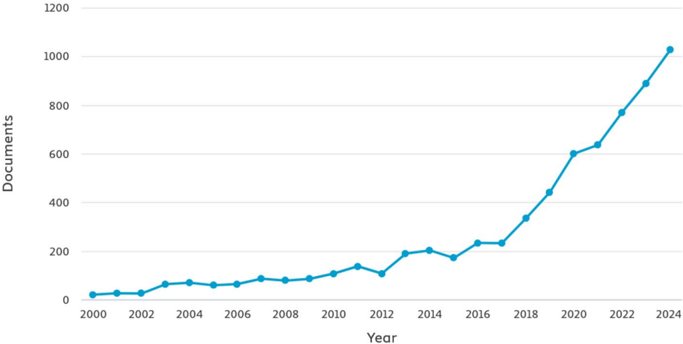
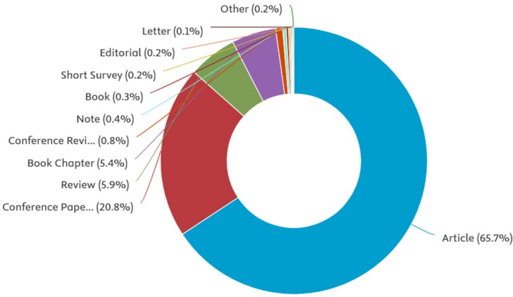
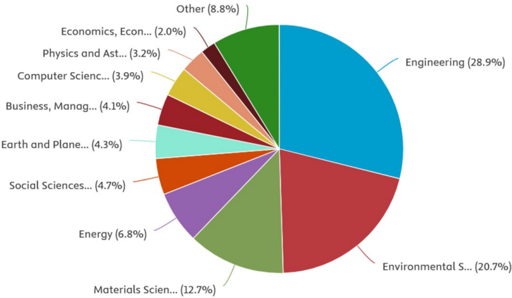
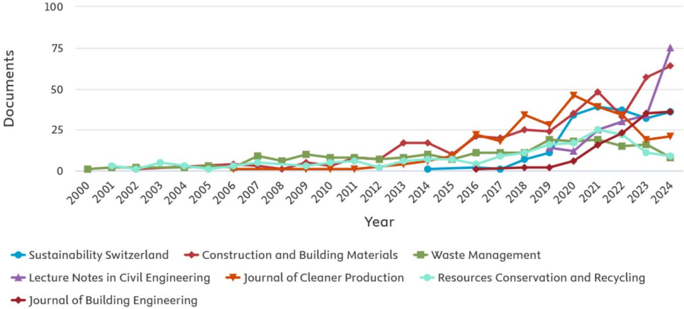
- CDW research grew from fewer than 200 documents per year before ~2015 to over 1,000 in 2024; the corpus is 65.7% journal articles, 20.8% conference papers, 5.9% reviews, and 5.4% book chapters, with engineering (28.9%) and environmental science (20.7%) dominating subject areas.
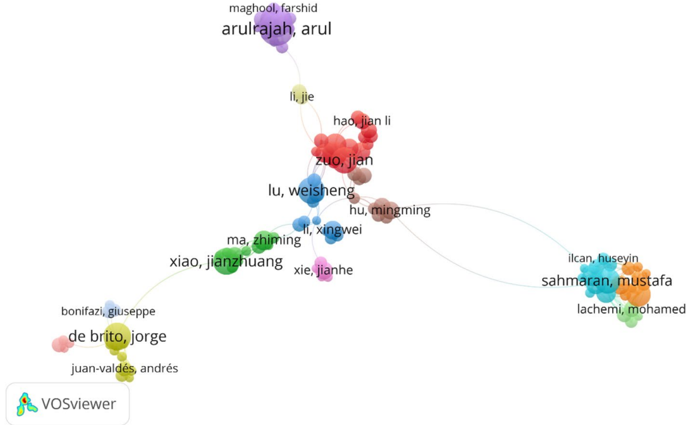
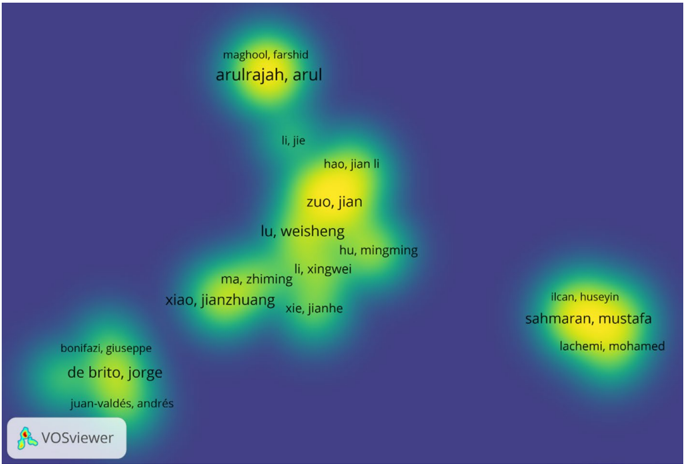
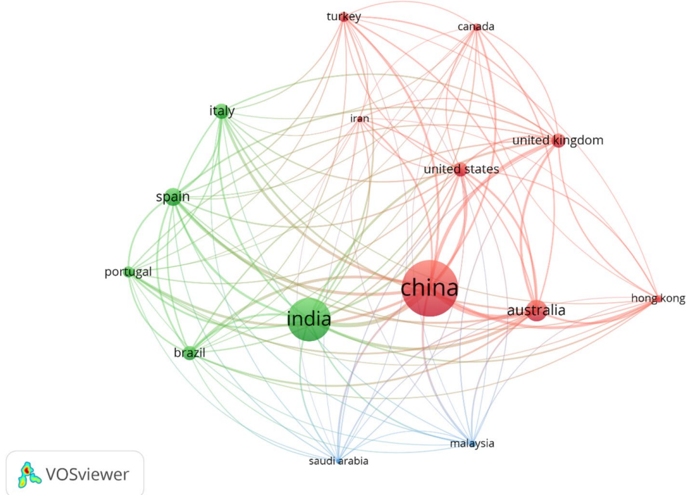
- China leads with 1,006 documents and 27,225 citations, followed by India (771 documents, 7,031 citations) and Australia (381 documents, 11,575 citations); Arulrajah, Arul is the most prolific author (45 documents, 1,024 citations), while Zuo, Jian has the highest citation count (1,486 from 29 documents).
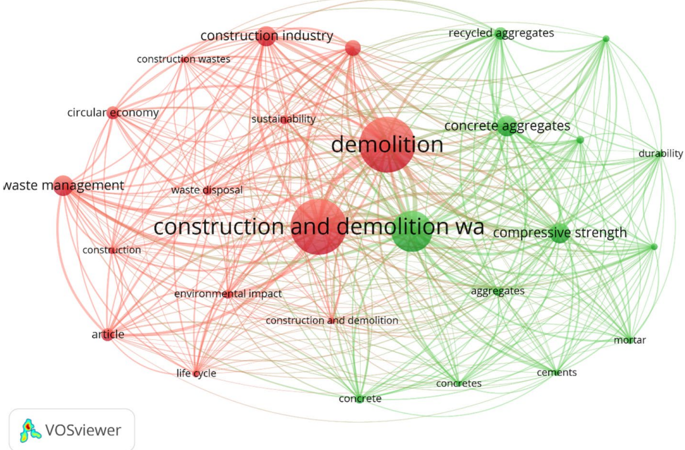
- Top keywords are "Construction and demolition waste" (2,459 occurrences), "Demolition" (2,456), and "Recycling" (1,815), with a red policy/environmental cluster and a green technical/materials cluster in the co-occurrence map.
- Cost-benefit analysis shows crushing and screening is cheapest and most mature (capital $2/ton, operational $3/ton, market value $8/ton, payback under a year in high-throughput settings), whereas thermal treatment and geopolymerisation yield higher-value products ($50–55/ton) but need $40–60/ton investment and 3–5 year paybacks; 3D printing and microbial precipitation remain financially unviable short-term.
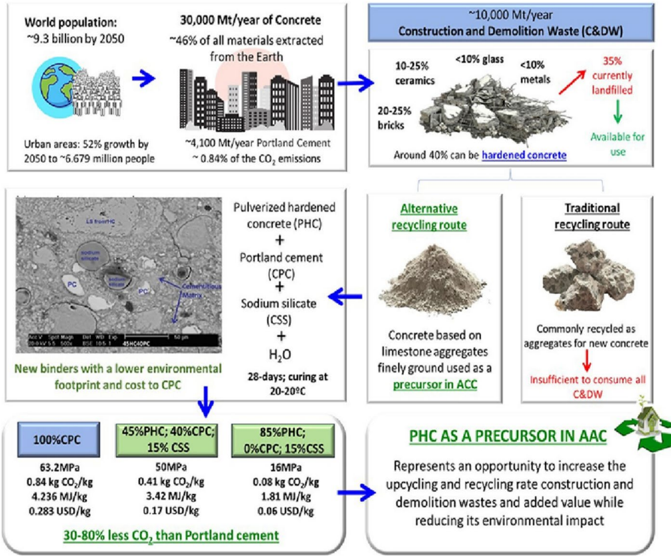
- Contextual figures cited: construction and demolition activities account for roughly 30–40% of total solid waste in developed countries, with about 600 million tons generated in the US in 2018; globally ~10,000 Mt/year of C&DW is generated, 35% of which is landfilled despite 40% being reusable hardened concrete, and pulverised hardened concrete in alkali-activated cement can cut CO₂ emissions by up to 80% versus pure Portland cement.
Methods
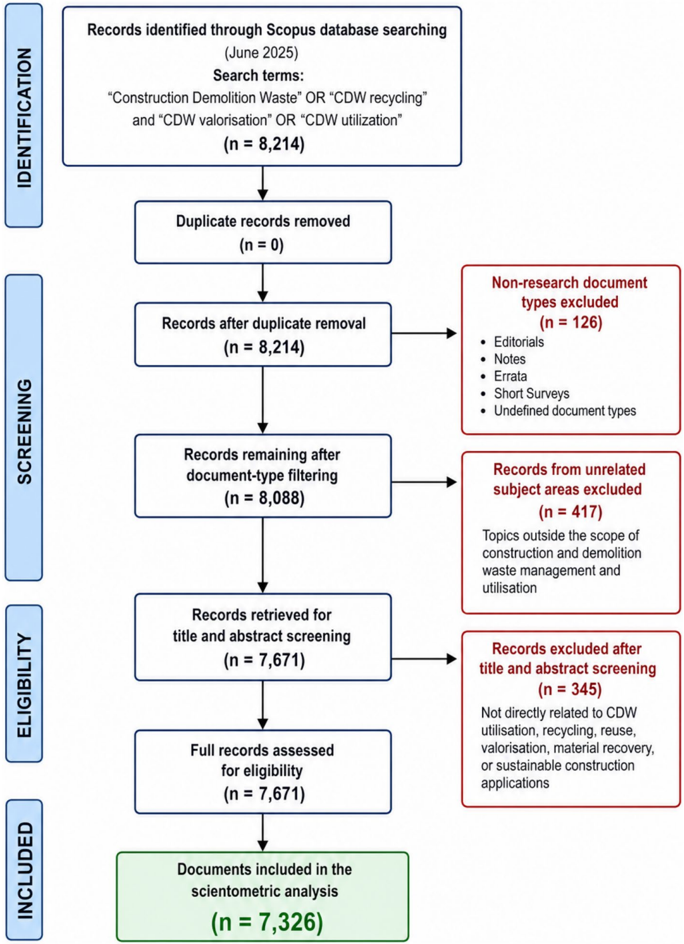
- Scientometric analysis of 7,326 documents retrieved from Scopus in June 2025 using keyword searches ("Construction Demolition Waste", "CDW recycling", "CDW valorisation"), refined by document-type filtering, subject-area screening, and manual abstract screening, with the PRISMA-style flow shown in Fig. 1.
- Bibliographic data exported as CSV and analysed with VOSviewer (v1.6.18) for co-authorship, keyword co-occurrence, institutional, and country networks, plus the built-in Scopus Analyzer for publication trends, author productivity, and citation metrics.
- A complementary conventional literature review structured around three themes: material valorisation, environmental performance (including LCA), and research gaps, synthesised through comparative tables, thematic charts, and conceptual diagrams.
Limitations
- Stated by the paper: restricting the analysis to Scopus may have excluded publications indexed exclusively in other databases (Web of Science, PubMed, Google Scholar), and this should be considered when interpreting findings; future work should integrate multiple databases for cross-validation.
- Stated by the paper: LCA evidence in the field is constrained by methodological inconsistency, data limitations, lack of standardisation, and gaps in life cycle inventory data (especially for informal recycling sectors), limiting comparability and policy use.
- Evident from the text: the review is qualitative and descriptive in its valorisation sections, with no new experimental data ("No datasets were generated or analysed during the current study"), and the cost-benefit figures in Table 6 are presented without stated sourcing or derivation, so their basis cannot be verified from the paper.
Model-written summary. Check it against the paper before relying on it.
Integrity signals
Registry
Cites
Statistics
Figures
Verification
Claims the paper makes
0 Valid · 11 Not valid · 62 Not checked · 110 Own results and interpretations
A result the paper reports from its own data — it cites no other source for it, so there is none to check. The quote shows it is in the paper.
In the paper
“The majority, 65.7%, are journal articles, indicating a strong focus on peer-reviewed scientific contributions.”
§ A scientometric and literature review of global trends and valorisation strategies for construction and demolition waste > 3.1 Publication trends and growth patterns
plain- Asserted: passes — The authors put it forward as true.
- Checkable: passes — It can be checked against evidence.
- Load-bearing: unclear — It is unclear whether the paper’s conclusions depend on it.
- Based: passes — The paper gives a reason why it holds.
A result the paper reports from its own data — it cites no other source for it, so there is none to check. The quote shows it is in the paper.
In the paper
“Conference papers make up 20.8%, reflecting active dissemination at academic and industry events.”
§ A scientometric and literature review of global trends and valorisation strategies for construction and demolition waste > 3.1 Publication trends and growth patterns
plain- Asserted: passes — The authors put it forward as true.
- Checkable: passes — It can be checked against evidence.
- Load-bearing: unclear — It is unclear whether the paper’s conclusions depend on it.
- Based: passes — The paper gives a reason why it holds.
A result the paper reports from its own data — it cites no other source for it, so there is none to check. The quote shows it is in the paper.
In the paper
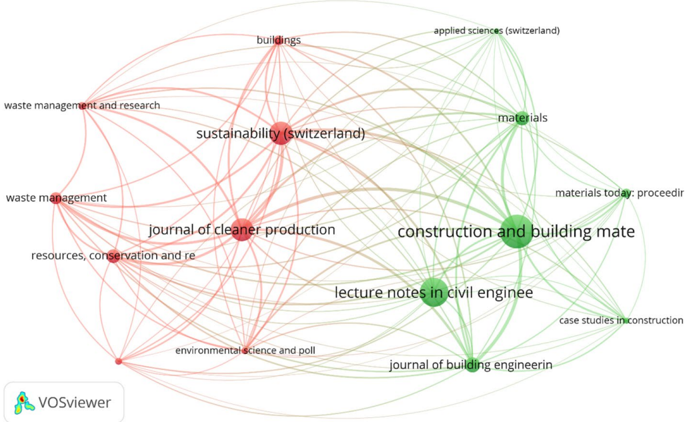
“Construction and Building Materials ranks highest with 300 documents and 10,153 citations, indicating its strong academic influence and relevance.”
§ A scientometric and literature review of global trends and valorisation strategies for construction and demolition waste > 3.3 Sources
plain- Asserted: passes — The authors put it forward as true.
- Checkable: passes — It can be checked against evidence.
- Load-bearing: unclear — It is unclear whether the paper’s conclusions depend on it.
- Based: passes — The paper gives a reason why it holds.
A result the paper reports from its own data — it cites no other source for it, so there is none to check. The quote shows it is in the paper.
In the paper
“Environmental science follows closely at 20.7%, emphasizing the ecological impacts and waste management strategies involved.”
§ A scientometric and literature review of global trends and valorisation strategies for construction and demolition waste > 3.1 Publication trends and growth patterns
plain- Asserted: passes — The authors put it forward as true.
- Checkable: passes — It can be checked against evidence.
- Load-bearing: unclear — It is unclear whether the paper’s conclusions depend on it.
- Based: passes — The paper gives a reason why it holds.
A result the paper reports from its own data — it cites no other source for it, so there is none to check. The quote shows it is in the paper.
In the paper
“Materials science contributes 12.7%, highlighting innovations in recycled materials and their performance in construction.”
§ A scientometric and literature review of global trends and valorisation strategies for construction and demolition waste > 3.1 Publication trends and growth patterns
plain- Asserted: passes — The authors put it forward as true.
- Checkable: passes — It can be checked against evidence.
- Load-bearing: unclear — It is unclear whether the paper’s conclusions depend on it.
- Based: passes — The paper gives a reason why it holds.
53 more claims
Create a free account to see all 183 claims and to verify the 74 references still open.
- It may state two separate claims as one. 87
- The quote only partly states this claim. 1
- Probably not a substantial claim. 65
Self-check
Percentages, sums and reported differences re-computed from the paper’s own numbers.
Each contradiction between two passages listed here was confirmed by an independent check.
Rated minor: it would not touch a result — a value no result rests on, a p-value that stays on the same side of the significance level, or a conflict that is clerical, resolved elsewhere in the paper, or outside its own findings.
In the paper
§ A scientometric and literature review of global trends and valorisation strategies for construction and demolition waste > Data availability
“No datasets were generated or analysed during the current study.”
§ A scientometric and literature review of global trends and valorisation strategies for construction and demolition waste > 2.1 Scientometric analysis
“This systematic refinement resulted in a final dataset of 7326 documents, which formed the basis of the scientometric analysis.”
Rated minor: it would not touch a result — a value no result rests on, a p-value that stays on the same side of the significance level, or a conflict that is clerical, resolved elsewhere in the paper, or outside its own findings.
In the paper
§ A scientometric and literature review of global trends and valorisation strategies for construction and demolition waste > 7 Conclusions
“| 4 | Sahamaran, Mustafa | 27 | 927 | 50 |”
§ A scientometric and literature review of global trends and valorisation strategies for construction and demolition waste > 7 Conclusions
“| 6 | Sahamaran, Mustafa | 26 | 646 | 13 |”
Rated minor: it would not touch a result — a value no result rests on, a p-value that stays on the same side of the significance level, or a conflict that is clerical, resolved elsewhere in the paper, or outside its own findings.
In the paper
§ A scientometric and literature review of global trends and valorisation strategies for construction and demolition waste > 2.1 Scientometric analysis
“The retrieved records were then screened by removing duplicate entries and document types not representing primary scientific research (e.g., editorials, notes, errata, and undefined records).”
§ A scientometric and literature review of global trends and valorisation strategies for construction and demolition waste > 3.1 Publication trends and growth patterns
“Minor categories include editorials, notes, and short surveys, each comprising less than 1%.”
Rated minor: it would not touch a result — a value no result rests on, a p-value that stays on the same side of the significance level, or a conflict that is clerical, resolved elsewhere in the paper, or outside its own findings.
In the paper
§ A scientometric and literature review of global trends and valorisation strategies for construction and demolition waste > 3.3 Sources
“The VOSviewer network visualization in Fig. 8 illustrates the interconnections among leading sources in CDW literature.”
§ A scientometric and literature review of global trends and valorisation strategies for construction and demolition waste > 7 Conclusions
“Figure: 8 Fig. 8 Fig. 8 Network visualization of some leading authors of construction demolition waste literature”
Citations
Cites
Silva, R. V., de Brito, J., & Dhir, R. K. (2014) · Construction and Building Materials · doi:10.1016/j.conbuildmat.2014.04.117 · Cited by 1,229
Construction and demolition waste management in China through the 3R principle
Huang, B., Wang, X., Kua, H., Geng, Y., Bleischwitz, R., & Ren, J. (2018) · Resources, Conservation and Recycling · doi:10.1016/j.resconrec.2017.09.029 · Cited by 1,047
Kabirifar, K., Mojtahedi, M., Wang, C., & Tam, V. W. Y. (2020) · Journal of Cleaner Production · doi:10.1016/j.jclepro.2020.121265 · Cited by 695
Critical evaluation of off-site construction research: A Scientometric analysis
Hosseini, M. R., Martek, I., Zavadskas, E. K., Aibinu, A. A., Arashpour, M., & Chileshe, N. (2018) · Automation in Construction · doi:10.1016/j.autcon.2017.12.002 · Cited by 647
López Ruiz, L. A., Roca Ramón, X., & Gassó Domingo, S. (2020) · Journal of Cleaner Production · doi:10.1016/j.jclepro.2019.119238 · Cited by 538
Characterizing the generation and flows of construction and demolition waste in China
Zheng, L., Wu, H., Zhang, H., Duan, H., Wang, J., Jiang, W., Dong, B., Liu, G., Zuo, J., & Song, Q. (2017) · Construction and Building Materials · doi:10.1016/j.conbuildmat.2017.01.055 · Cited by 535
Ghaffar, S. H., Burman, M., & Braimah, N. (2020) · Journal of Cleaner Production · doi:10.1016/j.jclepro.2019.118710 · Cited by 531
A review on current situation and challenges of construction and demolition waste management
Menegaki, M., & Damigos, D. (2018) · Current Opinion in Green and Sustainable Chemistry · doi:10.1016/j.cogsc.2018.02.010 · Cited by 512
Xiao, J., Ma, Z., Sui, T., Akbarnezhad, A., & Duan, Z. (2018) · Journal of Cleaner Production · doi:10.1016/j.jclepro.2018.03.277 · Cited by 488
Bravo, M., de Brito, J., Pontes, J., & Evangelista, L. (2015) · Journal of Cleaner Production · doi:10.1016/j.jclepro.2015.03.012 · Cited by 465
Research works printed but not linked: 2
- Agarwal M, Krishan A. Reusability of construction & demolition waste in bricks. Int Res J Eng Technol. 2017;4:147-51.
- Environmental Protection Agency (EPA). HQ 2019 year in review. Washington, DC: U.S. Environmental Protection Agency. 2020. https:// www. epa. gov/ sites/ defau lt/ files/ 2020-02/ docum ents/ hq_ 2019_ year_ in_ review. pdf Accessed 1 July 2025.
Metadata
- Authors
- Admasu, M. B., Barbhuiya, S., Das, B. B., & Adak, D.
- Affiliations
- Arba Minch University (ET)
- University of East London (GB)
- National Institute of Technology Karnataka (IN)
- National Institute of Technology Meghalaya (IN)
- Corresponding author
- Admasu, Muluken Bogale
- Venue
- Discover Environment
- Published
- 2026-09-17
- Volume
- 4
- Issue
- 1
- Pages
- 512
- ISSN
- 2731-9431 (ISSN-L)
- OpenAlex
- W7213460151
- Cited by
- 0
- References
- 66
- FWCI
- 0.00
- Type
- journal article
- Language
- en
- Open access
- gold
- doi.org
- Licence
- cc-by
- creativecommons.org/licenses/by/4.0 (tdm)
- creativecommons.org/licenses/by/4.0 (vor)
- Locations
- Discover Environment (publishedVersion, cc-by)
- DOAJ (DOAJ: Directory of Open Access Journals) (submittedVersion)
- Topics
- Physical Sciences › Engineering › Building and Construction › Recycled Aggregate Concrete Performance
- Physical Sciences › Engineering › Building and Construction › Recycling and utilization of industrial and municipal waste in materials production
- Physical Sciences › Engineering › Building and Construction › Sustainable Building Design and Assessment
- Keywords
- construction and demolition waste, waste valorization, recycled aggregate, circular economy, life cycle assessment, sustainable construction, waste recycling, resource recovery, cost-benefit analysis, waste management policy, research trends
About these checks
Registry, retraction, Cites and statistics results are computed, not judged, with one exception: a printed reference that no index lists is read once by a model before it counts as a citation error. Claims are extracted by a model and kept only when their quote appears verbatim in the text; each cited source is then checked, with a model’s help, for whether it says what the claim relies on. Those verdicts can be wrong — read the claim’s quote and the cited source before relying on one.
A language model drew the claims from the paper on 2026-11-27, under version 3 of the claim definition (model deepseek-v4.1-flash, prompt extract-v3).
A second model labelled each claim on 2026-11-27 (model jev-1.13-20260917, definition revision gold-guideline-v0.2).
Statistics and arithmetic are recomputed, not judged.
Confidence bands are shown only for fields calibrated on our annotated test set. None is calibrated yet, so no band is shown.
What counts as a claim ›How we measure confidence ›How we check this ›
Are you an author, or do you see a problem with this page? Request a review
Data sources
Bibliographic data: Semantic Scholar, OpenAlex, Crossref.
Contains information from the Semantic Scholar Academic Graph Datasets, made available under the ODC Attribution License (ODC-BY 1.0).
Semantic Scholar’s data is described in: Kinney, R., et al. (2023). The Semantic Scholar Open Data Platform. arXiv:2301.10140.
