

Tyr-179 and Lys-183 are essential for enzymatic activity of 11β-hydroxysteroid dehydrogenase
Open accessThe DOI matches its Crossref record; 12 of the 12 references it cites were found in a registry or an index.
Abstract
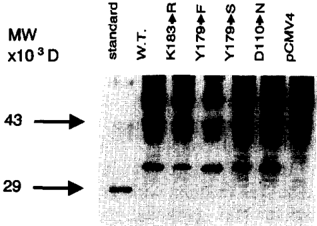
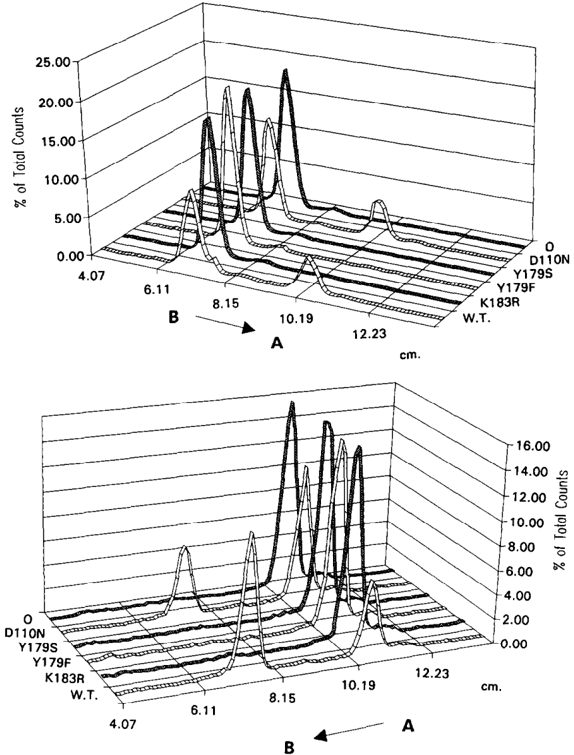
Tyr-179 and Lys-183 are likely to be functionally important residues in 11 beta-hydroxysteroid dehydrogenase, as these amino acids are absolutely conserved in all members of the "short chain dehydrogenase" family. We modified these residues by site-directed mutagenesis of rat cDNA and transfected these constructs into CHO cells. A highly but not absolutely conserved residue, Asp-110, was also studied. Mutation of Tyr-179 to Phe or Ser completely abolished enzymatic activity (interconversion of corticosterone and 11-dehydrocorticosterone), as did Lys-183-->Arg. Asp-110-->Asn affected activity only mildly. Tyr-179 and Lys-183 may be directly involved in the catalytic function of this class of enzymes.
Overview
The claims and statistics of this paper haven’t been checked yet.
Free: it reads the open-access text and checks the first 5 claims that cite a source we can check. Create a free account to check every claim.
Integrity signals
Registry
Cites
Statistics
Figures
Verification
Claims the paper makes
The claims and statistics of this paper haven’t been checked yet.
Free: it reads the open-access text and checks the first 5 claims that cite a source we can check. Create a free account to check every claim.
Claims other papers make about this one
Each is checked against this paper’s own text: does it say what the citing paper says it does?
The source backs part of the claim, not all of it — or backs it for a different population, condition or comparison.
In the citing paper
“Here, the deprotonated phenolic group of Tyr initially forms a hydrogen bond with the alcohol hydroxyl group and the deprotonated Tyr residue acts as a catalytic base to extract a proton from the substrate’s hydroxyl group.”
From Chemistry of the Retinoid (Visual) Cycle (2014) · cites this paper as [380]
Experimental — accuracy not yet measuredThe source backs part of the claim, not all of it — or backs it for a different population, condition or comparison.
In the citing paper
“In contrast, SDR’s show a Tyr-based catalytic center with adjacent Ser and Lys residues.378−381”
From Chemistry of the Retinoid (Visual) Cycle (2014) · cites this paper as [380]
Experimental — accuracy not yet measured
Self-check
Percentages, sums and reported differences re-computed from the paper’s own numbers.
The self-check needs the paper’s full text.
Citations
Cites
Kessler, S. W. (1975) · The Journal of Immunology · doi:10.4049/jimmunol.115.6.1617 · Cited by 2,915
Higuchi, R., Krummel, B., & Saiki, R. (1988) · Nucleic Acids Research · doi:10.1093/nar/16.15.7351 · Cited by 2,387
Mineralocorticoid action: target tissue specificity is enzyme, not receptor, mediated
Funder, J. W., Pearce, P. T., Smith, R., & Smith, A. I. (1988) · Science · doi:10.1126/science.2845584 · Cited by 1,628
Andersson, S., Davis, D. L., Dahlbäck, H., Jörnvall, H., & Russell, D. W. (1989) · Journal of Biological Chemistry · doi:10.1016/s0021-9258(18)83172-6 · Cited by 1,229
Edwards, C. R. W., Burt, D., Mcintyre, M. A., De Kloet, E. R., Stewart, P. M., Brett, L., Sutanto, W. S., & Monder, C. (1988) · The Lancet · doi:10.1016/s0140-6736(88)90742-8 · Cited by 1,068
Cloning and expression of rat cDNA encoding corticosteroid 11β-dehydrogenase
Agarwal, A. K., Monder, C., Eckstein, B., & White, P. C. (1989) · Journal of Biological Chemistry · doi:10.1016/s0021-9258(19)47248-7 · Cited by 455
Self-citationCharacteristics of short‐chain alcohol dehydrogenases and related enzymes
PERSSON, B., KROOK, M., & JÖRNVALL, H. (1991) · European Journal of Biochemistry · doi:10.1111/j.1432-1033.1991.tb16215.x · Cited by 449
Tannin, G. M., Agarwal, A. K., Monder, C., New, M. I., & White, P. C. (1991) · Journal of Biological Chemistry · doi:10.1016/s0021-9258(18)55351-5 · Cited by 436
Self-citationLAKSHMI, V., & MONDER, C. (1988) · Endocrinology · doi:10.1210/endo-123-5-2390 · Cited by 311
Expression of 11β-hydroxysteroid dehydrogenase using recombinant vaccinia virus
Agarwal, A. K., Tusie-Luna, M.-T., Monder, C., & White, P. C. (1990) · Molecular Endocrinology · doi:10.1210/mend-4-12-1827 · Cited by 155
Self-citation
Research works printed but not linked: 2
- Felgner, P.L., Gadek, T.R., Holm, M., Roman, R., Chan, H.W., Wenz, M., Northrop, J.P., Ringold, G.M., Danielsen, M. (1987) Proc. Natl. Acad. Sci. USA 84(21),7413-7417.
- Ghosh, D., Weeks, C.M., Grochulski, P., Duax, W.L., Erman, M., Rimsay, R.L., and Orr, J.C. (1991) Proc.Natl.Acad. Sci. USA 88,10064-10068.
Cited by
Items 101–129 of 129
Yamaguchi, H., Akitaya, T., Yu, T., Kidachi, Y., Kamiie, K., Noshita, T., Umetsu, H., & Ryoyama, K. (2011) · Journal of Molecular Modeling · doi:10.1007/s00894-011-1140-2 · Cited by 11
Three-dimensional structures of steroids and their protein targets
Duax, W. L., Ghosh, D., Pletnev, V. Z., & Griffin, J. F. (1996) · Pure and Applied Chemistry · doi:10.1351/pac199668061297 · Cited by 11
Structural Insights into Novel 15-Prostaglandin Dehydrogenase Inhibitors
Mallipeddi, P. L., Zhang, Y., Li, H., Markowitz, S. D., & Posner, B. A. (2021) · Molecules · doi:10.3390/molecules26195903 · Cited by 10
Han, L., Wang, S., Zheng, J., Zhu, Y., Wang, Y., Li, H., & Ge, R. (2023) · Ecotoxicology and Environmental Safety · doi:10.1016/j.ecoenv.2023.115638 · Cited by 10
Wang, H., Sang, J., Ji, Z., Yu, Y., Wang, S., Zhu, Y., Li, H., Wang, Y., Zhu, Q., & Ge, R. (2023) · Molecules · doi:10.3390/molecules28134894 · Cited by 10
Cloning and Characterization of a Blue Fluorescent Protein from Vibrio vulnificus
Su, J.-H., Chuang, Y.-C., Tsai, Y.-C., & Chang, M.-C. (2001) · Biochemical and Biophysical Research Communications · doi:10.1006/bbrc.2001.5590 · Cited by 10
Functional studies of 11β-hydroxysteroid dehydrogenase
White, P. C., Mune, T., & Agarwal, A. K. (1995) · Steroids · doi:10.1016/0039-128x(94)00028-b · Cited by 9
Self-citationWang, H., Sang, J., Ji, Z., Yu, Y., Wang, S., Zhu, Y., Li, H., Wang, Y., & Ge, R. (2024) · Environmental Toxicology · doi:10.1002/tox.24124 · Cited by 8
In silico characterization of the novel SDR42E1 as a potential vitamin D modulator
Hendi, N. N., & Nemer, G. M. (2023) · The Journal of Steroid Biochemistry and Molecular Biology · doi:10.1016/j.jsbmb.2023.106447 · Cited by 7
Smilda, T., Reinders, P., & Beintema, J. J. (1998) · Biochemical Genetics · doi:10.1023/a:1018748118901 · Cited by 7
Yamaguchi, H., Akitaya, T., Kidachi, Y., Kamiie, K., Noshita, T., Umetsu, H., & Ryoyama, K. (2011) · Cancer Informatics · doi:10.4137/cin.s8725 · Cited by 6
Labine, M., DePledge, L., Feirer, N., Greenwich, J. L., Fuqua, C., & Allen, K. D. (2020) · Journal of Bacteriology · doi:10.1128/jb.00098-20 · Cited by 6
Saloniemi, T. (2009) · UTUPub (University of Turku) · Cited by 7
Lysine Residues in the Coenzyme-Binding Region of Mouse Lung Carbonyl Reductase
Deyashiki, Y., Nakanishi, M., Sakai, M., & Hara, A. (1995) · Advances in experimental medicine and biology · doi:10.1007/978-1-4615-1965-2_30 · Cited by 3
Maser, E., & Oppermann, U. C. T. (1995) · Advances in experimental medicine and biology · doi:10.1007/978-1-4615-1965-2_27 · Cited by 3
Hao, T., Zhao, X., Ji, Z., Xia, M., Han, L., Sang, J., Wang, S., Li, L., Ge, R., & Zhu, Q. (2024) · Comparative Biochemistry and Physiology Part C Toxicology & Pharmacology · doi:10.1016/j.cbpc.2024.109900 · Cited by 1
Penning, T. M. (1996) · Advances in experimental medicine and biology · doi:10.1007/978-1-4615-5871-2_54 · Cited by 1
The Syndrome of Apparent Mineralocorticoid Excess
White, P. C. (2009) · Elsevier eBooks · doi:10.1016/b978-0-12-449851-8.00017-6 · Cited by 1
Self-citationG6PC1 and G6PC2 influence G6P flux but not HSD11B1 activity
Hawes, E. M., Boortz, K. A., Oeser, J. K., O’Rourke, M. L., & O’Brien, R. M. (2023) · Journal of Molecular Endocrinology · doi:10.1530/jme-23-0070 · Cited by 1
Milosevic, A. (2003) · heiDOK (Heidelberg University) · doi:10.11588/heidok.00003599 · Cited by 1
Structure-function analysis of 11β-hydroxysteroid dehydrogenase
Lawson, A. J. (2010) · University of Birmingham Institutional Research Archive (University of Birmingham)
Structure-function studies of the mammalian peroxisomal multifunctional enzyme type 2 (MFE-2)
Haapalainen, A. M. (2002)
Polycyclic group optimization in 11β-hsd1 inhibitors and their pharmacological evaluation
Leiva, R. (2017) · Dipòsit Digital de la Universitat de Barcelona (Universitat de Barcelona)
Mutations in KDSR Cause Recessive Progressive Symmetric Erythrokeratoderma
Goldsmith, L. A., Hu, R., Diaz, L. A., Paller, A. S., Rosman, I. S., Bayliss, S. J., Zhou, J., Vincent, N., Craiglow, B. G., Baserga, S. J., et al. (2017) · Carolina Digital Repository (University of North Carolina at Chapel Hill) · doi:10.17615/b4zx-va72
The Molecular Basis of Mineralocorticoid Action
White, P. C. (1999) · Humana Press eBooks · doi:10.1007/978-1-59259-697-3_13
Self-citationZhao, C., Yu, Z., Wang, M., Ying, Y., Tang, Y., Li, H., Ge, R., & Liang, J. (2026) · Toxicology and Applied Pharmacology · doi:10.1016/j.taap.2026.117883
Role of 11βHSD2 in salt and water homeostasis
Evans, L. C. (2012) · ERA
Genetic Disorders of the Renin-Angiotensin-Aldsterone System Causing Hypertension
White, P. C. (1998) · Endocrine updates · doi:10.1007/978-1-4615-5569-8_15
Self-citation
Metadata
- Authors
- Obeid, J., & White, P. C.
- Affiliations
- Cornell University (US)
- Corresponding author
- White, Perrin C.
- Venue
- Biochemical and Biophysical Research Communications
- Publisher
- Elsevier BV
- Published
- 1992-10
- Volume
- 188
- Issue
- 1
- Pages
- 222-227
- ISSN
- 0006-291X (ISSN-L)
- OpenAlex
- W2031973145
- Semantic Scholar
- a670695585415a3e1ab0cc1ef04858c6fcb40ca1
- Cited by
- 116
- References
- 12
- Citations by year
- 2026: 1 · 2024: 2 · 2023: 4 · 2021: 1 · 2020: 1 · 2018: 1 · 2017: 2 · 2015: 1 · 2014: 1 · 2013: 2 · 2012: 1
- FWCI
- 10.50
- Type
- journal article
- Language
- en
- Open access
- hybrid
- doi.org
- Licence
- cc-by-nc-nd
- www.elsevier.com/tdm/userlicense/1.0/ (tdm)
- www.elsevier.com/legal/tdmrep-license (tdm)
- creativecommons.org/licenses/by-nc-nd/4.0/ (vor, 4815 d)
- Locations
- Biochemical and Biophysical Research Communications (publishedVersion, cc-by-nc-nd)
- PubMed (publishedVersion)
- Funders
- March of Dimes Foundation
- National Institutes of Health (5f32dk008715-02, 5r01dk037094-06, 5r01dk042169-12)
- National Institute of Diabetes and Digestive and Kidney Diseases (DK42169, DK-08715, DK 37094)
- Topics
- Health Sciences › Medicine › Endocrinology, Diabetes and Metabolism › Hormonal Regulation and Hypertension
- Health Sciences › Medicine › Endocrinology, Diabetes and Metabolism › Adrenal Hormones and Disorders
- Physical Sciences › Chemistry › Organic Chemistry › Steroid Chemistry and Biochemistry
- Keywords
- 11β-hydroxysteroid dehydrogenase, site-directed mutagenesis, corticosterone, 11-dehydrocorticosterone, short-chain dehydrogenase/reductase family, catalytic residues, enzyme activity, rats
- MeSH terms
- Amino Acid Sequence, Animals, Base Sequence, Cricetinae, Hydroxysteroid Dehydrogenases, Kinetics, Lysine, Molecular Sequence Data, Oligodeoxyribonucleotides, Recombinant Proteins, Transfection, Tyrosine, Restriction Mapping, Mutagenesis, Site-Directed, CHO Cells, 11-beta-Hydroxysteroid Dehydrogenases, Rats
About these checks
Registry, retraction, Cites and statistics results are computed, not judged, with one exception: a printed reference that no index lists is read once by a model before it counts as a citation error. Claims are extracted by a model and kept only when their quote appears verbatim in the text; each cited source is then checked, with a model’s help, for whether it says what the claim relies on. Those verdicts can be wrong — read the claim’s quote and the cited source before relying on one.
Statistics and arithmetic are recomputed, not judged.
Confidence bands are shown only for fields calibrated on our annotated test set. None is calibrated yet, so no band is shown.
What counts as a claim ›How we measure confidence ›How we check this ›
Are you an author, or do you see a problem with this page? Request a review
Data sources
Bibliographic data: Semantic Scholar, OpenAlex, Crossref.
Contains information from the Semantic Scholar Academic Graph Datasets, made available under the ODC Attribution License (ODC-BY 1.0).
Semantic Scholar’s data is described in: Kinney, R., et al. (2023). The Semantic Scholar Open Data Platform. arXiv:2301.10140.
